c e-ISSN: 2348-6848, p- ISSN: 2348-795X Volume 3, Issue 01, January 2016
International Journal of Research (IJR)
Available at http://internationaljournalofresearch.orgThe Effectiveness of Partnership Systems between NGOs and
Smallholder Farmer Groups on Rural Development: The System
Theory Perspective
Patrick Nalere*
1; Milton Yago, PhD & Kenny Oriel, PhD
School of Accounting, Finance & Economics, Faculty of Business & Law
Leeds Beckett University, 1 Portland Gate, Leeds, LS1 3HB, United Kingdom
1
Corresponding author, email:
[email protected]
/
[email protected]
NOVEMBER, 2015ABSTRACT
The system theory has become a popular approach in the social sciences because it recognizes that interactions of parts of a phenomenon influence its functioning. Therefore, the paper presents the system theory perspective to hypothesize the factors that influence the interactions within parts of the systems of partnerships between NGOs and Smallholder Farmer Groups for the case of Uganda. The probit regression model was used to analyses survey data from a sample of 87 respondents from NGOs and SFGs working in partnership. Critical factors influencing interactions within partnership were identified under the elements of factors that: define the basic parts of partnership systems; drive partnership system; influence activities of the partnership system; influence feedback within partnership sub-system and the whole system; determine the nature of management of communication flaws; and the major communication channels external to the partnership. The greatest contribution lies in the need to recognize that system interplay influences system effective functioning. The effectiveness of the partnership system between NGOs and SFGs depends on how factors under each of the elements above supports or restrains the other, and how the dynamic interactions are balanced between them. Therefore, for the partnership systems to be effective, they should have a number of interactive variables under their control, or otherwise, where such factors dilute and/ or undermine each other, the negative influence is bound to be registered. In effect, the result indicates that partnership systems have particular drivers which maintain them in motion and/or facilitates the interactions between the different parts. For the system of partnerships between NGOs and Smallholder Farmer Groups to effectively influence rural development, the interactions of the different parts of the partnership system should effectively reinforce, complement and/or strengthen each other.
Key word: Effectiveness; Partnerships Systems; Rural Development; System Theory
I INTRODUCTION
Public Private Partnerships, or PPPs, are increasingly popular in the field of international development cooperation and sustainable development.
Partnerships remain popular in the field of development including rural development in both developing and developed countries. The popularity of partnerships in policy circles has steadily increased since the late 1980s to the extent that their preferment has become an overriding endorsed development strategy (Entwistle and Martin, 2005) to a variety of service delivery and fixing development problems.
Numerous streams of studies claim that partnerships are intimately linked to social perspective in which they operate. Meaning that Partnerships are conventionally perceived principally in the perspective of what they can do as organizations in their location (Clarke, and Glendinning, 2002) whether rural or urban. William & Sullivan (2011) argue that partnership is very much about learning from and with partners, and sharing and creating
1
c e-ISSN: 2348-6848, p- ISSN: 2348-795X Volume 3, Issue 01, January 2016
International Journal of Research (IJR)
Available at http://internationaljournalofresearch.orgknowledge imminent to address interdependent societal problems. Seldom however, does this kind of literature address the ideological underpinnings of partnership preferment for rural development, nor does it interrogate the notion of partnership and the inherent interactions within systems in a partnership. Other studies concern themselves more on detailing the failures of many partnerships (Clarke and Glendinning, 2002; Weiss, Anderson, and Lasker, 2002). These studies are quick to point out the reason for partnership failures and often to criticize the postulation that all partners are equal in a partnership. Yet, comprehensive case studies of how inherent interactions are managed and affect partnership functioning are still rare (MLauri, 2005; Ndandiko and Jamie, 2010).), to have a positive impact of development (whether rural or urban).
Given the increasing popularity of partnerships as a development strategy for service delivery towards rural development, it is important to understand how to explicitly conceptualize and understand the interactions at play within systems that make up partnerships as wholes. In relation to this, this study attempted to identify the critical factors influencing interactions within partnership using the case of partnership between NGOs and SFGs in Uganda. This provides specific guidance about the mechanism and factors through which given factors supports or restrains and how the dynamic interactions are balanced within partnerships to influence their effectiveness. A system theory perspective of partnership is provided is presented in the next section.
A System Theory Context of Partnerships
The systems theory recommends shifting the thinking from focusing on isolated entities to their context, from separate parts (sub-systems) to the whole (single system) (Eisler, and Montuori, 2001; Alter, 2007; Yoon and Kuchinke, 2005) or partnership. Based on this argument, (De Savigny and Adam, 2009) points out that a system is a set of two or more elements whose individual behavior affects the behaviors of the whole. Hall et al, (2002) adds that the system is shaped by the behaviour, interactions, and practices of all and among actors embedded in series of relationships that evolve with time.
To Hall et al, (2002) the system theory and partnerships are both about interdependence and interrelationships. This means that the units in the partnership system structure are sub-systems of groups of people playing different roles in organizations. These subsystems in partnership system structure are in practical patterns of relationships or interactions. They are in fact webs of connections which may be formal with others mostly tacit and informal. The subsystems derive their existence from their relationships with each other, and periodical interact to determine the functioning of the entire partnership system. The interactions are in terms of scheduled meetings for planning, monitoring, evaluation and/or learning depending on the development agenda being pursued by a given partnership system. Thus, the system theory approach views the partnerships as a whole system comprising of interacting subsystems, all of which are engaged in complex interactions with each other and the external environment (Dawson, 2006).
The Role of Interactions within a partnership
c e-ISSN: 2348-6848, p- ISSN: 2348-795X Volume 3, Issue 01, January 2016
International Journal of Research (IJR)
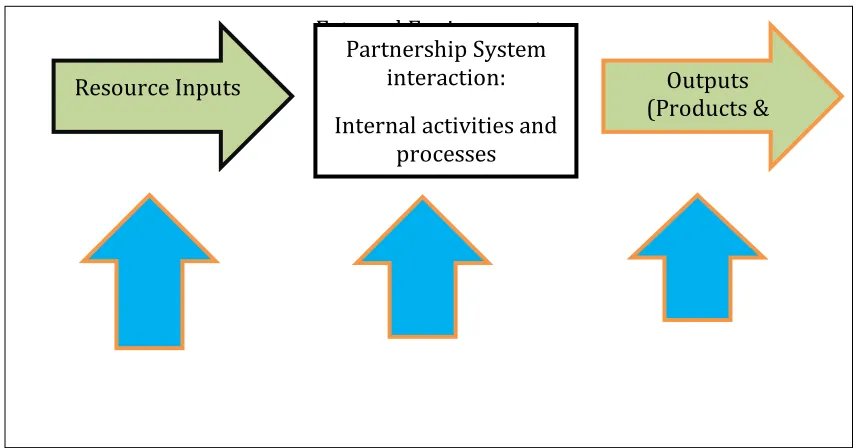
Available at http://internationaljournalofresearch.orgPartnerships between NGOs and smallholder farmer groups as systems to function require input and output of different parts / unit in order to exist and function well. Figure 1, looks at how such interactive process among different actors using a diversity of modes informs effective partnership between NGOs and Smallholder farmer groups to influence rural development. Looking at this interaction between the system and subsystems and the input and output, one again understands how partnership systems between NGOs and smallholder farmer groups operate.
Figure 1: Approaches to partnership system effectiveness. (Source: Author)
From diagram the partnership system employs an approach which assesses effectiveness by which it gets its resources required to implement its activities. The ability to interact and utilize well the acquired resources determines effectiveness of the partnership system at the input level. At internal process approach considers internal functioning of the partnership systems in terms of how they implement their activities and processes include empowerment of the human resources. The three level approaches shown in the diagram, each has something to offer to partnership system effectiveness, but the interactions are at different levels.
In relation to this idea, Partnership must be understood and managed as a system in order to understand why they operate the way they do. This is based on the argument that partnership system between NGOs and SFGs will be more effective and more sustainable if there is balance across the full range of processes of interactions of the sub systems.
The study here demonstrates the usefulness of using the framing of the system theory to the understanding of determinants of the partnerships system whose factor interaction influences rural development. This is aimed at establishing how partnerships as wholes and their subsystems interact within themselves and with each other (enhance cohesion and coexistence) to bring about effective delivery of rural development.
Measurement of Partnership System Effectiveness
Systems theory indicates that all parts of the system must fit properly for it to work as intended (Bailey, 2007). It is on this basis that Olbrich, and Jost, (2006) argue that a partnerships systems‟ strategy, its structure, and its
External Environment
System Approach Internal process Approach Objective Approach
Resource Inputs
Outputs
(Products &
Services)
Partnership System
interaction:
c e-ISSN: 2348-6848, p- ISSN: 2348-795X Volume 3, Issue 01, January 2016
International Journal of Research (IJR)
Available at http://internationaljournalofresearch.orgmanagerial process have to “interact” with one another for it to be effectively delivering as expected. The work of Dawson, (2006) further legitimizes the concept of interaction by demonstrating the relationships between partnership system performance and how well structure, technology, and human resources support each other through different level interactions. Perhaps, it is the lack of good interactions that partly accounts for the ineffectiveness of partnership systems, and what influences interactions and the implication of this?
The goal of this paper is to analyze the partnerships between NGOs and smallholder farmer groups from a systems theory perspective by establishing those factors that promote different level interactions of partnership systems between NGOs and SFGs in Uganda. The goal is achieved by examining how such interactions impacts on the effectiveness of partnership systems between NGOs and SFGs to finally influence rural development in Uganda. In this part of the study effectiveness of the partnership system is perceived as their ability to put in place operational critical elements such as:1) the basic internal parts of partnership system structure; 2) address factors internal and unique to the partnership system driving the activities; 3) identify the elements and how they work within themselves and with other parts of the partnership systems between NGOs and SFGs; 4) focusing on the major communications channels among partners within the partnership system; 5) properly managing communications flow within the partnership system; and 6) use of the major communications channels used external to the partnership system.
Measurement of partnership system effectiveness is the real challenge of this chapter. Borrowing the two theorems suggested by Kusher and Poole, (1996): Theorem a: boundaries of effectiveness; and Theorem b: Measurement of effectiveness. According to Towns (2001), Theorem b solves his criticism that „modern management system are too abstract‟, thus removing the myth of current organization effectiveness systems (Osborne, et al ., 2004) and lead them into „actual use‟ by highlighting particular aspects of organizational (in this case partnership system as an organization) performance. Theorem b becomes practical when it is transformed into (1) manageable number of attributes, and (2) some tangible measures. Whereas even after these two objectives are achieved, there is no guarantee that the resultant measures actually portray any measure(s) of partnership system effectiveness.
II DATA AND METHODOLOGY
Using cross-sectional design the study covered 40 organizations in central region of Uganda. From these organizations a total of 96 respondents were randomly selected with only 87 responses to the questionnaire. The questionnaire invested issues such as: 1) the basic internal parts of partnership system structure (organogram); 2) the factors internal and unique to the partnership system driving the activities; 3) elements and how they work within themselves and with other parts of the partnership systems between NGOs and SFGs; 4) the major communications channels among partners within the partnership system; 5) communications flows management within the partnership system; and 6) the major communications channels used external to the partnership system. This chapter examines only the significant factors that follow within the above six categories and how investing, focusing and/ or resolving the factors is perceived by the respondents to likely impact on the effectiveness of partnerships between NGOs and SFGs in Uganda. Once again positive coefficients of the significant factors depicted a likeliness of enhancing effectiveness, while negative ones to have an opposite effect.
Employing theorem a above, I define the domain of effective factors to include a number of known partnership system characteristics or factors as in Table 1 & 2. Based on theorem b, hypothesize the interaction of these partnerships system characteristics or factors would result into one or more measures of partnerships effectiveness a provided empirically by the questionnaire as indicated in Table 1 &2.
𝑃𝑎𝑟𝑡𝑛𝑒𝑟𝑠ℎ𝑖𝑝 𝑆𝑦𝑠𝑡𝑒𝑚 𝐸𝑓𝑓𝑒𝑐𝑡𝑒𝑖𝑣𝑒𝑛𝑒𝑠𝑠 𝑃𝑆𝐸 = 𝑓 𝑥 = 𝑥1, 𝑥2, 𝑥13, … … … , … … … . … 𝑥𝑛)………..….(1)
c e-ISSN: 2348-6848, p- ISSN: 2348-795X Volume 3, Issue 01, January 2016
International Journal of Research (IJR)
Available at http://internationaljournalofresearch.orgare used in this paper (list in Table 1&2). While 𝑥𝑖′𝑠 in relationship from the question above may be tangible measures, of PSE on the left-hand side, based on the MAIN null hypothesis, the relationship is causality rather than an equality relationship in nature.
The Probit Model
In this work, a probit regression model was adopted to investigate the relationship between various potential factors (given in Tables 1). In this study, the dependent variable considered is the effectiveness of the partnership systems between NGOs and SFGs that were categorized and recorded as 1 for agreement (strongly agree and agree) and 0 for no agreement (strongly disagree and disagree).
In order to analyze the relationship mathematically, a system must possess special properties. For instance, first the relationship must be known explicitly, secondly the attributes of importance must be quantifiable and not so numerous as to defy listing. Finally, the mode of behavior under the given set of relationship must be known. Unfortunately it is a rare system indeed that possesses all these properties, more exactly systems possess these qualities in degrees.
The probit model to estimate the effectiveness of the partnership systems between NGOs and SFGs, is as follows:
𝑌𝑖 = 𝑎1+ 𝛽𝑖 𝑛𝑛=1𝑋𝑖 + 𝜀 ………(2)
Where 𝑌𝑖 is a vector of binary variables, such that 𝑌𝑖 = 1 if the 𝑖𝑡ℎ𝑠 respondent is in agreement that a factor
influences the effectiveness of the partnership systems between NGOs and SFGs and 0 otherwise; 𝑋𝑖𝑠 are vector
of explanatory variables of the 𝑖𝑡ℎrespondent. It is assumed that 𝑋𝑖𝑠 is independent of the zero mean random variable. In the specific case of this study, the empirical model estimated is as follows:
𝑌𝑖 = 𝑎1+ 𝛽1𝑋1 + 𝛽2𝑋2+ 𝛽3𝑋3+ … … … . +𝜀 ……….…..(3)
Where: 𝑌𝑖 is the effectiveness of the process of partnership systems between NGOs and SFGs; 𝑋1, 𝑋2, 𝑋3, … … .. are the specific factors that where generated for each partnership systems during the study pilot study and verified through literature reviews and confirmed by running a simple probit model as in the process described in the section on choosing the independent explanatory variables and collinearity.
Independent variables are the values that can be altered in a specified model or equation (Arulmozhi, and Nadarajan, 2003). Independent variables offer the “input” which is adjusted by the model to change the “output.” A general empirical probit model was used as one of the preliminary criteria to choose variables to be incorporated in the econometric analysis. In the first instance, a probit model equation was calculated to establish the relationships between each of independent variables (factors that influence the effectiveness of the partnership system) with the dependent variable (the effectiveness of the partnership systems) in the survey. Different sets of variables drawn from each of part of the survey were considered in this preliminary procedure. The information set in table 1.1 – 1.7 above has a binary response (outcome, dependent) variable. There are several predictor variables listed under each element of the partnership system, which are all binary and taking two score 1 (one) or o (zero). Explanatory variables with a score 1, mean respondents stated that they agree that it has an influence (strong/ weak) on the partnership system while those with score 0 means respondents stated that they disagree that these have influence on the particular element of the partnership systems.
III RESULTS AND DISCUSSIONS
c e-ISSN: 2348-6848, p- ISSN: 2348-795X Volume 3, Issue 01, January 2016
International Journal of Research (IJR)
Available at http://internationaljournalofresearch.orgEstimation of the Model for Basic Parts of Partnership Systems
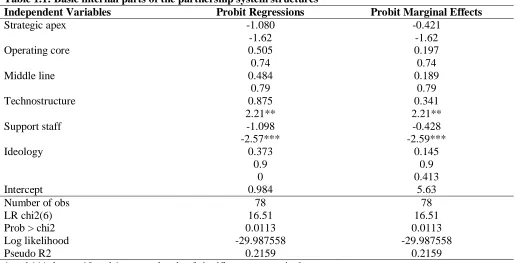
The study sought to explore the basic internal parts of the partnerships between NGOs and SFGs, based on the system theory. The results reveal that only the he techno-structure (analysts that design systems, processes, etc.) and the support staff (support outside of operating workflow)are the most significant internal parts that can be considered by partnerships between NGOs and SFGs to be effective enough to inform rural development as in table 8.2 below.
Table 1.1: Basic internal parts of the partnership system structures
Independent Variables Probit Regressions Probit Marginal Effects
Strategic apex -1.080
-1.62
-0.421 -1.62
Operating core 0.505
0.74
0.197 0.74
Middle line 0.484
0.79
0.189 0.79
Technostructure 0.875
2.21**
0.341 2.21**
Support staff -1.098
-2.57***
-0.428 -2.59***
Ideology 0.373
0.9
0.145 0.9
Intercept
0 0.984
0.413 5.63
Number of obs 78 78
LR chi2(6) 16.51 16.51
Prob > chi2 0.0113 0.0113
Log likelihood -29.987558 -29.987558
Pseudo R2 0.2159 0.2159
* and *** denote 10 and 1 percent levels of significance respectively
Therefore, the findings of the significant factors are discussed below.
c e-ISSN: 2348-6848, p- ISSN: 2348-795X Volume 3, Issue 01, January 2016
International Journal of Research (IJR)
Available at http://internationaljournalofresearch.orgThe support staff as one of the basic parts of partnership systems between NGOs and SFGs has as a negative of -1.098 in the probit regression and probit marginal regression of -0.428 (z =-2.59) both statistically significant at 1 percent level. The latter suggest that investing and focusing on interactions of the support staff as one of the basic parts of partnership systems, affects effectiveness of partnership systems between NGOs and SFGs negatively. In other words, investing in positive interactions of the support staff if agreed as one of the basic parts decreases the probability of effectiveness of the partnership systems between NGOs and SFGs by 1.098 points. In this case, investing positive interactions of the support staff as one of the basic parts of partnership systems is necessary but not crucial effectiveness of partnership systems between NGOs and SFGs in order to result into rural development in Uganda. The negative result of investing and focusing positive interactions of the on support staff as one of the basic parts of partnership systems is startling as it contradicts the findings of several studies such as Appelbaum (1997); and Cummings and Worley (2005) who argue effective partnerships must have strong and interactive support staff unit and in adequate numbers to in turn provide quality specific services to the other section or departments. The result may be explained by the fact that often than not in many partnerships between NGOs and SFGs like other organizations in Uganda, investing in support staff roles are underestimated or even excluded from the team. This is because, support staff are not directly involved in the primary process but providing an indirect operational support to other sectional staff. Nonetheless, in reality the indirect roles of an interactive support services include maintenance, clerical, food services, driving and provided by people such as accounts, transporter, administrators, and secretaries among others need to be acknowledged and recognized for the partnerships between NGOs and SFGs to be effective and promote rural development of the country.
The implication is that a partnership system is not an arbitrary group of organizations (partners) that come together by chance. Instead, they are consciously and formally established to accomplish certain goals that the member partners would not be able to achieve if they worked in isolation. Furthermore, the findings contribute to people those that may want to establish effective partnerships for rural development to consider investment in more structures as being critical. In conclusion, the positive and/ or strong interactions of the techno-structure (analysts that design systems, processes, etc.), and the support staff (support outside of operating workflow) with other basic parts of the partnership is critical if partnership system effectiveness are to deliver rural development, while enabling the participation of the local population. Shaping the partnership system and sub-systems into an effective entity is clearly one of the challenges that have to be met in successful rural development drive in Uganda.
Critical internal factors that drive the activities of partnership systems
The study also sought to investigate the factors that drive (activities) the interactive abilities of partnership system between NGOs and SFGs. From the six factors identified (see table 1.2) only three - technological capacity, management systems, and financial management, were statistically significant.
Table 1.2: Critical internal factors that drive the activities of partnership system
Independent Variables Probit Regressions Probit Marginal Effects
Machinery Organ & equipment 0.475
1.02
0.164 1.02
Technological capacity 0.875
1.84*
0.303 1.83*
Organizational culture 0.466
1.31
0.161 1.33
Management systems 1.322
3.15***
0.458 3.11***
Financial management -0.880
-2.1**
c e-ISSN: 2348-6848, p- ISSN: 2348-795X Volume 3, Issue 01, January 2016
International Journal of Research (IJR)
Available at http://internationaljournalofresearch.orgEmployee morale -0.616
-1.29
-0.213 -1.29
Intercept
-0.759 -2.76
0.297 4.98
Number of obs 78 78
LR chi2(6) 26.89 26.89
Prob > chi2 0.0002 0.0002
Log likelihood -37.288695 -37.288695
Pseudo R2 0.265 0.265
* and *** denote 10 and 1 percent levels of significance respectively
From the six factors identified (see table 1.2) only three - technological capacity, management systems, and financial management, were statistically significant and their discussions are presented below:
The results in table 1.2 , promoting technological capacity being one of the critical internal factors that drive the activities of partnership system between NGOs and SFGs has a positive of 0.875 and the marginal regression of 0.303 (z=1.83), both statistically significant at 10 % level. This implies that promoting technological capacity being one of the critical internal factors that drive the activities of partnership system has a positive interactive effect and agreeing that it is an important factor rather than disagreeing increases the probability of the effectiveness of the partnership systems between NGOs and SFGs to achieve rural development b7 by0.875 points. Therefore, the result is as expected, that promoting technological capacity is necessary and crucial in increasing on effectiveness of partnership system in order to inform rural development in Uganda. The result agrees with the findings of scholars such Collis (1994); Ernext et al. (1998); and Rousseva (2008) who assert that technological capacity improves the quality of health care process by enhancing communication, standardizing processes and enhancing workflow. Ernext et al. further claim that introducing technology increases the impact of employees in practical ways. While Rousseva observed, that technological capacity, supports and drives innovative work practices, improves work processes and impacts on efficiency and productivity of the organization. For instance, communication and information technologies increase the interactive levels and allow teams in partnerships between NGOs and SFGs to share and learn from each other. Notwithstanding the positive impact of Technological capacity , there are challenges for employees including the need for enhanced training, development of leadership, financial resources and personal and organizational relationships among others as noted by Hobday and Rush, (2007). Based on this note, the result may be informed by the fact that like other African countries such as Uganda has displayed.
c e-ISSN: 2348-6848, p- ISSN: 2348-795X Volume 3, Issue 01, January 2016
International Journal of Research (IJR)
Available at http://internationaljournalofresearch.orgFinally, the estimated coefficient of promoting better financial management as one of the Critical internal factors that drive the activities of partnership systems was a negative oft -0.880 with the marginal coefficient of -0.305 (z= -2.11) and both are statistically significant at 5 percent level. This means a 1 point increase in agreeing that enhancing financial management affects interactive abilities positively decreases the probability of effectiveness of partnership systems between NGOs and SFGs by 0.88 points. The result is not as expected, therefore surprising in a sense that it does not agree with the findings of Van Horne and Wachowicz (2015); and Andrew and Gallagher (2003) who argue that strong financial management in an organization offers solutions to major decision making regarding regular and adequate supply of funds through profitable investment decisions, financing decisions and dividend decisions. Perhaps, this may be attributed to the existing barter transactions resulting e from the high poverty levels in the rural areas of Uganda, which uses more of non-cash aspects such as improving financial management skills and the benefits that they may gain from this, like increased access to financial services in rural areas. Therefore financial management is crucial for the effectiveness of partnership systems between NGOs and SFGs in Uganda in order to inform rural development.
Factors that drive the activities of Partnerships as Wholes
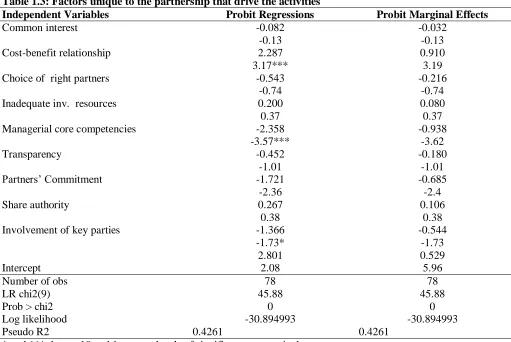
The study furthermore, investigated the unique factors that drive the activities of the whole – partnership systems between NGO and Smallholder farmer groups in Uganda.
Table 1.3: Factors unique to the partnership that drive the activities
Independent Variables Probit Regressions Probit Marginal Effects
Common interest -0.082
-0.13
-0.032 -0.13
Cost-benefit relationship 2.287
3.17***
0.910 3.19
Choice of right partners -0.543
-0.74
-0.216 -0.74
Inadequate inv. resources 0.200
0.37
0.080 0.37
Managerial core competencies -2.358
-3.57***
-0.938 -3.62
Transparency -0.452
-1.01
-0.180 -1.01
Partners‟ Commitment -1.721
-2.36
-0.685 -2.4
Share authority 0.267
0.38
0.106 0.38
Involvement of key parties -1.366
-1.73*
-0.544 -1.73
Intercept
2.801 2.08
0.529 5.96
Number of obs 78 78
LR chi2(9) 45.88 45.88
Prob > chi2 0 0
Log likelihood -30.894993 -30.894993
Pseudo R2 0.4261 0.4261
c e-ISSN: 2348-6848, p- ISSN: 2348-795X Volume 3, Issue 01, January 2016
International Journal of Research (IJR)
Available at http://internationaljournalofresearch.orgBelow is a presentation of the detailed discussions of only significant factors:
The estimated coefficient of cost-benefit relationship as one of the unique factors that drive the activities of the whole – partnership systems between NGO and Smallholder farmer groups was positive of 2.287, while the marginal effect was 0.91 (z=3.19) and both were statistically significant at 1 percent level. This suggests that enhancing cost-benefit relationship increases the probability of achieving effectiveness of partnership systems between NGOs and SFGs by 0.91 points. In other words, investing in cost-benefit relationship is necessary and more important for effectiveness of partnership systems between NGOs and SFGs to foster rural development in Uganda. The results in this case is not surprising at all as it concurs with the findings of Beauregard (1998); Mullin (2002); and Erberts, Randall, and Erickcek, (2002) who all argue that always in partnership agreements the public-private participation and the explicit sharing of risks, is always specified for costs and financial benefits. This result may probably be explained by the fact that success of partnerships between SFGs and NGOs in Uganda has always put emphasis of their existence to each partners bringing genuine value, and transferring real resources (value) as well as exercising shared responsibility for the outcomes of the action in what they have terms as “value for money”.
The marginal regression coefficient of -0.438 (z= -3.62) means that promoting Managerial core competencies decreases effectiveness of partnership systems between NGOs and SFGs by 0.438 points. Also the estimated coefficient of predictor (managerial core competencies - competent personnel) was negative of -2.358. Both coefficients were statistically significant at 1 percent level. In other words, investing in Managerial core competencies is necessary but not crucial for effectiveness of partnership systems between NGOs and SFGs needed to promote rural development in Uganda. The result is surprising in that it refutes the findings of scholars such as Rolland et al (2002); and Jean et al (2002) who argue that managerial core competencies is one of the factors that drive the activities of the partnership since it involves planning, organizing, staffing, directing and controlling. The argument of Jean et al is backed by Boydell and Rugkasa (2007) who observe that partnerships brings together institutional and human capacities in the form of skills, experiences and ideas to tackle common challenges that are often beyond the capacity of a single organization. Possibly, the result may be explained by the fact that most of the partnerships studies in this study rural based where issues of competencies is not appreciated for it is a scarce commodity. Most of the people employed especially in the stallholder farmer groups are the semi-illiterates. Among other factors, non- appreciation of managerial core competencies is one of the factors that drive the activities of the partnership may be the cause of the limited role played by SFGs in rural development in Uganda. Notwithstanding this, promoting managerial core competencies should be emphasized as one of the factors that drive the activities of the partnership, where it is limited will need enhancement.
c e-ISSN: 2348-6848, p- ISSN: 2348-795X Volume 3, Issue 01, January 2016
International Journal of Research (IJR)
Available at http://internationaljournalofresearch.orgparticipation requires particular skills which often are lacking in rural areas. Otherwise, as the literature seem to reveal, involving of all the key parties enhances understanding and garnering public support, thus compliance because stakeholders are more knowledgeable about, committed to, and supportive of joint actions, thus very necessary for the effectiveness of partnership systems. Enhancing the involvement of all the key parties in the project planning and implementation is a worthwhile investment and should be embraced by systems between NGOs and SFGs in order to spar rural development in Uganda
Elements Influencing Activities of the Partnership System
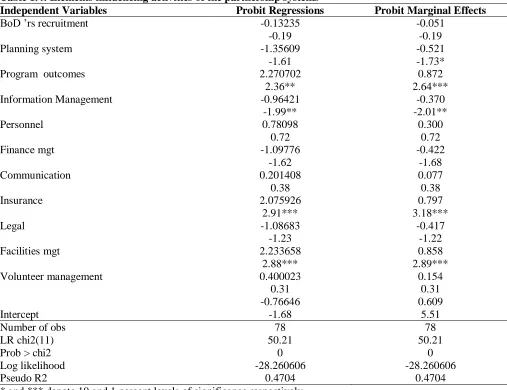
The study on another hand sought to establish the different elements of partnership systems between NGOs and smallholder farmer groups and how they interact within and their environments. Respondents were required to indicate the extent to which each of the eleven elements listed on the questionnaire influence activities of the partnerships.
Table 1.4: Elements influencing activities of the partnership systems
Independent Variables Probit Regressions Probit Marginal Effects
BoD ‟rs recruitment -0.13235
-0.19
-0.051 -0.19
Planning system -1.35609
-1.61
-0.521 -1.73*
Program outcomes 2.270702
2.36**
0.872 2.64***
Information Management -0.96421
-1.99**
-0.370 -2.01**
Personnel 0.78098
0.72
0.300 0.72
Finance mgt -1.09776
-1.62
-0.422 -1.68
Communication 0.201408
0.38
0.077 0.38
Insurance 2.075926
2.91***
0.797 3.18***
Legal -1.08683
-1.23
-0.417 -1.22
Facilities mgt 2.233658
2.88***
0.858 2.89***
Volunteer management 0.400023
0.31
0.154 0.31
Intercept
-0.76646 -1.68
0.609 5.51
Number of obs 78 78
LR chi2(11) 50.21 50.21
Prob > chi2 0 0
Log likelihood -28.260606 -28.260606
Pseudo R2 0.4704 0.4704
* and *** denote 10 and 1 percent levels of significance respectively
c e-ISSN: 2348-6848, p- ISSN: 2348-795X Volume 3, Issue 01, January 2016
International Journal of Research (IJR)
Available at http://internationaljournalofresearch.orgEnhancing the panning system as one of the key elements influencing activities of the partnership systems has a negative coefficient of -1.356 in the probit regression which is significant and therefore, this element has a slightly negative influence of on effectiveness of partnership system between NGOs and SFGs. Equally, enhancing the panning system has a marginal coefficient of -0.521 (z=-1.73). Both coefficients are significant at 10 percent levels. The result is shocking as it negates the views of Chamber (2002); and UNDP (2001) who maintain that enhancing the panning system provides the information management needed to make effective decision about resource (financial and human) allocation in a manner that enable achievement of partnership program objectives. In fact Chamber alludes that investing in panning encourages the development of the “what – if” scenario, where partnership system manager attempt to envision possible risk factors and design contingency plans to mitigate them. Possibly, this particular result may be explained by the belief that for the studied partnerships, the rural people are not well facilitated to participate in partnership system program design and implementation. It could be the major reason why Matove, (2006) notes that promoting planning in a partnership is an expensive act financially and time wise. Besides, as argued by Bakebwa, (2001) in Uganda due to poverty and illiteracy effective participation in program planning is difficult. Notwithstanding, the above argument, embrace planning that is participatory in nature increases program ownership, help address the actual community challenges and creates a competitive advantage, thus worth its investment.
From the result in Table 1.4, a promoting program planning and outcomes evaluation has a positive probit coefficient of 2.271 and a marginal coefficient of 0.872 (z= 2.640. Both are statistically significant at 1 percent level). It may be concluded that promoting program planning and outcomes evaluation is necessary and important to increasing the effectiveness of partnership systems between NGOs and SFGs in order to enhance rural development in Uganda. The result thus is not surprising as it concurs with the findings of Pinto, (2012); Malone, Mark, and Narayan, (2014) who claim that promoting program planning & outcomes evaluation can provide a mean to gauge whether a given program has been successful or not. On this Malone, Mark, and Narayan, further observes that it is necessary for leaders to assess where a program is in relation to its expected outcomes in order to make better informed decisions. The result could be explained by the known facts that in order to continuously improve implementation of program, necessary for managers of partnership systems between NGOs and SFGs, to continuously assess where the program is in relation to its outcomes. It may be on this basis that Hauge, (2001), in
his study on “Strengthening Capacity for Monitoring and Evaluation in Uganda” observes that conducting
program planning and evaluation helps in tracking specific indicators to promote accountability.
The result of promoting information management also has a negative coefficient of-0.964 and therefore a negative effect on the effectiveness of partnership system which is statistically significant at 5 percent level. The marginal effect of promoting information management is also negative of -0.371 (z=-2.01). The estimated marginal effect shows that promoting information management is likely to reduce the probability of achieving effectiveness of partnership systems between NGOs and SFGs by 0.371 points. In other words, promoting better information management is necessary but not crucial for effectiveness of partnership system between NGOs and SFGs in order to inform rural development in Uganda. The result is astounding as it contradicts the findings of Atta, and Parvyn-Wamahiu, (2003); and Maceviciute and Wilson (2002)who maintain that encouraging information management supports in decision making, to ensure good quality information is utilized by the organization (in terms of access, accuracy and reliability, effective sharing) to become more competitive and effective in its operations. Therefore, perhaps, this result is based on the assertion that for the partnerships studied, didn‟t manage information effectively for reasons of lack of good infrastructure in form of existing information systems, and expertise to capture relevant inform. In respect to this, understanding as well, a good model of effective information management should be selected suited the environment in which the partnership operates or as Choo (2002) referred to as work ecology that takes into account the social perspectives in influencing the fulfillment of information needs in an organization, in this case the partnerships between NGOs and SFGs in Uganda.
c e-ISSN: 2348-6848, p- ISSN: 2348-795X Volume 3, Issue 01, January 2016
International Journal of Research (IJR)
Available at http://internationaljournalofresearch.orgpercent level. This suggests that promoting insurance covers if agreed rather than disagreed that it is one of the key elements Influencing Activities increases the probability of achieving the effectiveness of partnership system
between NGOs and SFGs. In other words, promoting Insurance covers is necessary and crucial for the
effectiveness of partnership system between NGOs and SFGs in order to influence rural development in Uganda. This result is not amazing and it agrees with Buchmueller, et al (2005) who argues that having health insurance boosts personal wealth and financial health. This agrees also with USAID (2006), that claims that insurance covers contributes materially to economic growth by providing the investment climate and promoting a more efficient mix of activities that would be undertaken in the absence of risk management instruments. The result however may be surprising on another hand given that the rural areas of Uganda, insurance aspects are un heard of nor their services do exists. In rural areas of Uganda use informal insurance system such raring livestock, crop farming and in social schemes such as merry go round. Nonetheless, investment in insurance have diverse returns that evolve over time, reputational gains in the short terms, knowledge in the medium terms and growth in the
long terms, thus the need to promoting insurance covers where possible.
Providing required facilities has a positive coefficient of 2.234, with the marginal coefficient of 0.858 (z= 2.89) and both statistically significant at 1 percent level. The results implies that providing required facilities is necessary and fundamental in fostering effectiveness of partnership system between NGOs and SFGs which in turn cause rural development in Uganda. The result is not unanticipated as it agrees with Connor (2003); Barrett and Baldry (2003); and Atkin and Brooks (2005) who assert that better facility management offers an integrated approach to maintaining, improving and adapting the building and other infrastructure of an organisation in order to create an environment that strongly supports the organization objectives. In line with this Atkin and Brooks further observes that facility management creates processes that deliver and sustain a quality working environment and quality support services to meet partnership system strategic needs and goals. Barrett and Baldry also add that facility management affects not only revenues and costs but production, quality of life of employees, health and safety, the working environment and increasingly, the ability to retain employees. The result may be explained by the fact that the studied partnerships were involved in agriculture with much of their produce requiring post-harvest facilities, thus facility management seen as a critical aspect for the effectiveness of the partnership but also for many individual SFGs and NGOs.
Feedback within Partnership Sub-system and the Whole System
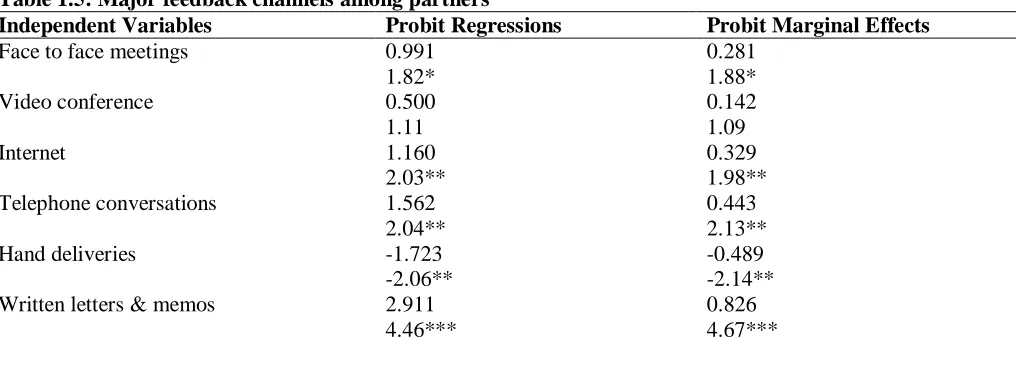
The partnership system between NGOs and smallholder farmer groups exchange information in the form of idea, feeling, among other things through several feedback loops which are either electronic in nature or otherwise as in Table 1.5 In this perspective communication is seen as the tool through which parties of a partnership use to solve problems and make decisions.
Table 1.5: Major feedback channels among partners
Independent Variables Probit Regressions Probit Marginal Effects
Face to face meetings 0.991
1.82*
0.281 1.88*
Video conference 0.500
1.11
0.142 1.09
Internet 1.160
2.03**
0.329 1.98**
Telephone conversations 1.562
2.04**
0.443 2.13**
Hand deliveries -1.723
-2.06**
-0.489 -2.14**
Written letters & memos 2.911
4.46***
c e-ISSN: 2348-6848, p- ISSN: 2348-795X Volume 3, Issue 01, January 2016
International Journal of Research (IJR)
Available at http://internationaljournalofresearch.orgIntercept
-2.893 -4.33
0.204 3.04
Number of obs 78 78
LR chi2(6) 53.21 53.21
Prob > chi2 0 0
Log likelihood -25.61768 -25.61768
Pseudo R2 0.5095 0.5095
* and *** denote 10 and 1 percent levels of significance respectively
From table 1.5, the major feedback channels including only the face to face e.g. meetings held at different levels, telephone conversations, hand deliveries, and written letters & memos were significant and their discussions are presented as follows:
The result in table 1.5 show that promoting face-to-face interaction has a positive coefficient of 0.991, while a marginal coefficient of 0.281 (z=1.88). One would still conclude that promoting face-to-face interactions in necessary and important to increasing the effectiveness of partnership systems between NGOs and SFGs to in turn induce rural development in Uganda. The effect is weak but statistically significant at 10 percent level. The result is not surprising as it is congruent with the findings of Duke (2001); and McLeod, (1997) who observe that face-to-face contacts facilitate the transfer of tacit knowledge or knowledge that is not written or definable but gained through experience. McLeod further argues that with face-to-face, the speaker can draw on visual clues from the audience to gain quick, immediate feedback and make quick response, which make participant to easily learn about one another‟s skills, experience and expertise. The result possibly may be explained based on the fact that face-to-face meetings in studied rural partnerships in Uganda are used for planning, delivery and evaluation purposes among others. This may explain the many responses from the focus group that face-to-face interactions provided them with immediate feedback and riches information medium which increases efficiency, satisfy beneficiaries, improves quality and creates innovations.
The result demonstrates that promoting internet use has a positive probit coefficient of 1.160 and a marginal coefficient of 0.329 (z=1.98). This means that promoting internet use increases the probability of effectiveness of partnership system between NGOs and SFGs in rural Uganda by 0.329 points. The result is statistically significant at 5 % level. Therefore, investing in internet services is necessary and essential in effectiveness of partnership system between NGOs and SFGs in order to foster rural development in Uganda. This result is not surprising in that it concurs with the findings of scholars such as Batinic, (2013) who asserts that the advent of the internet and the development of computers and telecommunication technology have made the world a global village a reality. Batinic, further argues that internet provide a better access to several sources of information required for development decisions. The result however, may be explained by the rapid spread of the internet to Uganda‟s rural areas especially the use of mobile phones which has sparked off excitement among the rural dwellers giving them hope for future flourishing businesses through easy communication with the outside world. This may also be a result of the country wide introduction of district Information Portals which has seen internet expansion to rural areas through internet kiosks and setting up internet points in every district headquarter (UCC, 2009).. As the internet is the world‟s biggest library and an essential source of information superhighway (Matsamura, 2001), it makes sense that partnership systems between NGOs and SFGs in Uganda embrace its use to ensure that those in rural alike are empowered to transform their lives and contribute to rural development, which in turn contributes to the whole country‟s socio-economic development of the country.
c e-ISSN: 2348-6848, p- ISSN: 2348-795X Volume 3, Issue 01, January 2016
International Journal of Research (IJR)
Available at http://internationaljournalofresearch.orgemail use is taking over, telephone communication is one of the most common and important forms of communication by which to manage both internal and external communication within organizations. Etta, and Paryn notes that telephone use has several benefits such as the where the interlocutors do not see each other, which may help to solve tricky or unfavourable situations, and it can be used simultaneously while taking notes, searching on the computer, and so on. Perhaps the result is what it is based on the argument that almost everybody from the studied partnership including those in rural areas of Uganda seem to have a mobile phone today (whether personal or for a close friend), making the phone one of the most important communication tools including in partnerships between NGOs and SFGs. This makes phone conversations not only critical for the effective functioning of partnerships but also contributing to effective community members‟ interactions which a vital component for the effectiveness of the partnerships between NGOs and SFGs to inform rural development. However, Scoot and Mckemey,(2004) also confirm that rural areas in Uganda remain un served under the current license arrangement as access to services is restricted to publicom booths and private individuals with mobile phones – several communities reported use of personal handsets, which to them offered a public spirited gesture rather than a commercial service. Therefore, it is evident that there remains a need for greater investment in
telecommunication infrastructure to enhance Telephone Conversations among others for rural development.
Promoting hand deliveries has a negative probit coefficient of -1.723 with a marginal coefficient of -0.489 (z=-214) and both are statistically significant (t 5 percent level. Equally, the estimated marginal effect of promoting hand deliveries decreases the probability of effectiveness of partnership system between NGOs and SFGs by 0.489 points. This means that improving hand deliveries is necessary but not crucial on effectiveness of partnership system between NGOs and SFGs in order to cause rural development in Uganda. The result is not unanticipated it negates the views of scholars such as Clarke and Stewart (1997), who affirms that hand deliveries is costly in terms of time, energy and money as the deliverer has to travel from the information source to where it is supposed to be received. This result could be explained by the fact that though hand deliveries communication is still an option for some people in rural Uganda including among the studied partnership, it has become the least applied channel of communication due to its slowness and emergence of more fast means of communication such as email, Skype, telephone, etc. However, in many instances hand deliveries is seen as a critical option for instance in legal related communication such as sermons. Notwithstanding the above drawback, hand deliveries may present an opportunity for more direct contact with information recipient, who could give a feedback immediately facilitating quick decision making as noted by Davis (2000), which in turn could increase effective partnership systems to inform rural development.
c e-ISSN: 2348-6848, p- ISSN: 2348-795X Volume 3, Issue 01, January 2016
International Journal of Research (IJR)
Available at http://internationaljournalofresearch.orgperspectives, experiences and position in the organization, making unlikely common understanding of written letters & memos by all who receive them. This may limit the levels of interactions to cause ineffectiveness of the partnership systems between NGOs and SFGs in rural Uganda, thus hampering likely development in rural areas.
Management of Communication Flaws
Equally, the study sought to understand the management of communication flaws prevailing among the partnership systems between NGOs and SFGs for addressing various communication huddles that may spring up.
Table 1.6: Successful and workable management of communication flaws factors
Independent Variables Probit Regressions Probit Marginal Effects
Downward communication 2.182
4.32***
0.731 4.58***
Upward communication -1.849
-3.33***
-0.620 -3.59***
Lateral / Horizontal communication -0.760
-1.95*
-0.254 -1.95*
Diagonal Communication -0.615
-1.28
-0.206 -1.33
External Communication 0.233
0.68
0.078 0.68
Intercept
-0.173 -0.43
0.277 4.44
Number of obs 78 78
LR chi2(5) 30.65 30.65
Prob > chi2 0 0
Log likelihood -36.896268 -36.896268
Pseudo R2 0.2935 0.2935
* and *** denote 10 and 1 percent levels of significance respectively
However, only four factors: downward flow of communication, upward flow of communication, lateral / horizontal communication, and diagonal communication were significant and are discussed as follows:
c e-ISSN: 2348-6848, p- ISSN: 2348-795X Volume 3, Issue 01, January 2016
International Journal of Research (IJR)
Available at http://internationaljournalofresearch.orgsuitable for the rural setting to make communication for development efficient and meet the needs of their rural target communities.
The results show that promoting upward flow of communication has a negative probit coefficient of -1.849 and a marginal coefficient of -0.62 (z=-3.59). The negative marginal effect means that promoting upward flow of communication decreases the effectiveness of partnership systems between NGOs and SFGs by 0.62 points. In other words promoting upward flow of communication is necessary but not vital in rural development in Uganda. The coefficients are both statistically significant at 1 % level. The result here appear to refute the findings of Keyton, (2011); and Lunenburg, (2010) who argues that bottom –up communication creates more commitment and royalty of workforce in a partnership, due to the fact that employees are given the chance to raise and speak dissatisfaction matters to the managers. furthermore, Lunenburg, (2010) reasons that upward communication is participative in nature since it allows the subordinates to convey their feeling, constructive suggestion and opinions and the work related in the decision making process. Whereas upward communication is merited with many benefits, such as feedback of information up the hierarchy of the partnership systems, perhaps, the result can be explained by the fact that for the studied partnerships, it is not easy for them to have a smooth upward flow as there are some deterrents within partnership between NGOs and SFGs which may prevent a good return flow. Kyakulumbye, Olobo, and Kisenyi, (2013) argues that challenges in rural setting such as intentional distortion of any communication, fear and reluctance by employees to engage in upward communication, among others affects
their interactions within organizations. These in turn affect the effectiveness of the partnerships between NGOs
and SFGs in Uganda, thus hampering rural development. Therefore, there is need for management of partnership between NGOs and SFGs to assess, design and utilize an appropriate communication flow that suits existing communication infrastructure with the partners.
Equally, the results show that promoting lateral / horizontal communication has a negative probit regression coefficient of -0.760. with a marginal coefficient of -0.254 (z=-1.95), which means that an increase in promoting lateral / horizontal communications decreases the effectiveness of partnership systems between NGOs and SFGs by 0.254points if this was agreed as a beneficial rather than disagreed. Therefore, promoting downward flow of communication is necessary but not essential in rural development in Uganda. This effect is weak and statistically significant at 10 percent level. This finding is surprising in that it is in variance with the findings of Canary, (2011); and Keyton, (2011) who asserts that horizontal Communication is essentially communication between peers, managers as the same levels and that it works well for big and complex partnerships. This means that the bigger in size and complex a partnership system becomes the need to embrace lateral / horizontal communication also increases. Keyton, further discusses that lateral / horizontal communication is time saving, facilitates coordination of tasks, facilitates co-optations among team members, is good for application in resolving conflicts of sections/ departments with others at the same level. However, perhaps the result may be explained by the fact that communication structures, functions, and accountability mechanism in the studied partnerships in Uganda including in rural areas are undeveloped. According to the Government Communication Strategy, 2011, the absence of clear structure and accountability mechanism results into poor coordination of information flows within and without government and other agencies. This could be the reason why horizontal communication flows within partnership between NGOs and SFGs in Uganda have not enhanced coordination by permitting flow of lateral information flows, enabling subsystems to interact productively with others without having to follow rigidly down and up channels. The partnership system studied were observed not keen at using taskforces, committees, liaison staff all of which can be viewed as very important to facilitate coordination of their tasks and their effectiveness in order to influence rural development.
Major Communication Channels External to the Partnership
c e-ISSN: 2348-6848, p- ISSN: 2348-795X Volume 3, Issue 01, January 2016
International Journal of Research (IJR)
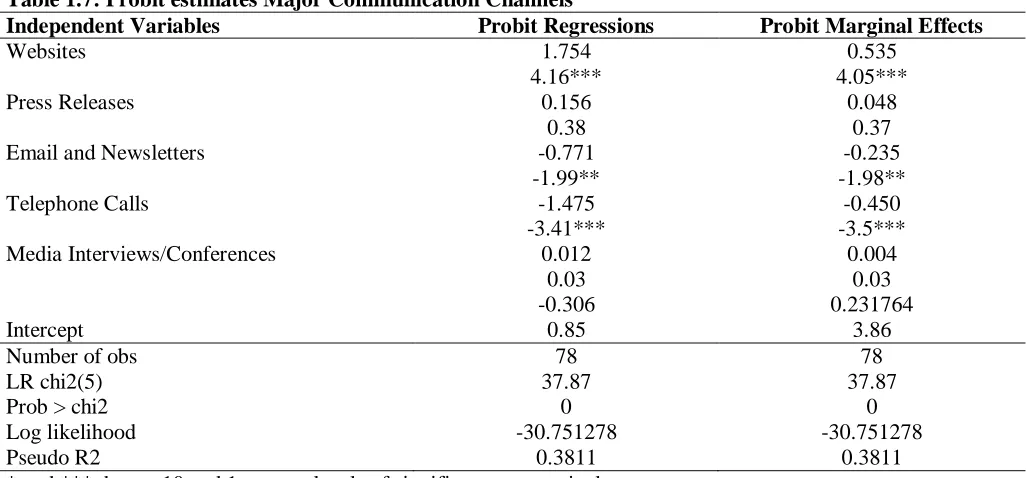
Available at http://internationaljournalofresearch.orgstudy identified the critical factors that affect management of communication flaws external to the partnership and whose focus in terms of investment is likely to influence rural development shown in Table 1.7.
Table 1.7: Probit estimates Major Communication Channels
Independent Variables Probit Regressions Probit Marginal Effects
Websites 1.754
4.16***
0.535 4.05***
Press Releases 0.156
0.38
0.048 0.37
Email and Newsletters -0.771
-1.99**
-0.235 -1.98**
Telephone Calls -1.475
-3.41***
-0.450 -3.5***
Media Interviews/Conferences 0.012
0.03
0.004 0.03
Intercept
-0.306 0.85
0.231764 3.86
Number of obs 78 78
LR chi2(5) 37.87 37.87
Prob > chi2 0 0
Log likelihood -30.751278 -30.751278
Pseudo R2 0.3811 0.3811
* and *** denote 10 and 1 percent levels of significance respectively
The detailed discussions of the significant variables are presented below.
Promoting use of website has a positive probit
coefficient of 1.754. Similarly the marginal
effect was 0.535 (z=4.05), which means that an
increase in promoting use of website increases
effectiveness of partnership system between
NGOs and SFGs by 0.535 points. This amounts
to saying that promoting use of websites is
necessary
but also
fundamental
for the
effectiveness of the partnership systems between
NGOs and SFGs to cause rural development in
Uganda. This effect is strong and statistically
significant at 1 % level. This result is not
surprising and agrees with Huizingh (2000);
Aladwani and Palvia (2002) who argues that a
website not only gives credibility, but also helps
give an impression and success of the partnership
system. Huizingh adds that a website introduces
the activities of the partnership system
throughout the world. Aladwani and Palvia
further assert that it is not the website that is
critical but its contents (features, functions,
c e-ISSN: 2348-6848, p- ISSN: 2348-795X Volume 3, Issue 01, January 2016
International Journal of Research (IJR)
Available at http://internationaljournalofresearch.orgThe results show that promoting email and
newsletters use has a negative probit coefficient
of -0.771 and statistically significant at 5 percent
level. This means that a unit increase in
promoting email and newsletters decreases
effectiveness of partnership system by 0.771.
Correspondingly, the estimated marginal effect
has a negative coefficient of -0.235 (z=-1.98),
implying that that an increase in the promotion
of email and newsletters decreases the
effectiveness of the partnership system between
NGOs and SFGs by 0.235 points if this was
agreed as a benefit rather than disagreed. This
effect is averagely strong and statistically
significant at 5 % level. This result is yet another
surprising one, as it negates the findings of some
scholars including Yell (2003); Seshadri and
Carstenson,
(2007);
Hewitt
(2007);
and
Cunningham and Greene (2008), who generally
confirm that emails have grown from a small and
exclusive means of communication to a major
communication medium with about 210 billion
email exchange per day. They further postulates
that emails have been embedded within
organizational
and
social
effective
communications for several benefits such as their
comparable cheapness, free online email address
that can be personalized to an extent (yahoo,
g-mail, hot-g-mail, etc.). It could therefore be that
this result is explained by the fact that within the
studied partnerships in Uganda, use of promoting
email and newsletters is made difficult, given
that rural areas in Uganda present a difficult
environment
for
deployment
of
telecommunication infrastructure due to shortage
of energy, high poverty levels, and illiteracy
among others. This may be evidenced by
Kawooya, (2004); Madanda, (2006); and
Serumaga, et al (2013) who maintains that
Uganda‟s potential for rural areas to benefit from
email and newsletters is a persistent question as
the rural areas have lag behind and suffers acute
shortage of electricity in the interconnected grid
and the un served rural areas, which constrain
development. The partnership systems between
NGOs and SFGs in Uganda to have email and
newsletters in rural areas where their target group
lives, there is need to address factors such as low
literacy levels, rural electrification, under
developed
access
network
and
lack
of
appropriate technology areas among others.
Lastly, the results show that promoting use of
telephone calls external to the partnership has a
negative probit coefficient of -1.475 and a
marginal coefficient of -0.45 (z=-3.5). The
marginal effect here means that promoting use of
telephone calls external to the partnership has a
negative effect and agreeing that it is an
important factor rather than disagreeing reduces
the probability of the effectiveness of partnership
systems between NGOs and SFGs by 0.45
points. The implication is that promoting
telephone calls external to the partnership
subsidies is necessary but not critical in rural
development in Uganda. This effect is strong and
statistically significant at 1 % level. This result is
surprising as it does not agree with Ulrich
(2004); Etta, and Paryn (2003) who debate that
applying
the
most
appropriate
telephone
c e-ISSN: 2348-6848, p- ISSN: 2348-795X Volume 3, Issue 01, January 2016