ISSN 2286-4822
www.euacademic.org
Impact Factor: 3.4546 (UIF)
DRJI Value: 5.9 (B+)
On Artin Cokernel of the Group (Q
2m
D
3
) where
m= 2
h
p and p is prime number
NESIR RASOOL MAHMOOD
Assistant Professor
University of Kufa
Faculty of Education for Girls
Department of Mathematics
Iraq
ZINAH MAKKI KADHIM
University of Kufa
Faculty of Education for Girls
Department of Mathematics
Iraq
Abstract:
The main purpose of This paper is to find Artin’s character
table
Ar(Q
2m
D
3
)
when m is even number such that m
2p,and p is a
prime number ;where Q
2m
is denoted to Quaternion group of order 4m,
time is said to have only one dimension and space to have three
dimension ,the mathematical quaternion partakes of both these
elements; in technical language it may be said to be "time plus space",
or "space plus time" and in this sense it has , or at least involves a
reference to four dimensions ,and how the one of time of space the three
might in the chain of symbols girdled "- William Rowan Hamilton
(Quoted in Robert Percival Graves "Life of sir William Rowan
Hamilton" (3 vols.,1882,1885,1889)) ,and
D
3
is Dihedral group of order
6.In 1962, C.W.Curits & I.Reiner studied Representation Theory of
finite groups ,
N.R.Mahmood studies The Cyclic Decomposition of the factor Group
cf(Q
2m
,Z)/
R(Q
2m
), In 2002, K-Sekiguchi studies Extensions and the
Irreducibilies of the Induced Characters of Cyclic P-Group, In 2006,
A.S.Abid studies Characters Table of Dihedral Group for Odd number.
Key words: words:
even number, prime number, Quaternion group,
and Dihedral group.
1. INTRODUCTION:
Representation Theory is a branch of mathematics that studies
abstract algebra structures by representing their elements as
linear transformations of vector spaces, a representation makes
an abstract algebraic object more concrete by describing its
elements by matrices and the algebraic operations in items of
matrix addition and matrix multiplication ,In which elements
of a group are represented by invertible matrices in such a way
that the group operation is matrix multiplication. Moreover,
representation and character theory provide applications ,no
only in other branches of mathematics but also in physics and
chemistry.
For a finite group G ,The factor group
R(G)/T(G)
is
called the Artin cokernel of
G
denoted
AC(G)
,
R(G)
denoted
the a belian group generated by Z-valued characters of G under
the operation of pointwise addition
, T(G)
is asubgroup of
R(G)
which is generated by Artin
,
s characters.
2. PRELIMINARS: [1]:(3,1)
The Generalized Quaternion Group Q
2m
:
For each positive integer m
2 ,The generalized Quaternion
Group
Q
2m of order 4m with two generators x and y satisfies
Q
2m
{x
h
y
k
,0
h
2m-
1,k=0,1}
(Q
2m
D
3) where m= 2
p and p is prime number
Let
G
be a finite group, all the characters of group
G
induced
from a principal character of cyclic subgroup of
G
are called
Artin characters of
G
.
Artin characters of the finite group can be displayed in a
table called Artin characters table of
G
which is denoted by
Ar(G);
The first row is
-conjugate classes ; The second row is
The number of elements in each conjugate class, The third row
is the size of the centralized |C
G
(cl
a
)| and other rows contains
the values of Artin characters .
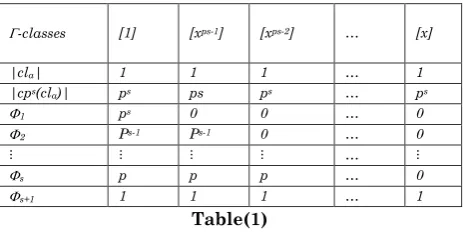
Theorem:[2]:(3,3)
The general form of Artin characters table of
Cp
s
When p is a prime number and s is a positive integer number is
given by :-
Ar(Cp
s
)
-classes
[1]
[x
ps-1]
[x
ps-2]
…
[x]
|cl
a|
1
1
1
…
1
|cp
s(cl
a)|
p
sps
p
s…
p
s
1p
s0
0
…
0
2P
s-1P
s-10
…
0
…
sp
p
p
…
0
s+11
1
1
…
1
Table(1)
3. THE MAIN RESULTS:
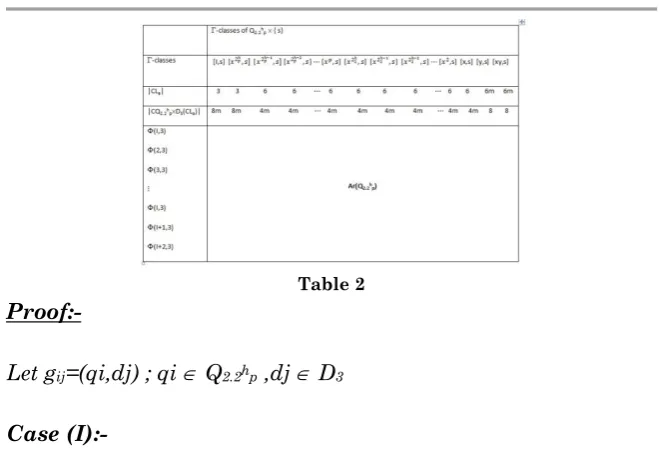
Theorem: (4,1)
The Artin
,
s character table of the group
(Q
2.2h
p
D
3
)
where
m=2
h
p such that h is any positive integer and p is prime
number, it is given as follows:
Table 2
Proof:-
Let g
ij
=(qi,dj) ; qi
Q
2.2hp
,dj
D
3
Case (I):-
Consider the group G=(Q
2.2hp
D
3
) and if H is a cyclic subgroup
of (Q
2.2hp
{I}) then H=
(q,1)
and
the principle character of H
and
j
Artin
,
s characters of
Q
2.2h
p
,1
j
i+2 ,The cyclic subgroup
of Q
2.2h
p
which are {
I
},{
},
{<
>},{<
>},
,{<
>},{<
>},{<
>},{<
+
,
, {<
+
,{<x>},{<y>},{<xy>}
and cyclic subgroup of
D
3
which are {
I
},{
r
},{
s
}, by using
theorem:
( )
{
( )
( )
∑
( )
( )
( )
}
H=
q,1
:-
1:-H
11
=
(I,1)
if g=(I,1) then
11
(g)=
( )
( )
(g)=
( )
.1=
( )
( )
.1=6.
j
(1)
since H
cl(I,1)=(I,1)
2:-H
21
=
(
,1
)
; ( a)if
g=(I,1)then
21
(g)=
( )
( )
( )
=
( )
.1=
( )
(Q
2m
D
3) where m= 2
p and p is prime number
(b)if g=(
,1) then
11
(g)=
( )
( )
.
( )
( )
.1=
(
)
.1=
(
)
(
)
.1=6
(
)
since H
(
)
=(I,1),(
)
otherwise=0.
3:-
if
g
(
,1)
then
j,1
(g)=
( )
( )
(
( ) (
)
=
(
)
(1+1)=
( )
(
)
.2=6
(
)
Since H
cl(g) ={g,g
-1
} and
( ) (
)
=1; since g=(q,I) ,q
Q
2.2hp
, q
If g
H then
j,1
(g) =0 =6.0 =0
(q) since H
cl(g) =
.
4:- H
41
=
( )
;(a) ifg=(I,1) then
41
(g)=
( )
( )
( )
=
.1=6
i+1
(I).
(b)
if
g=(
) (
)
( )
=
( )
( )
( )
=
.1=6
i+1
(
)
.
(c)
if
g=(y,1)
or
(y
3
,1)
then
41
(g)=
( )
( )
(
( )
(
)=
(1+1)=6.2=12.
Since
H
( ) *( ) (
) ( )+
and
( )
(
)
otherwise =0.
5:-
H
51
=
( )
;
(a)
if
g=(I,1)
then
51
(g)=
( )
( )
( )
=
.1=6
i+2
(I).
(b) if g=((
)
)
=(
,1) then
( )
=
( )
( )
( )
=
.1=6
i+2
(
).
(c) if g=(xy,1) or((xy)
3
,1) then
(g)
( )
( )
( ( )
(
))
(1+1)=6.2=12.
Case (II):-
Consider the group G=(Q
2.2hp
D
3
) and if H is a cyclic subgroup
of
(Q
2.2hp
{r}) then H=
(q,r)
and
the principle character of
H and
Artin
,
s character of Q
2.2hp
, 1
j
i+2 ,by using theorem:-
( )
{
( )
( )
∑
( )
( )
( )
}
H=
(q,r)
:-
1:-H
12
=
(I,r)
;
(a)
if
g=(I,1)
then
12
(g)
=
( )
( )
( )
=
( )
.1=
( )
( )
.1=2.
j
(I).
(b)
If
g=(I,r)or=(I,r
2
)
then
( )
( )
( )
( ( ) (
))=
( )
(1+1)=
( )
( )
.2=2.
( )
Since
H
cl(g)=
*( ) ( ) (
)+
and
( ) (
)
othrewise=0.
2:-H
22
=
(
,r)
(a)
if
g=(I,1)
then
( )
( )
( )
( )
=
(
)
(1)=
(
)
(1)=2
( )
(b)
if
g=(
,1)
then
( )
( )
( )
( )
=
(
)
(1)=
(
)
(
)
(1)=2
(
)
.
(c)
if
g=(I,r)
then
( )
( )
( )
(
( ) (
))
=
( )
(1+1)=
( )
.2=2
( )
.
(d)
if
g=(
,r)
then
( )
( )
( )
( ( )
(
))
=
( )
(1+1)=
( )
.2=2
( )
.
Since
H
cl(g)=
{( ) (
) ( ) (
)}
.and
( )
(
)
.othrewise=0.
3:- if g
(
,1),(
,r) then
j,2
(g)=
( )
( )
(
( ) (
))
(Q
2m
D
3) where m= 2
p and p is prime number
since H
cl(g)={g,g
-1
} ,and g={(q,r),(q,r
2
)} ,q
Q
2.2hp
,q
,
( ) (
)
if g
H then
j,2
(g)=0 = 6.0 =0 .
j(q) since H
cl(g)=
.
4:-
H
42
=
(y,r)
(a)
if
g=(I,1)
then
( )
( )
( )
( )
=
.1=2.(
) =2.
(I).
(b) if g=(y
2
,1) or (
,1) then
( )
( )
( )
( )
=
.1=2.(
)
=2.
(
).
(c)
if
g=(y,1)
or
(y
3
,1)
then
( )
=
( )
( )
(
( )
(
))
=
(1+1)=4.
(d)
if
g=(I,r)
then
( )
=
( )
( )
(
( )
(
))
=
(1+1)=2.(
)=2.
(q).
(e)
if
g=(y
2
,r)
or
(
,r)
then
( )
( )
( )
(
( ) (
))
=
( )
=2.(
)= 2.
(q).
(f)
if
g=((y,r)
or
(y
3
,r)
then
( )
=
( )
( )
(
( )
(
))
=
(1+1+1+1)=4.
Since
H
cl(g)=
*( ) (
) ( ) ( ) (
) ( )+
And
(g)=
(
(
)
.othrewise=0.
5:-H
52
=
(xy,r)
(a)
if
g=(I,1)
then
( )
( )
( )
( )
=
.1=2.(
) =2.
(I).
(b) if g=((xy)
2
,1)=(
,1) then
( )
( )
( )
( )
=
.1=2.(
)
=2.
(
).
(c)
if
g=(xy,1)
or
((xy)
3
,1)
then
( )
( )
( )
(
( ) (
))
=
( )
=4.
(d) if g=(I,r) then
( )
( )
( )
(
( ) (
))
=
(
(e) if g=((xy)
2
,r)=(
,r) then
( )
( )
( )
(
( ) (
))
=
( )
=2.(
)= 2.
(q).
(f)
if
g=(xy,r)
or((xy)
3
,r)
then
( )
=
( )
( )
(
( )
(
))
=
(1+1+1+1)=4.
Since
H
cl(g)=
*( ) (( )
)( ) ( ) (( )
) ( )+ ( )
((
)
0
Case (III):-
Consider the group G=(Q
2.2hp
D
3
) and if H is a cyclic subgroup
of
(Q
2.2hp
{s }) then H=
(q,s)
and
the principle character of
H and
Artin
,
s character of Q
2.2hp
, 1
j
i+2 ,by using theorem:-
( )
{
( )
( )
∑
( )
( )
( )
}
H=
(q,s)
1:-H
13
=
(I,s)
(a) if g=(I,1) then
( )
=
( )
( )
( )
( )
.1=
( )
.1=3.
j
(I).
(b)
if
g=(I,s)
then
( )
=
( )
( )
( )
=
( )
.1=
( )
.1=
( )
.
Since H
cl(g)=
*( ) ( )+
:-H
23
=
(
,s)
(a)
if
g=(I,1)
then
( )
=
( )
( )
( )
=
(
)
.1=
(
)
.1=3.
j
(I).
(b)
if
g=(
,1)
then
( )
=
( )
( )
( )
=
(
)
.1=
(
)
.1 ==3.
j
(
).
(c)
if
g=(I,s)
then
( )
=
( )
(Q
2m
D
3) where m= 2
p and p is prime number
(d)
if
g=(
,s)
then
( )
=
( )
( )
( )
=
(
)
.1=
(
)
.1=
( )
.
Since
H
cl(g)=
{( ) (
) ( ) (
)} ( )
((
)
1
3:- if g
(
,1),(
,s) and g
H ,if g
(
,1) ,g
(Q
2.2hp
{1})
then
j,3
(g)=
( )
( )
(
( ) (
)
=
(
)
(1+1)=
( )
(
)
.2=3
(
)
since g=(q,1),
q
Q
2.2hp
,q
,
if g
(
,s) and g
(Q
2.2hp
{s}) then
( )
=
( )
( )
( ( )
(
))
=
(
)
(1+1)=
(
)
.2=
( )
. since H
cl(g)={g,g
-1
}
,
( ) ((
)
1 if g
H then
j,3
(g)=0 =
(q) since
H
cl(g)=
.
4:-H
43
=
(y,s)
(a) if g=(I,1) then
( )
=
( )
( )
( )
.1=3.
(I).
(b)
if
g=(y
2
,1)
=(
,1)
then
( )
=
( )
( )
( )
.1=3.
(
).
(c) if g=(y,1) or (y
3
,1) then
( )
=
( )
( )
( ( ) (
))
(1+1)=6.
(d) if g=(I,s) then
( )
=
( )
( )
( )
=
.1=
(q).
(e) if g=(y
2
,s)=(
,s) then
( )
=
( )
( )
( )
=
.1=
(q).
(f) if g=(y,s) or (y
3
,s) then
( )
=
( )
( )
( ( ) (
))
5:-H
53
=
(xy,s)
(a) if g=(I,1) then
( )
=
( )
( )
( )
.1=3.
(I).
(b)
if
g=((xy)
2
,1)
=(
,1)
then
( )
=
( )
( )
( )
.1=3.
(
).
(c) if g=(xy,1) or ((xy)
3
,1) then
( )
=
( )
( )
( ( ) (
))
(1+1)=6.
(d) if g=(I,s) then
( )
=
( )
( )
( )
=
.1=
(q).
(e)
if
g=((xy)
2
,s)
=(
,s)
then
( )
=
( )
( )
( )
=
.1=
(q).
(f) if g=(xy,s) or ((xy)
3
,s) then
( )
=
( )
( )
( ( ) (
))
=
(1+1)=2.
Since
H
cl(g)
=
*( ) (( )
) ( ) ( ) (( )
) ( )+ ( )
((
)
1
Note: (xy)
2
=y
2
since (xy)
2
=xyxy= xyxy.y
2
y
2
=xyxy
3
y
2
=x(yxy
3
)y
2
=
xx
-1
y
2
=y
2
.
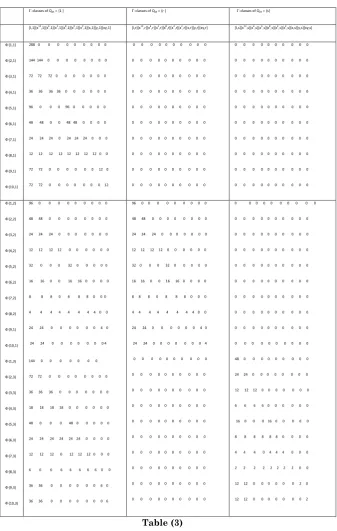
Example:-(4,2)
Let
m=2
h
p ,
such that
p=3 ,
and
h=2 , m=12 , Q
2m
=Q
24
;
To find Artin
,
s
character of the group
(Q
24
D
3
)
the cyclic subgroup of
Q
24
which are
{<1>},{<x
12
>},{<x
6
>},{<x
3
>},{<x
8
>},{<x
4
>},{<x
2
>},{<x>},{<y>},
{<xy>} and cyclic subgroup of
D
3
which are {<1>},{<r>},{<s>}
The
cyclic
subgroup
of
(Q
24
D
3
)
which
are
{<I,1>},{<x
12
,1>},{<x
6
,1>},{<x
3
,1>},{<x
8
,1>},{<x
4
,1>},{<x
2
,1>},
{<x,1>},{<y,1>},{<xy,1>} ,
{<I,r >},{<x
12
,r >},{<x
6
,r >},{<x
3
,r >},{<x
8
,r >},{<x
4
,r >},
{<x
2
,r >},{<x,r >},{<y,r >},{<xy,r >} ,
{<I,s >},{<x
12
,s >},{<x
6
,s >},{<x
3
,s >},{<x
8
,s >},{<x
4
,s >},
{<x
2
,s >},{<x,s >},{<y,s >},{<xy,s >} ,by using theorem:-
( )
{
( )
( )
∑
( )
( )
( )
(Q
2m
D
3) where m= 2
p and p is prime number
-classes of Q24 {s}
-classes of Q24 {r }
-classes of Q24 {1 }
[I,s][x12,s][x6,s][x3,s][x8,s][x4,s][x2,s][x,s][y,s][xy,s] [I,r][x12,r][x6,r][x3,r][x8,r][x4,r][x2,r][x,r][y,r][xy,r]
[I,1][x12,1][x6,1][x3,1][x8,1][x4,1][x2,1][x,1][y,1][xy,1]
0 0 0 0 0 0 0 0 0 0
0 0 0 0 0 0 0 0 0 0
0 0 0 0 0 0 0 0 0 0
0 0 0 0 0 0 0 0 0 0
0 0 0 0 0 0 0 0 0 0
0 0 0 0 0 0 0 0 0 0
0 0 0 0 0 0 0 0 0 0
0 0 0 0 0 0 0 0 0 0
0 0 0 0 0 0 0 0 0 0
0 0 0 0 0 0 0 0 0 0 0 0 0 0 0 0 0 0 0 0
0 0 0 0 0 0 0 0 0 0
0 0 0 0 0 0 0 0 0 0
0 0 0 0 0 0 0 0 0 0
0 0 0 0 0 0 0 0 0 0
0 0 0 0 0 0 0 0 0 0
0 0 0 0 0 0 0 0 0 0
0 0 0 0 0 0 0 0 0 0
0 0 0 0 0 0 0 0 0 0
0 0 0 0 0 0 0 0 0 0 288 0 0 0 0 0 0 0 0 0
144 144 0 0 0 0 0 0 0 0
72 72 72 0 0 0 0 0 0 0
36 36 36 36 0 0 0 0 0 0
96 0 0 0 96 0 0 0 0 0
48 48 0 0 48 48 0 0 0 0
24 24 24 0 24 24 24 0 0 0
12 12 12 12 12 12 12 12 0 0
72 72 0 0 0 0 0 0 12 0
72 72 0 0 0 0 0 0 0 12
(1,1) (2,1) (3,1) (4,1) (5,1) (6,1) (7,1) (8,1) (9,1) (10,1)
0 0 0 0 0 0 0 0 0 0
0 0 0 0 0 0 0 0 0 0
0 0 0 0 0 0 0 0 0 0
0 0 0 0 0 0 0 0 0 0
0 0 0 0 0 0 0 0 0 0
0 0 0 0 0 0 0 0 0 0
0 0 0 0 0 0 0 0 0 0
0 0 0 0 0 0 0 0 0 0
0 0 0 0 0 0 0 0 0 0
0 0 0 0 0 0 0 0 0 0
48 0 0 0 0 0 0 0 0 0
24 24 0 0 0 0 0 0 0 0
12 12 12 0 0 0 0 0 0 0
6 6 6 6 0 0 0 0 0 0
16 0 0 0 16 0 0 0 0 0
8 8 8 8 8 8 0 0 0 0
4 4 4 0 4 4 4 0 0 0
2 2 2 2 2 2 2 2 0 0
12 12 0 0 0 0 0 0 2 0 96 0 0 0 0 0 0 0 0 0
48 48 0 0 0 0 0 0 0 0
24 24 24 0 0 0 0 0 0 0
12 12 12 12 0 0 0 0 0 0
32 0 0 0 32 0 0 0 0 0
16 16 0 0 16 16 0 0 0 0
8 8 8 0 8 8 8 0 0 0
4 4 4 4 4 4 4 4 0 0
24 24 0 0 0 0 0 0 4 0
24 24 0 0 0 0 0 0 0 4
0 0 0 0 0 0 0 0 0 0
0 0 0 0 0 0 0 0 0 0
0 0 0 0 0 0 0 0 0 0
0 0 0 0 0 0 0 0 0 0
0 0 0 0 0 0 0 0 0 0
0 0 0 0 0 0 0 0 0 0
0 0 0 0 0 0 0 0 0 0
0 0 0 0 0 0 0 0 0 0
0 0 0 0 0 0 0 0 0 0 96 0 0 0 0 0 0 0 0 0
48 48 0 0 0 0 0 0 0 0
24 24 24 0 0 0 0 0 0 0
12 12 12 12 0 0 0 0 0 0
32 0 0 0 32 0 0 0 0 0
16 16 0 0 16 16 0 0 0 0
8 8 8 0 8 8 8 0 0 0
4 4 4 4 4 4 4 4 0 0
24 24 0 0 0 0 0 0 4 0
24 24 0 0 0 0 0 0 0 4
144 0 0 0 0 0 0 0
72 72 0 0 0 0 0 0 0 0
36 36 36 0 0 0 0 0 0 0
18 18 18 18 0 0 0 0 0 0
48 0 0 0 48 0 0 0 0 0
24 24 24 24 24 24 0 0 0 0
12 12 12 0 12 12 12 0 0 0
6 6 6 6 6 6 6 6 0 0
36 36 0 0 0 0 0 0 6 0