Collaborative In-Network Processing for Target Tracking
Juan Liu
Palo Alto Research Center, 3333 Coyote Hill Road, Palo Alto, CA 94304, USA Email:[email protected]
James Reich
Palo Alto Research Center, 3333 Coyote Hill Road, Palo Alto, CA 94304, USA Email:[email protected]
Feng Zhao
Palo Alto Research Center, 3333 Coyote Hill Road, Palo Alto, CA 94304, USA Email:[email protected]
Received 21 December 2001 and in revised form 4 October 2002
This paper presents a class of signal processing techniques for collaborative signal processing in ad hoc sensor networks, focusing on a vehicle tracking application. In particular, we study two types of commonly used sensors—acoustic-amplitude sensors for tar-get distance estimation and direction-of-arrival sensors for bearing estimation—and investigate how networks of such sensors can collaborate to extract useful information with minimal resource usage. The information-driven sensor collaboration has several advantages: tracking is distributed, and the network is energy-efficient, activated only on a when-needed basis. We demonstrate the effectiveness of the approach to target tracking using both simulation and field data.
Keywords and phrases:sensor network, target tracking, distributed processing, Bayesian filtering, beamforming, mutual infor-mation.
1. INTRODUCTION
Sensors of various types have already become ubiquitous in modern life, from infrared motion detectors in our light switches to silicon accelerometers in the bumpers of our cars. As the cost of the sensors comes down rapidly due to ad-vances in MEMS fabrication and because these sensors in-creasingly acquire networking and local processing capabili-ties, new types of software applications become possible, dis-tributed among these everyday devices and performing func-tions previously impossible for any of the devices indepen-dently. Enabling such functionality without overtaxing the resources of the existing devices, especially when these de-vices are untethered and running on batteries, may require us to rethink some important aspects of how sensing systems are designed.
1.1. Advantages of distributed sensor networks
There are a number of reasons why networked sensors have a significant edge over existing, more centralized sensing plat-forms.
An ad hoc sensor network can be flexibly deployed in an area where there is no a priori sensing infrastructure. Cover-age of a large area is important for tracking events of a sig-nificant spatial extent as in tracking events of a sigsig-nificant
spatial extent, as in tracking a large number of events simul-taneously, or for tracking dynamic events traversing the sens-ing ranges of many individual sensors, as in tracksens-ing a mov-ing vehicle.
In cases of tracking low-observable phenomena, such as a person walking in an obstacle field in an urban environment or a stealthy military vehicle, the signal-to-noise ratio (SNR) of data collected from a central location may be unaccept-able. As sensor density increases, the mean distance from the nearest sensor to a target decreases and the SNR received at the nearest sensor improves.
A large-area sensor network may also activate different parts of the network to process different queries from users, supporting a multimode, multiuser operation.
1.2. Sensor network challenges
The design of signal processing applications for the sensor networks involves a number of significant challenges. The primary concern is the limited energy reserve at each node. Combining information from spatially distributed sensor nodes requires processing and communicating sensor data, hence consumes energy. Second, the network must be able to scale to large numbers of nodes and to track many events.
communication is informed by the application needs. Data source selection is key to conserving network resources, managing network traffic, and achieving scalability.
1.3. Collaborative signal processing
Traditional signal processing approaches have focused on op-timizing estimation quality for a set of available resources. However, for power-limited and multiuser decentralized sys-tems, it becomes critical to carefully select the embedded sen-sor nodes that participate in the sensen-sor collaboration, balanc-ing the information contribution of each against its resource consumption or potential utility for other users.
This approach is especially important in dense networks, where many measurements may be highly redundant. The data required to choose the appropriate information sources may be dynamic and may exist solely on sensors already par-ticipating in the collaboration. We use the term collaborative signal processing to refer to signal processing problems dom-inated by this issue of selecting embedded sensors to partici-pate in estimation.
There already exist a number of approaches to col-laborative signal processing. Brooks et al. [1] described a prediction-based sensor collaboration that uses estimation of target velocities to activate regions of sensors. Our ap-proach builds on an information-driven apap-proach to track-ing that exploits information from both residual uncertain-ties of the estimation as well as vehicle dynamics (e.g., dy-namics as in the Brooks et al. approach). Estrin et al. [2]
developed the directed diffusion approach to move sensor
data in a network that seeks to minimize communication dis-tance between data sources and data sinks. Their approach has been successfully demonstrated in experiments. Our al-gorithms build on the directed diffusion so that the network routing is further informed by application-level knowledge about where to send information and where to get useful in-formation.
1.4. Organization of this paper
In this paper, we describe a particular approach to collabora-tive signal processing. A class of signal-processing algorithms will be presented to support the so-called information-driven sensor collaboration. The application of tracking a maneuvering vehicle will be used as a primary example throughout the discussion. Finally, experimental results from simulation and field data will be presented to validate the ap-proach.
2. SENSOR NETWORK AND TARGET TRACKING
The ability to track a target is essential in many commer-cial and military applications. For example, battlefield situ-ational awareness requires an accurate and timely determi-nation of vehicle locations for targeting purposes. Other ap-plications include facility security and highway traffic mon-itoring. Networked sensors are often ideally suited for tar-get tracking because of their spatial coverage and multiplic-ity in sensing aspect and modalmultiplic-ity. Each sensor acquires local, partial, and relatively crude information from its immediate
environment; by exploiting the spatial and sensing diversity of a multitude of sensors, the network can arrive at a global estimation by suitably combining the information from the distributed sources.
In this paper, we follow the information-driven sensor querying (IDSQ) framework in which sensors are selectively activated based on their utility and cost [3]. The applica-tion focus will be on tracking a moving vehicle through a two-dimensional sensor field. Because of the constraints on sensing range, computation, communication bandwidth, and energy consumption, we consider a leader-based track-ing scheme, where at any time instant there is only one sensor active, namely, the leader sensor, while the rest of the net-work is idle. The leader applies a measurement to its predic-tion of vehicle posipredic-tion and produces a posterior belief about the target location. The updated belief is then passed on to one of the neighboring sensors. The original leader goes back to sleep, and the sensor which receives the belief becomes the new leader, and the process of sensing, estimation, and leader selection repeats. The leader-based scheme has several advantages. Selective sensor activation and communication make the network energy-efficient of lower probability of de-tection, and are capable of supporting multiuser operation or multitarget tracking.
We use the following notations throughout this paper:
(i) superscripttdenotes time. We consider discrete time
t∈Z+,
(ii) subscriptk ∈ {1, . . . , K} (where applicable) denotes sensor index. ThisKis the total number of sensors in the network,
(iii) the target state at timet is denoted as x(t). Without
loss of generality, we consider the tracking application, wherex(t)is the location of the moving object in a
two-dimensional plane,
(iv) the sensor measurement of sensor at timetis denoted
z(t),
(v) the measurement history up to timetis denoted asz(t),
that is,z(t)= {z(0), z(1), . . . , z(t)},
(vi) the collection of all sensor measurements at timetare denoted asz(t), that is,z(t)= {z(t)
1 , z(2t), . . . , zK(t)}. This is used only inSection 2.2when our distributed tracking system is compared to a fully centralized system.
2.1. Distributed Bayesian estimation
The goal of tracking is to obtain a good estimate of the tar-get locationx(t)from the measurement historyz(t). For this
problem, we use the classic Bayesian approach. We would like our estimate x(z(t)) to be, on average, as close to the true
valuex(t)as possible according to some measure. That is, the
estimate should minimize the average cost
Ᏹ=Edxz(t), x(t), (1)
whered(·,·) is a loss function to measure the estimator per-formance. For example, d(x, x ) = x−x2 measures the
x(t): target position at timet; z(t): sensor measurement at timet;
vmax: upper bound on target speed; ᏺ: neighbor list.
Step0. Sleep until receive handoffpackage (t, p(x(t)|z(t))).
Step1. Diffuse belief using vehicle dynamics
p(x(t+1)|z(t))=p(x(t+1)|x(t))·p(x(t)|z(t))dx(t).
Step2. Do sensing: computez(t+1);
computep(z(t+1)|x(t+1)).
Step3. Computep(x(t+1)|z(t+1))∝p(z(t+1)|x(t+1))p(x(t+1)|z(t)).
Step4. For sensork∈ᏺ,
compute information utilityIk=I(x(t+2);z(t+2)|z(t+1))
selectknext=arg maxIk.
Step5. Handoff(t+ 1, p(x(t+1)|z(t+1))) tok
next. Go back to step 0.
Algorithm1: Algorithm for IDSQ tracker at each node.
For this loss function, the estimate is
xMMSE(t) =E
x(t)z(t)=
x(t)px(t)z(t)dx(t). (2)
This estimator is known as the minimum mean-squared er-ror (MMSE) estimator [4]. We informally refer to the current a posteriori distribution p(x(t)|z(t)) as thebelief. The key
is-sue is how to compute the belief efficiently.
As briefly explained earlier, we use a leader-based tracker to minimize computation and power consumption require-ments. At timet, the leader receives a belief statep(x(t)|z(t))
from the previous leader, and takes a new measurement
z(t+1). We assume that the following conditional
indepen-dence assumptions are satisfied:
(i) conditioned onx(t+1), the new measurementz(t+1) is
independent of the past measurement historyz(t);
(ii) conditioned onx(t), the new positionx(t+1)is
indepen-dent ofz(t).
These are standard assumptions in dynamics and fairly mild in practice. Under these assumptions, based on the new mea-surement, the leader computes the new beliefp(x(t+1)|z(t+1))
using the sequential Bayesian filtering
px(t+1)z(t+1)∝pz(t+1)x(t+1)
·
px(t+1)x(t)·px(t)z(t)dx(t). (3)
Sequential Bayesian filtering includes the traditional Kalman filtering [5] as a special case. While the former is restricted to linear systems and explicitly assumes Gaussian belief states and error models, the latter is suitable for more general dis-crete time dynamic systems. This is useful in multisensor tar-get tracking, where the sensor models and vehicle dynamics are often non-Gaussian and/or nonlinear, as will be discussed inSection 3.
In (3),p(x(t)|z(t)) is the belief inherited from the previous
step;p(z(t+1)|x(t+1)) is the likelihood of observation given the
target location; p(x(t+1)|x(t)) is related to vehicle dynamics.
For example, if the vehicle is moving at a known velocityv, then p(x(t+1)|x(t)) is simplyδ(x(t+1)−x(t)−v). However, in
practice, the exact vehicle velocity is rarely known. We as-sume that the vehicle has a speed “uniformly” (i.e., distance traveled per sample interval) distributed in [0, vmax], and the
vehicle heading is uniform in [0,2π). Therefore,p(x(t+1)|x(t))
is a disk centered atx(t)with radiusv
max. Under this model,
the predicted belief p(x(t+1)|z(t)) (the integral in (3)) is
ob-tained by convolving the old belief p(x(t)|z(t)) with the
uni-form circular disk kernel. The convolution reflects the dilated uncertainty about target location due to motion.
Once the updated beliefp(x(t+1)|z(t+1)) is computed, the
current leader hands it offto one of its neighboring sensors and goes back to sleep. An information-driven sensor selec-tion criterion, described inSection 4, is used to decide which neighboring sensor to hand the belief to based on the ex-pected contribution from that sensor. The most “informa-tive” sensor is selected and becomes the leader for the next
time stept+ 1. The IDSQ tracking algorithm is summarized
inAlgorithm 1.
Note that minimal assumptions are made in this formu-lation. We do not require any knowledge about the road con-figuration, and do not make the exclusive assumption that the vehicle travels only on a road. In particular, the vehicle dynamics model is rather crude. The vehicle can accelerate, decelerate, turn, or stop. We assume that the vehicle velocity sequence sampled at the tracking interval is statistically
inde-pendent. Onlyvmaxhas to be known or assumed. These
Table1: Single-step cost for centralized and distributed Bayesian tracking. In the second row,ᏺis the leader’s neighbor list. The last row is the power needed to communicate reliably through radio. We assume a particular model where the communication power is adjustable and is proportional to the communication distance raised to the power of RF attenuation exponentα(α≥2). RF overhead consumption and power consumption of sensing and is neglected.
Centralized Distributed
Computation O(K· |belief|), if (4) is true O(|ᏺ| · |belief|)
O(K2· |belief|), else
Bits to be communicated O(K· |belief|) O(|belief|)
Wireless comm. power O(|belief| · kζk−ζcenterα) O(|belief| · ζnext leader−ζleaderα)
computational load. We are currently exploring more realis-tic vehicle dynamics models, which take into account higher-order dynamics and other complex characteristics of vehicle trajectories. However, for the purposes of this paper, we have opted for the lower-computational complexity of this simple model.
This algorithm is fully distributed. There is no single cen-tral node in the network. Note that the sensor nodes do not have a global knowledge about the network such as its topology. Each node is only aware of its immediate neigh-bors and their specifications. The communication is exclu-sively neighbor-to-neighbor. Only local computation is in-volved in computing the measurementz(t)and updating the
belief state. As discussed inSection 1, such fully decentral-ized characteristics are often desirable to ensure reliability, survivability, and scalability of the sensor network.
2.2. Comparisons to centralized Bayesian estimation
It is interesting to see how this distributed sensor network compares to a fully centralized one. Consider a centralized
sensor network consisting ofKsensors. At any time instant
t, each sensork(k=1,2, . . . , K) informs the central process-ing unit of its measurementz(kt). The central processing unit updates the belief state using the same sequential Bayesian fil-tering technique as in (3), with the difference that instead of using the single sensor measurementz(t)(which is a scalar),
it uses the measurement vectorz(t) = {z(t) 1 , z
(t) 2 , . . . , z
(t)
K }. If the sensors measurements are mutually independent when conditioned on the target locations, then
pz(t)x(t)=
k=1,...,K
pzk(t)x(t)
. (4)
Compared to the centralized tracking algorithm, which
utilizes all K measurements at every time step, our
dis-tributed algorithm incorporates only one out of |ᏺ|
mea-surements each step, where|ᏺ|is the size of the leader node’s local neighborhood, and in general,|ᏺ| K. Hence the dis-tributed algorithm suffers from decreased tracking accuracy but scales much better in computation and communication
as the network grows.Table 1summarizes the cost for each
step of tracking in the centralized and distributed schemes. Unlike the centralized algorithm whose complexities go up linearly or superlinearly with K, the distributed algorithm has complexities independent ofK.
Figure1: Nonparametric representation of belief state.
2.3. Nonparametric belief representation
As we will see inSection 3, the observational model is non-linear; the likelihood p(z(t)|x(t)) is non-Gaussian, as is the
posterior belief p(x(t)|z(t)). In view of these characteristics,
we use a nonparametric representation for probability distri-butions (seeFigure 1). The distributions are represented as discrete grids in the two-dimensional plane. The grey level depicts the probability distribution function (pdf) evaluated at the grid location. The lighter the grid square, the higher the pdf value.
The nonparametric representation of likelihood and
pos-terior belief admits an efficient computation. The MMSE
es-timate (2) is simply the average of the grid locations in the belief cloud weighted by the belief value. The predicted be-liefp(x(t+1)|z(t)) (the integral in (3)) is a weighted sum of the
vehicle dynamics pdf conditioned on each grid point in the original belief cloud.
The resolution of the grid representation is constrained by the computational capacity, storage space, and commu-nication bandwidth of the leader node. For our choices of sensors, as will be detailedSection 3, the likelihood functions are relatively smooth. This smoothness allows low-resolution representation without much loss in performance. Further-more, in our experiment, we store only the grid points which have likelihood value above a fixed threshold. The grid points below this likelihood are neglected.
3. SENSOR MODELS
Figure2: Likelihood functionp(z|x) for acoustic amplitude sen-sors. The circle is the sensor locationζand the cross is the true tar-get location.
acoustic amplitude sensors calculate sound amplitude mea-sured at each microphone and estimate the distance of the vehicle based on the physics of sound attenuation. The DOA sensors are small microphone arrays. Using beamforming techniques, they determine the direction where the sound comes from, that is, the bearing of the vehicle.
The nonparametric Bayesian approach we are using poses few restrictions on sensor type and allows the network to easily fuse data from multiple sensor types. Relatively low-cost sensors such as microphones are attractive because of af-fordability as well as simplicity in computation, compared to imagers. However, there are no barriers to adding other sen-sor types, including imaging, motion, or magnetic sensen-sors.
3.1. Acoustic amplitude sensors
Assuming that the sound source is a point source and sound propagation is lossless and isotropic, a root mean-squared
(rms) amplitude measurement z is related to the sound
source positionxas
z= a
x−ζ+w, (5)
wherea is the rms amplitude of the sound source,ζ is the
location of the sensor, andwis rms measurement noise [6].
For simplicity, we modelwas Gaussian with zero mean and
varianceσ2. The sound source amplitudeais also modeled as
a random quantity. Assuming theais uniformly distributed
in the interval [alo, ahi], the likelihood has a closed-form ex-pression
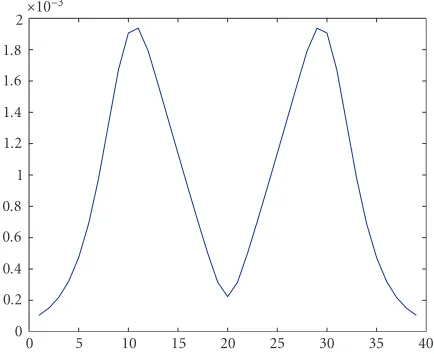
Figure3: The cross section of the likelihood (plotted inFigure 2) along the horizontal line past the sensor location.
where∆a=ahi−alo,r = x−ζis the distance between the sound source and the sensor, andΦ(·) is the standard error function. The details of the derivation is referred in [3].
Figure 2 shows an example of the likelihood function
p(z|x), a crater-shaped function centered at the sensor lo-cation. The thickness of the crater (outer radius minus inner radius) is determined byalo,ahi, andσ2. Fixing the first two, the thickness increases withσ2, as the target location is more
uncertain. Fixingσ2, the thickness increases asa
lodecreases or asahiincreases. In cartesian space, it is clear that this
like-lihood is non-Gaussian, and difficult to approximate as the
sum of gaussians. The cross section of the likelihood func-tion along the radial direcfunc-tion is plotted inFigure 3, and it is quite smooth and amenable to approximation by sampling.
The uniform, stationary assumption of source amplitude is computationally lightweight. To accommodate quiet vehi-cles and vehivehi-cles in idle state,alois set to zero in our experi-ments andahiis set via calibration. In practice, the uniform assumption is simplistic, and as part of our ongoing work, we are developing new models of source amplitude to bet-ter model vehicle engine sound characbet-teristics, exploiting the correlation of sound energy over time.
3.2. DOA sensors
Amplitude sensing provides a range estimate. This estimate is often not very compact and is limited in accuracy due to the crude uniform sound source amplitude model. These limi-tations makes the addition of a target bearing estimator very attractive.
For estimating the bearing of the sound source, we use the maximum likelihood (ML) DOA estimation algorithm proposed by Chen et al. [7]. Here we only outline the for-mulation of the estimation problem; interested readers may refer to their paper for more details.
Assume that we have a microphone array composed of
M identical omnidirectional microphones, and the sound
that the wave received at the array is a planar wave. In this case, the data collected at themth microphone at timenis
gm(n)=s0
n−tm
+wm(n), (7)
wheres0is the source signal,wmis the noise (assumed white Gaussian), andtmis the time delay, which is a function of the
target directionθ. Now consider the equivalent problem in
the Fourier frequency domain (by DFT of lengthL,LM).
We have
G(l)=D(l)S0(l) +W(l), (8)
forl=0,1, . . . , L−1, where
(i) G(l)=[G1(l), G2(l), . . . , GM(l)]Tis the frequency com-ponent of the received signal at frequencyl,
(ii) S0(l) is the signal component,
(iii) W(l)=[W1(l), W2(l), . . . , WM(l)]T is the noise com-ponent,
(iv) the steering matrix takes the form D(l) = [D1(l),
D2(l), . . . , DM(l)]T, andDm(l)=e−j2πltm/L. The ML estimator seeks an estimate
θ,S0=arg min
Given the arriving angleθ, the signal spectrum estimate is
S0(l)=D†(l)G(l), (10)
whereD†(l) is the pseudoinverse of the steering matrixD(l). Plugging-in (10), (9) boils down to a one-dimensional op-timization overθ∈[0,2π], which can be solved using sim-ple searching techniques. This DOA algorithm works well for wideband acoustic signals, and does not require the micro-phone array to be linear or uniformly spaced.
In our experiments, we use a microphone array with four
microphones, as shown inFigure 4. The centroid’s location
is defined asζ0=(0,0); the arriving angleθis defined as the
angle with respect to the vertical grid axis. This convention is used throughout the paper.
Due to the presence of noise, the DOA estimate of an-gles is often imperfect. The measurementz(i.e.,θ) is close
to the true underline angle θ with some perturbation. To
characterize the likelihood function p(z|x), we tested the DOA algorithm using recorded vehicle sounds from an AAV, running the DOA algorithm on an actual sensor node (see
Section 5.2for information on the node and vehicle). The test took place under reasonable noise conditions including air handling units at a nearby building and some street and aircraft traffic. We performed tests atr = 50,150,200, and 500 feet, andθ=0, π/8, π/4, and 3π/8.
Since the microphone array is symmetric in four quadrants, we only have to examine the first quadrant. At each combination, we ran the DOA algorithm 100 times and computed the histogram of the DOA estimates {zexp1, zexp2, . . . , zexp100}. Figure 5 shows the histograms for
Figure4: DOA sensor arrangement and angle convention.
r =50 feet. The histograms suggest that the distribution ofz
is unimodal and approximately centered atθ. Hence for the
angle measurementz, a Gaussian model with zero mean is
appropriate. The likelihood takes the form
pz|x=√ 1 2πσ2e
−(z−θ)2/2σ2
, (11)
whereθis calculated from the geometry of the sound source
positionxand the sensor positionζ. This model ignores the
periodicity of angles around 2π, and is accurate when the
varianceσ2is small.
In our experiments, we have observed that the DOA esti-mates are reliable in some middle distance range and is less reliable when the sound source is too near or too far away from the microphone array. This is to be expected. In the near field, the planar wave assumption is violated. In the far field, the SNR is low, and the DOA algorithm may be strongly influenced by noise and fail to obtain the correct angle. To ac-count for these factors, we developed a simplified likelihood model which is qualitatively reasonable and empirically be-haves well. The model varies the standard deviationσ accord-ing to distance, as illustrated inFigure 6. We first specify the range [rnear, rfar] in which the DOA algorithm performs
re-liably. In this range, the DOA estimate has a fixed standard deviation. For the nearfield range [0, rnear), as distance
de-creases, the standard deviation increases linearly to account for the increasing uncertainty of DOA readings. Likewise, in the far field range r > rfar, the standard deviation increases
withr.
Under this model, the likelihood functionp(z|x) is
plot-ted in Figure 7. It has a cone shape in the working range
rr=50, aa=0 25
20
15
10
5
0
0 0.5 1 1.5 2 2.5 3
(a)
rr=50, aa=23 25
20
15
10
5
0
26 26.5 27 27.5 28 28.5 29 29.5 30 30.5 31 (b)
rr=50, aa=45 16
14 12 10 8 6 4 2 0
48.5 49 49.5 50 50.5 51 51.5 52 (c)
rr=50, aa=67 25
20
15
10
5
0
69.5 70 70.5 71 71.5 72 72.5 73 73.5 74 74.5 (d)
Figure5: Histograms of the DOA estimatezatr=50 feet andθ=0, π/8, π/4, and 3π/8 in (a), (b), (c), and (d), respectively.
Section 2.1) has the flexibility to accommodate such non-compactness, while a standard Kalman filtering approach may have difficulty here.
4. INFORMATION-DRIVEN SENSOR SELECTION
Sensor selection is essential for the correct operation of the IDSQ tracking algorithm. The selection criterion is based
on information content to maximize thepredicted
informa-tion that a sensor’s measurement will bring. This selecinforma-tion is performed based on currently available information alone: the current leader’s belief state and its knowledge about the neighboring sensor locations and their sensing capabilities. No querying of neighboring sensors is necessary.
To measure the information content, we consider mutual information, a measure commonly used for characterizing the performance of data compression, classification, and es-timation algorithms and with a root in information theory.
4.1. Mutual information
LetU∈ᐁandV∈ᐂbe two random variables (or vectors)
having a joint pdfp(u, v).1The mutual information between
UandVis defined as
I(U;V)Ep(u,v)
log p(u, v)
p(u)p(v)
(12)
=
ᐁ
ᐂp(u, v) log
p(u, v)
p(u)p(v)dudv (13)
=Dp(u, v)p(u)p(v), (14)
whereD(··) is the relative entropy between two
distribu-tions, also known as the Kullback-Leibler divergence [8].
1In this section, we use the standard notation, with upper case symbols
180
Figure6: Standard deviationσin bearing estimation versus range. Herernear=20 meters,rfar=100 meters, andσ=10◦in [rnear, rfar].
Figure7: Likelihood functionp(z|x). The circle is the sensor loca-tion and the cross is the target localoca-tion. The standard devialoca-tion of the Gaussian distribution is as inFigure 6.
Similarly, the mutual information conditioned on a random variableW=wis defined as
I(U;V|W =w)Ep(u,v|w)
bits. The mutual information is symmetric in U and V,
nonnegative, and equal to zero if and only ifU andV are
independent.
The mutual informationI(U;V) indicates how much
in-formationVconveys aboutU. From a data compression
per-spective, it measures the savings in bits of encoding UifV
is already known. In classification and estimation problems, mutual information can be used to establish performance bounds. The higherI(U;V) is, the easier it is to estimate (or classify)UgivenV, or vice versa [9,10].
4.2. Sensor selection criterion
In our target tracking problem, we formulate the sensor se-lection criterion as follows. The leader, with a belief state
p(x(t)|z(t)), must decide which sensor in its neighborhood to
hand the belief to. The IDSQ suggests selecting the sensor
kIDSQ=arg max
whereᏺis the collection of sensors which the current leader can talk to, namely, the leader’s neighborhood. Essentially, this criterion seeks the sensor whose measurement zk(t+1), combined with the current measurement historyz(t), would
provide the greatest amount of information about the tar-get locationx(t+1). Intuitively,k
IDSQis the most “informative”
sensor among the neighborhoodᏺ.
From the definition of mutual information (12), the in-formation content of sensorkis
IX(t+1);Zk(t+1)Z(t)=z(t)
The computation of mutual information is illustrated in
Table 2.
We can also take a different view of mutual information,
interpreting it as a measure of the difference between two
densities. From (17), one can easily show that
IX(t+1);Z(t+1)
The Kullback-Leibler divergence term measures how diff
er-ent the updated belief, after incorporating the new measure-mentz(kt+1), would be from the current belief. Therefore, the IDSQ criterion favors the sensor which would on average give the greatest change to the current belief.
4.3. Reduction in dimensionality
Using the discrete representation of the belief, the complex-ity of computing mutual information grows exponentially in the dimension of the joint pdf. The random variableX(t+1)
is a two-dimensional vector for the target tracking problem over a two-dimensional plane. Thus, we need to compute mutual information from the three-dimensional joint den-sity p(x(t+1), z(t+1)
Table2: Computation of mutual informationI(X(t+1);Z(t+1)
For acoustic amplitude sensors, we note that observa-tion model (5) indicates that at any given time instant, the
observation Zk is related to the position X only through
Rk = X−ζk, the distance from the target to the sensor positioned atζk. Equivalently, we havep(zk|rk, x)=p(zk|rk). In this case,Rkis known as the sufficient statistics ofX. From the definition of mutual information, it is easy to show that
IX;Zk
=IRk;Zk
. (19)
This implies that instead of computing the mutual infor-mation from the three-dimensional densityp(x, zk), we can compute it from the two-dimensional densityp(rk, zk).
Likewise, for DOA sensors, from the observational model (11), we see thatZk is related toX only through the angle
Again, the computation of mutual information can be re-duced to a two-dimensional computation.
5. EXPERIMENTAL RESULTS
To validate and characterize the performance of the tracking algorithm, we carried out both simulations as well as experi-ments using real data collected from the field.
5.1. Simulation
In the simulation, the vehicle produces stationary sound with
a constant rms amplitudeA=40 and is traveling at a
con-stant speedv=7 m/s along a straight line (south to north) in the middle of a field. The field is 150×250 m2and covered by
K randomly placed sensors (K =24,28, . . . ,60). The sensor positions are simulated as follows:
(i) first, place the sensors in a uniform rectangular grid
withK/4 rows and four columns, evenly covering the
field;
(ii) then, add Gaussian noise with distributionN(0,25) to the horizontal and vertical coordinates.
A realization of this sensor position simulation is pictured in Figure 8. Acoustic sensor measurements are simulated asA/x−ζk+N(0,0.052). DOA sensor measurements are Gaussian random variables centered at the line through the sensor and the target withσ=3◦.
Without precise knowledge about the target vehicle, the tracking algorithm allows maximum speed of 15 m/s. The acoustic amplitude sensors assume thatalo=0,ahi=80, and
σk = 0.1 (twice the actual noise contamination to
accom-modate outliers). The DOA sensors assumes thatrnear=20
meters andrfar =100 meters. The standard deviation of the
DOA estimates is as plotted inFigure 6. The tracker updates the belief every 0.5 second.
The tracking algorithm begins with an initial belief which is uniform over the entire field. The acoustic amplitude sen-sor with the highest amplitude reading at timet =0 is ini-tialized as the leader. The connectivity between sensors is de-termined as follows: each sensor can talk to sensors within a 40-meter range; or if there are less than two sensors in range, it can talk to the two nearest sensors. The leader selects the next leader from among these sensors based on their infor-mation content according to the IDSQ rule.
To further enforce sensor diversity, we implement a “triplet” rule: the previous leader is not included in the
neighborhood of the current leader. That is, if A hands off
to B in the previous step, B is prohibited from selecting A as the next leader. This rule prevents the leadership from con-stantly oscillating between two sensors. This is important in assuring that biases, due to modeling error of one particular sensor, will not be overweighted in the overall result. Ideally, we would like to task the sensors more or less evenly to ex-ploit the spatial and sensing modality diversity of the sensors, expecting that the modeling errors across different sensors will probably balance each other.
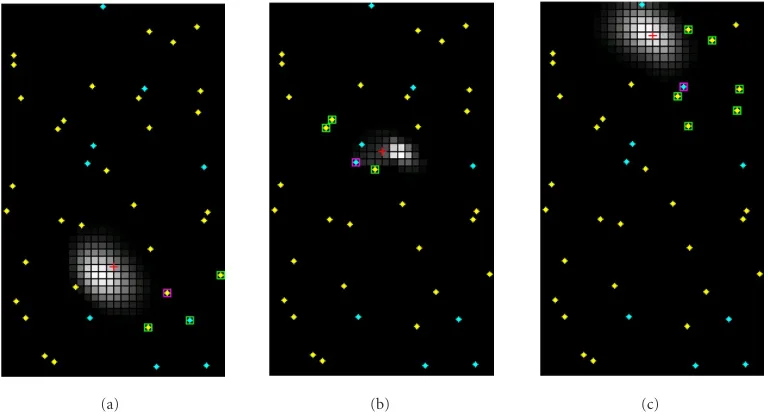
(a) (b) (c)
Figure8: Snapshots of a simulation run with 40 sensors, 30% DOA. The target is marked with a red “+.” The yellow diamonds are acoustic amplitude sensors; the cyan diamonds are DOA sensors. The active leader is the sensor circled with a magenta square. Its neighbors (after applying the triplet rule) are circled with green squares.
sensor-sparse regions (e.g., in Figures8aand8c). This is as expected since the SNR is higher in sensor-dense regions, and the leader has more neighbors to choose from. The collabo-ration between sensors are more effective.
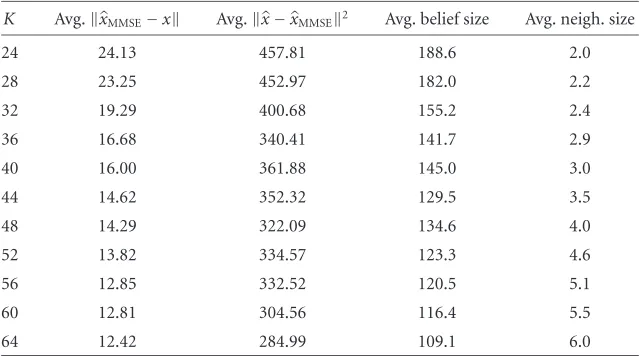
Table 3summarizes the statistics from simulation results for different values ofK. For eachK value, twenty runs are simulated. We usexto denote the target’s true location,xto denote the blocks in the belief state, andxMMSEto denote the
MMSE estimate of target location. From (2), we know that
xMMSEis simply the centroid of the belief state, computed as
the weighted average of location among all the blocks in the belief, weighted by the posteriorp(x(t)|z(t)). To analyze
track-ing performance, we use the distancexMMSE−xto measure
how far away the MMSE estimate is to the true target posi-tion, and use the variancex−xMMSE2to measure the spread
(thus the uncertainty) of the belief cloud. Other quantities of interest include the belief cloud size (directly related to com-munication throughput) and the neighborhood size. From
Table 3, we can see that the tracking performance (the mean error, variance, and belief size) improves as more sensors are deployed.Figure 9plots the average errorxMMSE−x.
Out-liers (the tracker losing the target) occur occasionally, espe-cially for smallK. The improvement in average tracking
per-formance (the blue curve) with increasingKis quite
promi-nent.
We have also experimented with varying percentage of
DOA sensors and summarized the result inTable 4. The
im-provement from 0 to 10% DOA is significant, thus it is desir-able to use a few DOA sensors in the sensor network though they are computationally more expensive than acoustic am-plitude sensors. The all-DOA network gives better results than the all-amplitude sensor network. This may be due to the fact that the acoustic amplitude sensors use the very
55 50 45 40 35 30 25 20 15 10
20 25 30 35 40 45 50 55 60 65
Figure9: Average error versus the number of sensors in the field. The points marked with a circle are the error average over the track-ing steps. The points marked with “∗” and linked using a blue line is the average over 20 runs.
crude uniform distribution for modeling sound source am-plitude.
5.2. Experiments on field data 5.2.1 Experimental setup
Table3: Tracking performance averaged over all tracking steps and twenty runs.
K Avg.xMMSE−x Avg.x−xMMSE2 Avg. belief size Avg. neigh. size
24 24.13 457.81 188.6 2.0
28 23.25 452.97 182.0 2.2
32 19.29 400.68 155.2 2.4
36 16.68 340.41 141.7 2.9
40 16.00 361.88 145.0 3.0
44 14.62 352.32 129.5 3.5
48 14.29 322.09 134.6 4.0
52 13.82 334.57 123.3 4.6
56 12.85 332.52 120.5 5.1
60 12.81 304.56 116.4 5.5
64 12.42 284.99 109.1 6.0
Table4: Tracking performance versus percentage of DOA sensors.
Percentage of DOA Avg.xMMSE−x Avg.xMMSE−x2 Avg. belief size
0 18.48 510.96 208.9
10% 16.84 416.17 168.2
20% 16.45 379.03 154.0
30% 15.48 345.68 138.3
40% 14.01 331.55 122.2
50% 14.05 373.88 122.6
60% 12.87 375.45 112.2
70% 11.89 327.94 104.4
80% 11.67 349.60 102.1
90% 11.31 366.50 99.7
100% 10.75 351.02 95.4
Figure10: AAVP7A1 tracked, armored assault vehicle.
The sensor network consisted of a total of 70 WINS 2.0 nodes from Sensoria Corp. A picture of a node is shown in
Figure 11along with a DOA array. The node specifications
are provided inTable 5. Among the 70 nodes, 20–25 nodes
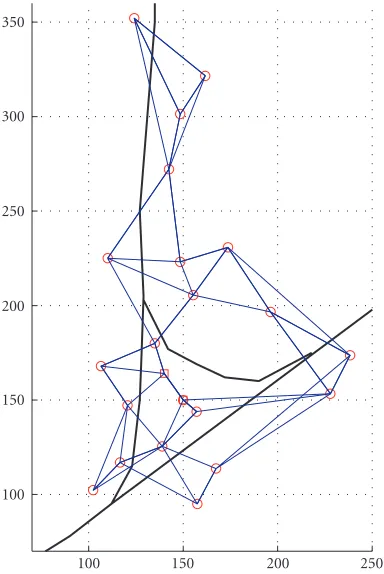
were available for our use. They are randomly positioned at the intersection of two dirt roads. The sensor layout and the
Figure11: WINS 2.0 node with DOA-sensing microphone array.
roads are shown inFigure 12. Vehicle maneuvers were
con-fined to the roads shown although, by choice, the algorithms of this paper do not assume this knowledge.
DOA sensing arrays were identical square arrays with 1
feet (0.305 m) on the side configured as shown inFigure 11
Table5: Specification of Sensoria nodes.
Manufacturer Sensoria Corp.
Processor
Hitachi SH4 7751
Performance 300 MIPS core, 1.1 GFLOPS floating point CPU Power Consumption 400 mW
Memory 16 MB RAM, 16 MB Flash
Operating system Redhat Linux 7
Data acquisition 4 channels, 16 bits @ 20 kHz
(this experiment sampled at 5 kHz throughout)
Communications
2 RF Modems @ 2.4 GHz Power: 10 or 100 mW Range: 25–100 m
350
300
250
200
150
100
100 150 200 250
Figure12: Road intersection with node layout at MCAGCC. The thick lines are the roads. The amplitude sensors are marked with a small circle, and the two DOA sensors (at (150, 150) and (140, 164)) are marked with small squares. The thin lines indicate the connec-tivity between sensors.
is aligned to magnetic north as shown in Figure 4.
Micro-phones were electret, flat to frequencies above 16 kHz, om-nidirectional to less than 2.5 dB, and were field-calibrated to ±2.5 dB.
5.2.2 Data acquisition and processing
Filtered acoustic amplitude and estimated DOA were com-puted and stored on all nodes at time intervals of 0.5 second
using the node signal processing routines described above. Additional data was collected for two DOA nodes using a portable data acquisition PC and sampled at an identical rate and resolution to the node’s data acquisition. In the experi-ments shown here, only these two “virtual” nodes are used for DOA measurements.
The IDSQ tracker, implemented in Matlab, then
post-processed this data to simulate the node-to-node handoff
and data source selection. Due to node dropout, the original network topology, as laid out in the field, has to be slightly augmented to prevent network segmentation; the resulting topology is shown inFigure 12.
5.2.3 Tracking results
Figure 13 shows a few snapshots of an AAV run on the north-east road. The vehicle is traveling at roughly a con-stant speed of 15 mph (6.7 m/s). The tracker is designed for
vmax=40 mph (17.9 m/s) and updates its belief every 0.5
sec-ond. For acoustic amplitude sensors, the parameters are set asalo=0,ahi=80, andσk=0.05 based on calibration data. For DOA sensors, the variance is set as inFigure 6. At time
t=0, the acoustic amplitude sensor with the highest reading is initialized as the leader. The initial belief is a big uniform square, centered at the leader with 50 meters (10 grids) to each side, as plotted inFigure 13a. The first few tracking steps can be considered as a “discovery” phase, where the tracker begins with very little knowledge and use sensor measure-ments to improve the belief. The green trail depicts the tra-jectory of the tracker estimates; in the discovery phase, it is gradually pulled over to the road (the red curve). Figures13b,
13c, and13d show the progress of tracking. Although our
tracker does not know the road configuration, it produces estimates which follows the road fairly closely.
(a) (b) (c) (d)
Figure13: Snapshots of an AAV run on the north-east road. Plotting convention is the same as inFigure 8. The red curves are the roads. The green curve is the estimated track.
6. DISCUSSION AND FUTURE WORK
In our experiments, we have glossed over the issue of auto-matically initializing a track when the vehicle enters the sen-sor field and instead hardwired a uniform initial probability distribution around the entry point. In the future, we plan to deploy a small number of “watchdog” sensors along the boundary of the sensor field. While the most part of the net-work remains idle, the watchdog sensors look out for events of interest. When a high-confidence detection occurs, sen-sors in that neighborhood wake up, elect a leader, causing the IDSQ tracker to initialize. When the target moves out-side the sensor field, the network goes back to the sleeping mode, with only the watchdogs turned on.
Bandwidth is at a premium in a sensor network. To fur-ther reduce the bandwidth requirement during sensor collab-oration, we can consider switching between nonparametric and parametric belief representations depending on the na-ture of the distribution. The parametric form is more com-pact when it is feasible since only the parameters of a dis-tribution need to be communicated from the current leader to the next. Even in the nonparametric representation, we may be able to encode the distribution using image com-pression techniques to significantly reduce the number of bits that need to be transmitted. Another improvement to the tracker could come from using more realistic dynamics models for sound source amplitudes and vehicles during the Bayesian filtering. We used a crude form of DOA likelihood function. More accurate, experimentally validated character-ization could also help improve the tracking.
Reliability is an important issue in the sensor network. A single leader tracking protocol, while conceptually sim-ple, might suffer from node failure or degradation. A multi-thread IDSQ tracker could partially alleviate such problems by providing some degree of redundancy. The challenge here is to maintain consistencies among and fuse information
from multiple threads of the tracker. In addition to the prob-lem of node dropout, the tracker must also accommodate sensor measurement outliers, perhaps through a local voting mechanism.
Extending the approach to tracking multiple targets faces is a significant next step. When multiple targets are far apart from each other, the network can partition into sub-networks and initialize independent trackers in parallel. The difficulty arises when some targets are in proximity with each other. The source separation and data association are two major technical hurdles that must be solved. The data associ-ation module will need to exploit classificassoci-ation knowledge of targets in order to better disambiguate between multiple tar-gets. The information criterion in the IDSQ tracker, in this case, must be extended to account for both state estimation as well as classification.
7. CONCLUSION
This paper has presented a principled approach to sensor se-lection and a class of signal processing algorithms for dis-tributed sensor network based on a mutual information measure, models of acoustic amplitude and bearing
sens-ing, and a computationally efficient implementation of the
IDSQ tracking algorithm. The tracker is distributed,
energy-efficient, and scalable. The approach has been demonstrated
in both simulation and on field data of a moving vehicle.
ACKNOWLEDGMENTS
REFERENCES
[1] R. Brooks, C. Griffin, and D. Friedlander, “Self-organized dis-tributed sensor network entity tracking,” International Jour-nal of High Performance Computing Applications, vol. 16, no. 3, pp. 207–220, 2002.
[2] D. Estrin, R. Govindan, J. Heidemann, and S. Kumar, “Next century challenges: scalable coordination in sensor networks,” inProc. 5th Annual International Conference on Mobile Com-puting and Networks, pp. 263–270, Seattle, Wash, USA, August 1999.
[3] M. Chu, H. Haussecker, and F. Zhao, “Scalable information-driven sensor querying and routing for ad hoc heterogeneous sensor networks,” International Journal of High Performance Computing Applications, vol. 16, no. 3, pp. 293–314, 2002. [4] H. V. Poor,An Introduction to Signal Detection and Estimation,
Springer-Verlag, New York, NY, USA, 2nd edition, 1994. [5] S. Haykin,Adaptive Filter Theory, Prentice Hall, Upper Saddle
River, NJ, USA, 3rd edition, 1996.
[6] L. E. Kinsler, A. R. Frey, A. B. Coppens, and J. V. Sanders, Fun-damentals of Acoustics, John Wiley and Sons, New York, NY, USA, 1999.
[7] J. C. Chen, R. E. Hudson, and K. Yao, “Joint maximum-likelihood source localization and unknown sensor location estimation for near-field wideband signals,” inAdvanced Sig-nal Processing Algorithms, Architectures, and Implementations XI, vol. 4474 ofSPIE Proceedings, San Diego, Calif, USA, July 2001.
[8] T. M. Cover and J. A. Thomas,Elements of Information Theory, John Wiley and Sons, New York, NY, USA, 1991.
[9] J. Ziv and M. Zakai, “On functionals satisfying a data-processing theorem,” IEEE Transactions on Information The-ory, vol. 19, pp. 275–283, May 1973.
[10] A. O. Hero, “On the problem of granulometry for a degraded Boolean image model,” inProc. IEEE International Conference on Image Processing, vol. II, pp. 16–20, Kobe, Japan, October 1999.
Juan Liureceived her B.E. degree in elec-tronic engineering from Tsinghua Uni-versity, China, in 1995, and the M.S. and Ph.D. degrees in electrical engineering from the University of Illinois at Urbana-Champaign, USA, in 1998 and 2001, respec-tively. In September 2001, she joined Palo Alto Research Center as a Research Scien-tist, working in the Embedded Collabora-tive Computing Area. Her research interests
include signal processing, statistical modeling, detection and esti-mation, network routing, and their applications to distributed sen-sor network problems.
James Reichis a Researcher in the Embed-ded Collaborative Computing Area of the Palo Alto Research Center (PARC). He re-ceived an Undergraduate degree in aero-nautical and astroaero-nautical engineering from the MIT and an M.S. degree from Carnegie Mellon in electrical and computer engineer-ing. His technical focus is in sensing and control using ad hoc networks of intelligent devices. His previous work ranges from
re-furbishing Von Braun-era rockets to control system design and in-tegration of PARC’s first active surface, the ISS airjet paper mover.
Feng Zhaois a Principal Scientist at Palo Alto Research Center (PARC), where he di-rects the Embedded Collaborative Comput-ing Area in the Systems and Practices Lab-oratory. He is also a Consulting Associate Professor of computer science at Stanford. His research interest includes distributed sensor data analysis, diagnostics, qualitative reasoning, and control of dynamical sys-tems. Dr. Zhao received his Ph.D. degree in