Other-Anaphora Resolution in Biomedical Texts with Automatically
Mined Patterns
Chen Bin
#, Yang Xiaofeng
$, Su Jian
^and Tan Chew Lim
* #*School of Computing, National University of Singapore
$^Institute for Infocomm Research, A-STAR, Singapore
{
#chenbin,
*tancl}@comp.nus.edu.sg
{
$xiaofengy,
^sujian}@i2r.a-star.edu.sg
Abstract
This paper proposes an other-anaphora resolution approach in bio-medical texts. It utilizes automatically mined patterns to discover the semantic relation between an anaphor and a candidate antecedent. The knowledge from lexical patterns is incor-porated in a machine learning framework to perform anaphora resolution. The ex-periments show that machine learning approach combined with the auto-mined knowledge is effective for other-anaphora resolution in the biomedical domain. Our system with auto-mined pat-terns gives an accuracy of 56.5%., yield-ing 16.2% improvement against the base-line system without pattern features, and 9% improvement against the system us-ing manually designed patterns.
1
Introduction
The last decade has seen an explosive growth in the amount of textual information in biomedi-cine. There is a need for an effective and effi-cient text-mining system to gather and utilize the knowledge encoded in the biomedical literature.
For a correct discourse analysis, a text-mining system should have the capability of understand-ing the reference relations among different ex-pressions in texts. Hence, anaphor resolution, the task of resolving a given text expression to its referred expression in prior texts, is important for an intelligent text processing system.
© 2008. Licensed under the Creative Commons Attri-bution-Noncommercial-Share Alike 3.0 Unported license (http://creativecommons.org/licenses/by-nc-sa/3.0/). Some rights reserved.
In linguistics, an expression that points back to a previously mentioned expression is called an anaphor, and the expression being referred to by the anaphor is called its antecedent. Most pre-vious work on anaphora resolution aims at identi-ty-anaphora in which both an anaphor and its antecedent are mentions of the same entity.
In this paper, we focus on a special type of anaphora resolution, namely, other-anaphora resolution, in which an anaphor to be resolved has a prefix modifier “other” or “another”. The antecedent of an other-anaphor is a complement expression to the anaphor in a super set. In other words, an other-anaphor is a set of elements ex-cluding the element(s) specified by the antece-dent. If the modifier “other” or “another” is re-moved, an anaphor becomes the super set includ-ing the antecedent. Thus, other-anaphora in fact represents a “part-whole” relation. Consider the following text
“IL-10 inhibits nuclear stimulation of nuclear factor kappa B (NF kappa B).
Several other transcription factors including NF- IL-6, AP-1, AP-2, GR, CREB, Oct-1, and Sp-1 are not affected by IL-10.”
Here, the expression “other transcription fac-tors” is an other-anaphor, while the “NF kappa B” is its antecedent. The anaphor refers to any transcription factors except the antecedent. By removing the lexical modifier “other”, we can get a supper set “transcription factors” that in-cludes the antecedent. The anaphor and antece-dent thus have a “part-whole” relation1.
Other-anaphora resolution is an important sub-task in information extraction for biomedical
1
domain. It also contributes to biomedical ontolo-gy building as it targeted at a “part-whole” rela-tion which is in the same hierarchical orders as in ontology. Furthermore, other-anaphora resolu-tion is a first-step exploraresolu-tion in the resoluresolu-tion of bridging anaphora. Furthermore, other-anaphora resolution is a first-step exploration in the resolu-tion of bridging, a special anaphora phenomenon in which the semantic relation between an ana-phor and its antecedent is more complex (e.g. part-whole) than co-reference.
Previous work on other-anaphora resolution relies on knowledge resources, for example, on-tology like WordNet to determine the “part-whole” relation. However, in the biomedical do-main, a document is full of technical terms which are usually missing in a general-purpose ontolo-gy. To deal with this problem, pattern-based ap-proaches have been widely employed, in which a pattern that represents the “part-whole” relation is designed. Two expressions are connected with the specific pattern and form a query. The query is searched in a large corpus for the occurrence frequency which would indicate how likely the two given expressions have the part-whole rela-tion. The solution can avoid the efforts of con-structing the ontology knowledge for the "part-whole" relation. However, the pattern is designed in an ad-hoc method, usually from linguistic in-tuition and its effectiveness for other-anaphora resolution is not guaranteed.
In this paper, we propose a method to auto-matically mine effective patterns for other -anaphora resolution in biomedical texts. Our me-thod runs on a small collection of seed word pairs. It searches a large corpus (e.g., PubMed abstracts as in our system) for the texts where the seed pairs co-occur, and collects the surrounding words as the surface patterns. The automatically found patterns will be used in a machine learning framework for other-anaphora resolution. To our knowledge, our work is the first effort of apply-ing the pattern-base technique to other-anaphora resolution in biomedical texts.
The rest of this paper is organized as follows. Section 2 introduces previous related work. Sec-tion 3 describes the machine learning framework for other-anaphora resolution. Section 4 presents in detail our method for automatically pattern mining. Section 5 gives experiment results and has some discussions. Finally, Section 6 con-cludes the paper and shows some future work.
2
Related Work
Previous work on other-anaphora resolution commonly depends on human engineered know-ledge and/or deep semantic knowknow-ledge for the “part-whole” relation, and mostly works only in the news domain.
Markert et al., (2003) presented a pattern-based algorithm for other-anaphor resolution. They used a manually designed pattern “ANTE-CEDENT and/or other ANAPHOR “. Given two expression to be resolved, a query is formed by instantiating the pattern with the two given ex-pressions. The query is searched in the Web. The higher the hit number returned, the more likely that the anaphor and the antecedent candidate have the “part-whole” relation. The anaphor is resolved to the candidate with the highest hit number. Their work was tested on 120 other -anaphora cases extracted from Wall Street Jour-nal. The final accuracy was 52.5%.
Modjeska et al., (2003) also presented a simi-lar pattern-based method for other-anaphora res-olution, using the same pattern “ANTECEDENT and/or other ANAPHOR”. The hit number re-turned from the Web is used as a feature for a Naïve Bayesian Classifier to resolve other -anaphors. Other features include surface words, substring matching, distance, gender/number agreement, and semantic tag of the NP. They evaluated their method with 500 other-anaphor cases extracted from Wall Street Journal, and reported a result of 60.8% precision and 53.4% recall.
Markert and Nissim (2005) compared three systems for other-anaphora resolution, using the same data set as in (Modjeska et al., 2003).
The first system consults WordNet for the part-whole relation. The WordNet provides in-formation on meronym/holonym (part-of rela-tion) and hypernym/ hyponym (type-of relarela-tion). Their system achieves a performance of 56.8% for precision and 37.0% for recall.
3
Anaphora Resolution System
3.1 Corpus
In our study, we used the GENIA corpus2 for our other-anaphora resolution in biomedical texts. The corpus consists of 2000 MEDLINE abstracts (around 440,000 words). From the GENIA cor-pus, we extracted 598 other-anaphora cases. The 598 cases do not contain compound prepositions or idiomatic uses of “other”, like “on the other hand” and “other than”. And all these anaphors have their antecedents found in the current and previous two sentences of the other-anaphor. On average, there are 15.33 candidate antecedents for each anaphor to be resolved.
To conduct other-anaphora resolution, an in-put document is preprocessed through a pipeline of NLP components, including tokenization, sen-tence boundary detection, part-of-speech (POS) tagging, noun phrase (NP) chunking, and named-entity recognition (NER). These preprocessing modules are aimed to determine the boundaries of each NP in a text, and to provide necessary information of an NP for subsequent processing. In our system, we employed the tool-kits built by our group for these components. The POS tagger was trained and tested on the GENIA corpus (version 2.1) and achieved an accuracy of 97.4%. The NP-chunking module, evaluated on UPEN WSJ TreeBank, produced 94% F-measure. The NER module, trained on GENIA corpus (version 3.0), achieved 71.2% F-measure covering 22 ent-ity types (e.g., Virus, Protein, Cell, DNA, etc).
3.2 Learning Framework
Our other-anaphora resolution system adopts the common learning-based model for identity -anaphora resolution, as employed by (Soon et al., 2001) and (Ng and Cardie, 2002).
In the learning framework, a training or test-ing instance has the form of 𝑓𝑣 𝑐𝑎𝑛𝑑𝑖𝑗, 𝑎𝑛𝑎 where 𝑐𝑎𝑛𝑑𝑖𝑗 is the 𝑗th candidates of the antece-dent of anaphor 𝑎𝑛𝑎. An instance is labelled as positive if 𝑐𝑎𝑛𝑑𝑖𝑗 is the antecedent of 𝑎𝑛𝑎, or negative if 𝑐𝑎𝑛𝑑𝑖𝑗 is not the antecedent of 𝑎𝑛𝑎. An instance is associated with a feature vector which records different properties and relations between 𝑎𝑛𝑎 and 𝑐𝑎𝑛𝑑𝑖𝑗. The features used in our system will be discussed later in the paper.
During training, for each other-anaphor, we consider as the candidate antecedents the preced-ing NPs in its current and previous two sentences.
2
http://www-tsujii.is.s.u-tokyo.ac.jp/~genia/topics/Corpus/
A positive instance is formed by pairing the ana-phor and the correct antecedent. And a set of negative instances is formed by pairing the ana-phor and each of the other candidates.
Based on these generated training instances, we can train a binary classifier using any dis-criminative learning algorithm. In our work, we employed support vector machine (SVM) due to its good performance in high dimensional feature vector spaces.
During the resolution process, for each other -anaphor encountered, all of the preceding NPs in a three-sentence window are considered. A test instance is created for each of the candidate ante-cedents. The feature vector is presented to the trained classifier to determine the other -anaphoric relation. The candidate with highest SVM outcome value is selected as the antecedent.
3.3 Baseline Features
Knowledge is usually represented as features for machine learning. In our system, we used the following groups of features for other-anaphora resolution
Word Distance Indicator
This feature measures the word distance between an anaphor and a candidate antecedent, with the assumption that the candidate closer to the ana-phor has a higher preference to be the antecedent.
Same Sentence Indicator
This feature is either 0 or 1 indicating whether an anaphor and a candidate antecedent are in the same sentence. Here, the assumption is that the candidate in the same sentence as the anaphor is preferred for the antecedent.
Semantic Group Indicators
A named-entity can be classified to a semantic category such as “DNA”, “RNA”, “Protein” and so on3. Thus we use a set of features to record the category pair of an anaphor and a candidate ante-cedent. For example, “DNA-DNA” is generated for the case when both anaphor and candidate are DNAs. And “DNA-Protein” is generated if an anaphor is a DNA and a candidate is a protein. These features indicate whether a semantic group can refer to another.
Note that an anaphor and its antecedent may possibly belong to different semantic categories. For example, in the GENIA corpus we found that
3
in some cases an expression of a protein name actually denotes the gene that encodes the pro-tein. Thus for a given anaphor and a candidate under consideration, it is necessary to record the pair-wise semantic groups, instead of using a single feature indicating whether two expressions are of the same group.
The semantic group for a named entity is giv-en by our preprocessing NER. For the common NPs produced from the NP chunker, we classify the semantic group by looking for the words in-side NPs. For example, an NP ending with “cells” is classified to “Cell” group while an NP ending with “gene” or “allele” is classified to “DNA” group.
Lexical Pattern Indicators
In some cases, the surrounding words of an ana-phor and a candidate antecedent strongly indicate the “part-whole” relation. For example, in “...asthma and other hypereosinophilic diseas-es”, the reference between “other hypereosino-philic diseases” and “asthma” is clear if the in-between words “and other” are taken into con-sideration. Another example of such a hint pat-tern is “one… the other …” The feature is 1 if the specific patterns are present for the current ana-phor and candidate pair. A candidate with such a feature is preferred to be the antecedent.
Hierarchical Name Indicator
This feature indicates whether an antecedent candidate is a substring of an anaphor or vice versa. This feature is used to capture cases like “Jun” and “JunB” (“Jun” is a family of protein while “JunB” is a member of this family). In many cases, an expression that is a super set comes with certain postfix words, for example, “family members” in
“Fludarabine caused a specific depletion of
STAT1 protein (and mRNA) but not of other STAT family members.”
This kind of phenomenon is more common in bio-medical texts than in news articles.
3.4 SVM Training and Classification
In our system, we utilized the open-source soft-ware SVM-Light4 for the classifier training and testing. SVM is a robust statistical model which has been applied to many NLP tasks. SVM tries to learn a separating line to separate the positive instances from negative instances. Kernel trans-formations are applied for non-linear separable
4
http://svmlight.joachims.org/
cases (Vapnik, 1995). In our study, we just used the default learning parameters provided by SVM-Light with the linear kernel. A more so-phisticated kernel may further improve the per-formance.
4
Using Auto-mined Pattern Features
The baseline features listed in Section 3.3 only rely on shallow lexical, position and semantic information about an anaphor and a candidate antecedent. It could not, nevertheless, disclose the “part-whole” relation between two given pressions. In section 2, we have shown some ex-isting pattern-based solutions that mine the “part-whole” relation in a large corpus with some pat-terns that can represent the relation. However, these manually designed patterns are usually se-lected by heuristics, which may not necessarily lead to a high coverage with a good accuracy in different domains. To overcome this shortcom-ing, we would like to use an automatic method to mine effective patterns from a large data set. First, we create a set of seed pairs of the “part-whole” relation. And then, we use the seed pairs to discover the patterns that encode the “part-whole” relation from a large data set (PubMed as in our system). Such a solution is supposed to improve the coverage of lexical patterns, while still retain the desired “part-whole” relation for other-anaphora resolution.
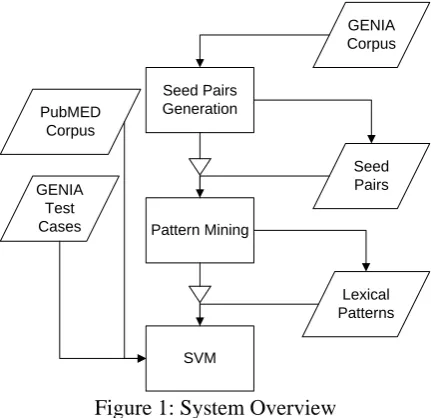
The overview of our system with the automat-ic mined patterns is illustrated in figure 1.
Seed Pairs Generation
Pattern Mining
SVM
GENIA Corpus
Seed Pairs
Lexical Patterns GENIA
Test Cases PubMED
Corpus
Figure 1: System Overview
4.1 Seed Pairs Preparation
A seed pair is a pair of phrases/words following “part-whole” order, for example,
“integrin alpha” - “adhesion molecules” where “integrin alpha” is a kind of “adhesion molecules”.
We extracted the seed pairs automatically from the GENIA corpus. The auto-extracting procedure makes uses of some lexical clues like “A, such as B, C and D”, “A (e.g. B and C)”, “A including B” and etc. The capital letter A, B, C and D refer to a noun phrase such as “integrin alpha” and “adhesion molecules”. For each oc-currence of “A such as B, C and D”, the program will generate seed pairs “B-A”, “C-A” and “D-A”.
Consider the following example,
“Mouse thymoma line EL-4 cells produce cyto-kines such as interleukin (IL) -2, 3, 4, IL-10, and granulocyte-macrophage colony-stimulating factor in response to phorbol 12-myristate 13-acetate (PMA).”
We can extract the following seed pairs, “interleukin (IL) -2” – “cytokines”
“IL -3” – “cytokines” “IL -4” – “cytokines” “IL -10” – “cytokines”
“granulocyte-macrophage colony-stimulating factor” – “cytokines”
A similar action is taken for other lexical clues. Totally, we got 909 distinct seed pairs ex-tracted from the GENIA corpus.
After the seed pairs have been extracted, an automatic verification of the seed pairs is per-formed. The first purpose of the verification is to correct chunking errors. For example, “HLA Class II Gene” may likely be wrongly split into “HLA Class” and “II Gene”. This kind of errors is repaired by several simple syntactic rules. The second purpose of the verification is to remove the inappropriate seed pairs. In our system, we abandoned the seed pairs containing pronouns like “those”, “they”, or nouns like “element”, “member” and “agent”. Such seed pairs may ei-ther find no patterns, or lead to meaningless pat-terns because “those” or “elements” have no spe-cific semantics and could refer to anything.
4.2 Pattern Mining
Having obtained the set of seed pairs, we will use them to mine patterns for the “part-whole” rela-tion. For each seed pair “antecedent - anaphor” (anaphor represents the NP for the “whole”,
while antecedent represents the NP for the “part”), our system will search in a large data set for two queries: “antecedent * anaphor” and “anaphor * antecedent” where the “*” denotes any sequence of words or symbols. For a re-turned search results, the text in between “ ante-cedent” and “anaphora” is extracted as a pattern. In our study, we used PubMed 2007 data set for the pattern mining. The data set contains about 52,000 abstracts with around 9,400,000 words, and is an ideal large-scale resource for pattern mining.
Consider, as an example, a seed pair “NK kappa B “ – “transcription factor”. Suppose that a returned sentence for the query “NK kappa B * transcription factor” is
“...NK kappa B family transcription factors...” And a returned sentence for the query “ transcrip-tion factor * NK kappa B” is
“...transcription factors, including NF kappa B...”
We can extract a pattern,
“ANTECEDENT family ANAPHOR” from the first sentence and a pattern
“ANAPHOR, including ANTECEDENT” from the second sentence.
We restrict the patterns so that no pattern span across two or more sentences. In other words, the pattern shall not contain the symbol “.”. The vi-olated patterns will be removed.
The count that a pattern occurs in the PubMed for a seed pair is recorded. As a pattern could be reduced by different seed pairs, we define the occurrence frequency of a pattern as the sum of the counts of the pattern for all the seed pairs, using following formula:
𝐶𝑝𝑎𝑡𝑖 = 𝑂𝑐𝑐(𝑝𝑎𝑡𝑖, 𝑠𝑗)
𝑠𝑖∈𝑆
𝐸𝑞(1)
where 𝐶𝑝𝑎𝑡𝑖 is the frequency of pattern 𝑝𝑎𝑡𝑖; 𝑠𝑗 is a seed pair; 𝑆 is the set of all seed pairs.
𝑂𝑐𝑐(𝑝𝑎𝑡𝑖, 𝑠𝑗) is the count of the pattern 𝑝𝑎𝑡𝑖 for
𝑠𝑗.
All the mined patterns are sorted according to its frequency as defined in 𝐸𝑞(1).
4.3 Pattern Application
For classifier training and testing, the patterns with high frequency are used as features. In our system, we used the top 40 patterns, while we also examined the influence the number of the patterns on the performance. (See Section 5.2)
in-stantiating with 𝑐𝑎𝑛𝑑𝑖𝑗 and 𝑎𝑛𝑎. For example, data set. The count of the query is recorded. The value of the pattern feature of a candidate is cal-culated by normalizing the occurrence frequency among all the candidates of the anaphor.
For demonstration, suppose we have an ana-phor “other transcription factors” with two ante-cedent candidates “IL-10” and “NF kappa B”. preted as a degree of belief that an anaphor and a candidate antecedent have the “part-whole” rela-tion, with regard to the specific pattern. Since the value of a pattern feature is normalized among all the candidates, it could indicate the preference of a candidate against other competing candi-dates.
5
Experiment Results
5.1 Experiments Setup
In our experiments, we conducted a 3-fold cross validation to evaluate the performances. The total 598 other-anaphora cases were divided into 3 sets of size 200, 199 and 199 respectively. For each experiment, two sets were used for training while the other set was used for testing.
For evaluation, we used the accuracy as the performance metric, which is defined as the cor-rectly resolved other-anaphors divided by all the testing other-anaphors, that is,
𝑎𝑐𝑐𝑢𝑟𝑎𝑐𝑦 =# of correctly resolved anaphors
# of total anaphors
5.2 Experiments Results
Table 1 shows the performance of different other-anaphora resolution systems. The first line is for the baseline system with only the normal features as described in Section 3.3. From the table, we can find that the baseline system only achieves around 40% accuracy. A performance is lower than a similar system in news domain by
Modjeska et al., (2003) where they reported 51.6 % precision with 40.6% recall. This differ-ence is probably because they utilized more se-mantic knowledge such as hypernymy and mero-nymy acquired from WordNet. Such knowledge, nevertheless, is not easily available in the bio-In our experiments, we tested the system with manually designed pattern features. We tried 10 patterns that can represent the “part-whole” rela-tion. Table 2 summaries the patterns used in the system. Among them, the pattern “Anaphor such as Antecedent” and “Antecedent and other Ana-phor” are commonly used in previous pattern based approaches (Markert et al., 2003; Mod-jeska et al., 2003).
Pattern
ANTECEDENT is a kind of ANAPHOR ANTECEDENT is a type of ANAPHOR ANTECEDENT is a member of ANAPHOR
ANTECEDENT is a part of ANAPHOR ANAPHOR such as ANTECEDENT ANTECEDENT and other ANAPHOR
ANTECEDENT within ANAPHOR ANTECEDENT is a component of ANAPHOR
ANTECEDENT is a sort of ANAPHOR ANTECEDENT belongs to ANAPHOR Table 2: Manually Selected Patterns
The second line of Table 1 shows the results of the system with the manual pattern features. We can find that adding these pattern features produces an overall accuracy of 47%, yielding an increase of 7% accuracy against the baseline sys-tem without the pattern features.
ma-nually designed patterns may not necessarily work equally well in different domains.
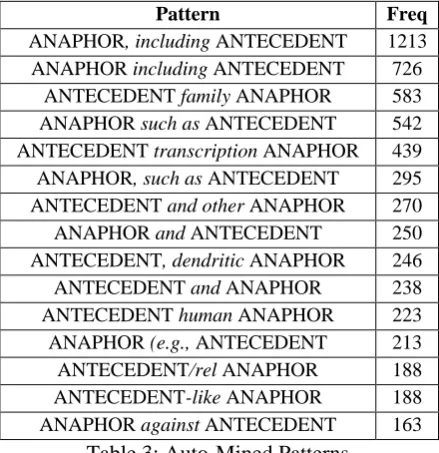
The last system we examined in the experi-ment is the one with the automatically mined pattern features. Table 3 summarizes the top mined patterns ranked based on their occurrence frequency. Some of the patterns are intuitively good representation of the “part-whole” relation. For example, “ANAPHOR, including ANTE-CEDENT”. “ANAPHOR, such as ANTECE-DENT” and “ANAPHOR and other ANTECE-DENT” which are in the manually designed pat-tern list, are generated.
The last line of Table 1 lists the result of the system with automatically mined pattern fea-tures. It outperforms the baseline system (up to 16% accuracy), and the system with manually selected patterns (9% accuracy). These results prove that our pattern features are effective for the other-anaphora resolution.
Pattern Freq
ANAPHOR, including ANTECEDENT 1213 ANAPHOR including ANTECEDENT 726
ANTECEDENT family ANAPHOR 583 ANAPHOR such as ANTECEDENT 542 ANTECEDENT transcription ANAPHOR 439 ANAPHOR, such as ANTECEDENT 295 ANTECEDENT and other ANAPHOR 270 ANAPHOR and ANTECEDENT 250 ANTECEDENT, dendritic ANAPHOR 246 ANTECEDENT and ANAPHOR 238 ANTECEDENT human ANAPHOR 223 ANAPHOR (e.g., ANTECEDENT 213 ANTECEDENT/rel ANAPHOR 188 ANTECEDENT-like ANAPHOR 188 ANAPHOR against ANTECEDENT 163
Table 3: Auto-Mined Patterns
To further compare the manually designed patterns and the automatically discovered pat-terns. We examined the coverage rate of the two pattern sets. The coverage rate measures the ca-pability that a set of patterns could lead to posi-tive anaphor-antecedent pairs. An other-anaphor is said to be covered by a pattern set, if the ana-phor and its antecedent could be hit (i.e., the cor-responding query has a non-zero hit number) by at least one pattern in the list. Thus the coverage rate could be defined as
𝐶𝑜𝑣𝑒𝑟𝑎𝑔𝑒(𝑃)
= #anaphors covered by the pattern set P
# total anaphors
The coverage rates of the two pattern sets are tabulated in table 4. It is apparent that the
auto-mined patterns have a significantly higher cover-age (more than twice) than the manually de-signed patterns.
Patterns Coverage Rate
Manually Designed 36.0 %
Auto-Mined 92.1 %
Table 4: Coverage Comparison
In our experiments we were also concerned about the usefulness of each individual pattern. For this purpose, we examined the loss of the accuracy when withdrawing a pattern feature from the feature list. The top 10 patterns with the largest accuracy loss are summarized in table 5.
Pattern Acc
Loss
ANAPHOR, including ANTECEDENT 4.18% ANAPHOR including ANTECEDENT 3.18% ANAPHOR such as ANTECEDENT 2.84% ANTECEDENT transcription ANAPHOR 2.17% ANTECEDENT and other ANAPHOR 2.01% ANAPHOR, such as ANTECEDENT 1.84% ANTECEDENT family ANAPHOR 1.84% ANAPHOR (e.g., ANTECEDENT 1.51% ANTECEDENT-like ANAPHOR 1.17% ANTECEDENT/rel ANAPHOR 1.17%
Table 5: Usefulness of Each Pattern The process of automatic pattern mining would generate numerous surface patterns. It is not reasonable to use all the patterns as features. As mentioned in section 4.3, we rank the pattern based on their occurrence frequency and select the top ones as the features. It would be interest-ing to see how the number of patterns influences the performance of anaphora resolution. In figure 2, we plot the accuracy under different number top pattern features. We can find by using more patterns, the coverage keeps increasing. The ac-curacy also increases, but it reaches the peak with around 40 patterns. With more patterns, the accuracy remains at the same level. This is be-cause the low frequency patterns usually are not that indicative of the “part-whole” relation. In-cluding these pattern features would bring noises but not help the performance. The flat curve after the peak point suggests that the machine learning algorithm can effectively identify the importance of the pattern features for the resolution decision, and therefore including non-indicative patterns would not damage the performance.
us-ing the Google-5-grams corpus5 which lists the hit number of all the queries of five words or less in the Web. Unfortunately, we found that the per-formance is worse than using PubMed. The pat-terns mined from the Web corpus only gives an accuracy of around 41%, almost the same as the baseline system without using any pattern fea-tures. The bad performance is due to the fact that most of bio-medical names are quite long (2~4 words) and occur infrequently in the non-technique data set. Consequently, a query formed by a biomedical seed pair usually cannot be found in the Web corpus (We found the coverage of the auto-mined patterns mined from the corpus is only about 20%).
Figure 2: Performance of Various No. of Patterns
6
Conclusion & Future Works
In this paper, we have presented how to automat-ically mined pattern features for learning-based other-anaphora resolution in bio-medical texts. The patterns that represent the “part-whole” rela-tions are automatically mined from a large data set. They are used as features for a SVM-based classifier learning and testing. The results of our experiments show a reasonably good perfor-mance with 56.5% accuracy). It outperforms (16% in accuracy) the baseline system without the pattern features, and also beats (9%) the sys-tem with manually designed pattern features.
There are several directions for future work. We would like to employ a pattern pruning process to remove those less indicative patterns such as “ANAPHOR, ANTECEDENT”. And we also plan to perform pattern normalization which integrates two similar or literally identical
5
http://www.ldc.upenn.edu/Catalog/CatalogEntry.jsp? catalogId=LDC2006T13
terns into a single one. By doing so, the useful patterns may come to the top of the pattern list. Also we would like to explore ontology re-sources like MESH and Genes Ontology, which can provide enriched hierarchies of bio-medical terms and thus would benefit other-anaphora res-olution.
Acknowledgements
This study on co-reference resolution is partially supported by a Specific Targeted Research Project (STREP) of the European Union's 6th Framework Programme within IST call 4, Bootstrapping of Ontologies and Terminologies STrategic REsearch Project (BOOTStrep).
References
Castano J, Zhang J and Pustejovsky J. Anaphora Resolution in Biomedical Literature. Submitted to International
Sym-posium on Reference Resolution 2002, Alicante, Spain
Clark H. Bridging. In Thinking. Readings in Cognitive
Science. Johnson-Laird and Wason edition. Cambridge.
Cambridge University Press; 1977.411–420
Gasperin C and Vieira R. Using Word Similarity Lists for Resolving Indirect Anaphora. In Proceedings of ACL Workshop on Reference Resolution and Its Application.
30 June 2004;Barcelona. 2004.40-46
Girju R, Badulescu A and Moldovan D. Automatic Discov-ery of Part-Whole Relations. Computational Linguistics, 2006, 32(2):83-135
Bernauer J.. Analysis of Part-Whole Relation and Subsump-tion in Medical Domain. Data Knowledge Enginnering
1996, 20:405-415
Markert K. and Nissim M. Comparing Knowledge Sources for Nominal Anaphora Resolution. Computational Lin-guistics, 2005, 31(3):367-402
Markert K, Modjeska N and Nissim M. Using the Web for Nominal Anaphora Resolution. In Proceedings of EACL Workshop on the Computational Treatment of Anaphora.
14 April 2003; Budapest. 2003.39-46
Mitokov R. Anaphor Resolution. The State of The Art. Working Paper, University of Wolverhampton, UK, 1999 Modjeska N, Markert K and Nissim M. Using the Web in
Machine Learning for Other-anaphor Resolution. In Pro-ceedings of the 2003 Conference on Empirical Methods in
Natural Language Processing. July2003,Sapporo.176-183
Soon WM, Ng HT and Lim CY. A Machine Learning Ap-proach to Coreference Resolution of Noun Phrases. Com-putational Linguistics, 2001, 27(4).521-544
Vapnik, V. Chapter 5 Methods of Pattern Recognition. In
The Nature of Statistical Learning Theory. New York. Springer-Verlag, 1995.123-167
Varzi C. Parts, Wholes, and Part-whole Relation. The Pros-pects of the Mereotopology. Data & Knowledge
Engi-neering, 1996, 20.259-286
Vieira R, Bick E, Coelho J, Muller V, Collovini S, Souza J and Rino L. Semantic Tagging for Resolution of Indirect Anaphora. In Proceedings of 7th SIGdial Workshop on
Discourse and Dialogue. July 2006; Sydney.76-79
Burges C. A Tutorial on Supporting Vector Machines for Pattern Recognition. Data Mining and Knowledge
Dis-covery 1998, 2:121-167