Western University Western University
Scholarship@Western
Scholarship@Western
Electronic Thesis and Dissertation Repository
3-11-2019 10:00 AM
Registered Nurses' Intention To Use Electronic Documentation
Registered Nurses' Intention To Use Electronic Documentation
Systems: A Mixed Methods Study
Systems: A Mixed Methods Study
Sarah Ibrahim
The University of Western Ontario
Supervisor Donelle, Lorie
The University of Western Ontario Graduate Program in Nursing
A thesis submitted in partial fulfillment of the requirements for the degree in Doctor of Philosophy
© Sarah Ibrahim 2019
Follow this and additional works at: https://ir.lib.uwo.ca/etd
Part of the Health Information Technology Commons, and the Public Health and Community Nursing Commons
Recommended Citation Recommended Citation
Ibrahim, Sarah, "Registered Nurses' Intention To Use Electronic Documentation Systems: A Mixed Methods Study" (2019). Electronic Thesis and Dissertation Repository. 6043.
https://ir.lib.uwo.ca/etd/6043
This Dissertation/Thesis is brought to you for free and open access by Scholarship@Western. It has been accepted for inclusion in Electronic Thesis and Dissertation Repository by an authorized administrator of
i
Abstract
BACKGROUND: Home care in Ontario has become the fastest growing sector and cornerstone of the healthcare system. As a result of the increased shift to the home care sector in Ontario, there have been several health information technology (HIT) initiatives to improve the quality and delivery of health care services to patients. This is exemplified with the province-wide development and implementation of electronic documentation systems (EDS). Electronic documentation systems have the potential to ensure timely, up-to-date and comprehensive patient health and care-related information is available and accessible to healthcare providers such as registered nurses regardless of their physical location. Access to patient health and care-related information supports high-quality nursing care, decision-making, and care delivery processes. Despite the benefits of EDS (i.e., improved workflow, reduced diagnostic and laboratory tests and adverse drug events), low intention by registered nurses to use these systems is well documented. Existing evidence suggests that an expressed intention to use HIT such as EDS is a direct predictor and antecedent of behavioural usage. Despite the growing efforts to understand registered nurses’ perceptions and overall intention to use EDS in practice, there is limited knowledge about registered nurses’ intention to use EDS in the context of home care practice.
AIMS: The purpose of this study was to understand and examine factors that influence nurses’ intention and overall perception of using EDS in their home care practice. The conceptual model framing this study was adapted from the Unified Theory of Acceptance and Use of Technology (UTAUT) to delineate the relationships among factors that influence registered nurses’ intention to use EDS in home care practice.
METHOD: A sequential, explanatory mixed methods design, using a sample of nurses from Ontario who are currently practicing within the home care sector were recruited to address the study’s objectives. Data were collected using both quantitative (online survey) and qualitative (semi-structured individual telephone interviews) methods. Quantitative data were analyzed with descriptive statistics and hierarchical multiple regression analysis and qualitative data were analyzed with content and inductive thematic analysis.
ii
CONCLUSION: Nurses play a significant role in the delivery of home health care services to Ontarians. The findings highlight the importance for: a) further exploration of the most appropriate model and / or adaptation of a model identifying a range of factors influencing nurses’ intention to use EDS in different healthcare contexts; b) continued integration of nursing informatics competencies within nursing curricula; c) an
organizational culture that supports the use of EDS in nurses’ home practice (i.e., enlisting user champions and providing adequate training and IT support); and d) having representation of nurses in the EDS design and / or implementation processes through a user-centered design approach.
iii
Co-Authorship Statement
iv
Acknowledgement
The process of completing my doctoral degree has been one filled with many emotions and experiences that has fuelled my thirst and desire for life-long learning. As I humbly reflect on the past few years, there are many individuals that have greatly
contributed to the successful completion of this dissertation and that are most deserving of being recognized.
First, I would like to acknowledge and sincerely thank my doctoral supervisors, Dr. Lorie Donelle and Dr. Sandra Regan. There are no words that can truly capture and express how grateful I am for being able to have continued my doctoral studies under your great supervision and guidance. The kindness, understanding, patience,
collaboration, wisdom, valuable insight, encouragement, and support that you offered to me is greatly appreciated. I would also like to thank my committee member, Dr. Souraya Sidani. Dr. Sidani, you have been beyond instrumental in helping me reach my potential. I greatly appreciate and treasure your mentorship, kindness, humility, sincerity and great friendship. It has been an absolute honour to work with such brilliant, committed, driven, and innovative researchers as yourselves, Sandra, Lorie and Souraya, and will always cherish this experience and time together.
Second, the dissertation would have been impossible to successfully complete without the financial support provided to me. I would like to acknowledge the financial support from the Western Graduate Research Scholarship, Ontario Graduate Scholarship Program, Age-Well: Canada’s Technology and Aging Network, Helen Fasken Nursing Bursary, and the Iota Omicron Chapter Research Grants. I would also like to thank the participants who took part in this study and their great contribution to this research.
Third, I would like to thank and acknowledge my great support system, which Wanda Hope Carter so eloquently put it “family and friends are hidden treasures, seek
them and enjoy their riches.” The dissertation was not without its great challenges and it
could not have been successfully completed without the incredible support,
v
Bukhari, Dr. Diana Sherifali, Meghna Mahajan, Mediha K., Sally Remus, and Dr. Linda Cooper. You are all treasures in your own unique way and am grateful to call you my dear friends and family.
Last but not least, I would like to sincerely thank my incredible family; Marize, mom and dad. I believe Eva Burrows captured the true love of family: “In family life, love is the oil that eases friction, the cement that binds closer together and the music that
brings harmony.” Marize, there are truly no words that can remotely capture or express
how dear you are to me and how much I look up to you (in ways that you will never know). You inspire me everyday with how you carry yourself, your passion, drive, determination, intelligence, compassion, resilience, and love. It is a privilege to call you my sister and I couldn’t imagine life without you; thank you for being my best friend.
vi
Table of Contents
Abstract ... i
Co-Authorship Statement... iii
Acknowledgement ... iv
Chapter 1 Background and Problem of Statement ...1
Introduction ...2
Background ...4
Home Care ...4
Health Information Technology ...5
Clinical Documentation Systems ...6
Intention-Behaviour Relationship ...11
Registered Nurses’ intention to using Health Information Technology ...11
Intention-Behaviour Models ...13
Limitations of Intention-Behaviour Relationship ...18
Problem Statement ...20
Study Purposes ...20
Research Questions ...21
Significance...21
Thesis Organization ...22
References ...23
Chapter 2 Factors influencing registered nurses’ intention to use health information technology in clinical practice: An integrative literature review ...33
Abstract ...34
Background ...35
Aims ...36
Design ...36
Search Methods ...37
Quality Appraisal ...37
Data Abstraction ...38
Results ...39
Search Outcomes ...39
Study Characteristics ...40
vii
1. Characteristics of nurses using technology ...47
2. Characteristics of Technology ...49
3. Characteristics of Organizational Environment ...49
Discussion ...50
Implications...53
Limitations ...55
Conclusion ...55
References ...56
Chapter 3 Predicting registered nurses’ intention to use electronic documentation systems in home care: Application of an Adapted Unified Theory of Acceptance and Use of Technology Model ...61
Abstract ...62
Background ...63
Conceptual Framework ...65
Methods...68
Design ...68
Sample...68
Participant Recruitment ...69
Instrumentation ...71
Demographic and Professional Characteristics ...71
Main Study Variables ...71
Results ...75
Demographic and Professional Characteristics of Participants ...75
Hypothesized Relationships ...77
Discussion ...79
Implications...83
Limitations ...85
Conclusion ...85
Chapter 4 A qualitative content analysis of nurses’ comfort and employment of workarounds with electronic documentation systems in home care practice ...96
Abstract ...97
Background ...98
Methods...99
viii
Sample...99
Data Collection and Analysis...100
Quantitative Data ...100
Qualitative Data ...100
Results ...102
Demographic and Professional Characteristics of Participants ...102
Participants’ comfort with EDS usage ...102
Category 1: Nurses’ Individual Characteristics ...104
Category 2: Technological Characteristics ...105
Category 3: Organizational / environmental characteristics ...108
Participants’ development of workarounds ...109
Discussion ...113
Reasons for Comfort / Discomfort ...113
Reasons for Workarounds ...115
Limitations ...117
Conclusion ...117
References ...118
Chapter 5 Exploration of nurses’ experience with using electronic documentation systems in home care ...123
Abstract ...124
Background ...125
Methods...126
Design ...126
Sample...126
Recruitment of Participants...127
Data Collection ...127
Data Analysis ...129
Findings...130
Sample Characteristics ...130
Themes and Subthemes...131
Theme 1: Individual Characteristics ...131
Theme 2: Technological Characteristics ...133
Theme 3: Workarounds...136
ix
Theme 5: Nurse-patient interactions ...140
Discussion ...141
Nurses’ individual characteristics ...141
Technological Characteristics ...143
Workarounds ...144
Organizational / Environmental Characteristics ...144
Nurse-patient interactions ...145
Implications...146
Limitations ...148
Conclusion ...148
References ...150
Chapter 6 Conclusion and Recommendations ...159
Background and Study Purpose ...160
Methods...161
Summary of Results ...163
Nurses’ overall perception of EDS within home care practice ...163
Factors influencing Nurses’ intention to Use EDS – Integration of quantitative and qualitative findings ...164
Nurses’ individual characteristics ...164
Technological characteristics and nurses’ intention to use EDS ...166
Organizational / Environmental Characteristics ...167
Additional Factors ...168
Implications...171
Strengths and Limitations of the Study ...179
Conclusion ...181
x
List of Appendices
Appendix A: Research Ethics Board (REB) Approval ...192
Appendix B: Research Ethics Board (REB) Study Closure ...194
Appendix C: Cover Letter for Pilot Testing Adapted Measures...195
Appendix D: Cover Letter for Quantitative Phase ...202
Appendix E: Reminder Follow-up Cover Letter ...206
Appendix F: Quantitative Phase Questionnaire Survey ...207
Appendix G: Letter of Information for Qualitative Phase ...221
Appendix H: Email Script for Participant Recruitment for Qualitative Phase ...225
xi
List of Tables
Table 1. Summary of Clinical Documentation Systems in Home Care ... 7
Table 2. Summary Table of Theoretical Frameworks and Models for End-Users’ Decisions related to Technology Usage ... 14
Table 3. Study Characteristics ... 42
Table 4. Summary of factors identified to directly and / or indirectly influence nurses’ intention to use health information technology in practice ... 46
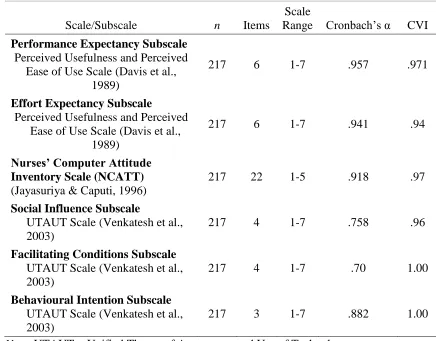
Table 5. Reliability and Content Validity Index of Scales ... 73
Table 6. Personal and Professional Characteristics ... 75
Table 7. Technology-related Characteristics ... 76
Table 8. Main Study Variables ... 77
Table 9. Summary of Hierarchical Regression Analysis for Variables predicting Behavioural Intention to use Electronic Documentation Systems in the home care sector ... 79
Table 10. Factors affecting nurses’ comfort and discomfort using Electronic Documentation Systems (EDS) in home care sector (n=186) ... 103
Table 11. Reported workarounds for Electronic Documentation System usage by nurses in the home care sector (n=53) ... 110
Table 12. Sample of Semi-Structured Questions ... 129
xii
List of Figures
Figure 1. Unified Theory of Acceptance and Use of Technology (UTAUT) (Venkatesh et al., 2003). ... 18 Figure 2. Adapted Unified Theory of Acceptance Model (UTAUT) ... 67 Figure 3. Themes and Subthemes of nurses’ experiences with EDS usage in home care
1
Chapter 1
2
Introduction
The health care system over the past several decades has been challenged by significant changes with an aging population, increased complex and palliative care needs, and rise in usage of health care services and in turn, cost of care (Doran et al., 2012; Kitchen, Williams, Pong, & Wilson, 2011; Santi, Berg, & Stolee, 2013; Qu & Sun, 2015). The considerable changes have led to the increased reliance on the home care sector, which is considered to be the fastest growing sector in Ontario’s healthcare system; with an estimated one million Ontarians receiving home care at any given time (Home and Community Care, 2015; Home Care Ontario, 2016; Kitchen et al., 2011). The growth in the home care sector can be attributed to: 1) the home being considered as the desirable place to receive health care and a cost-effective alternative to that of acute or long-term care facilities; 2) the need / importance of supporting the independence of individuals; and 3) the accessibility of technological advancements to support the delivery of efficient and high-quality health care and services (Barrett, 2011; Canadian Institute for Health Information [CIHI], 2011; Home Care Ontario, 2016; Kitchen et al., 2011).
Advancements in health information technology (HIT), that is, the application of information processing involving software and hardware for storing, sharing and
retrieving health data for decision-making and communication, has significantly changed the health care system, nursing practice and delivery of care to Ontarians (Payne, 2016; Thompson & Brailer, 2004). In today’s evolving healthcare system, it is imperative for healthcare providers (HCPs), specifically registered nurses, to adapt to the current and projected technological advancements that are being used to support the provision of high-quality home health care services, address the various and complex health care challenges, and deliver optimal quality nursing care (Payne, 2016; Ross-Kerr, 2003).
3
HCPs’ workflow, productivity, documentation, and care team processes (i.e.,
communication among members of the interdisciplinary team and continuity of care). Electronic documentation systems also have the potential to address inefficiencies that result from paper-based charting (i.e., duplication of tests, medication errors, incomplete or illegible notes, and loss of patient health data) (Infoway, 2013; Saranto & Kiunnunen, 2008; Smith, Smith, Krugman, & Oman, 2011).
Despite the potential benefits of using EDS, empirical evidence indicates that the transition from paper-based documentation systems to EDS does create significant changes to nursing practice; low intention by nurses to use such systems in practice has also been noted (Kaya, 2011; Kim, Lee, & Yoo, 2016; Kipturgo, Kivuti-Bitok, Karani, & Muiva, 2014). The low intention to use HIT such as EDS is attributed to the interaction between humans and technology, which is affected by a number of factors including: human, technological, and organizational / environmental characteristics (Gagnon, Orruno, Assua, Abderjelil, & Emparanza, 2012; Taiwo & Downe, 2013).
Although initiatives are underway provincially and nationally (i.e., Infoway, 2016) for the continued transition from paper-based to EDS, there is a lack of research
examining nurses’ intention to use such systems to support safe and effective nursing care within the home care sector (Leblanc, Gagnon, & Sanderson, 2012). Theoretical and empirical evidence suggests that behavioural intention is a direct antecedent or
determinant of actual behaviour usage (such as EDS usage); highlighting the importance of understanding the factors that influence this antecedent (Johnston & Warkentin, 2010; Sharma & Crossler, 2014; Venkatesh et al., 2012).
4
educators, software developers as well as decision and policy makers in developing effective strategies and interventions to enhance nurses’ intention and support the successful use of EDS by nurses in their day-to-day home care practice (Hung et al., 2014; Li et al., 2013; Qu & Sun, 2015). This is particularly meaningful as nurses move into new roles that are enabled and supported by technology (While & Dewsbury, 2011).
Background
Home Care
Home care has evolved over the years and has become the fastest growing sector within the healthcare system in Ontario (Home Care Ontario, 2016; Kitchen et al., 2011). Home care was first established in Ontario in 1970 (Canadian Home Care Association, 2015). Publicly funded home care falls under the jurisdiction of the Ontario Ministry of Health and Long-Term Care and encompasses an array of services to persons of all ages that help with rehabilitative, acute, chronic and palliative care needs (Home Care Ontario, 2016; Home Care Ontario, n.d.). The home care sector includes the active involvement of regulated (e.g., nurses) and unregulated (e.g., personal support workers) nursing staff and HCPs, not-for-profit and for-profit organizations, family and friend caregivers, and volunteers (Canadian Home Care Association, 2015; Home Care Ontario, 2016). Home care has the potential to ensure the right care, at the right time, and the right place is provided to Ontarians (Canadian Home Care Association, 2015). Further, home care has the potential to foster and maintain an individuals’ independence and dignity in their place of choice instead of less desirable living and care options (i.e., long-term care facilities) and to reduce healthcare costs (Sinha, 2012). For example, an expert group commissioned by the provincial government released a report entitled “Bringing Care Home” (2015), which estimated that in 2014, home care cost approximately $42 per day per person whereas the cost per day in long-term care facilities was $135 and in a hospital $450; accounting for a $93 and $408 cost difference per person per day respectively.
5
Health and Long-Term Care, 2018). The LHINs are responsible for funding, planning, and coordinating efficient and accessible community and home health care services with health service provider organizations to collectively offer health care services to all individuals at the community level (Ministry of Health and Long-Term Care, 2018).With the increased reliance on the home care sector in Ontario coupled with the LHIN’s
strategic investment in eHealth initiatives (LHIN, 2016), it is essential to examine the innovative technological advancements that have the potential to create new possibilities in the delivery of home health care services to Ontarians (Barrett, 2011; Home Care Ontario, 2016; Kitchen et al., 2011).
Health Information Technology
Health information technology (HIT) is the application of information processing that involves both computer hardware and software for the purposes of storing, sharing, retrieving and using health information and knowledge for decision-making and
communication (Lee, McCullough, & Town, 2013; Protti, 2015; Thompson & Brailer, 2004). Health information technology was introduced in the 1960s in hospitals and included ancillary information systems to support financial and billing services; later, HIT expanded to the management of pharmacy, laboratory and radiology services (Collen & Ball, 2015; Lee et al., 2013).
Over the last two decades, there has been increased implementation of HIT within the health care system to support the provision of care (Al-Khasawneh & Hijazi, 2016; Health Canada, 2015). Implemented HIT consists of a wide range of clinical and networking information systems such as EDS (i.e., electronic health records, picture archiving and communication system, nursing documentation, and medication
6
Specific to patients, the use of HIT supports aging in place, improves care delivery and access to preventative and treatment services, promotes independence, personalized care, and improved communication and collaboration with HCPs within the respective circle of care (Bowles et al., 2015; Canadian Home Care Association, 2015; Carretero, 2015; Meier et al., 2013). For HCPs, empirical evidence suggests that HIT has improved the efficiency of care delivery, documentation, workflow, and facilitates clinical team work and processes through enhanced collaboration and communication in real-time (Canadian Nurses Association, 2013; Hsiao & Chen, 2016; Kuo et al., 2013; Meier et al., 2013).
Clinical Documentation Systems
At the core of every health care encounter is clinical documentation (Jamal & Grant, 2014). Clinical documentation is a legal record of patients’ health condition(s), needs, and are reflective of current care and services being delivered; which is required to be complete, precise and up-to-date (Jamal & Grant, 2014). High-quality clinical
7
Table 1. Summary of Clinical Documentation Systems in Home Care
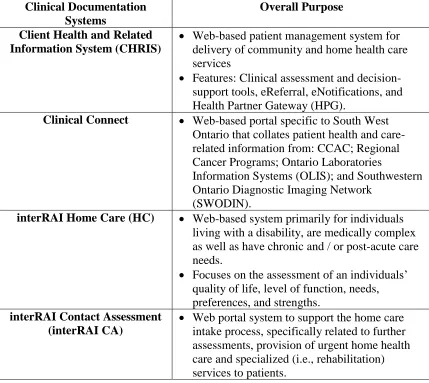
Client Health and Related Information System (CHRIS). CHRIS is a web-based patient management system that supports the delivery of community and home health care services for approximately 670, 000 individuals in Ontario (Health Shared Services Ontario, n.d.). The management system integrates digital health solutions across the province of Ontario to improve and streamline the delivery of home health care services. The features of CHRIS include: the integration of clinical assessment and decision-support tools (i.e., interRAI home care assessment tool); eReferral, which are electronic referrals from the acute care sector and / or emergency medical services to community and home care providers; and eNotifications, which are electronic notifications to community and home care providers of patient’s hospital admission and discharge plans
Clinical Documentation Systems
Overall Purpose
Client Health and Related Information System (CHRIS)
• Web-based patient management system for delivery of community and home health care services
• Features: Clinical assessment and decision-support tools, eReferral, eNotifications, and Health Partner Gateway (HPG).
Clinical Connect • Web-based portal specific to South West Ontario that collates patient health and care-related information from: CCAC; Regional Cancer Programs; Ontario Laboratories
Information Systems (OLIS); and Southwestern Ontario Diagnostic Imaging Network
(SWODIN).
interRAI Home Care (HC) • Web-based system primarily for individuals living with a disability, are medically complex as well as have chronic and / or post-acute care needs.
• Focuses on the assessment of an individuals’ quality of life, level of function, needs, preferences, and strengths.
interRAI Contact Assessment (interRAI CA)
8
(Health Shared Services Ontario, n.d.). The CHRIS also has a secure portal, Health Partner Gateway (HPG), that allows approved HCPs to access patient health information (i.e., clinical assessments and documents) as well as the ability, in real-time, “to receive, send and accept patient referrals and service orders” (Health Shared Services Ontario, n.d., p. 1).
Clinical Connect. Clinical Connect is a web-based portal that electronically collates patient health and care-related information from acute care settings, LHINs, Regional Cancer Care programs, Ontario Laboratories Information Systems (OLIS), and Southwestern Ontario Diagnostic Imaging Network (SWODIN) across South West Ontario (Clinical Connect, 2016). Through Clinical Connect, authorized HCPs can access, through desktop computers, mobile devices (i.e., iPhone, Android, Blackberry) and tablets (i.e., iPad), essential patient health and care-related information in real-time (Clinical Connect, 2016). The reported benefits of Clinical Connect include: the
reduction of duplication of patient documentation, procedures and tests, and improvement in care transfer and coordination between HCPs and organizations in South Western Ontario (Clinical Connect, 2016).
interRAI Home Care (HC). interRAI HC is a web-based system that supports the assessment of quality of life, needs, strengths, preferences and level of function for individuals living with disabilities and that have complex care needs (Health Shared Services Ontario, n.d.).
9
Electronic documentation systems (EDS), commonly referred to as electronic health record systems, electronic medical systems, computerized documentation, electronic clinical documentation or computer-based documentation, are secure, electronic information systems that are used by HCPs to systematically record, document,and access patient health and care-related information over time (HIMSS, 2011; Payne, 2016). The development and implementation of EDS such as the electronic health records (EHR) is a pan-Canadian initiative tasked by Canada Health Infoway Inc. (Infoway), a federally-funded, not-for-profit organization (Infoway, 2013). Infoway has supported agencies (i.e., eHealth Ontario) in the development of EDS, which can be accessed by HCPs providing care to patients regardless of their physical location (i.e., acute care, long-term care, community and home care) (Infoway, 2016; Office of the Auditor General of Canada, 2010). Information recorded into EDS include but are not limited to: patient demographics, diagnoses, past medical history, medications,
immunizations, assessment data, laboratory and imaging results (i.e., x-ray, Computerized Tomography [CT] and Magnetic Resonance Imaging [MRI] scans), clinical interventions, care plans and patient outcomes (HIMSS, 2011; Infoway, 2013; Payne, 2016).
Traditionally such patient health and care-related information were stored in paper-based documentation systems. However, several limitations of the paper-paper-based
documentation systems were noted; affecting both patients and HCPs. The limitations included:
a) difficulty sharing medical information with members of the interdisciplinary team, particularly if patients were seeing more than one HCP and if care was being delivered by several HCPs within the home;
b) patients having to constantly recount their medical history with every HCP encounter, resulting in frustrations for the patients and inaccurate, up-to-date medical information;
10
medical information, increasing the risk of unauthorized access of such information and the inability to track such activity; and
d) quality of care being compromised due to incomplete and / or illegible
handwriting / documentation, resulting in loss of important medical and health information; ability for nurses to accurately interpret and access clinical findings; increase in medical errors (i.e., with prescriptions); and duplication of diagnostic tests (Home Care Ontario, 2016; Infoway, 2013; McDowell et al., 2008).
The healthcare system is transitioning into EDS to mitigate the limitations of paper-based documentation systems. Benefits attributed to EDS implementation include:
a) improvements in legibility and completeness of documentation, which affects nurses’ ability to accurately interpret clinical findings, care plans and orders; and promotes quicker retrieval of comprehensive and up-to-date clinical data; b) reduction in laboratory and diagnostic tests (i.e., EHR and EMR systems have alert notification features for ordering redundancy and of past test results) and medical errors (i.e., availability of functions to alert HCPs of up-to-date and comprehensive list of medications, potential prescribing errors, adverse drug events from the interaction of other medications and patients’ allergies); c) improvement in patient outcomes through chronic disease management by
identifying individuals living with chronic diseases and at risk for poor health outcomes through the predictive-modelling algorithms and preventative care (i.e., improvements in immunizations, bone mineral density, and screening of cervical, breast and colorectal cancer); and
d) support continuity of care, communication and collaboration among HCPs in a timely manner and regardless of physical location (Dahrouge et al., 2012; Home Care Ontario, 2016; Infoway, 2013; Kaczorowski et al., 2013; Nguyen et al., 2014; Spencer & Lunsford, 2012; Tundia et al., 2012; Yee et al., 2012).
11
include: a) interrupted workflow and loss of productivity due to HCPs learning the system; b) initial time commitment required to enter data and convert paper-based documents / records to electronic documents; c) poorly designed EDS; and d) HCPs’ anxiety, apprehension, resistance and low intention towards using such systems (Boonstra & Broekhuis, 2010; Creswell, Bates, & Sheikh, 2013; Infoway, 2013; Nguyen et al., 2014; Schenk, Mayer, Barney, Estill, Goss, & Shreffler-Grant, 2016; Stroetmann, Artmann, Dumortier, & Verhenneman, 2012; Sugarhood, Wherton, Procter, Hinder, & Greenhalgh, 2013; Payne, 2016; Yen & Bakken, 2012). The latter barrier, intention to use, is the focus of this research study.
Intention-Behaviour Relationship
Over the past decades, several theories have been proposed to explain human behaviour (Sommer, 2011). Clinical practice is considered to be a form of human behaviour that is related to the implementation of interventions or health care services and guided by the motivational predispositions of a person (Eccles et al., 2006; Godin & Conner, 2008). Intention, that is, an individual’s subjective probability that he or she will engage in a given behaviour, is the immediate antecedent of actual behaviour (Fishbein & Ajzen, 2011; Fishbein & Ajzen, 1975; Fisher & Fisher, 1992; Gollwitzer, 1993).
Research examining nurses’ intention to use HIT in acute care practice found that intention predicted actual behavioural usage; accounting for 28.2%-58% of the variance in actual behavior of end-users such as nurses (Godin et al., 2008; Leblanc et al., 2012; Maillet et al., 2014; Sharifian, Askarian, Nematolani, & Farhadi, 2014; Wills, El-Gayer, & Bennett, 2008). Several factors influencing intention to use EDS have been examined, which provides valuable information on possible challenges or barriers that can be targeted with interventions to enhance use of HIT such as EDS by nurses in practice.
Registered Nurses’ intention to using Health Information Technology
12
important to note that findings of nurses’ low intention to use HIT particularly EDS have been predominantly examined within the acute care sector, with little to no focus on nurses’ use of such systems within the home care sector. Acute and home care sectors differ in working environments, which may influence nurses’ intention to use EDS differently. For example, home care nurses work independently and autonomously with limited direct and face-to-face interaction with colleagues (Lundy & Janes, 2014; Tourangeau et al., 2014). In comparison, nurses working in an acute care setting are in greater proximity with other HCPs and patient care resources. Moreover, the working environment of a home care nurse is unique: it comprises of several different locations (i.e., nurses’ car and home; patients’ home, and agency office), which may impact the availability of supplies and equipment. Whereas nurses working in an acute care setting have readily available human and material resources (Lundy & Janes, 2014; Torurangeu et al., 2014).
Underlying nurses’ low intention of using HIT such as EDS is the complex inter-related technical and social issues within an organization; making the introduction and uptake of HIT a complex and dynamic process (Creswell et al., 2013; Yen & Bakken, 2012). Empirical evidence suggests factors that influence the use of HIT such as EDS to be categorized into the individual, technological and organizational / environmental dimensions (Asua, Orruno, Reviriego, & Gagnon, 2012; Chau & Hu, 2002; Gagnon et al., 2012). For the individual dimension, research suggests that factors related to nurses’ age, professional experience, computer / technology knowledge, comfort working with computers and technology, and attitude towards the HIT influence nurses’ use of HIT in their in day-to-day practice (Hsiao, & Chen, 2016; Juo, Liu, Ma, 2013; Li, Talaei-Khoei, Seale, Ray, & MacIntyre, 2013; Van Houwelingen et al., 2015; Wu, Li, & Fu, 2011).
13
training and technology support were cited as shortfalls in intention to use HIT by nurses in practice (Li et al., 2013; Sugarhood et al., 2013).
Intention-Behaviour Models
The use of technology has been extensively explored since the inception of computer and information technology (Kijsanayotin, Pannurunothai, & Speedie, 2009). Several theories and models have been developed to explain how end-users make decisions to use technology (Ifinedo, 2016; Kijsanayotin et al., 2009). The theories and models originate from various disciplines such as sociology and psychology
14
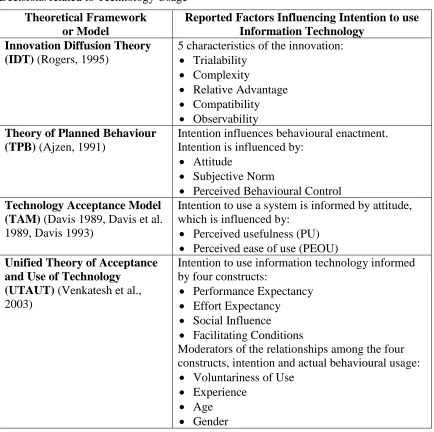
Table 2. Summary Table of Theoretical Frameworks and Models for End-Users’ Decisions related to Technology Usage
Theoretical Framework or Model
Reported Factors Influencing Intention to use Information Technology
Innovation Diffusion Theory (IDT) (Rogers, 1995)
5 characteristics of the innovation:
• Trialability
• Complexity
• Relative Advantage
• Compatibility
• Observability
Theory of Planned Behaviour (TPB) (Ajzen, 1991)
Intention influences behavioural enactment. Intention is influenced by:
• Attitude
• Subjective Norm
• Perceived Behavioural Control
Technology Acceptance Model (TAM) (Davis 1989, Davis et al. 1989, Davis 1993)
Intention to use a system is informed by attitude, which is influenced by:
• Perceived usefulness (PU)
• Perceived ease of use (PEOU)
Unified Theory of Acceptance and Use of Technology
(UTAUT) (Venkatesh et al., 2003)
Intention to use information technology informed by four constructs:
• Performance Expectancy
• Effort Expectancy
• Social Influence
• Facilitating Conditions
Moderators of the relationships among the four constructs, intention and actual behavioural usage:
• Voluntariness of Use
• Experience
• Age
• Gender
Innovation Diffusion Theory (IDT). The IDT proposes that adoption of technology is a function of the individual and technological characteristics. Innovation Diffusion Theory categorizes individuals on the basis of the rate / speed of adoption of the technology into: innovators, early adopters, early majority, late majority and laggards (Rogers, 1995). The five characteristics of the technology that affect its uptake are: 1) trialability, that is, the ease of experimenting with a technology or innovation; 2) complexity, that is, the degree to which an innovation is perceived to be easy to understand and use; 3) relative
15
good idea and advantageous; 4) compatibility, which is the degree to which an individual perceives the innovation or technology as being compatible with current values, needs and previous experiences; and 5) observability, referring to the degree to which the results and benefits of the innovation are evident and visible to individuals (Rogers, 1995). Several limitations of IDT have been noted: 1) the theory is technology driven because of the pro-innovation bias, that is, all individuals of a social system should adopt innovations and quickly. A second limitation of the IDT is that it does not account for the influence of the social environment on an individuals’ adoption of technology (Kole, 2000).
Theory of Planned Behaviour (TPB). The TPB originates from social cognitive theories and extends the Theory of Reasoned Action (TRA) (Ajzen, 1991; Fishbein & Ajzen, 1975). The TPB proposes that the enactment of a behaviour is determined by intention to perform the behaviour. Intention refers to the amount of effort the individual is willing to exert in a given behaviour (Ajzen, 1991). According to Ajzen (1991), intention is
influenced by three factors: a) attitude towards the behaviour, that is, the individual’s
beliefs and corresponding positive or negative perspective of the potential outcomes of intending to and actually performing a behaviour; b) subjective norm, that is, the
individuals’ perception of social influence (i.e., colleagues and supervisors) that affect his / her behavioural intention and performance; and c) perceived behavioural control, that is, the individual’s beliefs and perception of factors that facilitate or inhibit the ability to enact the behaviour. The TPB postulates that the combination of attitude, subjective norm, and perceived behavioural control lead to behavioural intention and in turn, the actual enactment of the behaviour (Ajzen, 1991). One of the main limitations of TPB is that the theory does not account for individual characteristics (i.e., demographic variables such as age and sex); making the assumption that all individuals experience the processes of the TPB similarly (Armitage & Conner, 2001).
Technology Acceptance Model (TAM). The TAM is based on principles adapted from Fishbein and Ajzen’s (1975) attitude paradigm from psychology. The TAM posits that the acceptance of a technology by a user is determined by two factors: 1) perceived
16
technology will enhance his / her job performance; and 2) perceived ease of use (PEOU), that is, the degree to which an individual believes that using a particular technology is effort free (Davis, 1989, Davis et al. 1989, Davis 1993). The TAM proposes that
intention to use and accept a technology is directly determined by one’s attitude towards using the system, which is determined by PU and PEOU (Davis et al. 1989; Davis & Venkatesh 2004). Several limitations have been noted of the TAM. First, Burton-Jones and Hubona (2006) suggest that the influence from external factors such as level of education, age and system experience may have a direct influence on the usage of the technology. Second, the TAM lacks a diversity of proposed variables, resulting in adaptations to the model to meet the specific necessities of the HIT being examined; creating confusion among researchers (Baenbasat & Barki, 2007; Kim et al., 2016). Finally, the simplicity of the model cannot universally explain end-users decisions and behaviours across a variety of technologies and within diverse adoption contexts (Anja, Gewald, & Ulrich, 2014).
The Unified Theory of Acceptance and Use of Technology (UTAUT). The UTAUT model, as presented in Figure 1, was developed to consolidate the theories and empirical evidence on individual’s intention, acceptance and adoption of information technology into a single unified theoretical model (Li et al., 2013). The UTAUT synthesized 32 constructs from eight theories and models that are widely used for examining factors that influence the adoption of technology, namely: TAM, TPB, a combined TPB / TAM, the Model of Personal Computer Utilization, IDT, and Social Cognitive Theory (SCT) (Maillet et al., 2014; Venkatesh et al., 2003).
The UTAUT model explains end-users’ (e.g., nurses) intention to use a specific information technology with four constructs: a) performance expectancy; b) effort expectancy; c) social influence; and d) facilitating conditions (Venkatesh et al., 2003).
Performance expectancy (consistent with the concept of perceived usefulness in the
17
(consistent with the construct of social norm in the TPB) and facilitating conditions refers to the impact important persons (i.e., supervisors and colleagues) have on the end-users’ use of the technology and their perception of support within the organizational and
technological infrastructure to use the respective technology (Venkatesh et al., 2003). It is postulated that performance expectancy, effort expectancy and social influence are direct determinants of behavioural intention and facilitating conditions is a direct determinant of actual behaviour performance (Venkatesh et al., 2003).
Within the UTAUT model, voluntariness of use, technological experience, age and gender moderate the relationships between the four key constructs and intention and actual behavioural usage (Venkatesh et al., 2003). The UTAUT model through its integrated and comprehensive approach to explain end-users’ such as nurses’ intention and usage of technology, has demonstrated a stronger explanatory power (i.e., accounts for 63.1% - 72.8% of the variance in usage intention and approximately 50% in actual technology use) in comparison to other models which explain only 27% - 40% of variance in acceptance to use HIT (Armitage & Conner, 2001; Kim et al., 2016;
18
Figure 1. Unified Theory of Acceptance and Use of Technology (UTAUT) (Venkatesh et al., 2003).
Limitations of Intention-Behaviour Relationship
Though behavioural intention is said to be an antecedent to actual behavioural performance or usage as proposed in several theories, a number of factors have been identified to potentially influence the intention-behaviour relationship (Fishbein & Ajzen, 2011; Kiriakidis, 2015). First is the stability of intention (Fishbein & Ajzen, 2011;
19
with allied HCPs, and access to up-to-date and comprehensive patient health and care-related information.
The second factor to potentially influence the intention-behaviour relationship is the intention-behaviour compatibility (Fishbein & Ajzen, 2011). Intention-behaviour compatibility is specific to the measure assessing intention and behaviour (Fishbein & Ajzen, 2011). If there is a lack of compatibility between the measures of intention and behaviour, it has the potential to demonstrate and be responsible for the weak correlation that has been noted within the literature (Fishbein & Ajzen, 2011). For example, some subjective measures used in practice to assess the intention and adoption of HIT are invalidated (Davis, 1989; Everson, Lee, & Friedman, 2014). Data obtained from
invalidated measures lower researchers’ confidence in accurately interpreting the results because of measurement error; measurement error can confound and / or attenuate the associations among the concepts of interest (Everson et al., 2014).
The third factor influencing the intention-behaviour relationship is literal
inconsistency (Fishbein & Ajzen, 2011). Literal inconsistency refers to an individuals’ failure to carry out the intention and in turn, enactment of actual behaviour. Though not empirically tested, it has been argued that literal inconsistency arises because individuals display favourable intention when the behaviour is perceived to be easy to perform, however individuals may change their mind when they perceive the behaviour as difficult to carry out (Campbell, 1963; Fishbein & Ajzen, 2011).
20
of such theories at the aggregate level rather than the individual level, intention is a good predictor of actual behavioural performance / usage (Fishbein & Ajzen, 2011).
Problem Statement
The implementation of EDS, one form of HIT, is a province-wide and
pan-Canadian initiative that holds promise in making comprehensive, up-to-date, and timely patient health and care-related information available at the right place and the right time for all HCPs (Infoway, 2013; Nguyen et al., 2014). This is particularly important for nurses because they spend the most amount of time with patients, are the largest group of regulated HCPs and users of EDS (Delucia, Ott, & Palmieri, 2009; Stevenson et al., 2010; WHO, 2013). Further, the inability for nurses to directly communicate and access up-to-date and accurate information may compromise decision-making, delivery of high-quality nursing care and in turn, impact patient health outcomes (Home Care Ontario, 2016; Schenk et al., 2016). Despite the potential benefits of EDS, there have been reports of low intention to use such systems in practice by nurses (Hsiao & Chen, 2016; Hung et al., 2014; Khalifa, 2013; Montague et al. 2013; van Houwelingen et al., 2015; Yen & Bakken, 2012). Electronic documentation systems that are not used at all or to their fullest capacity cannot be reasonably expected to contribute to improving access to information and quality of care; rendering them of little value and negatively impacting organizations, patients and allied HCPs that require relevant, accessible and timely clinical information (Oye, Iahad, & Ab-Rahim, 2012; Wills et al., 2008). Despite the growing efforts to understand nurses’ perceptions and overall intention to use EDS in practice, there is limited knowledge in the context of home care practice.
Study Purposes
21
Research Questions
The research questions that were addressed in this study were:
Question 1: What are the relationships of nurses’ personal and professional characteristics, and perceptions of the technological characteristics and organizational / environmental characteristics with their intention to use EDS within home care practice?
Question 2: How do nurses perceive the use of EDS within their home care practice?
Significance
Nurses play a significant role in the delivery of home health care services to Ontarians. To ensure high-quality nursing care is offered to patients and in turn, improve timely decision-making and patient health outcomes, nurses need access to up-to-date and accurate patients health and care-related information, which EDS hold promise in
offering (Barrett, 2011; Infoway, 2013; Home Care Ontario, 2016; Kitchen et al., 2011; Nguyen et al., 2014; Schenk et al., 2016). Empirical evidence supports the benefits of EDS in practice; however, there is limited knowledge of factors that influence nurses’ intentions to use such systems in their day-to-day home care practice.
22
Thesis Organization
The thesis was written in an integrated-article format as specified by the School of Postgraduate Studies at Western University. The goal of this thesis was addressed in a series of four papers (Chapters 2 to 5) that have been submitted for publication. The chapters are as follows:
Chapter 1: Introduction, includes the introduction, background of the problem, purpose of the research study, research questions, and significance of the study.
Chapter 2: is based on the manuscript entitled “Factors influencing registered
nurses’ intention to use health information technology in clinical practice: An integrative literature review.”
Chapter 3: is based on the manuscript entitled “Predicting registered nurses’
intention to use electronic documentation system in home care: Application of an Adapted Unified Theory of Acceptance and Use of Technology Model.”
Chapter 4: is based on the manuscript entitled “A qualitative content analysis of
nurses’ comfort and employment of workarounds with electronic documentation systems in home care practice.”
Chapter 5: is based on the manuscript entitled “Exploration of nurses’ experience
with using electronic documentation systems in home care.”
23 References
Ajzen, I. (1991). The theory of planned behavior. Organizational Behavior and Human
Decision Processes, 50, 179-211. Retrieved from
https://cas.hse.ru/data/816/479/1225/Oct%2019%20Cited%20%231%20Manage%2 0THE%20THEORY%20OF%20PLANNED%20BEHAVIOR.pdf
Al-Khasawneh, A., & Hijazi, H. (2014). A predictive e-health information system: Diagnosing Diabetes Mellitus using neural network based decision support system.
International Journal of Decision Support System Technology, 6(4), 451-469. doi:
10.4018/ijdsst.2014100103
Anja, N., Gewald, H., & Ulrich, H. (2014). Why do they resist? Examining salient factors
influencing physicians’ adoption behaviour. Conference Paper. Conference:
Proceedings of the Eighteenth Pacific Asia Conference on Information Systems (PACIS).
Armitage, C. J., & Conner, M. (2001). Efficacy of the Theory of planned behaviour: A meta-analytic review. The British Journal of Social Psychology, 40(4), 471-499. https://doi.org/10.1348/014466601164939
Asua, J., Orruno, E., Reviriego, E., & Gagnon, M. P. (2012). Healthcare professional acceptance of telemonitoring for chronic care patients in primary care. BMC
Medical Informatics and Decision Making, 12, 139-149.
https://doi.org/10.1186/1472-6947-12-139
Baenbasat, I., & Barki, H. (2007). Quo Vadis, TAM. Journal of the AIS,8, 211-218. Retrieved from https://aisel.aisnet.org/jais/vol8/iss4/16
Bamberg, S., Hunecke, M., & Blobaum, A. (2007). Social context, personal norms and the use of public transportation: Two field studies. Journal of Environmental
Psychology, 27, 190-203.
Barrett, L. L. (2011). Health at Home 2.0. Full Report. AARP. Retrieved from http://assets.aarp.org/rgcenter/health/healthy-home-11.pdf
Boonstra, A., & Broekhuis, M. (2010). Barriers to the acceptance of electronic medical records by physicians from systematic review to taxonomy and interventions. BMC
Health Services Research, 10, 231. doi:10.1186/1472-6963-10-231
Bowles, K. H., Dykes, P., & Demiris, G. (2015). The use of health information technology to improve care and outcomes for older adults. Research in
Gerontological Nursing, 8(1), 5-10. doi:10.3928/19404921-20121222-01
24
Campbell, D. T. (1963). Social attitudes and other acquired behavioral dispositions. In S. Koch (Ed.), Psychology: A study of a science (Vol. 6, pp. 94-172). New York: McGraw-Hill.
Canadian Home Care Association (2015). Technology enabled home care: Supporting
independence and improving health outcomes in the home setting. Retrieved from
http://www.cdnhomecare.ca/media.php?mid=4442
Canadian Institute for Health Information (CIHI). (2011). Health Care in Canada, 2011:
A focus on seniors and aging. Retrieved from
https://secure.cihi.ca/free_products/HCIC_2011_seniors_report_en.pdf
Canadian Nurses Association (CNA). (2013). Optimizing the role of nursing in home
health. Retrieved from
https://www.cna-aiic.ca/~/media/cna/page-content/pdf-en/optimizing_the_role_of_nursing_in_home_health_e.pdf?la=en
Carretero, S. (2015). Technology-enabled services for older people living at home independently: Lessons for public long-term care authorities in the EU member states. JRC Science and Policy Reports. Retrieved from
http://publications.jrc.ec.europa.eu/repository/bitstream/JRC96022/lfna27256enn.p df
Carrington, J. M., & Tiase, V. L. (2013). Nursing informatics year in review. Nursing
Administration Quarterly, 37(2), 136-143. doi:10.1097/NAQ.0b013e3182869deb
Chau, P.Y. K., & Hu, P. J. (2002). Examining a model of information technology acceptance by individual professionals: An exploratory study. JMIS, 18(4), 191-229. https://doi.org/10.1080/07421222.2002.11045699
Clinical Connect. (2016). Clinical Connect Overview. Retrieved from
http://info.clinicalconnect.ca/CC/wp-content/uploads/2014/05/ClinicalConnectOverview-General_Mar-2016.pdf
Collen, M. F., & Ball, M. J. (2015). The history of medical informatics in the United
States. Springer.
Cresswell, K. M., Bates, D. W., & Sheikh, A. (2013). Ten key considerations for successful implementation and adoption of large-scale health information
technology. Journal of American Medical Informatics Association, 20(e1), e9-e13. doi:10.1136/amiajnl-2013-001684
Dahrouge, S., Hogg, W., & Russell, G., Tuna, M., Geneau, R., Muldoon, L. K., … & Fletcher, J. (2012). Impact of remuneration and organizational factors on
completing preventative manoeuvres in primary care practices. Canadian Medical
25
Davis, F. D. (1989). Perceived usefulness, perceived ease of use, and user acceptance of information technology. MIS Quarterly, 13(3), 319-340. Retrieved from
https://pdfs.semanticscholar.org/3969/e582e68e418a2b79c604cd35d5d81de9b35d. pdf
Davis, F. D. (1993). User acceptance of information technology: System characteristics, user perceptions and behavioural impacts. International Journal of Man-Machine
Studies,38(3), 475-487. Retrieved from http://hdl.handle.net/2027.42/30954
Davis, F. D., Bagozzi, R. P., & Warshaw, P. R. (1989). User acceptance of computer technology: A comparison of two theoretical models. Management Science, 35(8), 982-1003.
Davis, F. D., & Venkatesh, V. (2004). Toward prototype user acceptance testing of new information systems: Implications for software project management. IEEE
Transactions on Engineering management, 51(1), 31-46. Retrieved from
http://www.vvenkatesh.com/wp-content/uploads/2015/11/2004(1)_IEEETEM_Davis_Venkatesh.pdf
Delucia, P. R., Ott, T., & Palmieri, P. A. (2009). Chapter 1 Performance in Nursing.
Reviews of Human Factors and Ergonomics, 5(1), 1-40.
Eccles, M. P., Hrisos, S., Francis, J., Kaner, E. F., Dickinson, H. O., Beyer, F., & Johnston, M. (2006). Do self-reported intentions predict clinicians’ behaviour: A systematic Review. Implementation Science, 1(28). doi:10.1186/1748-5908-1-28
Everson, J., Lee, S. Y. D., & Friedman, C. P. (2014). Reliability and validity of the American hospital association’s national longitudinal survey of health information technology adoption. Journal of American Medical Informatics Association, 21(2), e257-263. https://doi.org/10.1136/amiajnl-2013-002449
Fishbein, M., & Ajzen, I. (1975). Belief, attitude, intention, and behavior: An
introduction to theory and research. Reading, MA: Addison-Wesley.
Fishbein, M., & Ajzen, I. (2010). Predicting and changing behaviour: The Reasoned Action approach. Psychology Press. doi:10.4324/9780203838020
Fisher, J. D., & Fisher, W. A. (1992). Changing AIDS-risk behavior. Psychological
Bulletin, 111, 455-474.
Gagnon, M. P., Orruño, E., Asua, J., Abdeljelil, A. B., & Emparanza, J. (2012). Using a modified technology acceptance model to evaluate healthcare professionals’ adoption of a new telemonitoring system. Telemedicine and e-Health,18, 54-59. doi:10.1089/ tmj.2011.006
Godin, G., & Conner, M. (2008). Intention-behaviour relationship based on
epidemiologic indices: An application to physical activity. American Journal of
26
Gollwitzer, P. M. (1993). Goal achievement: The role of intentions. In W. Stroebe & M. Hewstone (Eds.), European review of social psychology, Vol. 4 (pp. 141–185). Chichester, UK: Wiley.
Health Canada. (2015). Canada Health Infoway. Retrieved from http://www.hc-
sc.gc.ca/ahc-asc/performance/estim-previs/plans-prior/2015-2016/supplement/supplement-5-eng.php
Health Shared Services Ontario (n.d.). Meet CHRIS: CHRIS - Health Shared Services
Ontario’s Provincial Digital Health Platform. Retrieved from
https://hssontario.ca/News/Pages/Meet-CHRIS.aspx
HIMSS. (2011). Nicholas E. Davies Award of Excellence – Ambulatory Care Award.
EHR Benefits – Examples. Retrieved from
http://apps.himss.org/davies/docs/2011_FactSheets/2011AmbDavies_HardSoftFact Sheet.pdf
Home and Community Care (2015). Bringing Care Home. Retrieved from http://health.gov.on.ca/en/public/programs/ccac/docs/hcc_report.pdf
Home Care Ontario (2016). Bringing Home Care into Ontario’s Technology Strategy. Retrieved from http://www.homecareontario.ca/docs/default-source/position-papers/bringing-home-care-into-ontario's-technology-strategy.pdf?sfvrsn=10
Home Care Ontario (n.d.). Facts & Figures - Publicly Funded Home Care. Retrieved from
http://www.homecareontario.ca/home-care-services/facts-figures/publiclyfundedhomecare
Hsiao, J. L., & Chen, R. F. (2016). Critical factors influencing physicians’ intention to use computerized clinical practice guidelines: An integrative model of activity theory and the technology acceptance model. BMC Medical Informatics and
Decision Making ,16(3). doi:10.1186/s12911-016-0241-3
Hung, S. Y., Tsai, J. C. A., & Chuang, C. C. (2014). Investigating primary health care nurses’ intention to use information technology: An empirical study in Taiwan.
Journal Decision Support Systems, 57, 331-342. doi:10.1016/j.dss.2013.09.016
Ifinedo, P. (2016). The moderating effects of demographic and individual characteristics on nurses’ acceptance of information systems: A Canadian study. International
Journal of Medical Informatics, 87, 27-35.
http://dx.doi.org/10.1016/j.ijmedinf.2015.12.012
Infoway. (2013). Canada Health Infoway: The emerging benefits of electronic medical
records use in community-based care. Retrieved from
27
Jamal, A., & Grant, C. (2014). An essential guide to clinical documentation improvement. CHIM Consulting Inc. Retrieved from
https://www.echima.ca/uploaded/pdf/reports/CDI_Whitepaper_Final_rOct%20201 4.pdf
Johnston, A. C., & Warkentin, M. (2010). Fear appeals and information security behaviors: An empirical study. MIS Quarterly, 34(3), 549-566. Retrieved from https://pdfs.semanticscholar.org/3287/2c203cb0fee038b381036dce7b6690f470a9.p df
Kaya, N. (2011). Factors affecting nurses’ attitudes toward computers in healthcare. CIN:
Computers, Informatics, Nursing,29(2), 121-129.
doi:10.1097/NCN.0b013e3181f9dd0f
Khalifa, M. (2013). Barriers to health information systems and electronic medical records implementation: A field study of Saudi Arabian hospitals. Procedia Computer
Science, 21, 335-342. doi:10.1016/j.procs.2013.09.044
Kijsanayotin, B., Pannarunothai, S., & Speedie, S. M. (2009). Factors influencing health information technology adoption in Thailand’s community health centres: Applying the UTAUT model. International Journal of Medical Informatics, 78(6), 404-416. doi:10.1016/j.ijmedinf.2008.12.005
Kim, S., Lee, K. H., & Yoo, S. (2016). Analysis of the factors influencing healthcare professionals’ adoption of mobile electronic medical record (EMR) using the unified theory of acceptance and use of technology (UTAUT) in a tertiary hospital.
BMC Medical Informatics and Decision Making, 16(12).
doi:10.1186/s12911-016-0249-8
Kipturgo, M. K., Kivuti-Bitok, L. W., Karani, A. K., & Muiva, M. M. (2014). Attitudes of nursing staff towards computerization: A case of two hospitals in Nairobi, Kenya. BMC Medical Informatics and Decision Making, 14(35).
https://doi.org/10.1186/1472-6947-14-35
Kiriakidis, S. (2015). Theory of planned behaviour: The intention-behaviour relationship and the perceived behavioural control (PBC) relationship with intention and behaviour. International Journal of Strategic Innovative Marketing, 2(3). doi:10.15556/IJSIM.02.03.004
28
Kole, E. S (2000). Connecting Women from Developing Countries to the Internet:
Searching for an Appropriate Paradigm. Paper presented at the panel ‗Making
Connections in the Internet Era: Theory and Practice for the 41st Annual Convention of the International Studies Association, ‗Reflection, Integration, Cumulation: International Studies Past and Future, 14-17 March 2000, Los Angeles, U.S.A.
Kuo, K. M., Liu, C. F., & Ma, C. C. (2013). An investigation of the effect of nurses’ technology readiness on the acceptance of mobile electronic medical record systems. BMC Medical Informatics and Decision Making, 13(88).
doi:10.1186/1472-6947-13-88
Leblanc, G., Gagnon, M. P., & Sanderson, D. (2012). Determinants of primary case nurses’ intention to adopt an electronic health record in their clinical practice. CIN:
Computers, Informatics, Nursing, 30(9), 496-502.
doi:10.1097/NXN.0b013e318257db17
Lee, C.C., Lin, S.P. Yan, S. L., & Tsou, M. Y. (2013). Evaluating the influence of perceived organizational learning capability on user acceptance of information technology among operating room nurse staff. Acta Anaesthesiol. Taiwan,51, 22-27. doi:10.1016/j.aat.2013.03.013
Lee, J., McCullough, J. S., & Town, R. J. (2013). The impact of health information technology on hospital productivity. The RAND Journal of Economics, 44(3), 545-568. doi:10.1111/1756-2171.12030
LHIN (2016). Central LHIN 2016-2017 eHealth Strategic Plan: Presentation to Central
LHIN Board of Directors. Retrieved from
http://www.centrallhin.on.ca/goalsandachievements/moreinitiatives/ehealth.aspx
Li, J., Talaei-Khoei, A., Seale, H., Ray, P., & Macintyre, C. R. (2013). Health care provider adoption of eHealth: Systematic literature review. Interactive Journal of
Medical Research, 2(1), e7. doi:10.2196/ijmr.2468
Lundy, L. & Janes, S. (2014). Community Health Nursing: Caring for the Public’s Health. (3rd ed.). Jones & Barlett Learning.
Lysyk, B. (2015). Community Care Access Centres - Financial Operations and Service
Delivery. Retrieved from
http://www.auditor.on.ca/en/content/specialreports/specialreports/CCACs_en.pdf
Maillet, E., Mathieu, L., & Sicotte, C. (2014). Modeling factors explaining the
acceptance, actual use and satisfaction of nurses using an electronic patient record in acute care settings: An extension of the UTAUT. International Journal of
29
McDowell, D. E., Dillon, T. W., & Lending, D. (2008). Perceived quality benefits influenced by usefulness and documentation accuracy of information. CIN:
Computers, Informatics, Nursing, 26(6), 350-357.
doi:10.1097/01.NCN.0000336463.72069.7c
Meier, C. A., Fitzgerald, M. C., & Smith, J. M. (2013). eHealth: Extending, enhancing, and evolving health care. Annual Review of Biomedical Engineering, 15, 359-382. doi:10.1146/annurev-bioeng-071812-152350
Ministry of Health and Long-Term Care (2015). Patients First: A proposal to strengthen
patient-centered health care in Ontario. Discussion Paper. Retrieved from
http://www.health.gov.on.ca/en/news/bulletin/2015/docs/discussion_paper_201512 17.pdf
Montague, E., Asan, O., & Chiou, E. (2013). Organizational and technological correlates of nurses’ trust in a smart IV pump. Computers Information Nursing,31(3), 142-149. doi:10.1097/NXN.0b013e3182812d95
Nguyen, L., Bellucci, E., & Nguyen, L. T. (2014). Electronic health records
implementation: An evaluation of information system impact and contingency factors. International Journal of Medical Informatics, 83, 779-796.
doi:10.1016/j.ijmedinf.2014.06.011
Office of the Auditor General of Canada. (2010). 2010 April Report of the Auditor General of Canada: Electronic Health Records in Canada - An overview of
Federal and Provincial Audit Reports. Retrieved from
http://www.oag-bvg.gc.ca/internet/English/parl_oag_201004_07_e_33720.html
Oye, N. D., Iahad, N., & Rabin, A. N. (2012). Behavioural intention to accept and use ICT in public university: Integrating quantitative and qualitative data. Journal of
Emerging Trends in Computing and Information Sciences, 3(6), 957-969. Retrieved
from
https://pdfs.semanticscholar.org/c833/58d958b0cf81180d30339716f3b673d6cd60.p df
Payne, S. (2016). The implementation of electronic clinical documentation using Lewin’s change management theory. Canadian Journal of Nursing Informatics,11(3). Retrieved from http://cjni.net/journal/?p=2882
Phichitchaisopa, N., & Naenna, T. (2013). Factors affecting the adoption of healthcare information technology. Experimental and Clinical Sciences Journal,12, 413-436. Retrieved from http://www.ncbi.nlm.nih.gov/pmc/articles/PMC4566918/
Protti, D. (2015). Missed Connections: The adoption of information technology in
Canadian Healthcare. Institute C. D. Howe Institute. Commentary No. 422.
Retrieved from
30
Qu, Z., & Sun, J. (2015). Understanding health information technology adoption: A synthesis of literature from an activity perspective. Journal Information Systems
Frontiers, 17(5), 1177-1190.
Rogers, E. M. (1995). Diffusion of Innovations (4th ed). New York: Free Press.
Ross-Kerr, J. C. (2003). Computer technology in nursing practice and research. In J. C. Ross-Kerr, & M. J. Wood (Eds.), Canadian Nursing: Issues and perspectives (pp. 269-279). Toronto, ON: Mosby.
Samaradiwakar, G. D. M. N., & Gunawardena, C. G. (2014). Comparison of existing technology acceptance theories and models to suggest a well improved theory / model. International Technical Sciences Journal (ITSJ), 11(1), 21-36.
Santi, S. M., Hinton, S., Berg, K., & Stolee, P. (2013). Bridging the information divide: Health information sharing in home care. Canadian Journal of Nursing Research,
45(1), 16-35.
Saranto, K., & Kinnunen, U. (2009). Evaluating nursing documentation - research
designs and methods: Systematic review. Journal of Advanced Nursing, 65(3), 464-476. doi:10.1111/j.1365-2648.2008.04914.x
Schenk, E. C., Mayer, D. M., Ward-Barney, E., Estill, P., Goss, L., & Shreffler-Grant, J. (2016). RN perceptions of a newly adopted electronic health record. The Journal of
Nursing Administration, 46(3), 139-145. doi:10.1097/NNA.0000000000000313
Sharifian, R., Askarian, F., Nematolahi, M., & Farhadi, P. (2014). Factors influencing nurses’ acceptance of hospital information systems in Iran: Applications of the Unified theory of acceptance and use of technology. Health Information
Management Journal,43(3), 23-28.
Sharma, S., & Crossler, R. E. (2014). Intention to engage in social commerce: Uses and
gratification approach. Conference Paper. Twentieth Americas Conference on
Information Systems, Savannah.
Sinha, S. K., (2012). Living longer, living well. Report Submitted to the Minister of Health and Long-Term Care and the Minister responsible for seniors on
recommendations to inform a Seniors strategy for Ontario. Retrieved from
http://www.health.gov.on.ca/en/common/ministry/publications/reports/seniors_strat egy/docs/seniors_strategy_report.pdf
Smith, K., Smith, V., Krugman, M., & Oman, K. (2011). Evaluating the impact of computerized clinical documentation. CIN: Computers, Informatics, Nursing, 23(3), 132-138.
Sommer, L. (2011). The theory of planned behaviour and the impact of past behaviour.
International Business and Economics Research Journal, 10(1), 91-110.