TRApriori Classification Based Algorithm by
Fuzzy Techniques to Reduced Time Complexity
Rohit Miri1,Priyanka Tripathi2, S.R.Tandan3,
1,3
Department of Computer Science & Engineering Dr. C.V. Raman University, Kota, Bilaspur, India (C.G.)
2
Department of Computer Technology National Institute of Technology, Raipur (C. G.)
Abstract—. Our simple classification technique on this approach is also able to remove the unwanted data sets that are not useful for making the decision system. We can also combined the fuzzy techniques, TRApriori Algorithm and classification technique to provide the close output. Our classification based fuzzy mining association algorithm can also work on low support values. Due to online notes (Video based and Web based) for education also plays an important role for enhancement of their result. Students of this generation are smart due to internet. Also the cost of internet goes down , a low income family student can also used web based learning.Video from NPTEL can also be downloaded from you tube free of cost. Once downloaded the video is distributed amongst the students.
Keywords—TRApriori, Classified data sets, fuzzy approach,
quantitative data
I.INTRODUCTION
In data mining technique, association rules plays an important role in knowledge discovery technique. Data mining is a technique digging out the essential thing and leaving unimportant item. Similarly if there is a huge amount of data or quantitatively data then we need a suitable algorithm or technique to remove or hide unimportant data. If someone is suffering from any diseases then he/she will ensure from many different ways of health checkup, it means it will check its diseases from two or more doctor or two or more blood testing. Similarly I am using fuzzy logic, classification technique, TRApriori mining algorithm to get the close output. Here our classification based fuzzy mining algorithm help in reduced time complexity in later steps of this algorithm. So we can remove the quantitavely data that are not important for making knowledge discovery. Our classification based fuzzy mining association algorithm can also work on low support values.
The remaining parts of this paper are organized as follows. Related research is reviewed in Section 2. The proposed fuzzy TRApriori data-mining algorithm is described in Section 3. An example is given to illustrate the proposed algorithm in Section 4. Experiments to demonstrate the performance of the proposed data-mining algorithm are stated in Section 5. Conclusions and future work are finally given in Section 6.
Fuzzy logic are used for intelligent system like human similarity[25]. Several fuzzy system are used for the set of data with some domain [14,16-17,18,20,22-24,29]. Fuzzy
approach with data mining approach has been used in [15,25,29]
II. RELATED WORK
As we know , the aim of data mining is to apply some kind of association rule on data sets. Getting this agrawal and his co-worker proposed some mining algorithm based on the large data sets to find association rule[1-10]. These break the mining steps into two phases. In the first phase candidate of itemsets are obtained and counted by scanning the transactions. The number of itemset must support the minimum pre-defined threshold value called minimum support. Then later we make the pair of item sets and apply the association rule for getting the required output.
Srikant and agrawal also proposed mine association rule that are partitioned based[27].The fuzzy set was first introduced by zadah in 1965 [29]. Fuzzy set is used to define the exact answer of data set when human being is unable to provide answer. Hong et al, proposed a fuzzy mining algorithm to mine fuzzy rules from quantitative data[22]. They required each quantitative data into a fuzzy set and fuzzy steps to find fuzzy rule. Cai at al proposed weighted mining rule of data sets[15]. Yue et al, then extended the fuzzy concept based an vectors[28].
III. THE PROPOSED FUZZY DATA-MINING CLASSIFIED
BASED ALGORITHM
I read all the references[1-29] for classification based techniques. They have used the fuzzy based mining techniques using TRApriori algorithm. I added the extra classified techniques. This technique will not require to fuzzifies every itemsets. On later steps of mining algorithm. This will reduces some complexity to theprior work. The TRApriori algorithm also works on low support and low confidence. Our proposed methodology is based on two part. First part mostly deal with classification based TRApriori algorithm set. Then later we will also apply the Apriri algorithm dor important fuzzy values for finding the association rule.
IV. AN EXAMPLE
final year of each course.. The data set includes 12 transactions, as shown in Table 1.I have taken the first 12 passed student from the course result.
Table 1. The set of students’ course scores
The data sets include 12 transaction with having three courses i. e undergraduate (Polytechnic) , Graduate (B.E) , Post Graduate (M.Tech) . Each course contain data sets of first year and final year grade marks. Each denotes as polytechnic first year (PPY) , Polytechnic final year (PFiY). B.E First Year (BFY), B.E Final Year (BFiY) , M.Tech First Year (MFY), Mtech Final Year (MFiY). The fuzzy membership function of above courses are shown in fig 1.
Fig. 1 Triangular Membership Function
In this, we have used triangular membership function because of its suppleness and computational efficiency. We can also derived its value from automatic adjustment [12]. We can also use Gaussian membership function..
We can categories it’s as Low , Middle and high. Thus we have used three fuzzy membership values are produced for each attributes. According to the predefined membership functions for this transaction data in table 1, the proposed classified based fuzzy TRApriori data mining algorithm proceed as follows.
Step 1:Transform the actual values of each attribute into fuzzy sets. Take PFY marks in case 1 as an example. The marks 60 is replaced by a fuzzy set (.6/low + 0.0/middle + 0.0 / high) Using the given membership functions. This step is repeated for all the data sets. At last the result obtained is as follow:-
Table 2: The fuzzy set transformation Table.
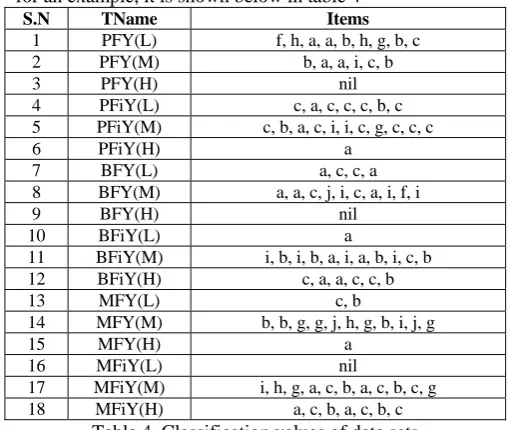
Step 2: Create a Classification of fuzzy values.The fuzzy values falls under the range of 0.01 to 0.10 is belong to category of ‘a’ item set. Similarly the fuzzy values fall under the range of 11 to .20 is belong to category of b item sets and so on upto item set ‘j’. These are is depicted on table 3 .
Table 3. The fuzzy classification table Step: 3 Take the proposed Database
Provide the proposed data set to its classified based value. for an example, it is shown below in table 4
S.N TName Items
1 PFY(L) f, h, a, a, b, h, g, b, c
2 PFY(M) b, a, a, i, c, b
3 PFY(H) nil
4 PFiY(L) c, a, c, c, c, b, c 5 PFiY(M) c, b, a, c, i, i, c, g, c, c, c
6 PFiY(H) a
7 BFY(L) a, c, c, a
8 BFY(M) a, a, c, j, i, c, a, i, f, i
9 BFY(H) nil
10 BFiY(L) a
11 BFiY(M) i, b, i, b, a, i, a, b, i, c, b
12 BFiY(H) c, a, a, c, c, b
13 MFY(L) c, b
14 MFY(M) b, b, g, g, j, h, g, b, i, j, g
15 MFY(H) a
16 MFiY(L) nil
17 MFiY(M) i, h, g, a, c, b, a, c, b, c, g 18 MFiY(H) a, c, b, a, c, b, c
Table 4. Classification values of data sets S.N Polytechnic
Engineering Graduate
Engineering Post Graduate PFY PFiY BFY BFiY MFY MFiY 1 60 65 68 76 66 75 2 61 68 78 67 67 77 3 58 67 62 76 70 70 4 67 65 64 80 80 88 5 62 76 74 83 78 85 6 63 72 73 81 74 87 7 72 65 66 75 77 88 8 57 70 61 88 78 85 9 59 80 62 86 82 90 10 61 64 73 72 76 82 11 66 66 70 85 74 85 12 64 64 73 83 71 78
SN 1 2 3 4 5 6 7 8 9 10 11 12 P L
F M Y H
.6 .0 .8 .1 .1 .2 .0 .8 .7 .0 .2 .3 .0 .0 .2 .1 .1 .9 .0 .0 .0 .0 .3 .2 .0 .0 .0 .0 .0 .0 .0 .0 .0 .0 .0 .0 P L
Fi M Y H
.3 .0 .1 .3 .0 .0 .3 .0 .0 .3 .2 .3 .3 .0 .2 .3 .9 .9 .3 .7 .0 .3 .3 .3 .0 .0 .0 .0 .0 .0 .0 .0 .1 .0 .0 .0 B L
F M Y H
.0 .0 .1 .3 .0 .0 .3 .0 .1 .0 .0 .0 .0 .6 .1 .3 1 .9 .3 .0 .1 .9 .6 .9 .0 .0 .0 .0 .0 .0 .0 .0 .0 .0 .0 .0 B L
Fi M Y H
.0 .1 .0 .0 .0 .0 .0 .0 .0 .0 .0 .0 .9 .2 .9 .0 .2 .1 .9 .1 .2 .9 .3 .2 .0 .0 .0 .0 .3 .1 .0 .1 .3 .0 .3 .0 M L
F M Y H
.3 .2 .0 .0 .0 .0 .0 .0 .0 .0 .0 .0 .2 .2 .7 .0 .7 1 .8 .7 .2 .9 1 .7 .0 .0 .0 .0 .0 .0 .0 .0 .1 .0 .0 .0 M L
Fi M Y H
.0 .0 .0 .0 .0 .0 .0 .0 .0 .0 .0 .0 .9 .8 .7 .1 .3 .2 .1 .3 .0 .2 .3 .7 .0 .0 .0 .1 .3 .2 .1 .3 .0 .2 .3 .0
S.N Item Range
1 a 0.01-0.10
2 b 0.11-.20
3 c 0.21-0.30
4 d 0.31-0.40
5 e 0.41-0.50
6 f 0.51-0.60
7 g 0.61-0.70
8 h 0.71-0.80
9 i 0.81-0.90
10 j 0.91-1
1 Low Middle High
Membership Value
Marks
Step:4 Find out the large itemset L1 L1
S.N Itemset Frequency
1 a 21
2 b 19
3 c 28
4 g 8
5 i 12
Table 5. L1 Item sets
Step 5: Now we will define the minimum support as .4 and the minimum confidence threshold as .5.
Step 6: find out the candidate itemset C1.
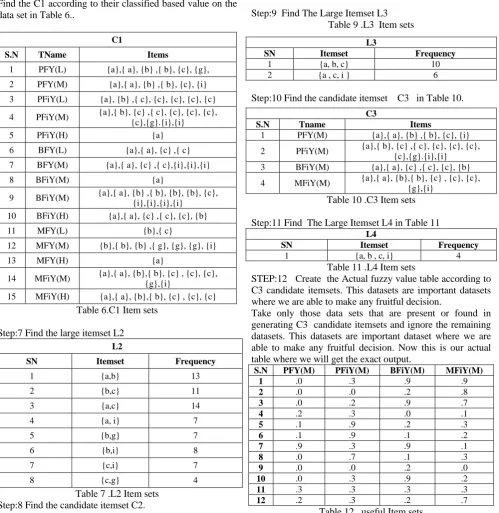
Find the C1 according to their classified based value on the data set in Table 6..
C1
S.N TName Items
1 PFY(L) {a},{ a}, {b} ,{ b}, {c}, {g},
2 PFY(M) {a},{ a}, {b} ,{ b}, {c}, {i}
3 PFiY(L) {a}, {b} ,{ c}, {c}, {c}, {c}, {c}
4 PFiY(M) {a},{ b}, {c} ,{ c}, {c}, {c}, {c}, {c},{g}.{i},{i}
5 PFiY(H) {a}
6 BFY(L) {a},{ a}, {c} ,{ c}
7 BFY(M) {a},{ a}, {c} ,{ c},{i},{i},{i}
8 BFiY(M) {a}
9 BFiY(M) {a},{ a}, {b} ,{ b}, {b}, {b}, {c}, {i},{i},{i},{i}
10 BFiY(H) {a},{ a}, {c} ,{ c}, {c}, {b}
11 MFY(L) {b},{ c}
12 MFY(M) {b},{ b}, {b} ,{ g}, {g}, {g}, {i}
13 MFY(H) {a}
14 MFiY(M) {a},{ a}, {b},{ b}, {c} , {c}, {c}, {g},{i}
15 MFiY(H) {a},{ a}, {b},{ b}, {c} , {c}, {c} Table 6.C1 Item sets
Step:7 Find the large itemset L2 L2
SN Itemset Frequency
1 {a,b} 13
2 {b,c} 11
3 {a,c} 14
4 {a, i} 7
5 {b,g} 7
6 {b,i} 8
7 {c,i} 7
8 {c,g} 4 Table 7 .L2 Item sets
Step:8 Find the candidate itemset C2.
Table 8 .C2 Item sets
Step:9 Find The Large Itemset L3 Table 9 .L3 Item sets
Step:10 Find the candidate itemset C3 in Table 10.
Table 10 .C3 Item sets
Step:11 Find The Large Itemset L4 in Table 11 L4
SN Itemset Frequency
1 {a, b , c, i} 4
Table 11 .L4 Item sets
STEP:12 Create the Actual fuzzy value table according to C3 candidate itemsets. This datasets are important datasets where we are able to make any fruitful decision.
Take only those data sets that are present or found in generating C3 candidate itemsets and ignore the remaining datasets. This datasets are important dataset where we are able to make any fruitful decision. Now this is our actual table where we will get the exact output.
S.N PFY(M) PFiY(M) BFiY(M) MFiY(M)
1 .0 .3 .9 .9
2 .0 .0 .2 .8
3 .0 .2 .9 .7
4 .2 .3 .0 .1
5 .1 .9 .2 .3
6 .1 .9 .1 .2
7 .9 .3 .9 .1
8 .0 .7 .1 .3
9 .0 .0 .2 .0
10 .0 .3 .9 .2
11 .3 .3 .3 .3
12 .2 .3 .2 .7
Table 12 . useful Item sets C2
S.N TName Items
1 PFY(L) {a},{ a}, {b} ,{ b}, {c}, {g} 2 PFY(M) {a},{ a}, {b} ,{ b}, {c}, {i} 3 PFiY(L) {a}, {b} ,{ c}, {c}, {c}, {c}, {c}
4 PFiY(M) {a},{ b}, {c} ,{ c}, {c}, {c}, {c}, {c},{g}.{i},{i} 5 BFY(M) {a},{ a}, {c} ,{ c},{i},{i},{i}
6 BFiY(M) {a},{ a}, {b} ,{ b}, {b}, {b}, {c}, {i},{i},{i},{i}
7 BFiY(H) {a},{ a}, {c} ,{ c}, {c}, {b} 8 MFY(M) {b},{ b}, {b} ,{ g}, {g}, {g}, {i} 9 MFiY(M) {a},{ a}, {b},{ b}, {c} , {c}, {c}, {g},{i} 10 MFiY(H) {a},{ a}, {b},{ b}, {c} , {c}, {c}
L3
SN Itemset Frequency
1 {a, b, c} 10
2 {a , c, i } 6
C3
S.N Tname Items
1 PFY(M) {a},{ a}, {b} ,{ b}, {c}, {i}
2 PFiY(M) {a},{ b}, {c} ,{ c}, {c}, {c}, {c}, {c},{g}.{i},{i} 3 BFiY(M) {a},{ a}, {c} ,{ c}, {c}, {b}
Step 13: Find the candidate itemset C1 fromactual fuzzy set.
Take the linguistic value PFY(M) as above example, the scalar cardinality is (.2 + .1 +. 1 + .9 +. 3 + .2) = 1.8.The C1 candidate itemset for this example is shown as follows: {(PF1Y(M),4.5), (BFiY(M),5.0), (MFiY(M),,4.6)}
S.N PFY(M) PFiY(M) BFiY(M) MFiY(M)
1 .0 .3 .9 .9
2 .0 .0 .2 .8
3 .0 .2 .9 .7
4 .2 .3 .0 .1
5 .1 .9 .2 .3
6 .1 .9 .1 .2
7 .9 .3 .9 .1
8 .0 .7 .1 .3
9 .0 .0 .2 .0
10 .0 .3 .9 .2
11 .3 .3 .3 .3
12 .2 .3 .2 .7
1.8 4.5 5.0 4.6 Table 13 . C1 Value
Step 14: Find the L1 large itemset.
The large itemset rides on the count value, which is greater than the minimum support value.In this exemplary dataset, L2 can be denoting as follows:
{(PFiY(M),(MFiY(M),2.30),(BFiY(M),(MFiY(M),3.00 ) }
Step:15 Find the candidate itemset C2 from l1 we will take the lesser membership value when we compare the two itemsets
S.N PFiY(M) BFiY(M) PFiY(M),
MFiY(M)
1 .3 .9 .3
2 .0 .2 .0
3 .2 .9 .2
4 .3 .0 .0
5 .9 .2 .2
6 .9 .1 .1
7 .3 .9 .3
8 .7 .1 .1
9 .0 .2 .0
10 .3 .9 .3
11 .3 .3 .3
12 .3 .2 .2
Table 14: C2 values
Step:16 find the L2 Large itemset
The linguistic value (PFiY(M), MFiY(M)) has the scalar cardinality of .3+.2+.2+.1+.3 +.1+.3+.1 +3+ .3+2=2.00. The Large itemset L2 shown as
The l2 large item set rides on the count value, which is greater than the minimum support.
{ (PFiY(M),(BFiY(M)),(PFiY(M),MFiY(M),2.30) (BFiY(M),MFiY(M) 3.00)}
STEP:17 Find the C3 candidate itemset
S.N PFY(M) BFiY(M) MFiY(M) PFiY(M),BFiY(M) MFiY(M)
1 .0 .9 .9 .3
2 .0 .2 .8 .0
3 .0 .9 .7 .2
4 .2 .0 .1 .0
5 .1 .2 .3 .2
6 .1 .1 .2 .1
7 .9 .9 .1 .1
8 .0 .1 .3 .1
9 .0 .2 .0 .0
10 .0 .9 .2 .2
11 .3 .3 .3 .3
12 .2 .2 .7 .2
Step 18.Construct the association rules for all the largeset .there are three possible association rules.
If BFiY = middle, then MFiY = Middle; If PFiY = Middle, then MFiY = Middle;
(b)We can also find the confidence of all the rule. Suppose our minimum threshold is .50 for confidence. Its confidence value is calculated as:
The confidence values of the other two rule are shown below.
“If BFiY = Middle, then MFiY = Middle” has a confidence value of 0.60;
“If PFiY = Middle, then MFiY = Middle” has a confidence value of 0.51;
The final resulting rules are thus obtained:
“If BFiY = Middle, then MFiY = Middle” has a confidence value of 0.60;
“If PFiY = Middle, then MFiY = Middle” has a confidence value of 0.51;
V. CONCLUSION
We can reduce the time complexity of large data set by using fuzzy data mining TRApriori classified based algorithm.
We can remove our quantitatively data set in to the qualitatively data set that are used to perform association of itemset.
Our classification based TRApriori fuzzy based mining association algorithm will also work on low support value and provide the fruitful result.
Our simple classification technique on this approach is also able to remove the unwanted data sets that are not useful for making the decision system.
We can also combine the fuzzy techniques, TRApriori Algorithm and classification technique to provide the close output.
ACKNOWLEDGMENT
We would like to express our sincere thankfulness to our guide Dr Priyanka Tripathi, for their helpful support and valuable advice during our research work.
REFERENCES
[1] Tzung-Pei Honga,Chan-Sheng Kuob,Shyue-Liang Wangc “A fuzzy AprioriTid mining algorithm with reduced computational time” Volume 5, Issue 1, December 2004, Pages 1–1
S.N itemset Frequency
1 PFiY(M),(BFiY(M)) 2.00
2 BFiY(M),(MFiY(M)) 3.00
[2] Tiberiu Ban , Fuzzy computing for complexity level of evaluation tests. Studia Univ, Babes-Bolai, Informatica, Volume LVIII number 1, 2013
[3] Tzung-pei-Hang, Guo-Cheng lan, Yi-Hsin lin and Shing-tai pan. An effective gradual data reduction strategy for fuzzy item set mining international journal of fuzzy systems , vol 15 no2 june 2013. [4]Usha Rani, R Vijaya Prakkash, Dr A. Gavardhan,Mining Multi-level
association Rules using fuzzy logic, International journal of emerging technology and advanced engineering. Volume 3, issue 8, August 2013.
[5] Ruchi Bhargava , Shrikant lade , Effective positive negative association rule mining using improved frequent pattern tree. International journal of advanced research in computer science and software engineering . Volume 3 , issue 4 April 2013 .
[6] Dharmendra Kumar , Deepak Bhardwaj rise of data mining: Current and Future application areas. IJCSI international journal of computer science issue vol 8 issue 5 No1 September 2011.
[7] Kanu Patel , Vatsal shal , jitendra patel , jayna donga comparision of various association rule mining algorithm on frequent itemsets. International journal of advanced research in computer Science and software engineering Vol-3 issue II nov 2013 .
[8] Jr Shian chen hung lieh chou, Ching Hsue Cheng, jen-ya Wang CPDA Based Fuzzy association rules for learning achievement mining, 2009 international conference on machine learning and computing IPCSIT vol3 (2011) IACSIT PRESS SINGAPUR.
[9]E Ramaraj, K Rameshkumar, N Venkatesan”A better performed transaction Reduction algorithm for mining frequent item set from large voluminous database”Volume 5, Issue 1, December 2004, Pages 1–10
[10] R. Agrawal, T. Imielinksi and A. Swami, “Mining association rules between sets Submitted manuscript 24 of items in large database,“ The 1993 ACM SIGMOD Conference, Washington DC,USA, 1993. [11] R. Agrawal, T. Imielinksi and A. Swami, “Database mining: a
performance perspective,” IEEE Transactions on Knowledge and Data Engineering, Vol. 5, No.6, 1993, pp. 914-925.
[12] R. Agrawal, R. Srikant and Q. Vu, “Mining association rules with item constraints,” The Third International Conference on Knowledge Discovery in Databases and Data Mining, Newport Beach, California, August 1997.
[13] R. Agrawal and R. Srikant, “Fast algorithm for mining association rules,” The International Conference on Very Large Data Bases, 1994, pp. 487-499.
[14] A. F. Blishun, “Fuzzy learning models in expert systems,” Fuzzy Sets and Systems, Vol. 22, 1987, pp 57-70.
[15] C. H. Cai, W. C. Fu, C. H. Cheng and W. W. Kwong, “Mining association rules with weighted items,” The International Database Engineering and Applications Symposium, 1998, pp. 68-77. [16] L. M. de Campos and S. Moral, “Learning rules for a fuzzy inference
model,” Fuzzy Sets and Systems, Vol. 59, 1993, pp.247-257. [17] R. L. P. Chang and T. Pavliddis, “Fuzzy decision tree algorithms,”
IEEE Transactions on Systems, Man and Cybernetics, Vol. 7, 1977, pp. 28-35. Submitted manuscript 25
[18] M. Delgado and A. Gonzalez, “An inductive learning procedure to identify fuzzy systems,” Fuzzy Sets and Systems, Vol. 55, 1993, pp. 121-132.
[19] W. J. Frawley, G. Piatetsky-Shapiro and C. J. Matheus, “Knowledge discovery in databases: an overview,” The AAAI Workshop on Knowledge Discovery in Databases, 1991, pp. 1-27.
[20] A.Gonzalez, “A learning methodology in uncertain and imprecise environments,” International Journal of Intelligent Systems, Vol. 10, 1995, pp. 57-371.
[21] T. P. Hong, C. H. Chen, Y. L. Wu and Y. C. Lee, "Using divide-and-conquer GA strategy in fuzzy data mining", The Ninth IEEE Symposium on Computers and Communications, 2004.
[22] T. P. Hong and J. B. Chen, "Finding relevant attributes and membership functions," Fuzzy Sets and Systems, Vol. 103, No. 3, 1999, pp.389-404.
[23] T. P. Hong and J. B. Chen, "Processing individual fuzzy attributes for fuzzy rule induction," Fuzzy Sets and Systems, Vol. 112, No. 1, 2000, pp. 127-140.
[24] T. P. Hong and C. Y. Lee, "Induction of fuzzy rules and membership functions from training examples," Fuzzy Sets and Systems, Vol. 84, 1996, pp. 33-47.
[25] T. P. Hong, C. S. Kuo, and S. C. Chi, “Mining association rules from quantitative data,” Intelligent Data Analysis, Vol. 3, No. 5, 1999, pp. 363-376. A. Kandel, Fuzzy Expert Systems, CRC Press, Boca Raton, 1992, pp.8-19. Submitted manuscript 26
[26] H. Mannila, “Methods and problems in data mining,” The International Conference on Database Theory, 1997.
[27] R. Srikant and R. Agrawal, “Mining quantitative association rules in large relational tables,” The 1996 ACM SIGMOD International Conference on Management of Data, Monreal, Canada, June 1996, pp. 1-12. [20] C. H. Wang, J. F. Liu, T. P. Hong and S. S. Tseng, “A fuzzy inductive learning strategy for modular rules,” Fuzzy Sets and Systems, Vol.103, No. 1, 1999, pp.91-105.
[28] S. Yue, E. Tsang, D. Yeung and D. Shi, “Mining fuzzy association rules with weighted items,” The IEEE International Conference on Systems, Man and Cybernetics, 2000, pp. 1906-1911.
[29] L. A. Zadeh, “Fuzzy sets,” Information and Control, Vol. 8, No. 3, 1965, pp. 338-353.
Rohit Miri is currently pursuing P.hd and H.O.D of Computer Science and Engineering, Dr. C.V. Raman University, Bilaspur, India. He received his B.E. degree in Computer Science and Engineering from the NIT, Raipur (formally known as Government Engineering College, Raipur) in 2004, and M. Tech degree in Computer Science from College of Engineering, Pune Maharastra, India. IN 2008 .His research interests include application of Artificial intelligence in robotics, Web Technologies, Data mining & Warehousing ,Cellular Technology.
Dr Priyanka Tripathi is working as an Assistant Professor in the Department of Computer Application at National Institute of Technology, Raipur. She has also worked on various projects in Tata Consultancy Services. She has done MCA in Govt Engineering College Raipur. Ph.D from Maulana Azad National Institute of Technology, Bhopal. Working in the area of web Technology,networking, agile computing. Presented various paper in International Conferences at USA, Thailand etc. Also Chaired sessions in international conferences.