© 2015, IRJET.NET- All Rights Reserved
Page 471
Tree structure based Optimized Multicast Routing Algorithm in MANET
Vikas R. Palekar
1
Assistant Professor, Department of CSE , DMIETR, Maharashtra, India
---***---Abstract -
Portable Ad-hoc Network (MANETs)assume a vital part in crisis interchanges where system needs to be built briefly and rapidly. Since the hubs move haphazardly, steering conventions must be very viable and dependable to ensure fruitful parcel conveyance. In view of the information conveyance structure, the majority of the current multicast steering conventions can be arranged into two organizers: tree-based and lattice tree-based. We watch that tree-tree-based ones have high sending effectiveness and low utilizations of transfer speed, and they may have poor power in light of the fact that one and only connection exists between two hubs. As a tree based multicast steering convention, MAODV(Multicast Ad hoc On-interest Vector) demonstrates a great execution in lightweight specially appointed systems. As the heap of system expands, QoS ( Quality of Service ) is corrupted clearly. We dissect the effect of system load on MAODV convention, and propose an advanced convention MAODV-BB (Multicast Ad hoc On-interest Vector with Backup Branches), which enhances strength of the MAODV convention by joining focal points of the tree structure and the lattice structure. It can redesign shorter tree limbs as well as build a multicast tree with reinforcement branches. Scientific investigation and reproduction results both exhibit that the MAODV-BB convention enhances the system execution over traditional MAODV in substantial burden specially appointed systems.
Key Words:
multicast routing, MAODV, tree structure,
backup branch
1. INTRODUCTION
Versatile specially appointed systems (MANETs) are self-arranging remote systems with no altered framework and concentrated administration .All the hubs move haphazardly, which speak with one another through multi-jump remote connections. In the event that two versatile hubs are not inside radio range, the correspondence between them can be built through one or more halfway hubs. Multicast is a productive approach to transmit bundles from one point or multi-focuses to multi-focuses, which can decrease the utilizations of system
© 2015, IRJET.NET- All Rights Reserved
Page 472
different systems. we consider a tree-based case and proposean improved convention MAODV-BB (Backup Branches) to enhance the execution of MAODV in overwhelming burden impromptu systems. The key thought of MAODV-BB calculation is to make full utilization of GRPH (Group-hi) messages that the gathering pioneer telecasts intermittently to overhaul shorter tree limbs and develop a multicast tree with reinforcement branches. The shorter branches diminish the asset involved and the presence of reinforcement branches dodges vast quantities of tree reproductions and upgrades heartiness of the convention. The enhanced convention doesn't bring additional control overhead, as well as guarantees high parcel conveyance proportion and low end-to-end delay. MAODV convention and dissects the effect of system load on MAODV the upgraded convention MAODV-BB in subtle element demonstrates in non-formal systems and determines the scientific presents reenactment results.
2. RELATED WORK
To give solid multicasting suitable to portable impromptu systems, a few specialists have continued attempting to improve existing multicast steering conventions. The fundamental ways to deal with enhance the power of tree-based multicast directing conventions are the improvement of selecting course component, hub versatility forecast, the foundation of various trees, the usage of multipath steering et cetera. Presents an Entropy-based long-life multicast steering convention in MAODV (E-MAODV)[8]. It utilizes entropy ideas to build up a systematic demonstrating, and chooses the long life multicast steering as indicated by entropy metric. This change diminishes the quantity of course remaking and guarantees the course solidness in element versatile systems, however it expands multifaceted nature of course foundations. Besides, this paper takes no additional measure to repair broken tree limbs. NMP-MAODV[9] (Node Mobility
Prediction-MAODV )guarantees non-separation
correspondence by dynamic connection switch before versatile hub splits far from upstream hub's sign extent. The multicast bunch individuals set the brought together cycle and compute the anticipated flight time.
On the off chance that the outcome is not as much as limit, then swing to the dynamic connection switch process. On the off chance that the connection switch methodology comes up short, it will start the MAODV repair process. The enhanced convention can work legitimately in profoundly portable system, however it builds extra control overhead because of MACT messages. In (RMAODV) [10] a Reliability of the Multicast Ad Hoc On-Demand Distance Vector directing
convention is proposed, which is in light of a convention transfer idea. The essential plans for solid correspondence can be named sender launched and beneficiary started methodologies. In the collector launched methodology, every beneficiary keeps up accepting records and appeals retransmission by means of a negative affirmation (NACK ) when slips happen. In RMAODV, we utilize the collector launched methodology and convention transfers are set along the multicast tree. Every hand-off hub has one and only upper hand-off to demand a retransmission.
Then again, one hand-off hub may have a few lower transfer hubs. At the point when a hand-off hub identifies a misfortune, it sends a NACK back to its upper transfer hub. The enhanced convention has a superior execution for bundle conveyance proportion and decreases the quantity of parcel re-transmissions, however it builds the likelihood of accepting information duplication to the beneficiaries in a multicast group.MT-MAODV[11] presents an improved steering convention (Multiple Tree-MAODV which focuses on issue identified with feature multicast over versatile specially appointed systems. To keep up nonstop feature spilling, it propose an augmentation to MAODV to develop two very disjoint trees.
© 2015, IRJET.NET- All Rights Reserved
Page 473
structure itself has been taken to streamline tree-basedmulticast directing conventions. To overcome such
wastefulness, we consolidate focal points of the tree structure and the lattice structure to advance the multicast tree structure, including redesigning shorter tree limbs and developing a multicast tree with reinforcement branches to enhance unwavering quality of the convention.
3. MAODV PROTOCOL INTRODUCTION
MAODV is an on-interest steering convention in view of separation vector, which is suggested by IETF MANET. In this area, we firstly give a brief depiction of course system in MAODV and afterward talk about the effect of system load on the MAODV convention.
3.1 Route system
MAODV is a steering convention outlined particularly for impromptu systems. Notwithstanding unicast steering, MAODV bolsters multicast and telecast also. MAODV convention develops an imparted conveyance tree to bolster different senders and beneficiaries in a multicast session. The course component in MAODV essentially comprises of course foundations and course systems of support. Television S-checked MACT and M-denoted the tree incoherence can't be kept up at MACT message. As a tree-based multicast steering convention, MAODV depends on flooding through the entire system to find the directing way and secure the multicast tree. At the point when a source hub needs to join a multicast aggregate or has information to send to the multicast bunch, it will show a course ask for (RREQ) message. Moderate hubs build converse course and forward the RREQ message. In the wake of accepting a RREQ message, the individuals from multicast gathering answer a course reply(RREP)message to setup a forward way. In the event that the source hub gets one or more RREP messages from the destination hubs before timeout, it picks one of the courses with the biggest grouping number and the littlest bounce check.
In MAODV, when an on-tree node detects a link broken, it will start the route recovery immediately. Firstly, it needs to determine whether the broken link is upstream or not. If it is, the node will delete the upstream node in its next-hop list, drop multicast data packets which should be sent and then send RREQ message with the flag J to reconstruct anew tree branch. Otherwise, the node will delete the downstream node in its next-hop list and then set pruning timer.
3.2 Impact of network load on the MAODV
protocol
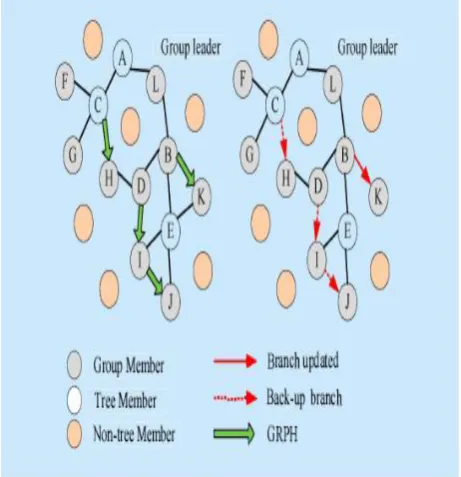
In light load ad hoc networks, the above mechanism of multicast route recovery is effective. Because most applications allow a small amount of packets lost before the multicast route recovery is completed. However, when the network is highly loaded, large number of packets will be discarded and poor robustness of the tree-based protocols appears. Therefore, only depending on the original route maintenance in MAODV cannot ensure the network performance. As shown in figure 1, in order to illustrate the impact of network load, we simply set two source nodes to send multicast packets. Node S I and node S2 both establish the routes to the multicast tree. When any one of multicast group members receives multicast packets, it will broadcast along the multicast tree branches. Due to mobile nodes moving randomly, the structure of established multicast tree may be destroyed partly. It needs to take some time to repair the broken link. During this period, large amounts of multicast data packets arrive in the multicast tree continuously. As a result of the invalid link, the multicast group member C cannot receive any multicast packets from node A and cannot forward multicast packets successfully to other group members, which results in packet delivery ratio decreased.
Fig.1 Impact of network load on MAODV
4. Change OF MULTICAST ROUTING
© 2015, IRJET.NET- All Rights Reserved
Page 474
4.1 GRAPH message development
In MAODV, the gathering pioneer occasionally shows GRPH
messages to redesign or keep up the multicast bunch data.
Keeping in mind the end goal to choose and include
reinforcement branches effectively, we broaden unique GRPH
(Group-hi) messages with the quantity of dynamic
downstream branches in MAODV-BB (Backup Branches).In
our tests, we set a maximum farthest point with the estimation
of three. Practically speaking, when the quantity of
downstream branches is bigger than as far as possible, the
execution of conventions won't be enhanced further. The
configuration of the augmented GRPH messages is
demonstrated in Table 1.
Table 1. The arrangement of GRPH message in MAODV-BB.
4.2 Backup branches selection and addition
In MAODV convention, when an on-tree hub firstly gets a
GRPH message with the same multicast bunch pioneer
location and multicast gathering location, it overhauls the
multicast bunch data in its gathering pioneer table and
multicast steering table. Normally, the GRPH message is
distinguished as the multicast bunch pioneer address and the
multicast gathering location. We include one reinforcement
steering table for each on-tree hub to spare the data of its
reinforcement tree limb in MAODV-BB. To perform the
change, the operation in the wake of accepting a GRPH
message is changed as taken after:
(a) lf it is the first run through for the on-tree hub to get the
GRAPH message, then swing to b, generally dispose of the
GRPH message;
(b) Determine whether the GRAPH message is gotten from its
upstream hub or not. In the event that it is, the hub needs to
perform the same operations MAODV, generally swing to c);
(c ) If the bounce to the gathering pioneer in the GRPH
message is not as much as that in multicast steering table and
the quantity of dynamic downstream branches is under the
point of confinement, then redesign the tree limb, generally
swing to d);
(d)Judge whether there is an accessible reinforcement branch
or not. On the off chance that there is, swing to e), generally
include another reinforcement branch in the reinforcement
steering table.
(e )If the jump to the gathering pioneer in the GRPH message
is not as much as that in the reinforcement steering table, then
upgrade its reinforcement branch, generally surrender the
GRPH message. For instance, in figure 2, hub K firstly gets a
GRPH message from hub B and afterward confirms that the
bounce to the gathering pioneer in the GRPH message is not
as much as that in multicast directing table.
Fig. Backup branches selection and addition
© 2015, IRJET.NET- All Rights Reserved
Page 475
diminish control movement and normal deferral. Besides, hubH, hub I and hub J separately include reinforcement branches in their reinforcement steering tables. Without harming the tree structure, the expansion of reinforcement branches enhances heartiness of the system and guarantees the system execution.
4.3 Multicast tree upkeep
Amid the period of multicast tree upkeep, when the upstream
hub distinguishes the connection broken, it will erase the
downstream hub in its next-jump rundown and set pruning
clock. At the point when the downstream hub distinguishes
the connection broken, it needs to figure out if there is an
accessible reinforcement branch in its reinforcement steering
table. In the event that there is, the downstream hub sends a
multicast initiation message with the banner J to empower the
reinforcement branch. In the meantime, the downstream hub
needs to send a multicast enactment message with the banner
P to prune the first upstream and erases the first upstream hub
in its next-bounce list. The presence of reinforcement
branches maintains a strategic distance from the methodology
of course recuperation and guarantees multicast information
parcels to transmit consistently.
5. Numerical PROVING AND DERIVATION
In this session, we firstly demonstrate that gathering
individuals own littler bounces to the multicast bunch pioneer
in MAODV-BB, because of including the overhaul operation
of tree limbs. The littler the bounce is, the less asset is
possessed. Also, we derivate the mathematic model to
demonstrate that the interim time between two course
recuperations clearly increments in the multicast tree with
reinforcement branches.
5.1 The redesigning operation of tree limbs.
Here we take non-formal routines to demonstrate. Hypothesis
1. The redesign operation of tree limbs can guarantee a fitting
way from a gathering part to the gathering pioneer. Evidence.
There is no vital distinction in the course system between the
enhanced convention MAODV-BB and MAODY. Just amid
the procedure of multicast tree systems of support, we add a
jump component to figure out if to redesign a shorter tree
limb. The redesign operation can give a shorter way from a
gathering part to the gathering pioneer. Therefore, a fitting
way from a gathering part to the gathering pioneer can be
guaranteed. Hypothesis 2. The jumps from gathering
individuals to the gathering pioneer in other course instrument
enhanced conventions are at least that in MAODY. In the
wake of including the redesign operation of tree limbs, the
bounces from gathering individuals to the gathering pioneer in
MAODY-BB are not exactly or equivalent to that in
MAODY. Evidence. Use decrease to foolishness. We expect
that the bounces from gathering individuals to the gathering
pioneer in other course system enhanced conventions are not
as much as that in MAODY.Base on the guideline of
MAODY, we can presume that it is a base bounce convention.
Anyhow, this is in inconsistency with the suspicion .In
MAODV-BB, if a shorter way to the gathering pioneer is
recognized amid the procedure of multicast tree systems for
upkeeps, the hub will overhaul the multicast tree limb.
Subsequently, the enhanced convention MAODY-BB
upgrades the tree structure with shorter branches amid the
period of multicast tree support
5.2 The current of reinforcement branches
The scientific model is determined as takes after: We depict versatile specially appointed systems as a diagram G=(N, E), where N and E individually speak to the hub et s and the connection sets .Assume that a branch P from anon-tree hub to the multicast bunch pioneer comprises of n remote connections.
The i-th link in the branch is denoted by Lj and its lifetime is
defined as Xr. If any one of the wireless links in the branch
breaks, the on-tree node will break away from the multicast
tree. So the lifetime of a branch P considering of n wireless
links can be expressed as Xp, where Xp=min{XLI ,xL2 ...
XL) .It is well known that XI' is an exponentially distributed
random variable. Therefore, its probability density function
© 2015, IRJET.NET- All Rights Reserved
Page 476
(1)
(2)
where k is a parameter associated with n .
Consider an on-tree node which has an available backup
branch to the multicast group leader, where the lifetime of the
tree branch is denoted by Xp1, and the lifetime of the backup
branch is denoted by Xp2,. Assume that Xp1, and Xp2 are
independent. Then the interval time between two route
recoveries in the multicast tree is described as a random
variable T, where
T=max{Xp1,xp2}. The probability density function of T is
calculated as
(3)
Where kl and k2 are the parameters respectively associated
with the tree branch and the backup branch, further Then we
can derive1 the mathematical expectation of T.
(t) dt=
= (t)dt= (4)
According to Eq. (4), it is not difficult to conclude that the
existence of backup branches makes the interval time between
two route recoveries in the multicast tree longer. It not only
reduces the frequency of tree reconstruction but also ensures
high packet delivery ratio in heavy load ad hoc networks. The
addition of backup branches improves robustness of the
tree-based multicast routing protocols and shows the advantages of
both tree-based and mesh-based protocol.
6. SIMULATION RESULTS AND EVALUATION
We run simulations with NS-214 to analyze and
compare MAODV-BB with MAODV in heavy load ad hoc
networks. NS-2 provides substantial support for simulation of
T CP, routing and multicast protocols over wired and
wireless networks.
6.1 Simulation environment
In the following simulation, 20 nodes move randomly in
a square area about 500 x 500 meters. Select 6 nodes to join
the multicast Radio propagation range for each node is 250
meters and channel capacity is 2 Mbps. Each simulation is
executed for 910 seconds of simulation time. A traffic
generator is developed to simulate CBR sources. The size of
the data payload is 512 bytes. Each source node sends out 5
packets per second. In order to test the influence of network
loads on the protocol performance, load of network is set to 5,
10, 15 and 20 packets per second respectively. Two-ray
ground propagation model is used in our experiments, and the
MAC layer protocol is IEEE 802.11. Table 2 lists the
simulation parameters.
6.2 Impact of network load
and average end-to-end delay to evaluate As a tree-based
multicast routing protocol, MAODV shows an excellent
performance in light load ad hoc networks. However, as the
load of network increasing, QoS is degraded obviously. In
order to illustrate the impact of network load on the
performance of MAODV, we select packet delivery ratio,
control overhead e the performance of protocols. Packet
Delivery Ratio Measure related to the reliability of
communication, the delivery ratio R is defined as:
R= (5)
Where is the number of multicast data packets
received at all multicast group members, and is the
number of multicast packets that a source node generated,
besides n is the number of multicast group members.
Control Overhead Control overhead reflects the degree
of network congestion and the efficiency of protocols, the
control overhead C is defined as:
© 2015, IRJET.NET- All Rights Reserved
Page 477
Where n data-s is the number of transmissions of
control packets in the whole network, and is the
same as abovementioned.
End to end average delay End to end average delay is usually
used to evaluate the effectiveness
of routing. Furthermore, it concludes whether the routing is
easy to be built. The end to end average delay T is defined as.
T=
Table II .Simulation parameters.
where total is the total time which multicast data
packets take from the source node to multicast group
members, and is the same as abovementioned. In the
simulation, load of network is set to 5, 10, 15 and 20 packets
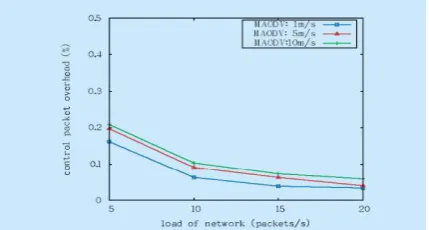
per second respectively. Furthermore, three curves in figure 3,
4 and 5 respectively represent simulation result with the speed
of 1m/s, 5m/s, 10m/s. Obviously, as network load increases,
the MAODV's packet delivery rate decreases. Moreover, as
network load increases, routing overhead also decreases due
to the total number of data bytes received by MAODV
receivers increasing. However control data transmitted,
remains fairly constant with increased network load there by
reducing the routing overhead.
Fig. Impact on packet delivery ratio
Fig. Impact of control overhead
6.3 Simulation results and performance
evaluation
At first, we simulate to prove that packet delivery ratio will
not be improved further when the number of downstream
branches is larger than the upper limit, as is shown in figure
6.In our experiments, we set an upper limit with the value of
three. The average hop from group members to the group
leader reflects the optimization of the multicast tree structure.
Figure 7 shows the comparison of average hop from group
members to the group leader. We observe from the simulation
result that MAODV-BB owns the smallest average hop. On
one hand, the updating operation of tree branches optimizes
the tree structure. On the other hand, backup branches can
provide more effective routing information for group
members. The load of network nearly has no effect on the
multicast tree structure, so the average hop under different
load of network remains almost the same. As follows, we
analyze and compare MAODV-BB with MAODV in heavy
load ad hoc networks by using packet delivery ratio and
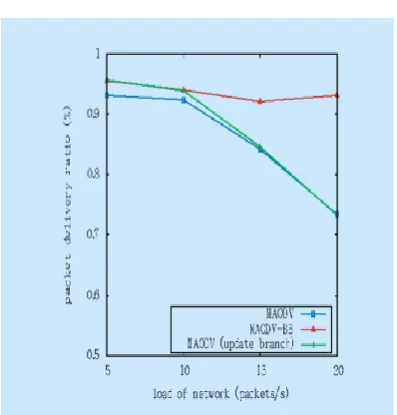
average end-to-end delay. Figure 8 shows the impact of
network load on packet delivery ratio. With the increasing of
© 2015, IRJET.NET- All Rights Reserved
Page 478
descended obviously. When the load of network is 20 packetsper second, the packet delivery rate of MAODV is about 10
percent lower than that in the network with 5 packets per
second. Only adding the updating operation to MAODV
improves the packet delivery ratio when the network load is
light. However, MAODV-BB's packet delivery is always
maintained at a high level even when the network load is
heavy. In MAODV-BB, the existence of backup branches
reduce the frequency of tree reconstruction and ensures high
packet delivery ratio in heavy load ad hoc networks .The
average end-to-end delay of MAODV-BB is least, as is shown
in figure 9. As the increasing of the network load, the packet
delivery delays become longer. This is because that the
recovery procedure takes a long time to repair the partition
and makes a bad effect on data transmitting. It is obvious to
see that the delay of MAODV-BB is always lower than
MAODV's. The update operation of tree branches optimizes
the tree structure and reduces delay.
Fig. Average hop to group leader
Fig. Comparison of packet delivery ratio
7. CONCLUSIONS
In this report, we have first given an introduction to optimised
protocol MAODV-BB based on MAODV, which improves
robustness of MAODV protocol by combining advantages of
tree structure with the mesh structure. The kye idea of
MAODV-BB is to make full use of GRPH messages that the
group leader broadcasts periodically to update shorter tree
branches and construct a multicast tree with backup branches.
It not only optimizes the tree structures but also reduces the
frequency of tree reconstruction. Mathematics modeling
derivations and simulation results both demonstrate that
MAODV-BB protocol improves the network performance
over conventional MAODV in heavy load ad hoc networks
which meets Qos requirements for communication in
MANET.
As further work ,it intend to study the reliability of tree-based
multicast routing protocols in varying condition such as node
mobility, group size. It also consider enhancing our protocol
with a global congestion control mechanism to solve the data
© 2015, IRJET.NET- All Rights Reserved
Page 479
REFERENCES
[1]Conti M ,Giordano S,"Multihop Adhoc networking :the therory ", in proceeding of IEEE Communications Magzine, pages 78-86,2007
[2]Luo Junhai, Ve Danxia, Xue Liu and Fan Mingyu","A survey of multicastrouting protocols for mobile ad-hoc networks",IEEE communication Surveys And Tutorials,pages 78-91,2008
[3]K. Viswanath, K. Obraczka, and G. Tsudik, "Exploring mesh and tree based multicast routing protocols for manets",International Journal of Computer Applications,28-42,2006
[4]E. M. Royer and C. E. Perkins,"Multicast ad hoc on-demand distance vector (maodv) routing", 2013
[5]Mingyang Zhong,Yunqing Fu,Xinqiang Jia,"MAODV protocol based on node mobility Prediction", usiness and E-Government (ICEE), 2011 International Conference,2011
[6]Soni S.k and Aseri T.Ci,"A review of current multicast routing protocol of mobile ad hoc
network"in proc. Second Int Conf.Computer Modeling and Simulation ICCMS,pages 207-211,2010
[7]K.Obkraczka,"Exploring mesh and tree based multicast routing protocols",vol no 5,pages 25-32,2011.
[8]W. S. Vunjung Vi Sung-Ju Le and M. Gerla," On-demand multicast routing protocol (odmrp) for ad hoc networks," draft-ietf-manet-odmrp-04.txt, 2002
[9]Hua Chen, Zhengxiang. Van, Baolin Sun, VueZeng, Xianying He, "An Entropy-Based Longlife Multicast Routing Protocol in MAODV" ISECS International Colloquium on Computing,Communication, Control, and Management,2009, Page(s): 314 -317
[10]Baolin Sun, Hua Chen, and Layuan Li, "A Reliable Multicast Routing Protocol in Mobile Ad Hoc Networks", In Proceedings of the 16th International Conference on Computer
Communication(ICCC2004), Beijing, China, September,2004, pp. 1123-1129
[11]CheeOnn Chow, Hiroshi Ishii. Video multicast over mobile ad hoc networks:" Multiple-
Tree Multicast AdHoc On-demand Distance Vector Routing Protocol (MT -MAODV)".