R E S E A R C H
Open Access
Performance analysis and optimal power
allocation for linear receivers based on
superimposed training
Abla Kammoun
1*and Karim Abed-Meraim
2Abstract
In this paper, we derive a performance comparison between two training-based schemes for multiple-input multiple-output systems. The two schemes are the time-division multiplexing scheme and the recently proposed data-dependent superimposed pilot scheme. For both schemes, a closed-form expression for the bit error rate (BER) is provided. We also determine, for both schemes, the optimal allocation of power between the pilot and data that minimizes the BER.
Keywords: Superimposed training sequence; MIMO systems performance; Linear receiver
1 Introduction
The use of multiple-input multiple-output (MIMO) antenna systems enables high data rates without any increase in bandwidth or power consumption. However, the good performance of the MIMO systems requires a priori knowledge of the channel at the receiver. In many practical systems, the receiver estimates the chan-nel by time division, multiplexing pilot symbols with the data. Although high quality of the channel estimation could be achieved especially when using a large number of pilot symbols [1], this method may entail a waste of the available channel resources. An alternative method is the conventional superimposed training. It consists in transmitting pilots and data at the same time. However, since during channel estimation, the data symbols act as a source of noise, the channel estimation is affected. In the literature, the impact of channel estimation error upon the performance indexes has been investigated. In [2] and [3], a comparison between the performance of the conventional superimposed training scheme and the time-multiplexing-based scheme has been carried out. The optimal power allocation between pilot and data that maximizes a lower bound of the maximum mutual infor-mation criterion has been provided. It has been shown
*Correspondence: [email protected]
1Alcatel-Lucent, Supélec, Plateau de Moulon, 3 rue Joliot Curie, 91192 Gif-sur-Yvette Cedex, Paris, France
Full list of author information is available at the end of the article
that the use of the optimal conventional superimposed training scheme entails a gain in terms of channel capacity only in special scenarios (many receive antennas and/or short coherence time). In other scenarios, the superim-posed training scheme suffers from high channel estima-tion errors, and its gain over the time-multiplexing-based scheme is often lost. For this reason, many alternatives to the conventional superimposed training scheme have been proposed in recent works.
In [4], Ghogho and Swami proposed to introduce a dis-tortion to the data symbols, prior to adding the known pilot in such a way to guarantee the orthogonality between pilot and data sequences. It is shown that the channel estimation performance is by far enhanced as compared to the standard superimposed scheme. This technique is referred to as the data-dependent superimposed training (DDST). While the DDST scheme exhibits the same chan-nel performance as its time-division multiplexed training (TDMT) counterpart, the effect of the introduced distor-tion may considerably affect the detecdistor-tion performance. The aim of this paper is thus to study the BER perfor-mance of the DDST and TDMT schemes, and to evaluate to which extent the performance of the DDST scheme is altered.
In the literature, the few works focusing on BER per-formance have been based on unrealistic assumptions like the uncorrelation between the noise and channel esti-mation error [5,6]. These assumptions make calculations
feasible for fixed size dimensions but are far away from being realistic. To make derivations possible while keeping realistic conditions, we will relax the assumption of finite size dimensions by allowing the space and time dimen-sions to grow to infinity at the same rate. Working with the asymptotic regime allows us to simplify the derivations, and at the same time, we observe that the obtained results apply as well to usual sample and antenna array sizes. We show also that the obtained expressions can be used to determine the optimal power allocation that minimizes the BER.
The remainder of this paper is as follows: in the next section, we introduce the system model. After that, we review in section 3 the channel estimation and data detection processes for the TDMT and DDST schemes. Section 4 is dedicated to the derivation of the asymptotic BER expressions. Based on these results, we determine the optimal allocation of power between data and training for both schemes. Finally, simulation results are provided in section 7 to validate the analytical derivation.
The following notations are used in this paper: Super-scriptsH, #, and Tr(.) denote Hermitian, pseudo-inverse, and trace operators, respectively. The statistical expecta-tion and the Kronecker product are denoted byEand⊗. The (K ×K) identity matrix is denoted by IK, and the
(Q×Q)matrix of all ones by1Q. The(i,j)th entry of a matrixAis denoted byAi,j.
2 System model and problem setting 2.1 Time-division multiplexing scheme
We consider aM×KMIMO system operating over a flat fading channel. Two phases are considered:
First phase: In the first phase, each transmitting antenna sendsN1pilot symbols. The received symbol
Y1writes as:
Y1=HPt+V1,
wherePtis theK×N1pilot matrix, and
Assumption 1. His the M×K channel matrix with independent and identically distributed (i.i.d.) Gaussian variables with zero mean and variance K1.
Assumption 2. V1is the M×N1matrix whose
entries are i.i.d. with varianceσv2.
Second phase: In the second phase,N2data symbols with powerσw2tare sent by each antenna so that the received signal matrixY2writes as:
Y2=HWt+V2,
where
Assumption 3. Wtis the K×N2data matrix with
i.i.d. bounded data symbols of powerσw2t, andV2is
the M×N2additive Gaussian noise matrix with
entries of zero mean and varianceσv2. Moreover,Wt is independent ofV1andV2.
2.2 Data-dependent superimposed training scheme Another alternative to the TDMT-based schemes is to send the training and data sequences at the same time. Since the data is transmitted all the time, these schemes allow efficient bandwidth efficiency but may suffer from the interference caused by the training sequence. Ghogho and Swami [4] proposed thus to distort the data so that is becomes orthogonal to the training sequence. The pro-posed distortion matrixDis defined as:
D=IN−J,
whereJ = KN1N
K ⊗IK, (we assume that N
K is the integer valued, N being the sample size). This distortion matrix was shown to be optimal in the sense that it minimizes the averaged Euclidean distance between the distorted and non-distorted data [7]. The received signal matrix at each block is therefore given by:
Y=HWd(IN−J)+HPd+V,
where
Assumption 4. Wdis the data matrix with i.i.d. bounded data symbols of powerσw2
d, andVis the M×N matrix whose entries are i.i.d. zero mean with varianceσv2.
Moreover,Pdis theK×Ntraining matrix. The chosen pilot matrixPdshould fulfill two requirements. It should be orthogonal to the distortion matrix D, thus satisfy-ingDPH
d = 0, and also verify the orthogonality relation
PdPHd = NσP2dIK in order to minimize the channel esti-mation error subject to a fixed training power. A possible pilot matrix that meets these requirements is
Assumption 5.
Pd(k,n)=σPdexp
j2πkn/K with k=0,· · ·,K−1
and n=0,· · ·,N−1.
(1)
3 Channel estimation and data detection 3.1 TDMT scheme
Ht=Y1PHt
PtPHt
−1
=H+V1PHt
PtPHt
−1
=H+Ht,
where Ht = V1PHt
PtPHt
−1
. Thus, the mean square error (MSE) is written as
MSEt=Mσv2tr
PtPHt
−1
.
As it has been shown in [1], the optimal training matrix that minimizes the MSE under a constant training energy N1σP2tshould satisfy
Assumption 6.
PtPHt =N1σP2tIK,
where σP2
t denotes the amount of power devoted to the transmission of a pilot symbol. The optimal minimum value for the MSEtis then given by
MSEt= KMσv2
N1σP2t .
In the data transmission phase, the linear receiver uses the channel estimate in order to retrieve the transmitted data. After channel inversion, the estimated data matrix is given by
Wt=Ht
#
Y2,
where Ht
#
denotes the pseudo-inverse matrix of Ht. Assuming that the channel estimation error is small, the pseudo-inverse of the estimated matrix can be approxi-mated by the linear part of the Taylor expansion as [8]:
Ht#
=H#−H#HtH#+H#
H#HHt
IM−HH#
. (2)
SubstitutingH#byHHH−1HHin (2), we obtain Ht
#
=H#−H#HtH#+
HHH−1HH
t,
where = IM −HHHH−1HHis the orthogonal pro-jector on the null space of H. Hence, the zero-forcing estimate of the transmitted matrix can be expressed as
Wt=Wt−H#HtWt+
H#−H#HtH#
V2
+HHH−1(H
t)HV2.
Consequently, the effective post-processing noiseWt=
Wt−Wtcould be written as
Wt= −H#HtWt+
H#−H#HtH#
+HHH−1(H
t)H
V2.
3.2 DDST scheme
The LS channel estimate is obtained by multiplyingYby
PH
d
PdPHd
−1
, thus giving
Hd=YPHd
PdPHd
−1=
H+VPH
d
PdPHd
−1=
H+Hd,
whereHd = VPHd
PdPHd
−1
denotes the channel esti-mation error matrix for the DDST scheme. As aforemen-tioned above in Assumption 5, the optimal training matrix that minimizes the MSE should satisfy
PdPHd =NσP2dIK.
The MSE is thus given by:
MSEd=Mσv2tr
PdPHd
−1= KMσv2 NσP2
d .
For the DDST scheme, we consider a zero-forcing receiver which, prior to inverting the channel matrix, cancels the contribution of the training symbols by right multiplying
Yby(I−J), where
Y=HWd(IN−J),
the matrixWdbeing the sent data matrix. Thus, the zero-forcing estimate ofWdis given by
Wd=Hd
#
Y(I−J)
=H#−H#HdH#+
HHH−1HH
d
×(HWd(I−J)+V(I−J)) =I−H#Hd
Wd(I−J) +H#−H#HdH#
V(I−J)
+HHH−1HH
dV(I−J) =Wd(I−J)−H#HdWd(I−J)
+H#−H#HdH#
V(I−J)
+HHH−1HH
dV(I−J) =Wd+
−WdJ−H#HdW(I−J) +H#−H#HdH#
V(I−J)
+HHH−1HH
Hence,
Wd= −WdJ−H#HdWd(I−J) +H#−H#HdH#
V(I−J)
+HHH−1HH
dV(I−J).
4 Bit error rate performance 4.1 TDMT scheme
In order to evaluate the bit error rate performance, we need to evaluate the asymptotic behavior of the post-processing noise observed at each entry of matrixWt. Using the ‘characteristic function’ approach, we can prove that conditioned on the channel matrix, the noise behaves asymptotically like a Gaussian random variable. This result is stated in the following theorem, but its proof is shown in Appendix 1.
Theorem 1. Under Assumptions 1, 2, 3, and 6, and under the asymptotic regime defined as
M,K,N1,N2→ + ∞ with
K N1+N2 →
c1, 0<c1<1
M
K →c2>1 and N2
N1 →
r,
the post-processing noise experienced by the ith antenna at each time k,Wt(i,k), for the TDMT scheme behaves in the asymptotic regime as a Gaussian random variable.
Eej(z∗Wt(i,k))−e−
σwt2δt(HHH)−1
i,i| z|2
4 −−−−−→
K→+∞ 0,
where
δt=c1(1+r)
σv2 σP2 t
+ σv2
σ2
wt
+c1(1+r)(c2+1)σv4
σ2
wtσ
2
Pt(c2−1) ,
and K→ + ∞refers to this asymptotic regime.
Remark 1. Note that as compared to the results in [9], our results make appear a new additive term of orderσv4.
With the Gaussianity of the post-processing noise being verified in the asymptotic case, we can derive the bit error rate for QPSK constellation and Gray encoding as [10]
BER=EQ(√x), (3)
where the expectation is taken with respect to the prob-ability density function of the post processing SNR at the ith branch defined as
γt=
1
δt
(HHH)−1
i,i .
From [11] and [12], we know that 1
(HHH)−1 i,i
is a weighted
chi-square distributed random variable with 2(M−K+1)
degrees of freedom, whose density function is given by
f(x)= K
M−K+1xM−Ke−Kx
(M−K)! 1[0,+∞[,
where 1[0,+∞[ is the indicator function corresponding
to the interval [0,+∞[. Hence, the probability density function ofγtis given by
fγt(x)= (Kδt)
M−K+1xM−Kexp(−Kδ tx)
(M−K)! 1[0,+∞[. (4)
Plugging (4) into (3), we get:
BERt=
(Kδt)M−K+1
(M−K)!
+∞
0
xM−Kexp(−Kδtx)Q(√x)dx.
(5)
To compute (5), we use the following integral function:
J(m,a,b)= a
m
(m)
+∞
0
exp(−ax)xm−1Q(√bx)dx.
(6)
The BER is, therefore, equal to
BER=J(M−K+1,Kδt, 1). (7)
The integral in (6) has been shown to have, forc > 0, the following closed-form expression [13]:
J(m,a,b)=
√
c/π (m+12)
2(1+c)m+12(m+1)2
×F1(1,m+
1 2;m+1;
1
1+c), c= b 2a,
where2F1(p,q;n,z)is the Gauss hypergeometric function
[14]. If c = 0 equivalently b = 0, it is easy to note thatJ(m,a, 0)is equal to 12. Whenmis restricted to pos-itive integer values, the above equation can be further simplified to [15]
J(m,a,b)= 1
2
1−μ
m−1
k=0
2k k
1−μ2
4
k
, (8)
Plugging (8) into (7), we get
4.2 DDST scheme
Unlike the TDMT scheme, the asymptotic distribution of entries of the post-processing noise matrix is not Gaus-sian. Actually, we prove that
Theorem 2. Under assumptions 4, 5, and under the asymptotic regime defined as
K
N →c1, 0<c1<1 with M
K →c2>1,
the post-processing noise experienced by the ith antenna at each time k behaves asymptotically as a Gaussian mixture random variable, i.e.,
Eexpjz∗[Wd]i,k
andQ is the cardinal of the set of all possible values of
We can also prove that conditioning on the fact that
[W]i,k=1
the post-processing noise satisfies
E
whereQ is the cardinal of the set of all possible values Wi = c1
1
c1−1
l=1 [W]i,l, and p
i is the probability that Wi takes the valueαi.
Proof.See Appendix 2.
The assumption of the Gaussianity of the post-processing noise has been always assumed. For time-division multiplexed training, this assumption is well founded, since the post-processing noise converges to a Gaussian distribution in the asymptotic regime (see Theorem 1).
In the superimposed training case, the distortion caused by the presence of data symbols affects the distribution of the post-processing noise which becomes asymptot-ically Gaussian mixture distributed. To assess the sys-tem performance in this particular case, we will start from the elementary definition of the bit error rate. Let
Wi,k denote the post-processing noise experienced at the ith antenna at time k (we omit the subscript d for ease of notations). As it has been previously shown that
Wi,k behaves as a Gaussian mixture random variable. Let σd2 be the asymptotic variance of Wi,k, i.e.,σd2 =
Using the symmetry of the transmitted data, the BER expression at the ith branch under QPSK constellation and for a given channel realization is given by
BERi=
Hence, conditioned on the channel, the asymptotic bit error rate can be approximated by
BERi,d=
Finally, the proposed approximation of the BER can be obtained by averaging with respect to the channel realizationH, thus giving
BERd=E
For QPSK constellations, it can be shown that#Q =
1
c1, where 1
c1 =
N
K is assumed to be integer. Moreover, the setSof the values taken by(αs)can be given by
σd , then the BER expression becomes
BERd=E
where the expectation is taken over the distribution ofγd given by
fγd(x)= (Kδd)
M−K+1xM−K
(M−K)! exp(−Kδdx).
The computation of the BER can be treated similarly to the TDMT scheme, thus leading to
BERd=
5 Optimal power allocation
So far, we have provided the approximations of the BER for the TDMT and DDST schemes. As it has been pre-viously shown, these expressions depend on the power allocated to data and training, in addition to other param-eters. While the system has no control over the noise power or the number of transmitting and receiving anten-nas, it still can optimize the power allocation in such a way to minimize this performance index. Next, we provide for the TDMT and DDST schemes the optimal data and training power amounts that minimize the BER under the constraint of a constant total power.
5.1 Optimal power allocation for the TDMT scheme Referring to the expressions of BER, we can easily see that the optimal amount of power allocated to data and pilot for the TDMT scheme is the one that min-imizes δt. Let c˜1 = (1 + r)c1, then minimizing δt with respect to σw2t and σP2
t under the constraint that N1σP2t+N2σw2t =(N1+N2)σ
2
T (σT2being the mean energy per symbol) results in the following lemma:
5.2 Optimal power allocation for the DDST scheme
For the DDST scheme, we can deduce from (13) that maximizingγdleads to minimize the BER. To maximizeγd, we need to optimizeδdas a function ofσw2dand under the constraint thatσ
2
Pd+(1−c1)σ
2
wd =σ
2
T. After straightforward calculations, we can find that the optimal values forσw2
dandσ
2
Pdare given by
Lemma 2. Under the data model, the optimal power allocation minimizing the BER under a total power constraintσT2 is given by
σw2 d=
(1−c1)
σT2+ c1(c2+1)σv2 c2−1
σT2
(1−c1)
(1−c1)
σT2+ c1(c2+1)σv2 c2−1
+c1σT2+ c1(c2+1)(1−c1)σ 2
v c2−1
, (17)
σP2 d=
c1σT2+ c1
(c2+1)(1−c1)σv2 c2−1 σ
2
T
(1−c1)
σT2+c1(c2+1)σv2 c2−1
+c1σT2+c1
(c2+1)(1−c1)σv2 c2−1
. (18)
6 Discussion
To get more insight into the proposed analysis, we provide here some comments and workouts on the theoretical results derived in the previous sections.
6.1 High SNR behavior of the BER
At high SNRs, the error variance parameters δt andδd are close to zero, and hence, using a first-order Taylor expansion of the BER expressions in (9) and (14), we obtain
BERt≈ 1
2M−K+1(Kδt)
M−K+1
2(M−K)+1 M−K+1
(19)
BERd≈ 1
2c11
+O((Kδd)M−K+1), (20)
whereO(x)denotes a real value of the same order of mag-nitude as x. From these approximated expressions, one can observe that the BER at the TDMT scheme is a mono-mial function of the estimation error variance parameter
δ and the number of transmittersK. For example, if the noise power is decreased by a factor 2, then the BER will decrease by 2M−K+1. The diversity gain is thus equal to M− K + 1, which is in accordance with the works in [16] and [5]. Also, we observe that for the DDST case, we have a floor effect on the BER (i.e., the BER is lower bounded by 1
2c11) due to the data distortion inherent to this transmission scheme.
6.2 Gaussian vs. Gaussian mixture model
In our derivations, we have found that the post-processing noise in the DDST case behaves asymptotically as a Gaus-sian mixture process, while in most of the existing works, the noise is assumed to be asymptotically Gaussian dis-tributed. In fact, one can show that for large sample sizes (i.e., whenc1 −→ 0), the Gaussian mixture converges to
a Gaussian distribution, allowing us to retrieve the stan-dard Gaussian noise assumption. However, for small or moderate sample sizes, the considered Gaussian mixture model leads to a much better approximation of the BER analytical expression than the one we would obtain with a post-processing Gaussian noise model. In other words, Theorem 2 results allow us to derive closed-form expres-sions for the BER that are valid for relatively small sample sizes.
6.3 Workouts on the optimal power allocation expressions of the TDMT scheme
We consider here two limit cases: (1) The high SNR case, whereσv2σT2and (2) the case of high-dimensional sys-tem (the number of transmit antennae is of the same order of magnitude as the number of receiver antennae), where c2−1 1. From (16), the data-to-pilot power ratio can
then be approximated by
case (1) σ
2
wt σP2 t
≈ √N1
N2K
(21)
case (2) σ
2
wt σP2 t
≈ N1
N2
. (22)
Equation (21) shows that the optimal power allocation in the high SNR case realizes a kind of trade-off between the pilot size and its power, such that the total energy N1σP2tis kept constant. This suggests us to use the smallest possible pilot size that meets the technical constraint of limited transmit power, to increase the effective channel throughput without loss of performance.
(in terms of power allocation) to the channel estimation and to the data detection.
6.4 Workouts on the optimal power allocation expressions of the DDST scheme
A similar workout is considered here for the DDST scheme. We consider the two previous limit cases, and we assume that the sample size is much larger than the num-ber of transmitters, i.e.,NK. In this context, we obtain the following approximations for the data-to-pilot power ratio:
case (1) σ
2
wd σP2
d ≈
N
K (23)
case (2) σ
2
wt σP2 t
≈1. (24)
Again, we observe that for the large-dimensional system case, one needs to allocate the same total energy to pilot and to the data. For high SNRs, one observes a kind of trade-off between the pilot power and size, but in a differ-ent way than the TDMT case. In fact, if we increase by a factor of 4 the sample size, one can increase the data-to-pilot power ratio by a factor of 2 without affecting the BER performance.
6.5 High SNR BER comparison of the two pilot design schemes
For the DDST scheme, the BER expression can be lower bounded as follows (using the convexity ofQ(√bx) as a function ofb):
BERd= 1
2c11−1
1
c1−1
s=0
1
c1 −1
s
J(M−K+1,Kδd, 4s2c21)
≥J(M−K+1,Kδd, 1 2c11−1
1
c1−1
s=0
1
c1 −1
s
4s2c21)
=J(M−K+1,Kδd, 1−c1)
≥J(M−K+1,Kδd, 1),
the latter inequality comes from the fact thatJ(m,a,b)is a decreasing function of its last argument. Now, in the high SNR and large sample size scenario (i.e., forσv2/σT2 1 and N N1,K), we have δt ≈ δd and by continuity J(M−K+1,Kδd, 1) ≈ J(M−K +1,Kδt, 1) = BERt. Consequently, in this context, the TDMT scheme is better than the DDST in terms of BER, i.e.,
BERd≥BERt.
7 Simulations
Despite being valid only for the asymptotic regime, our results are found to yield a good accuracy even for very small system dimensions. In this section, we present the
simulation results that compare between the TDMT and DDST schemes.
7.1 Performance comparison between DDST- and TDMT-based schemes
In this section, except when mentioning, we consider a 2× 4 MIMO system (K = 2,M = 4) with a data block size N=32.
7.1.1 Bit error rate performance
Figure 1 plots the empirical and theoretical BER under QPSK constellation forN = 32,K = 2, andM = 4 for the TDMT- and DDST-based schemes. All comparisons are conducted in the context when both schemes have the same total energy. The number of training symbols is set toN1=2 (N2=30) for the TDMT scheme.
For low SNR values (SNR below 6 dB), both schemes achieve approximatively the same BER performance, and therefore, the DDST scheme outperforms its TDMT counterpart in terms of data rate, since it has a bet-ter bandwidth efficiency. For high SNR values, the noise caused by the data distortion is higher than the addi-tive Gaussian noise, thus affecting the performance of the DDST scheme.
7.1.2 Applications
To compare the efficiency of the TDMT and DDST schemes, we consider applications in which the BER should be below a certain threshold, say 10−2. This may
be the case for instance of circuit-switched voice applica-tions. Note that for non-coded systems, a target BER of 10−2is commonly used.
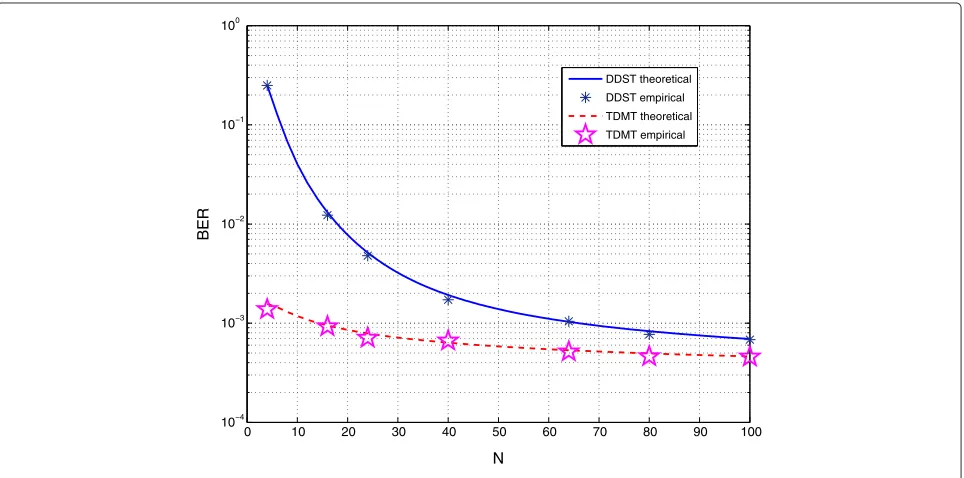
Application 1. In this scenario, we set the SNR σT2 σv2 to 15 dB. We then vary the ratioc1 = NK from 0.01 to 0.5.
Since we considerK=2 andM=4,N=K/c1varies also
withc1. For each value ofN, we compute the BER using (9)
and (14). Figure 2 illustrates the obtained results. We also superposed in the same plot the empirical results for the TDMT and the DDST scheme. The results show a good match, thereby supporting the usefulness of the derived results.
We note that the DDST scheme may be interesting for long enough frames (N ≥16). For small frames (high dis-tortion ratioc1), the distortion of the data becomes too
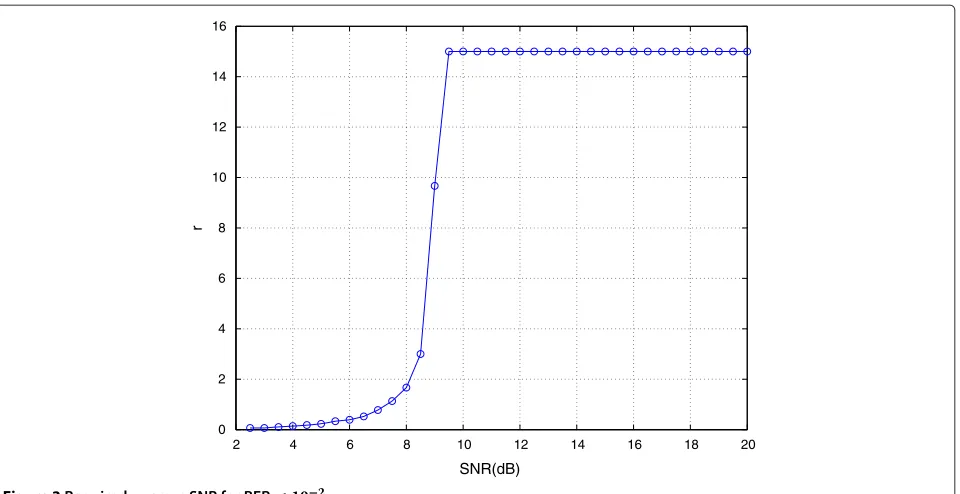
high, thus reducing the interest of the DDST scheme. Application 2. In this experiment, we propose to deter-mine for the TDMT scheme (K = 2,M = 4,N = 32) the optimal ratio N2
N1 that has to be used to meet a certain
quality of service. For that, we consider a scenario where the BER should be below 10−2. Using (15), (16), and (9),
we determine the minimum number of required training symbols to meet the BER lower bound requirement. We, then, plot the corresponding ratior= N2
0 5 10 15 20 25 10−6
10−5 10−4 10−3 10−2 10−1 100
SNR (dB)
BER
DDST empirical BER DDST theoretical BER TDMT empirical BER TDMTtheoretical BER
Figure 1Theoretical and empirical BER for the TDMT- and DDST-based schemes.
the SNR. We note that if the SNR is below 2 dB, the BER requirement could not be achieved. This is to be com-pared with the DDST scheme where the SNR should be set at least to 10.5 dB so as to meet the BER lower bound requirement as it can be shown in Figure 3. Moreover, for a SNR more than 8.5 dB, the minimum number of pilot symbols for channel identification (equal toK) is sufficient to meet the BER requirement.
8 Conclusion
In this paper, we have carried out theoretical studies on BER for two training-based schemes, namely, the basic time-division multiplexed training (TDMT) scheme and the data-dependent superimposed training (DDST)-based scheme. To make derivations possible, the asymptotic regime, where all the system dimensions grow to infin-ity with a constant pace, has been considered. For each
0 10 20 30 40 50 60 70 80 90 100 10−4
10−3 10−2 10−1 100
N
BER
DDST theoretical DDST empirical TDMT theoretical TDMT empirical
2 4 6 8 10 12 14 16 18 20 0
2 4 6 8 10 12 14 16
SNR(dB)
r
Figure 3Requiredrversus SNR for BER≤10−2.
scheme, we have derived closed-form approximations for the BER. We have also determined optimal power alloca-tions of power between data and training that minimize the asymptotic BER.
Appendices Appendix 1 Proof of Theorem 1
In the sequel, we propose to determine the asymptotic dis-tribution of the post-processing noise of each entry of the matrixWt. Actually, the(i,j)entry ofWtis given by
(Wt)i,j= −hi#Htwj+h#i
IK−HtH#
v2,j +,hi(Ht)Hv2,j,
whereh#i and,hidenote theith row ofH#and
HHH−1,
respectively, and wj and v2,j denote the jth columns of
WtandV2, respectively. Conditioned onH,V1, andWt,
(Wt)i,jis a Gaussian random variable with mean equal to−h#iHtwjand variance
σw2,K =σv2h#i −h#iHtH#+,hi(Ht)H
×h#iH−H#HHH
t
h#iH+Ht
,hiH.
Since our proof will be based on the ‘characteristic func-tion’ approach, we shall first recall the expression of the characteristic function for complex random variables:
Theorem 3. Let Xnbe a complex Gaussian random vari-able with mean mX,nand varianceσX2,n, such thatE(Xn− mX,n)2 = 0. Then, Xn can be seen as a two-dimensional
random variable corresponding to its real and imaginary parts. The characteristic function of Xnis, therefore, given by
Eexpj(z∗Xn)
=expjz∗mX,n
×exp
−1 4|z|
2σ2
X,n
.
Applying Theorem 3, the conditional characteristic function of(W)i,jcan be written as
Eexpjz∗(Wt)i,j
|V1,H,Wt
=exp−jz∗h#iHtwj
exp
−1 4|z|
2σ2
w,K
.
(25)
To remove the condition expectation on V1 and Wt, one should prove thatσw2,K converges almost surely to a deterministic quantity. Actually,σw2,K can be expanded as follows:
σw2,K =σv2h#ih#iH+σv2h#iHtHHH−1(Ht)h#i
−2σv2hi#Ht(HH)−1h#i
+σv2,hiHHtHt
,hi
H
.
Let
Aσ,K =σv2h#iHt
HHH−1(H
t)H
h#iH
Bσ,K =σv2,hiHHtHt
,hi
H
σ,K =h#iHtHHH−1h#i
H
The limiting behavior ofAσ,K can be derived using the following known results describing the asymptotic behav-ior of an important class of quadratic forms:
Lemma 3. [17, Lemma 2.7] Letx = [X1,· · ·,XN]Tbe a N×1vector, where the Xnare centered i.i.d. complex ran-dom variables with unit variance. LetAbe a deterministic N×N complex matrix. Then, for any p≥2, there exists a constant Cpdepending on p only, such that
E----1
Hence, ifAandxhave finite spectral norm and finite eight moment, respectively, we can conclude, using Borel-Cantelli lemma, about the almost convergence of the quadratic form N1xHAx, thus yielding the following
corollary:
Corollary 1.Letx=[x1,· · ·,xN]Tbe a N×1vector, where the entries xiare centered i.i.d. complex random variables with unit variance and finite eight order. LetAbe a deter-ministic N × N complex matrix with bounded spectral norm. Then,
1 Nx
HAx− 1
NTr(A)−→0 almost surely. By Corollary 1, the asymptotic behavior ofAσ,K is then given by
the dimensions go to infinity [18], we get
Aσ,K −
Note that Theorem 1 can be applied since the smallest eigenvalue of the Wishart matrix(HH)are almost surely uniformly bounded away from zero by(1−√c2)2>0 [19].
Before determining the limiting behavior of Bσ,K, we shall need the following lemma:
Lemma 4. Let Y = √1 Kyi,j
M,K
i=1,j=1 be a M × K with
Gaussian i.i.d entries. Then, in the asymptotic regime given by
Proof.Without loss of generality, we can restrict our proof to the case, wherei= 1. Lety1,· · ·,yK denote the
. Then, using
the formula of the inverse of block matrices, we get
vy= − On the other hand,
Using Corollary 1, we have
yH
the desired result.
We are now in position to deal with the termBσ,K. Using Corollary 1, we get
Using Lemma 4, we get that
i,i converges almost surely to c1
2−1 (its inverse is the mean of independent
random variables [12]). Then,
Bσ,K− we will be basing on the following result, about the asymptotic behavior of weighted averages:
Theorem 4. Almost sure convergence of weighted aver-ages [20] Leta = [a1,· · ·,aN]Tbe a sequence of N ×1
This theorem was proven in [20] for real variables. Since we are interested in the asymptotic convergence of the real part ofσ,K, it can be possible to transpose our prob-the real parts (respectively, imaginary parts) of aandx. Then,
Referring to Theorem 4, the convergence to zero of σ,K
finite. This is almost surely true, since
1
This leads to
σw2,K− ˜σw2,K −→0 almost surely,
Substituting σw2,K by its asymptotic equivalent in (25), we get
−→0 almost surely.
Also conditioning onWtandH,h#iHtwjis a Gaussian random variable with zero mean and variance
σm2,K = σ
Using the fact that the characteristic function of
h#iHtwjis
we obtain that conditionally on the channel
Eexpjz∗(Wt)i,j
−→0 almost surely.
We end up the proof by noticing thatσ˜m2,K + ˜σw2,K = Proof of Theorem 2
For the DDST scheme, the post-processing noise matrix
Wdis given by respectively, andw˜idenotes theith row of the matrixW.
The vector vT1,vT2T is a Gaussian vector. Since
Ev1vH2
=0, we conclude thatv1andv2are independent.
Then,v1andV2 = V
Using the same techniques as before, it can be proved that
and also that h#iV2H#
h#iH
−→0 almost surely.
On the other hand, we have
σv2(1−c1),hiVH2V2 we get that
σv2(1−c1),hiVH2V2 Gaussian random variable with a mean equal tow˜iJjand a varianceσw2
Using Corollary 1, we can easily prove that
σm2
Conditioning only onH, the conditional characteristic function satisfies:
Giving the structure of the matrixJ,w˜iJj involves the average of c1
1 symmetric-independent and identically
dis-tributed discrete random variables, and therefore,
Eexp−jz∗w˜i
We conclude the proof by noting that
Competing interests
The authors declare that they have no competing interests.
Acknowledgements
This research has been supported by the ERC Starting Grant 305123 MORE (Advanced Mathematical Tools for Complex Network Engineering).
Author details
1Alcatel-Lucent, Supélec, Plateau de Moulon, 3 rue Joliot Curie, 91192
Gif-sur-Yvette Cedex, Paris, France.2PRISME Lab., Ecole Polytechnique de
l’Université d’Orléans, 12 rue de Blois, BP 6744, 45067, Orléans Cedex 2, France.
Received: 4 January 2013 Accepted: 19 August 2013 Published: 13 September 2013
References
1. B Hassibi, B Hochwald, How much training is needed in multiple-antenna wireless links? IEEE Trans. Inform. Theory49(4), 951–963 (2003) 2. P Bohlin, M Tapio, Performance evaluation of MIMO communication
systems based on superimposed pilots. ICASSP4, 425–428 (2004) 3. M Codray, P Bohlin, Training-based MIMO systems—part I: performance
comparison. IEEE Trans. Signal Process55(11), 5464–5476 (2007) 4. M Ghogho, A Swami,Channel estimation for, MIMO systems using
data-dependent superimposed training. Paper presented at the 42nd Allerton conference on communication and computing, (Monticello, IL, USA, 29 September–1 October 2004)
5. C Wang, EKS Au, RD Murch, WH Mow, RS Cheng, V Lau, On the performance of the MIMO zero-forcing receiver in the presence of channel estimation error. IEEE Trans. Wireless Commun.6(3), 805–810 (2007)
6. EKS Au, C Wang, S Sfar, RD Murch, WH Mow, VKN Lau, RS Cheng, KB Letaief, Error probability for MIMO zero-forcing receiver with adaptive power allocation in the presence of imperfect channel state information. IEEE Trans. Wireless Commun.6(4), 1523–1529 (2007)
7. M Ghogho, A Swami,Optimal training for affine-precoded and
cyclic-prefixed block transmissions. Paper presented at the 2005 IEEE/SP 13th workshop on statistical signal processing, (Novosibirsk, Russia, 17–20 July 2005)
8. JR Magnus, H Neudecker,Matrix Differential Calculus with Applications in Statistics and Econometrics, 3rd edn. (Wiley, Chichester, 2007), p. 450 9. C Wang, EKS Au,Closed-form outage probability and BER of MIMO
zero-forcing receiver in the presence of imperfect CSI. Paper presented at SPAWC ’06 IEEE 7th workshop on signal processing advances in wireless communications, (Cannes, France, 2006), pp. 2–5
10. JG Proakis,Digital Communications, 3rd edn. (McGraw-Hill, New York, 1995)
11. DA Gore, RW Heath, AJ Paulraj, Transmit selection in spatial multiplexing systems. IEEE Commun. Lett.6(11), 491–493 (2002)
12. J Winters, J Salz, R Gitlin, The impact of antenna diversity on the capacity of wireless communication systems. IEEE Trans. Commun.42(234), 1740–1751 (1994)
13. T Eng, L Milstein, Coherent DS-CDMA performance in Nakagami multipath fading. IEEE Trans. Commun.43, 1134–1143 (1995) 14. IS Gradshteyn, IM Ryzhik,Table of Integrals, Series and Products, 7th edn.
(Academic, Amsterdam, 2007), p. 1171
15. R Xu, FCM Lau, Performance analysis for MIMO systems using zero forcing detector over Rice fading channel. Proc. IEEE Int. Symp. Circ. Syst.5, 4955–4958 (2005)
16. A Hedayat, A Nosratinia, Outage and diversity of linear receivers in flat-fading MIMO channels. IEEE Trans. Signal Process.55(12), 5868–5873 (2007)
17. Z Bai, J Silverstein, No eigenvalues outside the support of the limiting spectral distribution of large-dimensional sample covariance matrices. Ann. Probab.26, 316–345 (1998)
18. AM Tulino, S Verdú,Random Matrix Theory and Wireless Communications,. (Now Publishers, New Jersey, 2004), p. 182
19. JW Silverstein, The smallest eigenvalue of a large dimensional Wishart matrix. Ann. Probab.13(4), 1364–1368 (1985)
20. J Baxter, R Jones, M Lin, J Olsen, SLLN for weighted independent identically distributed random variables. J. Theor. Probab.1, 165–181 (2004)
doi:10.1186/1687-1499-2013-227
Cite this article as: Kammoun and Abed-Meraim:Performance analysis and optimal power allocation for linear receivers based on superimposed training.EURASIP Journal on Wireless Communications and Networking2013 2013:227.
Submit your manuscript to a
journal and benefi t from:
7Convenient online submission
7Rigorous peer review
7Immediate publication on acceptance
7Open access: articles freely available online
7High visibility within the fi eld
7Retaining the copyright to your article