Improved Key Recovery Attacks on
Reduced-Round AES with Practical Data and
Memory Complexities
Achiya Bar-On1, Orr Dunkelman2, Nathan Keller1, Eyal Ronen3, and Adi Shamir3
1 Department of Mathematics, Bar-Ilan University, Israel 2
Computer Science Department, University of Haifa, Israel
3 Computer Science Department, The Weizmann Institute, Rehovot, Israel
Abstract. Determining the security of AES is a central problem in cryptanalysis, but progress in this area had been slow and only a hand-ful of cryptanalytic techniques led to significant advancements. At Euro-crypt 2017 Grassi et al. presented a novel type of distinguisher for AES-like structures, but so far all the published attacks which were based on this distinguisher were inferior to previously known attacks in their complexity. In this paper we combine the technique of Grassi et al. with several other techniques in a novel way to obtain the best known key recovery attack on 5-round AES in the single-key model, reducing its overall complexity from about 232to less than 222. Extending our tech-niques to 7-round AES, we obtain the best known attacks on AES-192 which use practical amounts of data and memory, breaking the record for such attacks which was obtained in 2000 by the classical Square attack.
1
Introduction
The Advanced Encryption Standard (AES) is the best known and most widely used secret key cryptosystem, and determining its security is one of the most important problems in cryptanalysis. Since there is no known attack which can break the full AES significantly faster than via exhaustive search, researchers had concentrated on attacks which can break reduced round versions of AES. Such attacks are important for several reasons. First of all, they enable us to assess the remaining security margin of AES, defined by the ratio between the number of rounds which can be successfully attacked and the number of rounds in the full AES. In addition, they enable us to develop new attack techniques which may become increasingly potent with additional improvements. Finally, there are many proposals for using reduced round AES (and especially its 4 or 5 rounds versions) as components in larger schemes, and thus successful crypt-analysis of these variants can be used to attack those schemes. Examples of such proposals include ZORRO [17], LED [22] and AEZ [23] which use 4-round AES, and WEM [7], Hound [16], and ELmD [3] which use 5-round AES.
in the complexity of key recovery attacks. In the standard model (where the at-tack uses a single key rather than related keys), these techniques include the Square attack [8, 15], impossible differential cryptanalysis [1, 24], the Demirci-Sel¸cuk attack [10, 12], and the Biclique attack [2]. In most of these cases, it took several years -- and a series of subsequent improvements — from the invention of the technique until it was developed into its current form. For example, im-possible differential cryptanalysis was applied to AES already in 2000 [1] as an attack on 5-round AES, but it was only very recently that Boura et al. [6] im-proved it into its best currently known variant which breaks 7-round AES with an overall complexity of about 2107. The Demirci-Sel¸cuk attack was presented in 2005 [10] with a huge memory complexity of over 2200, and it took 8 years before Derbez et al. [12] enhanced it in 2013 into an attack on 7-round AES with an overall complexity which is just below 2100. Therefore, the development of any new attack technique is a major breakthrough with potentially far reaching consequences.
The latest such development happened in 2017, when Grassi et al. [21] pub-lished a new property of AES, calledmultiple-of-8, which had not been observed before by other researchers. At first, it was not clear whether the new observation can at all lead to attacks on AES which are competitive with respect to previ-ously known results. This question was partially resolved by Grassi [20], who used this observation to develop a new type of attack which can break 5-round AES in data, memory and time complexities of 232. However, a variation of the Square attack [15] can break the same variant with comparable data and time complexities but with a much lower memory complexity of 29. Consequently, the new technique did not improve the best previously known attack on 5 rounds, and its extensions to more than 5 rounds (see [19]) were significantly inferior to other attacks.
In this paper we greatly improve Grassi’s attack, and show how to attack 5-round AES in data, memory and time complexities of 221.5, which is more than 1000 times faster than any previous attack on the same variant. Due to the exceptionally low complexity of our attack, we could verify it experimentally by running it on real data generated from a thousand randomly chosen keys. As we expected, the success rate of our full key recovery attack rose sharply from 0.16 to almost 1 as we increased the amount of available data from 221to 222in tiny increments of 20.25. For data complexity of 221.5, the success rate was 52%.
By extending our technique to larger versions of AES, we obtain new attacks on AES-192 and AES-256 which have the best time complexity among all the attacks on 7-round AES which have practical data and memory complexities.
Low data and memory attacks were studied explicitly in a number of papers (e.g., [4, 5, 12]), but progress in applying such attacks to AES had been even slower than the progress in the “maximum complexity” metric. While some re-sults were obtained on variants with up to 5 rounds, the best such attack on 6 and more rounds is still the improved Square attack presented by Ferguson et al. [15] in 2000. We use the observation of Grassi et al., along with thedissection
develop the best attacks on 7-round AES in this model. In particular, our attack on 7-round AES with 192-bit keys requires 226 data, 232memory and 2153time, which outperforms the Square attack in all three complexity measures simulta-neously.
In addition to developing our new attacks on reduced-round AES, we ap-ply our techniques to the seemingly unrelated collision attack of Gilbert and Minier [18] on 7-round AES. We succeed to reduce the memory complexity of the Gilbert-Minier attack from 280to 240 and reduce the data complexity from 232to 230, without affecting the time complexity.
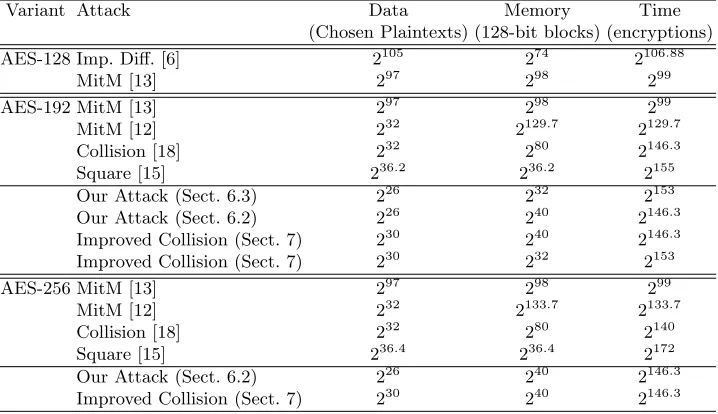
A summary of the known and new key recovery attacks in the single key model on 5 and 7 rounds of AES appears in Tables 1 and 2, respectively. The specified complexities describe how difficult it is to find some of the key bytes. Since our new attacks can find with the same complexity any three key bytes which share the same generalized diagonal, we can rerun them several times for different diagonals to find the full key with only slightly elevated complexities.
Attack Data Memory Time
(Chosen plaintexts) (128-bit blocks) (encryptions)
MitM [11] 8 256 264
Imp. Polytopic [26] 15 241 270
Partial Sum [27] 28 small 238
Square [9] 211 small 244
Square [9] 233 232 234
Improved Square [15] 233 small 233
Yoyo [25] 211.3 ACC small 231
Imp. Diff. [1] 231.5 238 233
Mixture Diff. [20] 232 232 232
Our Attack (Sect. 4) 221.5 221.5 221.5
ACC
Adaptive Chosen Plaintexts and Ciphertexts
Table 1.Attacks on 5-Round AES (partial key recovery)
Variant Attack Data Memory Time (Chosen Plaintexts) (128-bit blocks) (encryptions)
AES-128 Imp. Diff. [6] 2105 274 2106.88
MitM [13] 297 298 299
AES-192 MitM [13] 297 298 299
MitM [12] 232 2129.7 2129.7
Collision [18] 232 280 2146.3
Square [15] 236.2 236.2 2155
Our Attack (Sect. 6.3) 226 232 2153
Our Attack (Sect. 6.2) 226 240 2146.3
Improved Collision (Sect. 7) 230 240 2146.3
Improved Collision (Sect. 7) 230 232 2153
AES-256 MitM [13] 297 298 299
MitM [12] 232 2133.7 2133.7
Collision [18] 232 280 2140
Square [15] 236.4 236.4 2172
Our Attack (Sect. 6.2) 226 240 2146.3
Improved Collision (Sect. 7) 230 240 2146.3
Table 2.Attacks on 7-Round AES (full key recovery)
2
Brief Introduction to the AES
2.1 A Short Description of AES
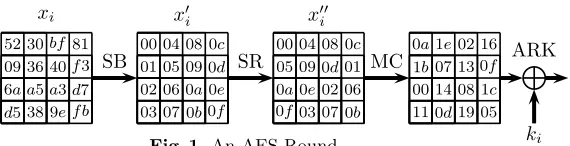
The Advanced Encryption Standard (AES) [9] is a substitution-permutation network which has 128 bit plaintexts and 128, 192, or 256 bit keys. Its 128 bit internal state is treated as a byte matrix of size 4x4, where each byte represents a value inGF(28). An AES round (described in Figure 1) applies four operations to this state matrix:
– SubBytes (SB) — applying the same 8-bit to 8-bit invertible S-box 16 times in parallel on each byte of the state,
– ShiftRows (SR) — cyclically shifting thei’th row byibytes to the left,
– MixColumns (MC) — multiplication of each column by a constant 4x4 ma-trix over the fieldGF(28), and
– AddRoundKey (ARK) — XORing the state with a 128-bit subkey.
An additional AddRoundKey operation is applied before the first round, and in the last round the MixColumns operation is omitted.
The key schedule of AES transforms the key intoN r+ 1 128-bit subkeys. We denote the subkey array byW[0, . . . ,4·N r+3], where each word ofW[·] consists of 32 bits. When the length of the key isN k32-bit words, the user supplied key is loaded into the first N k words of W[·], and the remaining words of W[·] are updated according to the following rule:
– Fori=N k, . . . ,4·N r+ 3, do
• If i ≡ 0 modN k then W[i] = W[i−N k]⊕SB(W[i−1] ≪ 8)⊕
RCON[i/N k],
• else ifN k= 8 andi≡4 mod 8 thenW[i] =W[i−8]⊕SB(W[i−1]), • OtherwiseW[i] =W[i−1]⊕W[i−N k],
where≪denotes rotation of the word by 8 bits to the left, andRCON[·] is an array of predetermined constants.
2.2 Notations
In the sequel we use the following definitions and notations.
The state matrix at the beginning of roundi is denoted byxi, and its bytes are denoted by 0,1,2, . . . ,15, as described in Figure 1. Similarly, the state matrix after the SubBytes and the ShiftRows operations of round i are denoted byx0
i andx00i, respectively. The difference between two values in statexi is denoted by
∆(xi). We use this notation only when it is clear from the context which are the values whose difference we refer to.
We denote the subkey of roundibyki, and the first (whitening) key byk−1, i.e., ki =W[4·(i+ 1)]||W[4·(i+ 1) + 1]||W[4·(i+ 1) + 2]||W[4·(i+ 1) + 3]. In some cases, we are interested in interchanging the order of the MixColumns operation and the subkey addition. As these operations are linear they can be interchanged, by first XORing the data with an equivalent subkey and only then applying the MixColumns operation. We denote the equivalent subkey for the altered version by ui, i.e., ui = M C−1(ki). The bytes of the subkeys are numbered by 0,1, . . . ,15, in accordance with the corresponding state bytes.
The plaintext is sometimes denoted byx−1, and sox0=x−1⊕k−1. Thej’th byte of the state xi is denoted xi,j. When several bytesj1, . . . , j` are considered simultaneously, they are denoted xi,{j1,...,j`}. When a full
col-umn is considered, it is denoted xi,Col(j), and if several columns are considered simultaneously, we denote them by xi,Col(j1,...,j`).
Sometimes we are interested in ‘shifted’ columns, i.e., the result of the ap-plication of ShiftRows to a set of columns. This is denoted byxi,SR(Col(j1,...,j`)).
Similarly, a set of ‘inverse shifted’ columns (i.e., the result of the application of
SR−1 to a set of columns) is denoted byx
i,SR−1(Col(j 1,...,j`)).
00 01 02 03 04 05 06 07 08 09 0a 0b 0c 0d 0e 0f 00 05 0a 0f 04 09 0e 03 08 0d 02 07 0c 01 06 0b 52 09 6a d5 30 36 a5 38 bf 40 a3 9e 81 f3 d7 f b 0a 1b 00 11 1e 07 14 0d 02 13 08 19 16 0f 1c 05
SB SR MC ARK
xi x′i x′′i
L
ki Fig. 1.An AES Round
In the attacks on 6-round and 7-round AES, we consider encryptions of sev-eral (e.g., 8) pairs of values. To simplify notations, in such a case we denote the plaintext pairs by (Pj,Pˆj),j = 1, . . . ,8, the corresponding ciphertext pairs by (Cj,Cˆj),j = 1, . . . ,8, and the corresponding pairs of intermediate values by (xji,`,xˆji,`), forj= 1, . . . ,8.
In all attacks, we exploit plaintext pairs (P,Pˆ) for which the corresponding intermediate values satisfy∆(x00
4,SR(Col(0))) = 0 (i.e., have a zero difference in the first shifted column just before the MixColumns operation of round 4). Hence, throughout the paper we call such pairsgood pairs.
Finally, we measure the time complexity of all the attacks in units which are equivalent to a single encryption operation of the relevant reduced round variant of AES. We measure the space complexity in units which are equivalent to the storage of a single plaintext (namely, 128 bits). To be completely fair, we count all operations carried out during our attacks, and in particular we do not ignore the time and space required to prepare the various tables we use.
3
The 4-round Distinguishers of Grassi
In this section we present the distinguishers for 4-round AES, which serve as the basis to all our attacks. The distinguishers were presented by Grassi [20], as a variant of the 5-round distinguisher introduced at Eurocrypt’17 by Grassi et al. [21]. Note that the distinguishers hold in a more general setting than the one presented here. For sake of simplicity, we concentrate on the special case used in our attacks.
Definition 1. Let xi, yi be two intermediate values at the input to round i of
AES, such that xi,Col(1,2,3) = yi,Col(1,2,3) (i.e., xi and yi may differ only in
the first column). We say that (zi, wi) is a mixture (or a mixture counterpart)
of (xi, yi) if xi, yi, zi, wi are distinct, and for each j = 0,1,2,3, the quartet (xi,j, yi,j, zi,j, wi,j)consists of two pairs of equal values.
In particular, if for some 0 ≤ j ≤ 3 we have xi,j 6= yi,j then either the
j’th bytes of zi and wi are equal to those of xi andyi, respectively, or they are
swapped; and if xi,j=yi,j, then thej’th bytes ofzi andwi can assume any pair
of equal values. (Note that it is allowed that for some j, we have xi,j =yi,j =
zi,j=wi,j.)
In either case,(xi, yi, zi, wi) is called a mixture quadruple.
mixtures can be represented by vectors in {0,1}4 which record whether z i,j is equal to xi,j or to yi,j, for j = 0,1,2,3. For example, (1000) corresponds to the mixture (zi, wi) such thatzi,Col(0) = (xi,0, yi,1, yi,2, yi,3) andwi,Col(0) = (yi,0, xi,1, xi,2, xi,3).
Pairs (xi, yi) such that xi,j =yi,j for exactly one value j0 ∈ {0,1,2,3}, are contained in about 4·28 = 210 unordered mixtures (as the pair (z
i,j0, wi,j0) can assume 28 possible values, each of the other pairs (z
i,j, wi,j) can assume two possible values, and we have to divide by 2 since we consider unordered mixtures).
Pairs such that xi,j = yi,j for exactly two values j0, j1 ∈ {0,1,2,3}, are contained in about 2·216= 217 unordered mixtures, and pairs such thatx
i,j=
yi,j for exactly three values j0, j1, j2 ∈ {0,1,2,3}, are contained in about 224 unordered mixtures.
Remark 2. We note that both mixtures with xi,j 6=yi,j for allj = 0,1,2,3 and mixtures with equality in at least one byte were considered in [20, Section 4]. The former type was considered in [20, Theorem 3] and used in the 5-round key recovery attack of [20] which we present below, while the latter was considered in [20, Theorem 4] and used in the 5-round distinguisher of [20] which we do not use in this paper. We use both types of mixtures in our attacks.
Observation 1. Let(xi, yi, zi, wi)be a mixture quadruple of intermediate values
at the input to round i of AES. Then the corresponding intermediate values
(xi+2, yi+2, zi+2, wi+2)sum up to zero, i.e.,
xi+2⊕yi+2⊕zi+2⊕wi+2= 0. (1)
Consequently, if for somej∈ {0,1,2,3}we havexi+2,SR−1(Col(j))⊕yi+2,SR−1(Col(j))= 0, then the corresponding intermediate values (x00i+3, yi+300 , zi+300 , w00i+3) (i.e., just
before the MixColumns operation of round i+ 3) satisfy
x00i+3,SR(Col(j))⊕yi+3,SR(Col(j))00 =z00i+3,SR(Col(j))⊕wi+3,SR(Col(j))00 = 0.
Proof. Let (xi, yi, zi, wi) be as in the assumption. The mixture structure is pre-served through the SubBytes operation of roundi, and then ShiftRows spreads the active bytes between the columns, such that each column contains exactly one of them. As a result, for each j ∈ {0,1,2,3}, either the unordered pairs (x00
i,Col(j), y00i,Col(j)) and (zi,Col(j)00 , wi,Col(j)00 ) are equal or else the unordered pairs (x00i,Col(j), zi,Col(j)00 ) and (yi,Col(j)00 , w00i,Col(j)) are equal. Both of these properties are clearly preserved by MixColumns and by the subsequent AddRoundKey and SubBytes operations. It follows that the intermediate values (x0
i+1, y0i+1, zi+10 , w0i+1) sum up to zero. As ShiftRows, MixColumns, and AddRoundKey are linear op-erations, this impliesxi+2⊕yi+2⊕zi+2⊕wi+2= 0.
Now, if for some j we have xi+2,SR−1(Col(j))⊕yi+2,SR−1(Col(j)) = 0, then by the round structure of AES we have xi+3,Col(j)⊕yi+3,Col(j) = 0, and thus,
x00
i+3,SR(Col(j))⊕yi+3,SR(Col(j))00 = 0. Furthermore, by (1) we havezi+2,SR−1(Col(j))⊕ wi+2,SR−1(Col(j)) = 0, and thus by the same reasoning as for (x, y), we get z00
Grassi [20] used his distinguisher (actually, only with one type of mixtures, as mentioned in Remark 2) to mount an attack on 5-round AES with data, memory, and time complexities of roughly 232. The attack algorithm is given in Algorithm 1.
Algorithm 1Grassi’s 5-Round Attack
1: Ask for the encryption of 232chosen plaintexts in whichSR−1(Col(0)) assumes all
232possible values and the rest of the bytes are constant.
2: Find a pair of ciphertexts (C1, C2) = (x5, y5) with zero difference inSR(Col(0)).
3: foreach guess ofk−1,SR−1(Col(0))do
4: Partially encrypt the corresponding plaintexts (P1, P2) = (x−1, y−1) through
AddRoundKey and round 0 to obtain (x1, y1).
5: Let (z1, w1) be a mixture of (x1, y1), partially decrypt it to find the
correspond-ing plaintext pair (P3, P4) = (z−1, w−1), and denote the corresponding ciphertexts
by (C3, C4) = (z5, w5).
6: if (z5, w5) does not satisfyz5,SR(Col(0))⊕w5,SR(Col(0))= 0then
7: discard the key guessk−1,SR−1(Col(0)).
8: Repeat Steps (1)–(8) for the other three columns, and check the remaining key guesses by trial encryption.
The structure of chosen plaintexts is expected to contain about 263·2−32 = 231 pairs for which the ciphertexts have a zero difference in SR(Col(0)). The adversary can find one of them easily in time 232, using a hash table. Step 3 of the attack requires only a few operations for each key guess. Since (x1, y1, z1, w1) form a mixture quadruple, by Observation 1 we know that if (x5, y5) have zero difference in SR(Col(0)), then we must have z5,SR(Col(0))⊕w5,SR(Col(0)) = 0. (Note that the MixColumns operation in the last round is omitted, and thus, the difference in the statez5 is equal to the difference in the statez400 discussed in Observation 1.) Therefore, if the condition fails, we can safely discard the key guess. The probability of a random key to pass this filtering is 2−32, and thus, we expect only a few key guesses to remain. Thus, the data, memory, and time complexities for recovering 32 key bits are 232, and for recovering the full key are about 234.
4
Improved Attack on 5-Round AES
In this section we present our improved attack on 5-round AES, which requires 221.5data, memory, and time to recover 24 key bits and less than 225data, mem-ory, and time to recover the full key. This is the first attack on 5-round AES whose all complexities are below 232. The attack was fully verified experimen-tally.
algorithm and analyze its complexity, and finally we describe the experiments we performed to verify the attack.
4.1 The Observations Behind the Attack
1. Reducing the data complexity to224.Our first observation is that we can reduce the amount of data used in Grassi’s attack significantly, and still find the mixture quadruple we need for applying the attack. Indeed, as will be shown in Corollary 1, a structure of 232 plaintexts that agree on bytesSR−1(Col(1,2,3)) and attain all values in SR−1(Col(0)) (which is the data set used in Grassi’s attack) contains about 3.2·264quartets that evolve into a mixture quadruple, and for more than 232among them, it is expected that the corresponding ciphertexts can be divided into pairs that have zero difference in bytesSR(Col(0)). (We do not make the exact calculation here, as this step will be later replaced by an upgraded step, for which we will perform the exact calculation.) Hence, it is expected that the data set contains more than 232mixture quadruples that can be used for the attack, while we need only one mixture quadruple.
Instead, we may start with 224plaintexts taken arbitrarily from the structure of size 232 used in Grassi’s attack. These plaintexts are expected to contain at least one mixture quadruple that can be used for the attack with a high probability. (Note that as we operate with quartets of plaintexts, reducing the data by a factor of 28 reduces the number of mixture quadruples by a factor of 232.)
However, if we simply apply Grassi’s attack with the reduced number of plaintexts, its time complexity is increased significantly, since for most of the choices of (z1, w1) in Step 5 of the attack, the corresponding plaintexts are not included in our data set. Actually, the probability that both plaintexts are included in the data set is about (224·2−32)2 = 2−16, and hence, the time complexity of the attack is increased to 248. This will be resolved in the next observations.
2. Reducing the time complexity by changing the order of operations.
Our second observation is that if (x1, y1, z1, w1) is a mixture quadruple then
x1⊕y1⊕z1⊕w1= 0, and consequently, by the linearity of the MixColumns and AddRoundKey operations,x00
0⊕y000⊕z000⊕w000 = 0 as well. This allows to perform a preliminary check of whether (x1, y1, z1, w1) can be a mixture quadruple, by checking a local condition for each of the bytes in k−1,SR−1(Col(0)) separately (i.e., bytes 0,5,10,15). That is, given a quartet of plaintexts (P1, P2, P3, P4), we can perform the check whether it is a mixture quadruple, using Algorithm 2 presented below.
We can use this procedure to replace the guess ofk−1,SR−1(Col(0))performed in Grassi’s attack. Specifically, given 224plaintexts, we expect 215pairs in which the ciphertexts have zero difference inSR(Col(0)). We take all 229pairs of such pairs, and apply Algorithm 2 for each of them.
Algorithm 2Efficient Guessing ofk−1,SR−1(Col(0))
1: foreach each guess ofk−1,0do
2: Compute the corresponding differencesx000,0⊕y000,0 andz000,0⊕w000,0.
3: if x000,0⊕y
00
0,06=z
00
0,0⊕w
00
0,0 then
4: Discard the guess ofk−1,0.
5: Repeat the above steps for bytes 5,10,15 ofk−1and bytes 1,2,3 ofx00,y00,z00, and w00, respectively.
6: foreach remaining guess ofk−1,{SR−1(Col(0))}do 7: Encrypt the quartet through round 0.
8: Check whether the values (x1, y1, z1, w1) constitute a mixture quadruple.
contains a mixture quadruple (which occurs with a high probability, as described above), then the procedure will succeed for the right guess of k−1,SR−1(Col(0)). For a wrong guess, the probability to pass Steps 1 and 2 is 2−64, and so all wrong guesses are expected to be discarded.
Let us analyze the complexity of the attack. In Steps 1–6 we go over the 28 possible values ofk−1,0, and check the condition for each of them separately. The same goes for each repetition of Step 7. The complexity of Steps 8-11 is even lower. Hence, the overall complexity of the attack is 229·28·4 = 239applications of a single S-box, which are roughly equivalent to 233 encryptions.
3. Reducing the time complexity even further by using a precomputed table.We can further reduce the time complexity of this step using a precom-puted table of size 221.4 bytes. To construct the table, we consider each quartet of inputs to SubBytes of the form (0, a, b, c), where (a, b, c) are arranged in in-creasing order (e.g., as numbers in base 2).1For each quartet, we go over the 28 values of the key byte ˆkand store in the entry (a, b, c) of the table the values of ˆ
kfor which
SB(ˆk)⊕SB(a⊕ˆk)⊕SB(b⊕ˆk)⊕SB(c⊕ˆk) = 0. (2)
It is expected that a single value of ˆk satisfies Condition (2). Now, if we are given a quartet (x, y, z, w) of plaintext bytes and want to find the value ofk−1,0 such that the four intermediate values after SubBytes sum up to zero, we do the following:
1. Consider the quartet (0, y⊕x, z⊕x, w⊕x).
2. Reorder it using the binary ordering to obtain (0, a, b, c) with a < b < c. Then access the table at the entry (a, b, c) and retrieve the value ˆk.
3. Setk−1,0= ˆk⊕x.
1
The keyk−1,0we found is indeed the right one, since the values after the addition ofk0,−1are (ˆk,ˆk⊕y,ˆk⊕z,kˆ⊕w), and thus, Condition (2) means exactly that the four values after SubBytes sum up to zero.
The table requires 224/3!≈221.4bytes of memory. In a naive implementation, its generation requires 221.4·28= 229.4applications of a single S-box and a few more XOR operations, which is less than 223.45-round encryptions. However, it can be generated much faster, as follows.
Instead of going over all triplets (a, b, c) and for each of them going over all values of ˆk, we go over triplets a, b,ˆk. For each of them, we compute t =
SB(ˆk)⊕SB(a⊕ˆk)⊕SB(b⊕ˆk). We know that Condition (2) holds for (a, b, c,ˆk) if and only ifSB(c⊕kˆ) =t, or equivalently, c=SB−1(t)⊕ˆk. (Note that this condition can be satisfied by more than one value ofc. In such a case, all values are inserted into the table). Therefore, we write ˆk in the table entry/entries of (a, b, SB−1(t)⊕ˆk) and move to the next value of ˆk. In this way, the table generation requires less than 224 S-box applications, which is negligible with respect to other steps of the attack.
Once the table is constructed, Step 1 of Algorithm 2 can be performed by 4 table lookups. Hence, the total time complexity of the attack is reduced to 229times (4 table lookups plus one round of encryption), which is less than 229 encryptions.
4. Reducing the overall complexity to 221.5 by a wise choice of
plain-texts.So far, we reduced the data and memory complexity to 224 and the time complexity to 229. We show now that all three parameters can be reduced to about 221.5 by a specific choice of the plaintexts.
Recall that in Improvement 1 we assumed that the 224 plaintexts are arbi-trarily taken from the structure of size 232 used in Grassi’s attack (in which
SR−1(Col(0)) assume all possible values and the rest of the bytes are constant). Instead of doing this, we choose all plaintexts such that byte 0 is constant in all of them. As will be shown in Section 8, this significantly increases the probability of a plaintext quartet to form a mixture quadruple, thus allowing us to reduce the data complexity, and consequently, also the memory and time complexities. Assume that we start with 221.5 plaintexts, taken arbitrarily from the 224 plaintexts that assume all values in bytes 5,10,15 and have all other bytes con-stant. As will be shown in Proposition 7, with a non-negligible probability the data set contains at least one good mixture quadruple and the attack can be applied. (The exact probability was verified experimentally to be about 51%; see Section 4.3).
5. Increasing the success probability by checking several columns in-stead of one. Finally, the success probability of the attack can be increased by considering not only plaintext pairs for which the ciphertexts have zero dif-ference inSR(Col(0)), but also pairs for which the ciphertexts satisfy the same condition for one of the columns 1,2,3. This increases the probability of a quartet to be useful for the attack by a factor of about 4, and thus, allows us to either reduce the data complexity by another factor of 41/4=√2 for roughly the same success probability, or to maintain the data complexity and increase the success probability. On the other hand, this requires to use four hash tables to filter the ciphertexts (each corresponding to a different shifted column of the ciphertext), and thus, increases the memory complexity by a factor of 4. We compromise on using one additional column, which increases the success probability from 51% to about (1−0.492) ≈76%, while keeping the memory complexity dominated by storing the 221.5plaintext/ciphertext pairs.
4.2 The Attack Algorithm and its Analysis
The algorithm of our 5-round attack is given in Algorithm 3.
As described in Improvement 4,T can be prepared in time of 221.4 S-box evaluations, and contains 221.4byte values. Steps 5,6 can be easily performed in time 221.5 using two hash tables of size 221.5 53-bit values, which are less than 221.5 128-bit blocks. The expected size of each listL
j is 242·2−32= 210. Hence, Steps 9–22 are performed for 219pairs of pairs. As described in Improvement 4, these steps take less than a single encryption for each quartet, and thus, their total complexity is less than 219 encryptions. Therefore, the data complexity of the attack is 221.5 chosen plaintexts, the memory complexity is 221.5 128-bit blocks, and the time complexity is dominated by encrypting the plaintexts.
It is clear from the algorithm that if the data contains a mixture quadruple for which the ciphertexts (P1, P2) have zero difference in SR(Col(0)), then for the right value ofk−1,{5,10,15}, this quadruple will be found and so the right key
will remain. The probability of a wrong key suggestion to remain is extremely low, as in the attack we examine ((221.5)2/2)2/2 = 283quartets and the filtering condition is on about 114.25 bits (which consist of 64 bits on the ciphertext side – requiring zero difference inSR(Col(0)) for two ciphertext pairs, and 50.25 bits on the plaintext side – requiring that the values (x1, y1, z1, w1) constitute a mix-ture quadruple, where the calculation uses Claim 2 below). So, the probability for a wrong key to pass the filtering is 2−33.25. As there are 224 possible key suggestions, with a high probability no wrong keys remain.
Note that the attack does not recover the value ofk−1,0 since the question whether a quartet of plaintexts in the structure evolves into a mixture quadruple or not, does not depend onk−1,0.
Algorithm 3Efficient 5-Round Attack Preprocessing
1: Initialize an empty tableT. 2: foralla < b < cdo
3: Store inT[a, b, c] all bytes values ˆkwhich satisfySB(ˆk)⊕SB(a⊕ˆk)⊕SB(b⊕ ˆ
k)⊕SB(c⊕ˆk) = 0. Online phase
4: Ask for the encryption of 221.5 chosen plaintexts in which bytes 5,10,15 assume different values and the rest of the bytes are constant.
5: Store in a list L0 all ciphertext pairs (C1, C2) such that C1,SR(Col(0)) ⊕ C2,SR(Col(0))= 0.
6: Repeat the previous step for Column 1 instead of Column 0, with a listL1.
7: forj= 0,1do
8: forall pairs of pairs (C1, C2),(C3, C4)∈Ljdo
9: Let the corresponding plaintexts be (P1, P2, P3, P4) = (x−1, y−1, z−1, w−1),
respectively.
10: Compute the values (y−1,5⊕x−1,5, z−1,5⊕x−1,5, w−1,5⊕x−1,5), and sort
the three bytes in an increasing order to obtain (a, b, c). 11: foreach value ˆkinT[a, b, c]do
12: Store inL5the valuek−1,5= ˆk⊕x−1,5.
13: Repeat the above steps for bytes 10 and 15 (with listsL10andL15,
respec-tively).
14: forall subkey candidates (k−1,5∈L5, k−1,10∈L10, k−1,15∈L15)do
15: Partially encrypt (P1, P2, P3, P4) through round 0 and compute x1, y1, z1, w1.
16: if (x1, y1, z1, w1) does not constitute a mixture quadruplethen
17: Discard subkey candidate.
18: Output all guesses ofk−1,5, k−1,10, k−1,15which remained.
This recovers 4·24 + 8 = 104 bits of the key, and the rest of the key can be recovered by exhaustive key search. Therefore, for full key recovery we need data complexity of 5·221.75≈224chosen plaintexts, memory complexity of 221.5 128-bit blocks (as the memory can be reused between the attacks), and time complexity of less than 225 encryptions.
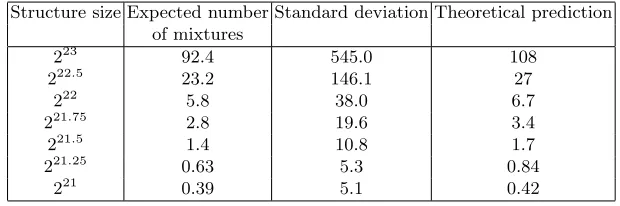
It is clear from the above analysis that the attack succeeds with a high prob-ability, that can be made very close to 100% by slightly increasing the data complexity. The experimental verification presented below shows that for 224 chosen plaintexts, the success probability is about 75%, while for 224.25 plain-texts, the success probability is already about 99%.
4.3 Experimental Verification
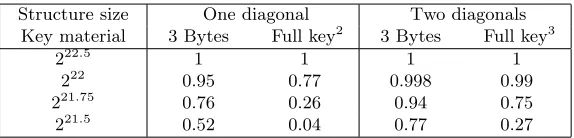
Structure size One diagonal Two diagonals Key material 3 Bytes Full key2 3 Bytes Full key3
222.5 1 1 1 1
222 0.95 0.77 0.998 0.99
221.75 0.76 0.26 0.94 0.75
221.5 0.52 0.04 0.77 0.27
Table 3.Success probability of the attack for different data complexities
bytes for 1000 different keys. The results we obtained were the following: For 221 plaintexts, the attack succeeded 162 times. For 221.25 plaintexts, the attack suc-ceeded 312 times. For 221.5 plaintexts, the attack succeeded 518 times, and for 221.75 plaintexts, the attack succeeded 764 times. For 222 plaintexts, the attack succeeded 949 times, and for 222.5 plaintexts, the attack succeeded in all 1000 experiments.
Based on these experiments, we calculated the success probability of full key recovery as p5, where pis the probability of recovering three key bytes (as in order to recover the full key we have to perform 5 essentially independent variants of the attack). Similarly, we calculated the probability of recovering three key bytes when two diagonals in the ciphertext are examined as 1−(1−p)2, since the attack fails only if two essentially independent applications of the basic attack fail.
The full details are given in Table 3. As can be seen in the table, with 221.75 chosen plaintexts and checking two diagonals on the ciphertext side, the success rate for recovering the first 3 key bytes is about 94%. The success rate for recovering the entire key is about 75% (where the data complexity is increased to 5·221.75≈224, as a different data set is required for each of the 5 applications of the basic attack). Starting with 222 plaintexts and checking two diagonals on the ciphertext side, the success rate for recovering 3 key bytes is very close to 1, and the induced success for recovering the entire key (with about 224.25 chosen plaintexts) is about 99%.
The experimental results clearly support our analysis presented in Section 8. We note that the significant increase of the success rate when the data complexity is increased very moderately follows from the fact that the attack examines quartets, and so multiplying the data by a modest factor of 20.25 doubles the number of quartets that can be used in the attack.
5
Attacks on 6-Round AES
In this section we present attacks on 6-round AES. We start with a simple extension of Grassi’s attack to 6 rounds, and then we present two improvements that allow reducing the attack complexity significantly. Our best attack has data
2
Data complexity increased by a factor of 5.
3
complexity of 226, memory complexity of 235, and time complexity of 280. These results are not very interesting on their own sake, as they are clearly inferior to the improved Square attack on the same variant of AES [15]. However, a further extension of the same attack techniques will allow us obtaining an attack on 7-round AES-192, which clearly outperforms all known attacks on reduced-7-round AES-192 with practical data and memory complexities (including the improved Square attack).
5.1 An Extension of Grassi’s Attack to 6 Rounds
Recall that in Grassi’s attack on 5-round AES, we take a structure of 232 plain-texts that differ only inSR−1(Col(0)), and search for ciphertext pairs that have zero difference inSR(Col(0)). Actually, the 4-round distinguisher underlying the attack guarantees a zero difference only in the statex00
4,SR(Col(0)), but as the 5th round is the last one, the MixColumns operation is omitted, and so, the zero difference can be seen in the ciphertext.
When we consider 6-round AES, in order to recover the difference in the state
x004,SR(Col(0))by partial decryption, we must guess all 128 key bits. However, we can recover the difference in one of these 4 bytes by guessing only four key bytes. Indeed, if we guess k5,SR(Col(0)) and interchange the order between the MixColumns and AddRoundKey operations of round 4, we can partially decrypt the ciphertexts through round 5 and MixColumns to obtain the value of byte 0 before MixColumns. As AddRoundKey does not affect differences, this allows us evaluating differences at the state x00
4,0.
By the distinguisher, the difference in this byte for both pairs in the mixture quadruple is zero. However, this is only an 16-bit filtering. In order to obtain an additional filtering, we recall that by Remark 1, each pair has at least 7 mixtures. Checking the condition for seven of them, we get a 64-bit filtering, that is sufficient for discarding almost all wrong key guesses. The attack is given in Algorithm 4.
For the right key guess, it is expected that after 232 pairs (P
1,Pˆ1), we will encounter a good pair (i.e., a pair for which the difference in the statex004,SR(Col(0))
is zero), and then by the distinguisher, the difference in the same state for all other 7 mixtures is zero as well. Hence, the right key is expected to be suggested. (Concretely, the probability that the right key is not suggested is (1−2−32)232
≈e−1). For wrong key guesses, for each pair (P
1,Pˆ1), the probability to pass the filtering of Step 11 is 2−64, and thus, the probability that there exists a guess of k5,SR(Col(0)) that passes it is 2−32. Hence, for all values of (P1,Pˆ1) except a few values, the list L1 remains empty and the pair is discarded after Step 16. For the few remaining pairs, the probability that there exists a guess of
k5,SR(Col(1))that passes the filtering of Step 18 is again 2−32, and so, for all but very few guesses ofk−1,{SR−1(Col(0))}, all pairs are discarded. The few remaining guesses are easily checked by trial encryption.
Algorithm 4Attacking 6-Round AES
1: Ask for the encryption of 232chosen plaintexts in whichSR−1(Col(0)) assumes all 232possible values and the rest of the bytes are constant.
2: foreach guess ofk−1,SR−1(Col(0))do
3: Select arbitrarily 232plaintexts pairs (P1i,Pˆ1i) from the structure.
4: foreach pair (x1−1, y 1
−1) = (P1,Pˆ1)do
5: Partially encrypt (x1
−1,xˆ1−1) through round 0, obtain (x11,ˆx11).
6: Take 7 mixtures of (x11,xˆ11) and denote them (x21,xˆ21), . . . ,(x81,xˆ81).
7: Partially decrypt the 7 mixtures to obtain the plaintext pairs (P2,Pˆ2) =
(x2−1,xˆ2−1), . . . ,(P8,Pˆ8) = (x8−1,xˆ8−1).
8: foreach value ofk5,SR(Col(0)) do
9: Take all ciphertext pairs (C1,Cˆ1), . . . ,(C8,Cˆ8).
10: Partially decrypt them through rounds 5,4. 11: if for all 1≤j≤8:xj400,0⊕xˆ
j00
4,0= 0 (i.e., all 8 pairs have a zero difference
in byte 0 before the MixColumns of round 4)then 12: Storek5,SR(Col(0)) in a listL1.
13: if L1 is emptythen
14: Discard the pair (P1,Pˆ1).
15: else
16: Repeat the same procedure for k5,SR(Col(1)), with respect to the byte x004,7 andL2.
17: if L2 is not emptythen
18: Repeat the same procedure fork5,SR(Col(2)) and k5,SR(Col(3)), with
respect to bytesx004,10andx
00
4,15, respectively.
19: Output the remaining key suggestions.
20: else
21: Discard the pair (P1,Pˆ1).
.If no pairs remain, move to the next guess ofk−1,SR−1(Col(0)).
essentially consist of partial decryption of one column through round 5 for 16 val-ues – which is clearly less than a single 6-round encryption. Therefore, the time complexity of the attack is 264·232 = 296 encryptions. The memory complex-ity is 232 (dominated by storing the plaintexts), and the success probability is 1−e−1= 0.63. The attack recovers the full subkeyk
5, which yields immediately the full secret key via the key scheduling algorithm.4
5.2 Improvements of the 6-Round Attack
In this section we present two improvements of the 6-round attack described above, which allow us to reduce its complexity significantly. While the resulting attack is still inferior to some previously known attacks on 6-round AES, we describe the improvements here since they will be used in our attack on 7-round AES, and will be easier to understand in the ‘simpler’ case of the 6-round variant.
4 We assume, for sake of simplicity, that the attack is mounted on AES-128. When
1. Using the meet-in-the-middle (MITM) approach. We observe that instead of guessing the subkey k5,{0,7,10,13}, we can use a MITM procedure.
Indeed, the difference in the bytex00
4,0(which we want to evaluate in the attack) is a linear combination of the differences in the four bytes x5,0, x5,1, x5,2, x5,3. Specifically, by the definition of MixColumns−1, we have
∆(x004,0) = 0Ex·∆(x5,0)⊕0Bx·∆(x5,1)⊕0Dx·∆(x5,2)⊕09x·∆(x5,3),
and thus the equation∆(x00
4,0) = 0 can be written in the form
0Ex·∆(x5,0)⊕0Bx·∆(x5,1) = 0Dx·∆(x5,2)⊕09x·∆(x5,3). (3)
Hence, instead of guessing the four key bytes k5,{0,7,10,13} which allow us to
compute the values of x5,0, x5,1, x5,2, x5,3 and to check the 64-bit condition on the differences inx00
4,0, we can do the following:
1. Guess bytesk5,{0,7}and computex5,0, x5,1. Store in a table the contribution of these bytes to Equation (3), i.e., the concatenation of the values 0Ex·
∆(xj5,0)⊕0Bx·∆(xj5,1) forj = 1, . . . ,8.
2. Guess bytes k5,{10,13} and compute x5,2, x5,3. Compute the contribution of these bytes to Equation (3), i.e., the concatenation of the values 0Dx·
∆(xj5,2)⊕09x·∆(xj5,3) forj= 1, . . . ,8, and search it in the table.
3. For each match in the table, store in L1 the combination k5,{0,7,10,13}. If
there are no matches in the table, discard the pair (P1,Pˆ1).
This meet-in-the-middle procedure is clearly equivalent to guessingk5,{0,7,10,13}
and checking the condition onx00
4,0 directly. The time complexity of the proce-dure, for each pair (P1,Pˆ1), is 2·216evaluations of two S-boxes for 16 ciphertexts, and 2·216 lookups into a table of size 216, which are less than 216encryptions.
This procedure can replace Steps 8–11 in the attack presented above, while all other parts of the attack remain unchanged. (Of course, Steps 18,20 can be replaced similarly, but their complexity is anyway negligible.) This reduces the time complexity of the attack to 232·232·216= 280encryptions, without affecting the data and memory complexities.
2. Reducing the data complexity using pairs of a special structure.
We consider pairs of intermediate values (x1, y1), such thatx1,j =y1,j holds for exactly two ofj= 0,1,2,3. As we show in Section 8.2, each such pair (called there ‘special pair’) has as many as 217 mixture counterparts, and therefore, even if we take a much smaller data structure (e.g., of size 226), one still expects that many of them are included in the structure. Moreover, ifx1= (c1, c2, γ1, δ1) and y1 = (c1, c2, γ2, δ2) then all the mixture counterparts are pairs of the form (z1, w1), where eitherz1= (c01, c02, γ1, δ1) andw1= (c01, c02, γ2, δ2) for somec01, c02, or z1= (c01, c20, γ1, δ2) andw1= (c01, c02, γ2, δ1) for somec01, c02. Furthermore, any two pairs of pairs of the described form constitute a mixture. Therefore, not only smaller data sets contain good pairs with many mixture counterparts, but also these pairs can be found efficiently.
Formally, it is shown in Proposition 5 below that if we take a structure of 226 plaintexts that agree on the bytes of SR−1(Col(1,2,3)), then with prob-ability of about 95%, the data set contains at least one good pair of the form described above. In order to detect the ‘special’ good pair, we make the following modification to Steps 1–6 of the attack:
1. Take a structure of 226 chosen plaintexts with the same value in all bytes, except possibly for bytes 0,5,10,15.
2. For each guess of subkey k−1,SR−1(Col(0)), do the following:
(a) Partially encrypt all plaintexts through AddRoundKey and round 0 to obtain the intermediate values at the statex1. Find all pairs (x1,xˆ1) of intermediate values for whichx1,j = ˆx1,j holds for exactly two values of
j. Divide them into 6 classesCj1,j2, according to the pair of values ofj in which equality holds.
(b) Forj1= 0, j2= 1:
i. Consider all pairs (xi1, yi1) in the classC0,1. Insert them into a hash table indexed by the four byte values at positions x1,{2,3}, y1,{2,3}.
Unify the cells that correspond to ((γ1, δ1),(γ2, δ2)) and ((γ1, δ2),(γ2, δ1)) for all values ofγ1, γ2, δ1, δ2. Discard all cells that contain less than 8 pairs.
ii. For each remaining cell, take 8 pairs from the cell, compute the 8 corresponding plaintexts (P1,Pˆ1), . . . ,(P8,Pˆ8) and store the octet of pairs in a listL.
(c) Repeat the above steps with other classesCj1,j2, until the size of the list Lreaches 232.
(d) Continue the attack with 232octets of plaintexts from the listL.
Step 2(a) can be performed using a hash table, with complexity of about 226 for each guess ofk
the attack remains about 280encryptions, and the success probability is close to 1−(1−2−32)232
≈1−e−1= 0.63, as in the original attack.
We note that actually, the data complexity can be further reduced to 225 cho-sen plaintexts, using the fact that on the ciphertext side, we can consider zero dif-ference in bytes SR(Col(1)), SR(Col(2)), orSR(Col(3)) instead ofSR(Col(0)), as suggested in Improvement 5 of the 5-round attack. As this somewhat reduces the success rate of the attack and slightly increases the time complexity, we preferred to keep the data complexity at 226instead.
To summarize, the data complexity of the improved attack is 226, its memory complexity is about 235 (needed to store the pairs in Step 2 of the attack), and its time complexity is 280 encryptions. Both improvements will be used in the 7-round attacks presented in the next section.
6
Attacks on 7-Round AES-192 and AES-256
In this section we present our new attacks on 7-round AES. First we present the attack on AES-256, which extends the 6-round attack by another round using a MITM technique, and then uses dissection [14] to reduce the memory complexity of the attack. Then we show how in the case of AES-192, the key schedule can be used (in conjunction with a more complex dissection attack) to further reduce the memory complexity of the attack. Our best attack on AES-192 recovers the full key with data complexity of 226, memory complexity of 232, and time complexity of 2152, which is better than all previously known attacks on reduced-round AES-192 with practical data and memory complexities.
6.1 Basic Attack on AES-192 and AES-256
The basic attack is a further extension by one round of the 6-round attack. Recall that in the 6-round attack we guess the subkey bytes k5,{0,7,10,13} and
check whether the state bytesx5,{0,1,2,3}satisfy a linear condition (Equation 3).
When we consider 7-round AES, in order to check this condition we have to guess the entire subkeyk6 and bytes 0,7,10,13 of the equivalent subkey u5. Of course, this leads to an extremely high time complexity. In addition, the filtering condition – which is on only 64 bits (i.e., 8 pairs with zero difference in a single byte) – is far from being sufficient for discarding such a huge amount of key material.
for the attack, we do not even need the procedure described in the 6-round at-tack. Instead, for each guess of the subkey k−1,SR−1(Col(0)), we encrypt all 226 plaintexts to compute the intermediate values at the state x1; we find all pairs of intermediate values with equality in two of bytes 0,1,2,3; for each such pair, we go over all its 217 possible mixture counterparts, partially decrypt them and check whether at least 12 of the corresponding plaintext pairs belong to the plaintext structure. This step does not require extra memory complexity, and its time complexity is at most 232·251·6·2−16·217= 286.6, which is dominated by the complexity of other steps of the attack, as we shall see below. Then, the following steps of the attack are performed for 13 mixtures, instead of 8 mixtures in the 6-round attack.
In order to reduce the time complexity, we extend the MITM procedure described in Section 5.2 to cover round 6 as well. Specifically, we modify the MITM procedure described in Improvement 1 of Section 5.2 as follows:
1. Guess bytes k6,SR(Col(0,3)) and u5,{0,13}, and compute x5,0, x5,1. Store in a table the contribution of bytesx5,0, x5,1 to Equation (3) (i.e., the concate-nation of the values 0Ex·∆(xj5,0)⊕0Bx·∆(xj5,1) for j = 1, . . . ,13) – 104 bits in total. (Note that we have 13 mixtures instead of 8 mixtures in the 6-round attack, in order to improve the filtering condition.)
2. Guess bytesk6,SR(Col(1,2))andu5,{7,10}, and computex5,2, x5,3. Compute the contribution of bytesx5,2, x5,3 to Equation (3), and search it in the table. 3. For each match in the table, store inL1 the combinationk6, u5,{0,7,10,13}.
After the MITM procedure, for each guess ofk−1,SR−1(Col(0))and for each pair (P1,Pˆ1), we remain with 2160·2−104= 256key suggestions. To discard the wrong ones, we repeat the attack for Col(1) of x5 (where now the only key bytes we need to guess areu5,{1,4,11,14} and we can again use MITM). In total, we have
a 208-bit filtering, and so at most a few suggestions of the entire key k6 and 64 bits of u5 remain. The attack can be completed easily be recovering the rest ofu5 via repeating the above procedure for Columns (2,3) of x5; this also provides additional filtering, and hence, only the correct key guess remains with an overwhelming probability.
What is the time complexity of the attack? The most time consuming op-eration is the first MITM procedure which is performed for 232 guesses of
k−1,SR−1(Col(0)) and for 232 pairs (P1,Pˆ1), and consists of 280 times decrypt-ing a full AES round and one column of another round, for 26 ciphertexts, plus 2·280table lookups. Estimating a table lookup as one full AES round (following common practice), the total time complexity is 232·232·280·5 = 2146.3 encryp-tions. The memory complexity is 280, required for the MITM procedure, and the data complexity of the attack is 226 chosen plaintexts.
6.2 Improved Attack on AES-192 and AES-256 Using Dissection
In this section we show that the memory complexity of the attack described above can be reduced from 280 to 240without affecting the data and time com-plexities, using thedissection technique [14].
For ease of exposition, we first briefly recall the generic dissection attack on 4-encryption (denoted in [14]Dissect2(4,1)) and then present its application in our case.
The algorithmDissect2(4,1) is given four plaintext/ciphertext pairs (P1, C1),
. . . ,(P4, C4) to a 4-round cipher. It is assumed that the block length isn bits, and that in each roundi(fori= 0,1,2,3) there is an independentn-bit keyki. The algorithm finds all values of (k0, k1, k2, k3) that comply with the 4 plain-text/ciphertext pairs (the expected number of keys is, of course, one), in time
O(22n) and memory O(2n). Instead of using the notations of [14], we will be consistent with our notations, and denote the plaintexts by (x0, y0, z0, w0) and the intermediate values before roundiby (xi, yi, zi, wi).
The dissection algorithm is the following:
1. Given plaintexts (x0, y0, z0, w0) = (P1, P2, P3, P4) and their corresponding ciphertexts (x4, y4, z4, w4) = (C1, C2, C3, C4), for each candidate value ofx2: 2. (a) Run a standard MITM attack on 2-round encryption with (x0, x2) as a single plaintext/ciphertext pair, to find all keys (k0, k1) which ‘encrypt’
x0 to x2. For each of these 2n values, partially encrypt y0 =P2 using (k0, k1), and store in a table the corresponding values ofy2, along with the values of (k0, k1).
(b) Run a standard MITM attack on 2-round encryption with (x2, x4) as a single plaintext/ciphertext pair, to find all keys (k2, k3) which ‘encrypt’
x2 tox4. For each of these 2n values, partially decryptC2 using (k2, k3) and check whether the suggested value fory2appears in the table. If so, check whether the key (k0, k1, k2, k3) suggested by the table and the cur-rent (k2, k3) candidate encryptsP3 andP4intoC3andC4, respectively.
We call the two 2-round MITM procedures internal ones, and the final MITM stepexternal.
The time complexity of each of the two internal 2-round MITM attacks is about 2n, and so is the time complexity of the external MITM procedure. As these procedures are performed for each value ofx2, the time complexity of the attack isO(22n) operations. The memory complexity isO(2n), required for each of the MITM procedures. Note that the time complexity of the attack is not better than the complexity of a simple MITM attack on a 4-round cipher with independent round keys. The advantage of dissection is the significant reduction in memory complexity – from 22n toO(2n).
Note that the contribution of the first part of the MITM procedure described above to Equation (3) can be represented as the XOR of two independent contri-butions: the contribution of state bytex5,0, which can be computed by guessing
k6,SR(Col(0))andu5,0, and the contribution of state bytex5,1which can be com-puted by guessing k6,SR(Col(3))and u5,13. The second half can be divided simi-larly. The contribution of each side to Equation (3) plays the role of the guessed intermediate value. Hence, we introduce the following auxiliary notations. For 1≤j≤13, let
aj= 0Ex·∆(x5,0j )⊕0Bx·∆(x5,1j ) = 0Dx·∆(xj5,2)⊕09x·∆(xj5,3) (4)
denote the contributions of the two sides to Equation (3) for ciphertext pair (Cj,Cˆj).
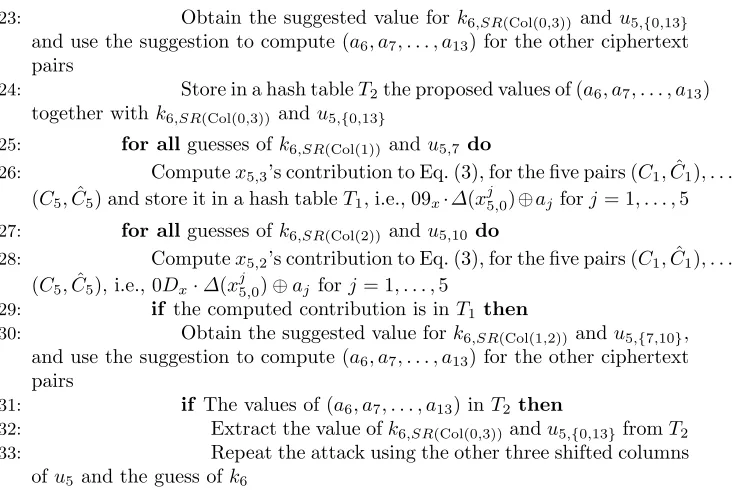
The resulting attack algorithm is Algorithm 5.
Algorithm 5Attacking 7-Round AES
1: Take a structureS of 226chosen plaintexts with the same value in all bytes, except possibly for bytes 0,5,10,15, and ask for its encryption.
2: foreach guess ofk−1,SR−1(Col(0))do
3: forall plaintextsPi∈S do
4: Partially encryptPi through the first round toxi 5: Find all pairs (x1,xˆ1) equal exactly in two bytesj1 andj2
6: Divide these pairs into 6 classesCj1,j2 according to the equal byte posi-tions (Find candidate mixtures)
7: for(j1, j2)∈ {0,1,2,3}, j1< j2 do 8: forall pairs (xi
1, yi1)∈Cj1,j2, denotex1= (c1, c2, γ1, δ1),y1= (c1, c2, γ2, δ2) anddo
9: forallc01, c02do
10: Letx01= (c01, c20, γ1, δ1),y1= (c01, c02, γ2, δ2) andx001= (c01, c02, γ1, δ2),
y001 = (c01, c02, γ2, δ1)
11: Partially decrypt (x01, y10) and (x001, y001) 12: if the pair of decrypted values is inS then
13: Add the pair to the listtmp
14: if the listtmphas at least 12 pairs then
15: Add (x1, y1) and the (at least) 12 pairs oftmptoL
16: for all13-tuple of plaintexts inL, denoted by (Pi,Pˆi) (i= 1, . . . ,13)do 17: for allcandidate value of (a1, a2, a3, a4, a5)do
18: for allguesses ofk6,SR(Col(0)) andu5,0do
19: Computex5,0’s contribution to Eq. (3), for the five pairs (C1,Cˆ1), . . . , (C5,Cˆ5) and store it in the hash tableT1, i.e., 0Ex·∆(xj5,0)⊕aj for j = 1, . . . ,5
20: for allguesses ofk6,SR(Col(3)) andu5,13do
21: Computex5,1’s contribution to Eq. (3), for the five pairs (C1,Cˆ1), . . . , (C5,Cˆ5), i.e., 0Bx·∆(xj5,0)⊕aj forj= 1, . . . ,5
23: Obtain the suggested value fork6,SR(Col(0,3)) andu5,{0,13}
and use the suggestion to compute (a6, a7, . . . , a13) for the other ciphertext pairs
24: Store in a hash tableT2the proposed values of (a6, a7, . . . , a13) together withk6,SR(Col(0,3)) andu5,{0,13}
25: for allguesses ofk6,SR(Col(1)) andu5,7do
26: Computex5,3’s contribution to Eq. (3), for the five pairs (C1,Cˆ1), . . . , (C5,Cˆ5) and store it in a hash tableT1, i.e., 09x·∆(xj5,0)⊕aj forj= 1, . . . ,5
27: for allguesses ofk6,SR(Col(2)) andu5,10do
28: Computex5,2’s contribution to Eq. (3), for the five pairs (C1,Cˆ1), . . . , (C5,Cˆ5), i.e., 0Dx·∆(xj5,0)⊕aj forj= 1, . . . ,5
29: if the computed contribution is inT1 then
30: Obtain the suggested value fork6,SR(Col(1,2))andu5,{7,10},
and use the suggestion to compute (a6, a7, . . . , a13) for the other ciphertext pairs
31: if The values of (a6, a7, . . . , a13) inT2 then
32: Extract the value ofk6,SR(Col(0,3))andu5,{0,13}fromT2 33: Repeat the attack using the other three shifted columns
ofu5 and the guess ofk6
The memory complexity of the attack is 240104-bit values (required in Steps 19 and 26), which are less than 240 128-bit blocks. As for the time complexity, for each guess ofk−1,{0,5,10,15}, each 13-tuple ((P1,Pˆ1), . . . ,(P13,Pˆ13))∈L, and each guessed 40-bit value (a1, . . . , a5), the internal MITM procedures take 240 time and the external MITM procedure consists of 240 times decrypting a full AES round and one column of another round, for 26 ciphertexts, plus 2·280 table lookups. Estimating a table lookup as one full AES round, the total time complexity of this step is 232·232·240·240·5 = 2146.3encryptions. The complexity of all other steps is negligible.
Therefore, the data complexity of the attack is 226 chosen plaintexts, the memory complexity is 240 128-bit blocks, and the time complexity is 2146.3 en-cryptions. The success probability is about 95% (which is the complexity that the data structure S contains a good special pair along with 12 of its mixture counterparts).
6.3 An Attack with Lower Memory Complexity on AES-192, Exploiting the Key Schedule
The situation for AES-192 is different, as there exists a strong relation be-tweenu5 andk6. Specifically, by the AES key schedule we have
k5,Col(1)=k6,Col(2)⊕k6,Col(3),
and
k5,Col(0)=k6,Col(2)⊕SB(k6,Col(1)≪8)⊕RCON[5].
Sinceu5,Col(j)=M C−1(k5,Col(j)) for eachj, two columns ofu5can be expressed as a combination of bytes of k6. As these two columns contain two of the four bytes of u5 guessed in the attack, we will be able to use this relation to re-duce the memory complexity of our attack (in exchange for increasing the time complexity).
Specifically, we use the following equations:
u5,0=M C−1(k5,Col(0))0= 0Ex·k5,0⊕0Bx·k5,1⊕0Dx·k5,2⊕09x·k5,3 = 0Ex·(k6,8⊕SB(k6,7)⊕20x)⊕0Bx·(k6,9⊕SB(k6,4))⊕
⊕0Dx·(k6,10⊕SB(k6,5))⊕09x·(k6,11⊕SB(k6,6)),
and
u5,7=M C−1(k5,Col(1))3= 0Bx·k5,4⊕0Dx·k5,5⊕09x·k5,6⊕0Ex·k5,7 = 0Bx·(k6,8⊕k6,12)⊕0Dx·(k6,9⊕k6,13)⊕
⊕09x·(k6,10⊕k6,14)⊕0Ex·(k6,11⊕k6,15).
As a preparation for modifying the MITM procedure, we rewrite the equations such that each side will consist of bytes guessed in one side of the MITM, and denote the equal parts by c1 andc2. We get:
c1= 0Ex·20x⊕u5,0⊕0Ex·SB(k6,7)⊕0Bx·k6,9⊕0Dx·k6,10⊕
⊕09x·SB(k6,6) = 0Ex·k6,8⊕0Bx·SB(k6,4)⊕0Dx·SB(k6,5)⊕09x·k6,11, (5)
and
c2= 0Bx·k6,12⊕0Dx⊕k6,13⊕0Dx·k6,9⊕
⊕09x·k6,10=u5,7⊕09x·k6,14⊕0Ex·k6,15⊕0Bx·k6,8⊕ ⊕0Ex·k6,11. (6)
Note that the valuesc1, c2 can be computedindependently by the two sides of the MITM procedure presented above. These values can be used as an additional filtering condition in the MITM process; however, we do not need more filtering conditions as the mixture counterparts can supply us with practically any num-ber of filtering conditions we need. Instead, we use these values to reduce the memory complexity using a more involved MITM procedure.
k−1, 232 pairs, and the valuesc1, c2), while the MITM procedure still guesses 80 key bits in each side. This seems to be non-optimal, as the time complexity seems to increase to 2160. However, as the valuesc
1, c2 are known, each side of the MITM can guess only 64 bits (i.e., 8 byte values) instead of 80, and recover the two remaining bytes via Equations (5),(6), using the knowledge of c1 and
c2. Thus, the MITM procedure effectively has only 64 subkey bits on each side, and hence, its time and memory complexities in a straightforward application are about 264. Hence, applying this modification to the basic MITM attack presented above reduces its memory complexity from 280 to 264, while leaving the time complexity unchanged.
However, recall that in our actual attack, the memory complexity of the MITM procedure is much lower – 240 – due to the use of dissection. Can we reduce the memory complexity of the dissection procedure using the external subkey guess? It turns out we can, but this is more complex. The problem is that in the internal MITM procedures, where only 5 subkey bytes are guessed from each side, the values ofc1, c2are not sufficient for guessing only 4 subkey bytes from each side and retrieving the fifth one, since each side of Equations (5), (6) contains values from the two sides of each internal MITM procedure.
Instead, we have to further subdivide Equations (5),(6) and introduce addi-tional guesses of intermediate values into the internal MITM procedures. To this end, we define c3, c4, c5, c6, which break each of the parts of Equations (5),(6) into two parts. We start with Equation (5):
c3=c1⊕0Ex·20x⊕u5,0⊕0Ex·SB(k6,7)⊕0Dx·k6,10= = 0Bx·k6,9⊕09x·SB(k6,6),
(7)
and
c4=c1⊕0Bx·SB(k6,4)⊕09x·k6,11= 0Ex·k6,8⊕0Dx·SB(k6,5). (8)
Note that in Equation 7, the left hand side can be computed given only the subkey bytes k6,SR(Col(0))and u5,0, while the right hand side can be computed given only the subkey bytesk6,SR(Col(3))andu5,13. Hence, each side of the first internal MITM procedure is able to compute c3. Similarly, in Equation 8, the left hand side can be computed given only the subkey bytes k6,SR(Col(1)) and
u5,7 while the right hand side can be computed given only the subkey bytes
k6,SR(Col(2))andu5,10. Hence, each side of the second internal MITM procedure is able to compute c4.
We do the same for Equation 6:
c5=c2⊕0Dx·k6,13⊕09x·k6,10= 0Bx·k6,12⊕ ⊕0Dx·k6,9, (9)
and
c6=c2⊕u5,7⊕09x·k6,14⊕0Ex·k6,11= 0Ex·k6,15⊕0Bx·k6,8. (10)
1. Constructing the plaintext pool.Take a structureSof 226chosen plain-texts with the same value in all bytes, except possibly for bytes 0,5,10,15. 2. For each guess of subkey k−1,SR−1(Col(0)), do the following:
(a) Construct the list Lof 13-tuples, in the same way as in Algorithm 5 (b) For each 13-tuple of plaintexts in L, which we henceforth denote by
(Pi,Pˆi) (fori= 1,2, . . . ,13), do the following:
i. External guess of two auxiliary bytes. Guess the byte values
c1, c2defined in Equations (5) and (6).
ii. For each candidate value of (a1, a2, a3, a4) defined in Equation 4: iii. First internal MITM procedure:
A. Guess bytesc3 and c5 defined in Equations (7) and (9), respec-tively.
B. Guess bytesk6,{0,7,10}and use the knowledge ofc3, c5to compute
k6,13andu5,0. Partially decrypt the ciphertext pairs to obtain the values in the statex5,0. Store in a table the contribution of the bytex5,0to Equation (3) for the pairs (C1,Cˆ1), . . . ,(C4,Cˆ4), i.e., the concatenation of the values 0Ex·∆(x5,0i )⊕aifori= 1, . . . ,4 – 32 bits in total.
C. Guess bytesk6,{3,9}andu5,13 and use the knowledge ofc3, c5 to computek6,6 andk6,12. Partially decrypt the ciphertext pairs to obtain the values in the statex5,1. Compute the contribution of the bytex5,1to Equation (3) for the pairs (C1,Cˆ1), . . . ,(C4,Cˆ4), i.e., the concatenation of the values 0Bx·∆(xi5,1) fori= 1, . . . ,4, and check it in the table.
D. For each value found in the table, use the suggested value of
k6,SR(Col(0,3))andu5,{0,13}and partially decrypt the ciphertexts
to obtain the values (a5, a6, . . . , a13). Store them in a table, to-gether with the suggestion fork6,SR(Col(0,3)) andu5,{0,13}.
iv. Second internal MITM procedure:
A. Guess bytesc4andc6 defined in Equations (8) and (10), respec-tively.
B. Guess bytesk6,{1,11}andu5,7 and use the knowledge ofc4, c6 to computek6,4 andk6,14. Partially decrypt the ciphertext pairs to obtain the values in the statex5,3. Store in a table the contribu-tion of the bytex5,3to Equation (3) for the pairs (C1,Cˆ1), . . . ,(C4,Cˆ4), i.e., the concatenation of the values 09x·∆(xi5,3)⊕ai for i = 1, . . . ,4 – 32 bits in total.
C. Guess bytesk6,{2,8}andu5,10 and use the knowledge ofc4, c6 to computek6,5 andk6,15. Partially decrypt the ciphertext pairs to obtain the values in the statex5,2. Compute the contribution of the bytex5,2to Equation (3) for the pairs (C1,Cˆ1), . . . ,(C4,Cˆ4), i.e., the concatenation of the values 0Dx·∆(xi5,1) fori= 1, . . . ,4, and check it in the table.
D. For each value found in the table, use the suggested value of
to obtain the values (a5, a6, . . . , a13). Check whether the vector exists in the table. If yes, output the suggested value ofk6 and
u5,SR(Col(0))for subsequent analysis.
v. For all remaining suggestions of k6 and u5,SR(Col(0)), retrieve the rest of u5 by mounting similar attacks on the other three columns sequentially, and then usek6 andu5 to retrieve the secret key.
Let us analyze the time complexity of the attack. The first internal MITM procedure (Step 2(b(iii))) is performed for each guess ofk−1,SR−1(Col(0)), each of 232 13-tuples inL and each guess ofc
1, c2, a1, a2, a3, a4 – that is, 2112 times in total. In this procedure, we guess two more bytes (c3, c5) and for each guess, we perform 224decryptions of two columns through one AES round for 8 ciphertexts, plus 2·224 table lookups, which are roughly equivalent to 224 full encryptions. Hence, the time complexity of this step is 2112·216·224= 2152encryptions. The complexity of the second internal MITM procedure (Step 2(b(iv))) is the same. Each of the internal MITM procedures yields 232 key suggestions (as a total of 10 key bytes are guessed, and there is a 48-bit filtering), and thus the external MITM procedure takes 2112·232= 2144time, which is negligible with respect to the previous steps. At the end of Step 2(b(v)), we are left with 248suggestions. Hence, the remaining steps are negligible with respect to the previous ones. The total amount of filtering is 13·32 = 416 bits, and thus, only the correct key guess is expected to remain. Therefore, the total time complexity of the attack is 2153encryptions.
As for the memory complexity: Storing the plaintexts requires 226 128-bit blocks. The internal MITM procedures require 224(due to the external guesses), the external MITM procedure requires 23280-bit values, and the other steps are negligible. Therefore, the total memory complexity of the attack is less than 232 128-bit blocks.
To summarize, the attack requires 226 chosen plaintexts, and has memory and time complexities of 232 and 2153, respectively.
7
Improving the Collision Attack of Gilbert and Minier
on 7-round AES
One of the first published attacks on the AES is a collision attack on 7-round AES proposed by Gilbert and Minier [18] in 2000. The attack is applicable to AES-192 and AES-256, and has data complexity of 232, memory complexity of 280, and time complexity of about 2140.5 In this section we show that for both AES-192 and AES-256, our techniques can be used to reduce the memory
5