ALEXANDER HOGENBOOM
Sentiment Analysis of Text
Guided by
Semantics and Structure
A L E X A N D E R H O G E N B O O M - S e n ti m e n t A n a ly s is o f T e x t G u id e d b y S e m a n ti c s a n d S tr u c tu re
ERIM PhD Series
Research in Management
E
ra
s
m
u
s
R
e
s
e
a
rc
h
I
n
s
ti
tu
te
o
f
M
a
n
a
g
e
m
e
n
t
-369 E R I D e si g n & l a y o u t: B & T O n tw e rp e n a d v ie s ( w w w .b -e n -t .n l) P ri n t: H a v e k a ( w w w .h a v e k a .n l)
SENTIMENT ANALYSIS OF TEXT GUIDED BY SEMANTICS AND STRUCTURE
As moods and opinions play a pivotal role in various business and economic processes, keeping track of one’s stakeholders’ sentiment can be of crucial importance to decision ma kers. Today’s abundance of usergenerated content allows for the automated monito ring of the opinions of many stakeholders, like consumers. One challenge for such auto -mated sentiment analysis systems is to identify whether pieces of natural language text are positive or negative.
Typical methods of identifying this polarity involve lowlevel linguistic analysis. Exis -ting systems predominantly use morphological, lexical, and syntactic cues for polarity, like a text’s words, their partsofspeech, and negation or amplification of the conveyed senti -ment. This dissertation argues that the polarity of text can be analyzed more accurately when additionally accounting for semantics and structure.
Polarity classification performance can benefit from exploiting the interactions that emo ti cons have on a semantic level with words – emoticons can express, stress, or disam -bi guate sentiment. Furthermore, semantic relations between and within languages can help identify meaningful cues for sentiment in multi-lingual polarity classification.
An even better understanding of a text’s conveyed sentiment can be obtained by gui -ding automated sentiment analysis by the rhetorical structure of the text, or at least of its most sentiment-carrying segments. Thus, the sentiment in, e.g., conclusions can be treated differently from the sentiment in background information.
The findings of this dissertation suggest that the polarity of natural language text should not be determined solely based on whatis said. Instead, one should account for
howthis message is conveyed as well.
The Erasmus Research Institute of Management (ERIM) is the Research School (Onder -zoek school) in the field of management of the Erasmus University Rotterdam. The founding participants of ERIM are the Rotterdam School of Management, Erasmus University (RSM), and the Erasmus School of Econo mics (ESE). ERIM was founded in 1999 and is officially accre dited by the Royal Netherlands Academy of Arts and Sciences (KNAW). The research under taken by ERIM is focused on the management of the firm in its environment, its intra- and interfirm relations, and its busi ness processes in their interdependent connections.
The objective of ERIM is to carry out first rate research in manage ment, and to offer an ad vanced doctoral pro gramme in Research in Management. Within ERIM, over three hundred senior researchers and PhD candidates are active in the different research pro -grammes. From a variety of acade mic backgrounds and expertises, the ERIM commu nity is united in striving for excellence and working at the fore front of creating new business knowledge.
Erasmus Research Institute of Management - Rotterdam School of Management (RSM) Erasmus School of Economics (ESE)
Tel. +31 10 408 11 82 Fax +31 10 408 96 40 E-mail [email protected]
Sentiment Analysis of Text
Guided by
Guided by Semantics and Structure
Sentimentanalyse van tekst geleid door semantiek en structuurThesis
to obtain the degree of Doctor from the Erasmus University Rotterdam
by command of the rector magnificus
Prof.dr. H.A.P. Pols
and in accordance with the decision of the Doctorate Board
The public defense shall be held on
Friday 13 November 2015 at 13:30 hours
by
Alexander Cornelis Hogenboom
Promotors: Prof.dr.ir. U. Kaymak Prof.dr. F.M.G. de Jong
Other members: Prof.dr. P.J.F. Groenen
Prof.dr. M.-F. Moens Dr. D.E. Losada
Copromotor: Dr.ir. F. Frasincar
Erasmus Research Institute of Management - ERIM
The joint research institute of the Rotterdam School of Management (RSM) and the Erasmus School of Economics (ESE) at the Erasmus University Rotterdam Internet: http://www.erim.eur.nl
ERIM Electronic Series Portal:http://repub.eur.nl/pub
ERIM PhD Series in Research in Management, 369 ERIM reference number: EPS-2015-369-LIS
ISBN: 978-90-5892-423-0 c
2015, Alexander Hogenboom
Design: B&T Ontwerp en advies www.b-en-t.nl
This publication (cover and interior) is printed by haveka.nl on recycled paper, ReviveR.
The ink used is produced from renewable resources and alcohol free fountain solution.
Certifications for the paper and the printing production process: Recycle, EU Flower, FSC, ISO14001. More info: http://www.haveka.nl/greening
All rights reserved. No part of this publication may be reproduced or transmitted in any form or by any means electronic or mechanical, including photocopying, recording, or by any information storage and retrieval system, without permission in writing from the author.
SIKS, the Dutch Research School for Information and Knowledge Systems (http://www.siks.nl)
Preface
“A journey is best measured in friends, rather than miles.” Tim Cahill (1944)
Journeys are all about getting to destinations that may at first seem rather distant and vague. In my experience, this holds true for a Ph.D. trajectory as well. A Ph.D. trajectory is a long journey, with the successful defense of a thesis being its intended destination. This destination may at first be nothing but a vague dot on the horizon – the outline and contents of a thesis, as well as the conditions for its defense, are typically shaped on the go. Experimental results, feedback from others, and new insights tend to lead to new research questions that demand further investigation before a thesis can be considered complete, or at the very least defendable. My own Ph.D. trajectory, albeit my personal journey, has not been a solitary one. Many people have helped shape the destination of my Ph.D. trajectory, and for that I am ever grateful.
In the first place, I would like to thank my promotors Prof.dr.ir. Uzay Kaymak and Prof.dr. Franciska de Jong, as well as my copromotor Dr.ir. Flavius Frasincar for guiding me through my Ph.D. trajectory. Uzay, thank you for allowing me to follow my own path, for challenging me not to focus on low-hanging fruit alone, and for stimulating me to set up my own line of research and to develop a coherent thesis in the process. Franciska, you have never ceased to amaze me with your spot-on feedback whenever needed, in spite of your own hectic schedule. Thank you for giving those ever subtle and often crucial nudges in the right direction, even while you were cooking dinner – yes, I did hear the pots and pans in the background when you gave your comments on one of our papers over the phone. Flavius, I know that I must have driven you crazy at first because of my just-in-time handling of deadlines, especially combined with my reluctance of showing any draft at all before being completely satisfied with it. I am thankful for your endless patience, and for how you have helped me make my Ph.D. trajectory a productive one nonetheless. Thank you for being the amazingly friendly, stimulating, and resourceful daily supervisor that you have been to me.
Furthermore, I would like to express my gratitude towards the members of my doctoral committee. Thank you for taking the time for critically reviewing my thesis in light of your own disparate areas of expertise that this dissertation touches upon. I am honored to have you in my committee.
This dissertation would not have existed in its current form without the involvement of the larger scientific community. I am thankful for the numerous anonymous reviewers that have provided valuable feedback on my manuscripts, as this feedback has helped further improve the manuscripts that now constitute this dissertation. Furthermore, I have had the privilege of meeting inspiring colleagues from all over the world at various conferences. Their presentations, their feedback, and our informal conversations have often sparked new ideas. One of such ideas has led to a fruitful collaboration with Dr. David Losada and Jose Manuel Gonzalez Chenlo from the University of Santiago de Compostela. David and Jose Manuel, I am happy that our paths crossed at the CIKM 2011 conference in Glasgow. It has been a great pleasure collaborating with you.
Besides the involvement of the larger scientific community, another crucial enabler for this dissertation has been the support of various organizations. I am thankful for the substantial funding and academic ecosystems provided by the Erasmus Studio, the Econo-metric Institute, the Erasmus Research Institute for Management (ERIM), the Dutch Re-search School for Information and Knowledge Systems (SIKS), and the Infiniti project on Information Retrieval for Information Services in the Dutch national program COMMIT. Concrete and practical support for the day-to-day work that came with my Ph.D. trajectory has been provided by the indispensable supporting staff of the Econometric Institute. Antonia, thank you for always making sure that the tenth floor was a clean and pleasant working environment, in spite of my tendencies of making a mess of both my desk and my chair. Marjon and Anneke, thank you for helping me out with the craziest things, ranging from taking care of several dozens of teaching assistant contracts to helping me fill in the simplest forms that, time and time again, seemed to hold so many mysteries for me. Marianne, Ursula, Elli, and Carien, thank you for making my life at university so much easier due to all of your efforts at the secretariat and in the office management.
Keeping up one’s spirits can be a challenge every now and then when undertaking a long journey like a Ph.D. trajectory. In this respect, I have been very lucky to be able to share my journey with a bunch of amazing fellow Ph.D. candidates. First, being able to share most of my journey with my twin brother Frederik has been priceless. Frederik, I could not have wished for a better office mate. It has not only been great fun to share an office with you at the tenth floor – it has been rather convenient as well. We have surely been the perfect occasional substitutes for one another at conferences and lectures...
Even though our office was officially a two-man office, it seemed to double as secondary office of two great colleagues and friends. Damir, your sense of humor, your contagious enthusiasm for new concepts, and your inseparable energy drinks have always helped create a unique atmosphere in the office – relaxed, yet strangely productive. I am happy to have both you and Frederik as my paranymphs. Wim, even the most mundane parts of a Ph.D. trajectory seemed to turn into something hilarious with you around. Thank you for, amidst all hilarity, always challenging my findings and beliefs with your witty and inquisitive nature, and for always putting things into the right perspective. Many more colleagues have made my time at Erasmus University Rotterdam enjoyable. In particular, I would like to thank Rui, Viorel, Milan, Kim, Charlie, Nalan, Tommi, and Yingqian for all the good times we have had at university as well as at conferences.
University is of course much broader than one’s own department and direct colleagues. The interdisciplinary lunch meetings of the Erasmus Studio have helped broaden my perspective beyond my own department and field of expertise and have as such been an enriching experience. Furthermore, thanks to my fellow board members, I have had an amazing time in the board of the Erasmus Ph.D. Association Rotterdam (EPAR).
Special thanks go to the students of the Economics & Informatics, Econometrics, and International Business Administration programmes. Educating you in information technology has been such a rewarding experience. In particular, I would like to thank the students with whom I have worked more intensively in the past few years. Bas, Frank, Paul, Daniella, Malissa, Gino, Milan, Maarten, Ferry, and Ewout, supervising you in the context of your seminars and theses has been a great experience, and your hard and devoted work has been truly inspiring. I am proud of how we have established a fruitful collaboration in the process, resulting in various scientific publications.
Support from my friends and family has been indispensable to me during my Ph.D. trajectory. I am thankful to my parents for dealing with my flexible definitions of day and night, for picking me up from my desk every now and then, for putting up with my long shower sessions that often helped clear my mind, for providing me with plenty of food for thought, and for always having a sunny spot available for me to read and review in. Last, to all of you close and dear to me, at times, it may have seemed as though everything revolved around my pursuit of a Ph.D. degree. Thank you for reminding me that there is so much more to life than obtaining a Ph.D. degree. Thank you for sticking with me during my journey. This journey has now come to an end, and new journeys await.
Rotterdam, July 2015 Alexander Hogenboom
Table of Contents
Preface vii
1 Introduction 1
1.1 Automated Sentiment Analysis . . . 2
1.2 Levels of Linguistic Analysis . . . 3
1.3 Research Objectives . . . 5
1.4 Contributions . . . 9
1.5 Outline . . . 11
2 Mapping Word-Based Sentiment Scores to Intended Sentiment 13 2.1 Introduction . . . 14
2.2 Analyzing Sentiment in a Multi-lingual Setting . . . 15
2.3 From Sentiment Scores to Star Ratings . . . 18
2.3.1 Sentiment Scoring . . . 19
2.3.2 Sentiment Mappings . . . 19
2.3.3 Star Ratings as a Non-Monotonic Function of Sentiment . . . 21
2.3.4 Incorporating a Bag-of-Sentiwords Representation . . . 22
2.4 Evaluation . . . 23
2.4.1 Experimental Setup . . . 23
2.4.2 Experimental Results on Dutch Documents . . . 26
2.4.3 Experimental Results on English Documents . . . 29
2.4.4 Overall Experimental Results . . . 32
2.5 Conclusions . . . 33
3 Emoticon-Guided Polarity Classification of Text 35 3.1 Introduction . . . 36
3.2 Related Work . . . 37
3.3.1 Emoticons as Cues for Polarity . . . 39
3.3.2 Framework . . . 41
3.4 Polarity Classification by Exploiting Emoticons . . . 44
3.4.1 Experimental Setup . . . 44
3.4.1.1 Data . . . 44
3.4.1.2 Implementation . . . 45
3.4.1.3 Emoticon Sentiment Lexicon . . . 45
3.4.1.4 Evaluation . . . 46
3.4.2 Experimental Results on Dutch Tweets and Forum Posts . . . 47
3.4.3 Validation on English App Reviews . . . 47
3.4.4 Caveats . . . 51
3.5 Conclusions . . . 52
4 Exploiting Semantics for Sentiment Analysis in a Multi-lingual Setting 55 4.1 Introduction . . . 56
4.2 Related Work . . . 58
4.2.1 Multi-lingual Sentiment Analysis . . . 58
4.2.2 Semantic Lexicons . . . 59
4.3 Framework . . . 60
4.3.1 Polarity Classification . . . 60
4.3.2 Traversing Relations between Semantic Lexicons . . . 62
4.3.3 Propagation of Sentiment within Semantic Lexicons . . . 65
4.4 Evaluation . . . 67
4.4.1 Experimental Setup . . . 68
4.4.2 Experimental Results . . . 69
4.5 Conclusions . . . 74
5 Using the Rhetorical Structure of Text in Sentiment Analysis 77 5.1 Introduction . . . 78
5.2 Structure-Guided Sentiment Analysis . . . 79
5.2.1 Rhetorical Structure Theory . . . 80
5.2.2 Rhetorical Structure and Sentiment . . . 81
5.3 Classifying Polarity Using Rhetorical Structure . . . 82
5.3.1 Fine-Grained Analysis . . . 82
5.3.2 Word-Level Sentiment Scoring . . . 84
5.3.3 Rhetorical Structure Processing . . . 86
5.3.3.2 Top-Level Rhetorical Structure . . . 87
5.3.3.3 Leaf-Level Rhetorical Structure . . . 87
5.3.3.4 Hierarchical Rhetorical Structure . . . 87
5.3.4 Classifying Document Polarity . . . 88
5.3.5 Weighting Schemes . . . 89
5.4 Evaluation . . . 90
5.4.1 Experimental Setup . . . 90
5.4.2 Experimental Results . . . 92
5.4.2.1 Baseline Performance . . . 92
5.4.2.2 Performance with Sentence-Level RST Trees . . . 93
5.4.2.3 Performance with Paragraph-Level RST Trees . . . 95
5.4.2.4 Performance with Document-Level RST Trees . . . 96
5.4.2.5 Comparison . . . 97
5.4.2.6 Optimized Weights . . . 101
5.4.2.7 Processing a Document . . . 105
5.4.2.8 Caveats . . . 106
5.5 Conclusions . . . 108
6 Large-Scale Polarity Ranking with Sentential Rhetorical Structure 111 6.1 Introduction . . . 112
6.2 Related Work . . . 113
6.2.1 Large-Scale Sentiment Analysis . . . 114
6.2.2 Rhetorical Structure and Sentiment Analysis . . . 115
6.3 Large-Scale Sentiment-Based Ranking Guided by Rhetorical Structure . . . 116
6.3.1 Finding Relevant Polar Sentences . . . 117
6.3.2 Parsing Sentential Rhetorical Structure . . . 119
6.3.3 Using the Structure of Key Sentences in Polarity Ranking . . . 120
6.4 Evaluation . . . 121
6.4.1 Experimental Setup . . . 121
6.4.1.1 Data . . . 122
6.4.1.2 Task and Baselines . . . 122
6.4.1.3 Training and Testing . . . 123
6.4.2 Experimental Results . . . 124
6.4.2.1 Polarity Retrieval Performance . . . 124
6.4.2.2 Weights for Rhetorical Relations . . . 126
7 Polarity Classification Using Structure-Based Vector Representations
of Text 129
7.1 Introduction . . . 130
7.2 Related Work . . . 131
7.2.1 Sentiment Analysis . . . 132
7.2.2 Vector Representations of Text for Sentiment Analysis . . . 133
7.2.3 Structure-Based Sentiment Analysis . . . 134
7.3 Classifying Polarity with Structure-Based Vector Representations of Text . 135 7.3.1 Linguistic Processing . . . 135 7.3.2 Extracted Features . . . 137 7.4 Evaluation . . . 138 7.4.1 Experimental Setup . . . 138 7.4.1.1 Experiments . . . 139 7.4.1.2 Feature Selection . . . 142 7.4.1.3 Polarity Classification . . . 142
7.4.2 Experimental Results on Movie Reviews . . . 143
7.4.2.1 Polarity Classification Performance . . . 143
7.4.2.2 Selected Features . . . 149
7.4.3 Experimental Results on Multi-Domain Reviews . . . 154
7.4.3.1 Polarity Classification Performance . . . 154
7.4.3.2 Selected Features . . . 157
7.4.4 Caveats . . . 163
7.5 Conclusions . . . 163
8 Conclusions and Outlook 165 8.1 Main Findings . . . 165
8.2 Future Work . . . 167
8.3 Outlook . . . 168
Bibliography 171
Summary in English 193
Nederlandse Samenvatting (Summary in Dutch) 195
About the Author 197
List of Figures
Chapter 11.1 Levels of linguistic analysis. . . 4 1.2 Content covered by the main chapters of this dissertation. . . 11
Chapter 2
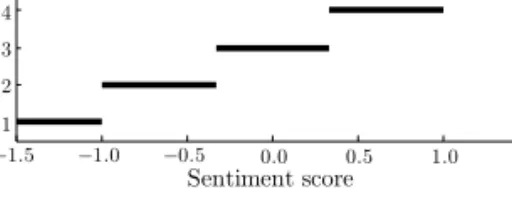
2.1 Intuitive mapping from sentiment scores to universal star ratings. . . 21 2.2 Distribution of documents over universal star rating classes, for our
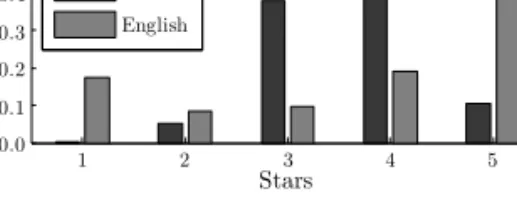
collec-tions of Dutch and English movie reviews. . . 24 2.3 Typical sentiment mappings constructed on the training set of one specific
fold of our evaluation on our Dutch corpus. . . 27 2.4 Typical sentiment mappings constructed on the training set of one specific
fold of our evaluation on our English corpus. . . 30
Chapter 3
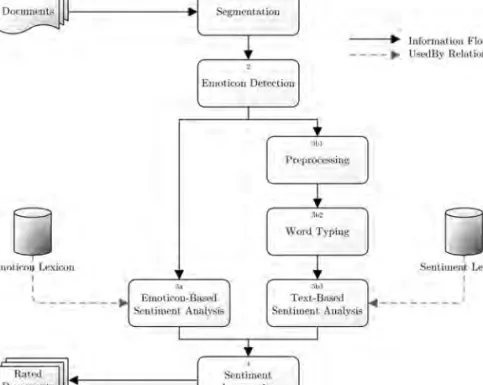
3.1 Overview of our emoticon-guided sentiment analysis framework. . . 42
Chapter 4
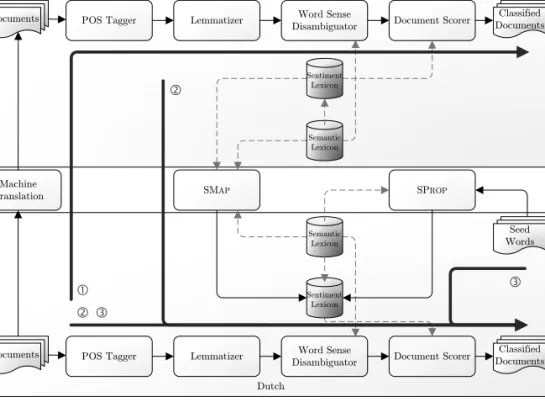
4.1 Our sentiment analysis framework, with language-specific components for both English and Dutch. . . 63 4.2 Our novel method for mapping sentiment scores from a reference language
to a target language. . . 64 4.3 Our proposed method for propagating the sentiment of a set of seed words
through the semantic lexicon of a target language. . . 66 4.4 Coverage of the terms (i.e., unique combinations of lemmas with their
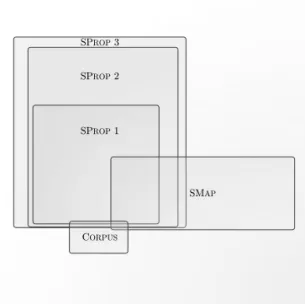
parts-of-speech) in DutchWordNet (Cornetto) by those occurring in our Dutch documents, and by the sentiment-carrying terms in the Dutch sentiment lexicons generated by ourSMapandSPropmethods. . . 73
Chapter 5
5.1 A positive RST-structured sentence, consisting of nuclei and satellites. . . . 80 5.2 RST-guided interpretations of a positive sentence, consisting of nuclei and
satellites. . . 84 5.3 A schematic overview of PAThoS, our lexicon-based binary polarity
clas-sification framework. . . 85 5.4 Thep-values for the paired, one-tailed t-test assessing the null hypothesis
of the mean accuracy of the methods in the columns being smaller than or equal to the mean accuracy of the methods in the rows. . . 98 5.5 Thep-values for the paired, one-tailed t-test assessing the null hypothesis
of the mean macro-level F1-scores of the methods in the columns being
smaller than or equal to the mean macro-levelF1-scores of the methods in
the rows. . . 99 5.6 Box plots of the optimized values of the most common RST relation types’
weights, as well as of the diminishing factor δ for weighting scheme X, for RST-based approaches guided by sentence-level, paragraph-level, and document-level RST trees. . . 102 5.7 Box plots of the optimized values of the most common RST relation types’
weights, as well as of the diminishing factor δ for weighting scheme F, for RST-based approaches guided by sentence-level, paragraph-level, and document-level RST trees. . . 103 5.8 Movie review cv817_3675, processed by various methods. . . 107
Chapter 7
7.1 Overview of our sentiment analysis feature extraction framework. . . 137 7.2 Thep-values for the paired, two-tailed t-test assessing the statistical
sig-nificance of differences in mean accuracy obtained by using our (combined) feature sets on the movie review corpus. . . 145 7.3 Thep-values for the paired, two-tailed t-test assessing the statistical
signif-icance of differences in mean macro-levelF1-scores obtained by using our
(combined) feature sets on the movie review corpus. . . 145 7.4 Characteristics of the top 1 features selected for all folds of our three
best-performing feature sets on the movie review corpus. . . 151 7.5 Characteristics of the top 10 features selected for all folds of our three
7.6 Characteristics of all features selected for all folds of our three best-performing feature sets on the movie review corpus. . . 151 7.7 The p-values for the paired, two-tailed t-test assessing the statistical
sig-nificance of differences in mean accuracy obtained by using our (combined) feature sets on the multi-domain review corpus. . . 156 7.8 Thep-values for the paired, two-tailed t-test assessing the statistical
signif-icance of differences in mean macro-levelF1-scores obtained by using our (combined) feature sets on the multi-domain review corpus. . . 156 7.9 Characteristics of the top 1 features selected for all folds of our three
best-performing feature sets on the multi-domain review corpus. . . 160 7.10 Characteristics of the top 10 features selected for all folds of our three
best-performing feature sets on the multi-domain review corpus. . . 160 7.11 Characteristics of all features selected for all folds of our three best-performing
List of Tables
Chapter 22.1 The weighted mean and standard deviation of the macro-level F1-scores
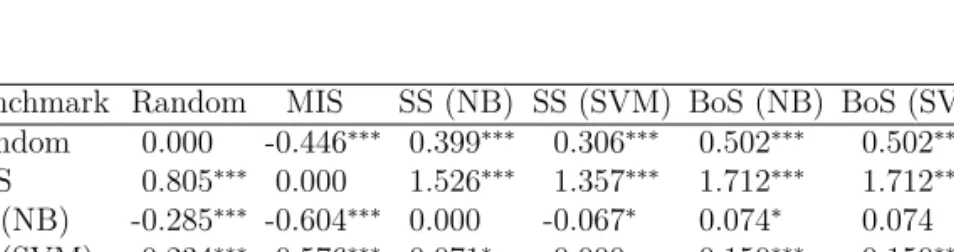
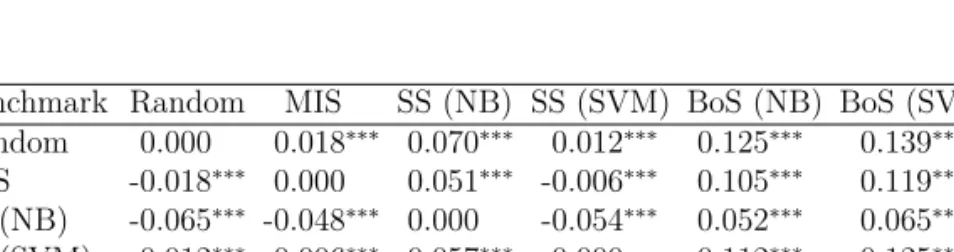
and accuracy over all classes, as computed for our considered methods on our Dutch movie review corpus, based on 10-fold cross-validation. . . 28 2.2 Relative differences of 10-fold cross-validated macro-level F1-scores of our
considered approaches, benchmarked against one another on our collection of Dutch movie reviews. . . 28 2.3 Relative differences of the 10-fold cross-validated overall accuracy of our
considered approaches, benchmarked against one another on our collection of Dutch movie reviews. . . 28 2.4 The weighted mean and standard deviation of the macro-levelF1-scores
and accuracy over all classes, as computed for our considered approaches on our English movie reviews, based on 10-fold cross-validation. . . 31 2.5 Relative differences of 10-fold cross-validated macro-levelF1-scores of our
considered approaches, benchmarked against one another on our collection of English movie reviews. . . 31 2.6 Relative differences of the 10-fold cross-validated overall accuracy of our
considered approaches, benchmarked against one another on our collection of English movie reviews. . . 31
Chapter 3
3.1 Typical examples of how emoticons can be used to convey sentiment. . . . 40 3.2 Typical examples of emoticon synsets. . . 41 3.3 The performance of our considered methods on our collection of Dutch
tweets and forum posts. . . 48 3.4 Relative differences of the overall accuracy of our methods, benchmarked
3.5 Relative differences of the macro-level F1-score of our methods,
bench-marked against one another on our collection of Dutch tweets and forum posts. . . 48 3.6 The performance of our considered methods on our collection of English
app reviews. . . 49 3.7 Relative differences of the overall accuracy of our methods, benchmarked
against one another on our collection of English app reviews. . . 49 3.8 Relative differences of the macro-level F1-score of our methods,
bench-marked against one another on our collection of English app reviews. . . . 49 3.9 The performance of our considered methods on English app reviews that
contain emoticons. . . 50 3.10 Relative differences of the overall accuracy of our methods, benchmarked
against one another on English app reviews that contain emoticons. . . 50 3.11 Relative differences of the macro-level F1-score of our methods,
bench-marked against one another on English app reviews that contain emoticons. 50
Chapter 4
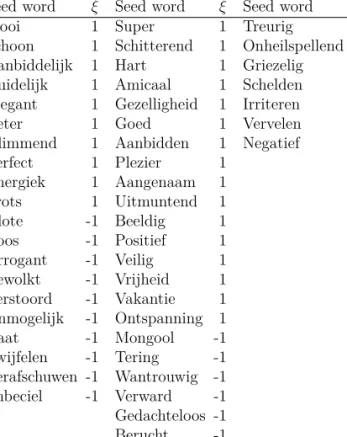
4.1 Considered sentiment-carrying seed words, with their associated sentiment scores. . . 70 4.2 The 10-fold cross-validated performance of our considered methods of
clas-sifying the sentiment conveyed by our collection of opinionated Dutch doc-uments by exploiting an existing sentiment analysis approach for English documents. . . 71 4.3 Relative differences of the 10-fold cross-validated overall accuracy of our
considered approaches, benchmarked against one another on our collection of opinionated Dutch documents. . . 71 4.4 Relative differences of the 10-fold cross-validated macro-level F1-score of
our considered approaches, benchmarked against one another on our col-lection of opinionated Dutch documents. . . 71
Chapter 5
5.1 Performance of our considered baseline methods, based on 10-fold cross-validation on the movie review data set. . . 92 5.2 Performance of our considered sentence-level RST-based approaches
uti-lizing the SPADE parser, based on 10-fold cross-validation on the movie review data set. . . 93
5.3 Performance of our considered sentence-level RST-based approaches uti-lizing the HILDA parser, based on 10-fold cross-validation on the movie review data set. . . 94 5.4 Performance of our considered paragraph-level RST-based approaches
uti-lizing the HILDA parser, based on 10-fold cross-validation on the movie review data set. . . 95 5.5 Performance of our considered document-level RST-based approaches
uti-lizing the HILDA parser, based on 10-fold cross-validation on the movie review data set. . . 96 5.6 Most common RST relation types in our corpus. . . 101
Chapter 6
6.1 RST relations taken into account in our experiments. . . 120 6.2 Performance of the TREC baselines for ranking positive and negative blog
posts, without sentiment-based information, guided byPolMeanBestN, and guided by our novel RST-based variant of PolMeanBestN. . . 125 6.3 Optimized satellite weights for RST relation types for positive and negative
rankings, along with the occurrence rate of these RST relation types in the training data. . . 126
Chapter 7
7.1 The feature sets used in our experiments . . . 140 7.2 Most common relations of satellites to their nuclei, identified bySPADE. . 141 7.3 The 10-fold cross-validated performance of our feature sets on the movie
review corpus. . . 144 7.4 Relative change in the 10-fold cross-validated overall performance on the
movie review corpus when including word-based features. . . 146 7.5 Relative change in the 10-fold cross-validated overall performance on the
movie review corpus when including sentiment-related features. . . 147 7.6 Relative change in the 10-fold cross-validated overall performance on the
movie review corpus when including RST-based features. . . 147 7.7 Feature counts for our feature sets on the movie review corpus, reported
as their total number of extracted features, as well as the mean (µ) and standard deviation (σ) of the number of features selected in each individual fold. . . 150 7.8 The 10-fold cross-validated performance of our feature sets on the
7.9 Relative change in the 10-fold cross-validated overall performance on the multi-domain corpus when including word-based features. . . 157 7.10 Relative change in the 10-fold cross-validated overall performance measures
on the multi-domain corpus when including sentiment-related features. . . 158 7.11 Relative change in the 10-fold cross-validated overall performance measures
on the multi-domain corpus when including RST-based features. . . 158 7.12 Feature counts for our feature sets on the multi-domain review corpus,
reported as their total number of extracted features, as well as the mean (µ) and standard deviation (σ) of the number of features selected in each individual fold. . . 159
List of Algorithms
Chapter 44.1 Classifying a document’s polarity. . . 62 4.2 Sentiment propagation via relations between semantic lexicons. . . 65 4.3 Sentiment propagation in a language-specific semantic lexicon. . . 66 4.4 Propagating a word’s sentiment in a lexical resource (propWord). . . 67
Chapter 5
Chapter 1
Introduction
Challenging economic conditions, speculative bubbles for cryptocurrencies like Bitcoin, and electronic word-of-mouth phenomena on social media have recently demonstrated how today’s markets are affected by people’s sentiment, i.e., by people’s moods or opinions. We have now reached a point where sentiment plays a pivotal role in various business and economic processes – consumer confidence is strongly related to the realization of economic conditions (Howrey, 2001; Ludvigson, 2004; Vuchelen, 2004), Bitcoin exchange rates are extremely sensitive to the craze of the day (Kristoufek, 2013), and sales (Rui et al., 2013; Yu et al., 2012), stock ratings (Yu et al., 2013), and reputation (Jansen et al., 2009) are influenced by subjective tweets, reviews, and other social media content. As such, keeping track of their stakeholders’ sentiment is crucial for today’s decision makers. A traditional way of keeping track of the sentiment of one’s stakeholders is to perform a representative survey that focuses on opinions on the current situation and expectations for the (near) future. Such a procedure is typically applied in order to compile macro-economic indicators that capture macro-economic sentiment, such as the University of Michigan Consumer Sentiment Index (CSI) or the Consumer Confidence Index (CCI) (Ludvigson, 2004). However, people’s expectation formation is thwarted by structural, psychologically driven distortions (Bovi, 2009) – when respondents consider survey questions to be vague or hard to assess, they tend to provide biased answers (Tversky and Kahneman, 1974). Furthermore survey panels tend to be rather small and encompass different respondent samples over time. This complicates the generalizability of survey findings, as observed sentiment shifts may be largely driven by differences in respondent samples (van Oest and Franses, 2008). Moreover, survey-based methods for tracking sentiment cannot tap into
many people’s sentimentright now. Yet, in today’s complex and dynamic markets, it is crucial for decision makers to understand and react to ever-changing circumstances in a timely and effective manner (Hogenboom et al., 2015d).
Fortunately, we live in an era in which digital traces of sentiment are ubiquitous. The Web as we know it today is a network of more than 555 million Web sites, with over two billion users (Pingdom, 2012). Every second, these users collectively enter about 50,000 search terms in query engines like Google (Internet Live Stats, 2014) and thus provide indirect proxies for their sentiment (Della Penna and Huang, 2009; Kristoufek, 2013; Preis et al., 2010; Vosen and Schmidt, 2011). Moreover, today’s Web users’ sentiment is revealed in a more explicit and specific manner in the thousands of reviews, blog posts, and tweets that are posted every second of the day. Besides the reviews, one in three blog posts (Melville et al., 2009) and one in five tweets (Jansen et al., 2009) discuss products or brands, and hence contain valuable information. However, in this era of Big Data, the abundant and ubiquitous user-generated content is often unstructured, scattered across the Web, and ever-expanding, thus rendering information extraction by manual analysis of all available data unfeasible (Madden, 2012). Tools for automated sentiment analysis of textual data can provide timely and effective support for decision making processes.
1.1
Automated Sentiment Analysis
Systems that perform automated sentiment analysis are mainly concerned with the ex-traction of subjective information from natural language text. This task poses three main challenges, i.e., the identification of relevant pieces of text (Mei et al., 2007; O’Hare et al., 2009; Zhang and Ye, 2008), the analysis of relevant textual data for conveyed sentiment (Cambria et al., 2013; Feldman, 2013; Liu, 2012; Pang and Lee, 2008), and the analysis of potential effects of the identified sentiment on entities of interest (e.g., products or brands) (Amigo et al., 2013; Jansen et al., 2009). This dissertation is specifically focused on the task of analyzing the sentiment conveyed by (presumably) appropriate textual data.
The analysis of sentiment conveyed by pieces of natural language text can serve various goals. Some sentiment analysis methods focus on distinguishing subjective text segments from objective ones (Wiebe et al., 2004) or on summarizing opinions (Lerman et al., 2009; Titov and McDonald, 2008), but the most common goal of sentiment analysis approaches is the identification of the polarity of words, sentences, text segments, or documents (Liu, 2012; Pang and Lee, 2008). This dissertation deals with the latter task of analyzing the polarity of natural language text. This task is commonly treated as a binary classification problem, which involves classifying the polarity of text as either positive or negative. However, more polarity classes – such as classes of neutral or mixed polarity, or star ratings ranging from, e.g., one to five stars – may be considered. The degree of positivity or negativity of a piece of text is another potential outcome of a polarity analysis.
Existing polarity analysis techniques stem from the fields of natural language pro-cessing, computational linguistics, and text mining, and range from machine learning methods to rule-based methods. Machine learning methods involve training of models on specific collections of documents (i.e., corpora) by means of mostly supervised methods that exploit patterns in vector representations of natural language text (Taboada et al., 2011). The most common and most useful features in these vectors indicate the presence or frequencies of specific words or word groups and constitute a so-calledbag-of-words
representation of text (Pang et al., 2002; Pang and Lee, 2004). These word-based features are often enriched with part-of-speech (POS) information, thus enabling the distinction between (types of) nouns, verbs, adjectives, and adverbs (Liu, 2012). Machine learning polarity analysis methods tend to perform comparably well on the corpora for which they have been optimized (Chaovalit and Zhou, 2005; Kennedy and Inkpen, 2006; Liu, 2012; Pang and Lee, 2008; Taboada et al., 2011), but they require a lot of (annotated) training data as well as training time in order to attain this competitive level of performance.
Compared to machine learning methods, rule-based polarity analysis approaches tend to be rather robust across domains and texts in terms of accuracy (Taboada et al., 2011). Rule-based methods mostly rely on lexicons that list words and their associated sentiment scores. The sentiment scores of words in a text are typically combined (e.g., summed or averaged) in accordance with predefined rules and assumptions in order to obtain a text’s overall sentiment score, which can be used as a proxy for the text’s polarity. This process renders the motivation for assigning a particular polarity to a text rather transparent, as opposed to black-box machine learning approaches. In the sentiment scoring pro-cess, negation (Heerschop et al., 2011c,d; Hogenboom et al., 2011a,b) or intensification (Taboada et al., 2011) of sentiment conveyed by words may be accounted for. Syntactic patterns based on POS information may be exploited as well, in order to focus the analysis on specific parts of a text that may be opinionated, such as adjectives that are preceded by adverbs (e.g., “very good”) (Turney, 2002). As such, rule-based approaches allow for intuitive ways of incorporating linguistic analysis into the polarity analysis process.
1.2
Levels of Linguistic Analysis
Natural language text can be analyzed at various levels (Jurafsky and Martin, 2000; Liddy, 2003), as visualized in Figure 1.1. The distinction between levels may not be clear-cut per se as it is the combination of these levels that helps convey meaning (Liddy, 2003). Yet, even though humans use all levels in order to gain understanding, this is not necessarily the case for systems that automatically process natural language (Liddy, 2003).
Pragmatics Discourse Semantics Syntax Lexicology Morphology Phonology
Figure 1.1: Levels of linguistic analysis.
The lowest level of linguistic analysis deals with phonetics and – especially – phonology. Phonetics comprises the study of the specific sounds that can be physically produced by humans. Phonology is concerned with how (a subset of) these sounds can be used in a language in order to encode meaning, thus enabling for instance the subtle difference between the singular “man” and the plural “men”.
A higher level of analysis is concerned with morphology, which deals with how mor-phemes, i.e., the smallest meaning-carrying units of a language, constitute words. In addition to a root, a word may contain one or more affixes. Each of these morphemes contributes to conveying a word’s meaning. For example, the word “preselected” consists of the root “select”, a prefix “pre” that signals that the selection has been made in ad-vance, and a suffix “ed” that signals the root verb’s perfect tense. Morphology builds upon phonology. For instance, even though the plural of “dog” has a suffix “s” (i.e., “dogs”), the phonological constraints for the English language dictate that the plural of “match” should have a suffix “es” rather than “s”, because the “tchs” sound of “matchs” is invalid. The subsequent level of lexical analysis deals with interpreting the meaning of indi-vidual words. In this process, a word can be assigned a lexical category, denoting its POS. The POS of a word plays an important role in conveying the word’s meaning. For instance, the adverb “well” implies success, whereas the noun “well” refers to a deep hole that has been dug in the ground in order to provide for, e.g., water.
The syntactic level of linguistic analysis is concerned with the meaning conveyed by combined words that form phrases or sentences. Syntactic dependency relationships be-tween words in a text can bring about differences in meaning when including or leaving out particular words, or when changing the word order. For instance, in the phrase “I do not like the awful simplicity of the plot”, “not” negates “like”, thus conveying that something is disliked, and “awful” amplifies the negative connotations of “simplicity”.
Leaving out the words “not” and “awful” would completely change the meaning of the phrase. Furthermore, the phrases “The dog bites a man” and “The man bites a dog” convey the same information on a lexical, morphological, or phonological level, whereas their differences in word order result in completely different meanings on a syntactic level. When analyzing text on a semantic level, the interactions of word-level meanings are dealt with. Some words have multiple senses, and their intended sense depends on the meaning of the context in which these words occur. Semantic analysis deals with such word sense disambiguation tasks. For example, the adjective “cool” could refer to a fairly low temperature, if the context in which it occurs discusses meteorological conditions, whereas it may express fashionable attractiveness or impressiveness in a review. Similarly, a “bank” can represent two disparate concepts when collocated with “water” and “money”. A higher level of linguistic analysis is concerned with discourse analysis. Discourse analysis deals with how meaning is built up in the larger communicative process. The premise is that each phrase, sentence, paragraph, or other discourse unit has a specific role in conveying the overall message of a text. Identifying a text’s rhetorical structure and the roles that text fragments have within this structure can provide valuable additional information, as it can help put the meaning of text fragments in the right perspective. Background or off-topic information may for instance be less relevant than or tangential to the main ideas and conclusions presented in a text.
The highest level of linguistic analysis deals with pragmatics, i.e., the purposeful use of language in specific situations, such that the meaning of a piece of text per se may differ from its meaning in practical use. The focus here is on enriching text with meaning that is not actually encoded in the text itself, but rather requires real-world knowledge. For example, the phrase “This movie is as entertaining as Wild Wild West” can only be understood to its full extent when incorporating the real-world knowledge of “Wild Wild West” being a movie from the late 1990’s that received Golden Raspberry Awards for, among others, Worst Picture and Worst Screenplay.
1.3
Research Objectives
Most existing approaches to automated sentiment analysis focus on the lower levels of linguistic analysis by making use of mostly morphological, lexical, and syntactic informa-tion (Liu, 2012; Pang and Lee, 2008). However, as the utilizainforma-tion of more, higher levels of linguistic analysis can improve a system’s understanding of text (Liddy, 2003), the anal-ysis of the polarity of text may be more accurate if it additionally accounts for semantics, as well as for the rhetorical structure of text as identified by means of discourse analysis.
Pragmatics could be exploited as well, yet doing so would require the incorporation of real-world knowledge from beyond the natural boundaries of a text. Therefore, in order to better utilize the potential of the information containedwithintext in the analysis of its polarity, the problem statement underlying this dissertation is:
How can semantic and structural aspects of text complement low-level linguistic information in the analysis of the polarity of text?
The low-level linguistic information referred to in this problem statement includes the typical morphological and lexical cues for a text’s polarity, as well as their associated POS information and syntactic dependencies that capture, e.g., negation or amplification. Such morphological and lexical cues can be, for instance, (roots of) words or sequences of characters representing emotions – i.e., emoticons.
Semantics can be involved in the polarity analysis of text by accounting for the inter-actions between cues for sentiment on a semantic level, thus capturing how the sentiment conveyed by some cues depends on the meaning of other cues. For example, the sentiment conveyed by words may depend on co-occurring emoticons. Another potentially fruitful way in which semantics can complement low-level linguistic information is the exploitation of semantic relations like synonymy and antonymy in order to propagate sentiment-related information from known cues to other, semantically related cues with an – a priori – un-known sentiment. This could be particularly useful in a multi-lingual setting in which sentiment-related information is scarce for (some of) the targeted languages.
In addition to accounting for semantic aspects of text, discourse analysis can be applied in order to be able to guide the polarity analysis process by a text’s rhetorical structure. This would allow for a distinction between the sentiment conveyed by, e.g., conclusions and the sentiment conveyed by, e.g., background information. However, scalability issues may need to be addressed in order to accomplish this, since automated discourse analysis is a computationally intensive process.
Mechanisms for accounting for semantic interactions, as well as for guiding the polarity analysis process by the rhetorical structure of text can be explicitly modeled by means of sets of rules. This allows for intuitive ways of incorporating such mechanisms in rule-based polarity analysis systems. However, semantic and structural aspects of text can also be captured by features that can prove beneficial for machine learning methods.
Various facets of the problem statement underlying this dissertation are addressed in the scientific articles (either published or accepted for publication) that constitute this dissertation. These articles deal with six distinct research questions.
Question 1: To what extent can polarity classes be identified by means of sentiment scores that stem from low-level linguistic analysis?
As most existing work on polarity classification focuses on the lower levels of linguis-tic analysis and as such makes use of morphological, lexical, and syntaclinguis-tic information (Liu, 2012; Pang and Lee, 2008), an initial assessment of these levels’ merits for polarity classification is an intuitive first step towards assessing the added value of higher levels of linguistic analysis. Therefore, in this dissertation, such an assessment is performed through an evaluation of how the sentiment conveyed by individual words and their mod-ifiers relates to polarity classes that capture a universal measure of the sentiment that authors of texts have intended to convey, i.e., author-provided star ratings that range from one to five stars. Models of varying complexity are considered in order to capture this relation, i.e., a monotonically increasing step function, a naive Bayes method, and a support vector machine. This analysis is done for English movie reviews as well as for Dutch movie reviews, in order to assess whether the findings are language-dependent.
Question 2: How do emoticons interact with sentiment-carrying content on a semantic level and how can this be exploited in polarity classification? Over the years, people have embraced the usage of so-called emoticons in user-generated content, as a means of providing – virtual – visual cues on how words in their written text should be interpreted. The meaning of a piece of text may as such depend on the presence and implications of emoticons, which thus contain potentially valuable polarity-related in-formation. This advocates the need to study how emoticons interact on a semantic level with (the sentiment conveyed by) the words in a piece of written text, and to subsequently capture the mechanics of this interaction in a rule-based polarity classifier. In the work discussed in this dissertation, such a classifier is evaluated on various collections of doc-uments, i.e., on Dutch tweets and forum messages, as well as on English app reviews. This evaluation is focused on assessing to what extent polarity classification performance can be improved by accounting for the modeled semantic interactions of emoticons with textual content.
Question 3: In what way can semantics assist in polarity classification in a multi-lingual setting?
The ever-growing amount of data in different languages renders multi-lingual polarity classification increasingly important. An intuitive approach would involve analyzing the polarity of texts that have been machine-translated to a reference language for which a polarity classifier is available. Yet, semantics may be lost in translation (Mihalcea et al., 2007) and the original content may be inaccurately represented in the reference language.
Devising a new polarity classifier for another language is an attractive alternative ap-proach, provided that tools for performing linguistic analysis on morphological, lexical, and syntactic level are available for that language. Whereas machine learning methods would require large amounts of annotated training data for a new language, rule-based approaches that rely on sentiment lexicons can be generalized from a reference language to another language relatively easily by using another lexicon. Such a lexicon can be constructed for a new language by carefully considering semantic relations between and within languages. This dissertation deals with various ways of exploiting such relations in order to create a polarity classifier for Dutch, given a polarity classifier for English.
Question 4: How can rule-based polarity classification be guided by the rhetor-ical structure of text?
A text’s rhetorical structure can provide detailed information on the role that specific text segments play in conveying the meaning of the text. Such information can help making rule-based distinctions between important text segments and less important ones in terms of their contribution to the sentiment conveyed by a piece of text as a whole. In work covered by this dissertation, the importance of text segments is identified based on the rhetorical structure of text as automatically identified by applying the Rhetorical Structure Theory (RST) of Mann and Thompson (1988) to various units of analysis and with various levels of granularity. The aim here is to extract information from a text’s rhetorical structure and to subsequently combine this information with sentiment-related information as extracted by means of lower levels of linguistic analysis. This approach is formalized in a rule-based classifier, that moreover accounts for semantics by disambiguating word senses and retrieving sentiment scores for the identified senses from a semantically enabled sentiment lexicon. This classifier is applied to a corpus of English movie reviews in order to assess the performance of polarity classification guided by the rhetorical structure of text.
Question 5: In what way can the rhetorical structure of text be exploited in large-scale polarity analysis?
The deep linguistic analysis needed in order to automatically identify the rhetorical struc-ture of a text is computationally intensive. This may thwart the applicability of strucstruc-ture- structure-guided polarity analysis in large-scale scenarios of use. Therefore, this dissertation covers work that investigates how a focused, rule-based, structure-guided analysis of the sen-timent conveyed by selected text segments can improve the performance of a polarity analysis tool in a large-scale polarity ranking task on a collection of English blog posts.
Question 6: How can the rhetorical structure of text be taken into account by a machine learning approach to polarity classification?
The rhetorical structure of a piece of natural language text can be accounted for in an intuitive way by a rule-based approach to polarity classification, because such an approach allows for the polarity analysis to differentiate between text segments based on their respective rhetorical roles. However, machine learning methods can achieve a more competitive polarity classification performance than rule-based methods (Chaovalit and Zhou, 2005; Kennedy and Inkpen, 2006; Liu, 2012; Pang and Lee, 2008; Taboada et al., 2011). Machine learning approaches to sentiment analysis typically use features that stem from morphological, lexical, or syntactic linguistic analysis, with the most common and most valuable features representing the (frequencies of) occurrence of specific words or word groups (Liu, 2012; Pang and Lee, 2008). In work included in this dissertation, features that capture a text’s rhetorical structure are proposed and evaluated for their usefulness in a machine learning approach to polarity classification of collections of English reviews in various domains. Semantics are accounted for as well, by applying word sense disambiguation and subsequently representing the words that occur in the reviews as the semantic concepts to which their senses belong.
1.4
Contributions
The contributions of this dissertation are manifold. First, commonly applied morphologi-cal, leximorphologi-cal, and syntactic processing is utilized in order to analyze the sentiment conveyed by individual words and their modifiers (Bal et al., 2011; Hogenboom et al., 2012a, 2014a). The contribution of these endeavors is not in the application of these common natural language processing techniques per se, but rather in the proposal and evaluation of vari-ous methods of mapping the resulting sentiment scores to polarity classes that capture a universal measure of authors’ intended sentiment. The most advanced method proposed in this work incorporates a representation of the sentiment-carrying content (Hogenboom et al., 2012b) into the polarity classification process. Another contribution of this work lies in the analysis of the extent to which the sentiment-related information obtained through morphological, lexical, and syntactic processing of text can separate universal classes of intended sentiment for movie reviews that have been written in two different languages, i.e., Dutch and English.
Other work reported on in this dissertation explores how emoticons interact on a semantic level with the (sentiment conveyed by) words in a text, and how this can be exploited when classifying the polarity of pieces of text (Hogenboom et al., 2013a, 2015a).
The key contribution of this particular work lies in the analysis of the role that emoticons play in conveying a text’s overall sentiment, as well as in the proposal and evaluation of a novel, rule-based method that exploits emoticons in lexicon-based polarity classification of documents from various domains, in both Dutch and English. Rather than accounting for emoticons on a lexical level (Thelwall et al., 2010), this work shows how to jointly use ex-plicit textual cues and emoticons when classifying the polarity of a text, by incorporating linguistic analysis on a semantic level into the polarity classification process.
The added value of accounting for semantics is further elaborated on in other work cov-ered by this dissertation. This work explores how a sentiment lexicon can be constructed for a new language by carefully considering semantic relations between and within lan-guages (Hogenboom et al., 2014b). The main contribution of this work lies in a novel sentiment mapping method that exploits semantic relations between language-specific se-mantic lexicons in order to construct a sentiment lexicon for a target language, i.e., Dutch, by making use of an existing sentiment lexicon for a reference language, i.e., English. The effectiveness of this method is compared with the effectiveness of a method that focuses on semantic relations within, rather than across languages (Heerschop et al., 2011b), as well as with the effectiveness of a machine-translation approach that does not specifi-cally account for semantics. These research efforts provide insight into the importance of semantics for polarity classification in a multi-lingual setting.
In addition to the work discussed above, this dissertation covers work in which not only semantic analysis, but also discourse analysis is applied in order to improve the polarity classification performance of methods that account for morphological, lexical, syntactic, and semantic information only (Heerschop et al., 2011a; Hogenboom et al., 2010b, 2015b). The main contributions of this work include the proposal and evaluation of methods of accounting for a text’s rhetorical structure – as identified by an automated RST-based analysis – on various levels of detail and for various units of analysis. Another contribution lies in the proposed weighting schemes that enable a rule-based polarity classifier to make a fine-grained distinction between text segments and their conveyed sentiment, based on these segments’ identified rhetorical roles. An analysis of the performance of this classifier on a set of English movie reviews provides insight into how a text’s rhetorical structure can best be accounted for. Moreover, in other work discussed in this dissertation, the scalability of RST-guided rule-based polarity analysis is improved by guiding the polarity analysis process by a shallow analysis of the rhetorical structure of only a small fraction of all text (Chenlo et al., 2013, 2014). An evaluation of the performance of the resulting polarity analysis tool in a large-scale polarity ranking task for English blog posts provides insight into the feasibility of large-scale RST-guided polarity analysis.
Low-Level Linguistic Information Semantics of
Co-occurring Cues Semantic Relations Structure-Guided Rule-Based Analysis Rhetorical Structure in Machine Learning Focused Structure-Guided Rule-Based Analysis 2 3 4 5 6 7
Figure 1.2: Content covered by the main chapters of this dissertation. The circled
numbers represent chapter numbers. The markings correspond with those in Figure 1.1.
A final contribution of this dissertation lies in the proposed structure-based features that facilitate a richer vector representation of natural language text, which should con-tribute to a more accurate classification of its polarity by means of a machine learning classifier (Hogenboom et al., 2015c). These features capture the extent to which text conveys sentiment as well, as this has been shown to be an important cue in sentiment analysis (Mangnoesing et al., 2012). The evaluation of a machine learning polarity classi-fier that uses the proposed features enables insight into the importance of accounting for structural aspects of content in a – performance-wise comparably competitive – machine learning approach to polarity classification, such that not only rule-based, but also ma-chine learning systems for automated sentiment analysis can be used more effectively for supporting decision making processes.
1.5
Outline
The next six chapters of this dissertation are based on scientific articles (either published or accepted for publication) that address the six research questions posed in Section 1.3. Figure 1.2 visualizes how these chapters build upon one another by exploring various ways of deploying increasingly more levels of linguistic analysis in the polarity analysis of text. Chapter 2 addresses the first research question by assessing the extent to which sentiment-related information obtained through morphological, lexical, and syntactic pro-cessing can be used for classifying the polarity of reviews. As such, Chapter 2 evaluates the usefulness of commonly used information obtained through low-level linguistic analysis.
Subsequently, Chapters 3 and 4 investigate the merits of additionally performing a se-mantic analysis when determining the polarity of various types of documents. Chapters 3 and 4 thus deal with the second and third research question, respectively, by including an extra level of linguistic analysis in the polarity classification process.
The merits of additionally incorporating discourse analysis into the polarity analysis process are investigated in Chapters 5, 6, and 7, in which not only semantic, but also structural aspects of content are accounted for in the analysis of the polarity of natural language text. In Chapter 5, a rule-based structure-guided polarity classification approach is proposed and evaluated, thus addressing the fourth research question. In order to answer the fifth research question, the developed rule-based structure-guided polarity analysis approach is adapted in Chapter 6 in order for it to be more suitable for large-scale polarity analysis. Chapter 7 deals with the sixth research question by proposing features that capture semantic and – above all – structural aspects of content, and by subsequently evaluating their usefulness in a machine learning approach to polarity classification.
Chapter 8 summarizes the main findings of the research covered by this dissertation and additionally presents concluding remarks regarding the underlying problem state-ment. An outlook on the implications of these findings and envisaged directions for future research then conclude this dissertation.
Chapter 2
Mapping Word-Based Sentiment
Scores to Intended Sentiment
∗
W
ith consumers generating increasingly more content describing their expe-riences with, e.g., products and brands in various languages, information systems that can monitor a universal, language-independent measure of people’s in-tended sentiment are crucial for today’s businesses. In order to facilitate sentiment analysis of user-generated content, we propose to map the sentiment conveyed by the words used in unstructured natural language text to universal star ratings that capture the intended sentiment. For these mappings, we consider a monotonically increasing step function, a naive Bayes method, and a support vector machine. We demonstrate that the way in which sentiment-carrying words reveal intended sentiment differs across our collections of Dutch and English texts. Moreover, our experimental re-sults indicate that language-specific sentiment scores based on sentiment-carrying words can separate universal classes of intended sentiment from one another only to a limited extent – semantic and structural aspects of content appear to play an important role in conveying an author’s intended sentiment.∗This chapter is based on the article “A. Hogenboom, M. Bal, F. Frasincar, D. Bal, U. Kaymak, and
F. de Jong. Lexicon-Based Sentiment Analysis by Mapping Conveyed Sentiment to Intended Sentiment.
2.1
Introduction
Today’s consumers are increasingly more inclined to share their opinions or experiences with, e.g., products and brands through the Web in the language of their preference. By now, one in three blog posts (Melville et al., 2009) and one in five tweets (Jansen et al., 2009) discuss products or brands. As anyone can nowadays write reviews and blogs, post messages on discussion forums, or publish whatever crosses one’s mind on Twitter at any time, today’s businesses face a continuous flow of an overwhelming amount of multi-lingual data of all sorts, containing traces of valuable information – consumers’ sentiment with respect to products, brands, and so on. In this wealth of user-generated content, explicit information on user opinions is often hard to find, confusing, or overwhelming (Pang and Lee, 2008). As such, the abundance of sentiment-carrying user-generated content renders automated information monitoring tools for sentiment crucial for today’s businesses.
Such information monitoring tools rely on sentiment analysis techniques, stemming from natural language processing, computational linguistics, and text mining. The goal of most sentiment analysis approaches is to determine the polarity of natural language text. Typical methods involve scanning a text for cues – e.g., words – signalling its polarity. Most state-of-the-art methods are machine learning approaches. Nevertheless, the use of sentiment lexicons, i.e., lists of words and their associated sentiment, possibly differentiated by Part-of-Speech (POS) and/or meaning (Baccianella et al., 2010), has gained attention in recent work (Cesarano et al., 2006; Devitt and Ahmad, 2007; Ding et al., 2008; Heerschop et al., 2011a,c; Hogenboom et al., 2012b; Taboada et al., 2011), as lexicon-based approaches have been shown to have a more robust performance across domains and texts than machine learning methods (Taboada et al., 2008). Additionally, lexicon-based methods allow for intuitive ways of accounting for other cues for sentiment – e.g., emoticons (Hogenboom et al., 2013a) – as well as for incorporating deep linguistic analysis into the sentiment analysis process, for instance by accounting for structural or semantic aspects of text (Chenlo et al., 2013; Heerschop et al., 2011a).
Existing sentiment analysis methods typically consist of language-specific components such as sentiment lexicons, or components for, e.g., identifying the lemma or POS of words. Each language-specific sentiment analysis approach typically produces sentiment scores for texts in its reference language, ranging from, e.g.,−1 (negative) to 1 (positive). Intuitively, such scores should be meaningful and comparable across languages. There-fore, many existing methods of analyzing sentiment in a multi-lingual setting make use of specific sentiment analysis approaches, and subsequently treat all language-specific sentiment scores equally in a cross-lingual analysis of sentiment (Bal et al., 2011).
However, sentiment scores have been shown not to be directly comparable across lan-guages, as they tend to be affected by several language-specific phenomena, such as ex-pressions or culture-dependent semantics (Bal et al., 2011; Wierzbicka, 1995a,b).
The language-specific sentiment scores produced by existing sentiment analysis meth-ods typically reflect the sentiment conveyed by the cues in the natural language content, which is not necessarily the sentiment which authors of such content have intended to convey. Therefore, we propose to map language-specific sentiment scores to a univer-sal, language-independent measure of people’s intended sentiment, i.e., star ratings. The number of stars assigned to a text typically reflects the extent to which the author (e.g., a reviewer) intends to convey positive sentiment with respect to the subject of the text (e.g., a reviewed product). As universal star ratings capture people’s intended sentiment rather than the language-dependent sentiment conveyed by natural language text, these star ratings can be used as culture-free analytical tools for analyzing people’s sentiment. Star ratings are, however, not always available. For instance, opinionated blog posts or tweets are not typically assigned scores by their respective authors in order to signal their intended sentiment. In this light, a major challenge is to automatically determine the star rating associated with reviews based on cues in the actual natural language content. In this chapter, we aim to gain insight in the relation between language-specific scores of sentiment conveyed by the words in natural language content on the one hand, and universal star ratings of intended sentiment on the other hand. As such, we aim to benefit from the robust and fine-grained type of analysis that traditional, lexicon-based sentiment analysis techniques offer (Taboada et al., 2008), while using universal star ratings to capture people’s intended sentiment.
The remainder of this chapter is structured as follows. First, we discuss related work on multi-lingual sentiment analysis in Section 2.2. Then, in Section 2.3, we propose several methods for mapping language-specific word-based sentiment scores to universal classifications of intended sentiment in order to facilitate more meaningful analyses of people’s true sentiment. An evaluation of our methods on Dutch and English documents is presented in Section 2.4. Last, we conclude in Section 2.5.
2.2
Analyzing Sentiment in a Multi-lingual Setting
In an extensive literature survey on sentiment analysis (Pang and Lee, 2008), the current surge of research interest in systems dealing with opinions and sentiment is attributed to the fact that, despite today’s users’ hunger for and reliance upon on-line recommenda-tions, explicit information on user opinions is hard to find, confusing, or overwhelming.
Many sentiment analysis approaches exist (Cambria et al., 2013; Feldman, 2013; Liu, 2012; Pang and Lee, 2008), yet the relation between language-specific sentiment scores stemming from such approaches and the actually intended sentiment has been relatively unexplored.
Some existing sentiment analysis approaches exploit (generic) lists of words and their associated sentiment, i.e., sentiment lexicons, when determining the subjectivity or po-larity of natural language text, possibly while accounting for negation (Heerschop et al., 2011c; Hogenboom et al., 2011a) or intensification (Taboada et al., 2011) of the sentiment conveyed by specific words. Other methods rely on machine learning techniques in order to exploit patterns in vector representations of text. These vectors are typically bag-of-words representations, in which features may represent the presence (Pang and Lee, 2004) or frequency (Pang et al., 2002) of specific words, parts of words, or word groups.
Lexicon-based approaches have an attractive advantage over machine learning ap-proaches to sentiment analysis in that they have a robust performance across domains and texts (Taboada et al., 2008). Additionally, lexicon-based approaches enable deep, yet computationally-intensive linguistic analysis to be incorporated into the sentiment analy-sis process (Heerschop et al., 2011a). Moreover, lexicon-based approaches can be general-ized relatively easily to other languages by using dictionaries (Mihalcea et al., 2007). On the other hand, lexicon-based methods tend to sacrifice computational efficiency as they often incorporate deep linguistic analysis into the sentiment detection procedures (Heer-schop et al., 2011a), and they are typically outperformed by machine learning methods in terms of classification accuracy in specific domains for which machine learning methods can be trained and optimized (Taboada et al., 2008).
This trade-off has inspired hybrid approaches, which combine the classification accu-racy and processing speed benefits of machine learning approaches with the robustness of lexicon-based methods. A promising step into this direction has been made with the in-troduction of abag-of-sentiwordsrepresentation (Hogenboom et al., 2012b), where a text is represented by means of a binary vector representation, with the features represent-ing the presence of sentiment-carryrepresent-ing words, retrieved from a general purpose sentiment lexicon. These sentiment-carrying words are assumed to play a crucial role in conveying sentiment, as opinionated texts significantly differ from non-opinionated texts in terms of occurrences of subjective words (van der Meer et al., 2011). The motivation for a binary representation lies in its superiority over a frequency-based representation (Pang et al., 2002) as well as in an assump