Transfer Learning for Information Retrieval
Pengfei Li
A thesis submitted in fulfilment of the requirements for the degree of Doctor of Philosophy
Master of Computing (Honors), Australia National University Master of Computing, Australia National University Bachelor of Software Engineering, Soochow University
School of Science
College of Science, Engineering and Health RMIT University
I, Pengfei Li, declare that this thesis titled “Transfer Learning For Information Re-trieval”, and the work presented in it is my own.
I certify that, except where due acknowledgement has been made, the work is that of the author alone; the work has not been submitted previously, in whole or in part, to qualify for any other academic award; the content of the thesis is the result of work which has been carried out since the official commencement date of the approved research program; any editorial work, paid or unpaid, carried out by a third party is acknowledged; and, ethics procedures and guidelines have been followed.
I acknowledge the support I have received for my research through the provision of an Australian Government Research Training Program Scholarship.
Signed: Pengfei Li
Date: April, 2019
Proportion of the work in this thesis has been accepted for previous publications:
• Pengfei Li. 2015. Transfer learning for information retrieval. In Proceedings of the 38th International ACM SIGIR Conference on Research and Development in Information Retrieval, 1061.
• Pengfei Li, Mark Sanderson, Mark Carman, and Falk Scholer. 2016. On the e↵ ec-tiveness of query weighting for adapting rank learners to new unlabelled collections. In Proceedings of the 25th ACM International on Conference on Information and Knowledge Management, 1413 1422
At the time of writing, the work in Chapter5 is under revision forInformation Sciences journal.
I would like to express my special appreciation and thanks to my advisors, Professor Dr. Mark Sanderson, and Associate Professor, Dr. Falk Scholer: both of you have been tremendous mentors for me. A special thanks to my external advisor, Associate Professor Mark Carman, who has been a fantastic mentor and always inspires me to achieve better. I would like to thank you all for encouraging me to chase my research dream and shape my way of viewing the world. Your advice on both research and my career has been priceless.
Thanks to all my colleagues in the same research office: Ahmed Mourad, Kevin Ong, and Johanne Trippas. You have been great friends and keep me from feeling lonely during this journey.
And finally, a special thanks to my wife, Xianan. Words cannot express how grateful I am to my special other. It has not been easy to tolerate and support me throughout the process, especially through all the days when I was just in my own zone. Without her, I could not make this far.
Abstract
College of Science, Engineering and Health School of Science
Doctor of Philosophy
man judgment is expensive and even impossible in some scenarios. Previous research has studied di↵erent approaches to solving the problem including generating relevance labels by crowdsourcing and active learning. Recent studies have started to find ways to reuse knowledge from a related collection to help the ranking in a new collection. However, the e↵ectiveness of a ranking function trained in one collection may be degraded when used in another collection due to the generalization issues of machine learning.
Transfer learning involves a set of algorithms that are used to train or adapt a model for a target collection without sucient training labels by transferring knowledge from a related source collection with abundant labels. Transfer learning can also be applied to L2R to help train ranking functions for a new task by reusing data from a related collection while minimizing the generalization gap.
Some attempts have been made to apply transfer learning techniques on L2R tasks. This thesis investigates di↵erent approaches to transfer learning methods for L2R, which are called transfer ranking. However, most of the existing studies on transfer ranking have been focused on the scenario when there are a small but not sucient number of relevance labels. The field of transfer ranking with no target collection labels is still relatively undeveloped. Moreover, the main reason why a transfer ranking solution is needed is that a ranking function trained in the source collection cannot generalize to the target collection, due to the di↵erences in the data distribution of the two collections. However, the e↵ect of the data distribution di↵erences on ranking model generalization has not been examined in detail. The focus of this study is the scenario when there are no relevance labels from the new collection (the target collection), but where a related collection (the target collection) has an abundant amount of training data and labels.
In this thesis, we first demonstrate the generalization gap of di↵erent L2R algorithms when the distribution of the source and target collections are di↵erent in multiple ways, and we then develop alternative solutions to tackling the problem, which includes in-stance weighting algorithms and self-labeling methods. Inin-stance weighting algorithms estimate weights for each training query in the source collection according to the target query distribution and use the weighted objective function to optimize a ranking function for the target collection. The results on di↵erent test collections suggest that instance weighting methods, including existing approaches, are not reliable. The self-labeling methods use other approaches to generate imputed relevance labels for queries in the target collection, which look to transfer the ranking knowledge to the target collection by transferring the label knowledge. The algorithms were tested on various transferring scenarios and showed significant e↵ectiveness and consistency. We thus demonstrate
developed in this thesis can help solve generic ranking knowledge transfer problems under di↵erent scenarios.
Declaration of Authorship i
Credits iii
Acknowledgements iv
Abstract v
List of Figures xii
List of Tables xiii
1 Introduction 1
1.1 Problem Statement . . . 2
1.2 Aim and Scope . . . 4
1.3 Significance of the Study . . . 6
1.4 Overview of the Study . . . 7
2 Background and Related Work 9 2.1 A Brief History of Ranking Models for IR . . . 9
2.1.1 Vector Space Model . . . 10
2.1.2 BM25 . . . 11
2.1.3 Language Model . . . 11
2.1.4 Learning-to-Rank. . . 13
2.2 Learning-to-Rank . . . 13
2.2.1 Training Data for L2R . . . 14
2.2.2 Formal Definition of Learning-to-Rank . . . 15
2.2.3 Evaluation for IR Models . . . 16
2.2.4 Learning-to-Rank Approaches. . . 18 2.2.5 Learning-to-Rank Datasets . . . 25 2.3 Transfer Learning. . . 28 2.4 Transfer Ranking . . . 30 2.4.1 Problem Definition . . . 30 2.4.2 Relatedness of L2R datasets. . . 30
2.4.3 Categories of Transfer Ranking . . . 31
2.4.4 Challenges of Transfer Ranking . . . 31
2.5 Literature Review . . . 32
2.5.1 Supervised Transfer Ranking . . . 33 2.5.1.1 Homogeneous Supervised TR . . . 34 Instance Weighting . . . 35 Sample Selection . . . 36 Feature Engineering . . . 38 Model Adaptation . . . 41 Co-regularization . . . 42 2.5.1.2 Supervised Heterogeneous TR . . . 43 2.5.2 Unsupervised TR . . . 46 2.5.2.1 Instance Weighting . . . 46 2.5.2.2 Weak Supervision . . . 47
2.5.3 Other TR-Related Problems. . . 48
2.6 Summary . . . 49
3 Dataset Shift in L2R 50 3.1 Introduction. . . 50
3.2 Data Generating Process. . . 52
3.3 Generalization of L2R Models . . . 55
3.4 Characterizing Dataset Shifts in L2R Datasets . . . 56
3.4.1 Covariate Shift . . . 57
3.4.1.1 Document Distribution Shift . . . 58
3.4.1.2 Query Distribution Shift . . . 59
3.4.1.3 Pooling Method Change. . . 60
3.4.2 The E↵ect of Covariate Shift on L2R Algorithms . . . 61
3.4.3 Prior Probability Shift . . . 62
3.4.4 Domain Shift . . . 62
3.5 Empirical Results . . . 63
3.5.1 Dataset . . . 63
3.5.1.1 Document Corpus Change . . . 63
3.5.1.2 Query Set Change . . . 64
3.5.1.3 Domain Shift . . . 64
3.5.2 Algorithms . . . 65
3.5.3 Experiment Set up . . . 65
3.6 Results and Discussion . . . 65
3.6.1 How does document corpus change a↵ect generalization of L2R algorithms? . . . 65
3.6.2 How does query set change a↵ect generalization of L2R algorithms? 68 3.6.3 How does domain change a↵ect generalization of L2R algorithms? 70 3.6.4 Discussion. . . 70
3.7 Conclusion . . . 71
4 Instance Weighting Methods for Unsupervised TR 73 4.1 Introduction. . . 74
4.2 Related Work . . . 77
4.3 Instance Weighting . . . 78
4.3.1 Instance Weighting for TR . . . 79
4.3.1.2 Feature Divergence . . . 80
4.4 Unsupervised TR Frameworks. . . 81
4.4.1 Weighted AdaRank (wAdaRank) . . . 82
4.4.2 Weighted LambdaMART (w MART) . . . 83
4.5 Experiments. . . 84 4.5.1 Collections . . . 85 4.5.2 Measures . . . 87 4.5.3 Setup . . . 87 4.5.4 Comparison Models . . . 87 4.6 Result Analysis . . . 89
4.6.1 Comparing AdaRank and LambdaMART . . . 89
4.6.2 Transferring with Di↵erent Algorithms . . . 90
4.6.3 Transferring Across Di↵erent Datasets . . . 91
4.6.3.1 LETOR 4.0. . . 91
Yahoo!L2R . . . 91
MSLR-LETOR 4.0 . . . 92
4.6.4 Does Query-Level Instance Weighting Work? . . . 92
4.7 Conclusions . . . 95
5 Self-Labeling Methods for Unsupervised TR 97 5.1 Introduction. . . 98
5.2 Related Work . . . 99
5.3 Problems with Instance Weighting for TR . . . 100
5.4 Expectation-Maximization (EM) for Unsupervised TR . . . 102
5.4.1 EM Algorithm for TR with Pairwise Preferences . . . 103
5.4.2 EM for TR with “Hard” Assignment . . . 107
5.5 Self-Training for Unsupervised TR . . . 109
5.6 Data and Methods . . . 112
5.6.1 Datasets. . . 112
5.6.2 Setup and Measurements . . . 114
5.7 Results and Discussion . . . 115
5.7.1 E↵ectiveness of Self-Labeling Methods . . . 115
5.7.2 Consistency of Unsupervised TR Approaches . . . 118
5.7.3 Analysis of Self-Labeling Methods . . . 119
5.8 Sensitivity of Parameter Settings . . . 121
5.8.1 Threshold Setting for RankHardLabelEM . . . 121
5.8.2 Confidence Versus Fixed Increments for RankSelfTrain. . . 122
5.8.3 Discussion. . . 124
5.9 Conclusion . . . 125
6 Minimally Supervised TR 127 6.1 Introduction. . . 127
6.2 Minimally Self-Training for TR . . . 129
6.2.1 Pairwise Label Imputation . . . 130
6.2.2 Early Stopping with the Validation Set . . . 131
6.2.3 PairwiseRankSelfTrain . . . 132
6.3.1 Datasets. . . 134
6.3.2 Setup and Measurements . . . 135
6.4 Result and Discussion . . . 136
6.4.1 Discussion. . . 138
6.5 Conclusion . . . 139
7 Conclusion and Future Work 140 7.1 Thesis Contribution . . . 141
7.2 Other Contributions . . . 142
7.3 Limitation of the Study . . . 143
7.4 The Future . . . 143
7.5 Overall Conclusion . . . 144
2.1 Two-stage ranking system . . . 14
2.2 Data formatting for L2R . . . 15
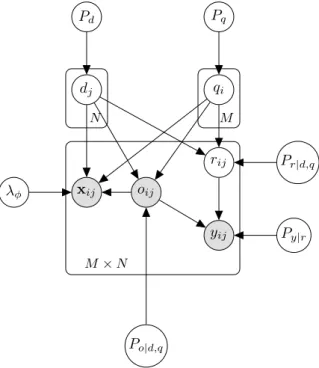
3.1 Model of training/test corpus generation for learning to rank: shaded (/unshaded) round nodes represent observed (/latent) variables . . . 54
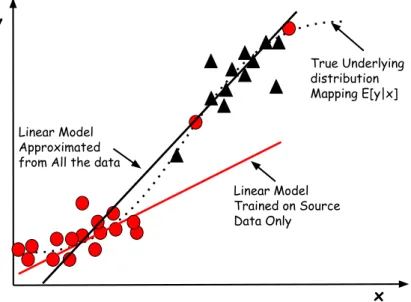
3.2 The red dots are instances observed in the source collection, the black triangle points are the instances in the target collection. All the instances are governed by the dashed line, which is the underlying distribution. The black line is the model trained when all the instances were observed, while the red line is the model when only the source collection data was observed . . . 58
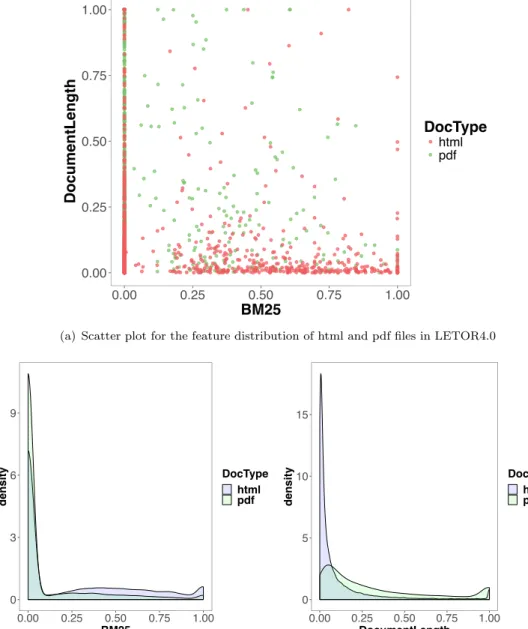
3.3 Feature distribution of html and pdf files in LETOR4.0 . . . 60
4.1 Pipelines for query-level instance weighting . . . 79
4.2 Density-ratio estimation methods . . . 79
4.3 Query representation methods. . . 80
4.4 JS Divergence Representation for Queries . . . 82
4.5 Plots of average rank across the 6 test environments for the 6 di↵erent Transfer Learning techniques and the “source” baseline system (where no TR was applied), the critical distance (CD) for the Nemenyi test (at the 5% confidence level). The lower the rank the better performance of the approach. . . 93
5.1 E↵ectiveness of w MART versus source sample size . . . 101
5.2 RankHardLabelEM & self-labeling paradigm . . . 109
5.3 Plots of average rank across the six test environments for the six dif-ferent transfer learning techniques and the MART.source and baseline MART.target system (where no TR was applied). The lower the rank the better performance of the approach. The critical distance (CD) for the Nemenyi test (at the 5% confidence level). . . 119
5.4 Performance vs iteration curve of di↵erent self-labeling methods under various settings.. . . 120
5.5 Comparing the parameter settings for RankHardLabelEM.. . . 122
5.6 Comparing the parameter settings for RankSelfTrain. . . 124
1.1 Di↵erent transfer ranking scenarios . . . 4
2.1 L2R test collections . . . 26
2.2 Di↵erence of L2R algorithms and conventional machine learning algorithms 32
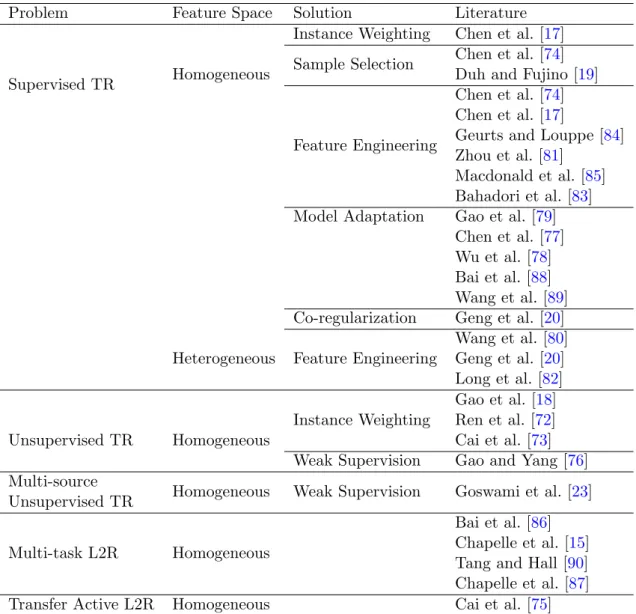
2.3 Literature classification . . . 34
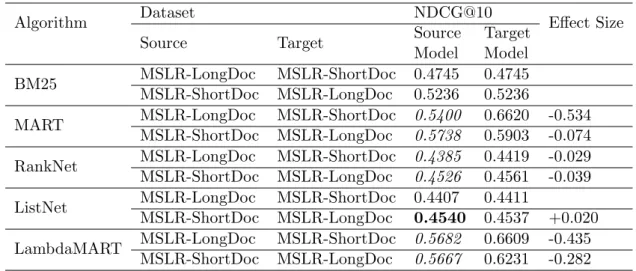
3.1 Results on di↵erent algorithms when the document corpus changes: each row is a group of experiments; the first column under the “NDCG@10” corresponds to the cross-collection training, while the second column is the in-collection training. Italic fonts denote the significant decrease in performance, the bold fonts denote the significant increase in the perfor-mance compared with the target model. The e↵ect sizes are shown in the last column. . . 66
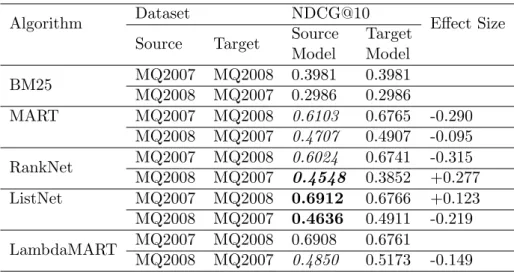
3.2 Results on di↵erent algorithms when the query set changes on LETOR4.0: each row is a group of experiments; the first column under the “NDCG@10” corresponds to the cross-collection training, while the second column is the in-collection training. Italic fonts denote the significant decrease in performance, bold fonts denote the significant increase in the performance compared with the target model. The e↵ect sizes are shown in the last column. . . 68
3.3 Results on di↵erent algorithms when the query set changes on long and short queries in MQ2008: each row is a group of experiments; the first col-umn under the “NDCG@10” corresponds to the cross-collection training, while the second column is the in-collection training. Italic fonts denote the significant decrease in performance, bold fonts denote the significant increase in performance compared with the target model. . . 69
3.4 Results on di↵erent algorithms on the Gov and OHSUMED collection in LETOR3.0: each row is a group of experiments; the first column under the “NDCG@10 corresponds to the cross-collection training, while the second column is the in-collection training. Italic fonts denote the signifi-cant decrease in performance, bold fonts denote the signifisignifi-cant increase in performance compared with the target model. The e↵ect sizes are shown in the last column. . . 71
4.1 Transfer settings for testing di↵erent algorithms. . . 86
4.2 E↵ectiveness (NDCG@10 score) on di↵erent transfer settings with wAdaRank. Bold text indicates the best scores of each column,"denotes the figure is significantly better than Ada.source, # denotes the figure is significantly worse than Ada.source. p <0.05 . . . 89
4.3 E↵ectiveness (NDCG@10 score) on di↵erent transfer settings with w MART. Bold text indicates the best scores of each column, " denotes the figure is significantly better than MART.source,# denotes the figure is signif-icantly worse than MART.source. p <0.05 . . . 89
5.1 E↵ectiveness (NDCG@10 score) on in-domain transfer settings with label imputation methods. Bold text indicates the best scores of each column,
"denotes the figure is significantly better than MART.source,#denotes the figure is significantly worse than MART.source,†denotes the figure is significantly better than w MART. p <0.05 . . . 116
5.2 E↵ectiveness (NDCG@10 score) on cross-domain transfer settings with label imputation methods. Bold text indicates the best scores of each column, " denotes the figure is significantly better than MART.source,
# denotes the figure is significantly worse than MART.source,†denotes the figure is significantly better than w MART.p <0.05 . . . 117
6.1 Experiment Setting for Minimally Supervised TR . . . 135
6.2 E↵ectiveness (NDCG@10 score) for 10 runs of minimally supervised TR when transferring from MSLR to LETOR 4.0. Bold text indicates the best scores of each row, † denotes the figure is significantly better than MART.source, ‡ denotes the figure is significantly better than Rank-SelfTrain,?denotes the figure is significantly better than MART.target.
p <0.05 . . . 137
6.3 E↵ectiveness (NDCG@10 score) for 10 runs of minimally supervised TR when transferring from Yahoo!L2R Set 1 to Set 2. Bold text indicates the best scores of each row, † denotes the figure is significantly better than MART.source, ‡ denotes the figure is significantly better than Rank-SelfTrain,?denotes the figure is significantly better than MART.target.
Introduction
Ranking has laid the foundations of many fields, for example, Information Retrieval (IR) and Recommender Systems, as well as Question Answering (QA). For IR applications like search engines, the ranking system looks to return a permutation of documents ordered by their relevance to an information request, expressed in queries, submitted to the system. However, the relevance of a document to an information need is not straightforwardly expressed in the document. Instead, various ranking models, which include the BM25 [1] and language models [2, 3], have been developed to predict the relevance via a set of signals extracted from both the document and the query. However, it has repeatedly been demonstrated that the ranking e↵ectiveness of ranking models varies across di↵erent test collections [4–6]. The majority of existing ranking models have been developed based on empirical studies and require parameter tuning for specific corpus. Recent research on Learning to Ranking (L2R) [7] has made significant strides towards training ranking models via machine learning techniques. Note that L2R is not learning to optimise the parameters for existing models, but to train a ranking model that can achieve optimised ranking function for a specific task.
Most L2R algorithms are supervised, which means plenty of training examples are re-quired. Relevance judgments for IR systems are expensive to generate, and quality control can be difficult. In many cases, relevance judgments from a related collection can help ranking function training for the new collection. For example, a hotel booking company based in the US wants to expand its market to Asia and South America. Al-though they may have an e↵ective ranking function for their existing markets trained
with labeled data, it may not generalize to the new market because of language or other di↵erences. However, the relevance judgments or click logs in their existing markets could help them build a new ranking system for the new markets using transfer learning techniques. This thesis investigates the technique used to transfer ranking knowledge from an existing collection (the source collection) to a new collection (the target collec-tion), which is named Transfer Ranking (TR).
1.1
Problem Statement
Like conventional machine learning problems such as regression and classification, the ranking model trained by L2R algorithms can only generalize well when the training and test data are drawn from the same distribution. The so-called “dataset shift” problem [8] arises when the assumption is violated. For example, the e↵ectiveness of a ranking function trained on one document collection will show some decrease when it is applied to a new document collection. Transfer learning [9–11], including its subproblems, domain adaptation [12–14], and multi-task learning [15,16], has been widely used in the machine learning community for solving dataset shift problems.
Potentially, transfer learning is also a solution to solve the dataset shift issues for L2R collections. However, conventional transfer learning techniques cannot be used for TR directly due to many reasons. One particular reason is that the training data for L2R is generated from a di↵erent process as it is from a conventional machine learning dataset. The training data for an L2R algorithm is initialized by retrieving documents from a collection for a set of queries. For efficiency, documents are pooled at a certain depth, however, this makes it harder to formalize the data generating process. As a consequence, the data distribution of L2R collection is governed by a number of factors: the query set, document collection, and pooling depth, as well as the retrieval model used to gather the pool of documents. All the factors have contributed to the challenge of implementing transfer ranking algorithms.
The training data is also used di↵erently by L2R models. According to Liu and others [7], three di↵erent types of algorithms have constituted the mainstream of L2R algo-rithms: pointwise, pairwise, and listwise algorithms. Most of the state-of-the-art L2R algorithms are listwise, so that the objective functions seek to minimize a query-level
loss. Furthermore, the evaluation of the e↵ectiveness of a ranking function is based on the averaged query-level measurement metric scores over a set of queries for testing.
Most of the existing transfer learning algorithms have sought to develop new techniques to minimize the di↵erences between the source and target collection. The complicated compromise of the L2R training data has made it a great challenge even to measure the dataset shift among two collections, which makes it harder to implement conventional transfer learning techniques for such collections.
In recent years, some attempts have been made to adapt some of the classical transfer learning algorithms so that they can work for L2R collections. For example, Chen et al. [17] and Gao et al. [18] have sought to develop instance weighting algorithms, for TR among L2R collections; weights are assigned to training instances in the source collection to change the data distribution to better resemble the distribution in the target. The authors have demonstrated some success with some small L2R test collections. The study has made important contributions to the study of TR problems, which has inspired many others to try new methods for the task. However, the algorithms have only focused on a particular transferring scenario where the di↵erence between the source and target collection is only the data distribution in the input space. Moreover, the developed algorithms can only work for pairwise algorithms.
Apart from instance weighting, some other methods have also been attempted to ad-dress the problem, which include sample selection [19], co-regularization [20], feature engineering [17,21] and other miscellaneous approaches. Most of the existing solutions can only work for a particular type of L2R algorithm. For example, pairwise L2R al-gorithms have been widely used for studying TR problems as it is easier to measure the distribution change for the preference data. However, since most of the advanced L2R algorithms are listwise and the evaluation of performance is conducted at the query level, TR for listwise algorithms at the query level is worth examining more closely.
The performance of a ranking system also depends on the resources available during the transferring process, as well as the right choice of the corresponding algorithms. Di↵ er-ent transferring scenarios, namely Unsupervised TRandSupervised TR, are listed and compared in Table 1.1. One commonality between the two transferring scenarios is that there exists a sufficient amount of labeled training examples in the source col-lection, which includes the document colcol-lection, queries submitted to the system, and
Table 1.1: Di↵erent transfer ranking scenarios
Ds Qs Rs Dt Qt Rt
Supervised TR p p p p p small amount Unsupervised TR p p p p p ⇥
Minimally Supervised TR p p p p p minimal amount
the corresponding relevance labels (or click-through logs) for query-document pairs. In some cases, the target collection only contains a document collection, a query set request through the system, and a smaller number of relevance labels available in the target col-lection. The aim of such a task, in supervised TR, is looking to leverage labeled training instances from a source collection to improve the training of the target ranking function. On the contrary, under the supervised TR scenario, no relevance judgments are assessed for the target collection. The task is more challenging as little information is known for the target collection. Later in the thesis, we also introduce a Minimally Supervised TR scenario, where is only a minimal amount of data required from the target collection to calibrate the transferring process.
Present understanding of TR algorithms is limited. The field of TR is still relatively undeveloped. The problem merits further investigation; for example, how to generalize di↵erent L2R models across di↵erent test collections; how to measure the relatedness of two L2R collections; and how to quantify the distribution change between L2R col-lections. Chapelle et al. [22] have also highlighted the need for further investigation of TR.
1.2
Aim and Scope
Most of the previous research on TR has been focused on supervised TR. Unsupervised TR scenarios require further investigation. This study seeks to address the unsupervised TR problem and aims to develop methods to improve the transfer e↵ectiveness of the machine-learned source ranking functions on a target L2R collection.
Therefore the focus of this study is unsupervised TR; the investigation of supervised TR algorithms falls outside the scope of this study. A previous study [23] has attempted to address the unsupervised TR problem when multiple source collections are available. However, we have excluded such settings from our study due to the difficulty of accessing
a valid testing environment and the fact that the setup cannot generalize to all real scenarios. Similarly, multi-task learning to rank is beyond the scope of this study.
In practice, there might exist some other information in the target collection which could help a transfer, for example: document information, collection information, and click logs. However, most of the public L2R test collections have purposely excluded such information from the collection. This study will focus on the unsupervised TR scenario with minimal information requirement, which is when the extracted feature vectors for query-document pairs are accessible.
One condition imposed by the study is that the source and target data should have the same feature space. Heterogeneous transfer learning, which looks to implement transfer learning when the feature spaces are di↵erent, will not be considered in this study.
To be able to develop better algorithms for unsupervised TR, several research questions are to be addressed.
Research question 1: What are the generalization abilities of various L2R
algorithms across di↵erent L2R collections?
Theoretical analysis of the generalization abilities of di↵erent L2R algorithms has been demonstrated by some early studies [24, 25]. However, the generalization ability of an L2R algorithm on a di↵erent collection has not been well studied. As mentioned in section 1.1, L2R collections can be distinct from one another in various ways, the impact of the di↵erences on the cross-collection is not easy to determine and needs further investigation.
Furthermore, understanding of the cross-collection generalization will help understand how TR can contribute to improving ranking e↵ectiveness on a target collection. An examination of generalization will lay the foundations for TR.
Research question 2: How can we implement unified unsupervised TR
algo-rithms on L2R collections to maximize the transfer e↵ectiveness on a target
collection?
The query-level nature of L2R algorithms poses some problems when implementing TR algorithms. The task of unsupervised TR is complicated further by unavailable relevance
information. In this study, we look to develop new TR algorithms that maximize the ranking e↵ectiveness on the target collection in an unsupervised environment.
Instead of developing algorithms that work for some specific L2R algorithms, the study seeks to develop unsupervised TR algorithms that fit most L2R algorithms.
Research question 3: How can we guarantee the performance of unsupervised
TR techniques so that they can work in various environments?
Finally, without any relevance judgment information from the target collection, it is hard to determine whether a successful transfer has been made. Further investigation is necessary to examine whether one could evaluate the performance of the TR algorithm with a minimal relevance judgment requirement.
1.3
Significance of the Study
One intended outcome of the study is to provide better insight into the generalization of the L2R algorithms. The further analysis of the data generating process - namely the probabilistic model controlling the data distribution - of L2R collection will broaden our understanding of L2R algorithms and can direct attention towards better strategies to establish L2R test collections. Moreover, the study will result in a better under-standing of how L2R algorithms are training. The thorough examination of various L2R algorithms across di↵erent test collections may reveal better practices for training L2R models.
Transfer learning has attracted much attention in machine learning communities. Most of the existing solutions for transfer are focused on classification and regression problems, where the distribution change happens in either the input feature space or the conditional distribution. This study will expand the current knowledge of transfer learning for ranking data and learning for matching problems [26].
The robustness of ranking functions across various collections has always been a con-cern for the IR community. The study of TR problems will provide new insight into how machine learning trained ranking function responds to a particular change in the collection.
The study can contribute many practical applications in the industry. For example, the knowledge we gain from the study of unsupervised TR is related to the following applications:
• Domain adaptation: TR knowledge from an existing ranking system to a new
domain, where no relevance judgments are available, for example, when an en-terprise search service provider wants to adapt a ranking function trained for a medical company to a newspaper corporation.
• Cross-language transfer: Deploy ranking system to a market where the
lan-guage of the collection is di↵erent from the original document collection, for ex-ample, when a search company looks to deploy their ranking system trained in the US market to other countries.
• Document collection shift: Update ranking systems when the original
docu-ment collection has substantially changed over time, for example, when a newspa-per press intends to update their news search engines after an extended newspa-period of time.
• Ranking adaptation to unseen collection: Adapt ranking function to a new
collection, where the content of documents is not available due to privacy consid-erations. For example, when an email service company want to train a ranking function for their customers email search system, where only some of their sta↵s email is disclosed for making relevance judgments.
1.4
Overview of the Study
The thesis consists of seven further chapters to address the posed research questions. In Chapter 2, the background theory of learning to rank and TR is discussed. To give a clear image of the field of TR, related works on both transfer learning and TR are also presented.
The main content of the study addresses the first research question through empirical study of various L2R algorithms across di↵erent test collections in Chapter 3, which includes a thorough examination of L2R algorithms by training and testing in various test collections, and an experiment to analyze what makes a good ranking model.
One of the most common solutions for transfer learning is instance weighting, which looks to change the data distribution in a source collection to be closer to the data distribution in a target collection by assigning instance weighting to training samples in the target collection. Instance weighting has also been used for TR. However, existing methods lack consideration of query e↵ects on rankings. In Chapter4, we develop query-level instance weighting algorithms. The algorithms are tested and compared with other instance weighting methods across various collections and di↵erent transferring settings. Instance weighting could be a great challenge for TR due to the difficulty of density ratio estimation for queries. Alternatively, one could use label imputation-based methods to generate pseudo relevance labels for training examples in the target collection. This approach is discussed in detail in Chapter 5. A challenge for all unsupervised TR algorithms is that the performance may vary in di↵erent transferring settings, yet it is hard to measure the performance without relevance information. In Chapter6, we have relaxed the condition (TR without any relevance labels) by allowing a few relevance judgments. Various techniques are studied to help train the system and improve the reliability of the algorithms.
Finally, conclusions of findings, the limitations and the future works of the studies are discussed in Chapter 7.
Background and Related Work
This chapter introduces the field of transfer learning for IR. It begins by introducing conventional ranking models for IR, followed by some basic background on learning-to-rank. The concept of transfer learning, as well as TR will be introduced in the next sections. The last section of this chapter will discuss some related work.
2.1
A Brief History of Ranking Models for IR
The task for an IR system is to find relevant documents from a corpus of documents in order to satisfy a particular information need, which is usually expressed in the format of a user-defined search query. An e↵ective IR system should discover as many relevant documents from the corpus as possible, and rank them in decreasing order of relevance to the information need.
Before learning-to-rank was introduced, many retrieval and ranking models were devel-oped. Most of these models aim to compute similarity scores between the documents and the query. The similarity scores are then used to determine which documents are included in the result list and the ranking orders. In the following subsections, some of the classical retrieval models will be reviewed briefly.
2.1.1 Vector Space Model
The vector space model (VSM) [27] is one of the earliest ranking models. Under the VSM model, both documents and queries are represented by vector representations in word space. The similarity between the query and document is then computed using cosine similarity. The element in the vector could be a statistic of the words, which may be word counts or term frequencyinverse document frequency (tf-idf). Thetf-idf score is a combination of two term statistics: term frequency and inverse document frequency, which aims to measure the importance of terms in the document and the whole corpus. There are di↵erent variants of term frequency and inverse document frequency. One of the simplest implementations of tf-idf is given as follows.
Term frequency (tf) is the frequency of a term t appearing in the document d, which can be computed as:
tf(t, d) =c(t, d) (2.1)
wherec(t, d) denotes the count of termtin documentd. There are also di↵erent variants of term frequency, which include document length normalized term frequency, logarith-mically scaled term frequency and others [28, 29]. For example,logarithmically scaled term frequency is calculated as:
tf(t, d) =log(1 +c(t, d)) (2.2)
The document frequency (df), on the other hand, measures the document frequency of a term in the collection. It measures how common a term is among all the documents in the collection. If a term in a document rarely appears in the collection, it provides an important signal for distinguishing the document from others. The inverse document frequency is commonly calculated as:
idf(t, C) = log |C|
|{d2C|t2d}| (2.3)
whereCdenotes a set of documents (the collection), and|C|is the size. Similar to term frequency, there exist other variants of inverse document frequency [28,29].
The VSM model calculates the cosine similarity of the document and the query using the inner product of the two vectors:
sim(d, q) = V~(d)·V~(q) ~
V(d) V~(q)
(2.4)
Here V~(d) and V~(q) are the vectors for the document and query respectively. |V~(d)|=
qP
iV~(d) is their Euclidean length. Given the similarity scores for every query-document
pair, documents are then ranked in the descending order.
2.1.2 BM25
BM25 [1] is a probabilistic ranking model that has been widely used for ranking docu-ments. Before BM25 was developed, several “BM” algorithms were proposed to heuristi-cally approximate the 2-poisson probabilistic model of Robertson and Walker [30]. One of the most famous variants of BM25 is the ATIRE BM25 [6], which can be computed as: BM25(d, q, C) = M X t2q idf(t, C)·c(t, d)(k1+ 1) tf(t, d) +k1(1 b+b·avgcc(d()d)) (2.5)
wherec(d) is the document length (number of words ind),avg c(d) is the average docu-ment length in the collection, andk1 andb are two user-specified parameters. Di↵erent
variants of BM25 have been developed; a complete comparison of di↵erent variants can be found in Trotman et al. [6]. BM25 and its variants have shown to be e↵ective on many TREC collections, however, its performance may vary amaong di↵erent collections.
2.1.3 Language Model
Language models [2] are widely used probabilistic retrieval approaches for document retrieval. Statistical modelings of text documents have been widely used for solving nat-ural language processing problems before they were introduced to IR by Ponte and Croft [2]. Language models for IR (LMIR) assume that queries are formulated by choosing terms from a relevant document. As a result, the relevance between the document and query can be approximated by estimating the “query likelihood” for a document, which is the likelihood of generating the query given the document. To be able to compute the
query likelihood, the algorithm first establishes a probabilistic language modelMd that
fits for each document din the collection.
The language model for each document is a categorical distribution over the set of terms, which can be approximated as follows:
ˆ
p(t|Md) =
c(t, d)
c(d) (2.6)
wherec(d) is the total number of terms in document d.
The query likelihood is calculated as p(q|Md). The probability that a query q been
generated from the language modelMd [2] is then estimated by:
ˆ p(q|Md) = Y t2q ˆ p(t|Md)⇥ Y t /2q (1 pˆ(t|Md)) (2.7)
Some terms appearing in the query may not be seen in the document, which means that ˆp(t|Md) could be zero. As a consequence, the query likelihood will be zero if
some of the query terms do not exist in the document, which is problematic. To tackle this “smoothing” issue, when a term is absent from the document, Ponte and Croft [2] proposed to smooth the probability with the term’s global probability in the collection:
ˆ
p(t|Md)⇡
c(t, C)
cl (2.8)
where c(t, C) denotes the counts of term t in collection C. cl = Pt0c(t0, C) is the
total number of tokens in the collection. Several variants of language models have been investigated to improve the stability.
A complete review of the language models was discussed in Zhai [31]. As it has shown above, smoothing the maximum likelihood of p(t|Md) can a↵ect the accuracy of the
language model. Many solutions have been proposed to improve the accuracy of the estimation, for example, the Jelinek-Mercer method [32] is a mixture model using the linear interpolation of the maximum likelihood model of the document with the model with the collection collection:
where MC is a language model fit for the whole collection, p(t|MC) is the likelihood of
the termtin the collection language model, is a parameter controlling the importance of the document and collection language model. Like BM25 models, most language models have tuning parameters. In Zhai and La↵erty [32], the authors have shown that the performance of language models on IR collections are sensitive to the parameters.
2.1.4 Learning-to-Rank
Many retrieval and ranking models have been proposed to achieve better ranking e↵ ec-tiveness. However, the e↵ectiveness of di↵erent ranking models can vary across di↵erent test collections, and many require parameter tuning. Data fusion methods [33,34] have been investigated for combining di↵erent retrieval models in order to take advantage of multiple models. However, the data fusion approaches also require settings for proper combinations of models.
Learning-to-rank is closely related to data fusion. Learning-to-rank algorithms use ma-chine learning techniques to combine various query-document-related features. The fea-tures could also be the scores produced by some retrieval models. However, as it has been pointed out by Macdonald et al. [35], the scenarios where data fusion and learning-to-rank can be used are di↵erent. More specifically, data fusion combines di↵erent retrieval results from di↵erent systems, which means the retrieved documents could be di↵erent.
The advent of learning-to-rank has brought significant improvements to the ranking e↵ectiveness of modern IR systems. It uses machine learning techniques to learn dis-criminative models, which combine various query-document-related features, to build more complex and e↵ective ranking functions. Previous studies [36] have demonstrated the power of learning-to-rank algorithms. The next section will provide a more detailed explanation of learning-to-rank algorithms.
2.2
Learning-to-Rank
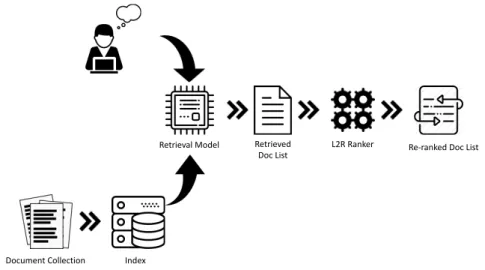
Learning-to-rank (L2R) is a field of research that uses machine learning techniques to solve ranking problems. For IR systems, the results represented to users are obtained via a two-stage ranking process illustrated in Figure2.1. A user submits a search query
Retrieval Model
Document Collection Index
Retrieved
Doc List L2R Ranker Re-ranked Doc List
Figure 2.1: Two-stage ranking system
expressing his/her information need to the retrieval system. For the consideration of ef-ficiency, a conventional retrieval model is used to retrieve potentially relevant documents from the collection. In the second stage, an L2R trained ranker is utilized to re-rank the set of documents [37] that have been retrieved during the first stage. One of the reason why L2R is only applied at the second stage is that some of the features used in L2R models may be too expensive to calculate, which can harm users’ search experiences.
2.2.1 Training Data for L2R
Like many other machine learning algorithms, L2R algorithms learn patterns from exist-ing examples. The trainexist-ing examples for learnexist-ing-to-rank algorithms are a set of ranked lists of documents corresponding to queries from a query set. As mentioned in the pre-vious section, documents in the ranked lists are first selected using a classical retrieval model. For efficiency consideration, a subset (usually the top k items) of the returned documents list is used for training. The documents retrieved for a query are represented by feature vectors. The features for L2R models could be: i) document features, for example, signals measuring the quality of the document like PageRank; ii) query fea-tures, which indicate the statistics of the queries, for example, the length of the query; and iii) matching features, which reflect the relation of the query and document. For example, matching features could be conventional retrieval models like BM25. The ranking order of retrieved documents for each query is inferred from assessor-annotated relevance labels or click-through data [38].
q1 d11: (f111,f112,f113,…,f11k) d12: (f121,f122,f123,…,f12k) d13: (f131,f132,f133,…,f13k) r11 r12 r13 qi
di1: (fi11,fi12,fi13,…,fi1k)
di2: (fi21,fi22,fi23,…,fi2k)
di3: (fi31,fi32,fi33,…,fi3k)
r11 r12 r13 … ... ... Query-level Document-level (d11,d12,r11-r12) (d11,d13,r11-r13) (d12,d13,r12-r13) (di1,di2,ri1-ri2) (di1,di2,ri1-ri2) Pair-level
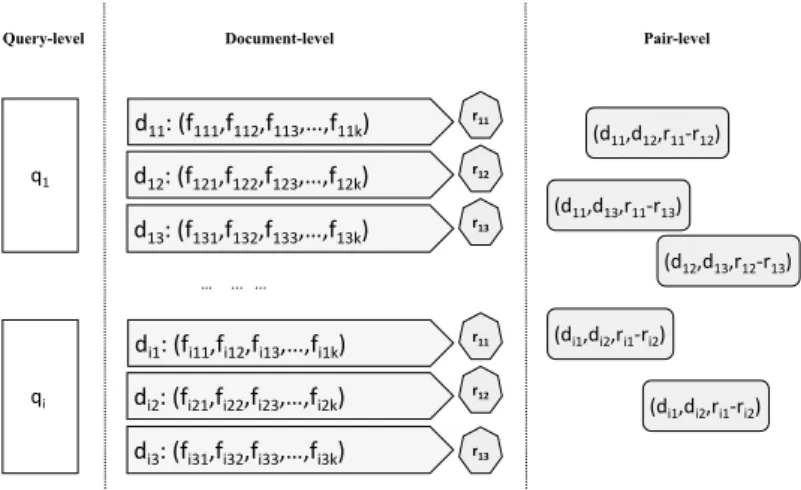
Figure 2.2: Data formatting for L2R
The relevance labels for query-document pairs can be binary (relevant/irrelevant). For more complicated systems like web search, graded relevance is usually employed. For example, the relevance label of query-document relevance could be labeled at four scales: irrelevant (0), marginally relevant (1), fairly relevant (2), and highly relevant (3) [39]. An example of L2R training data is demonstrated in Figure 2.2. According to the usage of data during the training, the training data for L2R forms three levels: query level, document level, and document pair level, which determines the di↵erences between di↵erent L2R algorithms.
2.2.2 Formal Definition of Learning-to-Rank
Following the notation in Cao et al. [40], let Q = {q1, q2,· · · , qm} be a set of queries;
di=(di1, di2,· · · , din) be the list of documents associated with query qi from document
space D, where dij is the jth document for query qi. Furthermore, let xij = (qi, dij)
be the feature vector generated from the query document pair. For simplicity, we will refer toquery document pairsasdocumentsthroughout the remaining sections. To avoid ambiguity, we use~xi to denote the set of document feature vectors corresponding
to the query~xi={xij}nj=1 and let~ri={rij}nj=1 be the list of relevance scores, whererij
denotes the score of thejth document forqi. Finally, we use⇡i to denote a permutation
of the documents for the ith query.
A training exampletij = (xij, rij) consists of a feature vectorxij and a relevance
examples for each query, i.e., the ranked list, as: li = (~xi,~ri). A training dataset
con-sisting of multiple queries with associated relevance judgments is then denoted byL. Given a training sample L, consisting of a set of ranked lists, drawn from the query setQ and the document collectionD, the objective of learning-to-rank algorithms is to train a ranking function that can best predict the ranking order of retrieve documents for a query, given the feature vectors for each document:
f({xi1,xi2,· · ·,xin}) ={⇡(1),⇡(2),· · · ,⇡(n)} (2.10)
Since it is difficult to train a function that directly map a set of feature vectors to a ranking order, L2R algorithms usually train ranking functions that predict relevance labels or real-valued relevance scores (indicating the degree of relevance) for individual documents. Documents are then ranked in decreasing order of the labels/scores.
Some other L2R algorithms train functions to predict the relative orders (pairwise pref-erences) of pairs of retrieved documents for the same query. A ranked list can then be induced from the pairwise ranking preferences.
2.2.3 Evaluation for IR Models
E↵ective retrieval models and ranking models aim to return a ranked list of documents to users that can meet their information needs. The e↵ectiveness of a retrieval system is usually measured using an evaluation metric that accounts for users’ perceptions of ranking quality on queries, and is averaged across all the queries submitted to the system. As a result, the objective of L2R models is to train ranking functions that can maximize these metrics. Before going into the details of how L2R algorithms are implemented, some IR evaluation metrics will be introduced in the following section to reflect the di↵erence between L2R and other machine learning tasks.
The two most straightforward metrics to measure the e↵ectiveness of IR models are precision and recall. Precision for a query is defined as the fraction of relevant documents among all the documents retrieved for an information need:
precision= #retrieved relevant docs
Meanwhile, recall is the percentage of retrieved relevant documents among all relevant documents in the collection:
recall = #retrieved relevant docs
#relevant docs (2.12)
However, past research [41] has shown that users are less likely to examine search results after the first or second pages. As a result, a criteria for a good IR system is that it ranks more relevant documents higher. Neither of the above metrics consider the rank positions of relevant documents in the returned list. If relevant documents are ranked on the bottom of the list, they will have the same precision and recall score with the list that put all relevant documents on top of the list. Precision and recall can only reflect how good the retrieval system is, but not its ranking e↵ectiveness.
Average precision (AP) is a metric that measures the average of precision values at each recall level (when running down the ranked list). As a result, the metric favors ranking functions that put relevant documents at the top of the list. These measurements can be completed up to some maximum rank, e.g., P@20.
The average precision of a query is the average of the precision values of the ranked list at the rank position of each relevant doc:
Average P recision= 1
|Dr| X
dk2DrP@k(li) (2.13)
where Dr is the set of retrieved relevant documents, |Dr| is the size of the retrieved
documents, andk is the ranking position of the document.
The mean average precision (MAP) measures the mean AP over all queries in the eval-uation set: M AP = 1 m m X i=1 1 n n X k=1 P@k(li) (2.14)
wherem is the total number of queries in the evaluation set.
One drawback of MAP is that it only considers binary relevance labels, meaning that documents are either considered relevant or irrelevant. However, as mentioned before, the degree of relevance of documents to queries can be di↵erent. As a result, graded relevance is sometimes applied for relevance judgments. Normalized Discounted Cumu-lative Gain (NDCG) [39], on the other hand, measures the ranking e↵ectiveness with
graded relevance. The cumulative gain (CG) aggregates gains in the number of relevant documents observed when iterating through the ranked list. For an ideal ranking, highly relevant documents should be ranked higher on the list, thus a rank-based discount func-tion is introduced to the cumulative gain so that the metric places more emphasis on top-ranked documents: DCG= k X i=1 2reli 1 log2(i+ 1) (2.15)
Here reli denotes the relevance judgement for theith document in the list and 2reli 1
is an exponent gain formula used in Burges et al. [42]. The denominator log 1 2(i+1) is the discount function. There exist other gain and discount functions for DCG, with a comparison of di↵erent methods discussed in Kanoulas and Aslam [43]. In e↵ect, a highly relevant document ranked higher in the list obtains more gain than a highly relevant document that ranked lower in the list. Since the length of the list as well as total members of relevant and irrelevant documents can vary across queries, a normalized DCG, NDCG, was proposed to normalize the metric with respect to the ideal ranking of the documents retrieved for each query:
N DCG= DCG
IDCG (2.16)
where IDCG is the ideal DCG score for the returned documents. Similarly, the e↵ ective-ness of a ranking system is measured by averaging across queries. Sometimes a cut-o↵
k is applied for the metrics to reflect the users’ preferences on topranked documents -for example, NDCG@10 measures the NDCG score at rank 10.
2.2.4 Learning-to-Rank Approaches
Di↵erent learning-to-rank algorithms have been developed to maximize the ranking ef-fectiveness of the trained ranking function on a target collection. As was noted in the previous section, the training data for learning-to-rank can be viewed on three di↵erent levels, and the objective can be achieved by minimizing losses at di↵erent levels. As a result, learning-to-rank algorithms can be classified as pointwise, pairwise and listwise
algorithms. In this section, we will explain the di↵erences between various learning-to-rank algorithms and how they are implemented.
Pointwise learning-to-rank algorithms train ranker functions at the document level. The algorithms are designed to minimize the expected loss over all the query document pairs used for training. Pointwise algorithms attempt to predict the relevance class of each document separately, and thus cast the ranking problem as a classification, regression or ordinal regression problem [7].
~
✓⇤ = argmin
~ ✓
E(x,r)2T[`(f(x;~✓)), r] (2.17) wherexis the feature vector for a query-document pair,ris the corresponding relevance label,T is the training set,f is the ranking function, ~✓is the parameter of the ranking function to be learned.
All ranking functions learned with pointwise algorithms take a query-feature vector as in-put; the di↵erences between the algorithms exist in the output space. The classification-based approaches predict a relevance label for the feature vector:
f(x;~✓)7!ˆr (2.18) where✓ are the parameters for functionf.
As a result, the loss function for classification-based approaches measures the gap be-tween the ground-truth labels and their predicted labels, `(f(x;~✓), r). The training is then aiming to minimize the average loss over the observed training set:
~ ✓⇤ ⇡argmin ~ ✓ 1 |T| X (x,r)2T [`(f(x;✓)~ , r)] (2.19)
whereTdenotes the number of training query document pairs in the collection. As has been mentioned previously, the relevance labels for the query document pairs could be either binary or multi-graded. As a result, some algorithms have cast the problem as a classification task and used binary classifiers like Support Vector Machines (SVM) [44] to predict the relevance labels.
The ranking function trained with a SVM model is in the linear scoring form: f(x;~✓) = ~
✓> (x)+b, where (.) is a kernel function that maps the feature vector to a kernel space, b is a constant. The relevance labels are mapped to binary labels: y = 1 whenr = 1,
~ ✓⇤=argmin ~ ✓ 1 2||~✓|| 2+ |T| X i=1 ⇠i subject to ✓~> (xi)6 1 +⇠i,ifri = 0,8i ~ ✓> (xi)>1 ⇠i,ifri= 1.8i ⇠i>0. (2.20)
where⇠ denotes the hinge loss:
⇠ =max(0,1 yi·f(x;~✓)) (2.21)
Other methods have also been investigated to deal with graded relevance, for example, Li et al. [45] have used boosted classification trees to minimize a surrogate loss 1 for the multi-class classification, which is then used to predict the relevance labels. Apart from the classification-based solutions, some research has looked to cast the problem as regression or ordinal regression problems [46–48] .
Pointwise algorithms minimize the di↵erences between the predicted relevance labels of documents and the ground-truth labels. However, since the absolute relevance labels are less significant than the relative ordering of pairs of documents, the solution can sometimes be problematic due to the complexity of relevance judgements.
Pairwise algorithms are a series of algorithms that use document pairs as training data. Di↵erent from pointwise algorithms, the inputs for pairwise L2R algorithms are pairs of documents retrieved for the same query, (xij,xik), which are from the same
ranked list. The output of pairwise L2R algorithms is a ranking function predicting whether one document is more relevant than another ( rijk = 1, 8 rij > rik, and
rijk = 1, 8 rij < rik). The ranking function is thus trained by minimizing the
expected pairwise loss:
~
✓⇤ =arg min
~ ✓
E(x2, r)2T[`(f(x2;~✓), r)] (2.22) 1a surrogate loss replaces and approximates a designed loss function
where x2 2{(xij,xik)j6=k}. In practice, as it is difficult to compute the distribution of
the document pairs, minimizing the mean pairwise loss is used:
~ ✓⇤ =arg min ~ ✓ 1 Nx2 X (xij,xik, r)2T `(f(xij,xik;~✓), r) (2.23)
The loss function for the pairwise models looks to minimize the gap between the pre-dicted pairwise preferences and the observed ranking preferences. RankingSVM[38] is an example of a pairwise L2R algorithm that uses the SVM learning algorithm to build a classifier that can predict the ranking preferences of a pair of documents. The input for the algorithm is the di↵erence between the feature vectors of the document pairs, while the labels ( r) are the di↵erence between the corresponding relevance labels.
ListwiseL2R are a set of algorithms that looks to directly optimize the ranking function at the query level. The objective of the listwise L2R algorithms is to minimize the expected loss over the ranking for each query:
~
✓⇤ = argmin
~ ✓
E(x,~r)2L[`(f(x;~✓),~r)] (2.24)
Similarly, the expected loss is estimated by the mean loss over the queries in the training set: ~ ✓⇤ =arg min ~ ✓ 1 Nq Nq X i=1 [`(f(xi;~✓),~ri)] (2.25)
The loss function for the listwise algorithm quantifies the di↵erence between the rank-ing orders of the documents in the query and the ground-truth rankrank-ings. Similar to the pointwise algorithm, the ranking function trained by the listwise algorithm takes a document feature vector as the input and outputs a relevance score. The documents are then ranked according to the relevance scores. The ground-truth rankings of the documents are inferred from the ground-truth labels of the query document pairs.
The loss function for listwise algorithms that compares the ground-truth ranking with the predicted ranking is not always straightforward. Some algorithms like ListNet [40] have attempted to use the cross-entropy loss of the permutation probabilities between
the ground-truth ranking and the predicted ranking:
`(f(xi;~✓),~ri) = p(⇡i|~ri) logp(ˆ⇡i|f(xi;~✓)) (2.26)
where p(⇡i|~ri) is the probability of observing a permutation⇡i, provided with the
rele-vance labels~ri. The permutation probability is estimated with the Plackett-Luce model
[49,50]; p(ˆ⇡i|f(xi;~✓)) is the probability of the permutation ˆ⇡i given the documents xi
and the ranking function f controlled by the parameters ~✓.
As discussed in the previous section, many metrics have been developed to measure the ranking e↵ectiveness. Some listwise algorithms attempt to directly optimize the algorithm to maximize the metrics. These ranking e↵ectiveness ranking metrics are, however, not smooth with respect to the relevance scores. Thus it is difficult for learning algorithms to optimize them directly. Di↵erent solutions have been proposed to achieve this goal by instead optimizing a surrogate objective function.
AdaRank[51] uses a boosting ensemble method called AdaBoost[52] to iteratively opti-mize the ranking function to achieve better ranking metric scores. Intuitively, AdaRank learns an ensemble of weak rankers that can achieve better ranking e↵ectiveness:
f(x) =
T X
t=1
↵tht(x) (2.27)
whereht(.) is the weak ranker trained at thetthiteration of the algorithm and↵tare the
weights forht(.). In each iteration of AdaRank, the algorithm learns a new weak ranker
to maximize the e↵ectiveness metrics such as NDCG and then adds the weak ranker to the ensemble. The new added weak ranker will come with a weight which is computed based on its performance on the training set. Moreover, according to the performance of the current ensemble, the queries are assigned with weights to reflect their importance in the next iteration. The purpose of doing so is to make sure that the algorithm will focus on the poorly performed queries under current ensemble. Finally, an ensemble of weak rankers is trained to gain better e↵ectiveness on the entire collection.
One of the state-of-the-art listwise algorithms is called LambdaMART [53], which trains boosted regression trees to maximize the ranking e↵ectiveness. Note that some re-searchers classify LamdaMART as pairwise algorithms as the loss function was com-puted based on pairs of documents. However, the loss function of LambdaMART also
involves the e↵ectiveness metric of the ranking, thus the training of the algorithm will also be a↵ected by the query distribution. As a result, LambdaMART is treated as listwise algorithm throughout the thesis. The output of the LambdaMART algorithms is an ensemble of regression trees, which is in the same format as Equation 2.27, but each hypothesis model ht(x) is a regression tree. LambdaMART was developed from a
pairwise algorithm called RankNet [42]. RankNet models the ranking preference prob-abilities of document pairs, ¯P(rij > rik), which are inferred from the relevance labels.
The ground-truth probability is modeled as:
¯
P(rij > rik) =
1
2(1 +Sij) (2.28)
whereSij = 1 ifrij > rik,Sij = 1 if rij < rik, and Sij = 0 ifrij =rik. The preference
probability for a pair of documents is modeled using the sigmoid function applied to the di↵erence between the relevance scores predicted by the model:
P(rij > rik) =
1
1 +e (sij sik) (2.29)
where controls the shape slope of the sigmoid function. To simplify, let ¯P(rij > rik)
and P(rij > rik) be denoted as ¯Pijk and Pijk respectively. RankNet uses the cross
entropy loss to estimate the cost between ¯Pijk and Pijk:
Cijk= P¯ijklogPijk (1 P¯ijk) log(1 Pijk) (2.30)
The cost function of the model on the training set is then calculated as:
C = X
qi2Q
X j,k
I(rij > rik) log (1 +e (sij sik)) +I(rij < rik) log (1 +e (sik sij)) (2.31)
In order to optimize the model, the gradients of the cost with respect to the document scores, ijk = @@Csijkij and ikj = @@Csijkik , will be calculated and the corresponding model
weights will be updated accordingly.
A continuing study [42] shows that the e↵ectiveness of the model can be further improved by incorporating weights to each document pairs for the cost function. The weights for
document pairs, | Zijk|, are the di↵erences in metrics. LambdaMART is a boosted
regression tree implementation of LambdaRank [42]. The cost function is computed as:
C= X
qi2Q
X j,k
| Zijk|(I(rij > rik) log (1 +e (sij sik))+I(rij < rik) log (1 +e (sik sij)))
(2.32)
At each iteration of LambdaMART, the algorithm fits a regression tree whose predicting labels are the lambdas of current model. Given a document dij that is more relevant
than another document dik, the gradient of the cost with respect to the relevance score
fordij,sij =f(xij,✓), is computed as:
ijk=
@Ci,j,k
sij
=
1 +e (sij sik)| Zijk| (2.33)
For an individual document in the training set, the gradient of the cost function with respect to its current model score is computed as:
ij = @Cij @sij = X k:k6=j | Zijk|(I(rij > rik) 1 +e (sij sik) +I(rij < rik)1 +e (sik sij)) = X k:k6=j I(rij > rik) ijk+I(rij < rik) ikj = X k:k6=j I(rij > rik) ijk I(rij < rik) ijk (2.34)
Note that Zijk will be zero if the dij and dik have the same relevance labels. As a
result, pairs of documents with equal relevance labels will not be a↵ect ij.
At each iteration of LambdaMART, the algorithm uses the s as the training label for each document and the predicted value at each leaf node of the current tree is updated as: km = P dij2Rkm @Cij @sij P dij2Rkm @2Cij @s2 ij = P dij2Rkm ij P dij2Rkm @ ij @sij (2.35)
whereRkm denotes the region of themth leaf of thekth tree, km is the value forRkm,.
The tree will be updated as: fk = fk 1(~x) +⌘Pm kmI(xi 2 Rm), where ⌘ is the
2.2.5 Learning-to-Rank Datasets
Di↵erent L2R test collections have been published to help the investigation of L2R algorithms. Table2.1 lists some of the existing L2R test collections.
LETOR3.0 [37] is an L2R collection developed by the Microsoft Bing search team based on the TREC 2003 Web Track [54], the TREC 2004 Web Track [55], and the medical collection OSHUMED [56]. Both the TREC 2003 Web Track and the TREC 2004 Web Track have three di↵erent topic sets that target di↵erent types of information needs: topic distillation (TD), name-page finding (NP), and home-page finding (HP). The task of TD is to find relevant homepages for a broad query, while both NP and HP queries are navigational queries. Both navigational tasks look to find a particular webpage for each query. However, NP queries specify the name of the page, while HP queries do not have the name of the homepage. The document corpus used by both the two web tracks is the GOV collection, which is a corpus of web pages with the ‘.gov’ domain, published by TREC2. The six-topic set from the Gov collection in LETOR3.0 has a small number of the queries, while nearly 1k documents were pooled per query. OSHUMED is a medical collection with 106 queries with each query containing 152.3 documents on average. The labels in LETOR3.0 are all binary, making each document as either relevant or irrelevant.
LETOR4.03 was built using the million query tracks [57, 58] from TREC 2007 and TREC 2008, which corresponds to query sets in LETOR4.0: MQ2007 and MQ2008. The GOV2 collection was used as the corpus for LETOR4.0. The average number of documents pooled for each query in MQ2007 is 41.1, while it is 19.4 in MQ2008. It is worth mentioning that the pooling methods used for LETOR4.0 are di↵erent from LETOR3.0. LETOR3.0 used BM25 as the base retrieval function and keeps the first 1k documents for ranking/judging, whereas LETOR4.0 used two di↵erent methods for pooling: Minimal Test Collections (MTC) and statAP [57]. Both are random sampling processes aimed at maximizing the information in the test collection to allow for better evaluation. The details of the two methods can be found in Allan et al. [58]. The relevance labels for query document pairs are judged at three levels, from 0 to 2.
The Microsoft learning-to-rank dataset (MSLR)4is a large L2R test collection developed 2http://ir.dcs.gla.ac.uk/test_collections/
3https://www.microsoft.com/en-us/research/project/letor-learning-rank-information-retrieval/ 4https://www.microsoft.com/en-us/research/project/mslr/
T a bl e 2 .1 : L2R te st col le ct ion s D at as et D o cu m en t C or p u s Q u er y S et Q u er y S iz e # F eat u re s Av g # D o cs R el ev an ce LE T O R 3. 0 GO V T D 2003 50 64 991. 0 B in ar y T D 2004 75 984. 5 HP 2003 150 984. 0 HP 2004 75 992. 1 NP 2003 150 981. 2 NP 2004 75 988. 6 O HS UM E D -106 45 152. 3 B in ar y LE T O R 4. 0 G O V2 M Q 2007 1, 692 46 41. 1 3-le ve l M Q 2008 784 46 19. 4 M S LR B in g se ar ch en gi n e M S LR -10K 10k 136 120. 0 5-le ve l (0-4) M S LR -30K 30k 119. 6 Y ah o o! L2R Y ah o o! se ar ch en gi n e S et 1 (US ) 29, 919 519 23. 7 5-le ve l (0-4) S et 2 (An As ian cou n tr y ) 6, 330 596 (R an k n or m al iz ed ) 27. 3 Y an d ex 2009 Y an d ex se ar ch en gi n e -9, 124 245 10. 6 5-le ve l (0-4) Is te ll a T IS C ALI IT ALI A se ar ch en gi n e Is te ll a LE T O R 33, 018 220 316 5-le ve l (0-4) Is te ll a-S LE T O R 33, 018 103
based on Bing’s retired collections. MSLR contains two collections, MSLR-30K and MSLR-10K. MSLR-10K is composed of 30k queries, whereas MSLR-10K is a small sample of MSLR-30K, which contains 10k queries. The average pooling depth is 120 documents for queries in MSLR. The documents pooled for queries are judged at 5-levels, from irrelevant (0) to perfectly relevant (4).
The Yahoo! learning-to-rank (Yahoo!L2R) [59] is an L2R collection published by Yahoo!. Yahoo!L2R consists of two collections: Set 1 and Set 2. Set 1 and Set 2 are built to facilitate research on TR. Set 1 was built based on the US web search market while Set 2 was built on an Asian web search market. Set 1 has many more queries than Set 2. The relevance of the documents was also judged at five levels. Yahoo!L2R has a rather shallow pooling depth, with only 23.9 documents judged per query. The number of features is di↵erent for the two collections. There are 519 and 596 anonymous5features respectively
in the two collections, with some overlap. All the features are rank-normalized as:
˜
xi :=
1
n 1|{j,xj <xi}| (2.36) The total number of distinct features is 700, and the values for missing features are set as 0.
Yandex Internet Mathematics 2009 (Yandex2009) is the test collection by the Russian search engine company Yandex. It contains 9124 queries with 10.6 sampled documents per query on average. The relevance labels are also valued from 0 to 4, while the features are anonymous.
Istella [60, 61] is a test collection from an Italian search engine that is used to study the efficiency issues of L2R. It contains two datasets, an Istella LETOR dataset, and its subset Istella-s LETOR dataset. Istella LETOR datasets contain 33,018 queries with 316 documents on average per query. The subset collection Istella-s is randomly sampled from the document pool. As a result, Istella-s contains the same number of queries, while the average document size is 103.
Although there are six sets of L2R collections, none of the existing collections are de-signed for evaluating TR algorithms, except for the Yahoo!L2R datasets. In the Ya-hoo!L2R collection, Set 1 and Set 2 are built for cross-domain TR. Information describ-ing the features in terms of the function used to compute them or even the one-to-one correspondence between the features for the two sets is not provided, which makes it hard to conduct further analysis. Moreover, the number of queries in Set 2 is very small and does not include any additional unlabeled data. As a result, Set 2 might be a biased sample from the second market, which makes it harder for knowledge trans-fer to be transformed as well as for performance evaluation to be addressed. In other collections, no explicit scenarios exist where we can apply TR, due to the limitation of the unknown/anonymous features, or the small scales of the datasets. Later in this thesis, we have manually developed some environments for evaluating TR algorithms. Furthermore, the fact that no query and document information in the dataset is avail-able for those large collections makes it difficult for us to explore other context-based methodologies for TR. As a result, in this thesis, we have limited our study of TR to feature distribution-based approaches.
2.3
Transfer Learning
The assumption made by almost all supervised learning algorithms is that the set of data used for training is a representative sample drawn from the same population as the test set. It is hoped that the predictive model trained on the training set will generalize to the whole population. As a result, conventionally, a new learning model will be trained to accomplish a new task. The training process will require massive training data. However, obtaining labels for training can be very expensive. For example, in IR, assessors will need to be recruited to annotate relevance labels for hundreds of thousands of query document pairs. Transfer learning [9, 62] looks to train or improve a learning model for a new/target task by transferring knowledge from an existing/source task, which provides a solution to the lack-of-training-labels problem.
As mentioned before, machine learning algorithms assume that the training and test set come from the same distribution. The performance of the trained model will be degraded if it is applied to a new task with di↵erent data distribution. The issue is commonly referred to as