M o d e l l i n g P e r f o r m a n c e B e h a v i o u r
Mark K.D. Haffey
and
Alex H.B. Duffy
CAD Centre, Department of Design Manufacture and Engineering Management,
University of Strathclyde, Glasgow, Scotland, U.K, G1 1XJ.
:
[email protected]
Abstract
This paper is placed in the context of the two elements of process performance that provide
the potential to pro-actively control a process in delivering the required output(s),
effectiveness, through the efficient utility of resources. In doing so, the potential to realise
optimised process performance may be achieved based upon developing an understanding of
current and future performance behaviour through the utility of lessons learnt from past
behavioural scenarios. Further, the need to acknowledge and consider various perspectives
within an organisation is discussed, as relative to the activity of design development, thus
providing the context for enabling past experiences to support current and future processes. A
method to provide the dynamism to support the determination and utility of information and
knowledge associated with performance behaviour, extending the ability to measure and
continually identify and derive the key factors upon which to perform, is discussed. A
high-level overview of work within the area of process performance, at the University of Strathclyde,
is presented in close.
1.
Introduction
organisation’s long-term strategic focuses acknowledging both the strengths and weaknesses associated with its internal systems and processes. Current support is, however, restrained through an inability to dynamically map between the opportunities and threats of a market and the strengths and weaknesses of an organisation that remain unique in terms of their resources, capabilities and competencies.
The design development1 process is such that the realisation and satisfaction of customer requirements is attained with inadequate support for designers and design management in considering product goals or requirements within the context of organisational performance requirements. Thus, the assignment of product requirements or goals are often considered from a customer or market perspective and consideration of how the satisfaction of such goals will effect upon business goals is retrospectively considered from perspectives such as finance or market share. While a product specification may support designers in focusing and controlling a range of factors or entities, as associated with the performance of a product, design managers lack the support of recognising how resources required to realise product performance will contribute or support the attainment of necessary performance levels within various organisational perspectives [4]. Designers and design managers are thus placed in an activity that requires an array of factors and goals to be considered, from a diverse range of organisational perspectives, to ensure that overall performance is not sacrificed against micro level, or process, levels of performance. Therefore, designers and design managers require to be pro-actively guided in realising the attainment of optimal process performance, from its outputs to the process utilised to generate such outputs, while giving due consideration to the range of affected organisational perspectives and the overall performance of the organisation. However, if designers and design managers were required, at each decision point, to consider all the factors associated with the range of organisational perspectives, as associated with a local performance objective, they would be consumed with an array of positively and negatively effecting factors and concerns. Support in identifying the key factors, or those critical to overall organisational performance, is therefore required to enable process level personnel and management to guide and focus their effort through acknowledging the key goals and perspectives critical to performance. That is, ways in which the performance behaviour of a process activity, acknowledging those factors that may be influenced or affected by an outcome or change and the metrics that support in identifying the progress and attainment of goals, can be understood and placed in an organisational context must be addressed and supported. In realising such a requirement, the ability to manage the accuracy and application of performance measures, as required by organisational strategies and improvement initiatives, may be supported in addition to providing representative feedback of a process’s level of performance.
It is the objective of this paper to discuss the need to provide organisations with the ability to identify, model and subsequently understand performance behaviour relative to organisational strategic objectives and goals. Discussing the perspectives of process performance and their associated performance objectives provides the context for introducing the need to understand performance behaviour while the
1
elements associated with process performance provides the formalism upon which to explicate and understand performance behaviour. The potential to realise process performance behavioural models is discussed through presenting the range of goals and knowledge transformation and representation techniques associated with data mining systems within the emerging field of knowledge data discovery. Finally, an overview of work within the area of process performance at the University of Strathclyde is discussed.
2.
Perspectives of process performance
In order to support and aid both designers and design process managers in recognising and achieving optimal performance they must be supported with the information that allows them to define, consider and understand the variables vital to performance that must be measured and controlled [5]. This subsequently requires the identification of the factors and perspectives that will effect and will be subsequently affected as a result of an outcome being realised at a decision point. For example, a product designer has the potential to substantially influence the attainable quality and lead times in operations within production and the cost of a product’s manufacture and assembly [6]. Therefore, designers have a responsibility to continuously re-appraise the products’ goals and the influential factors associated with activities within processes in order to ensure that their focuses, and in turn their goals, remain reflective of business goals and objectives [6]. Designers need to identify and subsequently consider their associated objectives of performance in addition to the perspectives within and out with an organisation that may, as a result, be impacted upon, negatively or positively, by the outcome of an activity or decision. Consequently, such influences should be considered at decision points to identify and assess any change in the potential obtainable performance of an organisation at various hierarchical levels. However, as decisions are being made at a process level regarding a product’s development (that may impact and control the degree of, for example, the financial performance that may be gained by an organisation) it is important to also relate and prescribe the contribution being made during specific development activities. With the complexity and innovation often associated with the process of design development, coupled with the need to recognise and accommodate the performance goals and levels of performance associated with subsequent development functions, designers are placed under substantial pressure to accommodate and consider such varied organisational perspectives of performance as those within the corporation, product and processes.
2.1.
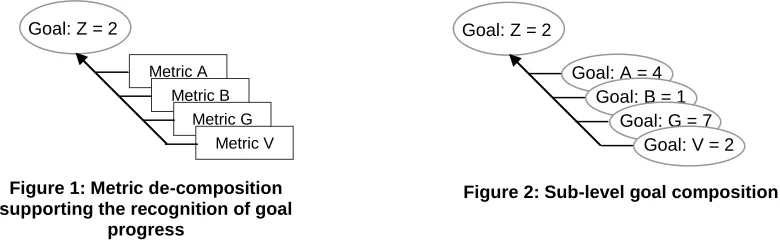
Corporate perspectiveidentifying those objectives that effect, or are affected by, other higher-level objectives. In order to decompose organisational strategic objectives into process or activity level objectives, the metrics, which will support in monitoring the degree of the initial goal’s attainment, must be defined as identified in Figure 1. However, defining the metrics that support in monitoring performance, within a specified organisational performance goal, requires that the metrics be provided with the targets or levels of performance that must be satisfied. In defining the targets of a metric a process is subsequently provided with, corresponding, sub-level goals thus enabling the process to focus and, therefore, recognise its contribution to higher-level business objectives and goals as identified in Figure 2. Recursively, these sub
goals must be supported with the relevant metrics that enable their progress to be monitored.
[image:4.612.111.501.226.348.2]The ability to decompose business objectives and goals into process level objectives and targets cannot be left to a secondary requirement and must be adequately supported. As presented in Figure 3, the ability to decompose goals and measures throughout an organisation is vital to attaining the necessary feedback on performance at various hierarchical levels throughout an organisation. Defining process level goals that may be misaligned from the objectives of the organisation contributes to ‘blindly’ defining the objectives of performance that, potentially, will contribute to organisational success. Therefore, the ability to align process level goals and objectives to organisational strategies will enable a representative and focused development process to contribute to the success of the organisation within its pre-determined focuses of performance. As represented in Figure 4, the need to align process or activity goals/metrics with higher-level business goals must be realised to ensure that the satisfaction of organisational strategic objectives are being supported and not restrained as a result of focusing solely upon a process’s individual objectives. Thus, the definition of metrics must remain appropriate to the goals otherwise
Figure 1: Metric de-composition supporting the recognition of goal
progress
Figure 2: Sub-level goal composition
Metric A Metric B
Metric G Metric V
Goal: Z = 2 Goal: Z = 2
Goal: A = 4 Goal: B = 1
Goal: G = 7 Goal: V = 2
A1
A21 A22
[image:4.612.119.488.583.722.2]A31 A32 A33
Figure 3: Decomposition of goals/metrics throughout an
organisation
Misalignment
Goals
Goals/Metrics (Sub-Level)
misalignment results in association with the generation of inaccurate and non-representative feedback performance measurements. Alignment is therefore referred to here as maintaining a commonality of focus from organisational objectives associated through the objectives at process and activity levels.
2.2.
Product perspectiveThe main aim of a designer, and the process of designing, is to develop a design solution that has the potential to satisfy the performance objectives within the relevant perspectives such as the customer, organisation and/or society. Progressing from an outline or specification of requirements through to a specification of an artefact a designer is guided in the transformation process by predefined and evolving performance requirements outlined through both qualitative and quantitative concerns and goals [8]. As outlined by Dym and Little, a product specification provides designers with numerical values and subjectively derived goals and parameters within the following three forms of specification [9]:
Prescriptive Specifications – defines specific values for attributes;
Procedural Specifications – defines the specific procedures for calculating attribute values and behaviours; and,
Performance Specifications – defines and characterises the desired behaviour of an artefact.
The above forms of specifications categorise the range of performance objectives, used to assess and guide designers at various stages, as derived from such perspectives and influences as the customer or the attainable levels of performance within technological capabilities. In addition, the performance objectives associated with a product, and the product’s development, are influenced by the objectives of the organisation. For example, a product has the potential to realise the desired performance levels of the organisation from generating financial returns to realising technological advances within a given market. However, such factors of success are, at such a level of analysis, more representative of the performance of a process’s output and the degree of effectiveness attained in satisfying business goals and less representative of the performance achieved within the process of development or process orientated organisational goals (i.e. corporate perspective). A successful product may therefore be classified based upon its ability to satisfy the requirements and expectations of the customer or its ability to capture and attain some percentage of market share and generate the necessary returns on investment. Thus, consideration of, for example, the financial success generated from a product’s absorption into a market becomes dependant upon other factors concerned with a product’s development such as the efficiency with which resources were consumed in satisfying goals or the degree of effectiveness attained.
2.3.
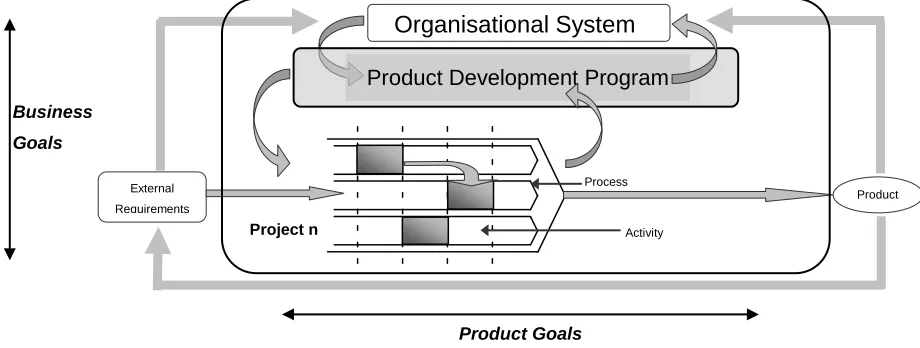
Process perspectiveresources to attain such deliverables. As outlined in Figure 5, a design process, within a project, is influenced by the organisation, the development program (such as the goals of other development functions) and the external environment (ranging from customer requirements to technical constraints).
Design development processes and activities, as a result, cannot remain solely focused upon the specifications and requirements of a product design but must, through the management of the process, consider the strategic focuses, objectives and the factors of performance that may contribute to, or potentially restrain, the degree of success experienced at both an organisational level and at a departmental level. The product development process, therefore, considers the performance goals and objectives of a product and is influenced and managed based upon the performance goals of the organisation at various levels. Therefore, daily activities and objectives must be related to the strategic orientation and objectives of a corporation and in turn recognise how activities contribute to the realisation of organisational, product, and/or the overall process goals [5]. At an activity level, design development personnel should be provided with the potential to identify the factors, within the relevant perspectives, that impinge upon the level of performance achievable at various organisational levels.
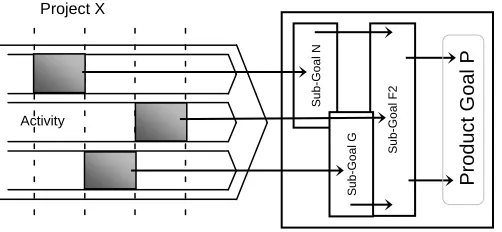
Having discussed the need for supporting personnel in recognising the relative strength and impact that the progress and attainment of process level objectives will have on higher organisational activities, processes and their associated activities, i.e. alignment, consideration should also be given to the effect of decisions upon subsequent development activities and processes. There is a need therefore, to support and maintain the congruency of objectives and goals throughout an organisation such that the goals defined within functions or projects are mutually reinforcing of both the overall product development process’s goal(s) and the goals defined within subsequent process functions as aligned within the overall strategic objectives of the organisation. As outlined in Figure 6, activities within a development process are relied upon to satisfy their desired performance goals and contribute to the achievement of the product’s goal(s). Ensuring the congruency of objectives throughout a development process would result in the assurance that individual goals defined at a process or activity level would not prove counter-productive or interfering with performance objectives defined within subsequent processes. However, in
[image:6.612.79.539.129.303.2]Project n
Figure 5: Placing the Development Process within an Organisational Context Product Goals
Business
Goals
External Requirements
Organisational System
Product Process
Activity
order to achieve such control of a development process the ability to predict and relate those influential, future, factors with the influenced factors must be supported. In realising such abilities a designer may be presented with the information on how subsequent functions may, potentially, achieve their predetermined business goals and product goals while providing the information and knowledge at decision points to assist them in attaining their, specific, desired levels of performance. Table 1 summarises the factors associated with the alignment and congruency of performance objectives throughout an organisation. In close, it is not enough to ensure the alignment of business objectives alone but the congruency of product development requirements must also be supported as, ultimately, they are inextricably linked.
3.
The elements of design process performance
Work by O’ Donnell and Duffy [10] has provided a generic model of process performance that introduces an understanding of how process activities and their management may be analysed with respect to higher level elements of performance. Their model identifies the components of an activity/process (i.e. input, output, goals/constraints and resources) and their relationships within the elements of effectiveness and efficiency formalised through the presentation of the E2 model. Figure 7 presents a basic process representation with an overlay of the elements of effectiveness and efficiency encompassing and relating the components of an activity within. Thus, the efficiency of a process details the relationship between the consumption of resources used to generate an output state from some input state, while effectiveness represents the ability of a process to obtain an output that satisfies the processes’ objectives and goals. While efficiency represents the relation between process inputs and outputs, it alone lacks the focus of what the objectives and goals of the process may be. Thus, the inclusion of effectiveness provides the context and focus for a process and the factors required that should be considered in terms of levels of efficiency and/or process goals. In turn, this brings to the process the potential to measure the degree of required goal satisfaction obtainable within the context of the efficiency levels with which resources may be consumed. The effectiveness of a process however may only be measured through the process’s performance in satisfying its required output at corresponding levels of abstraction and analysis.
Alignment Business Objectives
Top/Down - Bottom/Up
Goals/Metrics
Congruency Product Objectives
Process In/Out – Out/In
[image:7.612.360.543.212.354.2]Goals/Metrics Project X S u b -Go a l N S u b -Go a l F 2 S u b -Go a l G Activity P rod uc t G oa l P
[image:7.612.70.321.219.335.2]Figure 6: Maintaining congruency between activity and project goals
The E2 model provides the formalism to relate between both the effectiveness and efficiency of a process and therefore place each in context of the other. The ability to control the interactions between process effectiveness and efficiency realises the potential to manage a process based upon the measurement of the consumption of resources utilised to generate a degree of process effectiveness and vice versa.
From a performance perspective there is a need to consider the activity of designing, from its range of goals, influences and concerns, and its subsequent management, as presented in Figure 8, in order to accommodate and reflect the influences and goals associated with other organisational perspectives within a product development process. As outlined in Figure 8 an activity within a design development process will involve both the activity of designing and the management of the activity in order to control and focus upon the achievement of the activity’s performance goals. For further details on the interactions between the elements see [11].
Distinguishing between the performance objectives of an activity and its management provides the means to decompose higher-level organisational performance objectives and clarify the responsibilities associated with satisfying such objectives.
PD Function
KIDo
Goals/ Constraints
Resources KIDi
Efficiency
[image:8.612.181.435.145.308.2]Effectiveness
Figure 7: E2 Model of product development performance [10]
Figure 8: Relating the activity and management of the design process within the E2 model [11]
Goals
Inputs Outputs
Design (Actual)
Design (Management)
[image:8.612.142.474.443.637.2]The discussion on various organisational perspectives has highlighted and emphasised the need to identify how factors from different levels or departments within an organisation may effect or be affected by the definition, progress and attainment of performance goals. However, the need to segregate the factors of performance found within the perspectives discussed must be placed within the context of the elements of process performance, i.e. effectiveness and efficiency. Therefore, the distinction may be realised and maintained between the goals or deliverables concerning effectiveness requirements and the relevant process activity efficiency goals that are instrumental in realising such goals. In turn this provides the ‘visibility’ to control a process succinctly and in alignment with the objectives and performance levels as associated with both the output and resources that realise such an output [12]. In distinguishing yet relating between goals in such a way personnel are supported in decision-making assessing and identifying the potential for added value or indeed identifying when diseconomies of scale may be breached. With the provision of such an ability, the realisation of the available resources at a program level may subsequently be related to the individual goals at a project level and may therefore provide the means to manage the evolution of goal satisfaction based upon resources consumed and the degree of goal satisfaction.
In close, this section has presented the elements of performance and concerns that must be considered in order to present an accurate representation of an organisation. Further, the need to ensure that the goals of the various organisational perspectives are distinguished in terms of the design activity and its management and their interaction with process level output goals (effectiveness) and process performance goals (efficiency) was highlighted. We have presented the key performance elements that enable us to categorise and focus upon, relevant to a particular perspective and understanding, how process performance can be used to pro-actively control development activities in order to realise the optimum performance potential of an organisation.
4.
Re-engineering performance behaviour
objective. In doing so, the ability to support any initial, intuitively identified performance factors, which may effect upon a performance objective, could be potentially supported by using past behavioural models to refine, refocus and/or confirm that the most relevant and influential factors are being considered, measured and assessed. Managing process activities through the addition of prescriptive and predictive knowledge, regarding performance behaviour, would enable managers to, firstly, acknowledge the factors that may effect upon a potential objective but in addition would provide the foresight to predict the connotations of achieving an objective throughout related organisational perspectives and associated factors.
Performance behaviour infers that, in order to perform, the existence of any conflicts that may restrain the obtainable performance must be identified and therefore addressed [16]. Attaining an understanding of process performance behaviour would provide the necessary knowledge and information to enable managers to predict and foresee the existence of any subsequent conflicts that may transpire as a result of identifying, progressing or satisfying a performance objective. Therefore, personnel would be provided with a greater degree of control in satisfying, and indeed optimising, the potential performance within associated perspectives throughout the organisation. An understanding of the behaviour and dynamism of an organisation or process and its corresponding performance infers the need to measure performance but, in addition, requires the incorporation of the following requirements:
Define the factors that effect upon, and that are affected by, the definition, progress or attainment of performance goals, identifying those critical to the attainment of desired performance. Identifying the related factors within the varying organisational perspectives provides those in decision-making roles with the potential to recognise and understand the propagational effects of attaining desired levels of performance.
Define the relationships between dependent and independent performance factors, thus understanding how control of performance behaviour may be obtained.
Identify how factors from various organisational perspectives relate to the performance factors being addressed defining their relative weighting and distinguishing between positive and negative effectors. As a result, recognition of the strengths of influence that may be experienced within a performance objective provides the insight necessary to focus upon the key effectors that can control the level of performance obtained.
Categorise performance factors as being, relative to the level and speciality of focus, measures of effectiveness or efficiency. Categorising the factors of performance provides the necessary information to enable control to focus upon performance and its improvement.
Understand and learn how control of factors’ behaviour may be obtained and manipulated, thus enabling the management of processes to be supported through predicting and prescribing the propagational effects on performance within an organisation.
strengths is required. The identification and determination of relationships and their context specific relational weightings may therefore realise the ability to refine the number of performance factors being considered within a given scenario to a manageable yet reflective set of performance factors. In doing so, the ability to manipulate performance behaviour within an activity/process to, in turn, control the output and thus the effectiveness of an activity/process may be realised as aligned with higher-level organisational objectives. The resultant information on the relationships between process effectiveness and efficiency can thus realise the potential to focus on what needs to be changed and what must be protected and adhered to in order to realise both organisational and process level objectives. The need to identify and understand how process performance behaviour may be controlled is of crucial importance to providing the ability to both optimise the performance of various, related, organisational perspectives and pro-actively manage a development process.
5.
Extracting implicit performance behavioural knowledge
It has been accepted that lessons learnt from past experiences can be used to improve the performance of present and future activities [17]. For example, the definition of the factors to be deemed to be relevant to a certain performance assessment may be achieved based upon the expert or intuitive judgement of related personnel or through the analogy of other similar scenarios [18]. Further, based upon the definition of such factors, statistical analyses may be deployed to identify the strengths of the relationships that exist between the factors within a performance assessment and thus detail their relevancy and the subsequent accuracy with which they were intuitively identified. However, what restrains the effective application of such past experiences lies in their ability to reflect current and future conditions. Therefore, the need to accommodate and acknowledge the context within which past experiences were evolved, and subsequently map or manipulate such experiences to the context of current performance assessment, would increase the depth of potential learning opportunities and interpretations and in turn lead to more defined interpretations and the accuracy with which they may be applied [19]. The following section introduces the process of Knowledge Data Discovery and its analysis capabilities as realised through Data Mining techniques. After a brief introduction into data mining is provided the goals of its application and the techniques and representations used to realise these goals are discussed.
5.1.
Data mining in designdeveloped, namely, PERSPECT, provided the means and functionality to enable designers to extract and manipulate past design experiences and design cases to support current and future design requirements [22]. Despite receiving relatively little attention in design to date, data mining has been successfully utilised in areas such as fraud detection, identifying consumer trends and maximising the efficiency of production processes. Drawing from distinct research areas, such as machine learning, knowledge representation and statistics, data mining systems can be used to identify, modify and extract knowledge. Data mining tools can provide additional functionality to support designers through: the identification and exploration of relevant design spaces, supporting the use of experiential knowledge to reduce the pragmatic nature of decision making; the structuring of experiential knowledge through their ability to generalise, abstract, cluster and associate within design domains; and, possessing the ability to learn from new experiences based on Induction [23] and Neural Network [24] techniques for example. Such tools may be utilised to structure and manipulate experiential knowledge in order to map between previous design principles and current design perspectives.
5.1.1.
GoalsData mining is the process of discovering new knowledge or knowledge of interest such as patterns, associations, changes, anomalies, structures, principles, etc., from data or information repositories. The goals for discovering knowledge may be distinguished based on the intended use of the system such as: verification - systems used to verify or discount hypothesis based upon the specific needs of the
designer, and in turn controlled and directed by the user (controlled learning);
discovery - systems search for new patterns and present discoveries to the users. Such methods of
discovery may be initiated based on the guidance of a designer to analyse a certain domain through a predetermined perspective (controlled learning) or autonomously search a domain for models etc (automated learning). Discovery can be further broken down to:
- prediction - where the system discovers patterns for use in predicting the future behaviour of some entities; and,
- description - system finds patterns for the purpose of presenting them to the user in an interpretable form.
5.1.2.
Knowledge Transformation TechniquesData mining tools possess a wide range of techniques that, depending on the goal or reason for implementation, determines or controls the specific or suite of techniques that, potentially, may be utilised. Many such techniques have been in use for more than a decade, being utilised in specialised analysis tools, whose only prominent constraint was their inability to analyse large volumes of data. A range of knowledge transformation techniques, enabling the implementation of machine learning transformation abilities [25], as provided in data mining systems [21, 26] are presented in order to illustrate how the goals of a KDD process may be realised and introduce the functionality that can now be harnessed from such computational techniques.
Abstraction/detailing. Abstraction is a necessary step in generalisation. Abstraction is involved with the generation of a new version of a concept with less detail than the original. The abstraction of a concept dispenses the knowledge that is superfluous to the requirements while maintaining what is relevant. Detailing promotes the inclusion of specific knowledge.
Association/disassociation. Association is the discovery of relationships or correlations among given entities or descriptions based on logical, casual or statistical relationships. The relation may be expressed as a taxonomic relationship (kind-of) or a compositional relationship (part-of). The relationships can also be expressed by rules and equations showing attribute value conditions that occur frequently together in a group of similar designs. Disassociation reflects a lack of dependency between entities.
Classification/unification. Classification determines a specific index description that may be used to classify a design or associated entity into one of several predefined classes. Each group member is based on a level of similarity in some predetermined perspective, while remaining distinct from other groups. Unification groups all data without the use of a description or criteria.
Clustering/ungroup. Clustering or group rationalisation involves the grouping of similar past designs based on the similarity of some criteria. Ungrouping or decomposition removes the grouping.
Derivation/randomisation. Derivation is the process of deriving a piece of knowledge that is based on another piece(s) of knowledge, through a level of dependency. Randomisation transfers one knowledge segment into another by making random changes.
Generalisation/specialisation. Generalisation provides a concise and succinct description or model of a collection of data within a set of designs. Thus the description characterises all of the designs based on the specialisation of the concepts. Specialisation increases the specificity of the description.
5.1.3.
Knowledge representationcontribution that may impact upon the performance of current scenarios. In addition, various formalisms support users in understanding the results and in turn applying the knowledge associated with past experiences to current viewpoints. Data mining systems utilise specific knowledge representation formalisms, as presented below, to support the structuring of data, information and knowledge within a domain’s ranging viewpoints.
Decision Trees - enable an activity or process to be modelled in terms of specific decision points. The tree like structure represents a set of decision points with all possible outcomes represented. Such a representation of knowledge is similar, in knowledge content, to the rule-based formalism discussed below. The generation of a decision tree based on user’s contextual needs enables users to procedularise an activity, based on past experiences, to ensure the consideration and optimum satisfaction of all factors within a given performance scenario.
Dependency Networks - enable the generation of models based on identified significant dependencies between variables. A dependency network, as depicted in Figure 9, details how an independent attribute relates with dependant attributes. The information displayed in such a network provides users with the ability to make decisions while determining and recognising those related ‘trade-off’ attributes. Figure 6 below is derived based upon past experiences of how factors are affected, or may affect, an identified performance concern [2, 27-29].
The addition of the factor weightings (which details the strength of dependency between factors) enables users to, within a given scenario, focus and address the key concerns which may be effected by/from a performance concern and therefore manage the depth and range of factors to be considered.
Equations - provide a formalism, e.g. mathematical equations, for the dependencies between attributes.
The strength of relations between entities enables decision makers to base predictions of further requirements on previously determined facts [30]. Such predictions, based on past cases or empirical research, utilise models in the form of empirical equations as shown in Equation 1 [1, 31]. The model
Perceived Quality
Customer Return Factor
Customer Satisfaction
Product Performance
Product Return Rates (0.87) Customer Complaints (0.98)
Value (0.387) Usability (0.765)
Initial Costs (0.88) Life Costs (0.49) Features (0.21) Ease of Use (0.91)
Design Difficulty (0.8)
Quality (0.92)
Number of Steps (0.83)
Resources (0.98)
Design Type (0.72) Complexity of Knowledge
Cost ( 0.66) Infra-Structure (0.5) Time (0.88) 0.9
0.7
[image:14.612.104.515.372.574.2]0.8
allows users to calculate the development time of a process, based on the entities that have been shown to effect upon the outcome - be they restraining or reinforcing. Such models offer users the ability to visualise firstly what is effected by a change in one dimension, secondly, the relative weight of the change that will be propagated through the model’s dimensions and also how control of dependants may be used to effect and control the attainment of a desired outcome.
DT = 8.4 + 4.2PC + 0.09NN - 1.9 (PC * FP) - 0.09 (NN * FT)
Where:
DT = Development Time
PC = Product Complexity (Number of functions) NN = Newness (percentage change)
FT = Use of cross functional teams (dichotomous 0/1) FP = Use of a formal process (dichotomous)
Neural Networks (NN’s) – based upon the brain’s neural network, NN’s provide the ability to model a domain and subsequently modify that model based on newly encountered experiences. The ability to modify a domain model, through the adjustment of its internal weights, ensures that any new experience is used to update and maintain its knowledge content and therefore its output. A major drawback of an NN is its ‘black box’ approach to detailing their rationale as its basis for decision-making [32].
Production Rules – provides a representation of IF condition THEN action rules from data sets. Thus, if a
condition is satisfied then a logical conclusion may be drawn. If… Then rules are particularly helpful in the development of traditional rule based expert systems that may be used to help users to focus upon a subsection of potential scenarios and their resultant outputs that reflects current and future scenarios, e.g.:
IF(attribute) draught < (value)12.92
AND(attribute) lob > (value) 6.18
AND(attribute) engwt > (value) 350.5
THEN(conclusion) ENGL = (result)12.13
The knowledge transformation and representation techniques presented are not a comprehensive list but serve to show not only a selection of representations that data mining approaches can accomplish, but aids in the process of KDD to ensure that the goal of knowledge discovery is identified and matched onto the above representations and capabilities.
5.2.
SummaryThe goals and specific techniques of knowledge transformation, as realised through various data mining systems, have been presented with a view of introducing some of the goals and functionalities associated with their utility. The range of data mining tools available in the market place are being increasingly recognised as key analytical tools within organisations allowing analysers and users to gain a deeper and more controlled view and understanding of an organisation. Indeed, in many cases, the techniques and analysis capabilities enable organisations to focus and control their analysis efforts through the extraction of generalised while yet representative organisational models. A range of knowledge representation
techniques were presented in order to discuss the various formalisms that may be generated to suit certain specific analysis requirements.
6.
The research approach
Past development cases provide the potential to not only understand and extract the factors of success, in terms of organisational competencies and capabilities, but further support in identifying the aspects that markets consider to be factors that impact upon purchasing trends and, subsequently, market sales. The utility, and degree, of knowledge that may be extracted from past development cases may be restrained as a result of the complexity and the multi-dimensional nature of performance measurement associated with development activities and in the identification of the measures of success out with the process [33]. However, as the very activity of conducting a survey or questionnaire emulates the search for solutions, or the determination of the factors of success within the past, methods exist to extract the knowledge from past experiences. Focus meetings or brainstorming sessions attempt to overcome the distributed locations of information, goals, factors of success, and the factors and levels of performance yet they remain intuitive and consensus based. Further, such methods of identifying the objectives and measures concerned with organisational performance lack the associated knowledge in determining whether the goals, objectives and measures are coherent, i.e. aligned and congruent, with the objectives etc. at other organisational levels and departments.
The use of statistical methods within data mining systems may be used in understanding and controlling the utility of past experiences to best reflect and suit current requirements and control the range of variables to be assessed. Thus, the potential to define and control the attributes to be considered from the various organisational perspectives may be realised while controlling the number of factors that must be considered to a manageable, reflective, range. The potential therefore, to determine the degree of project completion, a necessary measure of performance by management [34], may be determined based upon an understanding of how past cases achieved ‘effectiveness’ from various performance objectives and the degrees of efficiency associated with their satisfaction. Through the utility of data mining techniques the realisation of utilising past experiences to explicate and understand how goals and objectives were obtained and satisfied previously, therefore identifying and relating between the attributes and factors [35], may enable past experiences to be transformed and manipulated to suit the performance goals and behaviours associated with today’s contexts.
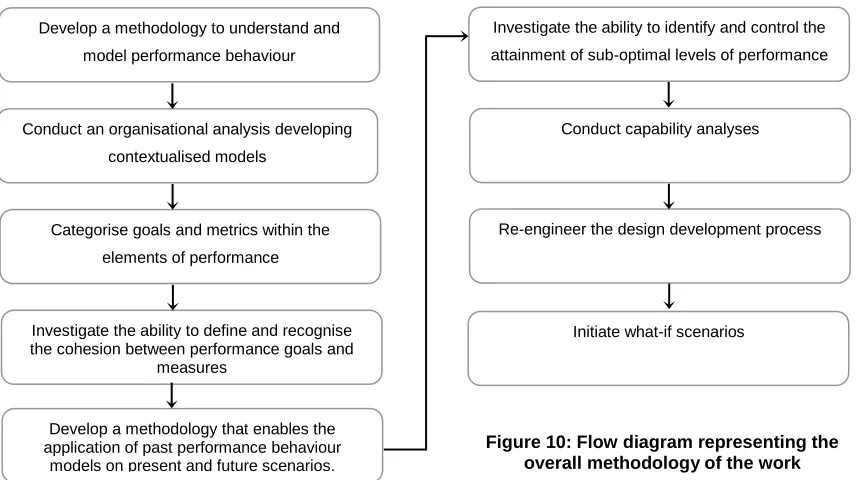
communication and learning potential gained from the ability to utilise past understandings of performance behaviour providing more practical and applicable recommendations [19]. The CAD Centre is currently carrying out an investigation into process performance measurement with a view of improving business performance as supported by Engineering and Physical Science Research Council (EPSRC) funding. The work has involved gathering and collating metrics that may be applied within the various perspectives of an organisation. In addition, a range of data mining techniques have been evaluated within the context and confines of engineering design generated information therefore enabling the research to utilise the most applicable knowledge transformation techniques and representations. The following points, and the proceeding flow diagram (Figure 10), represent the overall methodology of the work:
Develop a methodology for understanding and modelling performance behaviour thereby identifying both the goals and measures associated with categorised objectives and, further, how they interrelate. Analyse past behaviour in order to understand the interrelations that exist within certain contexts and use such understandings to support the development and control of future performance initiatives thus providing the means to realise design process re-engineering and the optimisation of organisational performance at both the macro and micro levels. Consideration will be given to the context that enables the mapping between past and future cases.
Categorise performance goals and metrics relevant to the elements of performance, i.e. effectiveness and efficiency, in doing so, the ability to focus and control the degree of effort required within various organisational perspectives may be realised. For example, the management of the consumption of resources used to attain activity level goals may be controlled to the degree of manipulating the resultant performance output of the activity yet remain congruent with the goals and measures of subsequent development processes.
The research is conditional upon the ability to maintain the coherence between objectives and measures throughout an organisation, i.e. alignment and congruency. Maintaining the cohesion between performance goals and measures, within the elements of effectiveness and efficiency, will be researched based upon the explication of past relationships between performance goals and measures in association with their corresponding contexts.
Develop the means to map between previously experienced goals and measures and apply them to current performance objectives thereby recognising the potential goals and measures within various perspectives to be affected by or upon the achievement of objectives. Therefore, recognising and understanding behavioural performance realises the potential to pro-actively control and predict the propagational effects that will be encountered through the associated goals and measures.
Research the means of identifying and controlling sub-optimal and superior process performance areas while providing the ability to ‘drill-down’ and analyse, understand and manipulate those contributing factors that have produced, or are likely to produce, such effects in the future.
development activities, resources are being utilised to satisfy company, and product, goals and objectives. By relating goals and objectives with inputs and resource consuming activities, in relation to the activities required levels of performance, decision makers may be given the information to identify any potential degrees of expansion or areas for optimisation in particular activities. Through categorising and maintaining the distinction between measures of process efficiency and effectiveness the potential to realise a priority listing of performance initiatives and objectives and their associated understanding of their degree of schedule impact as defined through performance behaviour assessments will be researched [40, 41].
Through the identification of those processes or activities that contribute to the attainment of sub-optimal levels of performance, as concerned with business goals and product/customer goals, explicate the information and knowledge that enables the development process to be re-engineered in order to optimise development processes and outputs. This infers a strong emphasis upon the ability to relate between goals and measures but, in addition, requires the ability to identify the associated organisational perspectives and in turn ‘prioritise’ the criticality of goals so that optimum performance may be achieved.
Enable the initiation of ‘what-if’ scenarios to assess and understand potential process improvements. Realised through applying the identified relationships between factors within current and predicted future scenarios the ability to manipulate the relations between factors enables the assessment of what constitutes optimal outputs with due consideration of both the factors and perspectives affected within an organisation and its processes. Therefore, process re-engineering may be based not only upon current process capabilities but will be investigated in terms of re-engineering the process based upon future strategic objectives.
The ability to model and predict performance behaviour in future scenarios may have some contribution to an organisations long-term success and competitiveness. As commented by Rusk, ‘the pace of events is moving so fast that unless we can keep our sights on tomorrow, we cannot expect to be in touch today’ [43]. What Rusk referred to was that in order to recognise, state and maintain a focus upon the long-term strategy of an organisation the ability to consider present decision points should be realised in conjunction with sufficient consideration of the context of future organisational strategies. Supported by Kaplan and Norton [44] who posited that organisational strategies should consider and account for the core competencies and capabilities possessed by an organisation and be placed in the context of long term success and competitiveness. The research may thus realise the potential of explicating and identifying organisational competencies, through enabling the identification of their structure and behaviour, providing the information and knowledge needed to support the definition, and achievement, of organisational strategies and begin to build the competencies and capabilities needed for future strategic initiatives. Thus, modelling performance behaviour will provide the means to identify and define competencies and capabilities, strengths and weaknesses, existing and required, to fulfil future strategic objectives. As a result, organisations will be able to conduct ‘what-if’ scenarios and experiments regarding processes, activities, factors of success, company cultures [45] and enable ‘Continuous Improvement’ within and out with organisational systems [46] as a result of acknowledging and considering the associated factors.
7.
Conclusion
This paper has discussed the need to support organisations in explicating, modelling and understanding performance behaviour through enabling management activities to identify what should be measured in the context of the required factors of success as defined through strategic objectives based upon explicated and manipulated experiential knowledge. A formalism that will provide the realisation of
Develop a methodology to understand and model performance behaviour
Conduct an organisational analysis developing contextualised models
Categorise goals and metrics within the elements of performance
Investigate the ability to define and recognise the cohesion between performance goals and
measures
Initiate what-if scenarios
Re-engineer the design development process Conduct capability analyses Investigate the ability to identify and control the attainment of sub-optimal levels of performance
Develop a methodology that enables the application of past performance behaviour
[image:19.612.95.523.72.312.2]models on present and future scenarios.
controlling process outputs through the management of the relevant resources and their dissipation was discussed, in conjunction with the need to identify the existence of sufficient and significant relations between factors of effectiveness and efficiency. A range of perspectives were presented, from the organisational level through to a process level, that provide the various factors that should be considered and the levels of required performance. The need to acknowledge the factors associated with performance behaviour, while acknowledging the strength and trade-offs between factors as determined from past cases and experiences, as a result of organisational perspectives, was discussed and presented. An approach to learn from past performance behaviours, acknowledging their context through defining their attributes and factors, was presented in the form of data mining. The utility of such approaches realises the potential to understand past performance behavioural models, which may have produced desirable or undesirable levels of performance, and manipulate their context, while maintaining the accuracy of developing and applying such models, to support current and future performance assessments. Through manipulating the experiential knowledge associated with performance behaviour the potential to control the evolution of a process and its performance, from the outputs generated to the resources utilised to attain such outputs, may now be realised and based upon factually supported feedback on the levels of performance and the factors to be considered. This paper has presented the foundation upon which organisations may realise the potential to pro-actively manage their performance within the context of the interactions between both business and product related goals.
References
1. Bashir, H.A., and Thomson, V., Metrics for design projects - a review. Design Studies, 1999. 20: p. 263-277.
2. Griffin, A. and A.L. Page, PDMA Success Measurement Project: Recommended Measures for Product
Development Success and Failure. Journal of Product Innovation Management, 1996. 13(6): p.
478-496.
3. Cooper, R.G. and E.J. Kleinschmidt, Benchmarking the Firm's Critical Success Factors in New Product
Development. Journal of Product Innovation Management, 1995. 12: p. 374-391.
4. Coates, G., I. Ritchey, A. H.B. Duffy, W. Hills and R.I. Whitfield, Integrated Engineering Environments for Large Complex Products. Concurrent Engineering: Research and Applications,2000, 8(3): p. 171 -182.
5. King, B., Hoshin Planning - The Developmental Approach, in Goal/QPC. 1989.
6. Pahl, G. and W. Beitz, Engineering Design: A Systematic Approach. Second ed. 1996: Springer-Verlag. 7. Loch, C., L. Stein, and C. Terwiesch, Measuring Development Performance in the Electronics Industry.
Journal of Product Innovation Management, 1996. 13: p. 3-20.
8. Balachahdran, M., Knowldege-Based Optimum Design. Topics in Engineering Design, ed. C.A. Brebbia and J.J. Connor. Vol. 10. 1993, Southhampton: Computational Mechanics Publications.
9. Dym, C.L. and P. Little, Engineering Design: A Project-Based Introduction, ed. R. Factor. 2000: John Wiley & Sons.
10. O'Donnell, F.J. and A.H.B. Duffy. Modelling Product Development Performance. in International
Conference on Engineering Design (ICED'99). 1999. Munich, Germany.
11. O'Donnell, F.J. and A.H.B. Duffy, A Methodology for Methodology and Analysis Performance in Design Development. 1st International Workshop on Performance Measurement. IFIP 5.7. Centre for Strategic Manufacturing, University of Strathclyde, Glasgow, UK,. 24-25 May 2001.
12. Clausing, D., Total Quality Development: A Step-by-Step Guide to World Class Concurrent Engineering. 1994, New York: The American Society of Mechanical Engineers.
13. Bititchi, U.S., Modelling of Performance Measurement Systems in Manufacturing Enterpr ises. International Journal of Production Economics, 1995. 42: p. 137-147.
15. Wright, A.L. and D.G. Ullman. Introduction to Developing Measurements of the Design Process. in Intl.
Conf. on Engineering Design, ICED99. 1999. Munich.
16. Hazelrigg, G.A., Game Theory, in Systems Engineering: An Approach to Information-Based Design. 1996, Prentice Hall: Saddle River, NJ. p. 361-406.
17. Armistead, C.G., J.-P. Pritchard, and S. Machin, Strategic Business Process Management for
Organisational Effectiveness. Long Range Planning, 1999. 32(1): p. 96-106.
18. Boehm, B.W., The Software Life-cycle: A Quantitative Model. 1981, Englewood Cliffs: Prentice Hall. 19. Jackson, A. The Importance of Contextualisation: A Structural Model of Performance. in Intl. Conf. on
Performance Measurement. 2000. University of Cambridge.
20. Adriaans, P. and D. Zantiinge, Data Mining. 1996: Addison-Wesley.
21. Fayyad, U.M., et al., Advances in Knowledge Discovery and Data Mining. 1996: AAAI, MIT Press. 22. Duffy, A.H.B. and Duffy, S.M., Customised Perspectives of Past Design form Automated Group
Realisation. Artificial Intelligence in Engineering. 1993. 8(3): p.183 -200.
23. Holland, J.H., et al., Induction: Process of Inference, Learning and Discovery. 1987: MIT Press.
24. Embrechts, M.J., Neural Networks for Data Mining, in Intelligent Engineering Systems through Artificial
Neural Networks, C.H. Dagli, et al., Editors. 1997. p. 741-746.
25. Persidis, A. and A.H.B. Duffy, Learning in Design, in Intelligent CAD, H. Yoshikawa, F. Arbab, and T. Tomigama, Editors. 1991, Elsevier, North-Holland.
26. Shapiro, P. and W.J. Frawley, Knowledge Discovery in Databases. 1991: AAAI, MIT Press.
27. Bahill, A.T. and W.L. Chapman. Case Studies in System Design. in International Symposis and
Workshop on Systems Engineering at Computer Based Systems. 1995.
28. Beaumont, L.R., The PDMA Handbook of New Product Development, J.M.D. Rosenau, Griffin, A., Castellion, G.A. and Anschuetz, N.D., Editor. 1997, John Wiley and Sons, Inc. p. 463-485.
29. Griffin, A. and A.L. Page, An Interim Report on Measuring Product Development Success and Failure. Journal of Product Innovation Management, 1993. 10: p. 291-308.
30. Goldense, B.L., Rapid Product Development Metrics. World Class Design to Manufacture, 1994. 1(1): p. 21-28.
31. Griffin, A., PDMA Research on New Product Development Practices: Updating Trends and
Benchmarking Best Practices. 1997, Institute for the Study of Business Markets, The Pennsyl vania
State University: Pensylvania.
32. Lu, H., R. Setiono, and H. Liu, Effective Data Mining using Neural Networks. IEEE Transactions on Knowldege and Data Engineering, 1996. 7: p. 741-746.
33. Kaplan, R.S. and D.P. Norton, The Balanced Scorecard - Measures that drive performance. Harvard Business Review, 1992. Jan- Feb 1992: p. 71-79.
34. Hales, C., Analysis of the Engineering Design Process in an Industrial Context. 1987: Grants Hill Publications.
35. Boehm, B.W., Software Engineering Economics. 1981: Prentice Hall.
36. Pawson, R. and N. Tilley, Realistic Evaluation. 1997, London: Sage Publications.
37. Wallace, K.M. and C. Hales. Possible Future Trends in Engineering Design Research. in Proc.
ICED-85: WDK-12. 1985. Zurich, Heurista.
38. Handy, C., Understanding Organisations. 1981, Middlesex: Penguin Books Ltd.
39. Wolstenholm, E.F. and R.G. Coyle, The Development of Systems Dynamics as a Methodology for
Systems Description and Qualitative Analysis. Journal of Operational Research Society, 1983. 34(7): p.
569-581.
40. Sinclair, D. and M. Zairi, Effective process management through performance measurement. Business Process Re-engineering & Management Journal, 1995. 1(3): p. 50-65.
41. Griffin, A., Metrics for Measuring Product Development Cycle Time. Journal of Product Innovation Management, 1993. 10: p. 112-125.
42. Kerssens-van Drongelen, I.C. and J. Bilderbeek, R&D performance measurement: more than choosing
a set of metrics. R&D Management, 1999. 29(1): p. 35-46.
43. Rusk, P.S., Structuring the Bills of Materials for a Complex Make-to-Order Product. Engineering Costs and Production Economics, 1989. 15.
44. Kaplan, R.S. and D.P. Norton, Putting the Balanced Scorecard to Work. Harvard Business Review, 1993. Sep-Oct 1993: p. 134-147.
45. Kerssens-van Drongelen, I.C. and A. Cook, Design principles for the development of measurement
systems for research and development processes. R&D Management, 1997. 27(4): p. 345-357.
46. Laakso, T., Performance Evaluation and Process Interventions - A method for Business Process
Development, in TAI Research Centre. 1997, Helsinki University of Technology: Helsinki.
![Figure 7: E 2 Model of product development performance [10]](https://thumb-us.123doks.com/thumbv2/123dok_us/1731780.126634/8.612.142.474.443.637/figure-e-model-product-development-performance.webp)