A Scalar Dynamic Conditional Correlation Model:
Structure and Estimation
Hui Wanga and Jiazhu Panb
aSchool of Finance, Central University of Finance and Economics, China.
bDepartment of Mathematics and Statistics, University of Strathclyde, UK.
Abstract. The dynamic conditional correlation (DCC) model has been popularly used for modeling con-ditional correlation of multivariate time series since Engle (2002). However, the stationarity conditions are established only most recently and the asymptotic theory of parameter estimation for the DCC model has not been discussed fully. In this paper, we propose an alternative model, namely the scalar dynamic conditional correlation (SDCC) model. Sufficient and easy-checking conditions for stationarity, geometric ergodicity and
β-mixing with exponential decay rates are provided. We then show the strong consistency and asymptotic normality of the quasi-maximum likelihood estimator (QMLE) of the model parameters under regular con-ditions. The asymptotic results are illustrated by Monte Carlo experiments. As a real data example, the proposed SDCC model is applied to analysing the daily returns of the FSTE 100 index and FSTE 100 futures. Our model improves the performance of the DCC model in the sense that the LiMcleod statistic of the SDCC model is much smaller and the hedging efficiency is higher.
MSC(2010): 37M10, 62F12.
Key words and phrases. Dynamic conditional correlation; stationarity; ergodicity; QMLE; consistency; asymptotic normality.
1
Introduction
adjusted to account for the most recent information. It is also the case for asset allocation, pric-ing structured products and systemic risk measurement (Brownlees and Engle (2017)). These facts motivate the construction of models that can summarize the dynamic properties of two or more asset returns. A class of models that address this topic is the multivariate GARCH models, in which volatilities and correlations at a given time are functions of lagged returns and lagged values of themselves. Seminal works in this area are the Constant Conditional Corre-lation (CCC) model of Bollerslev (1990), the Dynamic Conditional CorreCorre-lation (DCC) model of Engle (2002) and the Varying Correlation model of Tse and Tsui (2002). Extensions of the CCC model and the DCC model have been proposed, among others, by He and Ter¨asvita (2004), Cappiello, Engle and Sheppard (2006), Franses and Hafner (2009), Zako¨ıan (2010), Francq and Zako¨ıan (2011), Aielli (2013), Aielli and Caporin (2014). For the reviews of the literature on multivariate GARCH models, see Bauwens, Laurent and Rombouts (2006), Silvennoinen and Ter¨asvirta (2009) and Francq and Zako¨ıan (2010) etc.
The asymptotic theory of estimation for multivariate GARCH is far from being coherent, compared to univariate GARCH models. Bollerslev and Wooldridge (1992) proposed the con-dition that the likelihood follows a uniform weak law of large numbers for consistency of the QMLE. They also assumed asymptotic normality of the score but did not verify whether any of the conditions actually holds for specific multivariate GARCH models. Jeantheau (1998) gave conditions for the strong consistency of the QMLE for multivariate GARCH models and verified the conditions for the extended CCC model. Jeantheau’s work did not require conditions on the log-likelihood derivatives. Comte and Lieberman (2003) showed the consistency and asymptotic normality of the QMLE for the BEKK formulation. Asymptotic results were established by Ling and McAleer (2003) for the CCC formulation of an autoregressive moving average model with GARCH noises (ARMA-GARCH). Hafner and Preminger (2009) investigated the asymp-totic theory for VEC model proposed by Bollerslev, Engle and Wooldridge (1988). McAleer et al.(2009) developed a constant conditional correlation vector ARMA-asymmetric GARCH model and established the asymptotic normality of QMLE. Francq and Zako¨ıan (2011) established the strong consistency and asymptotic normality of QMLE for a class of multivariate asymmetric GARCH processes. Their processes generalize the extended CCC model of Jeantheau (1998) by allowing cross leverage effects.
us to consider a scalar version of the DCC model of Engle (2002) in the sense that we assume the conditional variance of every single asset to be constant but the correlation of the assets is dynamic. That is, we only focus on the dynamics of correlations. To apply the proposed SDCC model to practice, one should standardize the data for every individual asset first. In the SDCC model the location parameter is treated as a free estimator and may fit the data more ade-quately compared with the DCC model in which the location parameter is estimated by sample estimator (see Remark 2 in section 2 and the real data example in section 4). Referring to the result of Boussama et al. (2011), we will discuss the probabilistic structure of the SDCC model and derive its stationarity under simple conditions. Furthermore, we will show that the QMLE is strongly consistent provided that the model is stationary. The asymptotic normality of the QMLE is established under the assumption that the innovation has finite (8 +δ)th moment for someδ >0.
The rest of this paper is organized as follows: Section 2 introduces the scalar DCC model and gives the existence of strictly stationary solution with finite second moment to the model. Section 3 establishes the consistency and asymptotic normality of the QMLE. Section 4 discusses the finite sample performance of the QMLE through Monte Carlo simulations and a real data example on empirical application of the SDCC model to financial futures hedging problem. All proofs are presented in section 5.
In the sequel, →L, →P and a.s→ denote convergence in distribution, in probability and almost surely respectively. A′ denotes the transpose of a vector or a matrixA,T r(A) is the trace of a matrix A, |A| denotes the determinant of matrix A, andk · k denotes the Euclidean norm for both vectors and matrices, i.e. kAk=pT r(A′A). I
m is an m×m identity matrix and K is a constant or a random variable which does not depend on sample size and may be different at different places.
2
The model and its stationarity
Xt=R1t/2ηt
Rt= Σ−t∗1ΣtΣ−t∗1
Σt=C+ q
X
i=1
αiXt−iXt−i′ + p
X
j=1
βjΣt−j =: (σ2ij,t)m×m
Σt∗= diag{σii,t}
(2.1)
whereαi≥0,i= 1,· · · , q,βj ≥0,j= 1,· · · , p, and C= (cks)m×m is a positive definite matrix with unit-diagonal elements. R1t/2 is the unique positive definite square root ofRt. Furthermore,
{ηt}is a sequence of independent and identically distributed (iid) random vectors withE(ηt) = 0 and V ar(ηt) =Im, andηtis independent of Ft−1 =σ Xt−k, k≥1 for all t.
Remark 1. Here the condition thatC is unit-diagonal is a simple normalization such that the conditional correlation process is identifiable.
Remark 2. The SDCC model (2.1) focuses on capturing the dynamics of the conditional correlation. In fact, the conditional variance of i-th component Xit can be assumed asσ2it. We standardize the data by dividing them by their conditional standard deviations before applying this model. So we assume the conditional variance to be unity in the model for simplicity. We have two ways to apply the proposed SDCC model to real data of financial returns. The approximate way is that we can standardize the data by dividing them using the sample standard deviations over a moving window. But the usual way is the following two steps,and see the real data example in section 4 below for illustration.
Step 1. To capture the heteroscedasticity of each asset, fit a GARCH-type model or any other type of models to the conditional variance to each asset returns, and then obtain residuals for each asset. The specification of the univariate GARCH type models is not limited to the standard GARCH model, but can include any GARCH type process such as EGARCH, TGARCH, APGARCH, depending on special features of the data.
Step 2. To capture the dynamic conditional correlation across assets, fit model (2.1) to them−dimensional vector time series of residuals.
A1. The distribution Γ of ηt is absolutely continuous with respect to the Lebesgue measure onRm and the point zero is in the interior of E :=supp(Γ).
A2. Pqi=1αi+Ppj=1βj <1.
Theorem 1. Suppose that assumptions A1-A2 hold. Then there exists a unique strictly
sta-tionary solutionXt to model (2.1), and Xtis geometrically ergodic and geometrically β-mixing. Furthermore, EkXtk2<∞ and EkΣtk<∞.
Remark 3. Please refer to Fan and Yao (2003) for the definition of ergodicity, geometric ergodicity and β−mixing condition.
Remark 4. The moment structure of model (2.1) is very simple. Noting thatRt is bounded in the sense that kRtk ≤m a.s., for any τ > 0 we have EkXtkτ <∞ provided that Ekηtkτ <
∞. Thus, if model (2.1) has a strictly stationary solution, it is also weakly stationary when Ekηtk2 <∞. This is different from the BEKK model. The BEKK model might have a strictly stationary solution with infinite second moment even when the innovations have finite variance. Although in principle the main problem is only to find an appropriate function for the Foster-Lyapunov drift criterion, as Boussama et al. (2011) pointed out, it seems impossible to extend the univariate result to cover the BEKK model at the moment.
Remark 5. Since one usually uses absolutely continuous innovationsηt, such as multivariate Gaussian or multivariate student-t innovations with finite second moments, assumption A2 is the only condition to be checked. Furthermore, assumption A1 can be weakened further, see Boussama et al. (2011) for details.
3
Asymptotic properties of QMLE
The parameter in the SDCC model consists of the coefficients of the lower triangular part of the intercept matrix C and αi, βj, i = 1,· · · , q, j = 1,· · · , p. The number of unknown parameters is thus d = m(m−1)/2 +p +q, and the parameter vector is denoted by θ = (θ1,· · · , θd)′ with true parameter θ0 = (θ10,· · · , θd0)′. Let X1, · · ·, Xn be observations from model (2.1). Conditionally on initial values X0, · · ·,X1−q, ˜Σ0, · · ·, ˜Σ1−p, the Gaussian
quasi-likelihood function is
GLn(θ) = n
Y
t=1
1 (2π)m/2|R˜
t(θ)|1/2
expn−1
2X ′
tR˜−t1(θ)Xt
o ,
˜
Rt(θ) = ˜Σ−t∗1(θ) ˜Σt(θ) ˜Σ−t∗1(θ),
˜
Σt(θ) =C+ q
X
i=1
αiXt−iXt−i′ + p
X
j=1
βjΣt−j˜ (θ) =: (˜σ2ij,t(θ))m×m,
˜
Σt∗(θ) = diag{σ˜ii,t(θ)}.
(3.1)
The model is not assumed to be necessarily Gaussian, but we work with the Gaussian quasi-likelihood. The quasi-maximum likelihood estimator (QMLE) ˆθn is defined as
ˆ
θn= arg max
θ GLn(θ) = arg minθ ˜ Ln(θ),
where
˜ Ln(θ) =
1 n
n
X
t=1
˜
lt(θ) and ˜lt(θ) =Xt′R˜t−1(θ)Xt+ log|R˜t(θ)|. (3.2)
It will be convenient to approximate the sequence ˜lt(θ) by an ergodic stationary sequence. Therefore, we define
Ln(θ) = 1 n
n
X
t=1
lt(θ) and lt(θ) =Xt′Rt−1(θ)Xt+ log|Rt(θ)|, (3.3)
where
Rt(θ) = Σ−t∗1(θ)Σt(θ)Σ−t∗1(θ)
Σt(θ) =C+ q
X
i=1
αiXt−iXt−i′ + p
X
j=1
βjΣt−j(θ) =: (σij,t2 (θ))m×m
Σt∗(θ) = diag{σii,t(θ)}
(3.4)
We need the following assumptions to establish the strong consistency of the QMLE ˆθn.
A3. The parameter space Θ is compact, andθ0∈Θ.
A4. For anyθ∈Θ, Ppj=1βj <1.
A5. Any element ofXtcan not be determined by the other elements ofXtandFt−1.
The following theorem gives the strong consistency of the QMLE.
Remark 6. Assumption A5 is the identification condition for model (2.1). Jeantheau (1998) gave primitive conditions for identifiability for an extended version of the CCC model, see also Francq and Zako¨ıan (2011). For the discussion of the identification problem of the BEKK model and factor GARCH models, see Sherrer and Ribarits (2007), Fiorentini and Sentana (2001), and Doz and Renault (2004). However, the identifiability of the DCC model of Engle (2002) is still open.
To establish the asymptotic normality of the QMLE ˆθn, we need the following additional assumptions.
A6. θ0 is an interior point of Θ.
A7. E|ηt|8+δ<∞ for someδ >0.
A8. ηtη′tis non-degenerate with Eηtηt′ =Im.
Theorem 3. Under assumptions A1-A8,
√
n(ˆθn−θ0)
L
→N(0, J−1HJ−1),
where
H =Eh∂lt(θ0) ∂θ
∂lt(θ0)
∂θ′
i
and J =Eh∂
2l
t(θ0)
∂θ∂θ′
i .
4
Numerical properties
4.1 Simulation
This subsection presents numerical evidence on the finite sample performance of asymptotic results of the QMLE through a simulation study. We computed the estimator for a bivariate SDCC model (2.1) of order q = 1 and p = 1 with ηt ∼ N(0, I2) based on 1000 independent
4.2 A real data example: empirical analysis of financial hedging
4.2.1 Data description
The data used in this paper consist of the spot and futures prices of FSTE 100 index. The sample period covers from 12/11/2009 to 23/3/2012 with the sample size 597. Both the spot and futures prices are obtained from Forexpros. To avoid thin markets and expiration effects, the nearby futures contract is rolled over to the next nearest contract when it emerges as the most active contract. We split the sample into two subperiods: from 12/11/2009 to 4/11/2011 as the in-sample period, and from 7/11/2011 to 23/3/2012 as the out-sample period.
Table 2 lists the unit root and cointegration tests for the FSTE 100 futures and spot prices. The results of the Augmented Dickey-Fuller unit root test (ADF) indicate that both series of futures and spot indices are nonstationary. However, the first differences of the logarithmic stock indices (i.e. log-returns) of both futures and spot are stationary. In addition, the Engle-Granger two-step method reveals that the logarithm of spot price and the logarithm of futures price are cointegrated with a cointegrating vector near (1,−1), implying that the spreads between log-prices of spot and futures can serve as the error correction term.
Table 3 presents a summary of the statistics for the in-sample data, including the mean, median, standard deviation, skewness and kurtosis. Also presented in Table 3 are the results of the Jarque and Bera normality test and the Ljung-Box test for returns and square returns. Initially, the mean returns of both spot and futures are close to 0. The sample standard deviation of the futures returns is larger than that of the spot returns, indicating that the futures market is more volatile than the spot market. For both spot and futures the skewness coefficients are negative, and the kurtosis coefficients significantly exceeds three. The Jarque-Bera test provides clear evidence to reject the null hypothesis of normality for the returns of both spot and futures. The Ljung-Box statistics of returns and squared returns indicate possible serial correlation and autoregressive conditional heteroscedasticity (ARCH) effects in both spot and futures return series.
4.2.2 Estimation results
lagged basis helps to determine the spot and futures price movement, therefore, to facilitates adjustment of price deviation. Since the cointegration test indicates that the basis can serve as the error correction term, we impose the following mean models:
rst=φs0Bt−1+
p
X
i=1
φsirs,t−i+ q
X
i=1
ψsirf,t−i+εst (4.1)
rf t=φs0Bt−1+
p
X
i=1
φf irs,t−i+ q
X
i=1
ψf irf,t−i+εf t (4.2)
whererst= log(St)−log(St−1),rf t= log(Ft)−log(Ft−1),StandFtdenote spot and futures price at timetrespectively, andBt= log(St)−log(Ft) is the spread at timet. Before estimating the mean equations, we use the Akaike Information Criterion to determinepand q and obtain that p=q= 2. Table 4 presents the estimation results for the mean equations (4.1) and (4.2). The feedback effects between the spot and futures markets are observed. That is, the lagged spot (or futures) returns help to predict current futures (or spot) returns. More specifically, the one-step lagged futures returns have positive effects on current spot returns and negative effects on current futures returns, the two-step lagged futures returns have positive effects on both current spot returns and futures returns, the one-step lagged spot returns have positive effects on current futures returns, and the two-step lagged spot returns have negative effects on both current spot returns and futures returns. Furthermore, when considering only statistically significant estimates at a conventional significance level of 1%, the futures returns tend to increase when the basis is large in order to restore the long-run equilibrium relationship. Based on the above estimation, we adopt the SDCC model with p = q = 1 in this paper and the DCC model of Engle (2002) to model the conditional correlation between the spot returns and the futures returns. Since the DCC model is estimated by two steps through QMLE and the SDCC is used for standardized data, we fit GARCH(1,1) models for the residuals of equation (4.1) and (4.2) first, namely,
εit=h1it/2eit and hit=ωi+θi1ε2it+θi2hit−1, i=s, f (4.3)
whereωi>0, θi1 ≥0, θi2 ≥0 and θi1+θi2 <1 for i=s, f. Then for the standardized residuals
returns and the futures returns through a DCC and a SDCC model respectively, i.e.
et=R1t/2ηt
Rt=Q−t∗1QtQ−t∗1
Qt= (1−α−β) ¯Q+αet−1e′t−1+βQt−1= (qij,t)
Qt∗ = diag{√qii,t}
(4.4)
and
et=R1t/2ηt
Rt= Σ−t∗1ΣtΣ−t∗1
Σt=C+αet−1e′t−1+βΣt−1 = (σ2ij,t)
Σt∗ = diag{σii,t}
(4.5)
where ¯Q is the unconditional covariance of the standardized residuals resulting from the first stage estimation,C= (cij) is unit-diagonal positive definite, andα >0, β >0. We call the above SDCC model a GARCH-SDCC model, since the volatilities are modeled by the GARCH(1,1) models and the residuals are modeled by the SDCC model. On the other hand, we estimate volatility simply by the sample standard deviations of the log-returns data in a moving window with width 10. Namely, hit is estimated by the sample variance of ri,t−1,· · ·, ri,t−10, i =s, f.
Then, we standardize the log-returns data by √hit, i = s, f, and fit a SDCC model with p=q= 1 for the standardized data (this model is called a STD-SDCC model). Table 4 presents the estimation results and the LiMcLeod statistics for the conditional variance equations (4.3) and the correlation equations (4.4) and (4.5). Being consistent withQ2 statistics (in Table 2), both ARCH (θs1 and θf1) and GARCH (θs2 and θf2) effects are found to be significant at 5%
level in both spot and futures returns, with the GARCH effect being the dominant factor. TheQ andQ2 statistics indicate that the conditional variance models for both spot returns and futures
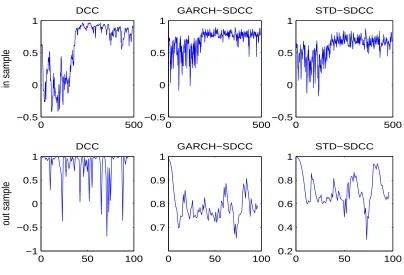
since the SDCC model is more flexible in the sense that the constant matrix is not set as in the DCC model. Figure 2 presents the estimated conditional correlation coefficients for the in-sample period and the forecasting conditional correlation coefficients. For the in-in-sample period, the DCC, GARCH-SDCC and STD-SDCC give similar results at least for the trend. However, for the out-sample period, the DCC gives more violent results which contradicts the relationship between the spot and futures. This may be caused by the inconsistency of the estimator of DCC model.
4.2.3 Potential effects on dynamic hedging strategy
In this subsection, we discuss the potential impacts on dynamic hedging due to the different correlations captured by the SDCC model and the DCC model. By the minimum variance principle, the optimal hedging ratio is defined as
∆t=ρt+1 q
hst+1/hf t+1,
whereρt is referred to as the conditional coefficient between spot returns and futures returns at time t, and hst, hf t denote conditional variances of spot returns and futures returns at time t respectively. We use two measures to investigate the performance of the hedging strategy. The first measure is to compute the reduction of the variance after hedging, namely
HE = V ar(ru(t))−V ar(r(∆t)) V ar(ru(t))
= 1−V ar(r(∆t)) V ar(ru(t))
whereV ar(ru(t)) is the variance of un-hedged portfolio andV ar(r(∆t)) is the variance of hedged portfolio. The second measure is the following mean-variance utility function:
U =E(rt)−γV ar(rt)
5
Proofs
5.1 Proof of Theorem 1
The main idea of the proof of Theorem 1 is to apply the theory of Boussama et al. (2011) to the SDCC model. We introduce some notations first. Denote the k−dimemsional Euclidean space byRk, the set of realm×dmatrices byMm×d(R), the vector space of realm×mmatrices by Mm(R), the subspace of symmetric matrices by Sm, the positive semi-definite cone by S+m and positive definite matrices byS++m . LetN be the set of natural numbers and N∗ be the set of natural numbers excluding zero (i.e. N∗\ {0} ). Put
Yt= vech(Σt)′,· · · ,vech(Σt−p+1)′, Xt′,· · ·, Xt−q′ +1 ′
, (5.1)
where vech is a transformation mapping Sm to Rm(m+1)/2 by stacking the lower triangular portion of a matrix. By (2.1) and (5.1), Yt has the form
Yt=F(Yt−1, ηt) (5.2)
and F is a continuous map (i.e. C1-map) from U ×Rm into U, where U is the open set in Rm(m+1)/2p× Rmq defined as
U = vech(Sm++)× · · · ×vech(Sm++)
| {z }
p
×Rm· · · ×Rm
| {z }
q .
Thus{Yt} is a Markov chain inU. Obviously, model (2.1) has a stationary solution if and only if (5.2) does. Suppose assumptions A1-A2 in section 2 hold. To apply the result of Boussama et al. (2011), we need to prove the following assertions, which are listed as lemmas 5.1-5.4, hold for the model under consideration.
Lemma 5.1. There exists a point ω ∈ intE and a point Ψ ∈ U such that the sequence (Yz
t )t∈N defined by Y0z = z and Ytz = F(Yt−z1, ω) for t ≥ 1 converges to the point Ψ for all
z∈U.
Proof. For arbitrary y ∈ U and t ≥ 1, define the sequence (Ytz)t∈N by Y0z = z and
Ytz = F(Yt−z1,0). We denote by Xtz and vech(Σzt) in Yt−z1 the associated values of Xt and vech(Σt) in Yt. Noting thatXt= Σ−t∗1ΣtΣ−t∗1ηt, we have Xtz = 0 for all t≥1 which yields that
vech(Σzt) = vech(C) + p
X
j=1
Therefore, for all t≥q andz∈U, the following equality holds
Ytz = Λ + ˜BYt−z1, (5.3)
where
Λ = (vech(C)′,0,· · · ,0)′ ∈(Rm(m+1)/2)p×(Rm)q, B˜ =
B 0
0 0
∈Mpm(m+1)/2+qm,
and
B =
β1Im(m+1)/2 β2Im(m+1)/2 · · · βp−1Im(m+1)/2 βpIm(m+1)/2
Im(m+1)/2 0 · · · 0 0
0 Im(m+1)/2 · · · 0 0
..
. . .. . .. 0 ...
0 · · · 0 Im(m+1)/2 0
∈Mpm(m+1)/2(R).
Since Pqj=1βj <1, we get that the spectral radius of the matrix Pjq=1βjIm(m+1)/2 is less than
1, which implies the same case for B by Proposition 4.5 of Boussama et al. (2011). Thus, (5.3) means Lemma 5.1 hold withω = 0 and Ψ defined by
Ψ = Λ + ˜BΨ. (5.4)
Let
¯
Σ = 1
1−Ppj=1βj
C. (5.5)
Then, ¯Σ is positive definite by assumption A2. We can easily verify that Ψ can be written as
Ψ = vech( ¯Σ)′,· · ·, vech( ¯Σ)′
| {z }
p
,0,· · ·,0
| {z }
qm
′
∈U. (5.6)
Now, we complete the proof of Lemma 5.1.
Lemma 5.2. There exist an algebraic varietyW ⊆ Rm(m+1)/2p× Rmq, aC1-mapf from U×Rm intoRm and a regular mapφfrom Rm(m+1)/2p× Rmq×Rm into Rm(m+1)/2p×
Rmq such that
(i) F(z, y) =φ(z, f(z, y)) for all (z, y) ∈U ×Rm, (ii) φ(W ∩U×Rm)⊆W ∩U,
Proof. From (2.1) and (5.1), we obtain immediately a regular map (for the definition of a regular map, see Boussama et al. (2011)) as follows
φ: Rm(m+1)/2p× Rmq×Rm→ Rm(m+1)/2p× Rmq such thatYt=φ(Yt−1, Xt).(5.7)
Letf be a map from U×Rm intoRm such that
f :U ×Rm→Rm, (Yt−1, ηt)→(Σ−t∗1ΣtΣ−t∗1)1/2ηt=Xt.
Since (Σ−t∗1ΣtΣ−t∗1)1/2is invertible, we obtain thatfz(·) =f(z,·) forz∈U is aC1-diffeomorphism, which means (iii) of Lemma 5.2 hold. Noting thatXt= (Σ−t∗1ΣtΣ−t∗1)1/2ηt, forYtdefined in (5.1), we have
Yt=F(Yt−1, ηt) :=φ Yt−1, fYt−1(ηt)
=φ(Yt−1, Xt), (5.8)
whereF is aC1-map fromU×RmintoU. Thus, we establish (i) of Lemma 5.2. In the following, we show that(ii) of Lemma 5.2 hold. Defineφk recursively by φ1 =φand
φk+1: Rm(m+1)/2p× Rmq× Rmk+1→ Rm(m+1)/2p× Rmq,
φk+1(y, x1,· · · , xk, xk+1) =φ φk(y, x1,· · · , xk), xk+1.
By Proposition 3.7 of Boussama et al. (2011), we can get the algebraic variety of states
W =Z [
k∈N∗
φk(Ψ,(Rm)k),
where Ψ is defined in (5.4) and satisfies (5.6), ZA denotes the closure of a set A in the Zariski topology. Here, Zariski topology means the topology over Rm(m+1)/2p× Rmq for which the algebraic sets in Rm(m+1)/2p× Rmq are the closed sets, and the Zariski closure of a setAis defined by
ZA= \
D Zariski closed,D⊇A D.
For anyk∈ N∗, consider y(k)∈φk Ψ,(Rm)k defined as
y(k) =φk(Ψ, x1,· · · , xk) =: (vech(σk)′,· · ·, vech(σk−p+1)′, x′k,· · · , x ′ k−q+1)
′
withx1,· · · , xk∈Rm. Denotex(k) = vech(xkx′k)′, vech(xk−1x′k−1)′,· · ·, vech(xk−q+1x′k−q+1)′ ′
and σ(k) = vech(σk)′,· · ·, vech(σk−p+1)′
′
with σ(0) =: σ = vech( ¯Σ)′,· · ·, vech( ¯Σ)′′ and x(0) = 0, where ¯Σ is defined in (5.5). It is easy to verify that
where Λ1= (vech(C)′,0,· · ·,0)′ ∈(Rm(m+1)/2)p and
A=
α1Im(m+1)/2 α2Im(m+1)/2 · · · αqpIm(m+1)/2
0 0 · · · 0
..
. . .. . .. ...
0 · · · 0 0
∈Mpm(m+1)/2×qm(m+1)/2(R).
By (5.4), (5.6) and the definition of σ(0), we can obtain σ= Λ1+Bσ, which implies that
σ= k−1 X
i=0
BiΛ1+Bkσ.
Therefore, (5.9) yields that
σ(k) = k−1 X
i=1
BiΛ1+Bkσ+
k−1 X
i=1
BiAx(k−i) =σ+ k−1 X
i=0
BiAx(k−i).
Hence, we have
vech(σk−j) =vech( ¯Σ) + k−1 X
i=1
Qi,j+1vech(xk−i−jx′k−i−j),
where for alli∈ {1,· · ·, k−1} and j∈ {0,· · · , p−1}, Qi,j+1 is defined byQi,j+1 = [BiA]1,j+1
with the conventionB0 =Ipm(m+1)/2,Bi= 0 ifi <0 and [Q]1,j+1is them(m+1)/2×m(m+1)/2
block from lines 1 tom(m+ 1)/2 and from columnsjm(m+ 1)/2 + 1 to (j+ 1)m(m+ 1)/2 of a matrix BiA. Therefore, W is the Zariski closure of
SΨ = [
k∈N∗
n
y(k) :x1,· · ·, xk∈Rm
o
= [
k∈N∗
n
Ψ + k−1 X
i=1
Qi,1vech(xk−ix′k−i),· · · ,Ψ + k−1 X
i=1
Qi,pvech(xk−p+1−ix′k−p+1−i), x1,· · ·, xk
o .
Noting thatφ(U×Rm)⊆U by its definition andφ(S
Ψ×Rm)⊆SΨdue to the above arguments,
we have
φ(W ∩U×Rm)⊆φ ZSΨ×Rm⊆Zφ(ZSΨ×Rm) =Zφ(SΨ×Rm)⊆Z SΨ=W,
sinceφis a regular map and thus continuous with respect to the Zariski topology. This completes the proof of Lemma 5.2.
Lemma 5.3. There exist a function V and positive constants τ < 1 , b <∞ as well as a small setKinW∩U such that the Foster-Lyapunov condition is satisfied, i.e. for anyx∈W∩U
Proof. Let
Σ = C
1−Pqi=1αi− Pp
j=1βj
.
SinceC is positive definite, assumption A2 implies that Σ is also positive definite. Furthermore, it is easy to verify that
Σ =C+ p
X
j=1
βjΣ + q
X
i=1
αiΣ. (5.10)
Define
V(Yt) = p
X
j=1
T r(VjΣt−j+1) +
q
X
i=1
Xt−i′ +1Vp+iXt−i+1+ 1,
Vk=
p−k+ 1 p+q C+
p
X
j=k
βjΣ, k= 1,· · · , p,
Vk+p=
q−k+ 1 p+q C+
q
X
i=k
αiΣ, k= 1,· · · , q.
Thus, we have
EV(Yt)|Yt−1 =y = ET r(V1Σt) +Xt′Vp+1Xt|Yt−1=y
+ p
X
j=2
T r(VjΣt−j+1) +
q
X
i=2
Xt−i′ +1Vp+iXt−i+1+ 1. (5.11)
By the formulation of Σt, we get
ET r(V1Σt)|Yt−1=y
= EnT rV1(C+
q
X
i=1
αiXt−iXt−i′ + p
X
j=1
βjΣt−j)
Yt−1 =y o
= T r(V1C) +
p
X
j=1
βjT r(V1Σt−j) +
q
X
i=1
αiXt−i′ V1Xt−i. (5.12)
SinceXt=R1t/2ηt,Rt=R1t/2R
1/2
t ,Eηtη′t=Im, and every entry of Σ−t∗1 is less than 1, it follows that
EXt′Vp+1Xt|Yt−1=y
= ET r(Vp+1Rt1/2ηtηt′R
1/2
t )
Yt−1=y
= T r(Vp+1Σt∗−1ΣtΣ−t∗1)
≤ T r(Vp+1Σt)
= T r(Vp+1C) +
p
X
j=1
βjT r(Vp+1Σt−j) + q
X
i=1
Combining (5.11)-(5.13), we obtain
EV(Yt)|Yt−1 =y
= T r[β1(V1+Vp+1) +V2]Σt−1 +· · ·+T r[βp−1(V1+Vp+1) +Vp]Σt−p+1
+T rβp(V1+Vp+1)Σt−p+Xt−′ 1[α1(V1+Vp+1) +Vp+2]Xt−1+· · ·
+Xt−q′ +1[αq−1(V1+Vp+1) +Vp+q]Xt−q+1+Xt−q′ αq(V1+Vp+1)Xt−q
+T r[(V1+Vp+1)C] + 1. (5.14)
By the definition ofVi, we deduce
βk(V1+Vp+1) +Vk+1=Vk− 1
p+qC, k= 1,· · · , p−1, (5.15) βp(V1+Vp+1) =Vp−
1
p+qC, (5.16)
αk(V1+Vp+1) +Vp+k+1 =Vp+k− 1
p+qC, k= 1,· · · , q−1, (5.17) αq(V1+Vp+1) =Vp+q−
1
p+qC. (5.18)
BecauseVkis positive definite, and αi >0,βj >0,i= 1,· · · , q,j = 1,· · · , p, we have Vk−p+1qC is also positive definite, k = 1,· · · , p +q. Consider the non-negative constants (τk)1≤k≤p+q defined by
τk= max
n
x′(Vk− 1
p+qC)x:x∈R m, x′
Vkx= 1
o .
Noting that{x:x′Vkx= 1}is a compact set, there exists xk∈Rm such that x′Vkx= 1 and
τk =x′k(Vk− 1
p+qC)xk= 1−
x′kCxk p+q .
The positive definiteness ofC means that 0≤τk<1,k= 1,· · · , p+q. Putτ0 = max{τk, k= 1,· · · , p+q} and we have τ0 ∈[0,1) and
Vk− 1
p+qC ≤τ0Vk, k= 1,· · · , p+q.
Therefore, for any M ∈Sd++, we get
T r(Vk− 1
p+qC)M
≤τ0T r(VkM), k= 1,· · · , p+q. (5.19)
From (5.14)-(5.19), we obtain that
If we choose τ = (τ0+ 1)/2 ∈ [1/2,1), b = T r(ΣC) + 1−τ0 ∈ (0,∞), the (FL) condition is
satisfied with the set given by
K ={W ∩U :V(x)≤ b τ −τ0}
.
Following the proof of Theorem 2.4 of Boussama et al. (2011), we can show that K is a small set. This complete the proof of Lemma 5.3.
Lemma 5.4. Any strictly stationary solution of the Markov chain Yt+1 =F(Yt, ηt) takes its values in the algebraic variety W ∩U.
Proof. SupposeXn be a strictly stationary solution of model (2.1). Define
Σ(k) = vech(Σk)′,· · · , vech(Σk−p+1)′
′
, X(k) = vech(XkXk′) ′
,· · · , vech(Xk−q+1Xk′−q+1)
′′ .
Noting that Σ(k+ 1) = Λ1+AX(k) +BΣ(k), we can deduce
Σ(k+ 1) = j−1 X
i=0
Λ1+BjAΣ(k−j) +
j
X
i=1
Bi−1AX(k−i)
for all k∈ N. Under assumption A2, the spectral radius of B is less than 1 by Proposition 4.5 of Boussama et al. (2011). Using similar arguments to the proof of Theorem 4.8 of Boussama et al. (2011), we obtain that
Σ(k) =σ+ ∞
X
i=1
Bi−1AX(k−i) a.s.
Thus,
vech(Σk) =vech Σ¯+ ∞
X
i=1
Qivech Xk−iXk′−i
a.s.,
withQi the them(m+ 1)/2×m(m+ 1)/2 block from lines 1 tom(m+ 1)/2 and from columns m(m+ 1)/2 + 1 to m(m+ 1) of a matrix Bi−1A,which implies that Y
t takes its values in the variety W and hence in W ∩U.
5.2 Proofs of Theorem 2 and Theorem 3
For the consistency of the QMLE, under assumptions A1-A5, we need to establish that
C1. limn→∞supθ∈Θ
Ln(θ)−L˜n(θ)= 0, a.s.
C2. E|lt(θ0)|<∞, and if θ=6 θ0,Elt(θ)> Elt(θ0).
C3. For any θ6=θ0, there exists a neighborhood N(θ) such that
lim inf
n→∞θ∗∈infN(θ)
˜
Ln(θ∗)> El1(θ0) a.s.
For the asymptotic normality of the QMLE, under assumptions A1-A8, we need to show that
N1. n−1/2Pnt=1 ∂lt(θ0)
∂θ L
→N(0, H) for a nonrandomH.
N2. J =: E[∂2lt(θ0)/∂θ∂θ′] =
ET r · Rt,iR−t1
· Rt,jRt−1
i,j=1,···,d < ∞ and J is non-singular.
N3. Esupθ∈Θ
∂3lt(θ)
∂θi∂θj∂θk
<∞for all i, j, k = 1,· · · , d.
N4. n−1/2Pnt=1 ∂lt(∂θθ0)−∂˜lt(∂θθ0)→P 0 and
sup θ∈Θ n−1
n
X
t=1
∂2l
t(θ) ∂θ∂θ′ −
∂2˜lt(θ) ∂θ∂θ′
→P 0.
(Refer to the proofs of Theorem 2.1 and 2.2 in Francq and Zako¨ıan (2004) for the univariate case.)
Before we prove the above assertions, some notations and elementary results on the norm of matrices and the differentiation of expressions involving matrices are introduced first. Let f(A) be a real valued function of a matrix A whose elements aij are functions of some variable y. Then, for square matricesAandB we have the following equalities and inequalities (see Magnus and Neudecker (1988)):
∂f(A) ∂y =T r
n∂f(A) ∂A′
∂A ∂y
o
, ∂log|A| ∂A′ =A
−1, ∂A−1
∂y =−A −1∂A
∂yA
−1, (5.20)
|T r(AB)| ≤ kAkkBk, kABk ≤ kAkkBk. (5.21)
For any functionft(θ), denote∂ft(θ)/∂θiby ·
ft,i(θ),∂2ft(θ)/∂θi∂θjby ··
·
Rt,i(θ) = −Σ−t∗1(θ) ·
Σt∗,i(θ)Rt(θ) + Σ−t∗1(θ) ·
Σt,i(θ)Σ−t∗1(θ)−Rt(θ) ·
Σt∗,iΣ−t∗1(θ); (5.22) ··
Rt,ij(θ) = Σ−t∗1(θ) ·
Σt∗,j(θ)Σ−t∗1(θ) ·
Σt∗,i(θ)Rt(θ)−Σ−t∗1(θ) ··
Σt∗,ij(θ)Rt(θ)
−Σ−t∗1(θ)Σ·t∗,i(θ) ·
Rt,j(θ)−Σ−t∗1(θ) ·
Σt∗,j(θ)Σ−t∗1(θ) ·
Σt,i(θ)Σ−t∗1(θ)
+Σ−t∗1(θ)Σ··t,ij(θ)Σ−t∗1(θ)−Σ −1
t∗ (θ) ·
Σt,i(θ)Σ−t∗1(θ) ·
Σt∗,j(θ)Σ−t∗1(θ)
−R·t,j(θ) ·
Σt∗,i(θ)Σ−t∗1(θ)−Rt(θ) ··
Σt∗,ij(θ)Σ−t∗1(θ)
+Rt(θ) ·
Σt∗,i(θ)Σ−t∗1(θ) ·
Σt∗,j(θ)Σ−t∗1(θ); (5.23) ···
Rt,ijk(θ) = −Σ−t∗1(θ) ·
Σt∗,k(θ)Σ−t∗1(θ) ·
Σt∗,j(θ)Σ−t∗1(θ) ·
Σt∗,i(θ)Rt(θ)
+Σ−t∗1(θ) ··
Σt∗,jk(θ)Σ−t∗1(θ) ·
Σt∗,i(θ)Rt(θ) + Σ−t∗1(θ) ·
Σt∗,j(θ)Σ−t∗1(θ) ··
Σt∗,ik(θ)Rt(θ)
−Σ−t∗1(θ) ·
Σt∗,j(θ)Σ−t∗1(θ) ·
Σt∗,k(θ)Σ−t∗1(θ) ·
Σt∗,i(θ)Rt(θ) + Σ−t∗1(θ) ·
Σt∗,j(θ)Σ−t∗1(θ) · Σt∗,i(θ)
· Rt,k(θ)
+Σ−t∗1(θ)Σ·t∗,k(θ)Σ−t∗1(θ) ··
Σt∗,ij(θ)Rt(θ)−Σ−t∗1(θ) ···
Σt∗,ijk(θ)Rt(θ)−Σ−t∗1(θ) ·· Σt∗,ij(θ)
· Rt,k(θ)
+Σ−t∗1(θ) ·
Σt∗,k(θ)Σ−t∗1(θ) · Σt∗,i(θ)
·
Rt,j(θ)−Σ−t∗1(θ) ·· Σt∗,ik(θ)
·
Rt,j(θ)−Σ−t∗1(θ) · Σt∗,i(θ)
·· Rt,jk(θ)
+Σ−t∗1(θ) ·
Σt∗,k(θ)Σ−t∗1(θ) ·
Σt∗,j(θ)Σ−t∗1(θ) ·
Σt,i(θ)Σ−t∗1(θ)
−Σ−t∗1(θ) ··
Σt∗,jk(θ)Σ−t∗1(θ) ·
Σt,i(θ)Σ−t∗1(θ)
+Σ−t∗1(θ) ·
Σt∗,j(θ)Σ−t∗1(θ) ·
Σt∗,k(θ)Σ−t∗1(θ) ·
Σt,i(θ)Σ−t∗1(θ)
−Σ−t∗1(θ) ·
Σt∗,j(θ)Σ−t∗1(θ) ··
Σt,ik(θ)Σ−t∗1(θ)
+Σ−t∗1(θ) ·
Σt∗,j(θ)Σ−t∗1(θ) ·
Σt,i(θ)Σ−t∗1(θ) ·
Σt∗,k(θ)Σ−t∗1(θ)
−Σ−t∗1(θ) ·
Σt∗,k(θ)Σ−t∗1(θ) ··
Σt,ij(θ)Σ−t∗1(θ) + Σ−t∗1(θ) ···
Σt,ijk(θ)Σ−t∗1(θ)
−Σ−t∗1(θ) ··
Σt,ij(θ)Σ−t∗1(θ) ·
Σt∗,k(θ)Σ−t∗1(θ)
+Σ−t∗1(θ) ·
Σt,k(θ)Σ−t∗1(θ) ·
Σt∗,i(θ)Σ−t∗1(θ) ·
Σt∗,j(θ)Σ−t∗1(θ)
−Σ−t∗1(θ) ··
Σt,ik(θ)Σ−t∗1(θ) ·
Σt,j(θ)Σ−t∗1(θ)
+Σ−t∗1(θ) ·
Σt,i(θ)Σ−t∗1(θ) ·
Σt∗,k(θ)Σ−t∗1(θ) ·
Σt∗,j(θ)Σ−t∗1(θ)
−Σ−t∗1(θ) ·
Σt,i(θ)Σ−t∗1(θ) ··
Σt∗,jk(θ)Σ−t∗1(θ)
+Σ−t∗1(θ) ·
Σt,i(θ)Σ−t∗1(θ) ·
Σt∗,j(θ)Σ−t∗1(θ) ·
Σt∗,k(θ)Σ−t∗1(θ)
−R··t,jk(θ) ·
Σt∗,i(θ)Σ−t∗1(θ)−R·t,j(θ) ··
Σt∗,ik(θ)Σ−t∗1(θ)
+ · Rt,j(θ)
·
Σt∗,i(θ)Σ−t∗1(θ) ·
Σt∗,k(θ)Σ−t∗1(θ)− · Rt,k(θ)
··
Σt∗,ij(θ)Σ−t∗1(θ)
−Rt(θ) ···
Σt∗,ijk(θ)Σt∗−1(θ) +Rt(θ) ··
Σt∗,ij(θ)Σ−t∗1(θ) ·
Σt∗,k(θ)Σ−t∗1(θ)
+ · Rt,k(θ)
·
Σt∗,i(θ)Σ−t∗1(θ) ·
+Rt(θ) ··
Σt∗,ik(θ)Σ−t∗1(θ) ·
Σt∗,j(θ)Σ−t∗1(θ)
−Rt(θ) ·
Σt∗,i(θ)Σ−t∗1(θ) ·
Σt∗,k(θ)Σ−t∗1(θ) ·
Σt∗,j(θ)Σ−t∗1(θ)
+Rt(θ) ·
Σt∗,i(θ)Σ−t∗1(θ) ··
Σt∗,jk(θ)Σ−t∗1(θ)
−Rt(θ) ·
Σt∗,i(θ)Σ−t∗1(θ) ·
Σt∗,j(θ)Σ−t∗1(θ) ·
Σt∗,k(θ)Σ−t∗1(θ). (5.24)
We then introduce several lemmas.
Lemma 5.5. Under assumption A5, model (2.1) is identifiable, namely For θ, θ0 ∈ Θ,
Rt(θ) =Rt(θ0) a.s. implies θ=θ0, where Rt(θ) is defined in (3.4).
Proof. We treat the case with q = 1, p = 0 and m= 2 first. Suppose Rt(θ) =Rt(θ0) a.s.
Then we have
σ212(θ0)
σ11,t(θ0)σ22,t(θ0)
= σ
2 12(θ)
σ11,t(θ)σ22,t(θ) ,
which means
(c0+α0X1,t−1X2,t−1)2
(1 +α0X12,t−1)(1 +α0X22,t−1)
= (c+αX1,t−1X2,t−1)
2
(1 +αX2
1,t−1)(1 +αX22,t−1)
.
After straight computation, we have
c20−c2+ (c20α−c2α0)(X12,t−1+X22,t−1) + (c20α2−c2α20+α20−α2)X12,t−1X22,t−1+
2(c0α−cα0)X1,t−1X2,t−1+ 2(c0αα0−cα0α)X1,t−1X2,t−1(X12,t−1+X22,t−1) +
2(c0α0α2−cαα20)X13,t−1X23,t−1+ (αα20−α0α2)X12,t−1X22,t−1(X12,t−1+X22,t−1) = 0
Ifθ06=θ, then there exists at least one random term in above equation whose coefficient is
non-zero. By implicit function theoremX1t can be determined byX2t which contradicts assumption A5. Thusθ0=θ. For general cases,σij,t(θ) can be represented as the sum of constant term, the function ofXitXjt term and the function of Ft−2 term. Similar method can yield the result of
Lemma 5.5 under assumption A5.
Lemma 5.6. Suppose assumptions A1-A3 hold. Then it follows that, fori,j,k= 1,· · · , d, (i) for any ∆>0,
Ehsup θ∈Θ
· Rt,i(θ)
i∆
<∞, Ehsup θ∈Θ
·· Rt,ij(θ)
i∆
<∞, Ehsup θ∈Θ
··· Rt,ijk(θ)
i∆
<∞;
(ii) ifEkηtk2w <∞ for somew >0, we have E
h
supθ∈Θ
R−t1(θ) iw
<∞.
Esup θ∈Θ Σ−t∗1(θ)
· Σt∗,i(θ)
∆<∞, Esup θ∈Θ Σ−t∗1(θ)
·
Σt,i(θ)Σ−t∗1(θ)
∆<∞,
Esup θ∈Θ Σ−t∗1(θ)
·· Σt∗,ij(θ)
∆<∞, Esup θ∈Θ Σ−t∗1(θ)
··
Σt,ij(θ)Σ−t∗1(θ)
∆<∞,
Esup θ∈Θ Σ−t∗1(θ)
···
Σt∗,ijk(θ)
∆<∞, Esup
θ∈Θ Σ−t∗1(θ)
···
Σt,ijk(θ)Σ−t∗1(θ)
∆<∞ (5.25)
for any ∆>0 and i, j, k= 1,· · · , d. From (5.22), we have
· Rt,i(θ)
≤Σ−t∗1(θ)
·
Σt∗,i(θ)k+kΣ−t∗1(θ) ·
Σt,i(θ)Σ−t∗1(θ)k+k ·
Σt∗,i(θ)Σ−t∗1(θ)
.
Combining with (5.25), we obtain thatEsupθ∈Θ
· Rt,i(θ)
∆<∞. Similarly, we can prove the
latter two inequalities of (i) hold.
(ii) Note that each element of Σ2t∗(θ) follows an univariate GARCH form. Since 1−Ppj=1βj >0 under assumption A2, there exist some 0< ρ <1 and positive constant K such that
σ2ii,t(θ)≤1 +K ∞
X
j=1
ρjXi,t−j2 ,
fori= 1,· · · , m. Since Θ is compact by assumption A3, we have
Ehsup θ∈Θ
σii,t2 (θ)iw <∞ (5.26)
ifEkXtk2w <∞, which is ensured by the definition of model (2.1) and the condition Ekηtk2w <
∞. According to appendix of Comte and Lieberman (2003), for a positive definite matrix D and a positive semi-definite matrix G, we have
k(D+G)−1k ≤KpT r(D−4). (5.27)
Since Θ is compact and C is positive definite, (3.1), (3.4) and (5.27) imply
sup θ∈Θk
Σ−t1(θ)k ≤K, sup θ∈Θk
˜
Σ−t1(θ)k ≤K, sup θ∈Θk
Σ−t∗1(θ)k ≤K, sup θ∈Θk
˜
Σ−t∗1(θ)k ≤K. (5.28)
Due to (5.26) and (5.28), we get
Esup θ∈Θ
R−t1(θ)w ≤Esup
θ∈Θ
Σ2t∗(θ)wsup
θ∈Θ
Σ−t1(θ)w ≤K
d X i=1 [sup θ∈Θ
σ2ii,t(θ)w <∞.
This completes the proof of Lemma 5.6.
Lemma 5.7. Suppose assumption A8 holds. If for some constant vector x= (x1,· · ·, xd)′,
Pd k=1xk
·
Proof. By (5.22) andRt= Σt−∗1ΣtΣ−t∗1, we have
·
Rt,k=−Σ−t∗1 ·
Σt∗,kΣ−t∗1ΣtΣ−t∗1+ Σ−t∗1 ·
Σt,kΣ−t∗1−Σ−t∗1ΣtΣ−t∗1 ·
Σt∗,kΣ−t∗1.
Multiplying Σt∗ from both the left and right sides ofPdk=1xk ·
Rt,k= 0 yields
d
X
k=1
xk − ·
Σt∗,kΣ−t∗1Σt+ ·
Σt,k−ΣtΣ−t∗1 ·
Σt∗,k= 0. (5.29)
Note that Σt∗is diagonal. From (2.1), we have Σ−t∗1 · Σt∗,k =
·
Σt∗,kΣt−∗1 = 12Σ−t∗2 ·
Σ2t∗,k= 12 ·
Σ2t∗,kΣ−t∗2, where
· Σ2
t∗,k =∂Σ2t∗/∂θk. Multiplying Σ2t∗ from both the left and right sides of (5.29) yields d
X
k=1
xk 2Σ2t∗ ·
Σt,kΣ2t∗− ·
Σ2t∗,kΣt−Σt · Σ2t∗,k
= 0.
It is easy to verify that · Σ2
t∗,k = 0 for k= 1,· · · , m(m−1)/2 for model (2.1). Thus, we have m(m−1)/2
X
k=1
2xkΣ2t∗ ·
Σt,kΣ2t∗+
d
X
k=m(m−1)/2+1
xk 2Σ2t∗ ·
Σt,kΣ2t∗− ·
Σ2t∗,kΣt−Σt · Σ2t∗,k
= 0. (5.30)
Note that the digonal elements of the first part of the left side of (5.30) are all zeros. Consider (i, i)th elements of the left side of (5.30), and we have
d
X
k=m(m−1)/2+1
xk 2σ4ii,t ∂σ2ii,t
∂θk −
2σ2ii,t∂σ
2
ii,t ∂θk
= 0
Since the probability ofσii,t2 = 1 +Pqs=1αsXi,t−s2 +
Pq
r=1αsσ2ii,t−r >1 is positive under assump-tion A8, we have
d
X
k=m(m−1)/2+1
xk ∂σ2ii,t
∂θk = 0.
The same argument as Francq and Zako¨ıan (2004) together with assumption A8 yields that xk = 0 for k=m(m−1)/2 + 1,· · ·, d. Thus, from (5.30) we obtain
m(m−1)/2 X
k=1
2xkΣ2t∗ ·
Σt,kΣ2t∗= 0.
On the other hand, the (i, j)th (i 6= j) element of the left side of the above equation is xm(i−1)+jσ2ii,t/(1 −
Pq
s=1βs). Since σii,t2 /(1 −
Pq
Proof of C1. By the compactness of Θ and assumption A2, we get supθ∈ΘPpj=1βj < 1. Due to (3.1) and (3.4), we deduce that, almost surely
sup θ∈Θ
Σt(θ)−Σt(˜ θ)≤Kρt (5.31)
for any t, where 0< ρ <1 is a constant andK is a random variable which depends on the past values {Xt, t≤0}. Since K does not depend on n, we can treat it as a constant. Note that
sup θ∈Θ
Ln(θ)−L˜n(θ) ≤ 1 n
n
X
t=1
sup θ∈Θ
Xt′(Rt−1(θ)−R˜−t1(θ))Xt+ 1 n
n
X
t=1
sup θ∈Θ
log|Rt(θ)| −log|R˜t(θ)|
=: P1+P2. (5.32)
We deal with P1 first. Due to (3.1) and (3.4), we have
R−t1(θ)−R˜t−1(θ) = Σt∗(θ)Σ−t1(θ)Σt∗(θ)−Σ˜t∗(θ) ˜Σ−t1(θ) ˜Σt∗(θ)
= Σt∗(θ)−Σ˜t∗(θ)Σ−t1(θ)Σt∗(θ) + ˜Σt∗(θ) Σ−t1(θ)−Σ˜ −1
t (θ)
Σt∗(θ)
+ ˜Σt∗(θ) ˜Σ−t1(θ) Σt∗(θ)−Σ˜t∗(θ)
=: P11+P12+P13
Furthermore, (5.28) and (5.31) imply
1 n
n
X
t=1
sup θ∈Θ|
Xt′P11Xt| = 1 n
n
X
t=1
sup θ∈Θ
T r(P11XtXt′)
≤ 1
n n
X
t=1
sup θ∈Θk
P11kkXtXt′k
≤ K
n n
X
t=1
ρtkΣt∗kkXtXt′k.
Duo to Theorem 1, there exists aδ >0 such that
E kΣt∗kδkXtXt′kδ
<∞.
Thus, we have ∞
X
t=1
P ρtkΣt∗kkXtXt′k> ε
≤
∞
X
t=1
ρtδE kΣt∗kδkX tXt′kδ
εδ
= E kΣt∗k δkX
tXt′kδ
εδ
∞
X
t=1
ρtδ
< ∞.
By the Borel-Cantelli lemma, we have
ρtkΣt∗kkXtXt′k a.s.
Therefore,
1 n
n
X
t=1
sup θ∈Θ|
Xt′P11Xt|−→a.s. 0 (5.33)
due to the Ces´aro lemma. Noting that kΣ˜t∗k ≤ kΣt∗k+Kρt, and using similar arguments to the proof of (5.33), we can get
1 n
n
X
t=1
sup θ∈Θ|
Xt′P13Xt|−→a.s. 0. (5.34)
But, because
1 n
n
X
t=1
sup θ∈Θ|
Xt′P12Xt| = 1 n
n
X
t=1
sup θ∈Θ
T r(P12XtXt′)
≤ 1n
n
X
t=1
sup θ∈Θk
P12kkXtXt′k
= 1 n
n
X
t=1
sup θ∈Θ
Σ˜t∗(θ) ˜Σ−t1(θ) Σt(θ)−Σ˜t(θ)) ˜Σ−t1(θ)Σt∗(θ)kXtXt′k
≤ K
n n
X
t=1
ρtkΣ˜t∗kkΣtkkXtXt′k,
similar to (5.33), we can show that
1 n
n
X
t=1
sup θ∈Θ|
Xt′P12Xt|−→a.s. 0. (5.35)
Combining (5.33), (5.34) and (5.35), we see that P1 a.s.→ 0.
We turn to P2 now. Notice that log(1 +x)≤xforx≥ −1. We have
log|Rt(θ)| −log|R˜t(θ)| = log
Im+ (Rt(θ)−R˜t(θ)) ˜R−t1(θ) ≤ mlogIm+ (Rt(θ)−R˜t(θ)) ˜R−t1(θ)
≤ mlog √m+kRt(θ)−R˜t(θ))kkR˜−t1(θ)k
≤ K+mlog 1 +kRt(θ)−R˜t(θ))kkR˜−t1(θ)k/
√ m
≤ K+√mkRt(θ)−R˜t(θ))kkR˜t−1(θ)k.
Symmetrically, we get
log|R˜t(θ)| −log|Rt(θ)| ≤mkRt(θ)−R˜t(θ))kkR−t1(θ)k.
Using similar argument to the proof of P1 a.s.→ 0 , we can get P2 a.s.→ 0. Thus, the proof of C1 is
Proof of C2. We first show thatElt(θ) is well defined for allθ∈Θ. Noting that for positive semi-definite matrices G1 and G2,|G1+G2| ≥max{|G1|, G2|}, we have
El−t (θ) ≤ Elog−|Rt(θ)|
≤ Emax0,−log|Σt∗(θ)|−2−log|Σt(θ)|
≤ Emax0,|Σt∗(θ)|δ−log|C|
< +∞,
which implies that Elt(θ) is well defined. Furthermore, we have
Elog|Rt(θ0)| = Elog|Σ−t∗2(θ0)|+ log|Σt(θ0)|
≤ |log|C||+|log|C∗||+E|Σt∗(θ0)|+E|Σt(θ0)|
< +∞,
whereC∗ =diag{cii, i= 1,· · · , m}. Therefore,
E|lt(θ0)| ≤E|Xt′Rt(θ0)Xt|+E
log|Rt(θ0)|= 1 +Elog|Rt(θ0)|<∞.
Letλi,tbe the eigenvalues ofR1t/2(θ0)R−t1(θ)R
1/2
t (θ0). We haveλi,t >0 sinceRt1/2(θ0)R−t1(θ)R
1/2
t (θ0)
is positive definite. Thus, we have
Elt(θ)−Elt(θ0)
= Elog |Rt(θ)|
|Rt(θ0)|
+Enηt′R1t/2(θ0)Rt−1(θ)R
1/2
t (θ0)−Imηt
o
= ElogR1t/2(θ0)R−t1(θ)R
1/2
t (θ0)
+T rnER1t/2(θ0)R−t1(θ)R
1/2
t (θ0)−Im
Eηtηt′
o
= E m
X
i=1
(λi,t−1−logλi,t)
≥ 0,
due to logx ≤ x−1 for any x > 0. Furthermore, logx = x−1 if and only if x = 1, so the inequality above is strict unless for all i, λi,t = 1 a.s., which implies Rt(θ) = Rt(θ0) a.s.. By
Lemma 5.5, we obtainθ=θ0 and thus assertion C2 holds.
Proof of C3. For any θ ∈Θ and any positive integer k, let Nk(θ) be the open ball with center θand radius 1/k. By C1, we have
lim inf
n→∞θ∗∈Ninfk(θ)∩Θ
˜
Ln(θ∗) ≥ lim inf
n→∞θ∗∈Ninfk(θ)∩ΘLn(θ
∗
)−lim sup n→∞θsup∗∈Θ|
Ln(θ∗)−L˜n(θ∗)|
≥ lim inf n→∞
1 n
n
X
t=1
inf
θ∗∈Nk(θ)∩Θlt(θ
By the ergodic theorem, we get lim inf n→∞ 1 n n X t=1 inf
θ∗∈Nk(θ)∩Θlt(θ
∗
) =E inf
θ∗∈Nk(θ)∩Θl1(θ
∗ ).
Due to the Beppo-Levi theorem, Einfθ∗∈Nk(θ)∩Θl1(θ∗) increases to El1(θ) whenk increases to
∞. By C2, we complete the proof of assertion C3.
Proof of N1. We show H <∞ first. Note that, from (3.3) and (5.20),
∂lt(θ) ∂θi
=T r ·
Rt,i(θ)R−t1(θ)−XtXt′R−t1(θ) ·
Rt,i(θ)R−t1(θ) (5.36)
fori= 1,· · · , d. By Minkowski inequality and Lemma 5.6, we have
ET r R·t,iR−t1
2
≤E
· Rt,i
2Rt−12≤Ek
· Rt,ik2+
8 δ
δ
4+δEkR−1
t k2+
δ 2
4
4+δ <+∞ (5.37)
provided that Ekηtk4+δ<∞ for someδ >0. Similarly, we have
ET r XtXt′R −1
t · Rt,iR−t1
2
= ET r ηtη′tR −1/2
t ·
Rt,iRt−1/2
2
≤ Eηtηt′2R−t1/2
·
Rt,iR−t1/2
2
≤ KET r(Rt−1R·t,iR−t1 · Rt,i)
≤ KEk(R−t1R·t,iR−t1 ·
Rt,i)k<∞. (5.38)
By (5.36), (5.37) and (5.38), we have
Eh∂lt(θ0) ∂θi
i2
≤2ET r R·t,iR−t1
2
+ 2ET r XtXt′R −1
t · Rt,iR−t1
2
<∞, (5.39)
which implies
E
∂lt(θ0)
∂θi
∂lt(θ0)
∂θj
≤
n
Eh∂lt(θ0) ∂θi
i2
Eh∂lt(θ0) ∂θj
i2o1/2
<∞.
Therefore, H <∞.
On the other hand, by (5.36), we have
E∂lt(θ0) ∂θ
Ft−1
= EhT r ·
Rt,iR−t1−R
1/2
t ηtη′tR −1/2
t · Rt,iR−t1
Ft−1
i
= T r R·t,iR−t1−R
1/2
t ImR−t1/2 · Rt,iR−t1
= 0.
Thus ∂lt(θ0)/∂θ are stationary martingale differences. Applying the martingale central limit
Proof of N2. From (5.36), it follows that
∂2lt(θ) ∂θi∂θj
= T r ··
Rt,ij(θ)R−t1(θ)− ·
Rt,i(θ)R−t1(θ) ·
Rt,j(θ)R−t1(θ)
+XtXt′Rt−1(θ) ·
Rt,j(θ)R−t1(θ) ·
Rt,i(θ)R−t1(θ)−XtXt′R−t1(θ) ··
Rt,ij(θ)R−t1(θ)
+XtXt′R −1
t (θ) ·
Rt,i(θ)Rt−1(θ) ·
Rt,j(θ)R−t1(θ)
. (5.40)
By Lemma 5.6, similarly with (5.37), we obtain that
ET r XtXt′R−t1
· Rt,jR−t1
· Rt,iR−t1
= ET r ηtηt′R−t1/2
· Rt,jR−t1
· Rt,iR
−1/2
t
≤ Ehηtηt′R−t1/2
· Rt,jR−t1
·
Rt,iR−t1/2
i
≤ KEhR−t1/2
· Rt,jR−t1
·
Rt,iR−t1/2
i
= KET r Rt−1/2 · Rt,jR−t1
·
Rt,iR−t1/2
′ Rt−1/2
· Rt,jR−t1
·
Rt,iR−t1/2
1/2
= KET r R·t,jR−t1 · Rt,iR−t1
· Rt,jR−t1
· Rt,iR−t1
1/2
≤ KE · Rt,i · Rt,j
R−t12
< ∞,
provided that Ekηtk4+δ<∞ for someδ >0. IfEkηtk4+η <∞, we can similarly show that the expectation of the norms for the other terms in the right side of (5.40) is finite. Thus,
E∂ 2lt(θ
0)
∂θi∂θj
<∞.
On the other hand, from (5.40) we have ,
E∂
2l
t(θ0)
∂θi∂θj
Ft−1
=T r R·t,iR−t1 · Rt,jR−t1
, (5.41)
which implies thatJ =ET r · Rt,iR−t1
· Rt,jR−t1
i,j=1,···,d. Similar proof ofE
∂2lt(θ0)/∂θi∂θj< ∞ yields J <∞.
Next, we will prove J is positive definite. LetAt,i =R−
1 2
· Rt,iR
−1 2
t , whereR−
1
2 is the unique
positive definite square root of R−t1. From (5.22), we have R·t,i is symmetric. Using that T r(AB) =vec(A′)′vec(B) and vec(ABC) = (C′⊗A)vec(B), we have
T r(At,iAt,j) = vec(At,i)′vec(At,j)
= vec( ·
Rt,i)′(R−
1 2
t ⊗R −1
2
t )(R −1
2
t ⊗R −1
2
t )vec( · Rt,j)
= vec( ·
LetPt′ = vec(R·t,1),· · · , vec(
·
Rt,d) and we have
E∂
2lt(θ 0)
∂θi∂θj
Ft−1
=Pt(Rt−1⊗R−t1)Pt′. (5.42)
Since Rt−1 is positive definite, we have Rt−1⊗R−t1 is positive definite using the fact that the eigenvalues ofA⊗B for any matrices Aand B are λiνj, whereλi andνj are the eigenvalues of AandB respectively. It follows that Pt(R−t1⊗R
−1
t )Pt′ is at least positive semi-definite. If there exists a constant vector x such thatx′Jx= 0, due to (5.42) we have
E(Ptx)′(R−t1⊗R −1
t )Ptx
= 0.
As the term under the expectation is non-negative, it is necessarily zero. Together with the positive definiteness of R−t1⊗R−t1, we obtain
Ptx= 0 a.s.
Recall the definition of Pt, we have d
X
k=1
xk ·
Rt,k = 0 a.s.
By Lemma 5.7, we have x = 0, which means that J is positive definite. This proves assertion N2.
Proof of N3. From (5.40), we obtain that the third order derivatives of the log-likelihood involves such terms as
T r R··t,ij(θ)Rt−1(θ) ·
Rt,k(θ)R−t1(θ)
,
T r ·
Rt,i(θ)R−t1(θ) ·
Rt,j(θ)R−t1(θ) ·
Rt,k(θ)Rt−1(θ)
,
T r R···t,ijk(θ)R−t1(θ)
,
and the traces of the same matrices pre-multiplied by XtXt′R−t1(θ). Therefore, for instance,
Esup θ∈Θ
T r XtXt′R−t1(θ)
·
Rt,i(θ)R−t1(θ) ·
Rt,j(θ)R−t1(θ) ·
Rt,k(θ)R−t1(θ)
≤ Esup θ∈Θ
h
R1t/2ηtη′tRt1/2R−t1(θ)
·
Rt,i(θ)R−t1(θ) ·
Rt,j(θ)Rt−1(θ) ·
Rt,k(θ)R−t1(θ)
i
≤ KEsup θ∈Θ
h R−t1(θ)
·
Rt,i(θ)R−t1(θ) ·
Rt,j(θ)R−t1(θ) ·
Rt,k(θ)R−t1(θ)
i
< KEsup θ∈Θ
h
R−t1(θ)4
·
Rt,i(θ)
·
Rt,j(θ)
· Rt,k(θ)
i
by Lemma 5.6 provided thatEkηtk8+δ <∞for someδ >0. Using similar method, we can show that ifEkηtk8+δ <∞ for someδ >0,
Esup θ∈Θ
T r XtXt′Rt−1(θ)
··
Rt,ij(θ)Rt−1(θ) ·
Rt,k(θ)R−t1(θ)
<∞
and
Esup θ∈Θ
T r XtXt′R−t1(θ)
···
Rt,ijk(θ)Rt−1(θ)
<∞.
Therefore, Esup θ∈Θ
∂3lt(θ) ∂θi∂θj∂θk
<∞
for all i, j, k= 1,· · · , d.
Proof of N4. From (5.36), we deduce that
∂lt(θ0)
∂θi −
∂˜lt(θ0)
∂θi = T r · Rt,iRt−1
−T r
· ˜ Rt,iR˜t−1
−Xt′R−t1R·t,iR−t1Xt+Xt′R˜ −1
t · ˜
Rt,iR˜−t1Xt
.
There are thus two types of terms to study. First, due to (5.22), we have
T r
· Rt,iR−t1
−T r
· ˜ Rt,iR˜−t1
= T r −2Σ−t∗1
· Σt∗,i+
· Σt,iΣ−t1
−T r −2 ˜Σ−t∗1 · ˜ Σt∗,i+
· ˜ Σt,iΣ˜−t1
≤ 2T r Σ−t∗1 ·
Σt∗,i−Σ˜−t∗1 · ˜
Σt∗,i+T r ·
Σt,iΣ−t1−
· ˜
Σt,iΣ˜−t1.
Similarly to the proof of Theorem 4 in Comte and Lieberman (2003), we can show that
sup θ∈Θ
·
Σt∗,i(θ)− · ˜ Σt,i(θ)
≤Ktd0ρt−1, (5.43)
whered0 = max(p, q)d(d+ 1)/2, andK is a random variable which depends on the past values
(Xt, t≤0) and can be then treated as a constant since it does not depend onn. Using the same method as the proof of assertion C1, we can obtain that
1 n n X t=1 T r · Rt,iR−t1
−T r
· ˜ Rt,iR˜−t1
−→P 0.
Second, the same method is suitable for Xt′Rt−1
·
Rt,iR−t1Xt−Xt′R˜ −1
t · ˜
Rt,iR˜−t1Xt
. Thus, the first
equality in N4 holds. Noting that the result in (5.43) can be extended to ··
Σt, namely
sup θ∈Θ
··
Σt∗,i(θ)− ·· ˜ Σt,i(θ)
Then, applying the same method as above, we know that the second equality in N4 holds. ACKNOWLEDGEMENTS
The research of Hui Wang is supported by National Natural Science Foundation of China (No. 71771224), National Social Science Foundation of China (No. 15BGJ037), the Program for National Statistics Science Research Plan (No. 2016LD02), the program for Innovation Research in Central University of Finance and Economics.
References
[1] Aielli, G.P.(2013). Dynamic conditional correlations: on properties and estimation.Journal of Business and Economic Statistics,31, 282-299.
[2] Aielli, G.P. and Caporin, M.(2014). Variance clustering improved dynamic conditional cor-relation MGARCH estimators. Computational Statistics &Data Analysis,76, 556-576.
[3] Bauwens, L., Laurent, S. and Rombouts, J.V.K.(2006). Multivariate GARCH models: a survey.Journal of Applied Econometrics,21, 79-109.
[4] Berkes I, Horv´ath, L. and Kokoszka P.(2003). GARCH processes: Structure and estimation. Bernoulli,9, 201-227.
[5] Bollerlsev, T. (1990). Modeling the coherence in short run nominal exchange rates: A multivariate generalized ARCH model.The Review of Economics and Statistics, 72, 498-505.
[6] Bollerlsev, T., Engle, R. and Wooldridge, J. (1988). A capital asset pricing mode1 with time varying covariances.Journal of Political Economy,96, 116-131.
[7] Bollerslev, T and Wooldridge, J.M. (1992). Quasi-maximum likelihood estimation and infer-ence in dynamic models with time-varying covariances.Econometric Reviews,11, 143-172.
[8] Boussama, F., Fuchs, F. and Stelzer, R. (2011). Stationarity and Geometric Ergodicity of BEKK Multivariate GARCH Models.Stochastic Processes and their Applications,121(10), 2331-2360.
[10] Cappiello, L., Engle R.F. and Sheppard, K. (2006). Dynamics in the correlations of global equity and bond returns.Journal of Financial Econometrics,4, 537-572.
[11] Comte, F. and Lieberman, O.(2003). Asymptotic theory for multivariate GARCH processes. Journal of Multivariate Analysis,84, 61-84.
[12] Diebold, F.X. and Nerlove, M. (1989). The dynamics of exchange rate volatility: A multi-variate latent factor ARCH model.Journal of Applied Econometrics,4, 1-21.
[13] Dennis, J.G., Hansen, E. and Rahbek A.(2002). ARCH innovations and their impact on cointegration rank testing. Working paper no. 22, Centre for Analytical Finance, University of Aarhus.
[14] Doz, C. and Renault, E. (2004). Conditionally heteroskedastic factor models: Identification and instrumental variables estimation. CIRANO working paper.
[15] Engle, R. F. (2002). Dynamic conditional correlation: A simple class of multivariate gener-alized autoregressive conditional heteroskedasticity models. Journal of Business and Eco-nomic Statistics,20, 339-350.
[16] Engle, R. F. and Bollerslev, T. (1986). Modelling the persistence of conditional variance. Econometric Reviews,5, 1-50.
[17] Engle, R. F. and Kroner, K. (1995). Multivariate simultaneous generalized ARCH. Econo-metric Theory,11, 122-150.
[18] Engle, R. F. and Sheppard, K. (2001). Theoretical and empirical properties of dynamic conditional correlation multivariate GARCH. Preprint.
[19] Fan, J. and Yao, Q. (2003).Nonlinear Time Series: Nonparametric and Parametric Meth-ods. Springer-Verlag: New York.
[20] Fiorentini, G. and Sentana, E. (2001). Identification, estimation and testing of conditionally heteroskedastic factor models.Journal of Econometrics, 102, 143-164.
[22] Francq, C. and Zako¨ıan, J.M. (2011). QML estimation of a class of multivariate asymmetric GARCH models.Econometric Theory,27(4), 1-28.
[23] Francq, C. and Zako¨ıan, J.M. (2004). Maximum likelihood estimation of pure GARCH and ARMA-GARCH processes.Bernoulli,10, 605-637.
[24] Francq, C. and Zako¨ıan, J.M. (2016). Estimating multivariate volatility models equation by equation.Journal of Statistical Society: Series B, Statistical Methodology ,78, 613-635.
[25] Franses, P.H., and Hafner, C.M. (2009). A generalized dynamic conditional correlation model for many ssset returns.Econometric Reviews,28, 612-631.
[26] Fernamian, J.D., and Malongo, H. (2017).On the stationary of dynamic conditional corre-lation models. Econometric Theory, 33, 636-663.
[27] Grossman, S. J. and Shiller, R. J.(1981). The determinants of the variability of stock market prices.American Economic Review,71, 222-227.
[28] Hafner, C.M. (2003) Fourth moment structure of Multivariate GARCH models.Journal of Financial Econometrics,1(1), 26-54.
[29] Hafner, C.M. and Preminger, A. (2009) On asymptotic theory for multivariate GARCH models.Journal of Multivariate Analysis,1(100), 2044-2054.
[30] He, C. and Ter¨asvirta, T. (2004). An extended constant conditional correlation GARCH model and its fourth-moment structure.Econometric Theory, 20, 904-926.
[31] Jeantheau, T. (1998). Strong consistency of estimators for multivariate ARCH models. Econometric Theory,14, 70-86.
[32] Kristensen, D. (2007). Uniform ergodicity of a class of Markov chains with applications to time series models. Working paper, Economics department, Columbia University.
[33] Lien, D. and Yang, L.(2008). Asymmetric effect of basis on dynamic futures hedging: Em-pirical evidence from commodity markets. Journal of Banking and Finance,32, 187-198.
[35] Magnus, J.R. and Neudecker, H. (1988). Matrix Differential Calculus with Applications in Statistics and Econometrics, Wiley, New York.
[36] McAleer, M., Hoti, S. and Chan, F. (2009). Structure and Asymptotic Theory for Multi-variate Asymmetric Conditional Volity. Econometric Reviews,28, 422-440.
[37] Sherrer,W. and Ribarits, E. (2007). On the Parametrization of Multivariate GARCH Mod-els.Econometric Theory,23, 464-484.
[38] Silvennoinen, A. and Ter¨asvirta, T. (2009). Multivariate GARCH Models. Handbook of Financial Time Series T.G. Andersen, R.A. Davis, J-P. Kreiss and T. Mikosch, eds. New York: Springer.
[39] Tse, Y. K., and Tsui, K. C. (2002). A multivariate generalized autoregressive conditional heteroskedasticity model with time-varying correlation.Journal of Business and Economic Statistics, 20, 315-362.
[40] Tweedie, R. L.(1988). Invariant measure for Markov chains with no irreductibility assump-tions.Journal of Applied Probability,25, 275-285.
−0.20 0 0.2 1
2 3 4 5 6 7 8 9 10
c12
−0.50 0 0.5 0.5
1 1.5 2 2.5 3 3.5 4
α
−2 0 2
0 0.2 0.4 0.6 0.8 1 1.2 1.4 1.6 1.8
[image:36.595.129.475.88.278.2]β
Figure 1: Kernel density estimator (full line) of the distribution of the QMLE errors for the estimation ofc12(the left figure),α(the middle figure) and β (the right figure) and Gaussian density (dotted line)
[image:36.595.151.444.431.498.2]with the same mean and variance.
TABLE 1
Estimation results of QMLE for SDCC(1, 1) model
parameter true value means bias RMSE c12 0.4 0.4007 0.0007 0.0411
α 0.2 0.2164 0.0164 0.1064 β 0.5 0.4708 -0.0292 0.2593
TABLE 2
Unit root and cointegration tests of FSTE 100 futures and spot prices
lns lnf Rs Rf Error
ADF -2.4039 -2.5240 −16.8242∗∗∗ −14.5936∗∗∗ −4.1916∗∗∗
Note: ***, ** and * refer to significance at level 1%, 5% and 10% respectively and we use the same
notation in the following. The critical values at 1%, 5% and 10% for the ADF test are -3.44, -2.86
[image:36.595.87.468.588.616.2]