Abstract - The study focused on the development of the application on predicting ICT Competency of teachers based from the model created from the different decision tree algorithms. The proponent decided to create a model and develop a system on predicting ICT competency using a decision tree to assess the level of ICT knowledge and by using the standardized questionnaires. This innovation can lead to a newer paradigm using artificial intelligence. Through developing such innovation, the teachers can easily identify the level of ICT knowledge using the framework from National ICT Competency Standards (NICS) by assessing the developed applications. The algorithm used on the prediction of Teachers ICT Competency are J48 and Best First Decision Tree (BFTree) with the highest accuracy value after being test using cross-validation and classification in Weka. The summary of the evaluation showed that the e-Assessment Application got an overall average weighted mean of 4.63, which described as a very high extent. Based on the response of the respondents, the strongest point of the system was its portability and performance efficiency, which earned the highest average mean among other major categories in the system evaluation. The e-Assessment Application in Predicting Teachers’ ICT Competency Level is very useful in terms of predicting the ICT knowledge and skills through the self-evaluation of teachers. The result of the self-assessment and validation of the School Head or Department Head is a big help on identifying different intervention to improve the ICT skills of the teachers used in the teaching instruction and apply the trends in Information Technology.
Keywords: Machine-learning, Algorithm, Prediction, Weka, Data Mining, Decision tree, ICT Competency, e-Assessment.
I. INTRODUCTION
Schools worldwide need to provide quality education with teachers’ qualification that provide students the best learning experience on the delivery of knowledge through ICT. The increasing demand for the 21st-century education made ICT competency of teachers in transforming students to achieve its goal. Educators should be hands-on on the use of Information Communication Technology (ICT) and be highly competent in the use of technology towards the students. To consider the use of the different ICT framework in teaching as a strategy make an efficient guide on the field
Revised Manuscript Received on April 12, 2019.
Reymon M. Santiañez, MIT Graduate School, DIT Student, St. Paul University Philippines, Cagayan 3500, Philippines. (E-mail: [email protected])
Maria Visitacion Nepomuceno Gumabay, DIT Program Coordinator, Information Technology, St. Paul University Philippines,
of teaching considering the fact that students today are digital natives and learned the use of ICT.
ICT integration is already in DepEd curriculum but the problem is on the implementation in the use of such technology that help the students learned it. As researched, no related study was conducted on the development of the application on predicting ICT Competency of teachers. Therefore, the proponent decided to create a model and develop a system on predicting ICT competency using decision tree based e-assessment application to assess the level of ICT knowledge of teachers. This innovation can lead to a newer paradigm using artificial intelligence. Through developing such innovation, the teachers can easily identify the level of ICT knowledge using the framework from National ICT Competency Standards (NICS) by assessing the developed applications. Moreover, with this innovation, educational institution can easily run through feedbacks and helped trained teachers to complement the 21st century learning methods.
Conceptual Framework
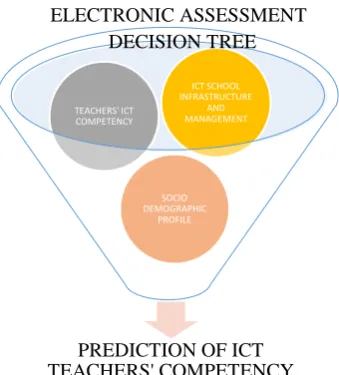
The framework shows the three variables that include the Socio-demographic profile, ICT School Infrastructure, Teachers’ ICT Competency that leads to the development of the system. The ICT Competency of teachers used as the basis for the creation of the model using a different algorithm in machine learning. This model used for the prediction of teachers’ ICT competency. Decision tree uses to solve classification problems and create a prediction of target class using decision rule, which taken from the prior data (Brid, Introduction to Decision Trees, 2018). The framework was conceptualized on the basis from the different literature cited.
E-Assessment Application using A
Decision-Tree in Predicting Teachers’
Information and Communication Technology
(ICT) Competency Level
Technology (Ict) Competency Level
Figure 1. Conceptual Framework Statement of the Problem
The main objective of the research is to develop an electronic assessment application that can predict Teachers’ ICT Competency Level.
Specifically, it sought to answer the following questions. 1. What are the significant correlates of ICT competencies
of Teachers?
2. What are the predictors of Teachers’ ICT competencies?
3. What decision tree algorithm is most appropriate in predicting teachers’ ICT competency level?
4. What proposed e-Assessment application can be developed using Decision Tree?
5. What is the extent of compliance of the developed application to ISO 25010 software quality standards in terms of:
5.1. Functional Sustainability 5.2. Performance Efficiency 5.3. Compatibility
5.4. Usability 5.5. Reliability 5.6. Security 5.7. Maintainability 5.8. Portability
6. What are the strengths and limitations of the developed system?
II. METHODOLOGY
Research Design
This study utilized a quantitative research that employs a descriptive method of research design wherein the researcher conducted a survey on the different participants from junior and senior high school in the Province of Biliran. The results of the study used as an inputs on the design of the model, which were used on the developmental type of research pertaining to the application of ICT Competency for teachers in the province.
Figure 2. Agile System Development Life Cycle (SDLC) Participants of the Study
The participants of the study are the public school teacher of the Junior and Senior High School in the province of Biliran. The province has 22 public Junior High School and 22 public Senior High School. The Senior High School cater to STEM, ABM, TVL, HUMSS, GAS strands of the K-12 curriculum. The public Junior High School has 633 public teachers while the Senior High School has 108 school teacher. In total, there were 741 public school teachers in the province of Biliran. Among the 741 public school teacher, only 254 was part of the study. The sample size is calculated from an online calculator with 5% marginal error, 95% level of confidence and the response distribution is 50%.
In order to verify the results of the data collected from the self-assessment of teachers’ ICT competency, triangulation method was utilized. In the triangulation method, there were eleven (11) Department Heads that validates the self-assessment of the teachers in the Junior and Senior High School. Part of the study is the involvement of the students to evaluate the teachers’ capability in ICT and there are three students in every teacher that is randomly selected to rate or evaluate the teacher, with a total of 762 students a participant on the different high schools.
After the development of the Electronic assessment ICT Teacher’s competency system application, the researcher implemented the study and was evaluate by 15 IT experts. Instrumentation
The researcher used questionnaires that served as basis in the development of the system on Predicting ICT Competency of Teachers. The ICT Competency is based from the National ICT Standards for Teacher (NICS) of the Commission on Information and Communications Technology. Upon the conduct of the study, the researcher created a set of questionnaires for teachers, School Heads and Department Heads to validate the teachers’ self-assessment, and students for verification purposes.
Data Gathering Procedure
The first procedure used by the proponent in developing the study was to make a communication for the different high school in the province involved in the research such as the District Supervisor and the School Heads. Afterwards, distributing questionnaires to selected participants was conducted. A total of 254 survey questionnaire was PREDICTION OF ICT
TEACHERS' COMPETENCY SOCIO
DEMOGRAPHIC PROFILE TEACHERS' ICT COMPETENCY
ICT SCHOOL INFRASTRUCTURE
collected from the first day until the fourth day around the Province of Biliran. The results of the survey questionnaire served as data sets in the development of predicting ICT competency of high school public teacher model using decision tree. The next step was to develop the system application through using the agile methods as part of the software development life cycle.
To evaluate the system using ISO 20510 Software Quality Standards the researcher asked 15 IT expert, Teacher ICT Coordinator of the school and Department Head to evaluate the system. The participants were given a set of survey questionnaires. The gathered data was analyzed using statistical tool.
Data Analysis
1. Statistical Data Analysis
The data collected from the participants was computed by the researcher for the result and conclusion of the study. The mean of every standard was calculated through the weighted mean and was inferred in accordance to its equivalent statistical definition. Another statistical tool used was the Pearson R Correlation to answer one of the objectives of the study. It is analyzed what variables is interrelated with the ICT competency level of teachers.
2. Decision Tree
WEKA (Waikato Environment for Knowledge Analysis). A collection of machine learning algorithms for data mining tasks. It contains tools for data preparation, classification, regression, clustering, association rules mining, and visualization. A data mining/machine learning tool developed by the Department of Computer Science, University of Waikato, New Zealand. The collected data from the participants was analyzed using decision tree algorithms such as CART, C4.5/J48 and BFTree to check and identify the level of accuracy of the system as to its performance with regards to the response time on the processing of data and on the creation of the model. The algorithm with high performance and high accuracy was used as a model in the development of application on ICT Competency of Teachers
2.1. Cross Validation
Cross-validation. A model evaluation method where the entire data was not utilized when training a learner. The dataset is divided into two sets, the dataset for training and test dataset for testing the performance of the learned model. In this paper, the researcher utilized the k-fold cross validation using 10-fold validation. K-fold cross-validation is one way to improve the holdout method. The data set is divided into k subsets, and the holdout method is repeated k times. Each time, one of the k subsets is used as the test set, and the other k-1 subsets are put together to form a training set. Then the average error across all k trials is computed. The advantage of this method is that it matters less how the data gets divided. Every data point gets to be on a test set exactly once and gets to be in a training set k-1 times. The variance of the resulting estimate is reduced ask is increased (Schneider, 1997).
III. RESULTS AND DISCUSSION
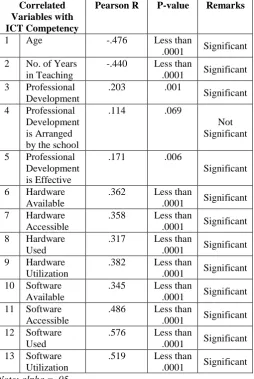
[image:3.595.308.563.257.637.2]level of ICT competency of teachers. Moreover, all the variables have significant relationship to the ICT competency except on professional development of teachers with a p-value of 0.069. This means that age, number of years, professional development whether its effectiveness or undertaken, availability, accessibility and usability of hardware and software have significant relationship with ICT competency of teachers. This means that the ICT competency level of teachers in the Junior and Senior High school is inversely affected with age and number of years of teaching. This means that the younger the age of teachers, the higher the possibility of utilizing ICT in the classroom discussion due to younger population being digital natives. This is also true for the teachers’ number of years of teaching.
Table 1. Relationship of ICT competencies of Teachers Correlated
Variables with ICT Competency
Pearson R P-value Remarks
1 Age -.476 Less than
.0001 Significant 2 No. of Years
in Teaching
-.440 Less than
.0001 Significant 3 Professional
Development
.203 .001
Significant 4 Professional
Development is Arranged by the school
.114 .069
Not Significant 5 Professional
Development is Effective
.171 .006
Significant 6 Hardware
Available
.362 Less than
.0001 Significant 7 Hardware
Accessible
.358 Less than
.0001 Significant 8 Hardware
Used
.317 Less than
.0001 Significant 9 Hardware
Utilization
.382 Less than
.0001 Significant 10 Software
Available
.345 Less than
.0001 Significant 11 Software
Accessible
.486 Less than
.0001 Significant 12 Software
Used
.576 Less than
.0001 Significant 13 Software
Utilization
.519 Less than
.0001 Significant Note: alpha = .05
Technology (Ict) Competency Level which correspond as the best predictor. It breaks down a
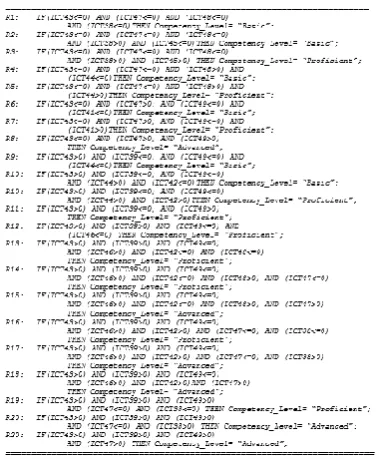
[image:4.595.338.528.48.278.2]dataset into smaller and smaller subsets while at the same time an associated decision tree is incrementally developed [1]. Algorithm generates the rules for the prediction of the target variable. With the help of tree classification algorithm the critical distribution of the data is easily understandable [2].
[image:4.595.62.275.137.310.2]Figure 3. Decision Rule Extracted from the J48 Decision Tree of Technology Operation and Concepts category.
Figure 4. Decision Rule Extracted from the BFTree Decision Tree of Social and Ethical category
[image:4.595.54.283.348.613.2]Figure 5. Decision Rule Extracted from the J48 Decision Tree of Pedagogical category.
Figure 6. Decision Rule Extracted from the J48 Decision Tree of Professional category.
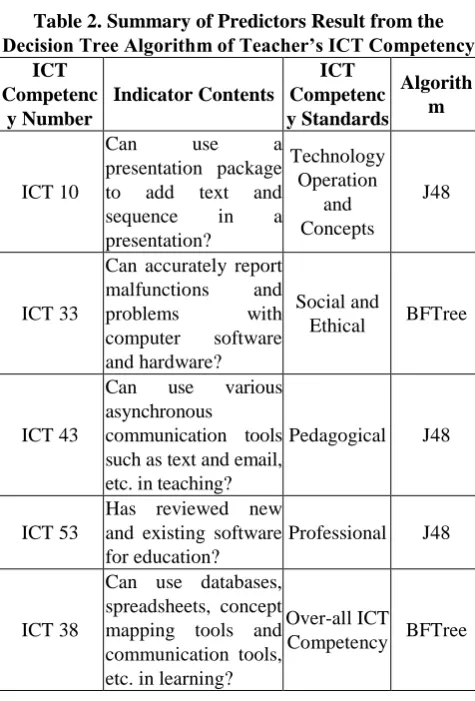
[image:4.595.343.509.476.709.2]Table 2. Summary of Predictors Result from the Decision Tree Algorithm of Teacher’s ICT Competency
ICT Competenc
y Number
Indicator Contents
ICT Competenc y Standards
Algorith m
ICT 10
Can use a
presentation package to add text and sequence in a presentation?
Technology Operation
and Concepts
J48
ICT 33
Can accurately report malfunctions and problems with computer software and hardware?
Social and
Ethical BFTree
ICT 43
Can use various asynchronous
communication tools such as text and email, etc. in teaching?
Pedagogical J48
ICT 53
Has reviewed new and existing software for education?
Professional J48
ICT 38
Can use databases, spreadsheets, concept mapping tools and communication tools, etc. in learning?
Over-all ICT
Competency BFTree
The table presents the summary of the analysis made from the different decision trees in pointing out the predictors’ value of ICT competency of teachers. Based from the decision, ICT and with the highest information gain and became the basis for its first split in every predictor in predicting the teachers' ICT Competency Level – Technology Operation and Concepts, Social and Ethical, Pedagogical, and Professional. On the other hand, the over-all ICT competency situates ICT 38 as predictor in the teacher’s capability of using it in the classroom.
Furthermore, the algorithm squared out potential predictor factors, an outcome was seen through checking the lesser, and greater influence of variables basing from the decision criteria. Thus, 5 ICT indicators serves as a predictor outcome in the study, basically, these predictors contain presentation package, reporting malfunctions and problems, usage of various asynchronous communication tools, reviewed new and existing software for education, and use databases, spreadsheets, concept mapping tools and communication tools, etc. in learning.
3. Decision Tree Algorithms as a model on the development of e-Assessment Application.
Table 3. Summary of Accuracy Level
Based on the result of the different decision tree algorithm using J48, CART and BFTree, results show that in the Technology Operations and Concepts the algorithm with highest accuracy level is J48, Social and Ethical is BFTree, Pedagogical is J48 algorithm, Professional is J48 algorithm and Overall competency resulted to an algorithm model of BFTree bearing the highest accuracy level among the three. 4. Screen Designs of the Developed e-Assessment
[image:5.595.306.546.157.315.2]Application
Figure 8. Home Page
[image:5.595.312.543.354.496.2]This page shows the home page of the system that used by the different users.
Figure 9. Login Page
[image:5.595.308.545.597.840.2]This figure above illustrates the login page with different account type or user level in the system, which include Teacher, Department Head, School Head, District Supervisor, Division Office and Administrator. The user had to select on the drop down button on the page that corresponds to each level of the account and login the system using the registered email address and password.
Technology (Ict) Competency Level Figure reflects the page where the teacher had a
[image:6.595.54.284.132.272.2]self-evaluation as to each capacity and knowledge regarding ICT competency. The teacher were choose Yes or No on the assessment form. After answering the form, the teacher submit the form subject for validation by the School Head or Department Head.
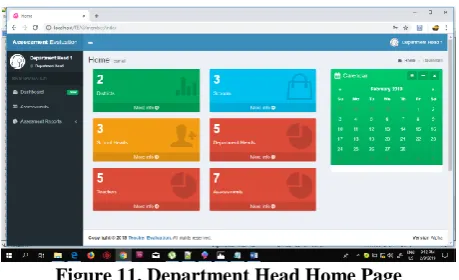
Figure 11. Department Head Home Page
[image:6.595.57.283.387.525.2]Another figure above illustrates the home page of the Department Heads Home Page account with the displayed the list of the teachers assessment, subject for validation by the department head. The figure shows also the assessment reports of the teachers under the school in term of ICT Competency Level in Technology Operations and Concepts, Social and Ethical, Pedagogical, Professional and Overall Competency
Figure 12. Summary of Assessment for the Overall ICT Competency of Teachers
In the over-all results, this page shows the result of teachers who successfully validated by the school head or department in the school as to its competency and gender. On the list of the Overall Competency of Teachers, on the Assessment Summary the user can preview the result by simply clicking the Preview button on the page.
[image:6.595.49.289.651.786.2]5. Extent of Compliance using ISO 25010 Software Quality Characteristics
Table 4. Summary of the Overall System Evaluation
Indicator Mean Interpretation
Functional Suitability 4.58 Very High Extent Performance efficiency 4.67 Very High Extent Compatibility 4.59 Very High Extent Usability 4.65 Very High Extent Reliability 4.63 Very High Extent Security 4.66 Very High Extent Maintainability 4.56 Very High Extent Portability 4.67 Very High Extent Overall Rating Result 4.63 Very High Extent
The table shows the summary of evaluation ratings. Performance efficiency and Portability has the highest weighted mean of 4.67, which described as very high extent. The participants agree also on the Maintainability as the least value with the weighted mean of 4.56, which described as Very High Extent among the ISO 25010 indicators. However, the evaluation result show on the Functional Suitability with weighted mean of 4.58, Compatibility weighted mean of 4.59, Usability weighted mean of 4.65, Reliability weighted mean of 4.63, and Security weighted mean of 4.66, Furthermore, the average weighted mean is 4.63 with the descriptive value of High Extent.
6. Strengths and limitations of the developed system The e-Assessment Application is very efficient and useful on the prediction of ICT competency of teachers. The system helped also the school head or department head to monitor properly the ICT knowledge of the teachers based on the result of the evaluation. Through this, the heads can make decisions on how to develop the teachers’ ICT skills by sending training based on the result on the competency level.
Based from the over-all evaluation of the system, performance efficiency and portability gains the highest weighted mean and serves as the strength of the e-Assessment of Teacher’s ICT Competency system application. This means that the quantity of accomplished worked by the system application works effectively. Among the variables indicated in this evaluation, resource utilization is the strongest variable that means the degree to which the amounts and types of resources used by the system performs its functions and meet requirements. If there is strength, the system evaluation also reflects the weakness of the system. Basing from the result of the evaluation, the system application weakest point is the maintainability part. Meaning the probability of performing a successful repair action within a given time is the weakest point. Modularity and analyzability is the lowest variable indicator in the evaluation. This gives the user recognition that the system may have difficulty in performing automatic execution of the task at hand and may resulted to an error in analyzing data.
With this strength and limitation, the researcher has made adjustments and reconsideration in the system application so that performance of the system would not impede all other functions.
IV. CONCLUSIONS
After a thorough analysis of the findings of this study, the following conclusion is drawn:
help on identifying different intervention to improve the ICT skills of the teachers that can be used in the teaching instruction and apply the trends in Information Technology. Through this application, it can help to address how the schools make solutions in improving the quality of instructions using Information and Communication Technology (ICT).
V. RECOMMENDATIONS
Based from the conclusion reached, the following is recommended by the researcher:
1. The system should be presented to the schools’ division superintendent for the utilization of the system.
2. The e-Assessment Application should be utilized by the different schools in the province of Biliran in predicting teachers’ ICT Competency level.
3. A stable internet connection should be available to the school to access the system.
4. Further study should be conducted by the future researchers to enhance the developed system.
5. Further studies to include other predictors’ variables such as age, years of teaching, hardware and software ICT Tools.
REFERENCES
1. S. Sayad, "Decision Tree," 27 February 2019. [Online].
Available:
https://www.saedsayad.com/decision_tree.htm.
2. A. Nadali, E. Kakhky and H. Nosratabadi, "Evaluating
the success level of data mining projects based on CRISP-DM methodology by a Fuzzy expert system," 2011 3rd International Conference on Electronics Computer Technology (ICECT), pp. vol.6, no., pp.161,165, 2011.
3. R. S. Brid, "Introduction to Decision Trees," 25 October
2018. [Online]. Available:
https://medium.com/greyatom/decision-trees-a-simple-way-to-visualize-a-decision-dc506a403aeb.
4. J. Schneider, "Cross-Validation," 7 Feb 1997. [Online].
Available: