EFFECTIVENESS OF STRUCTURED TEACHING PROGRAMME ON
KNOWLEDGE REGARDING RISK FACTORS AND PREVENTION
OF SUICIDAL BEHAVIOUR AMONG ADOLESCENTS IN A
SELECTED COLLEGE, SALEM.
By
Reg.No: 301231401
A DISSERTATION SUBMITTED TO
THE TAMILNADU DR. M.G.R. MEDICAL UNIVERSITY, CHENNAI, IN PARTIAL FULFILLMENT OF THE REQUIREMENT FOR THE
DEGREE OF MASTER OF SCIENCE IN NURSING
PSYCHIATRIC (MENTAL HEALTH) NURSING
CERTIFICATE
Certified that this is the bonafide work of Mr. N.Loganathan, Final Year M.Sc.(Nursing) Student of Sri Gokulam College of Nursing, Salem. Submitted in partial fulfillment of the requirement for the Degree of Master of Science in Nursing to the Tamilnadu Dr.M.G.R. Medical University, Chennai under the Registration No.301231401.
College Seal:
Signature: ………. Prof. Dr. K. TAMIZHARASI, Ph.D (N)., PRINCIPAL,
SRI GOKULAM COLLEGE OF NURSING, 3/836, PERIYAKALAM,
EFFECTIVENESS OF STRUCTURED TEACHING PROGRAMME ON
KNOWLEDGE REGARDING RISK FACTORS AND PREVENTION
OF SUICIDAL BEHAVIOUR AMONG ADOLESCENTS IN A
SELECTED COLLEGE, SALEM.
Approved by the Dissertation Committee on: 26.11.2013
Signature of the Clinical Speciality Guide: ………. Prof. S.VANITHA, M.Sc (N)., Professor and Head of the Department, Mental Health Nursing,
Sri Gokulam College of Nursing, Salem - 636 010.
Signature of the Medical Expert: ……… Dr. C. BABU, M.D.,
Consultant Psychiatrist,
Child and Adolescent and Deaddiction specialist, Sri Gokulam Hospital,
Salem - 636 004.
ACKNOWLEDGEMENT
“Appreciation is the highest form of prayer, for it acknowledges
the presence of good wherever you shine the light of your thankful thoughts” - Alan Cohen.
I wish to express my humble and sincere gratitude to God Almighty, Who showered his blessing, strength, wisdom and support on the dazzling path to complete this research work in an efficient manner.
I am sincerely thankful to Dr.K.Arthanari, M.D, Managing Trustee of Sri Gokulam College of Nursing for his encouragement, support and for the opportunity given to complete my project confidently and competently.
It is my privilege to express a deepest sense of gratitude to our respected Principal Prof.Dr.K.Tamizharasi, Ph.D(N)., Sri Gokulam College of Nursing for her enduring catalytic encouragement, guidance and support without that this work would have been an unrealised distant dream.
I would like to offer my special thanks to Mrs. J. Kamini Charles, M.Sc(N)., Vice Principal and Research Coordinator, Sri Gokulam College of Nursing, Salem for her invaluable suggestions, inspirational guidance and kind support for my research.
I would like to thank Mrs. Lalitha P, M.Sc (N)., Professor and former HOD of Mental Health Nursing for her tremendous support and help.
My special thanks are extended to Dr.C.Babu, M.D., Consultant Psychiatrist, Child and Adolescent and Deaddiction specialist, Sri Gokulam Hospital, Salem, who provided me with treasured guidance and support throughout my study.
I extend my earnest thanks to Mrs. J.Devikanna., M.Sc(N), Reader, for her guidance, suggestion, support and motivation to make this study a feasible and a successful one.
My sincere thanks goes to Mrs.D.Shoba Selvi, M.Sc.(N)., Mrs.Samaya Rani M.Sc.(N)., Mr.S.Nandakumar, M.Sc.(N)., and Mrs.Anusha, M.Sc.(N)., Lecturers, Department of Mental Health Nursing, for their guidance and support in the process of completion of this research work.
A special note of thanks is expressed to All M.Sc (N)., Faculty Members Sri Gokulam College of Nursing, who rendered timely help and support to complete the study.
I extend my heartfelt gratitude to The Principal of Sri Vidya Mandhir College, Salem. For having given me permission to conduct my research in your esteemed institution.
I am thankful to Mrs.A.Mary Manjula Rose, M.A,, M.Ed, M.Phil., Dr.N.Krishnan, M.A., Ph.D., whose editing suggestions and precise sense of language were decisive towards the completion of this research study.
I am obliged to the Medical and Nursing Experts for validating the tool and content used in this study.
Vellore for their helping hands in providing all needed literature to complete this research study.
My sincere thanks goes to all the Study Samples, who took part in this study, without their cooperation and readiness to assist, the study would have not been possible.
I would like to express my heartfelt gratitude to my lovable parents Mr. P.Nagarajan, Mrs. N. Vasanthi and my caring brother Mr.N.Dhanasekaran
for their earnest prayers, endless patience, steadfast inspiration and unremitted support throughout my endeavor.
My sincere and heartfelt thanks goes to Ms.N.Ramya., Ms.A.Sahaya Vivitha., Ms. Gincy Jose and Mr.A.Sanjai Kumar, who extended their help throughout my study.
I express my profound thanks to All My Classmates (TITANS) and Friends who extended their help throughout my study and who have always been there to encourage and inspire me.
TABLE OF CONTENTS
CHAPTER CONTENT PAGE NO
I INTRODUCTION 1-13
Need for the Study 03
Statement of the Problem 07
Objectives 07
Operational Definitions 08
Assumptions 09
Hypotheses 09
Delimitations 09
Projected Outcomes 09
Conceptual Framework 10
II REVIEW OF LITERATURE 14-31
Literature related to risk factors and suicidal behaviour.
Literature related to knowledge regarding risk factors and prevention of suicidal behaviour. Literature related to structured teaching
programme on knowledge regarding risk factors and prevention of suicidal behaviour among adolescents
14 20
25
III METHODOLOGY 32-38
Research Approach 32
Research Design 32
Population 34
Description of the Setting 34
Sampling 34
Variables 35
Description of the Tool 35
Validity and Reliability 36
Pilot Study 37
Method of Data Collection 37
Plan for Data analysis 38
IV DATA ANALYSIS AND INTERPRETATION 39-51
V DISCUSSION 52-54
VI SUMMARY, CONCLUSION, IMPLICATIONS AND RECOMMENDATIONS
55-59
BIBLIOGRAPHY 60-65
LIST OF TABLES TABLE NO TITLE PAGE NO 3.1 Scoring key for knowledge regarding Risk factors and
prevention of Suicidal Behaviour.
36
4.1 Frequency and percentage distribution of adolescents according to their selected personal variables.
41
4.2 Frequency and percentage distribution of adolescents according to their family related demographic variables.
43
4.3 Frequency and Percentage distribution of Adolescents according to the pre-test score on Knowledge regarding Risk factors and Prevention of Suicidal Behaviour.
45
4.4 Frequency and Percentage distribution of Adolescents according to the post test score on Knowledge regarding Risk factors and Prevention of Suicidal Behaviour.
46
4.5 Area wise Mean, SD, Mean percentage and differences in mean percentage of pre test and post test knowledge score regarding Risk factors and prevention of Suicidal Behaviour among Adolescents.
48
4.6 Mean, Standard deviation, paired‘t’ test value of knowledge among Adolescents before and after Structure Teaching Programme.
49
4.7 Chi-square test on pre-test knowledge regarding Risk factors and prevention of Suicidal Behaviour among Adolescents with their demographic variables.
[image:8.595.109.523.88.777.2]LIST OF FIGURES
FIGURE
NO.
TITLE PAGE
NO.
1.1 Conceptual Framework Based on Modified Imogene King’s
Goal Attainment Theory (1981) 12
3.1 Schematic Representation of Research Methodology 33
4.1 Percentage distribution of samples according to their pre test and post test knowledge score
LIST OF ANNEXURES
ANNEXURE
NO
TITLE
PAGE
NO
A. Letter seeking permission to conduct the research study. i B. Letter granting permission to conduct research study. ii C. Letter requesting opinion and suggestions of experts for
content validity of the Teaching material and research tools.
iv
D. Tool for Data Collection. v
E. Certificate of Validation. lxii
F. List of Experts for Content Validity. lxiii
G. Certificate of Editing. lxxi
ABSTRACT
This study was carried out to assess the Effectiveness of Structured Teaching Programme on Knowledge regarding Risk factors and Prevention of Suicidal Behaviour among Adolescents in a selected College, Salem. A quantitative evaluative approach with a pre-experimental (one group pre test- post test) design was adopted, the setting of the study was Sri Vidya Mandir College, Salem. The sample size was 60, who were selected by systematic random sampling technique. A Structured Self-administered questionnaire was used to assess the knowledge of the adolescents. The investigator involved the adolescents on Structured Teaching Programme regarding Risk factors and prevention of Suicidal Behaviour by using a Power-point slide presentation followed with pre-test. On 7th day, the post test was conducted. The collected data were analyzed by using both descriptive and inferential statistical methods, and interpretations were made based on the objectives of the study.
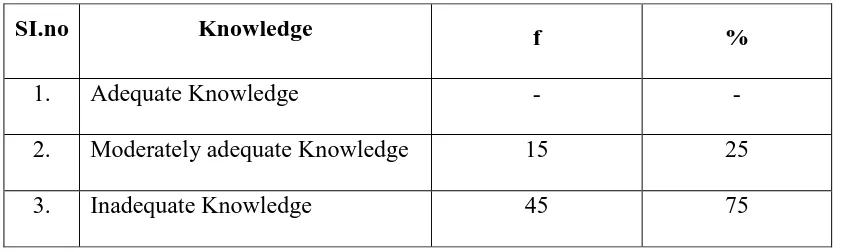
The study findings revealed that during Pre-test, the knowledge regarding risk factors and prevention of suicidal behaviour among adolescents 45(75%) had inadequate knowledge, 15(25%) had moderately adequate knowledge and none of them had adequate knowledge. During post test, 23 adolescents (38.33%) had adequate knowledge, 37(61.67%) had moderately adequate knowledge and none of them had inadequate knowledge. The mean score during pre-test was 9.9±3.88 and the mean score during post test was 17.03±4.12. The paired ‘t’ value was 16.84 which was significant at p≤0.05 level. Thus it shows that the structured teaching programme was effective in improving knowledge regarding risk factors and prevention of suicidal behaviour among adolescents. Therefore the hypothesis H1 was retained.
There was no significant association found between the pre-test scores on knowledge regarding risk factors and prevention of suicidal behaviour and the selected demographic variables at p≤0.05 level. Hence the stated hypothesis H2 was rejected.
1 CHAPTER -I
INTRODUCTION
“Striving to live is fundamental for
Every human living creatures”
The term ‘Adolescents’, refers to the ‘process of growing up’ or to the ‘period of life from puberty to maturity’. Adolescent is an in-between period beginning with the achievement of physiological maturity and ending with the assumption of social maturity that is with the assumption of social, sexual, economic and legal rights and duties of the adult. (Buhler’s, 1954)
There are major developmental changes and challenges associated with the period of adolescents. As youth acquire and consolidate the competencies, attitudes, and values, so the social capital is necessary to make a successful transition into adulthood. Late adolescents and the period following, often referred to as emerging adulthood, have been noted as particularly important for setting the stage for continuous development through the life span as individuals begin to make choices
and engage in a variety of activities that are influential on the rest of their lives. (Nicole Zarrett, 2009)
2
Suicide is "to kill oneself" or the act of intentionally causing one's own death. Suicide is a fatal outcome of long-term process shaped by a number of interacting cultural, social, situational, psychological and biological factors. All these factors play a crucial role in moulding individual's thinking. (Wikipedia, 2009)
Suicide is not only a personal tragedy; it represents a serious public health problem. Suicidal behaviour is a leading cause of injury and death worldwide. Suicidal behaviour can be conceptualized as a continuum ranging from suicidal ideation to suicide attempts and completed suicide. (Johnson, 2004)
Risk factors for suicide include mental and physical illness, alcohol or drug abuse, chronic illness, acute emotional distress, violence, a sudden and major change in an individual’s life, such as loss of employment, separation from a partner or other adverse events or in many cases, a combination of these factors. A number of psychological states increase the risk of suicide including hopelessness, loss of pleasure in life, depression and anxiousness, failure in love or educational problems, separation, physical or sexual abuse, emotional neglect, exposure to domestic violence while mental health problems play a role which varies across different contexts, and other factors, such as cultural and socio-economic status are also particularly influential. The impact of suicide on the survivors, such as spouses, parents, children, family, friends, co-workers and peers who are left behind, is immense and a poor ability to solve problems also plays a major role. (Fontana, 2002)
3
Adolescent with adequate support network of friends, family, religious affiliations, peer groups or extracurricular activities may have an outlet to deal with everyday frustrations. But many adolescents don’t believe that they have it and feel disconnected and isolated from family and friends. These teens are at increased risk of suicide. (Kanthan, 2001)
The prevention program has been designed to comply with the requirements for students and teacher education in suicide prevention which are now in effect in many countries across the globe. In all states, the program can also be used as part of ongoing in-service training related to student mental health. (American Foundation for Suicide Prevention, 2009)
The prevention of suicide is a collective responsibility of the government and the people. “Every citizen has a role to play in this noble cause. Suicides are not confined to any particular family. It can happen anywhere. The State has to create awareness of suicide prevention and create facilities for treatment and rehabilitation.” (Ramasubramanian, 2013)
Learning more about factors that might lead an adolescent to suicide may help to prevent further tragedies. Even though it's not always preventable, it's always a good idea to be informed and take action to help a troubled teenager. (Joint commission resource, 2001)
Need for the Study:
4
years. The mean suicidal rate for this age group is 7.4/100,000, Suicide rates is higher in males (10.5) than in females (4.1).
Worldwide the suicidal rate is estimated to represent 1.8% of the total global burden of disease in 1998 and the rate may get increase up to 2.4% in 2020.
According to UNICEF (2011), around 243 million people live in India, out of whom 40% of suicides were found among adolescents.
In India more than one lakh persons (1,35,445) lost their lives by committing suicide during the year 2012.
India alone contributes to more than 10% of suicides in the world. The suicide rate in India has been increasing steadily and has reached 11.2 per 100,000 in 2012, registering a 78% increase over the value of 1980 (6.3). A majority of suicide occurs among men and in younger age groups.
According to WHO (2012), out of every 1,00,000 people, 98 of them commit suicide annually. Worldwide the suicide rate has increased by 60% over the past 50 years in developing countries.
A report by World Health Organization states that 22.1/1,00,000 population committed suicide in Tamilnadu during 2011.
Tamilnadu has recorded the highest number of suicides due to family problems i.e. in 4824 members, 3663 people become victims to mental illness and 512 people committed suicide on account of passion related reasons whereas 238 people ended their lives occurring to failure in their examinations. (Vijayakumar.S, The Hindu News, 2013)
5
187,000. A large proportion of adult suicide deaths were found to occur in the age group of 15 - 29.
The four southern states - Tamil Nadu, Andhra Pradesh, Karnataka and Kerala contribute 42% suicide deaths in the case of men and 40% in the case of women. Maharashtra and West Bengal together accounted for an additional 15% of suicide deaths. Delhi recorded the lowest suicide rate in the country. In absolute numbers, most of the suicide deaths in the case of individuals, aged 15 years or the aged, were in Andhra Pradesh (28,000), Tamil Nadu (24,000) and Maharashtra (19,000). (British Journal the Lancet, 2010)
Tamil Nadu has reported the highest number of suicide victims (accounting for 12.3%) in 2010, third highest in 2011 (accounting for 11.8%) and highest in 2012 (accounting for 14.0%)
Among the cities, Bangalore (17%), Mumbai (14%), Chennai (11%) and Delhi (7%) accounted for nearly 50% of total suicides in the country (Gupta, 2002).
Palaniappan V.S., (2013) reported that in 2011 totally 2,747 suicides witnessed in West Zone of Tamilnadu (Namakkal, Salem, Dharmapuri and Krishnagiri) among 1,536 men, 1,016 women, 102 girls and 94 boys and in 2012 the Zone witnessed a marginal decline of just one case, registering 2,746 cases in Namakkal, Salem, Dharmapuri and Krishnagiri together.
6
43% of subjects reported past thoughts of suicide and 26% had suicidal thoughts during the month before the survey.
Kirmayer, L.J, Malus, M, (2007) conducted a study to examine risk factors related to suicidal behaviour among adolescents through a survey method. 4,554 adolescent students were selected. The risk assessment was done by using the self-administered questionnaire. The Survey report showed that (312 of 4,454) the adolescent students had seriously considered attempting suicide. 4.6% of them had attempted suicide at least once during the 12 months preceding the survey. Female adolescents were more likely to put their suicidal thoughts into suicidal action than were male adolescents. The researcher concluded that the adolescent suicide behaviour should be viewed as a serious problem. Measures can be taken to prevent suicide by looking at the factors significantly linked to suicidal behaviour among the adolescents. Steps can then be taken to identify adolescents who have serious suicidal ideation so that intervention can be taken to reduce the suicidal rate.
7
Prevention programme is important for nurses to look at the mental health of their patients, “Nurses who work with teens are in a prime position to make a connection with them. The simple act of caring provides a safe environment for the teens to open up and express their personal problems.” Strunk developed the Hospital’s surviving the Teens suicide prevention program by Butler Foundation in 2001. Since then, she has educated approximately 6,000 middle and high school students in Ohio and Kentucky annually, as well as parents and school staff members on suicide, finding positive ways of coping with stressors, recognizing depression and suicidal behaviours, responding appropriately, using adaptive coping measures, and communicating well at home. Students also did a role play with Strunk relating to how to help someone depressed or troubled. The programme included listening and looking for signs of depression or suicide, asking questions, supporting the person, and telling an adult who can help or referring them to a mental health professional. (Strunk, 2001)
So, the researcher felt that this study needs to be conducted to evaluate the effectiveness of structured teaching programme on risk factors and prevention of suicidal behavior among adolescents at college level.
Statement of the Problem:
“A Study to Evaluate the Effectiveness of Structured Teaching Programme on Knowledge regarding Risk factors and Prevention of Suicidal Behaviour among Adolescents studying in a Selected College, Salem”
Objectives:
8
2. To evaluate the effectiveness of structured teaching programme on knowledge regarding risk factors and prevention of suicidal behaviour among Adolescents.
3. To associate the pre-test knowledge regarding risk factors and prevention of suicidal behaviour among adolescents with their selected demographic variables.
Operational Definitions: Effectiveness:
It refers to increase in post-test score after administering structured teaching programme on risk factors and prevention of suicidal behaviour which will be assessed by using structured self administered questionnaire.
Structured teaching programme:
It refers to the systematically planned and organized LCD power-point teaching activity with specific objectives to improve knowledge on risk factors and prevention of suicidal behaviour.
Knowledge:
It is the verbal responses given by the adolescents regarding risk factors and prevention of suicidal behavior, which can be assessed through structured self- administered questionnaire.
Risk factors:
It refers to the reasons or factors that increase the suicidal attempt. Prevention:
9 Suicidal behaviour:
It refers to any act that are exhibited by the client “to kill oneself”. Adolescents:
College going students in the age group between 18-21 years. Assumptions:
1. Adolescents may have an inadequate knowledge on risk factors and prevention of suicidal behaviour.
2. Structured teaching programme may enhance the knowledge on prevention of suicidal behaviour among adolescents.
Hypotheses:
H1 : There will be a significant difference between the pre-test and post test score on knowledge regarding risk factors and prevention of suicidal behaviour among adolescents at P ≤ 0.05 level.
H2 : There will be a significant association between the knowledge regarding risk factors and prevention of suicidal behaviour among adolescents with their selected demographic variables at P ≤ 0.05 level.
Delimitation:
The study was delimited to: 1. The sample size 60.
2. The data collection period of 4 weeks. Projected outcome:
10 Conceptual Framework:
In this study Modified Imogene King’s Goal Attainment Theory, (1981) was adopted as a conceptual framework. This was aimed at assessing the effectiveness of structured teaching programme on knowledge regarding risk factors and prevention of suicidal behavior. Imogene king explains the concept of nurse and the patient as ‘they are expected to get involved mutually in communicating information, establishing goals and taking action to attain goals’. The goal achievement indicates when there is improvement seen followed with any defined intervention.
Components 1. Perception:
Perception is a state of being or process of becoming aware of something. Here the researcher bewares of inadequate knowledge existing among adolescents and the adolescents apprehend the need for attending the structured teaching programme regarding risk factors and prevention of suicidal behaviour.
2. Judgment:
Judgment is decisions which are made. Here the researcher decides to provide structured teaching programme regarding risk factors and prevention of suicidal behaviour to improve the knowledge, and the adolescents decides to participate in the research study.
3. Action:
11
suicidal behaviour to improve knowledge and the adolescents’ action is getting ready to undergo the structured teaching programme.
4. Reaction:
Reaction means setting up of mutual goal. In this study the researcher and the adolescents together involved in setting mutual goal to improve knowledge regarding risk factors and prevention of suicidal behaviour.
5. Interaction:
This refers to the mutual understanding between two or more individuals who are involved in goal-directed perception. Here the researcher involve in assessing the adolescents demographic variables, collecting data on knowledge regarding risk factors and prevention of suicidal behaviour by using structured self administered questionnaire in pre test and providing structured teaching programme regarding risk factors and prevention of suicidal behaviour by interfacing the adolescents.
6. Transaction:
Transaction means achievement of the goal. The goal is attained in terms of improvement in knowledge regarding risk factors and prevention of suicidal behaviour which was assessed through structured self administered questionnaire during post test.
7. Communication:
The verbal and non-verbal communication pattern used to collect data and to transfer the knowledge between researcher and the adolescents.
8. Time and space:
12
+
[image:23.792.26.753.74.486.2]
Fig-1.1: Conceptual Framework Based on Modified Imogene King’s Goal Attainment Theory (1981) On Effectiveness of Structured Teaching Programme regarding Risk factors and prevention of Suicidal Behaviour among Adolescents.
Structured teaching programme Definition, Causes, Risk factors, Warning signs, Facts and
fables, Prevention of
suicide and Suicidal awareness. Interaction Study Subject Pretest knowledge regarding Risk factors and prevention of Suicidal Behaviour among Adolescents of 18-21years by using Structured Self-administered questionnaire Researcher Communication Reaction
Action: Readiness to receive structured teaching.
programme.
Judgement: Adolescents decide to participate in structured teaching. programme.
Perception: Perceived need for structured teaching programme.
Perception: Bewares of inadequate knowledge existing among adolescents
Judgement: Decision made to provide Structured Teaching programme regarding prevention of suicidal behaviour. Transaction Post test knowledge regarding risk factors and prevention of suicidal behaviour by using Structured Self-administered questionnaire Goal Improvement in knowledge. (from Inadequate to Moderately adequate and Adequate) Involved in Mutual goal setting to improve knowledge. Action: Preparing study
subjects for Structured Teaching Programme.
Time and Space: Teaching provided for
around 45 minutes in a selected Arts and
13 Summary:
14 CHAPTER -II
REVIEW OF LITERATURE
Review of literature is an essential step in the development of a research work. It helps the researcher to design the proposed study in a scientific manner so as to achieve the desired result. It helps to determine the gaps, consistencies and inconsistencies in the available literature about particular subject under the study.
Review of literature for the present study is classified under the following headings,
1. Literature related to risk factors and suicidal behaviour among adolescents.
2. Literature related to knowledge regarding risk factors and prevention of suicidal behaviour among adolescents.
3. Literature related to effectiveness of structured teaching programme on knowledge regarding risk factors and prevention of suicidal behaviour among adolescents.
1. Literature related to risk factors and suicidal behaviour.
Prasad.J, et.al., (2010) conducted a study on rates and factors associated with
15
Aravind Pilai S, (2009) conducted a study to assess the prevalence and risk factors for suicidal behaviour among youth people in Goa, India. The objective of the study was to assess the risk factors and prevalence rate of suicide among the adolescents. The study samples were 3662 youths selected by using a convenient sampling technique from rural and urban communities in Goa. Suicidal behaviour during the recent 3 months and associated factors were assessed by using a structured interview those who had premarital sex, independent decision-making, physical abuse and alcohol use were identified as the major risk factors for suicidal behaviour. The result showed that 42.33% was due to depression, 12.19% drug use, 9.77% smoking, 7.11% drinking alcohol and 9.69% feeling hopelessness. The researcher concluded that violence and psychological distress were the dependent risk factors for suicidal attempts. Prevention programs for youth suicide in India had to address both the structural determinants of gender disadvantage and the individual experience of violence and poor mental health.
Tajma.M, (2009) conducted a study to assess the prevalence of suicide and related risk factors in Toyokawa, Japan. The objective of the study was to assess the prevalence rate and risk factors of suicide among adolescents. The data were obtained from 2436 adolescents by using interview technique. The result showed that 10.9% of adolescents were having suicidal ideation, 2.1% having a risk of attempted suicide and the prevalence rate was 2.8%. The researcher concluded that the suicidal risk and attempts were high while suicide ideation occurred at an earlier age and within the first year of suicidal ideation.
16
investigate the prevalence rate among late adolescents. The data were obtained through the web based survey by a Korean centre for disease control, and it was analyzed by using logistic regression method. The result showed that the prevalence rate of suicide attempt was 5.2% in South Korea. The risk factors of suicide attempt were due to suicidal ideation with 31.83%, depression 7.89%, drug use 4.67%, smoking 3.19%, feeling unhappiness 12.77%, drinking alcohol 2.39% and living with neither parent 22.4%. The researcher concluded that suicide prevention programs should be applied to the risk population prior to the suicide attempt.
Thompson A, (2009) conducted a study to assess the protective effects of self
17
Adolescents with high family support reported significantly higher levels of self-esteem than those with low family support, t (837.2) = -7.49, p < .001. 37% of adolescents were identified with suicide risk. Suicide risk was significantly and positively associated with age (r = 0.08, p < .05). Finally the researcher concluded that the self esteem influences in late adolescents suicide risk behaviours for youth with low as well as high family support interventions designed to strengthen both self esteem and support resources are appropriate.
18
Hirsch J.K and Conner K.R, (2007) conducted a study on optimism and suicide ideation among young adult college students in New York City, USA. The objective of the study was to find the relationship between optimism and suicidal ideation. The result showed that the college students may be at an increased risk for suicide and out of 284 college students, most of them are female students numbering 185 (65%) aged 18 and over. The outcome measure was the beck scale for suicidal ideation even after controlling the factors of age, gender, depressive symptoms and hopelessness and a better understanding of its protective role in risk group and cross culturally is needed. The researcher concluded that prevention progress designed to enhance optimum in the college setting might decrease suicide risk.
Akaya, (2007) conducted a study on suicidal risk among the Vinnese College going adolescent students in Australia. The objective of the study was to find the suicidal risk among the college students. Among the college students 214 samples were selected (n=214 mean age 18.4 years). The result showed that the self reported survey of assessing demographic charactering of suicide was completed by 3 students. 81(37.9%) college students reported having suicidal risk in their lives. Girls had the risk significantly more often than boys (girls 48.5%, boys 29.1% at p=0.001), the researcher concluded that female gender, substance problem, college type and cigarette smoking were the influential factors in risk of suicide among the adolescents.
19
of 20.9 years (SD=2.4). The researcher found 3 types of suicidal process from the samples. In the case of Group I the suicidal process was long-standing and included deliberate self harm prior to their death and direct communication to friends and family about suicidal ideas and plans. Group II involved sub groups namely those individuals with a protracted suicidal process that lasted approximately 5-10 years and those with a brief suicidal process lasting approximately 1 year. In the case of Group III there was emergence of the suicidal process as an acute response to functioning well. The researcher concluded that a greater understanding of the pathway which leads young people to take their lives is important to ensure that prevention strategies and health service delivery are as effective as possible.
Siddhartha T, (2006) conducted a study to assess the suicidal behaviour among the college students in Orissa. The objective of the study was to find out the suicidal ideation and attempted suicidal rate among the late adolescents. The 1232 samples were selected between the age group of 19-23 for the study. The self structured questionnaires were used to find out deliberate self harm behaviour. The study result showed that 31.4% of them had the life time prevalence of suicidal ideation, whereas 12.8% had attempted suicide in their life time. The result proved that there was higher prevalence of suicidal ideation and deliberate self harm among college students.
20
advanced practice psychiatric nurse verbally administered the RSQ to a convenience sample of 104 emergency department patients aged 12 to 82. Psychometric analysis demonstrated an adequate degree of reliability and criterion-related validity for the RSQ. Approximately 30% of all patients who participated screened positive for suicide risk. The result supports the continued use of the RSQ with adults exhibiting psychiatric chief complaints to determine imminent risk of suicide in patients who seek treatment in the emergency department. Nurses in all healthcare settings need to initiate suicide screening and implement nursing interventions directed toward suicide prevention.
2. Literature related to knowledge regarding risk factors and prevention of suicidal behaviour.
21
substances (87.10% m, 93.18% f), as well as depression episodes (90.32% m, 93.18% f). Loss of loving persons has a direct connection with suicidal behaviour (87.10% m, 69.32% f). There are some opportunities for those people to be helped by close friends (86.88% m, 93.18% f) and SOS services (86.88% m, 90.90% f). In a statistically more significant manner, correct answers are more frequently registered in female students who state that attempted suicide is more common in females (χ2= 4.28, p < 0.05). It can be concluded that medical students display a substantial knowledge of suicide-related themes, which could make them successful participants in educational programmes for provision of better living skills aimed at more successful response to stressful living situations.
22
Chien WT, Chan SW et.al., (2008) conducted a study to evaluate an education program on suicide prevention among general nurses in Hong Kong, China. The objective of the study was to evaluate the effect of an education programme on nurses' knowledge, attitude and competence on suicide prevention and management for patients with suicide attempt or ideation and their family members and to examine the strengths and weaknesses of the programme from the participants' perspectives. 54 registered general nurses from the medical and surgical units of two general hospitals completed the education programme. Focus groups were used for process (n = 24) and outcome evaluation (n = 18). 18-hour education programme on suicide prevention and management was undergone by the nurses. The findings suggested that the education intervention had benefited the participants by improving their attitude, confidence and professional skills in responding to patients with suicidal intent. The researcher concluded that barriers in the practice environment influenced nurse’s abilities to give optimal care to this group of patients and their family members.
23
that psycho-educational programs in adolescents may influence knowledge about suicide and attitudes towards suicidal persons but may not affect the use of coping styles or levels of hopelessness
MacDonald MG, (2007) conducted a study on education on major knowledge
about suicide to identify what training they may need about suicide prevention in Oakland University, USA. The study samples are 71 college-going adolescent students. It completed the 50 items and expanded revised facts on suicide quiz to examine their knowledge about suicide. The result showed that while overall knowledge was low for general information and for specific item concerning suicide among youth and elderly persons, knowledge was high on several items important for suicide prevention work. Higher suicide-related knowledge was found for knowing a suicide attempter, providing partial support for the hypothesis that personal experience with suicidal people may correspond with greater knowledge about suicide.
24
knowledge test and there was no significant difference between young adults and older adults on their knowledge of adolescent suicide, F(1, 237)=2.16, p> 0.05. The researcher concluded that both the young and older adults indicated a substantial degree of personnel experience with suicide and others possessed a reasonable attitude to adult suicide. It also showed that females have better knowledge than young male adults and also there is a need for inclusion of suicide education in school-based programs.
MahmethEskin, (2006) conducted a study to investigate the opinions about suicide and reactions to a suicidal peer among 89 females and 78 males in Turkish high schools. The study result showed that a more number of male persons believed that suicide should be discussed among friends. Compared to males, females perceived that suicidal persons are mentally ill and to be punished in another world. Females show greater acceptance of a suicidal classmate than males, and an attitude for openly discussing about suicide was associated with higher acceptance of suicidal classmate.
25
and in some cases there is an acceptance of suicide but there remains a substantial underlying stigmatization of suicide, and in the post test 72% had adequate knowledge and the remaining 37.98% had inadequate knowledge. Community members have some underestimation of the importance of mental illness as a cause of suicide. The content of public health messages used in suicide prevention programs should be applied in vulnerable group in the community in future by both qualitative and quantitative research approaches.
Beautrias AL, et.al., (2004) conducted a study to examine knowledge and attitude about suicide in New Zealand. The young people aged 25 were selected as a study sample. The study result showed that the young people over-estimate the prevalence of young suicide and the fraction of suicide accounted over by youth deaths and hold both conservation and liberal attitudes towards suicide. The primary source of information about suicide is media. These findings raise concerns about the potential for media coverage of youth suicide issues or normalize suicide as a common thing and there by unacceptance response among young people and suggest a need for careful dissemination of accurate information about suicide by knowledgeable, respected and reputed sources.
3. Literature related to structured teaching programme on knowledge regarding
risk factors and prevention of suicidal behaviour among adolescents.
26
consisted of predominantly Caucasian (73%) adolescents. Researchers collected pre-post evaluation surveys of the program, and feasibility interviews were conducted with the school guidance personnel who ran the program. The study results showed that prevention program produced appreciable effects 68.08% increased accurate knowledge and 72.88% of them improved in help-seeking attitudes and intentions among students. No significant changes were found in regards to self-reported formal help-seeking actions. The researcher concluded that the program may be an effective prevention program for school.
Orbach, I. and Bar Joseph, H, (2010) conducted a study on the impact of a
suicide prevention program for adolescents on suicidal tendencies, hopelessness, ego identity, and coping in Israel. The objective of the study was to examine the effectiveness of an experiential suicide prevention program. 393 adolescents from 6 schools participated in the study. The samples were randomly divided into experimental (n = 215) and control (n = 178) groups. Pretest-post test design was used, and the students completed questionnaires of suicidal tendencies, hopelessness, ego identity, and coping ability before and after the prevention program. The experimental groups took part in seven-week 2-hour meetings. The result showed that experimental groups were superior to the controls, with at least some of the dependent measures pointing out the effectiveness of the program.
27
students reported that they had been exposed to materials such as brochures, postures, video, radio and television messages on campus-related to suicide prevention. Another 245(84%) students reported awareness of at least one resource to which a friend who is at risk for suicide could be referred. However, when asked about knowledge of at least one crisis hotline number that could be given to a friend at risk for suicide, only 139(48%) students indicated an affirmative response.
Knox, K. L., Litts, D. A., Talcott, G. W., et.al., (2007) conducted a cohort
28
Aoun S and Johnson L.A, (2006) conducted a study to assess the impact of a suicide intervention programme from a consumer perspective in Australia. Self-administered questionnaires were distributed to consumers who had been referred to a suicide intervention counselor in the 2-year period of the programme in rural southwest Western Australia. The study result showed that three-quarters of respondents were positive about their experience with the service and half of the respondents no longer having thoughts of suicide, whereas only 20% of all respondents reported having attempted deliberate self-harm post-counseling. In dissatisfied group suicidal ideation and attempted self-harm were much higher. The dissatisfaction of respondents stemmed from the history of their treatment and the hassle created by many systems for them to access care. The researcher concluded that the overall outcome of this study is that, from the consumer's perspective, a high intensity approach to suicide intervention resolved is effective.
29
Aseltine, R. H. and DeMartino, R, (2004) conducted a study to evaluate the outcome of the signs of suicide (SOS) Prevention Program. The objective of the study was to examine the effectiveness of the signs of suicide prevention program in reducing suicidal behaviour. The total number of students selected from 5 high schools in Columbus, Hartford, were randomly selected as intervention and control groups. The researcher used Self-administered questionnaires which were completed by students in both groups approximately 3 months after program implementation. The result showed that significantly lower rates of suicide attempts and greater knowledge and more adaptive attitudes about depression and suicide were observed among students in the intervention group. The modest changes in knowledge and attitudes partially explained the beneficial effects of the program, and the researcher concluded that SOS is the first school-based suicide prevention program to demonstrate significant reductions in self-reported suicide attempts.
Eggert L.L, Thompson E.A, (2004) conducted a study to test the efficacy of
30
for suicide prevention however need further study as the assessment-only group who received limited prevention elements showed improvements similar to those of the experimental.
Aoun, S. and Johnson L, (2001) conducted a study on consumer's perspective of a suicide intervention programme at Western Australia. The objective of this study was to assess the impact of a suicide intervention program from a consumer’s perspective. Self-administered questionnaires were distributed to consumers who had been referred to a suicide intervention counselor in a 2-year period of the programme in rural southwest Western Australia. The result showed that Three-quarters of respondents were positive about their experience with the service, with half of the respondents no longer having thoughts of suicide whereas only 20% of all respondents reported having attempted deliberate self-harm post-counseling. Reported suicidal ideation and attempted self-harm were much higher in the dissatisfied group. However, the overall outcome of this study is that, from the consumer's perspective, a high intensity approach to suicide intervention resolved or improved the present problem and their ability to deal with it.
31
regression method for analyzing the collected data. The study result showed that at baseline “most adolescents did not hold sensible or accurate views about suicidal behavior; 74% did not believe that teenagers who kill themselves are usually mentally ill; 55% would not seek out help for themselves if they felt very upset; 53% would not encourage a suicidal friend to seek help from a mental health professional; 44% would ignore or joke about a peer who threatens suicide, and 43% would counsel a suicidal friend without obtaining help from someone else. This study found that following intervention there was a positive significant increase in help-seeking for a peer, and help seeking for one-self, and there was an increased likelihood of self-disclosure to a friend about suicidal ideations, and also an increased awareness about the role of mental illness in students. The researcher concluded that two messages need to be communicated to all adolescents. They must understand that suicidal attempts and completions are usually symptoms of treatable psychiatric illnesses, and adolescents should prepare themselves for emergency emotional situations.
Summary:
32 O1 X O2
CHAPTER -III
RESEARCH METHODOLOGY
The methodology of research indicates the general pattern of organising the procedure for gathering the valid and reliable data for the purpose of investigation. (Polit D.F, and Hunger, 2003)
The present study was carried out to determine the effectiveness of structured teaching progarmme on knowledge regarding Risk factors and Prevention of Suicidal behaviour among the Adolescents with a view to promote knowledge.
Research Approach:
The Quantitative evaluative research approach was adopted in this study. Research Design:
The research design chosen for this study was Pre experimental research design. (One group pretest post test design)
O1: Pre test.
33
Fig-3.1: Schematic Representation of Research Methodology Research approach
Quantitative evaluative research approach Research Design
Pre experimental research design (one group pretest post-test design)
Setting
Vidhya Mandir Arts and Science College, Salem.
Population
All Adolescents studying in Vidhya Mandir Arts and Science College, Salem.
Sample
Adolescents with the age group of 18 – 21 years who fulfilled the inclusion criteria.
Sample size and sampling technique
60 Samples through systematic random sampling technique.
Pre test- Structured self administered questionnaires used to assess the knowledge regarding risk factors and prevention of suicidal behavior.
Intervention
Structured Teaching Programme on risk factors and prevention of suicidal behavior.
Post test- Structured self administered questionnaires used to assess the knowledge regarding risk factors and prevention of suicidal behavior
34 Population:
Population is the set of people or entities to which the results of a research are to be generalised. (Denise F. Polit and Beck, 2011)
The study population consists of college adolescents both boys and girls. The total number of students in the college was 244.
Description of the setting:
The study was conducted in Sri Vidhya Mandir Arts and Science College at Neikkarapatti Salem. This college is a private organization. Which is 2km away from Sri Gokulam College of Nursing.
Sampling:
Sampling is the process of selecting a representative segment of the population under study. (Denise F. Polit and Beck, 2011)
Samples:
The samples comprised of the Adolescents between 18-21 years and who fulfilled the inclusion criteria.
Sample size:
The sample size of the study was 60. Sampling technique:
Systematic random sampling technique was adopted for selecting the samples for the study. The total number of adolescents were 244. The sample size was 60. The samples were selected based on the availability.
Kth = Total number of samples Sample size
= 244/60= 4.06
35 Criteria for sample selection:
Inclusion criteria:
Those who were in the age group of 18 to 21 studying in the selected college.
Those who were available at the time of data collection. Both boys and girls willing to participate in the study. Person who can read and write Tamil and English. Exclusion criteria:
The adolescents who had already been exposed to any teaching on risk factors and prevention of suicidal behaviour.
Variables:
Independent variable : Structured teaching programme on risk factors and prevention of suicidal behaviour.
Dependent variable : Knowledge regarding risk factors and prevention of suicidal behaviour.
Extraneous variable : Age, sex, type of family, place of accommodation, religion, and family monthly income, educational status of parents and occupation of parents.
Description of the tool: It consists of three sections, Section-I: Demographic data.
36
Section-II: Structured self-administered questionnaire to assess the knowledge
regarding risk factors and prevention of suicidal behaviour.
[image:47.595.129.508.292.408.2]The Structured self-administered questionnaire was used to assess the knowledge. The questions were under the subheadings related to general information, risk factors and warning signs of suicide and prevention of suicidal behavior.
Table 3.1: Scoring key for knowledge questionnaire.
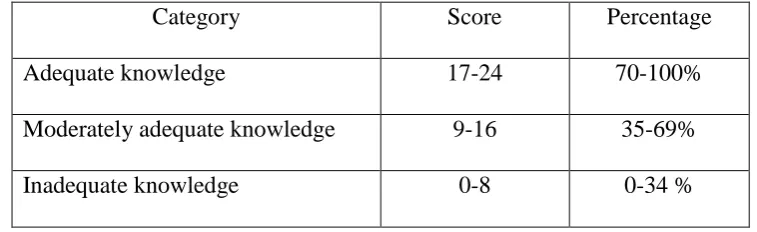
There were 24 questions where each correct answer was given the score of 1 and each wrong answer was given the score of 0.
Category Score Percentage
Adequate knowledge 17-24 70-100%
Moderately adequate knowledge 9-16 35-69%
Inadequate knowledge 0-8 0-34 %
Section III: Structured teaching programme on risk factors and prevention of
suicidal behaviour.
Teaching programme includes definition of suicidal behaviour, causes, risk factors, warning signs of suicide, facts and fables of suicide, prevention of suicide and suicidal awareness.
Validity and reliability:
Validity:
Validity refers to the degree which an instrument measures what it is supposed to measure. (Polit and Hungler, 2011)
37
The tool was found to be adequate and minor suggestions given by the experts which was incorporated.
Reliability:
Reliability is the degree of consistency or dependability with which an instrument measures an attribute. (Denise F.Polit and Beck, 2011)
The reliability of the tool was checked and established by using test – retest method, and the obtained r = 0.9 shows that the tool was highly reliable and it was considered for proceeding.
Pilot Study:
After obtaining the formal permission from Principal of Salem Sowdeshwari College, Salem, the pilot study was conducted from 22.07.2013 to 27.07.2013 among six study subjects. Pretest was conducted on 22.07.2013 with help the of structured self-administered questionnaire. Then the structured teaching programme was given regarding risk factors and prevention of suicidal behavior through LCD power point to the samples on the same day and the post test was conducted on 27.07.2013 with the same tool.
The findings of the pilot study revealed that it was feasible to conduct the main study.
Method of Data Collection: Ethical consideration:
Written permission was obtained from the Principal of Sri Vidhya Mandir Arts and Science College, Salem.
Oral consent was obtained from the study subjects. Period of Data Collection:
38 Data collection procedure:
The study samples 60 were selected by the systematic random sampling technique from Sri Vidhya Mandir Arts and Science College, Salem. The selected samples were explained about the purpose of the study. Then the pre test was done on 01.08.13 by using a structured self administered questionnaire and the adolescents were subdivided into 4 groups (15 in each group) followed with, the structured teaching programme was given to each group regarding definition of suicidal behaviour, causes, risk factors, warning signs of suicide, facts and fables of suicide, prevention of suicide and suicidal awareness through LCD power point presentation for about 45 minutes. Post test knowledge was assessed on 7th day by using the same tool.
Plan for Data Analysis:
Data was analysed by using both descriptive and inferential statistics.
Demographic information was calculated by using frequency and percentage. The effectiveness of structured teaching programme was calculated by using
inferential statistics (t-test).
Association between the pretest knowledge regarding risk factors and prevention of suicidal behaviour with their demographic variables was calculated by using inferential statistics (chi-square analysis).
Summary:
39 CHAPTER -IV
DATA ANALYSIS AND INTERPRETATION
Research data must be processed and analysed in an orderly fashion so that patterns and relationship can be discerned, validated, and hypotheses can be tested. Quantitative data analyzed through statistical analysis includes simple procedures as well as complex and sophisticated methods. (Polit, 2004)
This chapter deals with analysis and interpretation of the data collected to evaluate the Effectiveness of structured teaching programme on knowledge regarding Risk factors and Prevention of suicidal behaviour among adolescents in a selected college, Salem. The collected data was tabulated, organized and analyzed by using both descriptive and inferential statistics.
Section- A:
Distribution of adolescents according to their demographic variables. Section- B:
Distribution of adolescents according to their pre-test score on knowledge regarding risk factors and prevention of suicidal behaviour.
Section- C:
a) Distribution of adolescents according to their post test score on knowledge regarding risk factors and prevention of suicidal behaviour.
b) Comparison between the pretest and post test scores on knowledge regarding risk factors and prevention of suicidal behaviour among adolescents.
40 Section – D: Hypotheses testing
a) Effectiveness of structured teaching programme on knowledge regarding risk factors and prevention of suicidal behaviour among adolescents. b) Association between the pretest knowledge regarding risk factors and
41 Section – A
[image:52.595.110.523.230.771.2]Distribution of adolescents according to their demographic variables. Table.4.1:
Frequency and percentage distribution of adolescents according to their selected
personal variables.
n=60
Sl.no Personal variables Frequency (f) Percentage (%)
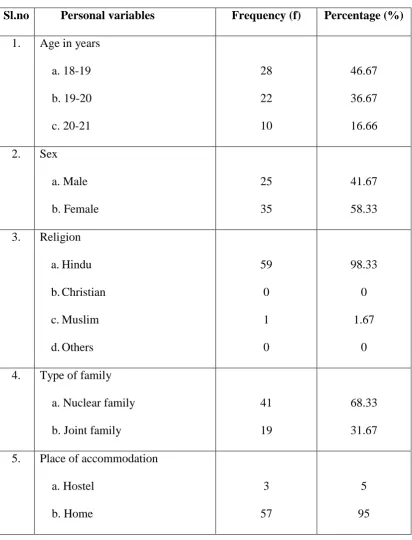
1. Age in years a. 18-19 b. 19-20 c. 20-21 28 22 10 46.67 36.67 16.66 2. Sex
a. Male b. Female 25 35 41.67 58.33 3. Religion
a.Hindu b.Christian c.Muslim d.Others 59 0 1 0 98.33 0 1.67 0 4. Type of family
a. Nuclear family b. Joint family
41 19
68.33 31.67 5. Place of accommodation
42
Table – 4.1 shows that 28(46.67%) samples are in the age group of 18-19 years, 22(36.67%) are in the age group of 19-20 years and 10(16.67%) are in
43 Table.4.2:
Frequency and percentage distribution of adolescents according to their family related demographic variables.
n=60
Sl.No
Family related demographic
variables Frequency (f) Percentage (%)
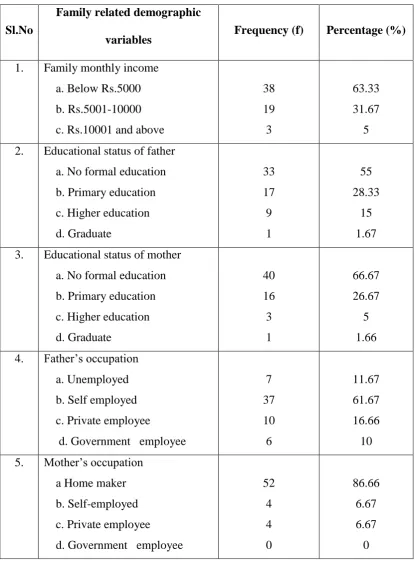
1. Family monthly income a. Below Rs.5000 b. Rs.5001-10000 c. Rs.10001 and above
38 19 3 63.33 31.67 5 2. Educational status of father
a. No formal education b. Primary education c. Higher education d. Graduate 33 17 9 1 55 28.33 15 1.67 3. Educational status of mother
a. No formal education b. Primary education c. Higher education d. Graduate 40 16 3 1 66.67 26.67 5 1.66 4. Father’s occupation
a. Unemployed b. Self employed c. Private employee
d. Government employee
7 37 10 6 11.67 61.67 16.66 10 5. Mother’s occupation
a Home maker b. Self-employed c. Private employee d. Government employee
44
Table-4.2 describes the distribution of study samples according to the family related variables. Pertaining to family monthly income, 38(63.33%) samples have a family monthly income of below Rs.5000, 19(31.67%) have their family monthly income between Rs.5001 – 10000 and only 3(5%) have a family monthly income of Rs.10001 and above.
In relation to samples father’s education concerned, 33(55%) have no formal education, 17 (28.33%) have primary education, 9(15%) have higher education and 1(1.67%) is a graduate.
Concerning to mother’s education, 40(66.67%) have no formal education, 16(26.67%) have primary education, 3(5%) have higher education and 1(1.66%) is a graduate.
Relating to father’s occupation, 7(11.67%) are unemployed, 37(61.67%) are self employed, 10(16.66%) are private employee and 6(10%) are government employees.
45 Section- B
[image:56.595.106.527.291.417.2]Distribution of adolescents according to their pre-test score on knowledge regarding Risk factors and Prevention of Suicidal Behaviour. Table 4.3:
Frequency and Percentage distribution of Adolescents according to the pre-test score on Knowledge regarding Risk factors and Prevention of Suicidal
Behaviour.
n=60
SI.no Knowledge f %
1. Adequate Knowledge - -
2. Moderately adequate Knowledge 15 25
3. Inadequate Knowledge 45 75
46 Section- C
[image:57.595.106.527.291.417.2]a. Distribution of adolescents according to their post-test score on knowledge regarding Risk factors and Prevention of Suicidal Behaviour.
Table 4.4:
Frequency and Percentage distribution of Adolescents according to the post test score on Knowledge regarding Risk factors and Prevention of Suicidal
Behaviour.
n=60
SI.no Knowledge f %
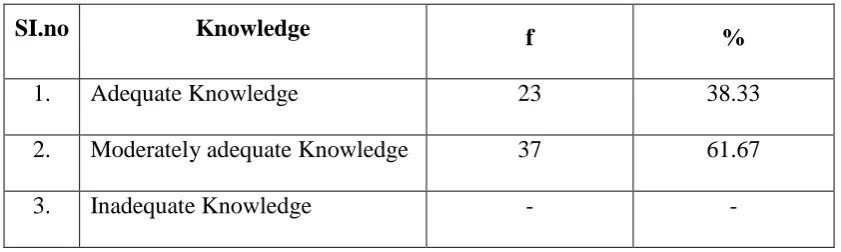
1. Adequate Knowledge 23 38.33
2. Moderately adequate Knowledge 37 61.67
3. Inadequate Knowledge - -
The above table shows that during post-test 23(38.33%) adolescents have adequate knowledge, 37(61.67%) have moderately adequate knowledge and none of them have inadequate knowledge regarding Risk factors and Prevention of Suicidal behavior.
47
b. Comparison between the pretest and post test scores on knowledge regarding
Risk factors and Prevention of Suicidal Behaviour among Adolescents.
Fig-4.1: Percentage distribution of samples according to their pre test and post test knowledge score.
The above figure-4.1 shows that during pre-test, 15(25%) adolescents have moderately adequate knowledge, 45(75%) have inadequate knowledge and none of them have adequate knowledge. During post-test, 23(38.33%) adolescents have adequate knowledge, 37(61.67%) have moderately adequate knowledge and none of them have inadequate knowledge regarding Risk factors and Prevention of Suicidal Behaviour. 0 10 20 30 40 50 60 70 80 90 100
Adequate Moderatly
[image:58.595.108.524.121.452.2]48
c. Comparison of area-wise Mean, SD, Mean percentage, Differences in mean
[image:59.595.88.567.290.508.2]percentage of pre test and post test knowledge score regarding risk factors and Prevention of Suicidal Behaviour among Adolescents.
Table 4.5:
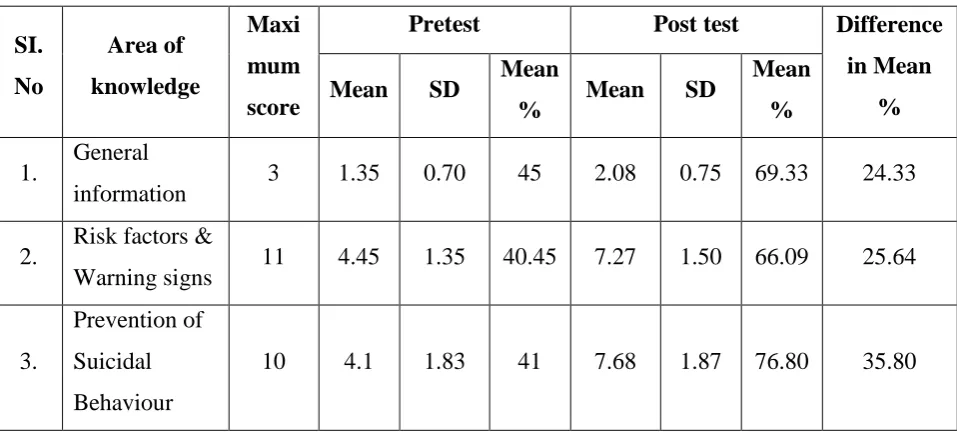
Area wise Mean, SD, Mean percentage and differences in mean percentage of pre test and post test knowledge score regarding Risk factors and Prevention of
Suicidal Behaviour among Adolescents.
n=60 SI. No Area of knowledge Maxi mum score
Pretest Post test Difference in Mean
% Mean SD Mean
% Mean SD
Mean %
1. General
information 3 1.35 0.70 45 2.08 0.75 69.33 24.33 2. Risk factors &
Warning signs 11 4.45 1.35 40.45 7.27 1.50 66.09 25.64
3.
Prevention of Suicidal Behaviour
10 4.1 1.83 41 7.68 1.87 76.80 35.80
The above table-4.5 shows that the General information related pretest mean score is 1.350.70 which is 45%, post test mean score is 2.080.75 which is 69.33% with a difference of 24.33%.
Pertained to warning signs and risk factors, the pretest mean score is 4.451.35 which is 40.45%, post test mean score is 7.271.50 which is 66.09% with a difference of 25.64%.
49 Section - D
Hypotheses Testing
a. Effectiveness of Structured-teaching Programme on knowledge regarding Risk factors and Prevention of Suicidal Behaviour among Adolescents.
Table 4.6:
Mean, standard deviation, paired‘t’ test value of knowledge among adolescents
before and after Structured-teaching Programme.
n=60
Knowledge Mean S.D ‘t’ Value df
Table
value
Pre test 9.9 3.88
16.84* 59 4.05
Post test 17.03 4.12
* Significant at p≤ 0.05 level
The above table-4.6 shows that the mean score during pre-test is 9.9 ± 3.88, and the mean score during post-test is 17.03 ± 4.12. The paired‘t’ test value is 16.84 which is significantly higher than the table value of 4.05 at p≤0.05 level. Hence hypothesis H1 is retained. Thus it becomes evident that the structured-teaching
50
b. Association between the pretest knowledge regarding Risk factors and
Prevention of Suicidal Behaviour among Adolescents and their selected demographic variables.
Table 4.7:
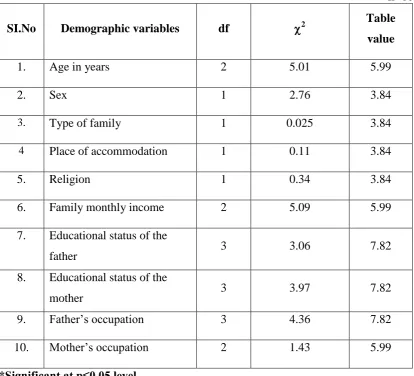
Chi-square test on pre-test knowledge regarding Risk factors and Prevention of Suicidal Behaviour among Adolescents with their selected Demographic
Variables.
n=60
SI.No Demographic variables df 2 Table value
1. Age in years 2 5.01 5.99
2. Sex 1 2.76 3.84
3. Type of family 1 0.025 3.84
4 Place of accommodation 1 0.11 3.84
5. Religion 1 0.34 3.84
6. Family monthly income 2 5.09 5.99
7. Educational status of the
father 3 3.06 7.82
8. Educational status of the
mother 3 3.97 7.82
9. Father’s occupation 3 4.36 7.82
10. Mother’s occupation 2 1.43 5.99
*Significant at p≤0.05 level
[image:61.595.109.524.276.652.2]51 Summary: