EFFECT OF WIRE EDM PROCESS PARAMETERS ON
MACHINING CHARACTERISTICS OF ALUMINIUM ALLOY 6061
USING TAGUCHI METHOD
This report is submitted in accordance with requirement of the Universiti Teknikal Malaysia Melaka (UTeM) for Bachelor Degree of Manufacturing Engineering
(Manufacturing Process) (Hons.)
by
SITI ZAHARAH BINTI MOHD B051410052
930727-11-5046
UNIVERSITI TEKNIKAL MALAYSIA MELAKA
BORANG PENGESAHAN STATUS LAPORAN PROJEK SARJANA MUDA
TAJUK:
SESI PENGAJIAN: 2016/17 Semester 2
Saya SITI ZAHARAH BINTI MOHD (930727-11-5046)
mengaku membenarkan Laporan PSM ini disimpan di Perpustakaan Universiti Teknikal Malaysia Melaka (UTeM) dengan syarat-syarat kegunaan seperti berikut:
1. Laporan PSM adalah hak milik Universiti Teknikal Malaysia Melaka dan penulis. 2. Perpustakaan Universiti Teknikal Malaysia Melaka dibenarkan membuat salinan untuk
tujuan pengajian sahaja dengan izin penulis.
3. Perpustakaan dibenarkan membuat salinan laporan PSM ini sebagai bahan pertukaran antara institusi pengajian tinggi.
4. **Sila tandakan (√)
SULIT
TERHAD
TIDAK TERHAD
(Mengandungi maklumat yang berdarjah keselamatan atau kepentingan Malaysiasebagaimana yang termaktub dalam AKTA RAHSIA RASMI 1972)
(Mengandungi maklumat TERHAD yang telah ditentukan oleh organisasi/badan di mana penyelidikan dijalankan)
Alamat Tetap:
NO. 226, KAMPUNG BARU, FELDA NERAM SATU, KEMAMAN, TERENGGANU.
Tarikh: _________________________
Disahkan oleh:
Cop Rasmi:
Tarikh: _______________________
** Jika Laporan PSM ini SULIT atau TERHAD, sila lampirkan surat daripada pihak berkuasa/organisasi berkenaan dengan menyatakan sekali sebab dan tempoh laporan PSM ini perlu dikelaskan sebagai SULIT atau TERHAD.
DECLARATION
I hereby, declared this report entitled “Effect of Wire EDM Process Parameters on Machining Characteristics of Aluminium Alloy 6061 using Taguchi Method” is the result
of my own research except as cited in references.
Signature : ………
Author’s Name : SITI ZAHARAH BINTI MOHD
APPROVAL
This report is submitted to the Faculty of Manufacturing Engineering of Universiti Teknikal Malaysia Melaka as a partial fulfilment of the requirement for Degree of
Manufacturing Engineering (Manufacturing Process) (Hons).
i
ABSTRAK
Electric Discharge Machining (EDM) adalah salah satu proses bukan traditional (NTP)
yang boleh digunakan ketika memesin reka bentuk geometri yang kompleks. Wire EDM
(WEDM) merupakan satu dari pada jenis EDM yang boleh digunakan untuk memotong dan
memesin bahan yang sangat keras, nipis dan juga menghasilkan lubang yang bersaiz mikro. Objektif utama projek ini adalah untuk mengkaji kesan proses parameter dari WEDM seperti pulse on time, pulse off time, voltage, dan peak current terhadap kesan pemesinan seperti material removal rate (MRR), kerf width (KW) dan surface roughness (Ra) daripada bahan
AA6061 dengan menggunakan Taguchi method sebagai reka bentuk eksperimen untuk
mengetahui parameter optimum. ANOVA digunakan dalam mencari parameter yang paling
penting. Mesin yang digunakan dalam projek ini adalah SODICK VZ300L bersama bersama
wayar tembaga berdiameter 0.2 mm sebagai elektrod. MRR dikira berdasarkan berat sebelum
dan selepas yang dibahagikan dengan masa permesinan manakala KW diukur menggunakan
Vertical Optical Comparator. Ra pula diukur menggunakan Portable Surface Roughness.
AA6061 dipilih sebagai bahan ujikaji kerana susah dipotong menggunakan cara konvensional. Bahan ini digunakan secara meluas dalam automotif, pembinaan dan aeroangkasa pada masa kini. Empat factor dengan tiga nilai berbeza iaitu nilai rendah, sederhana tinggi dan tinggi diaplikasikan menggunakan Taguchi Method dalam usaha mencari parameter penting yang
mempengaruhi kesan proses terhadap AA6061. Menggunakan Taguchi Method, hanya
sembilan parameter yang akan dijalan kan dan diulang 3 kali bagi setiap parameter itu. Berdasarkan keputusan dan perbincangan ujikaji, pulse on time merupakan parameter penting dengan peratusan tertinggi bagi setiap kesan proses sama ada menggunakan single objective
ii
ABSTRACT
iii
DEDICATION
To my beloved parents,
iv
ACKNOWLEDGEMENT
First and foremost, all praise to The Almighty, who made this accomplishment possible. I seek his mercy, favor and forgiveness.
Thousands of thanks to my great supervisor, Dr. Mohd Amaran bin Md Ali for the help, encouragement and guidance from the beginning until end of this writing project.
For my parents, Mohd bin Sulaiman and Zaleha binti Mohamad and my family who are always provides me with love and support all the time in order for me to complete this work. Their enthusiastic caring is valuable for me.
My thanks and appreciations also go to my colleagues in developing the project and people who gave willingly helped me out with their abilities.
v
TABLE OF CONTENT
Abstrak i
Abstract ii
Dedication iii
Acknowledgement iv
Table of Contents v
List of Tables ix
List of Figures xi
List of Abbreviations, Symbols, and Nomenclature xiii
CHAPTER 1: INTRODUCTION 1.1 Background of The Project ... 1
1.2 Problem Statement ... 2
1.3 Objective of The Project ... 3
1.4 Scope of The Project ... 3
1.5 Organization of This Report ... 4
CHAPTER 2: LITERATURE REVIEW 2.1 Electric Discharge Machining (EDM) ... 5
2.2 Wire Electric Discharge Machining (WEDM) ... 6
2.3 Wire Electrode
...
72.4 Dielectric Fluid ... 8
2.5 Workpiece Material ... 9
2.6 Parameters ... 6
2.7 Control Parameters ... 10
vi
2.7.2 Pulse OFF Time ... 10
2.7.3 Peak Current ... 11
2.7.4 Voltage... 11
2.8 Responses of WEDM ... 11
2.8.1 Kerf Width (KW) ... 11
2.8.2 Surface Roughness (Ra) ... 13
2.8.3 Material Removal Rate (MRR) ... 15
2.8.4 Surface Appearance ... 16
2.9 Design of Experiment (DoE) ... 16
2.9.1 Taguchi Method... 17
2.9.2 ANOVA Analysis ... 17
2.10 Summary ... 18
CHAPTER 3: METHODOLOGY 3.1 Introduction ... 19
3.2 Selection Machine and Materials ... 21
3.2.1 Wire Electrical Discharge Machine (WEDM) ... 21
3.2.2 Portable Surface Roughness Tester ... 23
3.2.3 Materials ... 24
3.2.4 Wire Electrode ... 25
3.3 Profile Design and Drawing ... 26
3.4 Identify The Method of DOE ... 28
3.4.1 Taguchi Method and Minitab Software ... 28
3.5 Parameters ... 29
3.6 Conduct of Experiment-Start The Machine Using WEDM ... 30
3.7 Vertical Optical Comparator ... 30
3.7.1 Procedure Calibrate Vertical Optical Comparator ... 31
3.7.2 Procedure Using Vertical Optical Comparator ... 31
3.8 Procedure for Measuring Surface Roughness ... 31
vii
3.8.2 Performing Calibration for Portable Surface Roughness ... 32
3.8.3 Start Measure the Surface Roughness ... 32
3.9 Procedure for Measuring Material Removal Rate ... 33
3.10 Data Collection and Analysis ... 33
3.11 Summary ... 37
CHAPTER 4: RESULT AND DISCUSSION 4.1 Experimental Data ... 38
4.2 Result of The Experiment ... 39
4.3 Analysis of The Result Using Single Objectives... 40
4.3.1 Effect on Material Removal Rate (MRR) ... 40
4.3.2 Effect on Kerf Width (KW) ... 44
4.3.3 Effect on Surface Roughness (Ra) ... 48
4.3.4 Effect on Surface Appearance ... 51
4.4 Analysis of The Result Using Multi Objectives ... 53
4.5 Summary Result ... 60
CHAPTER 5: CONCLUSION AND FUTURE WORK 5.1 Conclusion ... 63
5.2 Sustainability ... 65
5.3 Future Work ... 65
REFERENCES ... 66
APPENDICES ... 69 A Gantt chart of PSM 1
B Gantt chart of PSM 2 C Composition of AA6061
viii E Response table of Signal to noise ratio (MRR) F Response table of Signal to noise ratio (KW) G Response table of Signal to noise ratio (Ra) H ANOVA for MRR
I ANOVA for KW J ANOVA for Ra
K Predicted value for MRR L Predicted value for KW M Predicted value for Ra
ix
LIST OF TABLES
3.1 Specification of Sodick VZ300L wire cut 22
3.2 Chemical composition of AA6061 24
3.3 Physical properties of AA6061 25
3.4 Mechanical properties of AA6061 25
3.5 Electrical properties of AA6061 25
3.6 Specification of electrode wire 26
3.7 Design of experiment matrix 29
3.8 Control parameter 29
4.1 Input parameters and level for wire EDM of AA6061 39
4.2 Input parameters for the experiments 39
4.3 Experiments result of MRR, KW, and Ra 40
4.4 Experimental design and MRR result 41
4.5 S/N ratio response table for MRR – larger is better 42
4.6 ANOVA for MRR 43
4.7 Experimental design and KW result 44
4.8 S/N ratio response table for KW – smaller is better 45
x
4.10 Experimental design and Ra result 48
4.11 S/N ratio response table for Ra – smaller is better 49
4.12 ANOVA for Ra 50
4.13 Value of GRN (larger is better) and GRC for MRR 53
4.14 Value of GRN (smaller is better) and GRC for KW 54
4.15 Value of GRN (smaller is better) and GRC for Ra 55
4.16 Value of GRG and Rank of GRG value 56
4.17 Experimental design of GRG 57
4.18 S/N ratio response table for all parameter – larger is better 58
4.19 ANOVA for all parameter 59
4.20 Predicted mean value for each responses parameter 60
4.21 Percentage contribution of all parameters on the responses 61
4.22 Summarize result for single objective 62
xi
LIST OF FIGURES
2.1 Basic principle of EDM 6
2.2 Principle of WEDM 7
2.3 Schematic diagram of wire electrode 8
2.4 Percentage contribution for optimum factor that affected the KW 12
2.5 Percentage contribution for optimum factor that affected the Ra 13
2.6 Percentage contribution for optimum factor that affected the MRR 15
3.1 General flowchart of project 20
3.2 Sodick VZ300L wire-cut 21
3.3 Portable surface roughness 23
3.4 Aluminum Alloy 6061 24
3.5 Brass wire electrode 26
3.6 Drawing of the profile design 27
4.1 Effect of control parameters to MRR 42
4.2 Percentage contribution for MRR 43
4.3 Effect of control parameters to KW 46
4.4 Percentage contribution for KW 47
4.5 Effect of control parameters to Ra 49
4.6 Percentage contribution for Ra 50
xii
4.8 The largest crater 52
4.9 Effect of control parameters to respond parameters 58
4.10 Percentage contribution to all control parameter 59
xiii
LIST OF ABBREVIATIONS, SYMBOLS AND
NOMENCLATURE
AA6061 - Aluminium Alloy 6061
ANOVA - Analysis of Variance
Avg - Average
CNC - Computer Numerical Control
D - Depth
DoE - Design of Experiment
EDM - Electric Discharge Machining
GRA - Grey Relational Analysis
GRC - Grey Relational Coefficient
GRG - Grey Relational Grade
GRN - Grey Relational Normalization
H - Height
Ip - Peak current
KW - Kerf Width
MRR - Material Removal Rate
NTP - Non-traditional process
Ra - Surface roughness
xiv
SOP - Standard Operating Procedure
Tm - Time machining
Toff - Pulse off time
Ton - Pulse on time
V - Voltage
Wa - Weight after
Wb - Weight before
WEDM - Wire Electric Discharge Machining
1
This chapter discusses about the background, problem statement, objectives and scope of this project. Background explains about electrical discharge machining for wirecut machine. Then, the problem statement and the objectives of this project are described clearly. Besides that, the scope of this project which mentions about the machine used, type of raw materials, electrode, parameters and design of experimental.
1.1 Background of The Project
Todays, Non-Traditional Process (NTP) is being known and famous as a new technology in manufacturing engineering industry. NTP is a group of machining or process that produces high quality of product with precision, accuracy and productivity using high technology process which is applied non-contact between workpieces and cutting tools. Electrical Discharge Machining (EDM) is one of the important processes in NTP group.
In year 1970, EDM was being developed commercially after a scientist from Russia completely utilized the advantage of EDM in year 1943 (Kuriachen et al. 2012). However,
EDM was being discovered for the first time in long time ago in the year 1770 by Joseph Priestly who is English scientist. There are two types of EDM that are use today with different control parameters but in same respond parameters; wire EDM and EDM Die Sinking.
Days by days, wire EDM have a place and being used in manufacturing industry in various application such as aerospace, nuclear, medical and automotive industry (Guitrau et al.
1997). In addition, wire EDM become famous because it can be used in cutting and
INTRODUCTION
2
producing complex and smallest part for various type of material; ceramic, silicon, metal, cemented carbides, alloy and also sintered materials (Sivarao, 2015).
In wire EDM, there are various types of electrode to be used in order to machine and cut a workpieces or in order to complete a cutting process. Different type of workpiece materials can be used with different type of electrode materials. Normally for workpieces of aluminium material, electrode with copper type of material is suitable. There are also specific diameters of electrode that need to be known before start a machining process. The diameter of electrode also affected the quality and surface roughness of a part. The range of electrode is between 0.05 mm to 0.3 mm for copper, brass or tungsten material (Brajesh et al. 2014).
In this project, the effect of WEDM parameters such as pulse on time, pulse off time, voltage and peak current are investigated on the material characteristics such as material removal rate, kerf width and surface roughness of aluminium alloy 6061. After go through the machining process, the data measurement obtained are analysed using of Taguchi method. Then analyse of variance (ANOVA) to be applied in order to finish this investigation. Single and multi-objectives by Taguchi methods are implemented to find optimize result.
1.2 Problem Statement
3
1.3 Objective of The Project
The main objective of this project is to study the effect of wire-EDM process parameters on machining characteristics of material of aluminium alloy 6061. In order to achieve the main objective, three sub-objectives to be focus as below:
i. To study the wire-EDM process parameters such as pulse on time, pulse off time, peak current and voltage.
ii. To evaluate the effect of wire-EDM parameters on surface roughness (Ra), material removal rate (MRR) and kerf width (KW) of Aluminium Alloy 6061.
iii. To optimize using single and multi-objective of wire-EDM parameters on machining characteristics using Taguchi Method and ANOVA analysis.
1.4 Scope of The Project
4
1.5 Organization of This Report
5
This chapter describes about the previous research study that related to this project. The previous research study related are EDM, WEDM, control process parameters of WEDM, responses of WEDM, Aluminium Alloy 6061 material and DoE of Taguchi method and ANOVA analysis.
2.1 Electric Discharge Machining (EDM)
EDM is published for the first time during the Second World War. A study that relate to the manufacturing technology about the electrical discharge on the topic of ‘The Inversion of The Electric Discharge Wear Effect’ was published that time by Russians physicist. Their study also relate to the metal removal and distribution under control.
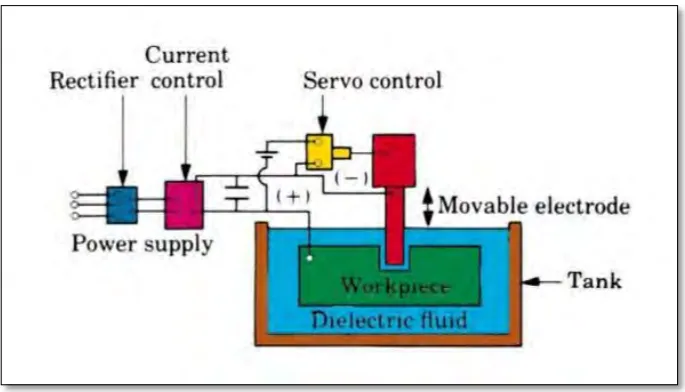
Nedians and Fortunecity (2007) stated that, there were four basic elements that must have in every EDM; spark generator, servo system, dielectric liquid and mechanical structure. In spark generator elements, the energy is required in the form of pulses. Usually it is in rectangular form. However, the generators can be distinguished based on the way in which the voltage is transformed and the pulse is controlled. Servo system is about corrosion of the electrode and workpieces during the process. The dimension of the electrode is changed in a time. The result is observed in interelectrode gap. When there is increase the interelectrode gap, the voltage required for sparking is increase too. Figure 2.1 shows principle of WEDM.
LITERATURE REVIEW
6
Figure 2.1: Basic principle of EDM (Kumar, R. 2014)
The advantages of using EDM are it can produce complex shape which is conventional machine cannot produce it. By using EDM, the machining process between workpieces and tools is not touch to each other or in other word, there is no direct contact. That is why it can machine even small workpieces or weak materials with exact dimension and highly precise and accuracy.
2.2 Wire Electric Discharge Machining (WEDM)