Evaluation of the YJB Pilot Resettlement
Support Panel Scheme
Evaluation of the YJB Pilot
Liz Phillips, Robert Smith, Kerry Martin, Palak Mehta, and
Ben Durbin. National Foundation for Educational Research
Views expressed in this report are those of the research team and not
necessarily those of the Welsh Government
For further information please contact:
Name: Robert Willis
Email: [email protected]
Welsh Government Social Research, 2012
ISBN 978 0 7504 7491 7
Contents
1. Acknowledgements... 1
2. List of abbreviations and acronyms ... 2
3. Background ... 3
3.1 The resettlement panels... 3
3.2 Methodology... 5
4. Case study 1 ... 10
4.1 The resettlement panel: set up and functioning... 10
4.2 The resettlement support worker... 13
4.3 The review body: role and effectiveness... 15
5. Case study 2 ... 21
5.1 The resettlement panels: set up and functioning... 21
5.2 The resettlement support worker... 28
5.3 Reviewing function... 30
5.4 Resettlement plans: commitment of resources... 31
5.5 Resettlement schemes: improving outcomes for young people... 33
5.6 Asset analysis... 34
5.7 Conclusion... 38
6. Case study 3 ... 41
6. 1 The resettlement panel: set up and functioning... 41
6.2 The resettlement support worker... 43
6.3 Reviewing function... 46
6.4 Resettlement plans: commitment of resources... 47
6.5 Resettlement schemes: improving outcomes for young people... 48
6.6 Asset analysis... 50
6.7 Conclusion... 54
7. Case study 4 ... 58
7.1 The resettlement panels: set-up and functioning... 58
7.2 The resettlement support worker... 63
7.3 The review body: role and effectiveness... 63
7.4 Resettlement plans: commitment of resources... 63
7.5 Resettlement schemes: improving outcomes for young people... 66
7.6 Asset analysis... 69
8. Case study 5 ... 75
8.1 The resettlement panels: set-up and functioning... 75
8.2 The resettlement support worker... 79
8.3 The review body: role and effectiveness... 81
8.4 Resettlement plans: commitment of resources... 81
8.5 Resettlement schemes: improving outcomes for young people... 83
8.6 Asset analysis... 86
8.7 Conclusion... 89
9. Case study 6 ... 92
9.1 Resettlement support panels: set-up and functioning... 92
9.2 The resettlement support worker... 96
9.3 The review body... 96
9.4 Resettlement support plans: commitment of resources... 97
9.5 Resettlement schemes: improving outcomes for young people... 99
9.6 Asset analysis... 102
9.7 Conclusion... 106
10. Summary of findings: all case studies... 109
10.1 The resettlement panels: set-up and functioning... 109
10.2 Panel functioning and effectiveness... 110
10.3 The resettlement workers... 111
10.4 The review bodies: role and effectiveness... 112
10.5 Commitment of resources... 112
10.6 Resettlement schemes: improving outcomes for young people... 113
11. Conclusions... 117
12. Recommendations ... 123
1. Acknowledgements
The research team at NFER would like to thank all of the strategic and
operational personnel and young people who gave up their time to take part in
this research.
The team would particularly like to express their thanks to staff at each of the
Youth Offending Teams (YOTs) for coordinating the case study visits and for
their cooperation with providing the quantitative data used in the evaluation.
We owe a debt of thanks to Lynzi Jarman of the YJB for her support and work
to enable the project to proceed smoothly.
Thanks also go to Lowri Randell-Evans, Sagina Khan, Alison Riley and
2.
List of abbreviations and acronyms
ASB: Anti-Social Behaviour
ASBO: Anti-Social Behaviour Order
ASSET: Young Offender Assessment Profile data
AWYOS: All-Wales Youth Offending Strategy
CAF: Common Assessment Framework
CAMHS: Child and Adolescent Mental Health Services
CRB: Criminal Records Bureau
CSP: Community Safety Partnership
CYPP: Children and Young People’s Partnership
EET: Education, Employment and Training
DTO: Detention and Training Order
IFST: Integrated Family Support Team
IOM: Integrated Offender Management
ISS: Intensive Supervision and Surveillance
LA: Local Authority
LAC: Looked After Child / Children
LSCB: Local Safeguarding Children Board
MAPPA: Multi-Agency Public Protection Arrangement
MARAC: Multi-Agency Risk Assessment Conference
NACRO: National Association for the Care and Resettlement of Offenders
NEET: Not in Education, Employment or Training
PPO: Prolific and Priority Offender
RSP: Resettlement Support Panel
TAC: Team Around the Child
WAG: Welsh Assembly Government
YISP: Youth Inclusion and Support Panel
YJB: Youth Justice Board
YOI: Young Offender’s Institution
YOS: Youth Offending Service
YOT: Youth Offending Team
YRO: Youth Rehabilitation Order
3. Background
The National Foundation for Educational Research (NFER) was jointly
commissioned in October 2009 by the Youth Justice Board (YJB) and the
Social Research Division of the Welsh Government to undertake an
evaluation of the YJB Pilot Resettlement Schemes. The evaluation was
completed in August 2011.
3.1 The resettlement panels
The YJB made funding available in July 2009 to enable six selected Youth
Offending Teams (YOTs) in Wales to expand resettlement for young people
aged 12 to 17 who are leaving custody. The funding is also aimed at
preventing young people from entering custody in the first place.
The pilot resettlement schemes are a new approach to addressing the issues
faced by young people in custody. They fit in with the priorities of the
All-Wales Youth Offending Strategy (AWYOS) Delivery Plan, in particular,
reducing reoffending and the use of custodial sentences, and increasing
effective resettlement.
Other reasons for adopting this approach, as outlined in the YJB-WAG
Resettlement Support Panels Pilot Guidance: 2010-2011, are:
• the comparatively low cost of providing a service that is predominantly aimed at coordinating access to shared resources
• the prior existence of suitable panels, such as Youth Inclusion Support Panels (YISPs), in many areas of Wales which would enable existing infrastructure to be used
• the need to hold partners to account for delivering services to those who are often marginalised and excluded
• the essential role that effective multi-agency coordination and information sharing has for preventing reoffending upon release.
[Source: Youth Justice Board and Welsh Assembly Government (2010). Resettlement
The guidance makes clear that the Resettlement Support Panels (RSPs) are
a key aspect of the pilot resettlement schemes. RSPs should have clear links
with local Children and Young People’s Partnerships (CYPPs), Community
Safety Partnerships (CSPs), Local Safeguarding Children’s Boards (LSCBs),
and the Local Criminal Justice Board.
The RSPs’ main objective is to coordinate multi-agency support for the
resettlement of young people through addressing substance misuse,
accommodation problems, mental health and education issues. The Panels
also assist young people in accessing education, employment and training
opportunities, mediate with families and peers, and encourage more
appropriate use of leisure time. Developing young people’s life skills, budget
management, healthy living, and raising their self-esteem and confidence to
facilitate positive decision-making are also RSP objectives.
RSPs are based on the following core operational components:
• a multi agency panel comprised of officers with sufficient seniority to commit resources to resettlement action plans
• an operational manager who is accountable for its delivery
• a named resettlement support worker or workers with responsibility for oversight of resettlement support plans for individual young people
• where a partner agency delivers parts of RSP, a service level agreement should be in place, including clear information-sharing protocols.
[Source: Youth Justice Board and Welsh Assembly Government (2010). Resettlement
Support Panels Pilot Guidance: 2010-2011]
RSPs typically have membership from social services, education, health
(particularly Child and Adolescent Mental Health Services (CAMHS), the
police, local authority housing department, housing providers, careers
advisers, YOT personnel, Young Offenders’ Institutions (YOIs), and Youth
The six Welsh LAs who took part in the evaluation were Bridgend, Caerphilly
and Blaenau Gwent, Conwy and Denbighshire, Gwynedd and Ynys Mon,
Merthyr Tydfil and Wrexham.
All RSPs are required to review the delivery of resettlement support plans and
outcomes for participating children and young people. Bridgend and
Wrexham, however, have an enhanced review function. This means that they
are required to scrutinise individual cases to ascertain whether resettlement
support could have been delivered differently to offer a more effective
community-based alternative to custody.
3.2 Methodology
The aims of the evaluation are to conduct a:
Process evaluation which examines:
• the setting up and functioning of the RSPs particularly with regard to ‘buy in’ from member agencies, and working together
• the role and impact of the resettlement support worker and the supervision support worker
• the role and effectiveness of the review body, and an:
Outcome evaluation
to determine:
• the effectiveness of the scheme in improving outcomes for young offenders
• the extent to which partners commit resources to resettlement support plans.
Recommendations for more effective implementation of the scheme based on
The NFER adopted a mixed methodology to fulfil the evaluation objectives.
The evaluation was conducted in five distinct yet complementary phases,
some of which were undertaken simultaneously.
Phase one was the project inception.
In Phase two, the research team collected and analysed quantitative Asset
(Young Offender Assessment Profile) data on the young people participating
in the pilot schemes. This data is compiled by YOTs and YOIs on all young
offenders. Asset data includes information on a young person’s age, gender,
offence(s), factors or circumstances which may have contributed to their
offending behaviour, their particular needs or difficulties, and risk of
reoffending. Young people who received a custodial sentence in the six pilot
areas in the year before the pilot scheme were compared with those who
were or are involved in the scheme.
In Phase three of the evaluation, five bilingual topic guides for the qualitative
data collection were designed. The topic guides are included in the Appendix
to this report, and were designed to be used in interviews with:
• Strategic WAG and YJB personnel • Members of the RSPs
• Resettlement support workers
• YOT managers and case workers
• Up to five young people participating in the pilot schemes in each area.
In Phase four, NFER researchers visited each pilot area twice, once during
May-July 2010, and again during November 2010-January 2011, to interview
these people.
During the first visit, the interviews explored the processes involved in the
set-up of the RSPs, their composition, and the rationale behind the pilot schemes.
after the establishment of the RSPs was examined. NFER also considered
the emerging impacts of the pilot schemes and the RSPs, along with the role
and impact of the resettlement support workers.
During the second visit, the research team focused more on the progress of
the RSPs and pilot schemes in improving outcomes for young people. Any
changes to the approaches adopted in each area and the impact of the pilot
schemes, including how they changed over time, were also explored.
Young people were asked about the resettlement work in terms of what had
been done, their opinions of it, and its impact(s) on their:
• offending behaviour
• accommodation status
• use of drugs and alcohol
• engagement with education, training and employment
• finding new, more positive interests
• family and friends • self-esteem
• feelings about their offending.
Analysis of Asset scores was used as part of the outcome evaluation.Asset is
a national format which the YJB expects YOTs to use when working with
young people. The young people are assessed to identify the likelihood they
may reoffend. This is on the basis of 12 ‘dynamic’ factors affecting offending
behaviour and four ‘static’ factors. A low Asset score indicates a lower
likelihood of reoffending.
Data was supplied by five out of the six areas on young people with whom
they have had contact. The data received varied between areas but typically
covered offences committed; programme participation; Asset scores;
background characteristics such as age, gender and ethnicity; and some
In summary the approach was to:
1. Identify young people who have participated in the programme, and
describe their pre-intervention characteristics using the available data
(focussing on fields where data was deemed to be reasonably reliable and
complete).
2. Identify a comparison group of young people sharing similar characteristics
but who did not participate in the programme. To ensure that the analysis was
not biased by unobserved characteristics which may have influenced both
participation in the scheme and the outcomes of interest, the young people in
the comparison group should not have had the opportunity to participate.1.
3. Compare post-intervention outcomes – defined as the one year period
beginning the month after the intervention start date – across the two groups
of young people.
In practice, there were some challenges implementing this approach. There
were low numbers of young people participating in the scheme, and missing
data was substantial. The analysis therefore used two comparison groups,
balancing the competing demands of ‘quality’ and ‘quantity’ of data:
• a core comparison group sharing similar characteristics in terms of number of offences committed, maximum gravity of offence and average Asset scores
• an extended comparison group which was similar to the core comparison group by way of gender, ethnicity and age.
During Phase 5 of the project, the research team collated and analysed all of
the evaluation data. A Final Report and executive summary were then
produced, and a presentation of the findings given to the project steering
group.
1
4.
Case study 1
This pilot covered an area with two local authorities (LAs). The research team
visited the Youth Offending Team (YOT) in July 2010 and again in December
2010. Face-to-face interviews were conducted with strategic and operational
YOT staff at both visits. Telephone interviews were conducted with young
people during the second visit only.
4.1 The resettlement panel: set up and functioning 4.1.1 Panel structure and membership
Respondents defined the main aim of the pilot resettlement scheme as
supporting young people to access the services they needed. To achieve this,
the RSP was used to hold discussions between staff from different support
agencies. One respondent explained this in the following way: “It is a matter of
providing the support up-front. We have a small number of young people who
many people don’t consider [providing services for] and this is a way of
highlighting their needs and ensuring they access the type of support they
require.”
The resettlement work built on effective partnership working already in place,
including links between the YOT, housing agencies and education and
training providers. The fact that the RSP covered two local authorities was not
thought to have reduced its effectiveness, largely because of the history of
collaboration between some of the agencies involved. Limited capacity was
reported to affect some stakeholders’ engagement with resettlement work,
rather than their willingness to engage.
It was decided not to establish a stand-alone resettlement panel in the YOT 1
area as it was thought that this could duplicate work already being
undertaken. Consequently, young people’s resettlement was discussed at an
existing panel which met monthly to consider Intensive Supervision and
The panel’s function was defined by interviewees as:
• Evaluating case management processes and formulating effective resettlement support plans on a multi-agency and independent basis
• Linking in processes to monitor young people’s risk of harm, vulnerability and likelihood of re-offending
• Collating, considering and discussing information about young people on a multi-agency basis to inform release plans and the resettlement process • Linking into custody reviewing processes, in particular when planning for
the final release date.
Although participation in the pilot resettlement scheme was voluntary, staff
operated on an assumption that young people would take part. A typical
comment which outlined this rationale was, ‘It is not an opt in but a opt out’.
The following individuals and agencies made up the RSP:
• YOT operational manager
• YOT prevention manager
• YOT education officer
• Child and Adolescent Mental Health Services representatives (CAMHS) • Police officer
• Substance misuse service staff
• Social services representatives.
Members were permitted to nominate deputies to attend panel meetings on
their behalf. Other agencies were invited to attend to discuss a particular case
if appropriate.
The irregular attendance of some panel members added to the work of the
YOT staff because they had to follow up decisions and discussions with those
agencies whose representatives had not attended. YOT staff and panel
members attributed these absences to workload issues.
Young people leaving custody or at risk of a custodial sentence were referred
to the panel through multi-agency teams. Their vulnerability and the risk of
Resettlement support plans and arrangements for supervision were also put
in place at panel meetings.
The panel was chaired by a former social services manager who was
respected as an impartial and authoritative figure. The YOT provided the
secretariat for the panel. Initially, the chair’s role was limited to reading reports
and chairing RSP meetings. However, during the pilot project, the chair
became more involved with leading the resettlement work and contributed to
individual case discussions.
Members believed that the panel worked well, as it provided an opportunity for
a wide range of stakeholders to meet and discuss individual cases from a
number of different angles. They felt that those attending the initial panel
meetings had sufficient authority to commit resources when required to do so.
At the second case study visit, however, it was noted that those attending
lacked such authority.
4.1.2 Panel functioning and effectiveness
Panel members believed that the RSP had encouraged less ‘silo’ working
among the attending agencies. This was attributed to the commitment and
work of stakeholders in the field rather than to the impact of the panel per se.
Silo working had not disappeared completely, however as those interviewed
felt that some people still needed to be convinced that the RSP was
undertaking work of real value to the young people concerned.
Several panel members questioned the need for the panel, on the grounds
that it duplicated existing work. They said that many of the young people who
were discussed at the RSP were also discussed at other meetings.
Some respondents felt that the RSP should be a responsibility of the YOT,
and that the lack of engagement by some external agencies reflected this
feeling. They were also concerned that actions agreed by the panel were
often not carried out. A panel member made the following comment which
people’s resettlement; “The world isn’t very different because of this panel. It
may be that things would be less structured and less formal without it. The
other agencies might not have had the full picture at the time of the risk
assessment but the quality of the work wasn’t down to the panel”.
The YOT amended the panel’s functioning in several ways through the course
of the evaluation. Firstly, they changed the format of the reports prepared for
the panel, to focus more on young people’s risk and vulnerability.
Progressively fewer young people were referred to the panel. The decision to
consider fewer young people was intended to prioritise those most in need of
resettlement support. Panel members believed that this improved the quality
of the resettlement support plans. They also maintained that it had led to a
more ‘joined-up’ approach that took account of the full range of issues
affecting young people, such as accommodation, education and welfare. As
one panel member said, “We went through a large number of cases, but not
always to the level of detail that was required. Now we have become more
focused, looking at what the priority cases are and giving more attention to
them”.
A further change to the panel’s functioning was that any young person already
in custody, already undertaking resettlement work, or deemed by the relevant
agencies to be high risk or very vulnerable, would be referred to the panel
automatically. This was because of significant crossover between these
groups.
4.2 The resettlement support worker
The resettlement support worker was central to the success of the pilot
scheme. Respondents believed that the resettlement support worker needed
to be known by the young person and should establish a relationship with
them early on. The worker should also maintain contact with agencies such as
housing and ETE to ensure that young people’s needs were fully met. As one
the young people need is available, that they have what they need to be able
to move on at the end of their sentence”.
Interviewees felt that the resettlement support worker’s role provided:
• additional contact over and above that provided by the case manager • informal monitoring to identify problems and gaps in resettlement support
plans
• a link between resettlement work and the case manager
• advocacy and support for the young people
• a way of signposting young people to services and helping them to access them.
In addition to the role of the resettlement worker, a member of staff seconded
from Careers Wales had a central role in the resettlement scheme. The focus
of their work was on linking with ETE providers to meet the needs of the
participating young people. The Careers Wales officer also examined the
young people’s support needs when accessing ETE provision, and ensured
that they had access to information about the ETE options open to them.
The resettlement worker, together with the Careers Wales officer, visited
custodial settings to meet the young people six to eight weeks prior to
release. This was to begin establishing a relationship with them and to identify
their ETE needs. Both officers also worked with young people on the
resettlement scheme who had not received a custodial sentence, to ensure
that their ETE needs were met.
The resettlement worker dealt mainly with accommodation issues faced by
young people leaving custody. This was done by referring the young people to
accommodation agencies and monitoring the service and support they
received, to ensure it was appropriate and sufficient.
Interviewees felt that the number of young people who engaged with the
resettlement scheme was disappointing. The resettlement worker had found it
release, despite prolonged efforts to do so. Interviewees also noted that the
resettlement worker had made nearly all the contact rather than the young
people themselves. One respondent stated, “We have tried to sustain the
links and raise awareness of what is offered, but the take-up was
disappointing. A lot of effort is put into it but very often the only contact is that
initiated by the resettlement staff”. This emphasises the challenges of
engaging with the young people and the need for those responsible to be
continually proactive in promoting engagement.
As a result, from August 2010, the resettlement activities were started at the
point of Pre-Sentence Review (PSR). This was much earlier that at the start of
the pilot scheme. Since then, the resettlement worker accompanied the YOT
case workers to each PSR meeting to offer support to the young people
before they went to court. The fact that a young person was engaged with the
resettlement scheme was mentioned at the pre-sentence hearing.
However, this change had not encouraged more young people to engage with
the resettlement work, even though many were at risk of receiving custodial
sentences. Those interviewed were disappointed about this, as illustrated by
the following comment: “The relationship is being started a lot earlier but we
are still a long way from getting the take-up we want … the strength is that
this model is more likely to succeed than what was previously in place”.
4.3 The review body: role and effectiveness
YOT 1 did not have an enhanced review function. Instead, YOT 1 reviewed
the pilot resettlement scheme and the resettlement work undertaken through it
in two main ways.
Firstly, YOT staff examined the resettlement work delivered through the pilot
scheme internally in 2009 in light of the challenges encountered in engaging
with young people. YOT 1 also undertook an assessment of the RSP’s
from the latter review was sent to the Local Safeguarding Children Board
(LSCB) and the Children and Young People’s Partnership (CYPP).
This had resulted in the following changes, which had been implemented by
October 2010:
• The RSP chair became more involved with planning the resettlement work and contributing to individual case discussions
• Changing the format of reports on young people discussed at the RSP to focus more on risk and vulnerability
• Referring fewer young people to the RSP to prioritise those most in need • Automatically referring young people already in custody, and those who
were high-risk or very vulnerable, onto the panel.
The impact of these changes is subject to further evaluation.
4.4 Resettlement plans: commitment of resources
YOT 1 used the resettlement funding to develop the work of the resettlement
panel and to appoint a part-time resettlement worker. Most of the funding for
the services that were required for effective resettlement work to be
undertaken was to be committed by the service providers involved.
Panel members believed that the agencies represented on the panel had
contributed the required resources. They thought this was due to their
recognition of the young people’s vulnerability and to a shared commitment to
meeting their needs. The panel had no statutory powers, however, and
therefore relied on its members’ goodwill and good practice. Some members
felt that the RSP should not ask its members to commit additional resources
as these should be available anyway, if the need arose. Rather than obtaining
resources, they thought that that the panel’s role should be to obtain better
4.5 Resettlement schemes: improving outcomes for young people
Interviewees said that the pilot scheme had helped to increase the
effectiveness of young people’s resettlement, and enhanced the quality of the
resettlement work undertaken by YOT 1. The RSP had added coordination to
resettlement and increased young people’s contact with available services
and support. Improved partnership working between panel members and
more efficient referral of the young people to the relevant support services
underpinned this, as the following comment reflects
“We are probably not doing anything radically different, it is more of a matter of trying to get more joined-up thinking and of highlighting cases of need to the relevant service providers”.
However, as noted earlier, the number of young people engaging with the
service was lower than intended. This was attributed to a feeling that the
young people did not want to be associated with the YOT after their orders
came to an end. According to one respondent, “The problem we face … is
that a lot of these young people associate the YOT and all the staff working
within it as part of the sentence, something they are required to do …. Many
of them then want nothing to do with it once their orders have come to an
end.”
Individuals delivering the resettlement work pointed to the positive benefits it
had brought for the small number of young people who had engaged with the
work. Were it not for the pilot scheme, the additional support provided by the
resettlement worker would not have been possible. “It is an added value,
something that is there to help and support them”,was how one respondent
described it. The resettlement worker’s role had also been important in
ensuring that relevant agencies responded to the needs of young people.
Moreover, the Careers Wales officer was considered to have helped the
resettlement work by ensuring ETE provision was in place, upon their release
This allowed discussion of young people’s needs with ETE providers in
advance of their engagement with any provision.
YOT personnel and panel members thought that resettlement work had
influenced the young people’s attitudes towards reoffending. However, these
stakeholders emphasised that its contribution was one of many factors
affecting this.
Stakeholders believed that it was difficult to attribute any changes in
substance misuse to the intervention work undertaken through the
resettlement scheme. While resettlement work could refer a young person to
substance misuse services, the outcomes depended on whether a young
person chose to engage with those services.
The fact that the resettlement worker could carry on working with the young
people after their sentences came to an end was cited as a positive impact of
the pilot scheme because it helped them to deal with issues that arose at a
crucial stage in their lives when they were especially vulnerable. Some
interviewees felt that the pilot scheme had strengthened exit strategies for
those leaving the youth justice system. However, as noted earlier, this was
not a universal view, given that some young people were keen to break away
from an involvement with the YOT as soon as possible.
It was recognised that the resettlement support provided through the scheme
was not the only factor influencing reoffending. For example, it was noted that
the local police were more likely to resort to on-the-spot fines, than to take
young people to court, which had a major impact in reducing the reported
level of offending in the area.
4.6 Asset analysis
4.7 Conclusion
The evidence from YOT 1 emphasised the need for young people’s
resettlement issues to be addressed by individuals with sufficient seniority to
be able to take decisions and to commit resources to meeting their needs.
The fact that the work of the body responsible for resettlement had been
reviewed had ensured that some key issues concerning the working of the
panel had been addressed. The need for systematic and regular review of the
way resettlement work is addressed became evident. Adding the
responsibility for resettlement to an existing body was effective in this case
and avoided the creation of an additional body.
The resettlement worker contributed by providing individual, one-to-one
support, including specific links with education and training providers. The
practical work of acting on behalf of the young people signposting services
and ensuring that service providers responded to needs was central, if the
role was to benefit the young people. For this approach to work there was a
need for the resettlement worker to establish relationships early.
The need to maximise the number of young people taking up the support was
recognised and the relatively low numbers engaging would suggest that more
work is needed to convince young people of the value of resettlement support.
The need to promote multi-agency working was something which became
evident although this was not confined to resettlement work. There was also a
need to share good practice across LAs given the fact that the level of
Key findings: YOT 1
The RSP: set up and functioning
The pilot resettlement scheme at YOT 1 supported young people to access the services they needed. YOT 1 used an existing panel to discuss young people’s resettlement. This functioned well, but some members lacked decision-making authority. Some members who attended less regularly than others felt that young people’s resettlement should remain the responsibility of the YOT. The panel encouraged cooperative working between agencies, however, some respondents felt that it duplicated existing work.
The resettlement support worker
The resettlement support worker’s role was central to the success of the pilot scheme. They supported and monitored young people; gave them advocacy and support; provided a link between resettlement work and the case
manager; and signposted young people to services. The worker engaged with young people at the point of Pre-Sentence Review (PSR). This helped to build relationships with them. Respondents felt that the numbers of young people who engaged with the pilot scheme was disappointing, despite the sustained efforts of the resettlement support worker.
The review body
YOT 1 did not carry out intensive reviews of interventions on individual young people. YOT staff reviewed the work of the RSP internally, and reported regularly to the Local Safeguarding Children Board (LSCB). The reviews led to changes in the resettlement worker’s role and that of the RSP chair, of the report format, and of panel intake and referral.
Resettlement plans: commitment of resources
YOT 1 used the resettlement funding to develop the panel’s work and to appoint the resettlement support worker. Respondents felt that the agencies had committed the necessary resources.
Resettlement schemes: improving outcomes for young people
Offending had reduced among young people over the course of the pilot scheme, although it was not possible to attribute this directly to the
5.
Case study 2
Youth Offending Team (YOT) 2 was initially visited in June 2010, and again in
November 2010. The Resettlement Support Panel (RSP) was fully functional
at both visits. RSP members, YOT staff and young people were interviewed at
both visits.
5.1 The resettlement panels: set up and functioning
Concerns about the number of young people sentenced to and remanded in
custody in this case-study area prompted the need for a greater focus on
resettlement support. Despite a history of effective partnership working in the
authority, a more joined up approach was required in order to provide an
enhanced package of support for young people. Utilising Youth Justice Board
(YJB) funding, the Youth Justice Service (YJS) led on the development of a
multi-agency resettlement panel and appointed a resettlement support worker
in September 2009. The first panel meeting was held in October 2009 and
continued to meet on a regular basis2 over the course of the pilot.
The aims and objectives of the YOT 2 RSP are to:
• develop a shared understanding and benchmarking for good multi-agency resettlement practice and decision making around custodial and remand sentence
• identify provision that could decrease the use of custody
• identify and address gaps in provision that could delay a young person’s release from custody
• increase inter-agency collaboration to overcome gaps in provision and avert possible remands to custody or custodial sentences.
Summing up the aims of the panel, one member partner said:
“I think it’s about trying to come together to pre-empt any problems and clear out any blockages which may jeopardise the successful resettlement of a young person”.
2
5.1.1 Panel structure and membership
The RSP met quarterly on YOT premises. Meetings were stand-alone and not
part of other scheduled events. The YOT took responsibility for the
organisation and administration of the panel meetings. The head of the YOT
chaired the session and took the minutes. Meetings typically lasted two hours
and followed a standard format. The minutes of the last meeting were
discussed and action points followed up. The resettlement support worker
then presented a progress report covering the following items:
• young people sentenced to custody (since the last meeting)
• young people remanded to custody or secure accommodation (since the last meeting)
• young people currently in custody and planning for their release
• follow-up of young people released (to measure the success of panel decisions)
• follow-up of young people where a custodial outcome was averted (due to the panel providing a package of support).
Panel members felt it would be useful to receive prior notice of the matters to
be discussed in advance of RSP meetings. This was felt to make for a more
effective meeting, as it enabled panel members to gather further information
from colleagues and identify solutions to present to the panel at its meeting.
Panel members were committed to attend meetings and to facilitate
resettlement support in their day-to-day work in their own organisations.
Between meetings, should an issue arise, that could not be resolved by
operational level staff within a partner agency, panel members had agreed
that the resettlement worker could contact them directly. This helped to
prevent delays and achieved a more rapid resolution to issues. Describing this
process, a panel member commented:
can, but in between times, if there were ever any blockages or ever any problems, they would sort them out and that’s happening.”
There was no formal method for referring young people to the panel. YOT
case managers identified young people requiring assistance from the
resettlement support worker. The support worker gave feedback about
individuals at each panel meeting based on a detailed analysis of each case,
developed through contact with the young people. Panel members also drew
attention to other young people (particularly the younger siblings of those
being discussed) who were known to their services, and who may benefit from
early intervention.
The resettlement support worker’s crucial role was evident here in providing
an effective conduit for information about all young people. They also had
dedicated time to prepare written reports and attend panel meetings. Without
such a role, it was likely that information about young people would be
required from several case managers and would be presented to the panel in
a more piecemeal way.
Over the course of the pilot, the numbers of young people in custody in this
area had fallen. This had allowed the panel to spend more time considering
the needs of a wider range of young people, including those at risk of custody,
and to discuss preventive measures. One panel member, describing types of
young people discussed at the panel, said:
Resettlement support panel meetings were attended (predominantly) by
senior strategic personnel. Panel members included:
• Head of YJS (Chair) • Child and Adolescent Mental
Health Services (CAMHS)representative
• Operational Manager -YJS • Chief Officer - Prevention & Inclusion
• Resettlement Support Worker – YJS
• Service Manager - Housing
• Superintendant - North Wales Police
• Career Wales representative
• Head of Service - Corporate Parenting
• Young Offenders Institution (YOI) representative
• Team manager - Community Safety Partnership (CSP)
• Senior Manager - Leaving Care
• National Association for the Care and Resettlement of
Offenders (NACRO) representative
• Independent housing provider representative.
In general, interviewees felt that all relevant services and agencies were
represented on the panel and numbers were sufficient for effective and
purposeful discussion. Membership grew slightly over the course of the pilot,
as representatives from NACRO and a YOI, attended more recent meetings.
Suggestions for potential future members included the youth service and the
young people’s substance misuse service. Initially, it was thought that the
panel meetings would be attended by court personnel such as the deputy
court clerk and the chair of youth court. Those individuals highlighted a
potential conflict of interest and decided not to attend, but welcomed feedback
on the panel’s work.
The level of representation on the resettlement support panel was seen as
one of the key factors in its success. Panel members told us:
other services, and then I can go back to the office and say, ‘this is what I want to happen”.
“It’s really handy, because with them [other panel members] being at that level they’ll take things forward and pass things down to their staff. It helps me because you can go and say, ‘I was at a meeting and your manager said’, or you can contact them [panel members] direct and then they’ll pass it down to whoever I need to see”.
Panel meetings were generally very well attended and given the senior level
of personnel involved, this demonstrates a high level of commitment to
improving outcomes for this group of young people.
5.1.2 Panel functioning and effectiveness
Interviewees typically reported that they had agreed to attend panel meetings,
because of the need to establish a more coordinated approach to
resettlement support. They felt that it was beneficial to have a greater
awareness of the work of other services. They also saw sharing information
about their own work (including service remit, procedures and targets) as
important. Panel members recognised that, in order to improve the
resettlement of young people, services needed to become more
solution-focused:
“I have tried to make a point of coming to these resettlement panel meetings in particular, because I understand what [the head of YJS’s] dilemma was a year ago, in terms of the number of people that were being remanded in custody, and some of that was because of lack of accommodation. When [the head of YJS] communicates that message you think, ‘well actually we might be part of the problem or part of the solution, that’s why I’m keen to come to these meetings.”
Panel members were strongly committed to resolving some of the issues
which had presented difficulties in the resettlement of young people in the
past. One interviewee commented that the panel had provided them with the
There have been very few challenges to the functioning of the panel in this
case-study area. One interviewee highlighted a potential difficulty when the
panel was first established due to the conflicting views one partner
organisation had about its aims and objectives:
“What he was saying is, ‘you’ve come to say that there’s too many people going into custody, well actually some of us might think that’s the best thing’. So then, we had a conversation about the limitations of custody and how it didn’t perhaps help that young person, and he was fine”.
While some individuals had missed meetings occasionally, panel members
agreed that that all of the necessary services and agencies were represented
and were equally committed to its work. They recognised that the panel may
not have functioned quite as successfully, had it not been for a concurrent
change in strategic level personnel in some of the partner organisations.
One of the biggest challenges for the effective resettlement of young people in
the area, and therefore a key challenge for the panel, was the limited
availability of accommodation. As a panel member explained:
“We don’t have a ready stock of vacant property and vacant supportive housing available. So if say [the Head of YJS] or [the resettlement support worker] phones up and says ‘look I’ve got this individual, they need housing in two weeks’, we’ve got to give some certainty that there’s going to be property there available for them. We can’t always say that we can, because it means we’ve got to leave that property vacant for two weeks, even if it’s available at that moment in time. One of the issues we’ve got is trying to reduce our costs in temporary accommodation generally and it’s going to become even more pertinent over the next three to four years when we’re facing thirty per cent cuts.”
At times, there were also challenges for the panel relating to differences in the
way services interpret legislation and national guidance,particularly around
housing responsibilities. This included, for example, responsibility for 16 and
17 year olds, requirements to undertake child in need assessments and the
The other challenges for the panel related to the pilot programme itself.
Interviewees found it difficult to use the first instalment of funding in a shorter
timescale than originally anticipated. There was also some uncertainty about
whether the panel arrangements met YJB requirements. Interviewees
reported that, to address this, they would have welcomed the opportunity to
meet with other pilot projects to compare approaches and share good
practice. Finally, given the time-limited funding for this work, there were also
concerns around its future sustainability (particularly the role of the
resettlement worker) which had implications for local planning.
Reflecting on what had influenced the success of the pilot, those involved
highlighted the following key factors:
• Senior strategic level representation: including staff with authority-wide perspectives, an ability to make service-level decisions, commit resources and resolve operational issues. ‘If there is an issue with a young person, we can raise it in this panel and from a higher level it tends to get sorted’. • Regular panel meetings: which are well-attended and include
representation from a wide range of services.
• Face-to-face dialogue: ‘It’s the physicality of meeting up face-to-face rather than sending requests by email and never having the chance to build relationships. It helps to decrease the time things take to progress’. • Collective agreement on the aims and objectives of the panel:
including, for example, members’ roles and remits.
• Commitment to a proactive approach: which may involve compromise, time and commitment of (scarce) resources.
• An understanding and appreciation of the needs and circumstances of young people requiring resettlement support: including, for example, empathy for the chaotic lifestyles of the young people.
• Opportunities to clarify service remits and establish a shared understanding. ‘That has to happen, you have to allow people to do that, but then it’s the opportunity to move on, and look at ways people can work together more effectively’.
• Well-managed yet informal meetings: ‘It runs quite well and it’s quite informal as well which is important, because we need to work problems out’
directly on a day-to-day basis that you’re actually moving on, and getting some achievement. There were a couple of people who went away [from the panel meeting] yesterday with jobs, but at the heart of it was the support worker’.
5.2 The resettlement support worker
The resettlement worker took up post at YOT 2 in September 2009. Prior to
this appointment the officer worked as a case manager at the YJS and as a
result had a good understanding of the local area and the issues relating to
the resettlement of young people.
The resettlement support worker post was full time. The officer had a
caseload which included all young people with a Detention and Training Order
(DTO) in juvenile custody.
Many of the impacts of the support worker role were inextricably linked to the
effectiveness of the resettlement panel and the commitment from strategic
personnel to improve outcomes for this group of young people. Nevertheless,
the role itself brought a wide range of benefits.
One of the key impacts of the role was the increased focus on and
prioritisation of the resettlement needs of young people, within the YJS and
partner agencies more widely.
“I think it’s given a focus, the whole team now know we’ve got this one officer trying to keep people out of custody. So I think it’s made everybody more aware that that’s what we’re trying to do”.
The role also allowed for greater planning and delivery of resettlement
support. This included the development of shared protocols with partner
services and the analysis of young people’s feedback on how resettlement
support could be made more effective. The resettlement worker was also
able to dedicate a significant proportion of time (perhaps over and above that
of a typical case manager) to supporting young people’s resettlement needs
options to present to magistrates at case hearings to reduce the likelihood of
a young person receiving a custodial sentence.
Those interviewed also felt that the resettlement worker had relieved the
workload of the wider YJS. For example, case managers no longer needed to
undertake time-consuming tasks such as contacting accommodation
providers and completing housing-related documentation. Describing the
situation, one YJS case manager told us:
“Me and my colleagues are under so much pressure. It’s really difficult to allocate time to do it, because it is really time intensive... There was some concern about what would happen about this initiative, if there wasn’t a dedicated officer. My own feeling is that we would struggle a bit, because no one would be taking responsibility for it and it’s possible that wouldn’t be the top of the priority list really”.
Having a single point of contact within the YJS, for liaison about a young
person’s resettlement needs, was also key. As a result, there were clearer
lines of communication,not only for staff but also for young people. This
reduced the time it took to resolve issues. One respondent noted:
“I know each individual and what area they work in, and if we have an issue with a young person, because we’ve developed a relationship with these individuals, it’s far easier to sort things out”.
“You can contact [name of resettlement support worker], he’ll have the answer for you... whereas if there was lots of different [resettlement support workers] then it’s difficult. I would imagine for the young people, because they know it’s [name of resettlement support worker] who they need to go to, it’s easy for them to contact him. Sometimes when you’re trying to contact the other youth justice workers about your clients, it takes time finding out who they are, tracking them down, trying to find what days they’re in.”
The resettlement worker was also central to the development of more
effective relationshipswith existing statutory partners and development of new
(and improved) relationships with voluntary sector services. Good
relationships were linked by respondents to the high personal regard the
“My impression is from my dealings with him, is that he’s very courteous and considerate, and good at getting your cooperation, which is important, because that’s the vital ingredient isn’t it? If you’re able to communicate with members of staff, that don’t meet very often perhaps.”
The effectiveness of the role was also linked to the specialist knowledge and
expertiseof the resettlement support worker, particularly relating to housing
law and duties of care. This meant partnership working was effective, as more
meaningful dialogue could take place.
“I have the knowledge of what the local authorities need to do, or have to do – what their obligations are, duty of care, stuff like that, which a more general practitioner they would probably have to go through all that time to discover [it] and work it out so I think that’s part of it”.
5.3 Reviewing function
YOT 2 had an enhanced review function. At each panel meeting, the
resettlement support worker presented a progress report on individual cases
which had been discussed previously by the RSP. This included the follow-up
of young people released from custody and those for whom a custodial
5.4 Resettlement plans: commitment of resources
While the agencies represented on the panel did not pool financial resources
for resettlement support services, they had each made a commitment to
attend regular panel meetings. Given the seniority of panel members, this
demonstrated a significant commitment of ‘in kind’ resources and should not
be underestimated. Indeed, many (if not all) of the services which made up
the panel were facing significant cutbacks in service funding, yet members
continued to attend meetings despite considerable pressures on their time.
5.4.1 Partnership working around resettlement
Interviewees agreed that the resettlement support panel had led to a range of
positive impacts, not only in terms of improved outcomes for young people,
but also wider improvements within and between services.
Commenting on the situation before the pilot, panel members referred to
difficulties in meeting young people’s resettlement needs, due to issues of
communication and cooperation between partner agencies. Coming together
for the panel was perceived to have removed these barriers and led to
improved relationships between services. One panel member, for example,
told us:
“I felt as though a lot of people were in their silos, in a tin house defending their budget and trying to limit their responsibility and just passing it off, and it got pretty frustrating. But there’s absolutely no doubt what the establishment of this has done for us, it’s changed all that.”
The panel was felt to have provided a forum for partners to explain to other
panel members the remit of their service, and the levels of support they were
able to offer young people, and the reasons for this. This in turn led to a
greater shared understanding among all those involved, and helped to clarify
how each service could contribute to improvements in this area:
“We’ve been able to have agency discussions about how we move things forward as well. It’s about clarification of roles, it’s about better working arrangements, and that’s important. And it’s about dispelling some myths as well, because sometimes there are myths about who should be doing what when in fact, they really shouldn’t. It’s just that opportunity to bring some clarity.”
“Coming to this panel just means I get to see what everyone else is inputting... it just helps that we all work together.”
There was a view that sharing information at resettlement support panel
meetings had led members to develop a better understanding of the wider
needs of young peopleand a stronger sense of urgency and commitment to
support them.
“Before, you were in your individual department and you were looking at your protocols and procedures for support and say this young person actually didn’t meet the criteria. You come here and you’re having a discussion with their worker and they’re saying ‘this and this and this’. The dialogue is open here, we can say ‘yes that is a stumbling block, but what can we do about it in addition to what we normally do?’ So I think there is that better understanding of each other’s priorities, and a willingness to think, ‘well actually I have a contribution to this”.
“There’s nothing like focusing the mind when you’re talking about individuals and the impact on individuals or families, you can do all that policy work but actually it’s not until you start talking about individuals where it reveals there may be tensions between different people’s problems, and I think you can only really do that if you’ve got that basis of trust and respect and an opportunity of, ‘well, how can we work together to get over this?”
The panel was also felt to have enabled more efficient working practices by
streamlining process, cutting through bureaucracy and reducing the number
“The panel gives me time to put a name to a face and build up relationships. It means that I’m no longer dealing with any one of twenty staff every time there is an issue. I’m not having to go in cold and build bridges, or spend hours going round in circles. I think it’s an efficient and effective way of dealing with other agencies.”
In the case of one agency, involvement with the panel had also led to the
increased prioritisation of young people with resettlement needs in their own
service planning:
“We’ve understood that there are some individuals who have such chaotic lives, and have such needs that the supported accommodation that’s already out at the moment just can’t cope with them basically, and you think, ‘well what are we going to do with this individual?’ So in our supportive operational plan we have done some work in terms of identifying supported accommodation for people with high needs... So that’s in our operational plan as a priority now.”
5.5 Resettlement schemes: improving outcomes for young people
Over the preceding year, this case study area had seen a dramatic decrease
in the number of young people sentenced to custody.
“Our custody rate has gone down by over fifty per cent. Now whether it’s because we’ve got a resettlement support officer or not I don’t know, but it has.... I don’t know whether it’s what we’re doing with the young people [anyway]. It’s very difficult [to know] why has it gone down but it has, and it coincides exactly with the time this post was put into place.”
There were individual cases where the resettlement support worker had
secured accommodation and, as a consequence, the court felt able to impose
a community order rather than a custodial sentence. Describing a recent
situation where the resettlement support worker assisted with a young
person’s placement in supported housing, a case manager explained:
something lined up’. We could say that we can propose ISS [Intensive Supervision and Surveillance] to this address, and we have some confidence [of its success] rather than some B and B or something like that.”
There were examples of where the resettlement support worker had mediated
between the young person and family members enabling the young person to
remain in the family home, or had acquired emergency accommodation for
the young person. The impacts of securing more appropriate accommodation
for young people was felt to reduce the likelihood that they would engage in
substance misuse and crime.
There were also impacts for young people in terms ofimproved access to
education and training. One panel member, for example, described how
improvements in the exchange of information about young people leaving
custody meant that community based provision could be arranged in advance
of their release:
“You’ve got an idea of the issues before they come out [of custody] and then we all work together when they come out, it helps them to settle down quicker so they won’t reoffend. If they’ve got something set up for them as soon as they come out of prison, they tend to respond better. It’s that gap when they’re hanging about waiting for things to do that you can find they can often reoffend… They come out and they’re doing education where they never thought they would.”
5.6 Asset analysis
This analysis is based on evidence for a total of 17 young people who were
referred to the panel. A core comparison group (drawn to reflect the offence
histories and characteristics of the intervention group closely) was selected
comprising of 15 young people, together with an extended comparison group
of 7 young people. This means that the total number of young people who are
included in the analysis is 39. Given the small number in the sample the
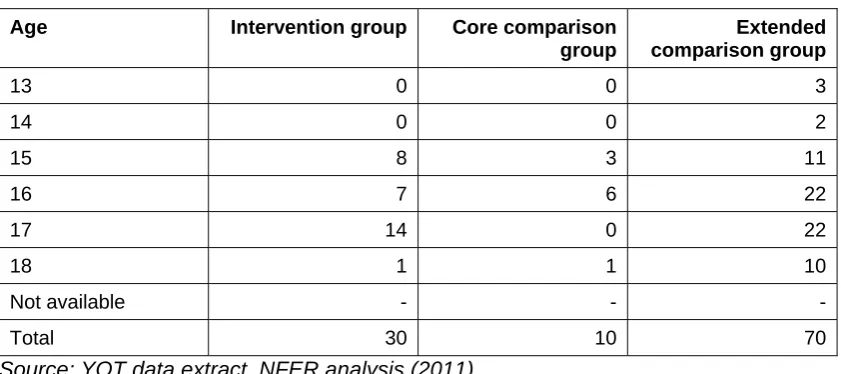
The majority (35 of 39) of the sample were male while 2 were female and the
gender of the other 2 was not known. The majority (27) were described as
White British.
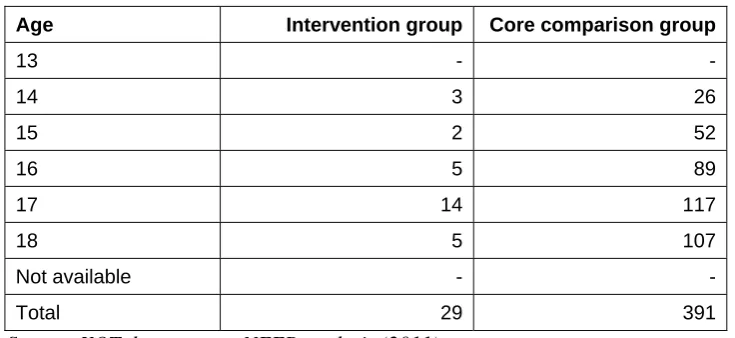
Table 5.1: Sample age profile
Age Intervention group Core comparison
group
Extended comparison group
13 - -
-14 - -
-15 4 2 1
16 3 5 0
17 8 5 2
18 2 3 0
Not available - - 4
Total 17 15 7
Source: YOT data extract, NFER analysis (2011)
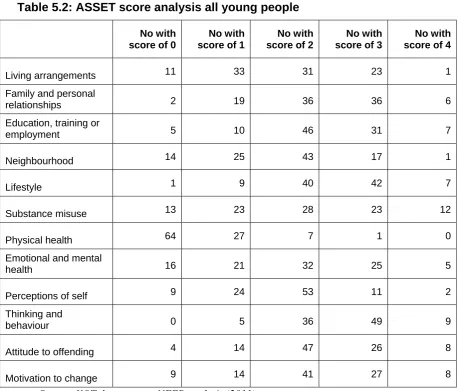
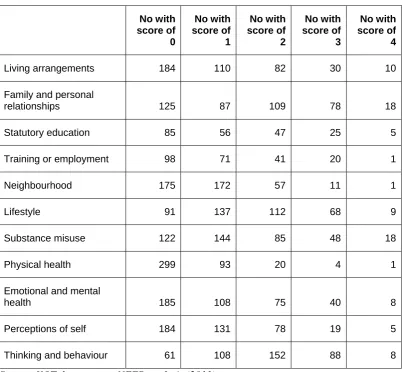
The Asset scores for each category for the sample of 39 young people before
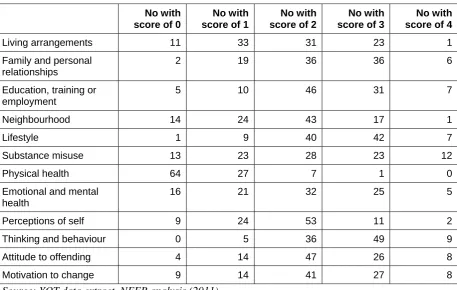
Table 5.2: ASSET score analysis all young people
No with score of 0
No with score of 1
No with score of 2
No with score of 3
No with score of 4
Living arrangements 11 33 31 23 1
Family and personal
relationships 2 19 36 36 6
Education, training or
employment 5 10 46 31 7
Neighbourhood 14 25 43 17 1
Lifestyle 1 9 40 42 7
Substance misuse 13 23 28 23 12
Physical health 64 27 7 1 0
Emotional and mental
health 16 21 32 25 5
Perceptions of self 9 24 53 11 2
Thinking and
behaviour 0 5 36 49 9
Attitude to offending 4 14 47 26 8
Motivation to change 9 14 41 27 8
Source: YOT data extract, NFER analysis (2011)
Around half of the sample were assessed as having an Asset score of 3 or
more in relation to family and personal relationships, lifestyle, substance
misuse, thinking and behaviour, attitude to offending and motivation to
change.
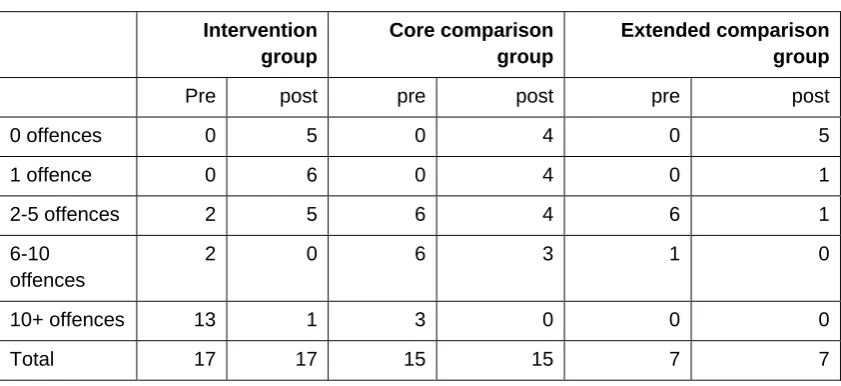
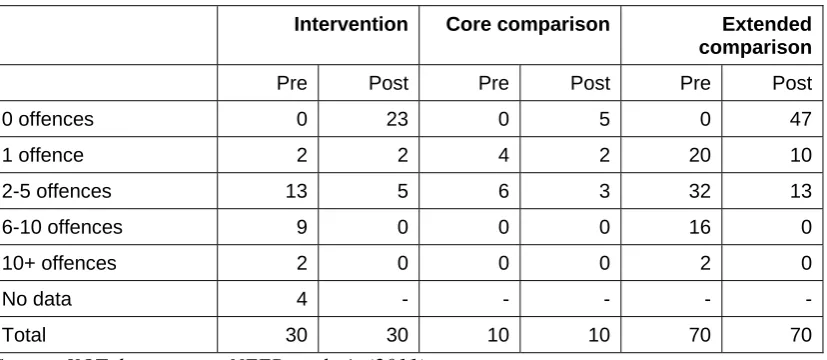
Table 5.3: Number of offences committed by group of young people
Intervention group
Core comparison group
Extended comparison group
Pre post pre post pre post
0 offences 0 5 0 4 0 5
1 offence 0 6 0 4 0 1
2-5 offences 2 5 6 4 6 1
6-10 offences
2 0 6 3 1 0
10+ offences 13 1 3 0 0 0
Total 17 17 15 15 7 7
Source: YOT data extract, NFER analysis (2011)
Most of the young people in the intervention group (15 young people) had
committed more than 6 offences before the intervention. This was a higher
percentage of the group than the core or extended comparison groups. Five
of the young people in the intervention group committed no offences after the
intervention, 6 offended once and 1 committed more than 10 offences. The
figures for the intervention group compared well with those for the core
comparison group (where 8 out of 15 young people committed 1 offence or
less) but contrasted with 6 of the 7 in the extended comparison group who
committed one offence or less).
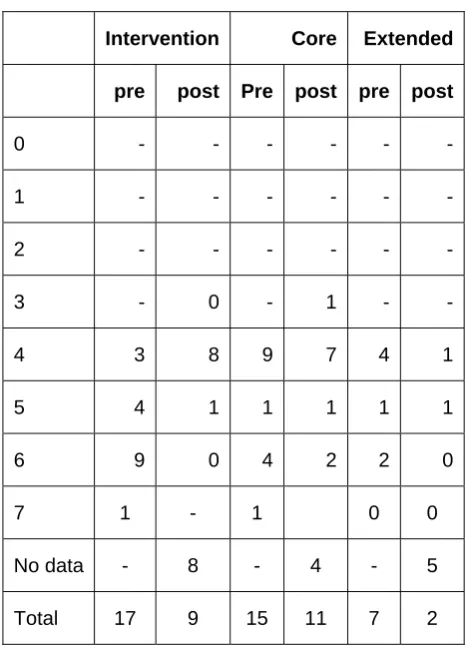
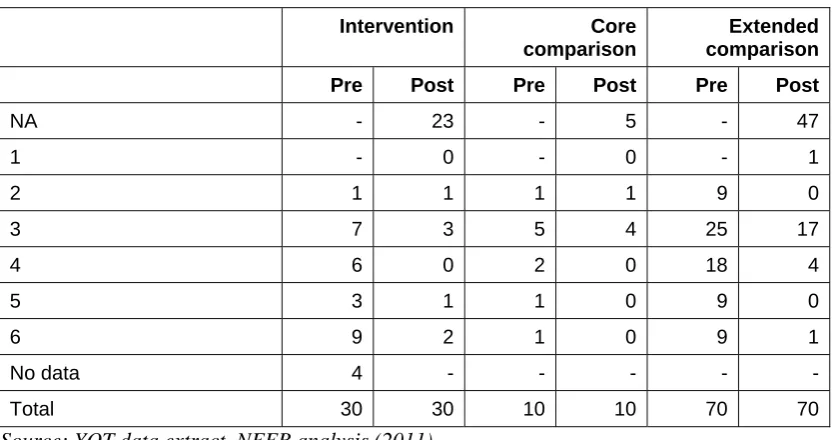
The maximum gravity of the offences committed by the young people before
Table 5.4: Maximum gravity of offences by group of young people
Intervention Core Extended
pre post Pre post pre post
0 - - -
-1 - - -
-2 - - -
-3 - 0 - 1 -
-4 3 8 9 7 4 1
5 4 1 1 1 1 1
6 9 0 4 2 2 0
7 1 - 1 0 0
No data - 8 - 4 - 5
Total 17 9 15 11 7 2
Source: YOT data extract, NFER analysis (2011)
The nature of the young people in the intervention group meant that they were
the most serious offenders before the intervention. The young people in the
intervention group were the most likely to commit the most serious offences
(gravity of 6 or higher) than the comparison group. After the intervention only
one of the young people in the intervention committed an offence of a gravity
of 5 or higher. This compared to 3 of the 15 in the core comparison group.
One of the young people in the intervention group committed an offence with
a gravity of 5.
5.7 Conclusion
The evidence from YOT 2 would suggest that ensuring a specific focus on
resettlement though a dedicated RSP had contributed to raising awareness of
the needs of the young people concerned and that it had helped to promote
to the way that relevant stakeholders had engaged with the RSP’s work and
their willingness to contribute resources. For resettlement to work, it needed
to be valued and recognised as important by those with sufficient seniority in
the relevant responsible organisations. The enhanced review function had
contributed to resettlement by providing a focused and informed discussion of
the issues concerned. However it is not evident what additional information
was shared or whether it was the intensity with which cases were discussed
that contributed to the effectiveness of the enhanced review body.
Resettlement work had benefited from the fact that a recognised and
experienced officer had been allocated responsibility who was able to
intervene and advocate on behalf of the young people concerned. As was
noted in the case study, this included ensuring effective communication
between key stakeholders.
The resettlement process within YOT 2 benefited from the fact that the
members of the RSP attended on a regular basis and took the time to work
together to develop appropriate responses to the needs of the young people
for whom they were responsible.
Key findings: YOT 2
The RSP: set up and functioning
RSP meetings were held separately from other processes at YOT 2. They aimed to reduce the use of custody for young offenders, to raise
understanding of good practice in young people’s resettlement, foster inter-agency working around resettlement, and to identify gaps in resettlement provision. Meetings were used to discuss young people currently in custody and those in the community who had received non-custodial sentences. Members felt that panel meetings worked well overall. They saw key partners as committed to attend meetings and to facilitate resettlement support.
Membership of the RSP had expanded over the course of the pilot.
The resettlement support worker