(2008)
www.electrochemsci.org
Poly (Alanine) Modified Carbon Paste Electrode for
Simultaneous Detection of Dopamine and Ascorbic Acid
Ongera Gilbert1, Umesh Chandra1, B.E.Kumara Swamy1,*, M.Panduranga Char1
, C.Nagaraj1 and B.S.Sherigara1
1 Dept. of P.G. Studies and Research in Industrial Chemistry, Kuvempu University, Shankaraghatta
-577 451,Shimoga, Karnataka, India.
2 Department of Chemistry, SSMRV Degree College, Jayanagar, Bangalore ,Karnataka, India *E-mail: [email protected]
Received: 22 July 2008 / Accepted: 11 August 2008 / Published: 8 September 2008
A carbon paste electrode modified with DL-alanine was investigated. The poly (alanine) modified carbon paste electrode (MCPE) showed excellent electrocatalytic effect on the oxidation of dopamine (DA) and ascorbic acid (AA). Favourable electrostatic interaction between negatively charged poly (alanine) film and cationic species of DA or anionic species of AA may mainly contribute to the response of DA and AA at this electrode. The anodic peaks of AA and DA were separated at about 204 mV at the poly (alanine) MCPE. Thus DA and AAcan be determined.
Keywords: Electropolymerisation; dopamine; ascorbic acid; DL-alanine; cyclic voltammetry
1. INTRODUCTION
Polymer modified electrodes (PMEs) have received great attention in recent years, as the polymer film have good stability, reproducibility, more active sites, homogeneity in electrochemical deposition and strong adherence to the electrode surface [1,2]. Electropolymerisation is a good approach to immobilize polymers to prepare PMEs. Carbon based electrodes have been used. Among them, glassy carbon electrodes (GCEs) have been widely used compared to metal electrodes due to its biocompatibility, having low residual current over a wide range and having minimal chances to show deteriorated response as a result of electrode fouling [3-5].
common cold, mental illness, cancer and Aids [8]. In mammalian brain DA and AA coexists in the extracellular fluids. Thus the simultaneous determination of DA and AA is of critical importance in the field of biochemistry and medical treatment. Among various determination methods includes ultraviolet spectroscopy (UV) [9,10], high performance liquid chromatography (HPLC) [11,12] and capillary electrophoresis (CE) [13]. Electrochemical approaches [14-16] have obtained considerable attention for their high sensitivity and selectivity, especially for the in-vivo detection of neurotransmitter. However the problem associated with this approach is mutual interferences between DA and AA at bare electrode. This is because DA and AA are oxidized at near same potential at this electrode, which results in an overlapped voltammetric response. It is thus impossible to discriminate DA from AA by the electrochemical method at a bare electrode. Most studies contribute to the determination of DA by eliminating the interference of AA. A permselective film or composite, such as nafion [14,15] stearic acid [16,17] calix compound [18] guaiacol derivatives [19] zeolite [20] and clay [21,22]. Another alternative is to determine DA by separating the DA oxidative potential response from that of AA by using carbon nanotubes [23] pyrimidine compounds [24] ferrocene derivatives [25] and polycatechol sulfonephthalein [26]. Besides the above, fast cyclic voltammetry [27,28] has been used in the determination of DA by suppressing the oxidative current response of AA. A recessed microdisk [29] and a powder microelectrode [30] have been successively employed in separation between the redox potentials of DA and AA. In addition there were reports of using sulfosalicylic acid [31] amino benzoic acid [32] pyrolle [33] L-methionine [34] toluidine blue [35] as monomer to fabricate a modified electrode for the simultaneous determination of DA and AA. As part of our study on the development of new electrochemical sensors for the determination of DA and AA [36-38]. The present work describes an electropolymerisation film of DL-alanine on the surface of carbon paste electrode by cyclic Voltammetric technique. On the basis of its different electrochemical behaviour the poly (alanine) MCPE enhanced the redox peak current of DA at its low concentration in the presence of high concentration of AA. The separation of the oxidation peak potential of DA and AA was 204 mV by cyclic voltammetry. Thus the present study provides a novel method for selective and sensitive detection of DA in the presence of AA, which has a significant attraction in biological and chemical fields.
2. EXPERIMENTAL PART
2.1. Reagents
Dopamine hydrochloride, ascorbic acid, DL-alanine was obtained from Himedia chemical company and were used as received. All other chemicals were of analytical grade. The acetate buffer solution (ABS) was prepared by mixing standard stock solutions of 0.2 M CH3COOH and CH3COONa
and adjusting the pH with 0.2 M CH3COOH or 0.2 M NaOH. Freshly prepared solutions of DA, and
2.2. Apparatus
Voltammetric measurements were performed with EA-201 Electro Analyser Chemilink systems controlled by a personal computer. A conventional three electrode cell was used with a saturated calomel electrode (SCE) as a reference, a platinum wire counter electrode and a bare or poly (alanine) modified electrode as working electrode. The pH values were measured with a digital pH meter MK VI (systronics).
2.3. Preparation of bare carbon paste electrode
The bare CPE was prepared by hand mixing of graphite powder and silicon oil at a ratio 70:30 (w/w) in an agate mortar until a homogenous paste was obtained. The paste was then tightly packed into a PVC tube (3mm internal diameter) and the electrical contact was provided by a copper wire connected to the end of the tube.
2.4. Preparation of poly (alanine) modified electrode
The paste packing procedure was same as that at the bare carbon paste electrode. Electrochemical polymerizations of DL-alanine at the carbon paste electrode was done by using cyclic voltammetric method in aqueous solution containing 1mM glycine in 0.2 M acetate buffer solution pH 7.0. Electropolymerisation was achieved by the formation of film that grew between –100 mV to 1400 mV at a scan rate of 50 mV/s for 5 cycles using cyclic voltammetry.
3. RESULTS AND DISCUSSION
3.1. Electropolymerisation of DL-alanine at the surface of carbon paste electrode
The electropolymerisation of DL-alanine on the surface of carbon paste electrode was investigated by cyclic voltammetry, which is shown in fig.1. The potential scan range especially the positive potential, was the most important factor for preparing the polymer film. If positive potential value for polymerization was below 1000 mV or negative one was above –100 mV there was no polymer formation on the surface of the electrode. When the positive potential value reached 1200 mV the electropolymerisation was observed. The experimental results showed that a better conductive polymeric film could be formed when potential scan window was from –100 mV to 1400 mV. Therefore we selected it for electropolymerisation potential window in this work.
poly (alanine) MCPE was carefully rinsed with double distilled water and was used for electrochemical analysis.
Figure 1. Cyclic voltammograms for 1mM DL-alanine recorded with bare CPE in 0.2 M ABS (pH 7.0) scan rate 50 mV/s
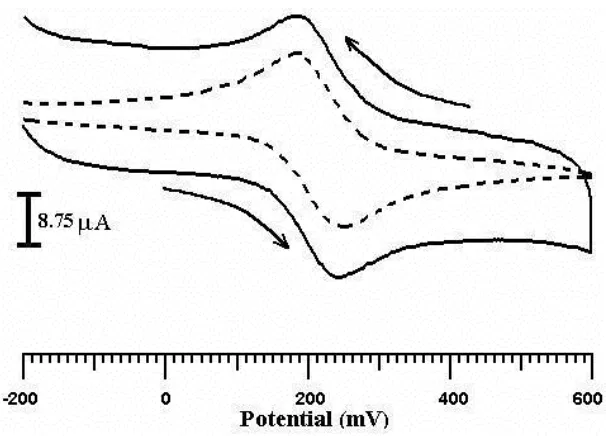
Figure 2. Cyclic voltammograms obtained for the electrochemical response of 1 mM K4 [Fe (CN) 6] at
[image:4.612.182.485.444.662.2]3.2. Electrochemical characterization of the modified electrode
Cyclic voltammetry was used to estimate the electroactive surface of the modified electrode. Fig.2 represents the CVs of bare CPE (dashed line curve) and poly (alanine) MCPE, which were recorded in 1mM K4 [Fe (CN) 6] solution containing 1 M KCl at a scan rate of 50 mV/s. Well defined
oxidation and reduction peaks due to the Fe2+/Fe3+ redox couple were observed. It could be seen from
fig.2 that the peak-to-peak separation of bare CPE (61 mV) is larger than that of the poly (alanine) MCPE (54 mV). This may be ascribed to the higher electrochemical activity of the poly (alanine) MCPE. Compared with the bare CPE the peak current at poly (alanine) MCPE increased and was 2.0 times of that on bare CPE. Due to increased peak current the modified electrode possesses the highest electrocatalytic activity [39, 40].
3.3. Electrochemical oxidation of AA at the poly (alanine) MCPE
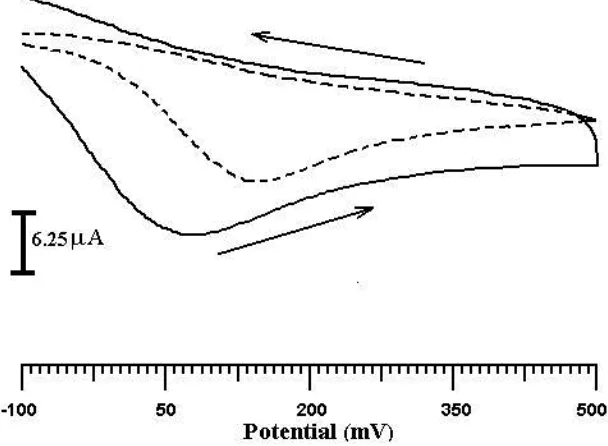
Fig.3 shows the cyclic voltammograms of AA at the bare CPE (dashed line curve) and poly (alanine) MCPE. At the bare CPE the oxidation peak occur at around 142 mV. Oxidation of AA at bare electrode is generally believed to be totally irreversible and requires high overpotential due to fouling of the electrode by the adsorption of oxidized product of AA [41]. However at the poly (alanine) MCPE, the oxidation peak potential of AA was obtained at around 71 mV which is shifted to less positive potential as compared to that of bare CPE, indicating that the poly (alanine) film on the electrode surface favours the oxidation process of AA.This film prevents the fouling of the electrode surface, hence faster electron transfer kinetics of AA at the poly (alanine) MCPE. Since the oxidation peak of AA is shifted to less positive potential it would not interfere with the measurement of DA
[image:5.612.169.473.455.678.2]3.4. Electrocatalytic oxidation of DA at poly (alanine) MCPE
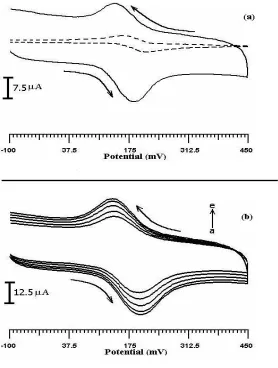
The electrochemical behavior of DA at the poly (alanine) MCPE was investigated using cyclic voltammetry and the cyclic voltammograms are shown in fig4a At the bare CPE the cyclic voltammogram of DA (dashed line curve) showed a pair of redox peak with the anodic peak potential at 218 mV and the cathodic peak potential at 164 mV in pH 7.0 ABS. The peak-to-peak separation was 54 mV. However for the poly (alanine) MCPE the anodic peak was located at 188 mV which was negatively shifted by 30 mV and the corresponding cathodic peak potential was located at 143 mV which was negatively shifted by 21 mV. The peak-to-peak separation was calculated as 45 mV. The results of the enhancement of the peak current showed the excellent catalytic a ability of poly (alanine) MCPE
Fig.4b shows the cyclic voltammograms of 0.1 mM DA on Poly (alanine) MCPE at different scan rates. With the increase of the scan rate, the redox peak currents also increased gradually. The relationship of the redox peak current with the scan rate was constructed and the results are shown in fig4c.In the range from 60-100 mV/s the redox peak currents were proportional to the square root of the scan rate, which indicate the electron transfer reaction was diffusion controlled.
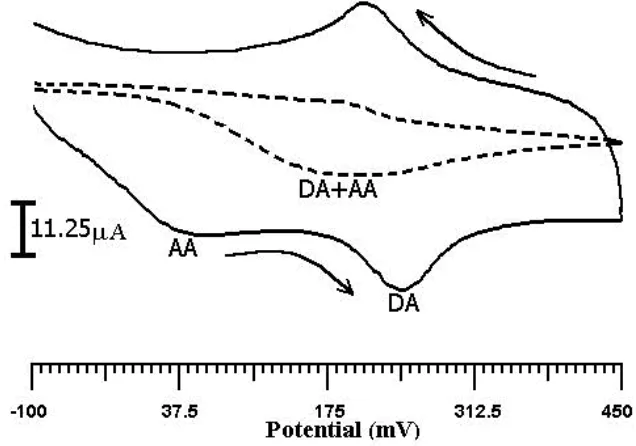
Figure 5. Cyclic voltammograms obtained at bare CPE (dashed line curve) and poly (alanine) MCPE (solid line curve) in 0.2 M ABS (pH 7.0) containing a mixture of 0.1 mM DA and 1 mM AA. Scan rate 50 mV/s.
3.5. Simultaneous detection of DA in the presence of AA at poly (alanine) MCPE
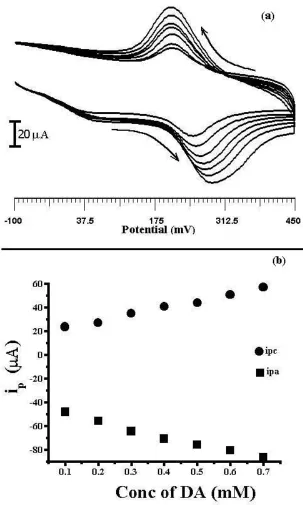
[image:7.612.150.468.338.561.2]Figure 6. (a) Cyclic voltammograms obtained at the poly (alanine) MCPE in 0.2 M ABS pH 7.0 containing 1mM AA and DA with different concentrations (a) 0.1 (b) 0.2 (c) 0.3 (d) 0.4 (e) 0.5 (f) 0.6 (g) 0.7 mM at a scan rate of 50 mV/s (b) plot of redox peak current of DA verses concentration.
[image:8.612.173.476.68.573.2]peak for DA and AA.Therefore it is impossible to use bare electrode for the voltammetric determination of DA in the presence of AA. Moreover the poly (alanine) MCPE resolved the voltammetric signal into two well defined voltammetric peaks at 41mV and 245mV corresponding to AA and DA respectively (solid line curve) This is because AA exists as anions in the pH 7.0 ABS, hence the electrostatic repulsion between the AA anions and the negatively charged groups on the electrode surface retarded the electron transfer and shifted the oxidation potential of AA towards more negative value so that the oxidation peak of DA could be separated from that of AA. As the oxidation potential of AA is readily oxidized well before the oxidation potential of DA is reached. Thus the catalytic oxidation of AA is possible at the poly (alanine) MCPE. The separation between the oxidative peaks of DA and AA was approximately 204 mV; hence the simultaneous determination of DA in the presence of ascorbic acid is feasible at the poly (alanine) MCPE.
3.6. Effect of DA concentration in the presence of AA at Poly (alanine) MCPE
Fig.6a shows the CVs at the poly (alanine) MCPE for 1 mM AA and DA at different concentrations in pH 7.0, 0.2 M ABS at a scan rate 50 mV/s. As show in fig.6b the anodic and cathodic peak current of DA increases with increase in concentration while the anodic peak current of AA remains constant due to its constant concentration in the experiment. Therefore the poly (alanine) MCPE showed its good selectivity and sensitivity in the electrochemical detection of DA in the presence of AA
4. CONCLUSIONS
This study has indicated that poly (alanine) MCPE exhibits highly electrocatalytic activity towards the oxidation of dopamine and ascorbic acid. The results also indicated that the problem of the overlapped voltammetric responses of DA with AA, due to their coexistence in real biological matrixes can be effectively overcome by use of poly (alanine) MCPE. The modified electrode has a good selectivity, sensitivity and reproducibility. With it’s low cost and easy of preparation, the poly (alanine) MCPE seems to be of great utility for further sensor development.
References
1. Y.Ohnuki, T.Ohsaka, H.Matsuda, N.Oyama, J.Electroanal.Chem. 158 (1983) 55. 2. A.Volkov, G.Tourillon, P.C.Lacaze, J.E.Dubois, J.Electroanal. Chem. 115 (1980) 279. 3. R.F.Rane, C.D.Blaha, Langmuir. 6 (1990) 56.
4. A.G.Ewing, M.A.Dayton, R.M.Wightman, Anal. Chem. 53 (1981) 1842 5. J.S.Mattson,T.T.Jones, Anal.Chem. 48 (1976) 2164.
7. R.D.O’Neill, Analyst. 119 (1994) 767.
8. O.Arrgoni,C.D.Tullio, Biochem.Biophys.Acta 1569 (2002) 1.
9. L.Zhang,N.Teshima,T.Hasebe, M.Kurihara, T.Kawashima, Talanta 50 (1999) 677. 10. M.Zhu,X.Huang,J.Li,H.Shen, Anal.Chim.Acta 357 (1997) 261.
11. G.Aymard, B.Labarthe, D.Warot, I.bertin, B.Diquet, J.Chromatogr. B.Biomed. Appl. 744 (2000) 25.
12. Y.Wang,D.S.Fice,P.K.F.Yeung, J.Pharm.Biomed.Anal. 21 (1999) 591. 13. G.Li, Z.Zhang, X.Chen, Z.Hu, Z.Zhao, M.Hooper, Talanta 48 (1999) 1023. 14. D.M.Zhou,H.X.Ju, H.Y.Chen, J.Electroanal. Chem. 408 (1999) 219. 15. H.Ramzi,M.Agazadeh,B.Habibi, J.Electroanal. Chem. 547 (2003) 25. 16. C.D.Blaha,D.Liu,A.G.Phillips, Biosens.Bioelectron. 11 (1996) 63.
17. D.P.Nikolelis, S.S.E.Petropoulou, E.Pergel, K.Toth, Electroanalysis 14 (2002) 783. 18. D.P.Nikolelis, S.S.E.Petropoulou, Biochim. Biophys. Acta. 1558 (2002) 238. 19. G.Milczarek, A.Ciszewski, Electroanalysis 15 (2003) 529.
20. J.Wang, A.Walcurius, J.Electroanal.Chem. 407 (1996) 183.
21. J.M.Zen,W.M.Wang,G.Tlangovan, Anal.Chim.Acta. 372 (1998) 315. 22. M.Lasroix,P.Bianco,E.Lojou, Electroanalysis 11 (1999) 1068.
23. Z.H.Wang, Q.L.Liang,Y.M.Wang, G.S.Luo, J.Electroanal.Chem. 540 (2003) 129. 24. M.Chen, H.L.Li, Electroanalysis 10 (1998) 477.
25. M.H.Pournaghi-Azar, K.Ojani, Talanta 42 (1995) 1839. 26. C.X.Cai, K.H.Xue, Microchem.J. 61 (1999) 183.
27. P.S.Cahill, Q.D.Walker, J.M.Finnegan, G.E.Mickelson, E.R.Travis, R.M.Wightman, Anal.Chem. 68 (1996) 3180
28. R.M.Ventron, K.D.Troyger, Anal.Chem. 74 (2002) 183.
29. W.R.Vandaveer, D.J.Woodward, I.Fristch, Electrochim.Acta. 48 (2003) 3341 30. J.Chen, Q.S.Cha, J.Electroanal.Chem. 463 (1999) 93.
31. H.Zhao, Y.Z.Zhang, Z.B.Yuan, Z.B.Yuan, Anal.Chim.Acta.441 (2001) 117 32. F.Xu, M.N.Gao, L.Wang, G.Y.Shi, W.Zhang, L.T.Jin, Talanta 55 (2001) 329. 33. T.F.Kang, G.L.Shen, R.Q.Yu, Talanta. 43 (1996) 2007.
34. W.Ma, D.M.Sun, Russ. J. Electrochem. 43 (2008) 1382. 35. Y.Chen, J.Yuan, X.Wang, C.Tian, Anal. Sci. 20 (2004) 1725. 36. B.E.Kumara Swamy, B.J.Ventron, Analyst 132 (2007) 876.
37. E.Niranjana, R.Raghavendra Naik, B.E.Kumara Swamy, B.S.Sherigara and H.Jayadevappa, Int. J. Electrochem. Sci. 2 (2007) 923.
38. Umesh Chandra, Ongera Gilbert, B.E. Kumara Swamy, Yadav D Bodke and B.S. Sherigara Int. J. Electrochem. Sci. 3 (2008) 1044
39. Laviron, J.Electroanal.Chem. 100 (1979) 263. 40. E.Laviron, J.Electroanal.Chem. 101 (1979) 19.
41. P.R.Roy,T.Okajima,T.Ohsaka, Bioelectrochem. 59 (2003) 11.