Copyright 0 1993 by the Genetics Society of America
Maintenance of Genetic Variability Under Strong Stabilizing Selection:
A Two-Locus
Model
Sergey Gavrilets*.t and Alan Hastings*’*?§
*Division of Environmental Studies, University of Calijornia, Davis, Calijornia 95616, ?N. I . Vavilov Institute
of
General Genetics, 11 7809 GSP-1, Moscow B-333, Russia, %Institute fo r Theoretical Dynamics, University of Calqornia, Davis, Cal$ornia 95616, and%enter f o r Population Biology, University of Calgornia, Davis, Calijornia 95616
Manuscript received November 9, 1992 Accepted for publication January 27, 1993
ABSTRACT
We study a two locus model with additive contributions to the phenotype to explore the relationship between stabilizing selection and recombination. We show that if the double heterozygote has the optimum phenotype and the contributions of the loci to the trait are different, then any symmetric stabilizing selection fitness function can maintain genetic variability provided selection is sufficiently strong relative to linkage. We present results of a detailed analysis of the quadratic fitness function which show that selection need not be extremely strong relative to recombination for the polymorphic equilibria to be stable. At these polymorphic equilibria the mean value of the trait, in general, is not equal to the optimum phenotype, there exists a large level of negative linkage disequilibrium which “hides” additive genetic variance, and different equilibria can be stable simultaneously. We analyze dependence of different characteristics of these equilibria on the location of optimum phenotype, on the difference in allelic effect, and on the strength of selection relative to recombination. Our overall result that stabilizing selection does not necessarily eliminate genetic variability is compatible with
some experimental results where the lines subject to strong stabilizing selection did not have significant reductions in genetic variability.
S
INCE the classical papers by WRIGHT (1935) andROBERTSON (1 956) there has been a general belief that in the absence of other factors stabilizing selection on an additive character cannot maintain genetic var- iability in more than one locus. T o explain the main- tenance of genetic variability observed in natural pop- ulation, which presumably are under stabilizing selec- tion, a number of models with additional factors have
been proposed. These factors include dominance, mu-
tation, epistasis, pleiotropy, genotype-environment in-
teraction, migration (e.g., KOJIMA 1959; LEWONTIN
1964; BULMER 1973; LANDE 1975; GILLESPIE and
TURELLI 1989; GIMELFARB 1989, 1992; HASTINCS
and HOM 1990; GAVRILETS and DE JONG 1993; ZHI-
VOTOVSKY and GAVRILETS 1992). Analytical studies and most of the numerical studies of stabilizing selec- tion on a single additive character that have been
done incorporate simplifying assumptions such as
weak selection approximation, equal contributions of loci to the character or optimal phenotype equal that of the completely heterozygous individual. Numerical
results by GALE and KEARSEY (1968) and KEARSEY
and GALE (1 968) suggested, however, that relaxation of these assumptions can cause new effects. These authors demonstrated that strong “triangular” stabi- lizing selection on an additive trait can maintain vari- ability in two and three loci if the effects of the loci
are different. Analysis of the stabilizing selection on
Genrtirs 134: 3177-386 ( M a y . 19931)
an additive character under broader assumptions has been started in several recent papers. Using a weak selection approximation ( i e . , assuming no linkage dis-
equilibrium), NAGYLAKI (1989) showed that if the
contributions of two diallelic loci to an additive trait are sufficiently different, some forms of stabilizing selection can maintain variability in both loci. HAST- INGS and HOM (1 990) used the weak selection approx-
imation assuming that the contributions of loci are different and that the optimal phenotype is different from the phenotype of a complete heterozygote. They
found that monomorphic equilibria and equilibria
with one locus polymorphic can be stable simultane- ously. GAVRILETS (1993) applied both the weak selec- tion approximation and a strong selection approxi- mation to a two-locus epistatic viability model with equivalent loci. He showed that moderate changes in the strength of selection relative to recombination can cause significant changes in quantitative and qualita-
tive characteristics of equilibria.
In this paper we consider these effects simultane- ously and show that some surprising results emerge. In particular, we show that if stabilizing selection on a single additive character is sufficiently strong rela- tive to recombination, genetic polymorphism can be maintained provided contributions of the loci to the character are not equal. The structure of this paper
general model of stabilizing selection on an additive trait controlled by t w o diallelic loci. Then we present detailed analysis of the case of quadratic stabilizing selection. We determine exact conditions for existence and stability of monomorphic equilibria and equilibria with one locus polymorphic. We present results of the approximate analysis of equilibria with t wo polymor- phic loci. We demonstrate that such equilibria exist and can be stable. In the final section, we discuss quantitative genetics implications of our results.
GENERAL MODEL
Let an additive quantitative trait be controlled by
t w o diallelic loci. We shall use the notation from HASTINCS and HOM (1 990). Assume that the alleles at locus i have effects a,/2 and -a,/2, and that a, # 0. We designate the larger of the a, as a i and, without
loss of generality, assume that a 1 = 1. Let x I , xq, x:3 and x4 be the frequencies of the gametes with the effects z l = ( 1
+
a q ) / 2 , z., = (1 - a q ) / 2 , z:4 =(-1
+
4 / 2 and z4 = (-1 - a2)/2 on the trait. We assume that the fitness depends only on genotypic value so that the fitness, U I , ~ : of an individual formedby gametes i and j and havlng phenotype z,
+
z, can be represented asw,/ = w(z,
+
5). (1) We assume that the fitness function w ( z ) has its opti- mum at zO, which in general, is not zero; we scale w ( z )so that w(z,,) = 1. We suppose that w ( z ) decreases monotonically from its optimum. Let wi =
x,
wl,xl andW
= w,x, be the marginal fitness of gamete i and the mean fitness of the population, respectively. T h e dy- namics of the gamete frequencies under selection and recombination are described by the standard relationswhere r is the recombination rate, D = x1x4
-
X ~ X : ~ is the standard linkage disequilibrium, and w i 4 is the fitness of a heterozygote at both loci, w I 4 = w ( 0 ) . In (2) the sign is minus for i = 1 and 4 and is plus for i= 2 or 3.
I t has been repeatedly remarked (e.g., HASTINCS
1987; BURGER 1989; NACYLAKI 1989) that if a double heterozygote has the optimum phenotype, ie., z,, = 0,
and fitness function is symmetric, i . e . , w(z
-
zll) =w ( q I
-
I), the model of stabilizing selection on an additive trait reduces to the symmetric viability model analyzed in a number of papers (e.g., BODMER and FELSENSTEIN 1967; KARLIN and FELDMAN 1970). One of the properties of this model is existence of a locallystable polymorphic equilibrium under sufficiently
tight linkage (KARLIN and FELDMAN 1970). Restating this in terms of a model of stabilizing selection we
have the following result.
I f the contributions of the loci to the trait are d#erent and the stabilizing selection fitness function has its opti- mum at the phenotypic value of a heterozygote and is
symmetric about it, then f o r linkage sufficiently tight rela-
tive to selection there always exists a locally stable equilib- rium polymorphic at both loci.
In general, for tight linkage it is possible to have more than one stable polymorphic equilibrium, and the equilibria with tw o loci polymorphic can be stable simultaneously with other equilibria. If z0 # 0, then one cannot use the results on the symmetric viability model. Nevertheless, as we shall show below, in some cases the conclusion about existence of a locally stable polymorphic equilibrium under tight linkage is still valid. T h e result presented in this section assumes that linkage is sufficiently tight relative to the strength of selection; the proof is based on the assumption that the ratio r / s is much less than unity [see KARLIN and FELDMAN (197O)l. In this paper, we argue that the conclusion about the maintenance of genetic variabil- ity under stabilizing selection on an additive trait is valid even if selection is not extremely strong or
equivalently if linkage is not extremely tight. T o dem- onstrate this we shall analyze the simplest (from an analytical point of view) class of stabilizing selection fitness functions, namely quadratic fitness functions.
QUADRATIC: STABILIZING SELECTION
Let the fitness function w ( z ) be a quadratic
w ( z ) = 1
-
s(z-
zo)', (3)where s is the parameter measuring the strength of selection, and zo is the optimum phenotype which, in general, is not zero. T h e model (2) has two types of equilibria: equilibria with D = 0 and equilibria with D # 0; we shall consider them separately. At an equilib- rium with
D
= 0 either w, =W
o r x, = 0. T h e system(2) with fitnesses (3) has eight equilibria with D = 0: four equilibria with only a single gamete represented in the population and four equilibria with two gametes present.
Stability of monomorphic equilibria: T h e equilib- ria with a single gamete, at which both loci are fixed, always exist. T h e conditions for stability can be found by excluding one of the gamete frequencies using the relation x I
+
x q+
xg+
xq = 1 and calculating the eigenvalues of the corresponding (3 X 3)-matrix V =(d(Ax,)/dx,) (cf: BODMER and FELSENSTEIN 1967). That
was done using Mathematica software (WOLFRAM
1988). An equilibrium is stable if the modulus of all
Strong Stabilizing Selection 379
x i
+
A x i are less in modulus than unity.) We will designate the equilibria by the vector of gamete fre- quencies. T h e conditions for stability of the equilibria with a single gamete present are as follows. For the equilibrium (1 ,O,O,O), the stability condition iszO
>
'/2+
a2 and z0>
1+
a2/2, (4a)" ~ ~ 1
+
4S( 1+
(~2)(1+
ap-
2 ~ 0 )<
0. (4b)For the equilibrium (0,l ,O,O), the stability condition is
For the equilibrium (O,O, 1 ,O), the stability condition is
For the equilibrium (O,O,O,l), the stability condition is
zo
<
-%-
a2 and zO<
-1-
(~212, (7a)- T w I ~
+
~ ( l+
( ~ p ) ( l+
up+
2 ~ 0 )<
0. (7b)Note that if selection is very weak relative to recom- bination, i.e., s
<<
r , inequalities 4b, 5b, 6b and 7b are satisfied and the stability depends only on the condi- tions 4a, 5a, 6a and 7a. T h e latter are exactly those found by HASTINCS and HOM (1990) for the case of weak selection. One can show that if equilibrium (1 ,O,O,O) is stable under weak selection (s<<
r ) , it is stable under strong selection ( T<<
s), and vice versa. T h e same conclusion is true for equilibrium (O,O,O,l).I f equilibrium (0,1,0,0) or (0,0,1,0) is stable under strong selection, it is stable under weak selection, b u t the opposite is not necessarily true. These equilibria can become unstable as the strength of selection rel- ative to recombination decreases.
Existence and stability of equilibria with one locus polymorphic: T h e equilibria with two gametes with
D
= 0, at which one of the loci is fixed while the other is polymorphic, are given by(xF,xz,O,O), where x: = -2
+
CY2+
220( X I
*
,O,xg*
,O), where x: = '/2-
a2+
z0,(8b)
*
X J = 1 - x ] ,
*
(O,O,x:,xz), where x: =
2
+
f f p+
2ro2a2 ,
(8c)
*
x4 = 1
-
x 3 ,*
(O,xz,O,x:), where x; = '/2
+
a 2+
ZO,( 8 4
x: = 1
-
x p .*
These equilibria are biologically meaningful, if non- zero gamete frequencies lie between zero and one;
the corresponding conditions are given in [HASTINGS
and HOM (1990), Exps. (8), (12), (6) and (10)). Con-
ditions for stability were found as before ($ BODMER
and FELSENSTEIN 1967). An equilibrium of the form
(8) is stable if it is feasible and the following conditions are satisfied.
At the equilibrium (xT,x~*,O,O) the stability condi- tion is
(1
-
a;)s+
m14(3-
2 4>
0. (9)At the equilibrium (x:,O,x.?,O) the stability condition is
(-1
+
(Y;)(Y2S+
W ] 4 ( 3 f f p-
220)>
0. ( l o )At the equilibrium (O,O,x.?,x?) the stability condition is
(1
-
ffg)S+
rW]4(3 f 2Zo)>
0. (1 1)At the equilibrium (O,xz,O,x:) the stability condition is
(-1
+
a;)(Y*s+
m14(3a*+
2Zo)>
0. (12)Note that if selection is very weak relative to recom- bination, i.e., s
<<
r , the first terms in (9-12) can be neglected and the stability conditions reduce to those given by HASTINGS and HOM [ 1990, Exps. (1 5a), (1 6-IS)]. One can easily see that under strong selection
( r
<<
s) equilibria ( x : , x$,O,O) and (O,O,xs,xz) are stable provided they are feasible, while equilibria(xy,O,xf,O) and (O,x~,O,x,*) cannot be stable. All these equilibria can change their stability with change in the ratio rIs.
Existence and stability of polymorphic equilibria: At polymorphic equilibria
D
# 0. Unfortunately, if zo# 0, these equilibria cannot be found in explicit form. Earlier approximate analysis shows that if selection is very weak relative to recombination, there exists a single equilibrium with two polymorphic loci but it
cannot be stable (e.g., HASTINCS and HOM 1990). Here we shall consider the opposite situation when selection is strong relative to recombination. To demonstrate existence of stable polymorphic equilibria, we shall use two different techniques: regular perturbation analysis and bifurcation analysis.
strong selection: If selection if very strong relative to recombination, one can consider dynamic Equations
(2) assuming that r = 0 (BODMER and FELSENSTEIN
1967; KARLIN and MACGREGOR 1972). If there is no
recombination, dynamics of gamete frequencies are described by
Besides eight equilibria with D = 0, which were ana- lysed in the preceding section, system (13) with fit- nesses (3) has two additional equilibria (cf: BODMER and
EELSENSTEIN
1967): an equilibrium of the formand an equilibrium of the form
(1 4 4
*
x4.0 = 1 - x 1
*
.o.(Here and in what follows, subscripts after commas are used to denote the order of terms in perturbation expansions in terms of r/s.) In general, when the number of loci is two, system (1 3) can have equilibria with three and four gametes. Such equilibria, how- ever, do not exist if fitnesses are given by (3). Equilib- ria ( 14) are biologically meaningful if nonzero gamete frequencies lie between zero and one. T h e equilib- rium (O,x&,,x.&,,O) is feasible if
(1
-
4 2>
Z()>
-( 1-
4 2 . (1 5 )The equilibrium (X~.~),O,O,X&,) is feasible if
(1
+
012)/2>
z g>
-(I+
( ~ 2 ) / 2 . (16)Note that D is negative at equilibrium (O,x&~,x&~,O)
and is positive at equilibrium (x~(),O,O,x&). The con- ditions for stability were found as before. T h e equilib- rium (O,x(T.o,x~~o,O) is stable if it is feasible, while equi- librium ( X ~ , ~ , , O , O , X ~ , ~ , ) cannot be stable. Figure 1 sum-
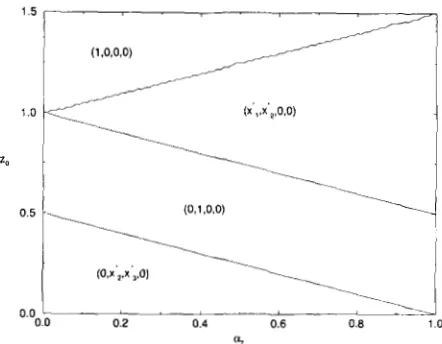
marizes the stability results for the case r = 0. In Figure 1 we divide parameter space, i . e . , possible values for az, the relative effect of the locus of smaller effect on the character, and zo, the optimum pheno- type, into regions corresponding to stability of differ- ent equilibria [$ HASTINGS and HOM (1990), Figure
13. Without loss of generality, we only display the region with zo positive since the results for negative z0
are easily obtained from the results for positive zO,
using the inherent symmetries in the model. This figure shows that in contrast to the weak selection
results (HASTINGS and HOM 1990), under very strong
1.5
1
%
FIGURE I.-Regions of existence and stability of different equi- libria on the (a?, 20) plane for very strong selection ( T / S = 0). T h e
equilibrium that is stable in the corresponding region is designated by the vector of gamete frequencies.
selection different equilibria cannot be stable simul- taneously. Note that
1
1-
LYZ 1/2 is the minimum ofthe contributions of the gametes to the trait value. Thus, genetic variability can be maintained in both loci under very strong (relative to recombination) quadratic stabilizing selection on an additive trait if the deviation of the optimum phenotype from that of the complete heterozygote is less than the minimum of the contributions of the gametes to the trait value. We know, however, that as selection becomes weaker, the completely polymorphic equilibrium loses stabil- ity. I t is of interest to know how different character- istics of the polymorphic equilibria depend on the ratio r / s . To answer this question w e shall use regular perturbations techniques. See HASTINGS (1 985) and GAVRILETS (1992) for other examples of application of this method in analysis of two locus models.
We shall look for polymorphic equilibria of (2) as power series in t 5 r / s :
x,* = X,,()
+
E X ; . ] 4-. .
.) (17)
where as the zero order terms we shall use the equi- librium gamete frequencies from (1 4). At equilibrium the right-hand sides of equations (2) are zero. Substi- tuting (1 7) in ( 2 ) and equating the terms correspond- ing to the same power of E , w e find algebraic equations
from which perturbation terms x,.] can be found. T h e corresponding formulae for the equilibria that reduce to equilibria (O,x~.o,x~,o,O) and (x&,O,O,x&) as 6 + 0 are given in BODMER and FELSENSTEIN (1 967). Below we present first order estimates which were found using Mathematica software (WOLFRAM 1988). All cal- culations are simplified if one uses a linear transfor- mation
Strong Stabilizing Selection 381
Let us consider the equilibrium that reduces to
( O , X ~ , ~ , X ~ , ~ , ~ ) as t + 0. T h e first order estimates for the equilibrium gamete frequencies are
Using (18) we can find first order estimates for the allele frequencies
p , , p 2 ,
linkage disequilibrium D and the normalized linkage disequilibrium D/D,,I.Ix, whereD,,,, is the maximum linkage disequilibrium that is possible at the given allele frequencies, DlllilY =
min{plp2), ( 1
-
pl)(l-
p 2 ) ) . These values are givenby:
(1 9b)
where
pl,o
= x&,p,.,)
= x;*.,. These expressions show that an increase in the ratio r / s causes a shift of allele frequencies from95
and a decrease in the abso- lute value of linkage disequilibrium. Note that since1
D*/DlnLlXI
d 1, the first order analysis gives feasible estimates untilIn the APPENDIX w e show how the regular perturba- tion techniques can be used to get rough estimates for the critical value of the ratio r/s under which the polymorphic equilibrium becomes unstable.
Polymorphic equilibria that bifurcate from mon- omorphic equilibria and equilibria with one locus polymorphic: If selection is very weak relative to recombination ( i e . , t
>>
1) there exist equilibria poly-morphic at both loci which cannot be stable (HASTINGS
and HOM 1990). In the preceding section, we showed that if selection is very strong relative to recombina- tion ( i e . , t
<<
1) there exist two polymorphic equilibriaone of which can be stable. In this section, we shall
show that for moderately strong selection several poly- morphic equilibria exist and at least two of them can be stable simultaneously. As was noted earlier, mon- omorphic equilibria and equilibria with one locus polymorphic that are stable under weak selection can become unstable as selection becomes stronger. When this happens, a new polymorphic equilibrium bifur- cates from the old one. Bifurcation theory provides a means to compute the stability and approximate lo- cation of this new equilibrium. General references for bifurcation theory techniques employed here are
Iooss and JOSEPH (1 98 1) and GUCKENHEIMER and
HOLMES (1 983); for examples of application of these techniques in two locus models see HASTING (1 98 1,
1982, 1985b).
Let us consider monomorphic equilibrium (0,l ,O,O). T o analyze stability of this equilibrium we shall con- sider dynamic equations
(2)
for i = 1, 3 , 4 , substituting 1 - x 1-
x?-
x4 for x2. At this equilibrium the stability matrix V has form1 1 / W 2 2 ?-w I 4 / W 2 2
(
g
( 1 2-
?-w14)/wz2m141w22 1s/w22
: )
where 1, w12
-
tup:! = ~ ~ 4 - 2+
a2+
2 q ) , 12 wI4-
2n2-
2 ~ 0 ) . Assume that condition (5a) is satisfied, i . e . , that 1,<
0, 15<
0. That implies that -2<
l I / w 2 2<
0 and that -2<
&,/w22<
0. In this case, equilibrium (0,l ,0,0) is stable if r>
rr and unstable if r<
r,, where-
w?:! = s(l-
“‘))(I-
“2-
2%0), 19 E w24-
w22 = s(1r, E 1
-
w22/w14(21)
= s(-I
+
(Yp)(-l+
a2+
2zo)/w14(see Expression 5b). Bifurcation theory implies that as
r varies through rr, a second equilibrium whose value
depends on r passes through this fixed monomorphic
equilibrium. To approximate this equilibrium and
find condition for stability the first step is to change variables ( i e . , gamete frequencies) so that the nondi- agonal elements of matrix V are zero at the point where r = rr. A n appropriate change of variables is
x1 = y1
-
2 3 = y r ,
x4 = ys
-
9 2 .Note that negative values of y2 are not biologically
meaningful because then x3 would be negative. T h e next step is to find the coefficient fz2 of y; in the equation for Ay, to use in the bifurcation calculations. Bifurcation theory says that at the new bifurcating equilibrium, to lowest order, the equilibrium values of yl and 9 3 do not change from their values at equilib-
m 1 4
i?]
-
12 m]4 Y2,m 1 4
rium (0,l ,0,0), wile y2 = -(rc
-
r)/f;2. T h e biologicallymeaningful positive polymorphic equilibrium solu- tions occur for r
<
rr and are stable ifj
&
<
0. Calculatingjln value at equilibrium (0,1,0,0), we have(22)
-
CY^-
8zo(l - 012)+
~zZ)].T h e last expression can be used to find whether the bifurcating solution is stable (ie., whetherf;L2
<
0). In particular this is always true for small deviations of z0from 0. Similar techniques can be used to find condi- tions for stability of equilibria that bifurcate from monomorphic equilibrium (O,O, 1,O) and the equilibria with one locus polymorphic. One can show that a pair of polymorphic equilibria that bifurcate from mono- morphic equilibria (0,1,0,0) and (0,0,1,0) can exist and be stable simultaneously. The bifurcating equilib- ria will be discussed further in the section devoted to the case z0 = 0.
Phenotypic effects: In this section we consider how phenotypic variables such as the mean value of the trait, the genotypic variance and its components, and mean fitness of the population at a polymorphic equi- librium depend on the parameters of the model. For simplicity we shall analyze only the polymorphic equi- librium that exists and is stable under very strong selection. At the equilibrium ( ~ , X ~ ~ ) , X . & ) , O ) , to zero order the mean value, i, and the genotypic variance, G , of the trait, the mean fitness of the population and the ratio of G to the genic variance Vg (= 2a]Lp, (1
-
p,))
areis) =
2%).
( 2 3 4G,o = (1 - ( ~ 2 ) ~ ( 1
-
~ ; ) / 2 , (23b)5.0 = 1
-
~ ( l-
a2)’(2-
~ $ / 4 , ( 2 3 ~ )where VI) = x;,,,
-
= 2z0/(l-
ax). Expression 23a shows that in general at this polymorphic equilibrium the mean value of the trait is not equal to the optimum value. Polymorphic equilibria with the mean value of the trait different from the optimum value have also been found in the mutation-selection balance models (BARTON 1986; HASTINGS 1990). Deviation of the optimum phenotype from zero decreases the geno- typic variance maintained under stabilizing selection (see Expression 23b). Expression 23d shows that a substantial amount of additive genetic variance is “hidden” at this equilibrium. T h i s variation will be “released” by recombination if selection is relaxed. Using first order estimates of the gamete frequencies, one can show that to first orderi i . 0
+
- w147 vo
s (1
-
ag)’where i,o, G,() and 6.0 are given by (23). Expression
24b shows that the effect of increase in the ratio r / s
on the genotypic variance depends on the location of optimum phenotype; it increases G for small
I
zo1
and causes the opposite effect for largeI
zoI.
Decrease in recombination rate always causes an increase in the mean fitness (see Expression 24c). Increasing the re- combination rate also reduces the fraction of the genetic variance that is “hidden” by linkage dis- equilibrium.Analysis of the case zo
=
0: As we noted earlier, ifthe optimum phenotype coincides with that of the
complete heterozygote, the model considered above reduces to the two locus symmetric viability model analyzed in a number of papers (e.g., BODMER and FELSENSTEIN 1967; KARLIN and FELDMAN 1970). Ex- act results known for this model can be used to check the validity of our approximations and to get further insight into behavior of our model. If 2 0 = 0, poly-
morphic equilibria of both types that were analyzed above can be found in exact form.
Polymorphic equilibrium that exists under very strong selection: In the symmetric viability model there exists a symmetric polymorphic equilibrium with allele frequencies equal one half and gamete frequencies:
XI = xq =
‘/2
+
D ,xp = X Q = ’/2
-
D ,
where the linkage disequilibrium D is given by
[KARLIN and FELDMAN (1970), Expr. (2.3) with m = 4sa2]. This equilibrium is stable
- 3 p
-
2 4 1+
a;)r+
s‘(1-
>
0 (26)4sa2,
p
= sa;, y = s, a = s(1-
a#, 6 = s(l+
a‘#. [KARLIN and FELDMAN (1970), Expr. (4.5) with m =Strong Stabilizing Selection 383
cies equal one half and linkage disequilibrium
1 r
4
4sa2D
=--
+-
(27)Polymorphic equilibria that bifurcate from mon- omorphic equilibria and equilibria with one locus polymorphic: If z() = 0, monomorphic equilibria (1,0,0,0) and (0,0,0,1) cannot be stable (see Expres- sions 4 and
7).
Monomorphic equilibria (0,I ,O,O) and (O,O, 1 , O ) are simultaneously stable ifa‘
>
Yz, r/s>
(1-
a# (28)(Expressions 5 and 6). Equilibria with one locus poly- morphic ( x ~ , x ~ , O , O ) and (O,O,x.?,x4*), are not feasi- ble (see Expressions 8). Equilibria (x:,O,x:,O) and
(O,xz,O,x:) are feasible, if a‘
<
Yi (Expression 8). These equilibria simultaneously exist and are stable ifa‘
<
Yz, r/s>
(1-
4 ) / 3 (29)(expression 10 and 12). Note that monomorphic equi- libria and equilibria with one locus polymorphic can- not be stable simultaneously. When as a result of decrease in t h e ratio r/s monomorphic equilibria (0,1,0,0) and (O,O, 1,O) or equilibria with one locus polymorphic (x:,O,x?,O) and (O,x?,O,x4*) become un- stable, a new pair of polymorphic equilibria arise. These “unsymmetric” equilibria can be found exactly using formulae given in Appendix 1 of KARLIN and FELDMAN (1 970):
-(I
+
a 2 ) J s ( I-
a)‘- r Ju = +
gray
( 3 0 4
r 2
+
2rs(l+
a:)-
s‘(1-
a:)2sr
1
-
a2 s(1 -I- a2)‘-
r 1+
a‘ s(1-
a‘)’-
rf
v =
--
u , (30b)3r‘
-
4rs(l+
ai)+
s‘(1-
ai)‘t =
4rsa2 ( 3 0 4
where as before u = x ]
-
x4, v = x2-
xg, t = xI+
x4-
x2-
x3. T o see that these “unsymmetric” equilibria bifurcate from monomorphic equilibria (0,l ,O,O) and (0,0,1,0) and equilibria with one locus polymorphic(x:,O,x.f,O) and ( O , x ~ , O , x ~ ) it is sufficient to substitute the critical values of the recombination rate from (28) and (29) for r in (30). T h e resulting values of u , v and
t exactly describe equilibria (0,l ,O,O) and (O,O, 1,O) and
(x:,O,x?,O) and (O,x$,O,x4*). Comparison of (26) with (30) shows that “unsymmetric” equilibria do not exist then the symmetric equilibrium is stable and that they reduce to the symmetric equilibrium then the expres- sion in the left-hand side of (26) equals zero. Thus, each of the two branches of the equilibria given by
0.40
I
I
I 1
r/s
CL.
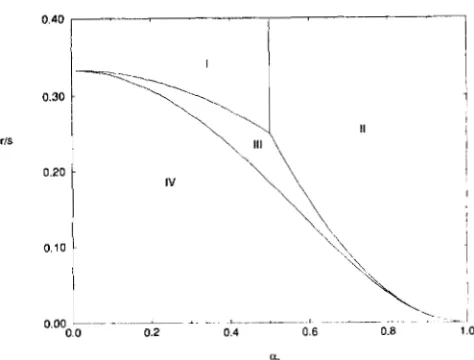
FIGURE 2.-Regions of existence and stability of different equi- libria on the ( a p , T / S ) plane for zo = 0. The roman numerals denote the regions where the following equilibria exist and are stable: I ,
monomorphic equilibria (0,l .O,O) and (0,0,1 ,O); 11, single polymor- phic equilibria (xl,O,xg,O)and (O,x~,0,xq); 111, a pair of“unsymmetric” doubly polymorphic equilibria; IV, “symmetric” doubly polymor- phic equilibrium.
(30) connects a monomorphic equilibrium with an equilibrium with one locus polymorphic bifurcating from them then they become unstable and crosses the symmetric equilibrium at the point where it becomes unstable. This pair of “unsymmetric” equilibria is stable. Figure 2 shows regions of stability of different equilibria. We see that when the symmetric equilib- rium is stable it is the only stable equilibrium, while in other regions the stable equilibria (monomorphic,
with one locus polymorphic, or “unsymmetric” poly-
morphic) occur in pairs. In the latter case results of evolution depend on the initial conditions. The main conclusion that can be drawn from this figure is that selection need not be extremely strong relative to recombination to maintain genetic variability in both loci.
DISCUSSION
selection approximation. This approximation is valid in the strict sense if A / r
<<
1, where A is the maximum difference in fitnesses between genotypes, and r is the recombination rate (NAGYLAKI 1976). In NAGYLAKI’S (1 989) asymptotic results for strong selection on one or both loci, A is about 1, while a necessary condition for the maintenance of variability under Gaussian fitness function, d>
1.3 leads t o A>
1 - e“.92 = 0.8. Hence in these situations even for nonlinked loci the inequality A / r<<
1 is not true. Thus, this analysis still left open the question of the dependence of the pos- sibility of stable multilocus polymorphism on the in- tensity of stabilizing selection.In this paper we have shown that if the double heterozygote has the optimum phenotype and the
contributions of the loci to the trait are different, then any symmetric stabilizing selection fitness function can maintain genetic variability provided selection is suf- ficiently strong relative to linkage. Figure
2
shows that selection need not be extremely strong relative t o recombination for the polymorphic equilibria to be stable. For example, if ap is about 0.5, polymorphism is stable for r / s S‘A.
Genetic variability can be main- tained for small r / s values if zo # 0 provided the deviation of the optimum phenotype from that of a double heterozygote is not very much. A sufficient condition for existence of locally stable polymorphic equilibrium under quadratic stabilizing selection for small r / s values isI
zOI<
(1-
4 / 2 . Decrease i n difference of allelic effects ( i e . , increase in CY.) and increase in1
z o ) both decrease possibility of stable polymorphism. These results seem not to be restricted by the case of quadratic fitness; similar conclusions are valid for other stabilizing selection fitness func- tions. For example, one can show that for linkage sufficiently tight and “triangular” fitness function, w ( z )= 1
-
sI
z-
zoI,
there exists a locally stable polymor- phic equilibrium, providedI
zoI
<
(1-
a2)/2. As r / s+ 0 this equilibrium reduces to an equilibrium in the form (O,x~,x:~,O).
T h e polymorphic equilibria that were analyzed in this paper are characterized by some interesting prop- erties. First, the mean value of the trait at equilibrium is not equal to the optimum phenotype. This means that analysis of a population at such an equilibrium would exhibit a component of apparent directional selection. Second, these equilibria have large levels of negative linkage disequilibrium which “hides” additive genetic variance. The “hidden” genetic variation will be “released” by recombination if selection is relaxed. Third, different equilibria including different poly- morphic equilibria can be stable simultaneously a n d , hence, the outcome of evolution depends on the his- tory. Fourth, increasing the strength of selection can result both in increase or decrease of the genotypic variance. Of special interest is a possibility of increase
in the genotypic variance as a result of increase in the intensity of selection. This can occur, for example, if the population is near a monomorphic equilibrium or an equilibrium with one locus polymorphic and this
equilibrium becomes unstable when selection is
strengthened. Another situation is when the popula- tion is at a stable polymorphic equilibrium and z,,
deviates from zero (see Expression 23 and 24). O u r results show that global characteristics of equilibria significantly depend on relative strength of selection and linkage. For example, there is n o stable polymor- phic equilibrium for very weak selection, one such equilibrium for very strong selection, and several sta- ble polymorphic equilibria for moderately strong se- lection.
O u r overall results here that stabilizing selection does not necessarily eliminate genetic variability are consistent with some experimental results on the ef- fects of applying strong stabilizing selection t o labo- ratory populations. In some of these cases (FALCONER
1957; PROUT 1962), the lines subject to strong stabi- lizing selection did not have significant reductions in genetic variability relative to control lines, which is compatible with the results we have derived here. Note that, in contrast, explanations for the mainte- nance of genetic variability based on mutation selec- tion balance would predict that strong stabilizing se- lection would reduce genetic variability.
We thank THOMAS NAGYLAKI, REINHARD BURGER and an anon-
ymous reviewer for helpful comnlents on the manuscript. This
work was supported by U.S. Public Health Service grant R01 GM 321 30 to A . H .
L I T E R A T U R E C I T E D
BARTON, N . , 1986 The maintenance of genetic variability through a balance between mutation and stabilizing selection. Genet. Res. 47: 209-216.
BODMER, W. F . , and J . FELSENSTEIN, 1967 Linkage and selection: theoretical analysis o f the deterministic two locus random mat- ing model. Genetics 57: 237-265.
BULMER, M . , 1973 The maintenance of the genetic variability of polygenic characters by heterozygote advantage. Genet. Res. 22: 9-12.
BURGER, R., 1989 Linkage and the maintenance o f heritable variation by mutation selection balance. Genetics 121: 175- 184.
FALCONER, D. S . , 1957 Selection for phenotypic intermediates in Drosophila. J. Genet. 55: 551-561.
GALE, J. S . , and M . J. KEARSEY, 1968 Stable equilibria under stabilizing selection in the absence o f dominance. Heredity 23:
553-56 1 .
GAVRILETS, S . , 1993 Equilibria in an epistatic viability model under arbitrary strength o f selection. J. Math. Biol. (in press). GAVRILETS, S., and G. DE JONG, 1993 Pleiotropic models of poly-
Strong Stabilizing Selection 385
GIMELFARB, A , , 1989 Genotypic variation for a quantitative char- acter maintained under stabilizing selection: epistasis. Genetics
GIMELFARB, A . , 1992 Pleiotropy and multilocus polymorphism.
GILLESPIE, J. H., and M. TURELLI, 1989 Genotype-environment interaction and the maintenance of polygenic variability. Ge- netics 121: 129-138.
GUCKENHEIMER, J.. and P. HOLMES, 1983 Nonlinear oscillations, dynamicdl systems, and bifurcations of the vector fields. Springer, New York.
HASTINCS, A , , 1981 Simultaneous stability of D = 0 and D # 0 for multiplicative variability at two loci: an analytical study. J. T h e o r . Biol. 8 9 69-8 1.
HASTINGS, A , , 1982 Unexpected behavior in two locus genetic systems: an analysis of marginal underdominance at a stable equilibrium. Genetics 102: 129-1 38.
HASTINGS, A , , 1985a Equilibrium properties of two-locus two-
allele models. Genetics 1 0 9 799-8 12.
HASTINGS, A., 1985b Four simultaneously stable polymorphic equilibria in two-locus two-allele models. Genetics 1 0 9 255- 261.
HASTINGS, A , , 1987 Monotonic change of the mean phenotype in
HASTINGS, A , , 1990 Maintenance of polygenic variation through mutation-selection balance: bifurcation analysis of a biallelic model. J. Math. Biol. 28: 329-340.
HASTINGS, A . , and C. HOM, I990 Multiple equilibria and main- tenance of additive genetic variance in a model of pleiotropy. Evolution 44: 1153-1 163.
HOPPENSTEADT, F. C., 1976 A slow selection analysis of two-locus, two allele traits. Theor. Popul. Biol. 9: 68-81.
HORN, R. A , , and C. R. JOHNSON, 1985 Matrix Analysis. Carn- bridge University Press, Cambridge.
IOOSS, G., and D. D. JOSEPH, 1981 Elementary Stability and Si@-
cation Theory. Springer, New York.
KARLIN, S., and M. FELDMAN, 1970 Linkage and selection: two-
locus symmetric viability model. Theor. Popul. Biol. 1: 39-7 1.
KARLIN, S., and J. MCGREGOR, 1972 Application of method of small parameters to multi-niche population genetic model. Theor. Popul. Biol. 3: 186-209.
KEARSEY, M. J., and J. S. GALE, 1968 Stabilizing selection in the absence of dominance: an additional note. Heredity 23: 6 17- 620.
KOJIMA, K . , 1959b Stable equilibria for the optimum model. Proc.
LANDE, R., 1975 T h e maintenance of genetic variability by mu- tation in a polygenic character under linked loci. Genet. Res.
26: 221-235.
LEWONTIN, R. C., 1964 T h e interaction of selection and linkage.
11. Optimal model. Genetics 50: 757-782.
NAGYLAKI, T., 1976 T h e evolution of one- and two-locus systems. Genetics 83: 583-600.
NAGYLAKI, T., 1989 T h e maintenance of genetic variability in two-locus models of stabilizing selection. Genetics 122: 235- 248.
PROUT, T . , 1962 T h e effect of stabilizing selection on the time of development in Drosophila melanogaster. Genet. Res. 3: 364- 382.
ROBERTSON, A . , 1956 T h e effect of selection against extreme deviants based on deviation or hemozygosis. J. Genet. 54: 236- 248.
WRIGHT, S . , 1935 Evolution in populations in approximate equi-
WOLFRAM, S., 1988 Mathematzca: A System for Doing Mathematics
123: 217-227.
Genetics 130: 223-227.
two-locus models. Genetics 117: 583-585.
Natl. Acad. Sci. USA 45: 989-993.
librium. J. Genet. 30: 257-266.
by Computer. Addison-Wesley, Reading, Mass.
I
0.40
I
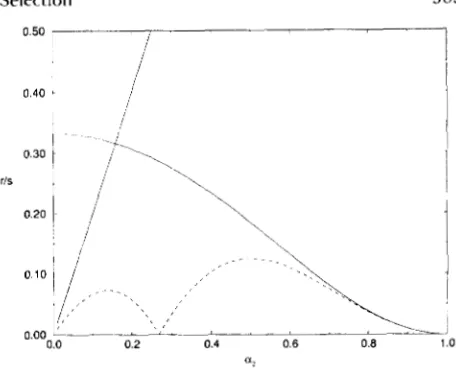
FIGURE 3.-The dependence of the critical value of the ratio r /
s on a2 for zu = 0. T h e solid curve represents the exact dependence calculated from (26). T h e dashed curve represents the first order approximation calculated from (A4). T h e first order analysis gives feasible estimates of the gamete frequencies in the region below the straight line.
ZHIVOTOVSKY, L., and S. GAVRILETS, 1992 Quantitative variabil-
ity and multilocus polymorphism under epistatic selection. Theor. Popul. Biol. 42: 254-283.
Communicating editor: R. R. HUDSON
APPENDIX
I n the main text we used regular perturbation tech- niques to find location of the perturbed equilibria. Substituting new perturbed equilibrium gamete fre- quencies x,,o
+
e ~ , , ~ into the matrix that determines the stability of equilibria and calculating the correspond- ing eigenvalues, we can find stability conditions for the perturbed equilibria. T h e first order perturbation X,, for an eigenvalue X of the matrix V = V,O+
C V . ~ iswhere x and y are a right and a left eigenvector of V,,,
that corresponds to X.0 and ( y T x ) # 0 (HORN and
JOHNSON 1985, Section 6.3.12).
For simplicity let us assume that r
<
s<<
1 (cf:HOPPENSTEADT 1976). In this case recurrence equa- tions
(2)
are approximated by the corresponding dif- ferential equations, and the stability of equilibria de- pends on the eigenvalues of matrix U = {d(GAxJ/dxJj.(2i,0). The right eigenvectors of this matrix are
while the corresponding left eigenvectors are
Computing first order perturbation for the ele- ments of matrix U , we find that the first order esti- mates for the eigenvalues of the stability matrix are
(A4c)
Expressions (A4) can be used to find the estimates of the critical value of the recombination rate r (or the ratio r / s ) under which the equilibrium becomes unstable. Figure 3 shows how ( r / s ) < depends on a2 in the case when z0 = 0. This figure also presents the exact dependence calculated from (26). Note that when Xu,() = Xu," (near a2 value about 0.27) a right and a left eigenvector corresponding to Xu,() and to Xu,() are orthogonal and expression ( A l ) cannot be used. Fig- ure 3 shows that for a p