CRASSA. I. STRUCTURAL AND FUNCTIONAL COMPLEXITY I N THE AD-3 REGION'
FREDERICK J. DE SERRES, JR.2
Osborn Botanical Laboratory, Yale University, New Haren, Connecticut and Biology Dirision, Oak Ridge National Laboratory, Oak Ridge, Tennessee
Received March 5, 1956
LARGE number of adenine-requiring strains with a purple phenotype have now
A
been obtained for study of the problem of the reversibility of X-ray-induced mutations a t the ad-3 locus in Neurospora crassa. However, subsequent investigations have shown that these phenotypically similar mutants represent two distinct groups on the basis of physiological (heterokaryon) and genetic (crossing) analyses. I n this paper, it will be shown that these groups represent two closely linked loci in the ad-3region. Studies on the mutability of X-ray-induced purple adenine mutants will be considered in a subsequent paper.
MATERIALS
i\Tm mutant strains
The 24 purple adenine mutant strains used in this investigation were obtained by the'lfiltration technique" of WOODWARD, DE ZEEUW, and SRB (1954) on untreated or X-irradiated macroconidia of the St. Lawrence wild type strain 74A. The isolates of these mutants used in the present investigation, with the exception of the strains with additional genetic markers, are the originals and not strains extracted from crosses to other mutant or wild type strains. The genetic background of the 24 purple adenine strains may be thus considered essentially identical.
The non-purple adenine strain, El, was also derived from the St. Lawrence wild type strain 74A. This strain utilizes adenine but not hypoxanthine for growth (N. J. JOHNSON unpublished) and will be referred to as an adenine-specific strain.
Standard mutant strains
The other mutant strains used were: hist-2 (histidine), C94 (HAAS, et al. 1952); ad-3
(purple adenine), 35203, 38701, 38709, 45601, 68306; and nic-2 (nicotinic acid), 43002 (BEADLE and TATUM 1945). Isolates of these mutant strains were obtained from the culture collections of PROF. N. H. GILES or DR. P.
ST.
LAWRENCE of Yale Univer- sity.The terminology used to refer to mutant strains is that proposed by BARRATT, NEWMEYER, PERKINS, and GARNJOBST (1954).
A portion of this material was taken from a thesis presented t o the Faculty of the Graduate School of Yale University in partial fulfillment of the requirements for the degree of Doctor of Philosophy.
THE AD-3 REGION I N NEUROSPORA 669
METHODS
The medium used was the standard Neurospora minimal (BEADLE and TATUM 1945). The growth tubes used for the determination of growth rates of the heterokary- ons are essentially the same as the tubes closed a t one end described by RYAN ef al. (1943). Crosses were made on synthetic crossing medium (WESTERGAARD and MITCHELL 1947) with the appropriate biochemical supplementation. Random ascospore analyses on crosses were made by the plating methods of NEWMEYER (1954). Heterokaryon tests were made with heavy conidial suspensions of the individ- ual mutant strains. Approximately 0.03 ml of the individual conidial suspensions was placed in spots near the periphery of petri plates previously prepared with 15-20 ml of minimal medium solidified with 1.0 percent agar. Each plate contained control spots of the two strains being tested with each other, and two spots where conidia were mixed and heterokaryon formation could take place. The spots where the conidia were mixed were diametrically opposed so that when a positive heterokaryon test was obtained, the two heterokaryons grew toward each other, and did not rapidly overgrow the control spots. When heterokaryon tests were made on “leaky” strains, which grow to some extent on unsupplemented minimal medium, hetero- karyon formation could be detected only by the difference in size of the colony formed on the control spot of the “leaky” strain versus the spots where conidia from both strains were mixed. All plates were incubated a t 25°C and results recorded after 24-36 hours.
EXPERIMENTAL
Preliminary studies
Linkage studies with purple adenine mutant 35203 and with genetic markers known to be linked to this mutant (see BARRATT et al. 1954) have demonstrated that the
ad-3 locus is located 2 to 3 units to the right of the hist-2 locus and 2 to 3 units to the left of the nic-2 locus. Additional crosses of the 24 purple adenine strains (derived from the St. Lawrence wild type strain 74A) with the double mutant strain hist-2 nic-2, have shown that, in general, these purple adenine strains have linkage relation- ships similar to strain 35203. This evidence was interpreted as indicating that the 24 purple adenine strains and strain 35203 represented alterations of the same locus and were, therefore, presumably allelic.
However, it was not feasible to obtain more direct evidence for the allelism of these strains from intercrosses, for, as demonstrated in the original studies of MITCHELL and HOULAHAN (1946) and later studies by G. K ~ ~ L M A R K (unpublished) for mutants 35203, 38701, 38709, 45601, and 68306, various intercrosses and selfings of purple adenine mutants were highly sterile. While different methods were being tried to increase the numbers of viable ascospores from these crosses, attempts were made to obtain preliminary evidence for allelism from heterokaryon tests.
Heterokaryon tests with purple adenine strains derived from strain 7 4 A
could be demonstrated that, under comparable experimental conditions, the individ- ual purple adenine strains would give positive heterokaryon tests with the non- purple adenine-specific strain, E l , which has an identical genetic background, and negative tests with one or all of the other purple adenine strains.
When such tests were made by the methods described previously, positive hetero- karyon tests were obtained not only between each of the purple adenine mutants and the non-purple adenine-specific strain, but also in certain combinations of the purple adenine mutants. I n the initial experiment, when all 24 of the purple adenine mutants were tested against one member of this group, all the mutant combinations except three gave positive heterokaryon tests. It appeared that there were two groups of purple adenine mutants, a small group of alleles containing three of the 24 mutants (group A), and a larger group of alleles with 21 mutants (group B). Since the positive heterokaryon tests among the purple adenine mutant strains were unanticipated, an experiment was performed to confirm and extend these observations by testing all 24 purple adenine mutants for heterokaryon formation with each other in all possible combinations. Within twenty-four hours, all the group A mutants had formed heterokaryons with all the group B mutants, and no evidence was obtained for heterokaryon formation with any of the other mutant combinations. In all cases where heterokaryon formation was observed, the duplicate spots where conidia were mixed on each plate were in agreement. With one of the “leaky” purple adenine mutants, which has only a partial requirement for adenine a t 25”C, the lag period was sufficient for heterokaryon formation with the three group A mutants to take place a t a time when the control spots of the “leaky” mutant showed only slight growth. On the basis of the results of these heterokaryon tests, the 24 purple adenine strains derived from the St. Lawrence wild type strain 74A can be divided into two physio- logically distinct groups: group A-strains A1 through A3; group B-strains B1 through B21.
Heterokaryon tests with the original purple adenine slrains
Since no evidence for heterokaryon formation between mutant 35203 and its presumed alleles was obtained in the experiments of MITCHELL and HOULAHAN (1946), backcrosses of these strains were made to obtain isolates that would form heterokaryons with biochemical mutants derived from the St. Lawrence wild type strain 74A. Originally, such isolates were available only for mutant 35203. Hetero- karyon experiments on these isolates demonstrated that 35203 gave positive hetero- karyon tests only with group A mutants, indicating that strain 35203 is in group B. FI isolates of strains 38701, 38709, 45601, and 68306 have since been used to group these mutants. Subsequent heterokaryon experiments on these strains have shown that strains 38701,38709, and 68306 are in group A, and strain 45601, in addition to strain 35203, is in group B.
Growth rates of group A-group B heterokaryons
THE AD-3 REGION IN NEUROSPORA 671
TABLE 1
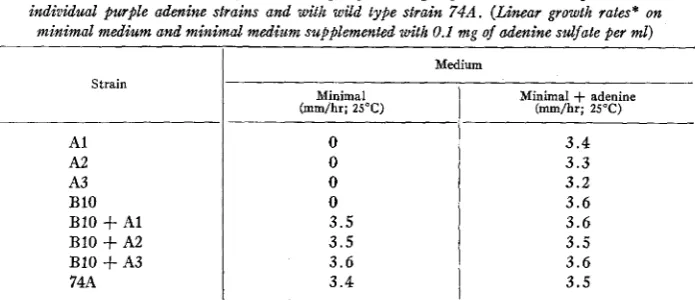
Growth rates of selected heterokaryons between group A and group B strains as compared with the individual purple adenine strains and with wild type strain 74A. (Linear growth rates* on
minimal medium and minimal medium supplemented with 0.1 mg of adenine sulfate per ml)
-
Medium Strain
Minimal
1
Minimal+
adenine (mm/hr; 2 5 T ) (mm/hr; 25°C)A1 A2 A3 B10 B10
+
A1 B10+
A2 B10+
A3 74A0
0 0 0
3.5 3 . 5 3 . 6 3 . 4
3 . 4 3 . 3 3. 2 3 . 6 3 . 6 3 . 5 3 . 6 3 . 5
* Each growth rate based on the linear growth made in a 40.5-hour period in triplicate tubes.
ior, the individual heterokaryons were all established a t about the same time, and all the plates were overgrown by the heterokaryotic colonies a t the same rate. Since the growth rates of these heterokaryons were essentially the same, experiments were performed to compare the growth rates of selected heterokaryons with the parental wild type strain 74A, to determine whether these heterokaryons grew a t wild type rate. If the group A-group B mutants were not completely complementary in the heterokaryons formed between them, then the growth rates of these heterokaryons might be less than wild type rate, and approach or equal wild type rate only by supplementation with exogenous adenine or a comparable growth factor.
By the growth tube method described previously, growth rates of individual heterokaryons between mutants Al, A2, and A3 with mutant B10 were compared on minimal medium, and minimal medium supplemented with adenine with the growth rates of the individual mutants and that of wild type. The results of this experiment are presented in table 1. None of the individual strains frGm either group grew on minimal medium, but heterokaryons formed with these mutants grew a t rates comparable to wild type. No evidence was obtained for adenine stimulation of any of the heterokaryons, since the growth rates on minimal medium supplemented with adenine were comparable to those obtained on unsupplemented minimal medium.
Random ascospore analyses of group A X group B mutant crosses
might correspond to two genes so closely linked that random fluctuations in linkage values obscured the order.
If this were the case, the order of the genes with reference to the markers could be either hist-2 ad-A ad-B nic-2 or hist-2 ad-B ad-A nic-2. Hence, crosses were made with appropriately marked strains to determine whether the two groups were separable by crossing over.
Preliminary attempts with corn meal agar (BEADLE and TATUM 1945) or the Westergaard-Mitchell synthetic crossing medium supplemented with low levels of adenine sulfate (0.05--0.15 mg/ml) to intercross or self purple adenine mutants were not consistent. When ascorpores were formed, they exhibited a low viability. Sup- plementation of the Westergaard-Mitchell synthetic medium with higher levels of adenine sulfate (0.6-1.0 mg/ml) gave large numbers of viable ascospores when inter- group crosses were made (group A X group B). Intragroup crosses (group A X group A or group B
x
group B) and selfings, however, did not respond to high levels of adenine or numerous other supplementations that were tried. Even when large numbers of ascopores were obtained in these crosses, under optimal crossing condi- tions, the viability of the ascospores ranged from three to ten percent.Crosses of all the individual group B purple adenine strains (except strain 45601) were made, initially, with the triple mutant strain hist-2 A2 nic-2 to determine whether adenine-independent isolates could be obtained from such crosses, and to determine whether the origin of adenine-independent isolates was associated with crossing over between the hist-2 and nic-2 markers. If adenine-independent isolates occur and are associated with normal crossing over they should be almost entirely of genotypes
+++nit-2
or hist-Z+++ depending on the linear order of the two groups. When these crosses were analyzed, the majority gave rise to adenine-inde- pendent isolates in the limited number of ascospores analyzed in each cross (ca 6,000).Most, or all, adenine-independent isolates from any particular cross were of genotype
+++nic-Z. No isolates of genotype hist-,?+++ were obtained in any of these
crosses.
Since most of the group B mutants did give rise to adenine-independent isolates in crosses with the marked A2 strain, and since they were associated in origin with crossing over in one direction only between the linked markers, these data were interpreted as indicating (1) that the two physiological units that give rise to group A and group B purple adenine mutants in the ad-3 region correspond to two separate, but closely linked genes, and (2) that the linear order of these genes with reference to other selected markers in this region of linkage group I is: sex hist-2 ad-A ad-B d c - 2
me(3.5809) (see BARRATT et al. 1954).
THE AD-3 REGION I N NEUROSPORA 673
A1 X hist-2 35203 nic-2 A3 X hist-2 35203 nic-2
TABLE 2
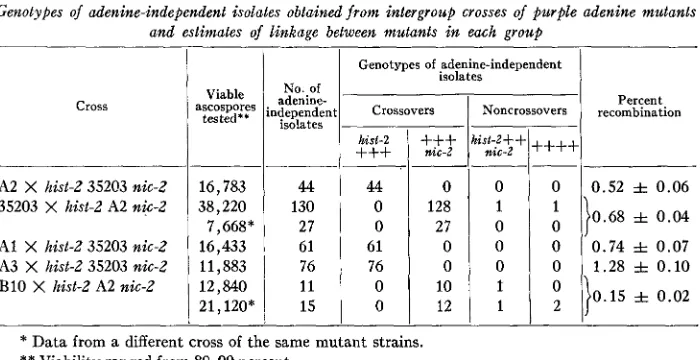
Genotypes of adenine-independent isolates obtained from intergroup crosses of purple adenine mutants and estimates of linkage between mutants in each group
0
7,668* 27 27 0
16,433 61 6 ; I O 0 0 0. 74 f 0.07
11,883
1
76 76 0 0 0 1.28 f 0.10cross
1
I
1
Genotypes of adenine-independentI
isolateshisl-2
+++
hist-2++I
+++
1
nic-2I
sic-2j++++j
/- I-- I- -1-1-1 I
B10 X hist-2 A2 nic-2 12,840
1
21,120*I
::
I
x
1
;; ;
1
;
l}O.15*
0 . 02I I I I I
* Data from a different cross of the same mutant strains. ** Viability ranged from 80-90 percent.
one direction between the closely linked markers. I n the reciprocal crosses of A2 with 35203, the association of one or the other marker with the origin of adenine-independ- ent isolates is consistent with the order of genes postulated from previous crosses.
I n these crosses, as in some of the crosses discussed previously, a few adenine- independent isolates have been obtained of “noncrossover” genotypes (table 2). Each one of these exceptional types was examined genetically, since apparent adenine- independent isolates of these genotypes can originate in a number of ways. A certain fraction of those of genotype
++++
proved to be heterokaryons, which arose presumably either as pseudo-wilds (MITCHELL et al. 1952; PITTENGER 1954) or through heterokaryon formation between group A and group B ascospores on the plates. These have been eliminated in the tabulation. I n the cross 35203 X A2, the low frequency of these exceptional types is low enough to have arisen from multiple crossover events. I n the cross of B10x
35203, however, other phenomena may be responsible. Some or all of the exceptional adenine-independent isolates from this cross could represent instances of reverse-mutation since these strains are known to be mutable. I n addition, the possibility of gene conversion must be considered in view of the recent results of LINDEGREN (1955) and MITCHELL (1955a, b).Although the viability of ascospores obtained from such crosses is still very low owing to crossing difficulties, various interallelic crosses within each of the two groups of physiological alleles have been attempted by using marked strains of A2 or 35203. Preliminary analyses on four of these crosses show that adenine-independent isolates do arise. However, since the numbers of adenine-independent isolates from any particular cross have been small, and since they are of both “parental” and “cross- over” genotypes, the mechanism (or mechanisms) by which adenine-independent isolates originate in specific interallelic crosses in the ad-3 complex remains obscure.
Preliminary evidence for complexity ,from a serial ascospore analysis on a group
Although analyses of various intergroup crosses by plating methods have indicated that adenine-independent isolates do arise, this method of analysis does not permit the recovery of the presumed complementary crossover product, the double purple adenine mutant. I n order to determine whether the double mutant could be recovered from an ascus in which one of the ascospore pairs was adenine-independent, serial ascospore isolations were made from the cross
++
35203 (group B)+
X hist-2 A2 (group A)+
nic-2 (GILES and DE SERRES unpublished). Although only a portion ofthis analysis has been completed, some of the results are pertinent to the present analysis. I n a total of 325 asci giving complete germination (at least one member of each ascospore pair germinated), five asci have been obtained containing adenine- independent ascospore pairs. I n each of these asci, three pairs of ascospores are adenine requiring and the remaining pair is adenine independent. I n each case, the genotype of the adenine-independent pair of ascospores is +++nic-2, as might be anticipated from the results obtained from ascospore platings of this same cross (table 2).
The objectives of the current analysis of these five asci are to determine whether the presence of both singles and the double mutant can be demonstrated in each ascus by genetic and biochemical techniques.
A X group B CTOSS
CONCLUSIONS
Previous evidence from experiments on purple adenine mutants 35203, 38701, 38709,45601, and 68306 by MITCRELL and HOULAHAN (1946) suggested that these mutants were allelic, since only purple progeny were obtained when these mutants were crossed among themselves. On the basis of this evidence, this locus was sub- sequently designated the ad-3 locus by BARRATT et al. (1954). Combined evidence from the present study, however, indicates that the ad-3 locus is not unitary, as was once thought, but rather a complex consisting of phenotypically similar purple adenine mutants that fall into two physiologically distinct groups.
THE AD-3 REGION I N NEUROSPORA 675
groups of mutants have mutually complementary biochemical functions. Further- more, such heterokaryons grow on minimal medium a t the same rate as the parental wild type strain 74A.
The behavior of purple adenine mutants in crosses also indicates the presence of two physiologically distinct groups. Selfings of purple adenine mutants are character- istically highly sterile under all crossing method variations that have been tried. Few ascospores are formed and usually over 90 percent of these ascospores fail to germi- nate. When various crosses are made among purple adenine mutants, the high sterility characteristic of the selfings is observed only when intragroup crosses are made. Intergroup crosses show the same high germination of ascospores generally found in crosses between unrelated biochemical mutants. It appears, then, that the sterility and low germination of ascospores from crosses of purple adenine mutants is indicative of the physiological identity of the parental strains.
The analysis of intergroup crosses has shown that the two physiologically dis- tinct groups are separable by crossing over. Moreover, in such crosses, the origin of adenine-independent isolates is associated with crossing over in one direction only between closely linked markers. I n these crosses, the origin of “wild type” segregants is the same as would be expected from crosses of any two closely linked genes.
Since the purple adenine mutants fall into two groups, which give positive hetero- karyon tests and which give rise to adenine-independent type predominantly by crossing over in one direction between closely linked markers, the data seem best interpreted on the basis of two functionally d8erent but closely linked genes. Since mutation of either gene gives rise to phenotypically similar purple adenine mutants, and since these genes are closely linked, it is proposed that the gene loci be designated
ad-3A and ad-3B. Group A mutants, then, are a t the ad-3A locus and group B mutants a t the ad-3B locus.
S U W A R Y
(1) Heterokaryon experiments have shown that 24 purple adenine mutants derived from the St. Lawrence wild type strain 74A fall into two physiologically distinct groups: group A-A1 through A3; group B-B 1 through B21. Additional hetero- karyon experiments have shown that of the five original purple adenine strains, 38701, 38709, and 68306 are in group A, and 35203 and 45601 are in group B.
(2) In general, group A and group B strains are mutually complementary in inter- group heterokaryons, and that such heterokaryons grow a t wild type rate.
(3) Random ascospore analyses of intergroup crosses have demonstrated that the origin of adenine-independent isolates is associated with crossing over in one direction only between closely linked markers. The physiological groups thus correspond to two functionally different, but closely linked genes. Since mutation of both of these genes gives rise to phenotypically similar purple adenine mutants, it is proposed that the gene loci be designated ad-3A and ad-3B. Group A mutants result from mutation a t the ad-3A locus and group B mutants from mutation a t the ad-3B locus.
ACKNOWLEDGMENTS
The author wishes to express his deepest appreciation to PROFESSOR NORMAN H. GILES for his guidance, criticism, and encouragement throughout the course of this study. The main part of this work was carried out during the tenure of a Wadsworth Fellowship from Yale University.
LITERATURE CITED
BARRATT, R. W., D. NEWMEYER, D. D. PERKINS, and L. GARNJOBST, 1954 Neurospora crassa. Advances in Genet. 6: 1-93.
BEADLE, G. W., and E. L. TATUM, 1945
mutations concerned with nutritional requirements. Am. J. Botany 32: 678486. LINDEGREN, C. C., 1955
gene conversion. Science 121: 605407.
HAGS, F., M. B. MITCHELL, B. N. AMES, and H. K. MITCHELL, 1952 of Neurospora crassa. Genetics 37: 217-226.
MITCHELL, H. K., and M. B. HOULAHAN, 1946 Federation Proc. 6: 370-375.
MITCHELL, M. B., 1955a
Natl. Acad. Sci. U. S. 41: 215-220.
Map construction in Neurospora. 11. Methods of producing and detecting Non-Mendelian segregation in a single tetrad of Saccharomyces ascribed to A series of histidineless mutants Adenine-requiring mutants of Neurospora crassa. Aberrant recombination of pyridoxine mutants of Neurospora. Proc. 1955b Further evidence of aberrant recombination in Neurospora. Proc. Natl. Acad. Sci. U. S. MITCHELL, M. B., T. H. PITTENGER, and H. K. MITCHELL, 1952 Pseudo-wild types in Neurospora NEWYEYER, D., 1954 A plating method for genetic analysis in Neurospora. Genetics 39: 604-618. PITTENGER, T. H., 1954 The general incidence of pseudo-wild types in Neurospora crassa. Genetics
39: 326-342.
RYAN, F. J., G. W. BEADLE, and E. L. TATUM, 1943 The tube method of measuring the growth rate of Neurospora. Am. J. Botany 30: 784-799.
WESTERGAARD, M., and H. K. MITCHELL, 1947 Neurospora. V. A synthetic medium favoring sexual reproduction. Am. J. Botany 34: 573-577.
WOODWARD, V. W., J. R. DE ZEEUW, and A. M. SRB, 1954 The separation and isolation of partic- ular biochemical mutants of Neurospora by differential germination of conidia, followed by filtration and selective plating. Proc. Natl. Acad. Sci. U. S. 40: 192-200.
41: 935-937.