© 2015, IRJET.NET- All Rights Reserved
Page 834
Building Information Modeling (BIM)
Shrikant Bhuskade
Assistant Professor,
Department of Civil Engineering,
Prof. Ram Meghe Institute of Technology & Research, Amravati (M.S.) (India)
---***---Abstract -
The case study shows that BIMdoes enhance the traditional scheduling and cost estimating methods with a more reliable and and cost parameters concurrently to BIM components in the building model to deliver a scheduled financial analysis, and iii) allocation of resources on 4D BIM model to analyse and plan the resource usage based on the most updated design, and even simulate the resource allocation.
Key Words:
BIM, modelling, cost estimation, resources
allocation, construction scheduling
1. INTRODUCTION
Building Information Modeling (BIM) is a set of interacting policies, processes and technologies generating a “methodology to manage the essential building design and project data in digital format throughout the building's life-cycle”. As a key part in the project lifecycle, contractors play an important role in making sure the project will be delivered on time and within the budget. This project will show how BIM technology will benefit for Architect, Engineer and contractors for Estimating & schedule and cost controls. It begins with a general introduction of BIM technology and the different ways it works compared with traditional CAD (Computer Aided Design) method, and continues with evaluation of BIM tools. It then explains the uses of Scheduling and Cost Estimating in BIM respectively and provides a case study to show how BIM can work for Architect. Engineer and contractor.
Building Information Modeling (BIM) is an emerging technology throughout the world in the Architecture, Engineering, and Construction (AEC) industries. BIM technology provides users with accurate and consistent building/project data and information, accommodating the functions needed to model the building and provides a virtual view of it. Building information models are increasingly used, for several purposes by the diverse
stakeholders during the different phases of the project and building lifecycle.
BIM revolutionize the AEC industry, being not only a change between CAD and parametric modeling with 3D capabilities, but a change of workflows, methodologies, process, and relations. Basically it changes the way business is done throughout the industry. Although all of these changes may seem too much to be easily accepted by the industry, the benefits are much greater, making BIM the future for the industry.
Nowadays, Construction and BIM technologies are built for the trailer and the office. To improve productivity and efficiency in construction, these technologies need to be built it for the field, where the work is done and money is spent. According to the Construction Industry Institute 75% of all construction dollars are spent in the field, however, 90 % of the technology is made for the trailer and the office.
2. AUTODESK REVIT
Autodesk Revit is a building information modeling software for architects, structural engineers, MEP engineers, designers and contractors. It allows user to design a building and structure and its components in 3D, annotate the model with 2D drafting elements, and access building information from the building model's database. Revit is 4D BIM capable with tools to plan and track various stages in the building's lifecycle, from concept to construction and later demolition.
© 2015, IRJET.NET- All Rights Reserved
Page 835
adjust the floor area reported in schedule, redraw sectionviews, etc., so that the model will remain connected and all documentation would be coordinated. The concept of bi-directional associativity between components, views and annotations was a distinguishing feature of Revit for many releases. The ease of making changes inspired the name Revit, a contraction of Revise-It. At the heart of the Revit is a parametric change propagation engine that relied on a new technology, context driven parametric, that was more scalable than the vibrational and history driven parametric used in mechanical CAD software. The term parametric building model was adopted to reflect the fact that changes to parameters drove the whole building model and associated documentation, not just individual components.
3. LITERATURE REVIEW
Jia Qi1 at el studied that the construction industry has incurred the most fatalities of any United States industry in the private sector in recent years. Whereas many factors may contribute to this statistic, one likely cause is due to designers who often lack design for construction safety knowledge, which results in many safety hazards being built into project designs. Therefore, there is a compelling need for tools that can put the safety-in-design concept into practice. To improve the current situation, a prevention through design (PTD) tool based on computer software was developed. Construction safety best practices were compiled into computable rules so that the PTD tool can automatically conduct compliance checking. Brittany K. Giel1 at el studied that the recent emergence of building information modeling (BIM) and the evolution of virtual design and construction (VDC) in the architecture, engineering, and construction (AEC) industry are fundamentally changing the process by which buildings are designed and constructed. However, the perceived high initial cost of implementing BIM has deterred many industry professionals from adopting this technology. The potential savings to an owner choosing to invest in BIM as an additional service were estimated based on the measurable cost benefits associated with reduced schedule overruns, fewer requests for information (RFIs), and reduced change orders.
Nawari O. Nawari studied that Building information modeling (BIM) is rapidly gaining acceptance as the preferred method of communicating the design professional’s intent to the owner and various stakeholders. These data-rich models can be used effectively by other members of the design team to coordinate the fabrication of a building’s different systems. This has innumerable advantages in off-site construction domain in- cluding speed, economy, sustainability, and safety.
3. RESULT & DISCUSSION
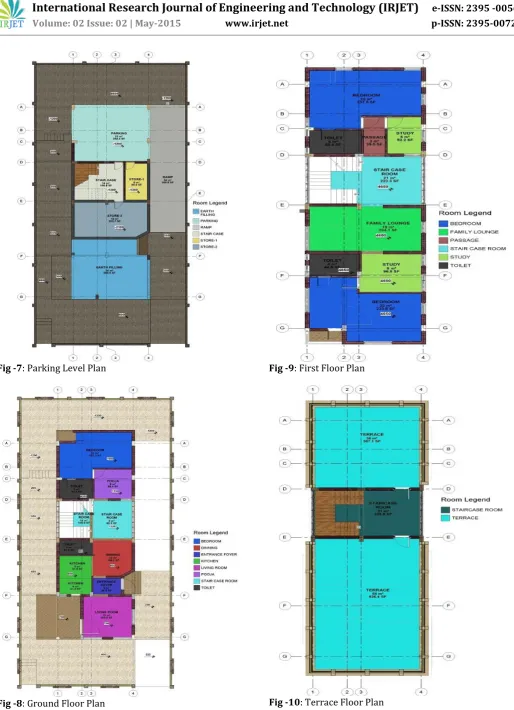
The model or project is a frame structure consist of a
one residential building. The building consist of floor
such as parking level, Ground Floor, First floor,
Terrace Floor and staircase cap level. In front of the
building there is lawn area and in side portion there
is ramp which connected with the parking area for
parking purpose. Staircase is provided from parking
area up to the terrace level.
Revit works exactly opposite to AutoCAD. In AutoCAD,
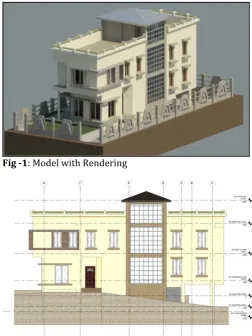
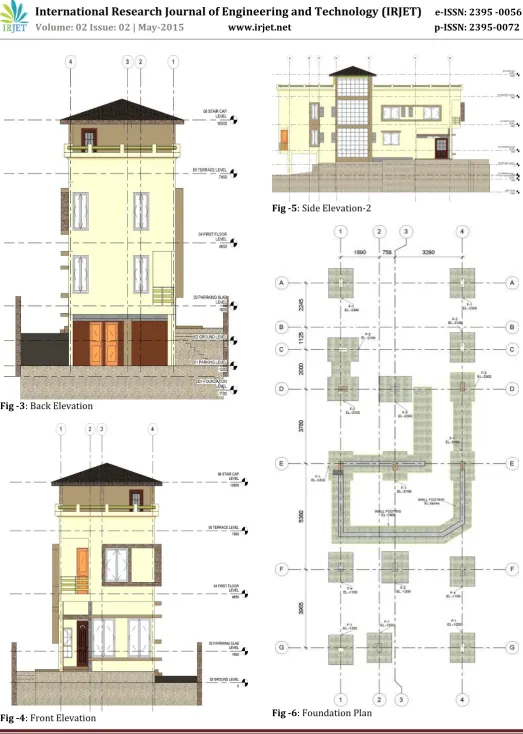
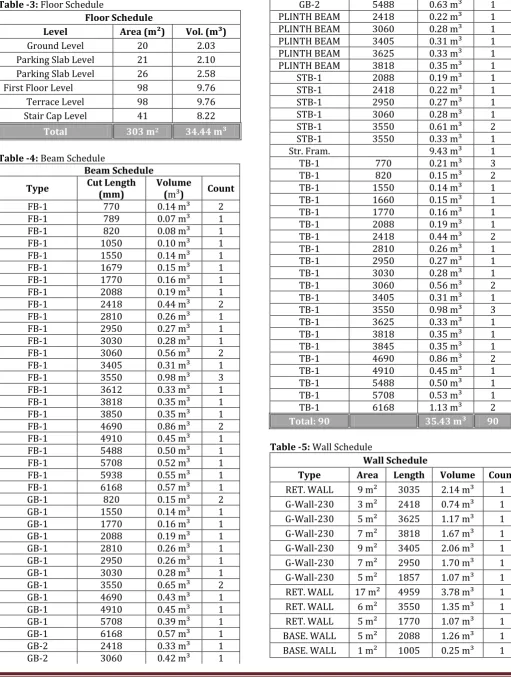
first to draw 2D drawing and then move towards 3D (Not BIM). In Revit first to create direct 3D model and then get directly 2D drawing with material quantity and many more which is essential to manage construction of building. In the present work it is created 3D model and able to get 2D drawing as shown below and material quantity as per the requirements. The schedule of foundation, column, beam, floor and wall is tabulated.Fig -1: Model with Rendering
© 2015, IRJET.NET- All Rights Reserved
Page 836
Fig -3: Back ElevationFig -4: Front Elevation
Fig -5: Side Elevation-2
© 2015, IRJET.NET- All Rights Reserved
Page 837
Fig -7: Parking Level PlanFig -8: Ground Floor Plan
Fig -9: First Floor Plan
© 2015, IRJET.NET- All Rights Reserved
Page 838
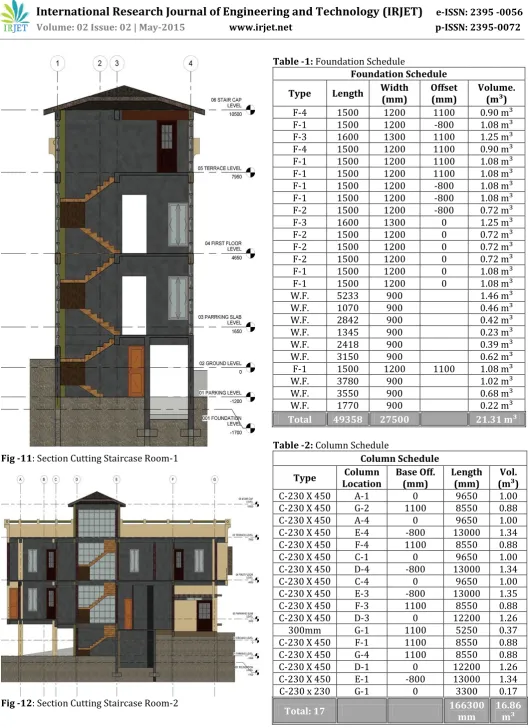
Fig -11: Section Cutting Staircase Room-1Fig -12: Section Cutting Staircase Room-2
Table -1: Foundation Schedule
Foundation Schedule
Type Length Width (mm) Offset (mm) Volume. (m³)
F-4 1500 1200 1100 0.90m³
F-1 1500 1200 -800 1.08 m³
F-3 1600 1300 1100 1.25 m³
F-4 1500 1200 1100 0.90 m³
F-1 1500 1200 1100 1.08 m³
F-1 1500 1200 1100 1.08 m³
F-1 1500 1200 -800 1.08 m³
F-1 1500 1200 -800 1.08 m³
F-2 1500 1200 -800 0.72 m³
F-3 1600 1300 0 1.25 m³
F-2 1500 1200 0 0.72 m³
F-2 1500 1200 0 0.72 m³
F-2 1500 1200 0 0.72 m³
F-1 1500 1200 0 1.08 m³
F-1 1500 1200 0 1.08 m³
W.F. 5233 900 1.46 m³
W.F. 1070 900 0.46 m³
W.F. 2842 900 0.42 m³
W.F. 1345 900 0.23 m³
W.F. 2418 900 0.39 m³
W.F. 3150 900 0.62 m³
F-1 1500 1200 1100 1.08 m³
W.F. 3780 900 1.02 m³
W.F. 3550 900 0.68 m³
W.F. 1770 900 0.22 m³
Total 49358 27500 21.31 m³
Table -2: Column Schedule
Column Schedule
Type Column Location
Base Off. (mm)
Length (mm)
Vol. (m³)
C-230 X 450 A-1 0 9650 1.00
C-230 X 450 G-2 1100 8550 0.88
C-230 X 450 A-4 0 9650 1.00
C-230 X 450 E-4 -800 13000 1.34
C-230 X 450 F-4 1100 8550 0.88
C-230 X 450 C-1 0 9650 1.00
C-230 X 450 D-4 -800 13000 1.34
C-230 X 450 C-4 0 9650 1.00
C-230 X 450 E-3 -800 13000 1.35
C-230 X 450 F-3 1100 8550 0.88
C-230 X 450 D-3 0 12200 1.26
300mm G-1 1100 5250 0.37
C-230 X 450 F-1 1100 8550 0.88
C-230 X 450 G-4 1100 8550 0.88
C-230 X 450 D-1 0 12200 1.26
C-230 X 450 E-1 -800 13000 1.34
C-230 x 230 G-1 0 3300 0.17
Total: 17 166300
mm
© 2015, IRJET.NET- All Rights Reserved
Page 839
Table -5: Wall Schedule
© 2015, IRJET.NET- All Rights Reserved
Page 841
3. CONCLUSIONS
The Building Information Model are produced, the quantity take offs can be generated to provide cost estimations on a construction project. BIM based 4D scheduling helps understanding of the construction components and schedule progress that in turn results better construction planning. In other words, BIM provides time and cost savings and yields better quality construction products. Overall, Building Information Modeling is a great concept.
REFERENCES
[1] Jia Qi1; Raja R. A. Issa, F. Svetlana Olbina, and Jimmie Hinze, (2014), ‘Use of Building Information Modelling in Design to Prevent Construction Worker Falls’ [2] Brittany K. Giel1 and Raja R. A. Issa, (2013), ‘Return
on Investment Analysis of Using Building Information Modelling in Construction’
[3] Rui pedro lopes fernandes, (2013), ‘Advantages and Disadvantages of BIM Platforms on Construction Site’ [4] Nawari O. Nawari, (2012), ‘BIM Standard in Off-Site
Construction’
[5] Mehmet F. Hergunsel, (2011), ‘Benefits of building information modelling for construction managers And Bim based scheduling’
[6] Ralph Grabowski, (2010 December), ‘CAD & BIM: Is There a Free Pass?’ A research paper from upfront. Research funded by Graphisoft
[7] Design Best Practice (2010, January 28). Case Studies [WWW document]. URL http://www.dbp.org.uk/ [8] Christoph mershbrock, Bjorn Erik munkvold, (2009) -
research review on building information modeling in construction an area ripe for IS research.
[9] McGraw-Hill Construction. (2009). “The business value of BIM: Getting building information modeling to the bottom line.” McGraw-Hill construction Smart Market Rep., McGraw Hill, New York
[10]Xinan Jiang (2008) Developments in cost estimating and scheduling in BIM technology.
[11]Behm M. (2008). Rapporteur's Report; construction sector, Journal of safety research, 39, 175–178. [12]Cooke, T. Lingard, H. Blismas, N. Stranieri, A. (2008).
ToolSHeDTM: The development and evaluation of a decision support tool for health and safety in construction design, Engineering, Construction and Architectural Management, 4, 336 – 351.
[13]Kam-din Wong, Qing Fan (2006) - building information modeling (BIM) for sustainable building design.
[14]Behm, M. (2005). Linking construction fatalities to the design for construction safety concept, Safety Science, 43, 589–611.
[15]Allen, R., Becerik, B., Pollalis, S., Schwegler, B. (2005). Promise and Barriers to Technology Enabled and Open Project Team Collaboration, Journal of
Professional Issues in Engineering Education and Practice, 131(4), 301- 311.
[16]BIM Server 1.1 [Computer software]. Budapest, Hungary, Graphisoft.
[17]http://www.autodesk.in/product/revit families.
BIOGRAPHIES
Shrikant Bhuskade Assistant Professor, Department of Civil Engineering,
Prof. Ram Meghe Institute of Technology & Research, Badnera,