Volume 2010, Article ID 910695,10pages doi:10.1155/2010/910695
Research Article
Tree Based Protocol for Key Management in
Wireless Sensor Networks
M.-L. Messai,
1M. Aliouat,
2and H. Seba
31Ecole Doctorale ReSyD, Universit´e Abderrahmane Mira, Bejaia 06000, Algeria
2D´epartement Informatique, facult´e des sciences, Universit´e Ferhat Abb`es, S´etif 19000, Algeria
3Laboratoire LIESP, Universit´e Claude Bernard Lyon1, IUT LYON1, 71, rue Peter Fink, 01000 Bourg-en-Bresse, France
Correspondence should be addressed to H. Seba,[email protected]
Received 6 April 2010; Accepted 26 August 2010
Academic Editor: Zhiqiang Liu
Copyright © 2010 M.-L. Messai et al. This is an open access article distributed under the Creative Commons Attribution License, which permits unrestricted use, distribution, and reproduction in any medium, provided the original work is properly cited.
Securing a wireless communication has generally a vital importance, particularly when this communication is in a hostile environment like in wireless sensor networks (WSNs). The problem is how to create cryptographic keys between sensor nodes to ensure secure communications. Limited resources of sensor nodes make a public key cryptosystem such as RSA not feasible. So, most solutions rely on a symmetric cryptosystem. In this paper, we propose a new key management scheme based on symmetric cryptography which is well adapted to the specific properties of WSNs. The evaluation of our solution shows that it minimizes memory occupation, ensures scalability, and resists against the hardest attack: compromised nodes.
1. Introduction
The convergence of technological advances in microelectron-ics and wireless communications has enabled the emergence of a promising area: Wireless Sensors Networks (WSNs). WSNs come from the combination of embedded systems and distributed systems. WSNs have opened the way for a multitude of research areas and the huge interest generated by researchers activities calls for broad fields of applications in the near future.
Sensors appear as miniaturized systems, equipped with a processing unit and storage of data, a unit of wireless transmission and a battery. Organized as a network, the sensors (or nodes) of a WSN, despite resource constraints in computing capacity, storage, and energy, have to play an essential role in quasi all domains of human environment. They are primarily dedicated to collect data from physical phenomena such as monitoring global warming and send them to a base station (also called the sink) [1]. Figure 1 shows an example of a WSN composed of ten sensor nodes deployed randomly around a base station. Depending on the size of the deployment area, the transmission range of the sensor nodes, and the base station, sensor nodes can communicate with the base station directly or indirectly
by computing a hop-by-hop route to it. Many barriers to the common deployment of WSNs have to be overcome before they can reach their full maturity. Among these obstacles, the security problem is acute and must be addressed adequately and in accordance with the binding characteristics of WSNs. Because of their constraints and their deployment in unattended and hostile environments, the different nodes of a WSN are vulnerable to node compromising and also to physical damage [2]. In addition, the use of wireless transmission makes WSNs permeable to all sorts of malicious attacks. Consequently, security is a real challenge to rise.
Several key management protocols for WSNs were proposed to respond to the security requirements of these environments. Unfortunately, node compromising is rarely or not enough investigated and most of these protocols have a weak resilience to this attack. In this paper, we present a symmetric-based key management solution for WSNs called
STKM (Spanning Tree Key Management for WSN).STKM
BS
Figure1: Example of WSN.
node compromise while preserving energy consumption at the level of sensor nodes.
The rest of the paper is organized as follows. First, we discuss related work inSection 2. InSection 3, we present our solution and give its detailed algorithms.Section 4is devoted to an analysis and a simulation of the proposed solution.
Section 5concludes our work.
2. Background and Motivation
Key management is the process by which cryptographic keys are generated, stored, protected, transferred, loaded, used, and destroyed [3]. Figure 2lists a selection of existing key management solutions proposed for WSNs in the literature, for a detailed state of the art see [3]. Most existing key management solutions are based on symmetric cryptography mainly because of its reasonable energy consumption. Asym-metric cryptography involves the use of a pair of keys (public key and private key) to encrypt and decrypt messages. Each node in the network has a public and a private key, the first is known throughout the network, the second is secret, that is, known only by the node. The source node encrypts messages using the public key of the destination node, and this latter uses its private key to decrypt received messages. In symmetric cryptography, the source and the destination use the same key to encrypt and decrypt messages. Asym-metric cryptography offers better resistance against node compromise attack and allows scalability but requires an additional part on software and hardware of the nodes. Some researchers investigated asymmetric cryptographic tools and propose adapted solutions. Examples of such solutions are Tiny Public Key (TinyPK) [4] and Tiny Elliptic Curve Cryptosystem (TinyECC) [5].
With symmetric cryptography, the simplest idea is to load a secret information in the sensor nodes before their deployment in the network. This secret information
deployed in the network may be the secret key itself or an auxiliary information that helps nodes to derive the real secret key shared by the nodes. With this secret key, nodes can securely exchange messages [3]. The main disadvantage of this solution is that compromising one node (access to the preloaded key) might lead to compromise the entire network. To overcome this limitation, several researchers propose schemes that establish pairwise keys rather than a unique global key. For example in [6], the authors focus on developing cost-saving mechanisms while weakening the threat model. They propose Key Infection, a lightweight security protocol suitable for use in noncritical commodity sensor networks where an attacker can monitor only a fixed percentageαof communication channels. WithKey Infection, a node wishing to communicate securely with other nodes simply generates a symmetric key and sends it in the clear to its neighbors.
In [7], Blon describes a Key-matrix-based dynamic key generation solution. In this solution, some of the possible link keys in a network of sizeNare represented as a (λ+1)×N key matrix. The scheme stores small amount of information in each sensor node, so that some pair of nodes can calculate corresponding field of the matrix, and uses it as the link key. This solution isλ-secure, meaning that keys are secure if no more thanλnodes are compromised.
Anotherλ-securesolution is presented in [8] and called
Polynomial-based key predistribution scheme. This scheme
distributes a polynomial share (a partially evaluated polyno-mial of degreeλ) to each sensor. So, each sensor node stores a polynomial withλ+ 1 coefficients and every pair of sensor nodes can establish a key using the property of symmetry of polynomials. The solution isλ-secure, meaning that coalition of less thanλ+ 1 sensor nodes knows nothing about pairwise keys of others.
In [9], the authors proposeBROSK (BROadcast Session Key negotiation protocol). WithBROSK every node broad-casts a message containing its nonce. So, every two neighbor-ing nodes that hear each other can compute a common key which is function of their two nonces. Neighboring nodes authenticate themselves with a predeployed key which is supposed to be unreachable in the case the node is captured. In [10], the authors propose a variation of this protocol where the predeployed key is used only for a restricted period of time during which nodes establish pairwise keys. Then, the predeployed key is erased. However, Hello messages used to establish pairwise keys are sent in the clear. So, an attacker that captures a node and also eavesdrops hello messages can use the IDs and nonces contained in these messages to derive established keys.
Perrig et al. propose in [11]SPINS, a key management protocol that relies on a trusted base station to distribute keys. SPINS contains two parts: SNEP (Secure Network Encryption Protocol) that protects communications between a node and the base station or between two nodes, and
μTESLA(microtime efficient streaming loss-tolerant
Key management in WSNs
Using asymmetric cryptography
[4, 5] Using symmetric
cryptography
No key pre-distribution [6] Master key based pre-distribution [9, 10]
Paire-wise key pre-distribution [7, 8]
Base station participation [11] Probabilistic key pre-distribution [14, 15, 16]
Dynamic key management [17]
Hierarchical key management [12]
Location based keys [13]
Figure2: Existing key management solutions for WSNs.
additional memory space to store authentication keys. In [12], the authors propose LEAP (Localized Encryption and Authentication Protocol); a key management protocol intended to support several communication patterns. In this protocol, each node stores four types of keys: individual, pairwise, cluster, and group. An individual key is a key shared between a node and the base station. A pairwise key is shared between a node and each of its neighbors. A cluster key is a key shared between a node and all neighboring nodes. A group key is a key common to the entire network. The individual key is preloaded. After deployment, neighboring nodes establish pairwise keys. They authenticate themselves using a predeployed key which is erased as soon as pairwise keys are established. To establish cluster keys and the group key, nodes use broadcasts and message relaying. The protocol
usesμTesla[11] to authenticate broadcasts.
Liu et al. propose in [13]LBKs(location-based keys) that relies on location information to achieve key management. The keys are established according to the geographical location of sensor nodes. However, knowing the geographical location of nodes is not guaranteed with random deploy-ment. Eschenauer and Gligor [14] propose a scheme based on a random key predistribution. In this scheme, each sensor randomly picks a set of keys and their identifiers from a key pool before deployment. Then, a shared-key discovery phase is launched where two neighbors exchange and compare list of identities of keys in their key chains. Basically, each sensor node broadcasts one message and receives one message from each node within its radio range where messages carry key ID lists. So, any pair of nodes has a certain probability to share at least one common key. The challenge of this scheme is to find a good tradeoff between the size of the key pool and the number of keys stored by nodes to achieve the best probability. The main drawback of this approach
is that if the number of compromised nodes increases, the fraction of affected links also increases. Other solutions use the principle of probabilistic key predistribution [15, 16] introduced in [14]. For example, the authors of [16] suppose that the deployment area is a grid-based structure oft∗ncells called groups. Groups contain the same number of sensor nodes. The protocol usest∗nkey pools such that neighboring key pools have more keys in common. Sensor nodes are deployed with the key pool that corresponds to their group in the deployment area. After deployment, nodes sharing keys can communicate directly. Nodes that do not share keys must establish a path key using their neighbors. In [15], the authors propose to increase the amount of key overlap required in the shared-key discovery phase. Their scheme calledQ-compositerequiresqcommon keys to establish a link key. Link between a pair of sensor nodes is set as a hash of all common keys. The scheme improves resilience because the probability that a link is compromised, when a sensor node is captured, decreases, but probability of key sharing also decreases because a pair of nodes has to share q keys instead of one.
Eltoweissy et al. [17] propose EBS (Exclusion-based System), a key scheme that assigns each nodek keys from a key pool of sizek+m. If node capture is detected, rekeying occurs throughout the network. However, the authors [17] did not indicate a method for detecting a compromised node. Moreover, even if a small number of nodes in the network are compromised, information in the entire network could be discovered.
Section 4 summarizes the properties of these different
However, they do not deal with key refresh which makes key management dynamic and adds a further difficulty to the task of attackers. Furthermore, existing solutions neglect the effect of captured node attacks.
We develop in this paper a key management framework well adapted to WSNs challenges especially scalability. We focus on establishing a key refresh scheme with minimum costs that allows to deal with the resistance against the hardest attack: node compromising.
3. STKM: A Spanning Tree-Based Key
Management Solution for WSNs
In this section, we describe a new key management protocol for WSNs. Our main objective is to offer a robust and simple security framework that meets the resource constraints of sensor nodes. The main idea of STKM is to build a tree in a secure manner and while conserving energy after a random deployment of nodes. Thereafter, this tree is used for rekeying to save communications. In fact, with a tree only log2(n) messages are necessary to rekey a network ofnnodes. We begin by presenting the assumptions and notations used in the design of the solution, and then we give the detailed algorithms.
3.1. Assumptions and Notation. Our solution relies on the
following assumptions.
(i) The sensor network is static (nodes are not mobile). (ii) The sensor nodes are homogeneous: the sensor nodes
are similar in their processing capacity, communica-tion, energy, and storage.
(iii) The deployment is random: the neighbors of any node are not known prior to deployment.
(iv) An attacker can listen to all traffic, reflect old messages, or inject its own messages.
(v) The compromise of a node implies that all informa-tion stored in its memory is known by the attacker. (vi) The base station has no constraints on the capabilities
of computing, storage and cannot be compromised.
(vii) The communication channels are bidirectional; if a nodeucan receive a message from nodev, thenucan send a message tov.
(viii) A base station which is generally the sink is responsi-ble for initiating the key management process. (ix) Each sensor node has a unique identifier.
Table 1shows the notations that are used to write algorithms
in the remaining of the paper. Each sensor nodei, including the base station, maintains the following variables.
(i)Fatheri: the father of the sensor in the final spanning
tree. The base station is the root of the tree, so FatherBSis set tonull.
(ii)Leveli: the level of the sensor in the tree. The level of
the root is zero, that is,LevelBS=0.
(iii)Sonsi: a list containing the identifiers of the sons of
nodeiwithin the tree.
(iv)Neighborsi: a list containing the identifiers of the
neighbors of nodei. This list is maintained to cope with node failure and node capture as described further in this section.
The protocol uses the following types of messages.
(1)Hello, Sender ID, Sender Level, MACKr(Sender ID,
Sender Level, SenderFather)Kr : this message is used
to construct the spanning tree. It is encrypted with the predeployed keyKr.Sender IDis the identifier of
the sensor node that sends the message. TheSender
levelis the position of the node in the tree. So, the
base station which is the root of the tree is at position 0.
(2){REFRESH,BS,New Kr, Mal List, MACKBS,Si(BS,
new Kr)}KBS,Si:this message initiated by the base
station is used to update keyKrwhich is shared by all the sensor nodes.Mal List is a list of nodes that are suspected to be malicious (captured nodes).
(3){REFRESH-REQ, Si, MalIDKi-BS}: this message is sent by a sensor node to the base station to request a key refresh. A nodeSirequests a key refresh when it
suspects a neighborMal IDto be captured.
(4){JOIN, Sn, Nn, MACKr(Sn, Nn)}Kr: this message is
used by a new node to join the network. Sn is
the identifier of the new node and Nn is a nonce
generated by him.
(5){Join-Ack, Si, Leveli, Nn, Ni, MACKr (Si, Leveli,
Ni)}Kr: this message is used by neighboring nodes to
acknowledge the receipt of a Join request.
(6){Father, Sn, Si, Ni}Kr: this message is used by a new
nodeSnto inform surrounding nodes that its father
in the spanning tree is nodeSi.
3.2. Algorithm. Each sensor nodeSi is launched with three
keys: Ki,BS, KBS,i and Kr. Ki,BS and KBS,i are shared with
the base station. They both serve to secure communications between the sensor nodeSiand the base station.Ki,BSserves to encrypt/decrypt messages sent bySi to the base station
while KBS,i serves to encrypt/decrypt messages sent by the
base station to Si. The aim of using two keys is to make
more difficult the task of a cryptanalysis attacker. KeyKr is
shared by all nodes of the network; this key is used to encrypt (decrypt) messages immediately after deployment.
After deployment, each node copies its key Kr in its
RAM (volatile memory) and removes it from its nonvolatile memory (EROM). If an attacker captures (physical access) a node after deployment, he will not have access to the key Krrapidly. The base station initiates the construction of the
spanning tree by broadcasting aHellomessage as follows:
BS−→∗: {HELLO, BS, 0,null,MAC
Kr(BS, 0,null)}Kr.
Table1: Notation.
Notation Description
Si ith sensor node in the network,Sidenotes the (unique) identifier of the sensor node.
{M}k The encryption of messageMwith keyk.
S →∗:M A nodeSbroadcasts the messageM, any node in the radius of perception of the BS receives the messageM. MACk(M) The Message Authentication Code of the messageMwith the symmetric keyk.
A||B The concatenation of the informationAwith informationB.
Ni A nonce generated by nodeSi.
BS
s1
s4
s8 s10
s2
s5
s6
s7
s3
s9
(a)
BS
s1
s4
s8 s10
s2
s5
s6
s7
s3
s9
(b) BS
s1
s4
s8
s10 s2 s5
s6
s7 s3
s9
(c)
Figure3: Tree construction.
The purpose of this message is to discover neighboring nodes of the base station. Upon receiving the message for the first times each nodeSiset, its father to BS and sets its level in the
tree to 1. Then,Sibroadcasts a similar message that is,Si →
∗:{HELLO,S
i, 1, BS,MACKr(Si, 1, BS)}Kr, in its neighboring
hood to allow other nodes to join the tree and so on until all the nodes join the tree.
When receiving other Hello messages, each node uses them to set its list of sons in the tree and computes common keys with them or simply constructs its list of neighbors.
Algorithm 1 describes the detailed actions achieved by a
sensor node when receiving a Hello message.
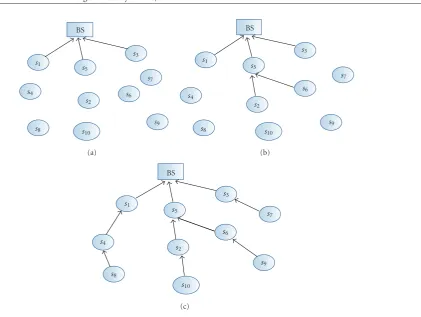
Figure 3 shows some steps of the construction of the
spanning tree of the WSN depicted onFigure 1.Figure 3(a) shows the first step where the neighbors of the base station join the tree. InFigure 3(b), we only show the step during which neighbors of nodes S5 join the tree. Finally, the complete tree is depicted inFigure 3(c).
3.3. Tree Maintenance and Rekeying. Once the tree is
con-structed, each node shares a symmetric key with the base station, a symmetric key with its father in the tree, and the key Kr with the whole network. A rekeying process is
launched by the base station periodically to refresh Kr as follows.
(1) The BS sends to each son Si a Refresh message
encrypted with their common keyKBS,Si{REFRESH,
BS, New Kr, null,MACKBS,Si(BS, new Kr)}KBS,Si.
Note that in a periodic refreshmal IDis set to null. However, if the base station issues the REFRESH
because of a captured node attack, it includes the ID of this node in the message.
(2) When a son node of the base station receives the Refresh message, it updates keyKr bynew Kr, then
Recieve{Hello, Sender ID, Sender Level, MACKr(,Sender ID, Sender Level, Sender Father)}Kr
If the message is received for the first time Then
Fatheri:=Sender ID; /∗Father receives the identifier of the sender.∗/
Leveli:=Sender Level+ 1;
If (Fatheri=/ BS) Then
/∗Compute a common key with the father∗/
KSi,Sender node:=HKr(SiSender nodeLeveli);
/∗if the father is the BS a shared key already exists.
Si → ∗:{HELLO, Si, Leveli, Fatheri, MACKr(Si, Leveli, Fatheri)}Kr;
Else
If (Leveli=Sender Level – 1) AND (Sender Father==Si) Then
Add the nodeSender IDto the list of sons; IfSi< >BS then
Compute a shared key with the son Sender ID:
KSi,Sender ID:=HKr(SiSender IDLeveli+ 1);
EndIF Else
Add the nodeSito the list of neighbors;
End IF
Algorithm1:
symmetric key shared between father and son. So, the Refresh message goes downward within the tree till reaching all the sensor nodes. Thus, all sensor nodes get the new global key.
A rekeying process may also be trigged if malicious/captured nodes are detected in the network. Because they are resource constrained, sensor nodes cannot implement mechanisms for detecting malicious nodes. For example, putting a sensor node in promiscuous mode is not feasible. Detecting captured nodes is conceivable only if the captured node issues attacks such as sending unnecessary messages to its neighbors to cause energy depletion. When a nodeSisuspects
one of its neighbors, saySm, to be captured, two situations are
possible.
(i) If the suspected node Sm is the son of Si, node Si
ignores the messages ofSm and removes it from the
list of sons. Then it generates a nonceNiand sends
{REFRESH-REQ, Si, SmKi-BS}to its father on the tree. This message goes upward until it reaches the BS. This last broadcasts a refresh message{REFRESH,
BS, New Kr,Sm, MACKBS,Si(BS, new Kr)}KBS,Siin
the tree. With this message, Kr is updated and all
sensor nodes are aware thatSmis malicious.
(ii) If the suspected node Sm is the father of Si, node
Si must first contact one of its neighbors in the list
neighborsi to find another father and by the way
another path to reach the base station. If it succeeds in this task, it issue aREFRESH-REQas in the precedent case.
In both cases, it is the base station that decides if it issues a key refresh or not. We suppose that the base station has more means and resources to detect malicious/captured nodes. Captured nodes may also send REFRESH-REQ messages only to consume energy and to evict honest nodes from
the network. If the base station detects this behavior, it may issue aREFRESHmessage that evicts the node that sends the
REFRESH-REQfrom the network.
Adding a new nodeSnis achieved as follows.
(1)Sn generates a nonce Nn and broadcasts a join
message as follows:Sn →∗:{JOIN, Sn, Nn, MACKr
(Sn, Nn)}Kr, TheJOINmessage is encrypted with the
current value ofKr, the key shared by all the sensor
nodes. So, the new sensor node must be launched with this key at deployment. Note here that deploying a new sensor must be synchronized with the periodic rekeying process to avoid deploying a new node with an obsolete key.
(2) When receiving the Join message, every nodeSiin the
transmission range of the new node generates a nonce Niand responds with the following message:
{Join-Ack,Si, Leveli, Nn, Ni, MACKr(Si, Leveli, Ni)}Kr.
(2)
(3) The new node declares the source of the first received message as a father and diffuses the following message:{Father,Sn,Si,Ni}Kr.
(4) The father node adds the new son node in its sons list. The surrounding nodes that heard theFathermessage add the new node to their list of neighbors.
(5) The father and the son compute their shared keys.
4. Evaluation
4.1. Comparison with Exiting Solutions. In this section, we
evaluate the performance of our solution and compare it with existing ones. We use the following metrics to achieve this evaluation.
(i) Memory complexity: memory needed to store keys. (ii) Communication Complexity: number of messages
exchanged for key management.
(iii) Key connectivity: the probability that two nodes (or more) share a key.
(iv) Resilience against node capture: this metric measures the impact of a node compromise on the security of the rest of the network. We quantify this metric with the three following values:
(a) good resilience: the compromised node affects only its neighbors (local influence),
(b) weak resilience: the compromised node affects its neighbors and also some nonneighboring nodes,
(c) very weak resilience: if the compromise of one node leads to compromise the whole network.
(v) Scalability: this metric measures the flexibility of the protocol with the size of the network. In other words, the metric shows how the cost of the protocol, that is memory and message overhead, varies when the network becomes larger. Scalability is a very impor-tant metric to consider when distributed algorithms are proposed, especially for dense WSNs. To quantify scalability, we use the following values:
(a) very good: the protocol does not induce further costs when the number of nodes in the network increases,
(b) good: the protocol induces reasonable costs when the number of nodes increases,
(c) medium: the cost of the protocol depends on the number of nodes.
Table 2 presents the results of comparing key management
protocols described inSection 2with the proposed solution. The different notations used in the table are described in
Section 2. In the proposed scheme, a node needs to store
initially three keys before deployment. After deployment, each node computes a number of keys that is the function of the number of its neighbors. If a nodeSihasdneighbors,
wheredare sons, the set of keys stored by the nodeSiis two
keys (with the base station) + one key (shared by the whole network) +dkeys. The memory complexity of our solution is acceptable for nowadays sensors.
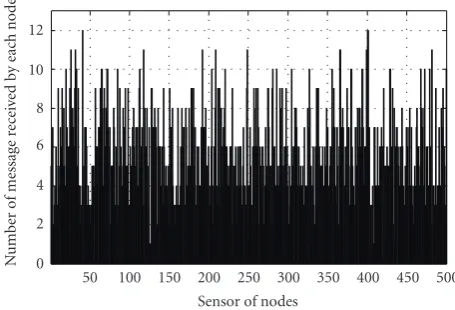
The analysis of the communication complexity for the construction of the tree is measured by the number of messages received and issued by each node. Each node sends a message and receivesdmessages from its neighbors, that is, d+ 1 messages by each node. Our solution has a low-complexity communication over other proposed solutions
50
300 350 400 450 500
Figure4: Average number of messages for each node in a network of 500 sensor nodes.
Figure5: Percentage of corrupted links versus number of captured nodes.
[6,9–13], moreover, it is deterministic; key connectivity is equal to one (no concept of probability).
Preserving energy in WSNs is very important and having a low communication complexity means that the solution minimizes energy.
4.2. Simulation Results. To validate the results presented by
table II, we also measured the performance of our protocol by simulation. In this section, we provide an overview of our simulation model and some of the results we obtained. We implemented our scheme within the MATLAB framework (MATLAB for MATrix LABoritory is a matrix-based system for scientific and engineering calculation). We considered WSNs with 500 sensor nodes deployed randomly in an area of 250∗250 meters square. Each sensor node has a signal range of 15 meters.
Table2: Comparison.
Our solution 3 + number of
sons d + 1 100% Good Good
n: number of nodes in the network.d: number of neighbors.Piis the probability that two nodes share a key in the corresponding protocol.mis the size of the key pool.
of each sensor node. We took the average of the values registered at the level of each sensor node.Figure 4illustrates the obtained results. It appears that our random deployments generate an average number of neighbors at most equal to 12. If the value of energy consumed by each type of message is known, we can compute the total energy consumed during tree construction.
We then considered the resilience of our scheme to node capture. We compute the resilience to node capture by the fraction of total communication links that are compromised by the capture of x nodes. We assume that sensor nodes
are randomly captured by an attacker.Figure 5presents the obtained results. It shows that for a network of 500 sensor nodes, an attacker must capture at least 100 sensor nodes to reach all communications in the network. This corresponds to 20% of nodes in the network.
500 550
800 850 900 950 1000
Figure6: Maximum number of messages received by a node versus network size.
evolves when the size of the network becomes larger. The curve is almost logarithmic which is very acceptable.
4.3. Security Analysis. In this section, we analyze the security
of our solution. As mentioned in the assumptions (cf.
Section 3.1), the base station will not be compromised. An
outsider attacker, who does not know the key Kr, cannot discover the meaning of messages diffused by nodes after deployment. Nevertheless, an attacker can compromise one or more nodes, so he becomes an insider attacker. The keys of the compromised node can be used for forging wrong messages (reading message, for example,) and also consume nodes’ energy by sending useless messages to his sons and father. If the base station can detect an abnormal behavior of a node, it can lunch a rekeying to refreshKr and revoke
this node. In the following, we analyze the behavior of our solution for three types of attack.
(1)HELLO flood attack: in our proposal, nodes
dis-cover their neighbors by sending aHELLOmessage encrypted with the key Kr. An attacker without
knowing the keyKrcould not launch aHELLOFlood
attack.
(2) Sybil attack: in the algorithm, an MAC of the node’s identifier, its level, and its father’s identifier is calculated to authenticate the sender and the receiver. Therefore, a node cannot play a role of other nodes.
(3) Node capture attack: when a node is captured, this does not affect its neighbors. In fact, after a node is captured, what can an attacker do? Since he has the key shared with the base station, he may send wrong information (lectures) to that base station. The latter may have a mechanism to verify the behavior of sender nodes. The attacker also has access to the keys of the sons of the victim enabling it thereafter to send unnecessary messages to these sons in order to consume their energy and cause battery depletion. Nodes that detect these useless messages can suspect the captured node and inform the base station with a
REFRESH-REQmessage.
5. Conclusion
Security is a necessity for most applications using WSNs, especially if the sensor nodes are deployed in unsafe areas, such as battlefields, strategic places (airports, critical buildings. . .). These sensor nodes operating in difficult access places, without protection and without possibility of recharging their batteries, may be subject to disruptive and malicious actions. Therefore, it is important to provide to them an acceptable security level. The primary objective of WSN nodes is to collect data and transmit them to a decision center. So, this must be done in a trustworthy and safe way. In this paper, we presented a key management solution to WSN that deals with one of the hardest attack: node capture. The main idea of the solution is to quickly and cheaply build a spanning tree that serves to refresh the shared key with min-imum costs. The solution is scalable and uses little memory.
As a perspective of our present work, we plan to use the NS2 simulator to compare the performance of our solution with other solutions from the literature. We also work on a mobile version of our scheme.
References
[1] I. F. Akyildiz, W. Su, Y. Sankarasubramaniam, and E. Cayirci, “A survey on sensor networks,”IEEE Communications Maga-zine, vol. 40, no. 8, pp. 102–114, 2002.
[2] T. Kavitha and D. Sridharan, “Security vulnerabilities in wireless sensor networks: a survey,” Journal of Information Assurance and Security, vol. 5, pp. 31–44, 2010.
[3] Y. Xiao, V. K. Rayi, B. Sun, X. Du, F. Hu, and M. Galloway, “A survey of key management schemes in wireless sensor networks,”Computer Communications, vol. 30, no. 11-12, pp. 2314–2341, 2007.
[4] R. J. Watro, D. Kong, S.-F. Cuti, C. Gardiner, C. Lynn, and P. Kruus, “TinyPK: securing sensor networks with public key technology,” in Proceedings of the 2004 ACM Workshop on Security of Ad Hoc and Sensor Networks (SASN ’04), pp. 59– 64, October 2004.
[5] P. Ning and A. Liu, “TinyECC: elliptic curve cryptog-raphy for sensor networks,” http://discovery.csc.ncsu.edu/ software/TinyECC/.
[6] R. Anderson, H. Chan, and A. Perrig, “Key infection: smart trust for smart dust,” inProceedings of the 12th IEEE Interna-tional Conference on Network Protocols (ICNP ’04), pp. 206– 215, October 2004.
[7] R. Blom, “An optimal class of symmetric key generation systems,” in Proceedings of the Eurocrypt 84 Workshop on Advances in Cryptology: Theory and Application of Crypto-graphic Techniques, pp. 335–338, Springer, 1985.
[8] C. Blundo, A. D. Santix, A. Herzberg, S. Kutten, U. Vaccaro, and M. Yung, “Perfectly-secure key distribution for dynamic conferences,” inProceedings of the 12th Annual International Cryptology Conference on Advances in Cryptology, pp. 471–486, Spring, Berlin, Germany, 1992.
[9] B. Lai, S. Kim, and I. Verbauwhede, “Scalable session key construction protocol for wireless sensor networks,” in Pro-ceedings of the IEEE Workshop on Large Scale RealTime and Embedded Systems (LARTES ’02), 2002.
[11] A. Perrig, R. Szewczyk, V. Wen, D. Culler, and J. D. Tygar, “SPINS: security protocols for sensor networks,” in Proceed-ings of the 7th Annual International Conference on Mobile Computing and Networking, pp. 189–199, ACM Press, July 2001.
[12] S. Zhu, S. Setia, and S. Jajodia, “LEAP: efficient security mechanisms for large-scale distributed sensor networks,” in
Proceedings of the 10th ACM Conference on Computer and Communications Security (CCS ’03), pp. 62–72, October 2003. [13] D. Liu and P. Ning, “Location-based pairwise key establish-ments for static sensor networks,” inProceedings of the 1st ACM Workshop on Security of Ad Hoc and Sensor Networks (CCS ’03), pp. 72–82, October 2003.
[14] L. Eschenauer and V. D. Gligor, “A key-management scheme for distributed sensor networks,” inProceedings of the 9th ACM Conference on Computer and Communications Security, pp. 41– 47, November 2002.
[15] D. Liu, P. Ning, and L. I. Rongfang, “Establishing pairwise keys in distributed sensor networks,” ACM Transactions on Information and System Security, vol. 8, no. 1, pp. 41–77, 2005. [16] W. Du, J. Deng, Y. S. Han, S. Chen, and P. K. Varshney, “A key management scheme for wireless sensor networks using deployment knowledge,” in Proceedings of the IEEE International Conference on Computer Communications (IEEE INFOCOM ’11), pp. 586–597, March 2004.