Pattern Matching Refinements to Dictionary-Based Code-Switching
Point Detection
Nathaniel Oco Rachel Edita Roxas
De La Salle University De La Salle University
2401 Taft Avenue Malate, Manila City 2401 Taft Avenue Malate, Manila City 1004 Metro Manila, Philippines 1004 Metro Manila, Philippines
[email protected] [email protected]
Abstract
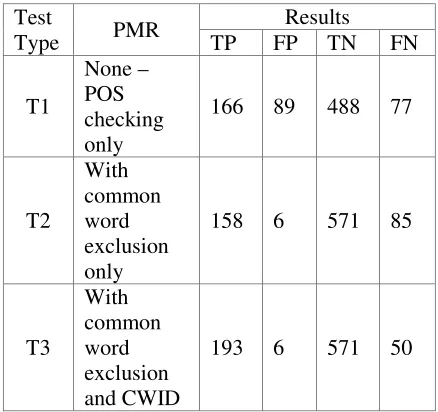
This study presents the development and evaluation of pattern matching refinements (PMRs) to automatic code switching point (CSP) detection. With all PMRs, evaluation showed an accuracy of 94.51%. This is an improvement to reported accuracy rates of dictionary-based approaches, which are in the range of 75.22%-76.26% (Yeong and Tan, 2010). In our experiments, a 100-sentence Tagalog-English corpus was used as test bed. Analyses showed that the dictionary-based approach using part-of-speech checking yielded an accuracy of 79.76% only, and two notable linguistic phenomena, (1) intra-word code-switching and (2) common words, were shown to have caused the low accuracy. The devised PMRs, namely: (1) common word exclusion, (2) common word identification, and (3) common n-gram pruning address this and showed improved accuracy. The work can be extended using audio files and machine learning with larger language resources.
1 Introduction
Code-switching (CS) is “the use of two or more linguistic varieties in the same interaction or conversation” (Myers-Scotton and Ury, 1977). It is often prevalent in communities where there is
language contact. According to linguistic studies (Bautista, 1991; Bautista, 2004; Borlongan, 2009), code-switching reasons are mainly driven by proficiency or deficiency in the languages involved. Proficiency-driven code-switching takes place when a person is competent with the two languages and can easily switch from one to the other “for maximum efficiency or effect”. On the other hand, deficiency-driven code-switching takes place when people are forced to code-switch to one language because they are “not competent in the use of the other language”. Oral communication in both languages can be enhanced by the detection of code-switching points (CSPs). To detect CSPs, we developed a dictionary-based approach using a rule-based engine (Naber, 2003), and we also developed pattern matching refinements (PMRs) to improve accuracy.
As testbed, this study focuses on Tagalog-English code-switching, which can be classified into (1) intra-sentential and (2) intra-word code-switching. Intra-sentential CS is the switching between Tagalog and English words and clauses, while intra-word CS is the use of English root words with Tagalog affixes and morphological rules. An example of intra-sentential CS is “Unless let us say may mga bisita siya” (translated as: Unless let us say he/she has visitors) and an example of intra-word CS is “nagdadrive” (incompeleted aspect of the English verb “drive”). The system developed can effectively be used to detect intra-sentential (Tagalog to English and English to Tagalog) and intra-word CSPs.
This paper is organized as follows: related works in section 2, CSP detection in section 3, pattern matching refinements in section 4, testing and discussion in section 5, and conclusion in section 6.
2 Related Works
In the field of computing, several studies have been done to automatically detect CSPs. The areas that are commonly involved are machine learning, audio signal processing, and natural language processing (NLP). In machine learning, patterns are derived from large data sets such as in the CSP studies of Spanish-English (Solorio and Liu, 2008) and Chinese-English (Burgmer, 2009), which used the transcription of forty minutes and four hours of audio recordings, respectively. In audio signal processing, analyses of speech corpora (e.g. the Cantonese CUSENT and the English TIMIT) using acoustic models (White et al., 2008) are studied. Analyses of trained phone models (Chan et al., 2004) are also studied.
In NLP, a related study (Yeong and Tan, 2010) explored n-gram-based approaches and also presented dictionary-based approaches. N-gram-based approaches such as alphabet bigram, grapheme bigram, and syllable structure use similarity measures and language models extracted from a corpus. On the other hand, dictionary-based approaches such as language vocabulary list and affixation information match the word against a dictionary. Table 1 shows a performance comparison of different NLP approaches (Yeong and Tan, 2010). The table shows that dictionary-based approaches yield lower accuracy rates than model-based approaches and are known to have lower performance ratings.
Approach Accuracy
Dictionary -based
Affixation
Information 76.26%
Vocabulary List 75.22%
N-gram-based
Alphabet Bigram 91.29% Grapheme Bigram 91.82% Syllable Structure 93.73%
Table 1: Performance comparison of different NLP approaches (Yeong and Tan, 2010)
3 CSP Detection
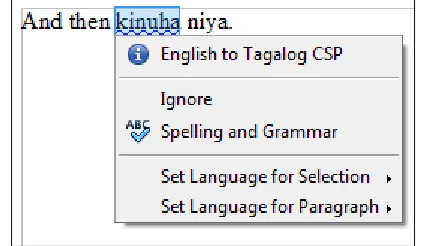
The system has been plugged into OpenOffice and it highlights CSPs in an OpenOffice document. Figure 1 shows a sample screenshot of the system detecting CSP in the sentence “And then kinuha niya” (translated as: And then he/she took it).
Figure 1: Sample screenshot of the system showing English to Tagalog CSP
After studying the Philippine component of the International Corpus of English (Bautista et al., 2004), we experimented on a dictionary-based approach to detect CSPs using LanguageTool (Naber, 2003) – a rule-based style and grammar checker engine that can run as an OpenOffice extension. Figure 2 shows the architecture of the developed system. LanguageTool requires two language resources to run: (1) the tagger dictionary and (2) the rule file. For the tagger dictionary, we utilized and edited word declarations from the English (ENG TD) and Tagalog (TAG TD) supports. For the rule file (RF), we developed pattern matching rules.
Figure 2: Architecture of the system
3.1 Tagger Dictionary
The CSP tagger dictionary contains approximately 298,498 words from the English language support, 7,441 words from Tagalog, 35 punctuation marks, 54,157 proper nouns and 1000 new word declarations, for a total of 361,131 words. File size was almost 10MB. We reduced it to 1MB by encoding1 it to a smaller file, making it easier to load. Figure 3 shows sample word declarations. To distinguish between Tagalog and English words, a header tag was assigned to Tagalog words and a different one to English words. The words in the tagger dictionary are classified into four header tags: Tagalog words (“TAG”), English words (“ENG”), proper nouns (“NPRO”), and punctuations (“PSNS”).
Figure 3: Sample word declarations
LanguageTool supports different languages. As comparison, Table 2 shows the word count in six
1
Morfologik was used to convert text files to FSA-encoded .dict files. Morfologik is available at:
http://sourceforge.net/projects/morfologik/files/
language supports. The numbers highlight that Tagalog is a poorly-resourced language.
Language Support Word Count
German 4,158,968
Polish 3,662,366
French 550,814
English 354,744
Asturian 157,747
Tagalog 7,484
Table 2: Number of word declarations in six language supports
3.2 Rule File
The rule file, like any xml file, is composed of elements and attributes. Figure 4 shows a sample rule file. The three main elements are: (1) pattern, (2) message, and (3) example. Pattern refers to the token or sequence of tokens and/or part-of-speech (POS) to be matched; message refers to the feedback, which will be shown to the user if the pattern matches the input; and example refers to the sentences used for testing. If a pattern matches, CSPs are marked and message is shown to the user.
Figure 4: An English to Tagalog CSP rule using POS checking
Pattern matching in CSP detection works by checking if a word is English or Tagalog, i.e. has a header tag “ENG” or “TAG”. This would result in false positives if it is a common word – a word that appears in both the English and Tagalog tagger dictionaries – as this would have both header tags. An example of a common word is “may” (e.g.
kasimputi kasimputi TAG ADCO S
# # PSNS
$ $ PSNS
nonsecluded nonsecluded ENG JJ nonsecludedness nonsecludedness ENG NN nonsecludedly nonsecludedly ENG RB Abbottson Abbottson NPRO Abboud Abboud NPRO Abby Abby NPRO
<rule id="ENGLISH-TAGALOG" name="Code Switch to Tagalog">
<pattern case_sensitive="no" mark_from="1">
<token postag="ENG.*" postag_regexp="yes"/> <token postag="TAG.*" postag_regexp="yes"/> </pattern>
<message>English to Tagalog CSP</message>
<example type="incorrect">I want to be
<marker>sundalo</marker>.</example> <example type="correct">They are soldiers.</example>
</rule> OpenOffice.org
LanguageTool
Input
CSP Language Resources
TAG TD ENG
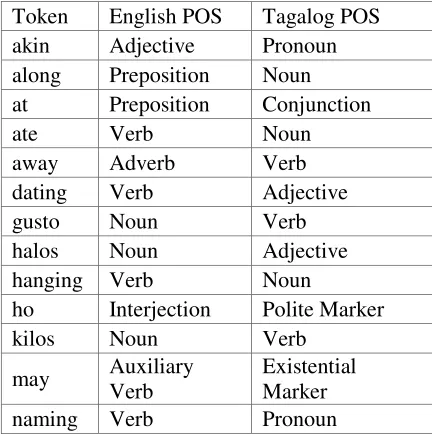
“may ENG…” and “may TAG…”), which could be an English Verb or a Tagalog existential marker. Another example is “raw”, which could be an English adjective or a Tagalog enclitic.
Using POS checking, one true positive and one false positive are detected in the sentence “Unless let us say may mga bisita siya” (translated as: Unless let us say he/she has visitors). Both “may” and “mga” are detected as English to Tagalog CSP. We developed pattern matching refinements to improve accuracy.
4 Pattern Matching Refinements
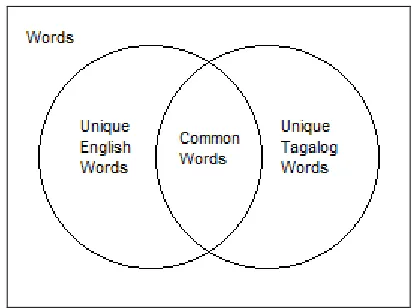
Pattern matching refinements (PMRs) work by separating pattern matching for sentences involving common words and words with unknown POS. Figure 5 shows the diagram of the different word types. Words (W) are generally classified into four: unique English words (UEW), unique Tagalog words (UTW), common words (CW), and unknown words (W-(UEW∪UTW)). Unique English words are words with “ENG” header tags only. The same applies for Tagalog words (“TAG”). Since the English tagger dictionary is well-resourced, unknown POS indicate either intra-word code-switching or undeclared Tagalog words.
Figure 5: The set of words showing the intersection of UEW and UTW as common words
4.1 Common Word Exclusion
We developed common word exclusion to reduce the detection of false positives in sentences involving common words. The uniqueness of a word in a tagger dictionary is taken into consideration (i.e. a word does not have multiple
declarations with different header tags) and common words are excluded from the pattern. If a unique English word is followed by a unique Tagalog word, then the second word is a CSP. The same applies if a unique Tagalog word is followed by a unique English word. Figure 6 shows a pattern without common word exclusion and Figure 7 shows a pattern with common word exclusion. The list of common words was generated by getting the intersection of word declarations with header tag “ENG” and those with header tag “TAG”. For scalability, a new tag “CW” was created and common words were added in the tagger dictionary with this tag. This PMR is similar to common word pruning (Dimalen and Roxas, 2007), which was used as a language model improvement to increase the accuracy rate of language identification involving closely-related languages. The difference is common words are completely discarded in common word pruning while in this PMR, common words are excluded from the pattern and declared only as exceptions.
Figure 6: Pattern matching without common word exclusion
Figure 7: Pattern matching with common word exclusion
Using common word exclusion, no true positive nor false positive is detected in the sentence “Unless let us say may mga bisita siya” (translated as: Unless let us say he/she has visitors).
<token postag="ENG.*" postag_regexp="yes">
<exception postag="CW.*"
postag_regexp="yes"> </exception></token>
<token postag="TAG.*" postag_regexp="yes">
<exception postag="CW.*"
Token English POS Tagalog POS
noon Noun Pronoun
paring Verb Noun
piling Verb Noun
raw Adjective Enclitic
ring Noun Enclitic
sawing Verb Adjective
tinging Verb Adjective
Table 6: Sample list of common words with different semantic information
A combination of all pattern matching refinements yielded the highest accuracy with 94.51%. This can be attributed to the detection of common words and intra-word CS.
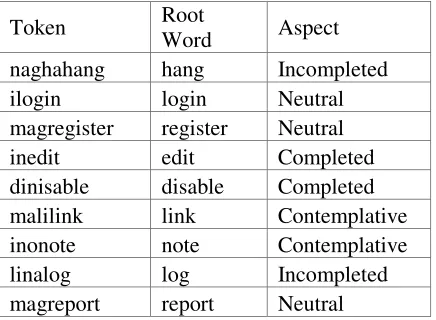
A close analysis of the false negatives reveals that some intra-word CS was not detected. Table 7 shows a sample list. The n-gram sequence of these words is not unique and is found in the Tagalog n-gram profile. Intra-word CS with n-n-gram sequence similar to Tagalog words is not properly detected by the system.
Token Root
Word Aspect
naghahang hang Incompleted
ilogin login Neutral
magregister register Neutral
inedit edit Completed
dinisable disable Completed
malilink link Contemplative
inonote note Contemplative
linalog log Incompleted
magreport report Neutral
Table 7: Sample list of verbs with intra-word CS that were not detected
6 Conclusion and Recommendation
This paper has shown that the application of PMRs significantly increased accuracy. The tests show that with all PMRs, the system was able to achieve 94.51% accuracy. The result is higher than no improvements used. The results are also higher than the results yielded by dictionary-based
approaches in a related study (Yeong and Tan, 2010).
As future work, other forms of multilingualism can be considered. There are instances where more than two languages are involved in code-switching and these are rarely documented. Also, code-switching involving dialectal variations may be considered and since Tagalog is a poorly-resourced language, bootstrapping can be applied. Additional resources may also be added and machine learning be used, such as in (Solorio and Liu, 2008) and (Burgmer, 2009). Also, the work can be extended to cover audio files, such as in (White et al., 2008) and (Chan et al., 2004).
Acknowledgments
This work has been funded by the Department of Science and Technology - Philippine Council for Industry, Energy and Emerging Technology Research and Development (DOST-PCIEERD) through the “Inter-Disciplinary Signal Processing for Pinoys (ISIP): ICT for Education” Program and also supported by the University Research Coordination Office of De La Salle University (No. 20FU211).
We thank Prof. Dr. Ma. Lourdes S. Bautista, Dr. Ariane Borlongan, and Ms. Mary Anne Conde for being instrumental to the completion of this study. We also thank reviewers for their comments.
References
Ariane M. Borlongan. 2009. Tagalog-English Code-Switching in English Classes in the Philippines: Frequency and Forms. TESOL Journal, 1: 28-42. Carol Myers-Scotton and William Ury. 1977. Bilingual
Strategies: The Social Functions of Code-Switching. International Journal of the Sociology of Language, 13: 5-20.
Christoph Burgmer. 2009. Detecting Code-Switch Events based on Textual Features. Diploma Thesis. Karlsruhe Institute of Technology, Karlsruhe. Christopher M. White, Sanjeev Khudanpur, James K.
Daniel Naber. 2003. A Rule-based Style and Grammar Checker. Diploma Thesis. Bielefeld University, Bielefeld.
Davis Muhajereen D. Dimalen and Rachel Edita O. Roxas. 2007. AutoCor: A Query Based Automatic Acquisition of Corpora of Closely-related Languages. In Proceedings of the 21st Pacific Asia Conference on Language, Information, and Computation. Seoul, Korea: Korean Society for Language Information.
Joyce Y.C. Chan, P.S. Ching, Tan Lee, and Helen M. Meng. 2004. Detection of Language Boundary in Code-Switching Utterances using Bi-Phone Probabilities. In Proceedings of the 4th International Symposium on Chinese Spoken Language Processing. Hong Kong, China: Chinese University of Hong Kong.
Ma. Lourdes S. Bautista. 1991. Code-Switching Studies in the Philippines. International Journal of the Sociology of Language, 88: 19-32.
Ma. Lourdes S. Bautista. 2004. Tagalog-English Code-Switching as a Mode of Discourse. Asia Pacific Educational Review, 5 (2): 226-233.
Ma. Lourdes S. Bautista, Loy V. Lising, and Danilo T. Dayag. 2004. ICE-Philippines Lexical Corpus - CD-ROM. London: International Corpus of English. Nathaniel A. Oco and Allan B. Borra. 2011. A
Grammar Checker for Tagalog using LanguageTool. In Proceedings of the 9th Workshop on Asian Language Resources Collocated with IJCNLP 2011. Chiang Mai, Thailand: Asian Federation of Natural Language Processing.
Thamar Solorio and Yang Liu. 2008. Learning to Predict Code-Switching Points. In Proceedings of the 2010 Conference on Empirical Methods in Natural Language Processing. Honolulu, HI: Association for Computational Linguistics.