CSEIT1725183 | Received : 10 Oct 2017 | Accepted : 26 Oct 2017 | September-October-2017 [(2)5: 888-894 ]
International Journal of Scientific Research in Computer Science, Engineering and Information Technology © 2017 IJSRCSEIT | Volume 2 | Issue 5 | ISSN : 2456-3307
888
Numerical modeling for thermal management of fuel cell by
using Al
2O
3, SiC and CuO water based nanofluids
Dr. Nirmal Kumar Kund
Associate Professor, Department of Production Engineering, Veer Surendra Sai University of Technology, Burla, India
ABSTRACT
Fuel cell thermal control is very much vital for its smooth and effective performance. The current investigation relates to a fuel cell which is encapsulated in a horizontal duct open at both the ends. The nanofluid as coolant is allowed to pass through the annular region between the fuel cell and duct. Three different water based nanofluids, namely Water-Al2O3, Water-SiC and Water-CuO, are considered as coolants in the present investigations. The
numerical studies are carried out to obtain the heat transfer behavior of encapsulated fuel cell for maintaining its temperature within the safe limit. For that, a 2D numerical model is being developed. The continuity, momentum and energy equations are solved to predict the thermal behavior. The simulations are performed to predict the temperature fields and temperature contours. The trends of results are along the expected lines. Simulation results predicted with three different water based nanofluids are analyzed and compared for realizing the relative importance of the stated nanofluids. The model parameters considered are fuel cell heat flux of 10 W/cm2 and
nanofluid velocity of 9 m/s at duct inlet. The Water-SiC is found as the nanofluid rendering very much ideal fuel cell application without any kind of thermal letdown.
Keywords: Fuel Cell, Cooling, Simulation, Nanofluids, Water-Al2O3, Water-SiC, Water-CuO
I.
INTRODUCTION
The devices that produce electricity through electrochemical reactions are termed as fuel cells. The fuel cells transform chemical energy stored in the fuel to electrical energy. Mostly hydrogen is used as fuel and the ambient air acts like an oxidant. However, in few cases methanol is also used as fuel and pure oxygen as oxidant. Fuel cells require a fuel source and will perform for infinite period of time if inflows of fuel are maintained. As the power generation takes place without burning of fossil fuels (or any other energy sources), fuel cells produce very less pollution since the byproduct involved in fuel cell is only heat and water. For the said reason it comes under green energy technology. The maintenance of fuel cell is simple since there are very few moving parts in the system as compared to any other energy sources. Fuel cells do not require traditional fuels like oil or gas and can thus decrease financial reliance on oil supplying nations.
Xuan and Roetzel [1] established concepts of heat transfer correlations concerning about nanofluids. S. Litster and McLean [2] described about the functioning of various proton exchange membrane (PEM) fuel cell electrodes.Min et al. [3] performed the parametric studies of proton exchange membrane fuel cell (PEMFC) numerically. Xuan et al. [4] reviewed about the contaminations in PEM type hydrogen fuel cells. various approaches for thermal management of proton exchange membrane fuel cell systems. Jong-Woo and Song-Yul [8] investigated about the coolant control in PEM fuel cell systems.Zhang and Kandlikar [9] performed critical reviews of cooling techniques in PEM fuel cell stacks. Mohamed and Atan [10] analyzed about the excessive heating on thermal and electrical resistance of a polymer electrolyte membrane fuel cell. Keshavarz et al. [11] executed numerical studies on the influences of nanofluids on mini-channel heat sink. Houchang et al. [12] studied about the operation features of air-cooled proton exchange membrane fuel cell stacks at ambient situations.
From the abovementioned text, to the best of author’ knowledge, it is well understood that there is not a single detail computational study relating to the effects of water based nanofluids (namely Water-Al2O3,
Water-SiC and Water-CuO) on heat transfer behavior of fuel cells. With this perspective, the present paper demonstrates numerical investigations with the stated nanofluids on thermal characteristics of fuel cells. And also, the numerical model includes additional key factors like inertia, viscosity and gravity effects apart from the usual issues concerning the present physical problem. However, the stated model ignores both compressibility and viscous heat dissipation effects. The model is very well demonstrated for the detailed numerical investigations on the influences of the already stated nanofluids (as they significantly affect the cooling characteristics) by taking fuel cell heat flux and duct inlet nanofluid velocity as the important model parameters. Finally, the predictions of the model relating to various nanofluids are along the lines of expectations as well.
II.
DESCRIPTION OF PHYSICAL PROBLEM
The graphical illustration of a representative fuel cell to be inserted in a duct is shown in the figure 1. The corresponding physical model as illustrated in figure 2, describes about the overall heat transfer from the fuel cell which is encapsulated in a horizontal duct open at both the ends. The coolants considered in the present investigations are three different water based nanofluids named as Water-Al2O3, Water-SiC and
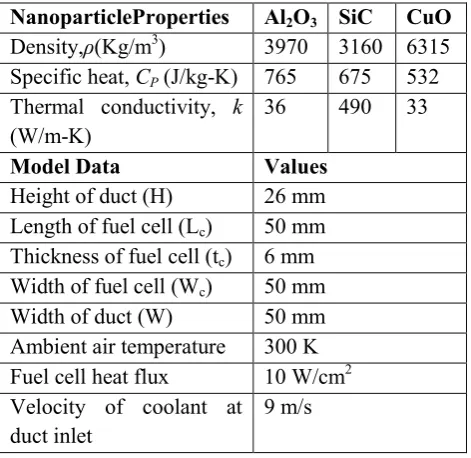
Water-CuO. A 2D model is considered to save computation/simulation time by ignoring end effects in the transverse direction. The model includes the viscosity along with the gravity effect as well. The fluid flow is considered to be laminar and incompressible. The no slip boundary condition is specified at the walls. The velocity inlet boundary condition is set at the entry to the duct from where water based nanofluids are allowed to pass through. A pressure outlet boundary condition is specified at the exit of the duct. The ambient condition is taken at the entry to the duct. For cooling of the fuel cell surface, a convective boundary condition in the form of heat flux is introduced to simulate the overall temperature variation inside the duct due to heat transfer. The thermo-physical properties of different nanoparticles alongside the other system parameters, are presented in table 1.
Figure 2. 2D computational domain of physical model with flow of coolant inside the duct
Table 1. Thermophysical properties of nanoparticles and model data Ambient air temperature 300 K Fuel cell heat flux 10 W/cm2
Velocity of coolant at duct inlet
9 m/s
III.
MATHEMATICAL FORMAULATION
The current physical problem is represented by a set of governing transport equations which are solved through the current computational methods concerning both modeling and simulation. The related continuity, momentum and energy equations in 2D for a fully developed hydrodynamic and thermal flow situations are described in equations from (1) to (4), respectively. The compressibility and the viscous heat dissipation effects are ignored in the present physical condition. Continuity equation:
A. Numerical scheme and solution algorithm
The abovementioned governing transport equations are converted into generalized form as follows.
u
SThe converted governing transport equations are discretized with the second order upwind scheme using a pressure based finite volume method with the using the stated velocity field to get the corresponding temperature field. In other words, all the said equations are solved together (but not independently) owing to interdependency between the related parameters.
B. Choice of grid size, time step and convergence criteria
Convergence in inner iterations is happened while the condition|
|
is satisfied concurrently for
all variables, where 𝜑stands for each variable u, v, and T at a grid point at the current iteration level, 𝜑old
represents the corresponding value at the previous iteration level, and 𝜑max is the maximum value of the
variable at the present iteration level in the whole domain.
V.
RESULTS AND DISCUSSION
Numerical simulations are carried out to study the effects of three different water based nanofluids ( such as Water-Al2O3, Water-SiC and Water-CuO) on
cooling characteristics of fuel cell in terms of temperature distributions (i.e. temperature contours/ fields) and surface temperatures of fuel cells. At the outset, the height of the duct is considered to be 26 mm, besides, the thickness and the length of the fuel cell as 6 mm and 50 mm respectively. Furthermore, the heat flux related to the fuel cell is taken as 10 W/cm2 and the
velocity of nanofluid at the duct inlet is selected as 9 m/s.
A. Case study with Water-Al2O3 nanofluid as
coolant
With the said model conditions, so as to study the influence of Water-Al2O3 nanofluid on the thermal
behavior of the fuel cell, the numerical simulations are performed, by taking into account the thermophysical properties of the said nanofluid.
Figure 3 demonstrates the simulated results of the temperature field (together with the colored scale bar displaying the temperature values in terms of K) as obtained at the stated model conditions by considering Water-Al2O3 nanofluid as coolant. The surface
temperature of fuel cell is found to be350 K (which is very close to the safe limit of 356 K temperature as desired in order to avoid the thermal failure of the fuel cell). As expected, the temperature of the Water-Al2O3
nanofluid is maximum near the vicinity of fuel cell. And also, the temperature of the Water-Al2O3 nanofluid
gradually decreases with the increase in the distance from the fuel cell and then it becomes equal to the atmospheric temperature in the far field region. The corresponding temperature contour is also
demonstrated in figure 4. In addition, the trends of results are along the lines of expectations.
Figure 3. Temperature field with Water-Al2O3
nanofluid as coolant.
Figure 4. Temperature contour with Water-Al2O3
nanofluid as coolant.
B. Case study with Water-SiC nanofluid as coolant
With the stated model conditions, in order to investigate the influence of Water-SiC nanofluid on the thermal behavior of the fuel cell, the numerical simulations are performed, by taking into account the thermophysical properties of the stated nanofluid.
cell). As expected, the temperature of the Water-SiC nanofluid is maximum near the vicinity of fuel cell. And also, the temperature of the Water-SiC nanofluid gradually decreases with the increase in the distance from the fuel cell and then it becomes equal to the atmospheric temperature in the far field region. The corresponding temperature contour is also demonstrated in figure 6. Here also, the trends of results are along the expected lines.
Figure 5. Temperature field with Water-SiC nanofluid as coolant.
Figure 6. Temperature contour with Water-SiC nanofluid as coolant.
C. Case study with Water-CuO nanofluid as coolant
With the said model conditions, so as to study the influence of Water-CuO nanofluid on the thermal behavior of the fuel cell, the numerical simulations are performed, by taking into account the thermophysical properties of the stated nanofluid.
Figure 7elucidatesthe simulated results of the temperature field (together with the colored scale bar displaying the temperature values in terms of K) as obtained at the stated model conditions by considering
Water-CuO nanofluid as coolant. The surface temperature of fuel cell is found to be340 K (which is also within the safe limit of 356 K temperature as desired in order to avoid the thermal failure of the fuel cell). As expected, the temperature of the Water-CuO nanofluid is maximum near the vicinity of fuel cell. And also, the temperature of the Water-CuO nanofluid gradually decreases with the increase in the distance from the fuel cell and then it becomes equal to the atmospheric temperature in the far field region. The corresponding temperature contour is also demonstrated in figure 8. The trends of results are along the lines of expectations as well.
Figure 7. Temperature field with Water-CuO nanofluid as coolant.
Figure 8. Temperature contour with Water-CuO nanofluid as coolant.
D. Comparison of temperatures of fuel cells obtained with different nanofluids as coolants
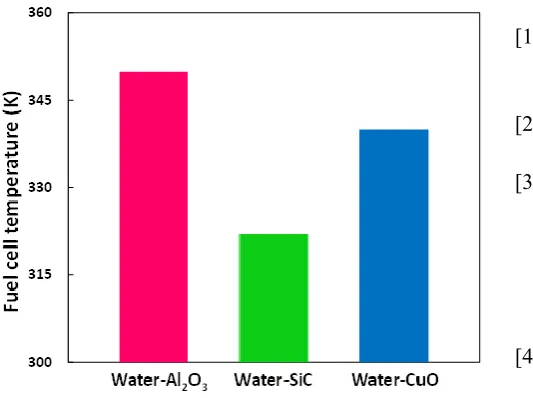
Table 2 illustrates the computationally predicted temperatures of the fuel cells as obtained with the use of three different water based nanofluids (namely, Water-Al2O3, Water-SiC and Water-CuO) as coolants.
comparable with each other. As expected, the variations in the numerically predicted temperatures of the fuel cells are witnessed very clearly with the use of the stated water based nanofluids as coolants. This is owing to the variations in the thermal conductivities of the corresponding nanoparticles as described in table 1.
Table 2. Comparison of numerical predictions of fuel cells temperatures with different nanofluids as coolants.
Name of
Similarly, figure 9 also elucidates the plot showing the variations in the fuel cells temperatures with three different water based stated nanofluids as coolants. It is well understood that the trends of the variations in the computationally predicted results are along the lines of expectations.
Figure 9. Variations in fuel cells temperatures with different water based nanofluids as coolants
VI. CONCLUSION
A computational model concerning about to the fuel cell is developed to predict the thermal behavior with three different water based nanofluids, namely Water-Al2O3, Water-SiC and Water-CuO as coolants. The
model includes additional key factors like inertia,
viscosity and gravity effects apart from the usual issues concerning the present physical problem. However, the stated model ignores both compressibility and viscous heat dissipation effects. The model is very well demonstrated for the detailed numerical investigations on the influences of the already stated nanofluids (as they significantly affect the cooling characteristics) by taking fuel cell heat flux of 10 W/cm2 and duct inlet
nanofluid velocity of 9 m/s as the important model parameters. The predictions of the model pertaining to the different nanofluids are along the expected lines. Direct comparison with other numerical models of fuel cells is not possible because of the absence of such models in the literature. However, the experimental comparison with an in-house experimental setup is planned for the future. With the said model conditions, it is observed that the Water-SiC nanofluid renders appropriately effective cooling behavior without any such thermal failure and is the optimum one as the fuel cell temperature is very far below the safe limit. Therefore, the said model alongside the nanofluid can be used straightway in production houses to increase heat transfer and for fuel cell thermal management.
VII.
REFERENCES
[1] Xuan Y, Roetzel W. Conceptions for heat transfer correlation of nanofluids. Int J Heat Mass Transfer 2000; vol 43:3701-7.
[2] S. Litster, G. McLean, PEM fuel cell electrodes, Journal of Power Sources 130 (2004) 61-76. [3] Min CH, He YL, Liu XL, Yin BH, Jiang W,
Tao WQ. Parameter sensitivity examination and discussion of PEM fuel cell simulation model validation part II: results of sensitivity analysis and validation of the model. J Power Sources 2006; vol 160:374-85.
nanofluid for an electronic liquid cooling system. Appl Therm Eng 2007; vol 27:1501-6. [7] Sangseok Yu, Dohoy Jung, Thermal
management strategy for a proton exchange membrane fuel cell system with a large active cell area, Renewable Energy 33 (2008) 2540- 2548.
[8] Jong-Woo Ahn, Song-Yul Choe, Coolant controls of a PEM fuel cell system, Journal of Power Sources 179 (2008) 252-264.
[9] Zhang G, Kandlikar SG. A critical review of cooling techniques in proton exchange membrane fuel cell stacks. Int J Hydrogen Energy 2012;37: 2412-29.
[10] W. A. N. W. Mohamed and R. Atan, Analysis of Excessive Heating on the Thermal and Electrical Resistance of a polymer electrolyte membrane fuel cell. International Journal of Automotive and Mechanical Engineering (IJAME) ISSN: 2229-8648 (Print); ISSN: 2180-1606 (Online); Volume 5, pp. 648-659, January-June 2012.
[11] Keshavarz Moraveji M, Mohammadi Ardehali R, Ijam A. CFD investigation of nanofluid effects (cooling performance and pressure drop) in mini-channel heat sink. Int Commun Heat Mass Transfer 2013; vol 40:58-66.