An Analysis of Economic Load Dispatch in
Power System Using Genetic Algorithm
Chiragkumar Patel1, Rakesh B. Shah2, Minaxi L. Patel 3, Rajesh D.Panchal4
Assistant Professor, Dept. of EE, Hasmukh Gowami College of Engineering, Vahelal, Gujarat, India1
Lecturer, Dept. of EE, RCTI, Sola, Ahmedabad, Gujarat, India2
Assistant Professor, Dept. of EE, GEC, Dahod, Gujarat, India3
Lecturer, Dept. of EE, RCTI, Sola, Ahmedabad, Gujarat, India4
ABSTRACT: The objective of this paper is to solve an Economic Load Dispatch problem in Power System using Genetic Algorithm method. The Aim of this work is to minimize total fuel cost of generation. Data has been taken from the IEEE standard data sheet. Genetic Algorithm method is implemented in MATLAB.
KEYWORDS: Economic Load Dispatch; Genetic Algorithm; Lambda Iteration Method, Fuel Cost.
I. INTRODUCTION
Economic Load Dispatch problem is the most important optimization problem in modern power system. Main aim of economic load dispatch problem is allocation of power generation to different thermal units to minimize overall fuel cost while satisfying the load demand and operating constraints [1].
Conventional methods to solve the Economic Load Dispatch Problem are as follows : Lambda Iteration method, Linear Programming and Dynamic Programming [2]. These methods have some limitations when using with more complex problems [3]. Advanced techniques have been developed for solving optimization problems. Examples are Neural Network [4], the Simulated Annealing method [5], Fuzzy Logic and Genetic Algorithm and so on.
II.ECONOMIC LOAD DISPATCH Economic Load Dispatch
The Economic Load Dispatch is the process of allocation of generation to different thermal units. The main goal of Economic Load dispatch is to minimize the overall fuel cost of generation [1].
Generator Operating Cost
The total cost includes the fuel cost, labour cost, supplies and maintenance. Costs of labour, supplies and maintenance
are fixed. Figure 1 shows the N Thermal units committed to serve a load of Pload. The Input to each unit, shows the Fuel
1
2
3
4
N
Pload
F1
F2
F3
F4
FN
P1
P2
P3
P4
PN
Boiler Turbine Generator
Fuel Input
Fig.1. N Thermal units committed to serve a load of Pload
Figure 1 shows the N Thermal units committed to serve a load of Pload.
III.PROBLEM FORMULATION Objective function
Fuel cost function is expressed as a quadratic function. The total fuel cost is given by
F(Pgi) = aiPgi*2 + biPgi + ci Rs/hr , i= 1, 2 , 3 ,….n (1)
Where ai, bi, ci are cost coefficients for ith unit. Fi(Pgi) is the total fuel cost of generation. Pgi is the generation of ith unit
[1].
Power balance constraint
Power generated should be same as the total load demand PD (in MW).
PD=∑ Pgi (2)
The transmission and generator losses have been neglected [1].
Generation limits constraint
The output power of each generating unit has a upper and lower bound so that it is lies between these limits.
Pgimin≤Pgi≤Pgimax (3)
Where Pgimin and Pgimax are minimum and maximum load demand of generator i, respectively [1].
IV.GENETIC ALGORITHM
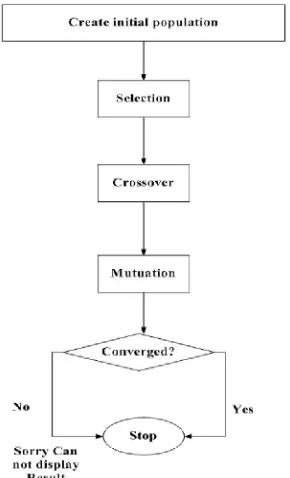
Flow Chart of Genetic Algorithm
Fig.2. Flow Chart of Genetic Algorithm
Figure 2 shows the Flow Chart of Genetic Algorithm.
Algorithm for ELD using GA
1. Read data namely coefficients ai,bi,ci , population size, power demand and Pmin and Pmax.
2. Create the initial population randomly size of N.
3. Check the constraints, evaluate fitness function and store the total cost of generation and related variables.
4. Apply Genetic Operators.
5. Check Converse, if abs(conv)>gap then GA cannot find solution. if abs(conv)<gap then Genetic Algorithm will
give solution.
V. RESULT AND DISCUSSION
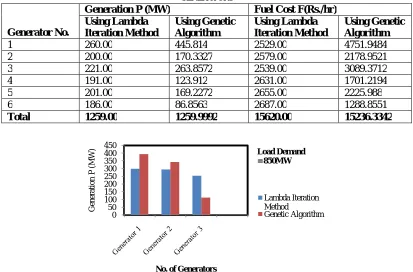
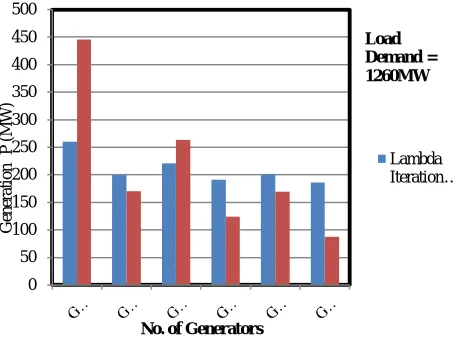
The Economic Load Dispatch problem was solved using Lambda Iteration Method and Genetic Algorithm. The programs are implemented in MATLAB 7.12.0. The performance is evaluated without considering losses using 3 generator and 6 generator test system. The power demand is considered to be 850MW and 1260MW respectively. The
coefficients of fuel cost andmaximum and minimum power limits are given in Table I and Table II respectively. Table
III shows the comparingresults of Lambda Iteration Method andGenetic Algorithmfor 3 generators. Table IV shows
the comparing results of Lambda Iteration Method and Genetic Algorithm for 6 generators.
TABLE I. FUEL COST COEFFICIENTS FOR 3 GENERATOR SYSTEM
Unit No.
ai bi ci Pi min
(MW)
Pi max
(MW)
1 0.001562 7.92 561 150 600
2 0.00194 7.85 310 100 400
TABLE II. FUEL COST COEFFICIENTS FOR 6 GENERATOR SYSTEM
TABLE III. Generator
No.
ai bi ci Pi min
(MW)
Pi max
(MW)
1 0.0070 7.0 240 100 500
2 0.0095 10.0 200 50 200
3 0.0090 8.5 220 80 300
4 0.0090 11.0 200 50 150
5 0.0080 10.5 220 50 200
6 0.0075 12.0 190 50 120
TABLE IV. COMPARISONOFLAMBDAITERATIONMETHODANDGENETICALGORITHM FOR 3
GENERATORS
Generator No.
Generation P (MW) Fuel Cost F(Rs./hr)
Using Lambda Iteration Method Using Genetic Algorithm Using Lambda Iteration Method Using Genetic Algorithm
1 300.00 394.2443 3074.00 3926.1946
2 295.00 342.8098 2795.00 3229.043
3 254.00 112.9449 2419.00 1039.6571
Total 849.00 849.999 8288.00 8194.8947
TABLE V. COMPARISONOFLAMBDAITERATIONMETHODANDGENETICALGORITHM FOR 6
GENERATORS
Generator No.
Generation P (MW) Fuel Cost F(Rs./hr) Using Lambda Iteration Method Using Genetic Algorithm Using Lambda Iteration Method Using Genetic Algorithm
1 260.00 445.814 2529.00 4751.9484
2 200.00 170.3327 2579.00 2178.9521
3 221.00 263.8572 2539.00 3089.3712
4 191.00 123.912 2631.00 1701.2194
5 201.00 169.2272 2655.00 2225.988
6 186.00 86.8563 2687.00 1288.8551
Total 1259.00 1259.9992 15620.00 15236.3342
0 50 100 150 200 250 300 350 400 450 G en era ti o n P (M W )
No. of Generators
Lambda Iteration Method
FIGURE 3 SHOWS THE COMPARISON OF TOTAL GENERATION FOR 3 GENERATORS.
Fig.4 Comparison of total fuel cost for 3 generators
FIGURE 4 SHOWS THE COMPARISON OF TOTAL FUEL COST FOR 3 GENERATORS.
Fig.5 Comparison of total generation for 6 generators
Figure 5 shows the comparison of total generation for 6 generators.
Fig.6 Comparison of total fuel cost for 6 generators
0 1000 2000 3000 4000 5000 F u el Co st F (Rs ./ h r)
No. of Generators
Lambda Iteration Method Load Demand = 850MW 0 50 100 150 200 250 300 350 400 450 500 G en era ti o n P (M W )
No. of Generators
Lambda Iteration … Load Demand = 1260MW 0 500 1000 1500 2000 2500 3000 3500 4000 4500 5000 F u e l C o st F (R s. /h r )
No. of Generators
Figure 6 shows the comparison of total fuel cost for 6 generators.
VI.CONCLUSION
In this paper Lambda Iteration Method and Genetic Algorithm are applied to solve ELD problem. From the results it is clear that Genetic Algorithm gives the better results then Lambda Iteration Method.
REFERENCES
[1] Koustav Dasgupta, Sumit Banerjee. “An Analysis of Economic Load Dispatch using Different Algorithms”. 1st International Conference on
Non Conventional Energy ICONCE 2014.
[2] Deschamps, D.. Pptimization in power system planning. In: e1-Abiad, AH. Ed. Power system analysis and planning. London: Hemishpere Publishing Corporation. Pp.201-208,1981.
[3] Bakirtzis, A. etal. Genetic algorithm solution to the economic dispatch problem. IEEE proceedings- generation, transmission and distribution. Vol. No 141. Issue: 4. Pp.377-382, July 1994.
[4] Lee, K.Y. etal. Adaptive hopfield neural network for economic dispatch. IEEE transactions on power systems. Vol.18. No:2. Pp.519-529, Feb. 2003.
[5] Simopoulos, D., and Contaxis, G. 2004. Unit commitment with ramp rate constraint using simulated annealing algorithm. IEEE Melecon. Dubrovnik, Croatia. Pp.845-849, May 12-15.
[6] J. Wood and B.F.,Wollenberg, “Power generation, operation and control”, New York: John Wiley Inc., 1984.