Delay Minimization in Cognitive Mesh
Networks Using Recursive Algorithm in
DORP Protocol
R. Anbarasi
1, D.Kumutha
2M.E Student [Applied Electronics], Dept. of ECE, Kingston Engineering College, Vellore, Tamil Nadu, India
Assistant Professor, Dept. of ECE, Kingston Engineering College, Vellore, Tamil Nadu, India 2
ABSTRACT: Joint design of routing and Resource allocation algorithms in cognitive radio based wireless mesh networks. The mesh nodes utilize cognitive overlay mode to share the spectrum with primary users. Prior to each transmission, mesh nodes sense the wireless medium to identify available spectrum resources. Depending on the primary user activities and traffic characteristics, the available spectrum resources will vary between mesh transmission attempts, posing a challenge that the routing and resource allocation algorithms have to deal with to guarantee timely delivery of the network traffic. To capture the channel availability dynamics, the system is analyzed from a queuing theory perspective, and the joint routing and resource allocation problem is formulated as a non-linear integer programming problem.
The objective is to minimize the aggregate end-to-end delay of all the network flows. A distributed solution scheme is developed based on the Lagrangian dual problem. Numerical results demonstrate the convergence of the distributed solution procedure to the optimal solution, as well as the performance gains compared to other design methods. It is shown that the joint design scheme can accommodate double the traffic load, or achieve half the delay compared to the disjoint methods. It is shown that the joint design scheme can accommodate double the traffic load, or achieve half the delay compared to the disjoint methods.
KEYWORDS: On Demand Routing Protocol (DORP), Destination-Sequenced Distance-Vector (DSDV) protocol, delay, cognitive, Recursive Algorithm, Dynamic Source Routing and Adhoc network.
I. INTRODUCTION
COGNITIVE radio is a promising technology aiming at better utilization of available channel resources by prescribing the coexistence of licensed (or primary) and unlicensed (secondary or cognitive) radio nodes on the same bandwidth. One of the key challenges in the design of cognitive radio networks is the design of dynamic spectrum allocation algorithms, which enable the cognitive nodes to opportunistically access the available wireless spectrum, without interfering with existing primary nodes. Therefore, dynamic spectrum access techniques have received significant attention. In [2] and [3] the cognitive radio problem was investigated from an information theoretic standpoint. The cognitive transmitter is assumed to transmit at the same time and on the same bandwidth of the primary link. Interference is mitigated through the use of complex precoding techniques that require perfect prior information about the primary signal.
Hence, controlling the interaction between the routing and the spectrum management functionalities is of fundamental importance. While cross layer design principles have been extensively studied by the wireless networking research community, the availability of cognitive and frequency agile devices motivates research on new algorithms and models to study cross-layer interactions that involve spectrum management-related functionalities.
network-wide radio spectrum resources needed to support traffic for a given set of user sessions. The joint routing and resource allocation design has an objective for the minimization of the end-to-end delay and accommodate higher traffic. The performance of the proposed protocol is thoroughly studied and compared to the performance of a disjoint protocol. The disjoint protocol solves the routing problem first and then allocates resources along the constructed routes. The routing metric used favours links with higher primary idle probability while penalizing the total number of hops. The resource allocation part aims at minimizing the end-to-end delay along the preselected routes.
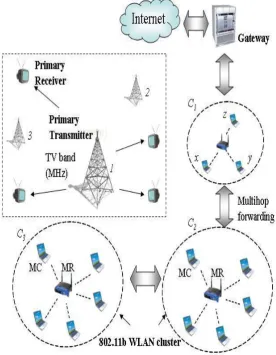
Interference is mitigated through the use of complex precoding techniques that require perfect prior information about the primary signal. The concept of a time-spectrum block was introduced in and protocols to allocate such blocks were proposed. The authors derived optimal and suboptimal distributed strategies for the secondary users to decide which channels to sense and access under a Partially Observable Markov Decision Process (POMDP) framework. The cognitive radio concept is desirable for a wireless mesh network (WMN) in which a large volume of traffic is expected to be delivered since it is able to utilize spectrum resources more efficiently. Therefore, it improves network capacity significantly. However, the dynamic nature of the radio spectrum calls for the development of novel spectrum-aware routing algorithms.
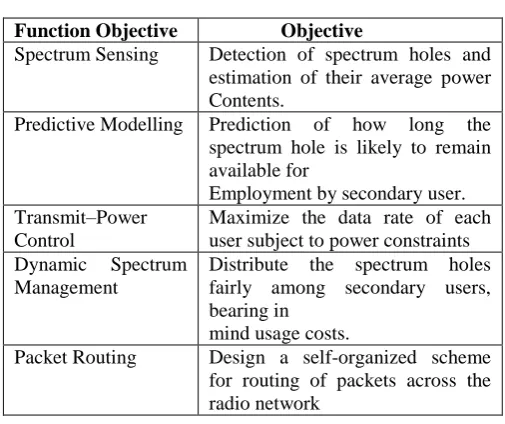
Function Objective Objective
Spectrum Sensing Detection of spectrum holes and estimation of their average power Contents.
Predictive Modelling Prediction of how long the spectrum hole is likely to remain available for
Employment by secondary user. Transmit–Power
Control
Maximize the data rate of each user subject to power constraints Dynamic Spectrum
Management
Distribute the spectrum holes fairly among secondary users, bearing in
mind usage costs.
Packet Routing Design a self-organized scheme for routing of packets across the radio network
Table 1 Functional Objectives of Cognitive Radio
Spectrum Sharing in CR Networks of the wireless channel necessitates coordination of transmission among the CR users. In the CRAHNs, the sensing schedules are determined and controlled by each user and are not synchronized by any central network entity. Thus, the CR ad hoc users independently perform sensing on an on-demand basis - i.e., when CR users want to transmit or are requested their spectrum availability by neighbouring users. This closely couples the sensing functionality with spectrum sharing among the CR users that is an integral part of the medium access control (MAC) layer coordination.
Fig 2 Block Diagram of MAC
Cognitive radios has the following challenges,
Challenge 1 - The spectrum-awareness
Designing efficient routing solutions for CRNs requires a tight coupling between the routing module(s) and the spectrum management functionalities such that the routing module(s) can be continuously aware of the surrounding physical environment to take more accurate decisions.
Challenge 2 - Setting up of „„quality” routes in dynamic variable environment and reduce end to end delay The „„route quality” has to be re-defined such that the timely delivery is guaranteed with lower delay less packets loss.
The routing and spectrum management algorithms should ensure maximum utilization of available spectrum and accommodate higher traffic.
The main objective in this work is to find the best routing and resource allocation strategies in order to minimize the average end-to-end delay of multiple data connections in the cognitive radio based wireless mesh network. Because of the primary nodes activity, the spectrum resources available to the cognitive mesh nodes are varying in both space and time. Therefore, any successful routing strategy will have to work closely with the resource allocation strategy in order to make sure that any selected route will have enough resources available to guarantee the required Quality of Services (QoS). Because of this strong interdependence between the routing and resource allocation strategies, we propose to deal with the routing and resource allocation strategies in a joint fashion rather than separating the two problems.
Before presenting joint design strategy we need first to analyze the effect of the routing and resource allocation decisions on the network performance. This is achieved by relying on queuing theory to model the different aspects of the cognitive mesh network and to form a basis for our routing and resource allocation protocol design.
II. EXISTINGSOLUTION
The existing solution is a design for routing and resource allocation in a joint fashion for cognitive radio mesh networks. The methodology using DORP end to delay drastically and increases the maximum throughput. But it does not extend its support to any Wireless Sensor networks that are random and mesh networks.
Also the existing solution concentrates only on the delay and throughput of the cognitive mesh networks. Various network parameters need to be considered for the throughput like packet ratio, channel measurement, Quality of Service and packet delivery rate.
Fig 3 Architecture of Cross Layer Optimization
III.PROPOSEDMODEL
The proposed solution deals with extending the DORP protocol to be applied in Wireless Sensor networks like random and mesh networks. The methodology is also used to validate the network throughput using the other parameters like Quality of Service, Channel Measurement, Packet loss and Packet delivery rate.
The proposed solution also aims in reducing the end to end delay and increase the throughput by applying the Recursive Algorithm and Hidden Terminal Communication concept to the network using DORP Protocol.
Packet Delivery Rate in telecommunication networks, the transmission time, is the amount of time from the beginning until the end of a message transmission. In the case of a digital message, it is the time from the first bit until the last bit of a message has left the transmitting node. The packet transmission time in seconds can be obtained from the packet size in bit and the bit rate in bit/s as:
Packet transmission time = Packet size / Bit rate
Example: Assuming 100 Mbit/s Ethernet, and the maximum packet size of 1526 bytes, results in Maximum packet transmission time = 1526×8 bit / (100 × 106 bit/s) ≈ 116 μs
The packet delivery time or latency is the time from the first bit leaves the transmitter until the last is received. In the case of a physical link, it can be expressed as:
Packet delivery time = Transmission time + Propagation delay
In case of a network connection mediated by several physical links and forwarding nodes, the network delivery time depends on the sum of the delivery times of each link, and also on the packet queuing time (which is varying and depends on the traffic load from other connections) and the processing delay of the forwarding nodes. In wide-area networks, the delivery time is in the order of milliseconds.The network throughput of a connection with flow control, for example a TCP connection, with a certain window size (buffer size), can be expressed as:
Network throughput ≈ Window size / roundtrip time
In case of only one physical link between the sending and transmitting nodes, this corresponds to: Link throughput ≈ Bitrate × Transmission time / roundtrip time
A. Recursive Algorithm:
Priority mechanisms are used to optimize the network utilization, while meeting the requirements of each type of traffic. The user may generate different priority traffic flows by using the loss priority bit capability and when buffer overflow occurs, packets from the low priority flow can be selectively discarded by network elements. Priority mechanisms can be classified into two categories: time priority and space priority.
Time priority mechanisms control the transmission sequences of buffered packets while space priority mechanisms control the access to buffer. Chipalkatti et al. studied the performance of time priority mechanisms including Minimum Laxity Threshold (MLT) and Queue Length Threshold (QLT) under mixed traffic of real-time and non-real-time packets. Their results show that the First In First Out (no special priority) policy causes relatively high losses for real-time traffic while providing low delays for non-real-time traffic. The converse holds true when priority is given to real-time traffic unconditionally. Space (or loss) priorities propose to provide several grades of services through the selectively discarding low priority packets. This type of priority mechanisms exploit the fact that low priority packets may be discarded in case of congestion, without significantly compromising the source‟s QoS requirements.
Space priority mechanisms that have been investigated are primarily the Pushout mechanisms and Partial Buffer Sharing (PBS). In both the mechanisms, each source marks every packet with a priority level, indicating high priority and low priority packet. A description of several space priority mechanisms are given below,
In the Pushout mechanism, high priority packet may enter the queue even when it is full, by replacing a low priority packet already in queue. If a low priority packet arrives at the queue when it is full, then it will be discarded. With this mechanism, vital packets will only be lost when the queue is full and there are no ordinary packets waiting for service in the queue. Multi-queue based Push-out policy can achieve highest buffer sharing as well as service differentiation and fairness assurance.
1. First Come First Serve scheduling methods
2. Decentralized Pre-emptive Scheduling using content delivery Network 3. Decentralized Non- Pre-emptive Scheduling using content delivery Network 4. Space Priority Mechanisms using recursive Algorithm.
5. Partial Buffer Sharing using recursive Algorithm.
IV.EXPERIMENTALRESULTS
NS2.35 Network simulator is used to simulate a wireless network with DORP Protocol(applied Recursive Algorithm). The simulation results are given below,
DELAY ANALYSIS
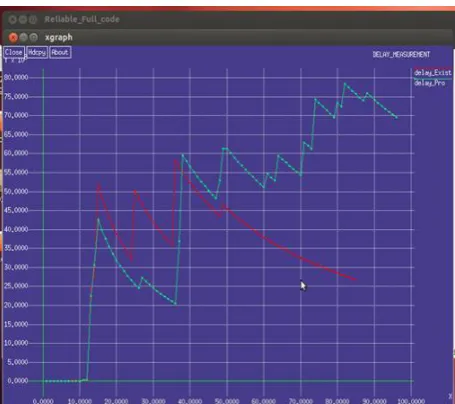
Delay refers to the time taken for a packet to be transmitted across a network from source to destination. Hence delay has to be reduced in DORP protocol in order to improve the reliability. Delay for the existing system using DORP protocol and proposed DORP protocol (Recursive Algorithm) is given below.
Fig 4 Comparison of delay for both existing and proposed system
THROUGHPUT ANALYSIS
Fig 5 Comparison of Throughput for both existing and proposed system
LOSS ANALYSIS
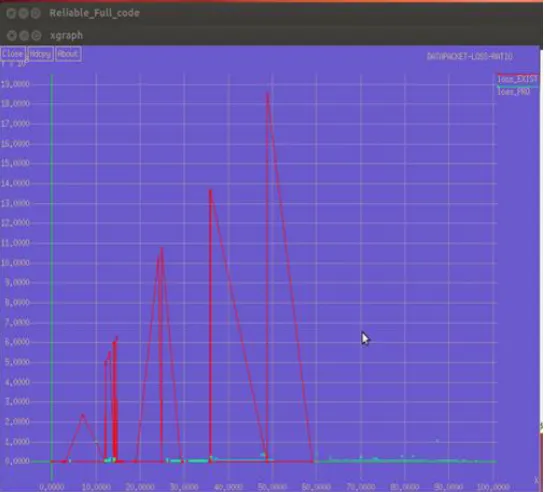
Packet loss occurs when one or more packets of data travelling across a computer network fail to reach their destination. Packet loss for both existing and proposed system is simulated using DORP and DORP protocol (Recursive Algorithm applied) and their graphs are simulated.
Fig 6 Comparison of Loss Ratio for both existing and proposed system
PACKET DELIVERY RATIO ANALYSIS
∑ Number of packet receive / ∑ Number of packet send.
Fig 7 Comparison of Packet Delivery Ratio
SOURCE FREQUENCY
Source frequency is calculated for both existing and proposed system using DORP and DORP protocol (Recursive Algorithm applied) and their comparison graph is shown below.
Fig 8 Comparison of Source Frequency for both existing and proposed system
DESTINATION FREQUENCY:
Fig 9 Comparison of Destination Frequency for both existing and proposed system
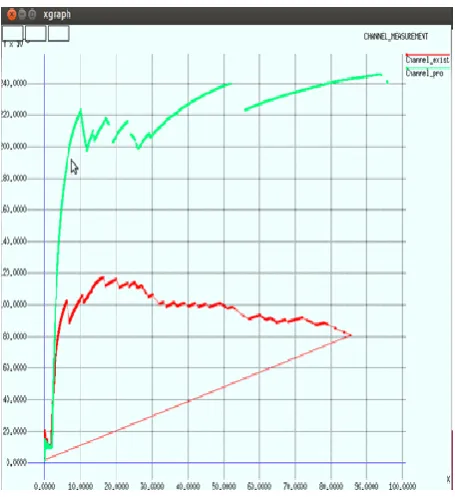
CHANNEL MEASUREMENT:
Channel measurements are indispensable for wireless system design. It is the wireless channel that determines the ultimate performance limits of any communication system. In the beginning of cellular communications, fading and path loss of narrow band channel were the key figures of merit. This has changed with wide band multi antenna, multiuser system. New important of the radio channel became obvious: the channels frequency selectivity, directivity, Polari metric properties and their relation to channel of the users.
V. CONCLUSION
Joint design of routing and resource allocation schemes in cognitive radio based WMNs. For this class of networks, cross-layer design schemes are crucial since disjoint design strategies lead to lower performance (in terms of delay, or the number of admissible traffic streams) or infeasible solutions in many cases. It was shown that the proposed design scheme with DORP Protocol using the Recursive Algorithm can accommodate higher traffic load, and achieve lower delay. DORP Protocol (Recursive Algorithm applied) will improve the other parameters in the Wireless Mesh Network and enhance the performance of wireless mesh network. The other parameters that are improved in the Mesh/Random network are Quality of Service, Channel Measurement, Packet loss and Packet delivery rate.
REFERENCES
[1] S. Haykin, “Cognitive radio: brain-empowered wireless communications,” IEEE J. Sel. Areas Commun., vol. 23, no. 2, pp. 201–220, Feb.2005. [2] N. Devroye, P. Mitran, and V. Tarokh, “Achievable rates in cognitive radio,” IEEE Trans. Inf. Theory, vol. 52, no. 5, pp. 1813–1827, May 2006. [1] S. Haykin, “Cognitive radio: brain-empowered wireless communications,” IEEE J. Sel. Areas Commun., vol. 23, no. 2, pp. 201–220, Feb.2005. [2] N. Devroye, P. Mitran, and V. Tarokh, “Achievable rates in cognitive radio,” IEEE Trans. Inf. Theory, vol. 52, no. 5, pp. 1813–1827, May 2006. [3] A. Jovicic and P. Viswanath, “Cognitive radio: an information-theoretic perspective,” in Proc. 2006 IEEE Intl. Symp. Inf. Theory, pp. 2413–2417. [4] Y. Yuan, P. Bahl, R. Chandra, T. Moscibroda, and Y. Wu, “Allocating dynamic time-spectrum blocks in cognitive radio networks,” in Proc.2007 ACM MobiHoc, pp. 130–139.
[5] Q. Zhao, L. Tong, A. Swami, and Y. Chen, “Decentralized cognitive MAC for opportunistic spectrum access in ad hoc networks: a POMDP framework,” IEEE J. Sel. Areas Commun., vol. 25, no. 3, pp. 589–600, Apr. 2007.
[6] Q. Wang and H. Zheng, “Route and spectrum selection in dynamic spectrum networks,” in 2006 IEEE Consumer Commun. Netw. Conf. [7] C.-F. Shih, W. Liao, and H.-L. Chao, “Joint routing and spectrum allocation for multi-hop cognitive radio networks with route robustness consideration,” IEEE Trans. Wireless Commun., vol. 10, no. 9, pp. 2940– 2949, 2011.
[8] H. Khalife, S. Ahuja, N. Malouch, and M. Krunz, “Probabilistic path selection in opportunistic cognitive radio networks,” in 2008 IEEE GLOBECOM.
[9] Y. T. Hou, Y. Shi, and H. D. Sherali, “Optimal spectrum sharing for multi-hop software defined radio networks,” in Proc. 2007 IEEE Intl. Conf. Comput. Commun., pp. 1–9.
[10] G. C., W. Liu, Y. Li, and W. Cheng, “Joint on-demand routing and spectrum assignment in cognitive radio networks,” in Proc. 2007 IEEE International Conf. Commun., pp. 6499–6503.
[11] L. Ding, T. Melodia, S. Batalama, and M. J. Medley, “Rosa: distributed joint routing and dynamic spectrum allocation in cognitive radio ad hoc networks,” in Proc. 2009 ACM International Conf. Modeling, Analysis Simulation Wireless Mobile Syst., pp. 13–20.
[12] D. Cabric, S. M. Mishra, and R. W. Brodersen, “Implementation issues in spectrum sensing for cognitive radio,” in Proc. 2004 Asilomar Conf. Signals, Syst., Comput., pp. 772–776.
[13] A. Ghasemi and E. Sousa, “Collaborative spectrum sensing for opportunistic access in fading environments,” in Proc. 2005 IEEE Symp. New Frontiers Dynamic Spectrum Access Netw., p. 131-136.