Balancing Output Length and Query Bound in Hardness
Preserving Constructions of Pseudorandom Functions
∗
Nishanth Chandran
†Sanjam Garg
‡Abstract
We revisit hardness-preserving constructions of a pseudo-random function (PRF) from any length doubling pseudo-random generator (PRG) when there is a non-trivial upper boundqon the number of queries that the adversary can make to the PRF. Very recently, Jain, Pietrzak, and Tentes (TCC 2012) gave a hardness-preserving construction of a PRF that makes onlyO(logq) calls to the underlying PRG whenq= 2nand≥ 1
2. This dramatically improves upon the efficiency of the construction of Goldreich,
Goldwasser, and Micali (FOCS 1984). However, they explicitly left open the question of whether such constructions exist when < 1
2. In this work, we give constructions of PRFs that make onlyO(logq) calls
to the underlying PRG whenq= 2n, for 0< <1; our PRF outputsO(n2) bits (on every input), as
opposed to the construction of Jainet al. that outputsnbits. That is, our PRF is not length preserving; however it outputs more bits than the PRF of Jain et al. when > 1
2. We obtain our construction
through the use of information-theoretic tools such asalmostα-wise independent hash functions coupled with a novel proof strategy.
1
Introduction
Pseudo-random functions. Goldreich, Goldwasser, and Micali introduced the fundamental notion of pseudo-random functions in their seminal paper [12]. A pseudo-random function (PRF) is a keyed function
F:{0,1}`× {0,1}n → {0,1}m(with key length`and input lengthu) such that no efficient adversary, that
can make adaptive oracle queries to F, can distinguish between the outputs of Fand a uniformly random function (fromubits tonbits). Pseudo-random functions have found extensive applications in cryptography - from symmetric-key cryptography to software protection to zero-knowledge proofs [11, 10, 9, 17, 16].
Goldreich et al. showed how to construct a PRF from any length doubling pseudo-random generator, that is a functionG:{0,1}n → {0,1}2nthat takes as input a seed ofnbits and outputs 2nbits that are
com-putationally indistinguishable from the uniform distribution on 2nbits. We will refer to their construction as the GGM construction. The GGM construction gives rise to a PRFGGMG :{0,1}`× {0,1}n → {0,1}m
for ` = n and m = n (in fact this construction works for any input length u ∈N with other parameters remainingn).
Hardness preservation. Now, assume that the underlying PRG G has “σ bits of security”, mean-ing that no adversary of size 2σ can distinguishG(U
n) fromU2n(whereUtdenotes the uniform distribution
on t bits) with advantage more than 2−σ. The GGM construction of a PRF is hardness preserving, i.e.,
if G has cn bits of security (for some constant c > 0 and all sufficiently large n), then GGMG has c0n
bits of security for some 0 < c0 ≤ c. The domain size of the PRF can be arbitrary ({0,1}u), but the
GGM construction makes u calls to the underlying PRG, and hence the efficiency of GGMG depends
critically on u. Levin [15] suggested a trick that improves the efficiency when u is large; first hash the u bits down to v bits, using a universal hash function, and now apply the GGM construction to the v
∗Full version of paper published at Indocrypt 2014 †Microsoft Research, India; Email:
[email protected]. Work done while this author was at Microsoft Research, Redmond.
‡University of California, Berkeley; Email:
bits obtained. Now, the efficiency of the GGM construction can be reduced tov calls to G, and v can be set to ω(logn), if we want security only against polynomial-size adversaries. However, if we care about preserving hardness (if G has cn bits of security), then we are forced to set v = Ω(n) and hence, the best hardness-preserving construction of a PRF, F, from a length-doubling PRG, G, requires Θ(n) calls toG(except in the case whenu=o(n) is sublinear, in which case one can use the GGM construction directly).
Constructing PRFs with bound on queries of adversary. Jain, Pietrzak, and Tentes [13] considered a setting, in which the size of the adversary is still 2σ (or 2cn when G is exponentially hard),
but there is a boundq on the number of queries that the adversary can make to the PRFF. Surprisingly, by making such a restriction on the adversary, they can dramatically improve the efficiency of PRF constructions. In more detail, they consider an adversary of size 2cn who can make only q = 2n (for
constant 12 ≤ <1) queries toF; against such an adversary, they give a construction of a PRFFthat only makes Θ(n) calls to the underlying PRG, but is still hardness preserving.
Hardness preservation and bounding queries in practice. We stress here that the notion of hardness preserving constructions of PRFs is important both in theory as well as in practice. For example, if we have a hardness preserving construction of a PRF (and the underlying PRG has exponential security) we can scale down the security parameter by almost a logarithmic factor in practical scenarios where security against only polynomial-size adversaries is required. This implies an almost exponential improvement in the efficiency. Furthermore, in most practical situations, we will be able to bound the number of queries that the adversary can make to the PRF; e.g., if we are using the PRF for constructing a symmetric encryption scheme, it is conceivable that we can bound the number of ciphertexts that the adversary can get to see (which inherently bounds the number of queries to the PRF that the adversary can get). In such situations, we can obtain much more efficient hardness preserving constructions of PRFs.
1.1
Our Results
Unfortunately, for the case when < 12, that is when q = 2o(√n), the construction of Jain et al.[13] does not offer any further improvement in efficiency, and the best hardness preserving construction ofFfrom G
makes Θ(√n) calls toG.
In this work, we are precisely interested in answering the following question: can we obtain a hardness preserving construction of a PRF from a PRG that makes o(√n) calls to G, when q, the bound on the number of queries that the adversary can make to the PRF, is 2o(√n)?
Roughly speaking it seems that, as any hardness preserving construction of a PRF tries to make fewer calls to the underlying PRG, its ability to output pseudo-random bits reduces.1 In the setting where a PRF from a PRG makes o(√n) calls to G and when q is bounded by 2o(
√
n) we present a tradeoff between the
output length of the PRF, the boundq, and the level of hardness preserved. In particular:
• We provide a hardness preserving construction of a PRF F : {0,1}`× {0,1}n → {0,1}n2
(where ` = Θ(n) denotes the seed length, n denotes the input length, and n2 denotes the output length),
that makes Θ(n) calls toG: {0,1}n → {0,1}2n for anyu∈
N, where q = 2n
and 0< <1. Note that the PRF in this construction outputsn2 bits as opposed tonbits as in the construction of Jain
et al.[13]. For the case when > 12, our construction outputs more number of random bits than the construction of Jain et al.[13], while making the same number of calls toG.
• Next, we note that if we wished to output more number of bits (say n, as opposed to n2, when < 1
2), then we can obtain a construction that makes the same Θ(n
) calls to G, but the resulting
PRFF:{0,1}`× {0,1}n → {0,1}n has only n2bits of security.
Alternatively, we can obtain a construction of a PRF withcnbits of hardness andnbits of output by repeating the construction of F:{0,1}`× {0,1}n → {0,1}n2
,n1−2 times in parallel. While the total
number of calls to the PRG made by this construction will be Θ(n1−) (which is larger than Θ(n) for
0< < 12), the advantage of this construction is that the depth of the circuit evaluating our PRF will still be Θ(n).
• We also note that, just as in [13], our results extend to the case when we start with a PRG G that has only σ=o(n) bits of hardness, and we have a boundq= 2σ on the number of queries that the adversary can make to the PRF, when 0< <1.2
• Finally, we mention that, similar to Jain et al.[13], our techniques can be used to give more efficient constructions in other settings; for example by applying it to the work of Naor and Reingold [21] who construct PRFs computable in low depth from pseudorandom synthesizers (objects stronger than PRGs but weaker than PRFs). The construction of [21] gives a hardness-preserving construction of a PRF from a pseudorandom synthesizer (PRS) with Θ(n) calls to the PRS in depth Θ(logn). Our techniques can be used to improve the efficiency of their construction to Θ(logq) whenever one can put an upper boundq= 2n,0< <1 on the number of adversarial queries.
Concurrent and independent work. Concurrently and independently of our work, Berman et al. [4], using very different techniques based on cuckoo hashing, show how to construct a hardness preserving PRF from n bits to n bits that makes O(n) calls to the underlying PRG when the bound on the number of queries made by the adversary is 2n, for any 0< <1. A technical comparison between our work and the work of Bermanet al.[4] follows:
• In our construction the seed length of the PRF contructed, `, is Θ(n), while the PRF construction of Berman et al.[4] requires a seed of length Θ(n2).
• Secondly, in the case when < 12, their PRF outputs more random bits (n) than our construction (n2); however, when > 1
2, the situation is reversed, and our PRF outputs more random bits (n 2)
as opposed to their construction (as well as [13], since both constructions outputnbits) while making the same number of GGM calls.
1.2
Technical Difficulties and New Ideas
In order to present the high level ideas behind our construction, we shall begin by describing Levin’s trick and how Jainet al. build upon it to construct a PRF that makes fewer calls to the PRG.
Background. Recall that the key idea behind Levin’s trick [15] is to first hash the input bits down using a (information-theoretically secure) universal hash function h:{0,1}u → {0,1}v, and then applying
the GGM construction to the obtained hashed bits. The efficiency of the GGM construction depends on the output length of this hash function. Now observe that that in order to use Levin’s trick, to obtain a hardness preserving construction, one must set v = Θ(n). Ifv were to be o(n), then the probability that two inputs xi and xj collide on the hash function’s output would be 2−o(n). In other words F(xi) =F(xj)
(since F(x) = GGMG(k, h(x))) and this would prevent us from achieving exponential security. Hence we
need that a hardness preserving construction of a PRF makes Θ(n) calls to the underlying PRG.
The key idea of Jainet al. is to exploit tools from information-theoretict-wise independent hash functions and hash the bits using a hash functionh1 to 2tbits anyway (t is chosen to be logq, whereq= 2
√ n is the
bound on the number of queries that the adversary can make toF) and then evaluate the GGM construction on it.3 Of course there will be collisions and so they do not output the generated value directly. Instead they use the output in order to derive a key for another hash function h2 which is then applied on the original un-hashed input. The resulting value is the output. The derivation of the key from the output of the GGM function involves stretching the output of the GGM function using the PRG. In particular, the output of
GGMis stretched by a factor oftso that it is large enough to serve as the seed forh2.
Roughly speaking ifh1andh2are botht-wise independent hash functions, then Jainet al. can argue the security of their scheme as long as the adversary makes less thanqqueries to the PRF. The crucial idea is that sinceh1ist-wise independent not too many inputs (specifically no more thant) can collide on the first hashing. Furthermore the few (up tot) that do happen to collide on a specific value will ultimately lead to random outputs ash2 is alsot-wise independent. More formally,h1 is at-wise independent hash functions,
2For clarity of exposition, we present our results only in the case whenGhas exponential hardness.
3We consider only the case whereq= 2√nin the discussion below, but the argument holds forq= 2n, for1
and therefore the probability that one gets a t+ 1-wise collision after the first hashing (i.e., somet+ 1 of theqqueries hash down to the same value) is upper bounded roughly by 1
2t2, which is exponentially small, whenq≥2√n. This implies that with very high probability, at mosttinputs will use the same seed for the t-wise independent hash functionh2and hence the outputs will be pseudorandom.
Now, observe that the total number of calls that the above PRF construction makes to the underlying PRG is Θ(t). This is because the GGM construction is executed on at-bit input (generated as the output of the hash functionh1) which makes tcalls to the underlying PRG. The construction additionally makest calls in deriving the key forh2from the output ofGGM.
Overview of our construction: new ideas. In order to reduce the number of calls in the above construction, we need to reduce the number of calls thatFmakes in two places: the GGM part, as well as the PRG stretch (to sample the t-wise independent hash functionh2) part. We are interested in the case when q= 2n
, for 0< < 1
2 and would like to obtain a construction that makes Θ(n
) calls to the PRG.
However in order to make just Θ(n) calls to the PRG we need to reduce the output length of the first hash
functionh1 to Θ(n). Recall that the probability of at+ 1-wise collision is bounded by roughly 21t2, which
is sub-exponential (when < 12) for our setting. Another problem is that far too many inputs to the F
will collide in the key of h2 than whath2 is equipped to handle. The only option seems to be to make the hash functions much more resilient to collisions, or in other words increase the parametert for bothh1 and
h2. That is, we use α-wise independent hash functionsh1 and h2 for some parameter α=ω(t). However this is fundamentally problematic since the GGM part of the construction outputs n bits that need to be “stretched” to get a seed of length Θ(αn) bits. This, unfortunately, would end up requiringω(t) calls toG
for stretching the output ofGGMfromnbits to Θ(αn).
Our key idea here is to use approximate constructions of α-wise independent hash functions [20, 1, 14] for h1 and h2. The key advantage of these hash functions is that they can be constructed using roughly Θ(mα) bits of randomness (where m is the output length), instead of the Θ(nα) bits needed for perfect constructions (where n is the input length). Hence by decreasing the output length we can obtain the desired level of resilience to collisions. This allows us to obtain a tradeoff between the efficiency of the PRF and the length of the output it generates.
Even though our construction makes a seemingly simple tweak to the construction of Jain et al. [13], unfortunately their proof strategy does not work for us. The fundamental reason behind this is that having a perfect t-wise independent hash function allows them to reduce an adaptive distinguisher directly to a non-adaptive distinguisher. Intuitively speaking, this follows from the fact that the outputs of the t-wise independent hash function are uniformly random strings and hence when these values are used as the outputs of the PRF, they prove useless for the adaptive distinguisher. Formally, this follows from a claim of Maurer [18]. However, in our setting, the responses are not uniform and the slight bias could help the adversary choose its queries intelligently, triggering the events that ultimately allow it to distinguish the function from random. This prevents us from using the results of Maurer [18]. It is worth noting here, that the problem of constructing adaptively secure pseudorandom functions from non-adaptive pseudorandom functions [19, 22, 23, 8, 2, 4] is a very important problem that has received plenty of attention.
For our construction, we prove security against adaptive distinguishers using a step-ladder approach. More specifically, consider an adaptive distinguisher that makes i queries to the PRF. Its distinguishing advantage can be used to upper bound the statistical distance between the distribution of the responses toi adaptive queries and the distribution ofiuniform strings. This statistical difference gives us an upper bound on the advantage an adaptive distinguisher has in the choice it makes for the i+ 1th query over its non-adaptive counterpart. Given this we can evaluate the distinguishing advantage of an non-adaptive distinguisher that makesi+ 1 adaptive queries. Carefully applying this process repeatedly allows us to obtain a bound on the distinguishing advantage of an adaptive distinguisher makingqqueries.
1.3
Roadmap
We start by recalling the preliminary notions and definitions needed in Section 2. Then we provide our construction in Section 3 and the proof of our main theorem in Section 4. Finally we conclude in Section 5.
2
Preliminaries
In this section we recall and define some basic notions and setup notation. Let λ denote the security parameter. We say that a function isnegligiblein the security parameter if it is asymptotically smaller than the inverse of any fixed polynomial. Otherwise, the function is said to be non-negligible in λ. We say that an event happens with overwhelming probability if it happens with a probability p(λ) = 1−ν(λ) where ν(λ) is a negligible function inλ.
Notation. We denote values and bit strings by lower case letters and random variables by upper-case letters. Sets are denoted by uppercase calligraphic letters. We use Un to denote the random
variable which takes values uniformly at random from the set of n bit long strings and Rn,m to denote
the set of all functions F : {0,1}n 7→ {0,1}m. For a set X, Xt denotes the t’th direct product of
X, i.e., (X1, . . . ,Xt) of t identical copies of X and for a random variable X, X(t) denotes the random
variable which consists of t independent copies of X. Let x ← X denote the fact that x was chosen according to the random variable X and analogously let x ← X denote that x can chosen uniformly at random from set X. For random variables X0, X1 distributed over a set X, we use X0 ∼ X1 to denote that the random variables are identically distributed, we use X0 ∼δ X1 to denote that they have a statistical distance δ, i.e. 12P
x∈X | PrX0[x]−PrX1[x] |≤ δ, and finally we use X0 ∼(δ,s) X1 to denote that they are (δ, s) indistinguishable, i.e. for all distinguishers D of size at most |D| ≤ s we have
|PrX0[D(x)→1]−PrX1[D(x)→1]|≤δ.
2.1
Pseudorandom Functions
We recall the definitions of pseudorandom generators (PRG) and pseudorandom functions (PRF). Subse-quently we will describe theGGMconstruction of a pseudorandom function from a pseudorandom generator.
Definition 1 (PRG [5, 25]) A length-increasing function G:{0,1}n 7→ {0,1}m where m > nis a (δ, s)
-hard pseudorandom generator if
G(Un)∼(δ,s)Um
We say thatGhasσbits of securityifGis(2−σ,2σ)-hard. Gisexponentially hard if it hascnbits of security
for somec >0, andGissub-exponentially hardif it has cn bits of security for somec >0,0< <1.
Stretching a PRG.LetG:{0,1}n → {0,1}2n be a length doubling function. Fore∈
N, letGe:{0,1}n→
{0,1}en be the function that takes an nbit string as input and expands it to anen bit string usinge−1
invocations ofG. This can be done sequentially or via a more efficient parallel computation of depthdlogee. We now have the following lemma.
Lemma 1 As stated in [13]. Let Gbe a (δ, s)-hard PRG, then Ge is a(e·δ, s−e· |G|)-hard PRG.
Definition 2 (PRF [12]) 4 A function F : {0,1}` × {0,1}n → {0,1}m is a (q, δ, s)-hard pseudorandom
function (PRF) if for every oracle aided distinguisher D∗ of size|D∗| ≤s making at mostqoracle queries
|Prk←{0,1}`[DF(k,·)→1]−Prf←Rn,m[D
f(·)→1]|≤δ
Fhas σbits of security against qqueries if F is(q,2−σ,2σ)secure. If q is unspecified then it is assumed to
be unbounded (the size 2σ of the distinguisher is a trivial upper bound on q).
The GGM Construction. Goldreich, Goldwasser and Micali [12] gave the first construction of a pseu-dorandom function from any length doubling PRG. Their construction is described below. For any length doubling PRG G : {0,1}n → {0,1}2n, GGM
G : {0,1}n× {0,1}n → {0,1}n is defined as a function that
takes as inputxalong with a seedk. The output of the functionGGMG(k, x) iskx that can be obtained by
recursive evaluation usingk=kandka||0||ka||1:=G(ka) (wheredenotes the empty string).
Proposition 1 (PRF [12]) IfGis a(δG, sG)-hard PRG, then for anyn, q∈N,GGMG:{0,1}n×{0,1}n→ {0,1}n is a(q, δ, s)-hard PRF where
δ=n·q·δG s=sG−q·n· |G|
We remark, that in general, using the above same transformation, one can also obtain a PRF GGMG : {0,1}n× {0,1}u→ {0,1}n for any u∈
N. We will useGGMG to refer to the PRF so obtained (with input
lengthu) when the value ofuis clear from context.
2.2
Information theoretic tools
The construction of pseudorandom functions presented in this paper relies on some well studied information theoretic tools. Next we recall these notions.
Definition 3 (α-wise independence [6, 24]) For `, m, n, α ∈ Z, a function h : {0,1}` × {0,1}n →
{0,1}m is α-wise independent, if for every α distinct inputs x
1, . . . , xα ∈ {0,1}n and a random key k← {0,1}` the outputs are uniform, i.e.
hk(x1)||. . .||hk(xα)∼Um(α)
Proposition 2 For any α, n, m≤n there exists an α-wise independent hash function with key length`= n·α.
Definition 4 (Almost α-wise independence [20]) For`, m, n, α∈Z, a functionh:{0,1}`× {0,1}n→
{0,1}m is (δ, α)-wise independent, if for every α distinct inputs x
1, . . . , xα ∈ {0,1}n and a random key k← {0,1}` the outputs are statistically close to uniform, i.e.
hk(x1)||. . .||hk(xα)∼δ Um(α)
Proposition 3 ([1, 14]) For anyα, n, mthere exists a(δ, α)-wise independent hash function with key length
`=O(mα+ lognδ).5
3
Our Construction
Our construction will use two parametersq, α. Recall thatqrepresents the bound on the number of queries to the PRF that the adversary is allowed to make. We will uset as a shorthand for the value logq. On the other hand αis a parameter that will depend on the other parameters in the system. Very roughly looking aheadαwill need to increase as the desired level of security increases.
We use a (δ1, α+ 1)-wise independent hash function h1:{0,1}`1× {0,1}n→ {0,1}2twith appropriate seed length`1=O(tα+ logδn1). (cf. Proposition 3) We will also need a (δ2, α+ 1)-wise independent hash function
h2:{0,1}`2× {0,1}n→ {0,1}mwith appropriate seed length`2=O(mα+ logδn2).
LetCG :{0,1}`1+n× {0,1}n→ {0,1}mbe our PRF that on input a keyk=k
0||k1(wherek0∈ {0,1}`1 and
k1∈ {0,1}n) andx∈ {0,1}n, computes the output as:
C(k, x) =h2(G2t(GGMG(k1, h1(k0, x))), x).
5To see that this is true, use Theorem 3 from [1] and consider the construction that outputs 2n·mbits which areδ-away
(inL1 norm) frommα-wise independence using roughlymα+ 2 log(αlog(2
n·m)
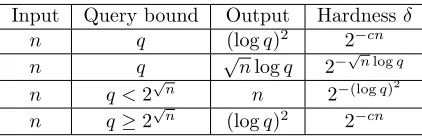
Input Query bound Output Hardnessδ
n q (logq)2 2−cn
n q √nlogq 2−√nlogq
n q <2√n n 2−(logq)2
n q≥2√n (logq)2 2−cn
Figure 1: Security obtained for different settings of parameters.
Theorem 1 (Main Theorem) If Gis a(δG, sG)-hard PRG, then CG is a(q, δ, s)-secure PRF where
δ≤4·q·t·δG+
q2 2n +
q2 2tα +q
2·2tα(δ
1+q·δ2) +q·δ2
mα+ log n δ2
≤ctn
where c > 0 is an appropriately chosen constant and t = logq. Finally note that the seed length, ` = O(tα+ log n
δ1 +n)and a total ofΘ(t)calls are made to G.
s=sG−q· |CG| −2q·t· |G|
Implications of Theorem 1. Now, suppose we want to obtain a hardness-preserving construction to obtain a PRF with c0n bits of hardness, then in order to obtainδ= 2−c0n, we must settα=n. This means that m≈t2(from the constraintmα+ log n
δ2 ≤ctn); in other words we obtain a hardness-preserving construction of a PRF that outputs n2 bits. At the other end of the spectrum, suppose we want the PRF to outputn bits, then we must setα≈t, which gives us a PRF with n2 bits of hardness. To give a better perspective of the various results obtained by setting the values of αand mappropriately, we give some examples for the choices of these parameters in Figure 1.
4
Proof of Theorem 1
We prove Theorem 1 by considering the following sequence of hybrids H0,H1. . . ,H4. In hybrid Hi (for i ∈ {0,1, . . .4}) samples are generated according to the circuit Ci (described in the sequel). In the first
hybrid,C0corresponds to the execution ofCitself and in the last hybridH4,C4 corresponds to the random functionRn,m.
[-] Hybrid H0: This hybrid corresponds to actual evaluation of the function C. In other words
C0(k, x) = C(k, x) = h2(G2t(GGMG(k1, h1(k0, x))), x). For any machine DC0 of size s and that makes q queries toC0 letpD0 =Pr[DC0(·)= 1].
[-] Hybrid H1: This hybrid is the same as the previous hybrid except that we use a random func-tion R2t,n instead of theGGMG execution. More specifically, C1(k, x) = h2(G2t(R2t,n(h1(k0, x))), x). For any machineDC1 of size sand that makesqqueries toC
1 letpD1 =Pr[DC1(·)= 1]. We now show:
Lemma 2 For every adversarial q-query distinguisherD of size s≤sG−2q·t· |G| −q· |CG| we have that |pD1 −pD0| ≤2q·t·δG.
Proof. Assume |pD0 −pD1| >2q·t·δG. Then we construct a distinguisher D0 of size at mosts+q· |CG|
(which is equal to sG−2q·t· |G|), that distinguishes GGMG from R2t,n with a distinguishing advantage >2q·t·δG, leading to a contradiction to Proposition 1. D0 has access to an oracleO(·) that generates a
sample according toGGMG(k1,·) (for a randomk1) or according toR2t,n and it needs to distinguish among
Now we describe our distinguisher D0. D0 samples a random seed k0 of appropriate length. It executes D internally that makes queries for C. Consider a query x. Let y be the response of O on the query h1(k0, x). D0 responds with the value h2(G2t(y, x)) to D. Observe that the responses of D0 to D correspond to evaluations of the circuit C0 if the oracle O(·) samples according to the distribution
GGMG(k1,·) (for a randomk1) and to evaluations of the circuitC1if the oracle samples according toR2t,n.
Hence the success of D is distinguishing between the two cases directly translates to the success of D0 in distinguishing GGMG from R2t,n. Note that D0 makes q queries to O which is same as the number
of queriesDmakes. Note that the size of our distinguisherD0is larger than the size ofDby at mostq·|CG|.
[-] Hybrid H2: This hybrid is the same as the previous hybrid except that we use a random func-tionRn,2tn instead of executing G2t. More specifically,C2(k, x) =h2(Rn,2tn(R2t,n(h1(k0, x))), x). For any machineDC2 of sizesand that makes qqueries toC
2, letpD2 =Pr[DC2(·)= 1]. Now, we show:
Lemma 3 For any adversarial q-query distinguisher D of sizes =sG−2q·t· |G| −q· |CG| we have that |pD2 −pD1| ≤2q·t·δG.
Proof. Assume|pD0 −pD1|>2q·t·δGfor a distinguisherDof sizes. Then we can construct a distinguisherD0
of size at mosts+q· |CG|(which is equal tos
G−2q·t· |G|), that distinguishes aq-tuple of samples ofG2t(Un)
from a q-tuple of samples of U2tn with a distinguishing advantage >2q·t·δG. Using a standard hybrid
argument this distinguisher yields another distinguisher D00 that distinguishes between a single sample of
G2t(U
n) from a single sample ofU2tnwith a distinguishing advantage>2·t·δG. This contradicts Lemma 1.
Now we describe our distinguisherD0. D0 gets as input aq-tuple (a1, a2. . . aq) which has samples either
from G2t(U
n) or from U2tn. D0 internally executes D and answers the oracle queries of D by executing C1. However it uses ai instead of generating values using G2t. More specifically, it uses a fresh value of ai
for every query, except for repeat queries. In case of a repeat query it responds with the value that was returned previously (for the query being repeated). If the input tuple consists of samples from G2t(U
n),
then the distribution corresponds to the circuit C1. On the other hand if the samples are fromU2tn, then
the distribution corresponds to the circuit C2. Hence the success of D in distinguishing between the two cases directly translates to the success ofD0 in distinguishingq-tuple ofG2t(Un) fromq-tuple ofU2tn. Note
that the size of our distinguisherD0 is larger than the size of Dby at mostq· |CG|.
[-] Hybrid H3: This hybrid is the same as the previous hybrid except that we use one random function Rt,2nt instead of two functions Rn,2nt and R2t,n. More specifically, C3(k, x) = h2(Rn,2nt(h1(k0, x)), x). For any machineDC3 of size sand that makesq queries to C
3 letpD3 =Pr[DC3(·) = 1]. We now show the following lemma:
Lemma 4 For every adversarialq-query distinguisherD we have (unconditionally) that|pD3 −pD2| ≤
q2 2n.
Proof. Observe that C2 consists of two nested random functionsf(·) =Rn,2nt(R2t,n(·)) and on the other
hand C3 consists of one random function g(·) = R2t,2nt(·). Further, note that every time C2 (resp., C3) is called f(·) (resp., g(·)) is executed exactly once. Hence, the distinguishing advantage of an unbounded q-query distinguisherDcan be bounded by the distinguishing advantage of an unbounded distinguisher (that makesqqueries) in distinguishing betweenf(·) andg(·).
Without loss of generality we assume that all the queries of the distinguisher are distinct. Let E be the event that theqqueries (all distinct among themselves) of the distinguisher are such that all of the queries to the internal random functionR2t,n(·) inf(·) are distinct. Observe that, conditioned on the eventE, the
distributions generated byf(·) andg(·) are the same. Hence the distinguishing advantage of an unbounded distinguisher (that makesqqueries), in distinguishing betweenf(·) andg(·), can be upper bounded by the probability of event E failing to happen. This corresponds to the probability that q uniformly random
values are such that there is a collision among two values. This value is ( q 2)
2n which is upper bounded by
q2 2n.
[-]Hybrid H4: This hybrid corresponds to a random function. More specifically,C4(k, x) =Rn,m(x). For
any machineDC4 of size sthat makesqqueries toC
Lemma 5 For every adversarialq-query distinguisherD we (unconditionally) have that|pD4 −pD3| ≤
q2 2tα+ q2·2tα(δ1+q·δ2) +q·δ2.
Proof. We prove this lemma using a step ladder approach. For an adaptive distinguisherD letED i be the
event such thatDsucceeds in making adaptive queriesx1, x2. . . xi such that there exists a subsetI ⊆[i] of
size|I|=α+ 1 such thath1(k0, xj) =h1(k0, xk) for allj, k∈ I. Intuitively speakingEiDis the event thatD
is able to force anα+ 1-wise collision on the output of the inner hash function in theiqueries that it makes. At this point we claim the following lemma and prove it separately. This lemma will be used crucially in the rest of the analysis.
Lemma 6 For every adversarial i-query distinguisher D we (unconditionally) have that |Pr[DC3(·) = 1|¬ED
i ]−Pr[DC4(·)= 1|¬EiD]| ≤i·δ2.
Proof. We start by stressing that the distinguisher here is only allowed to make i queries and all the probabilities considered in this proof are for the setting where we condition on¬ED
i .
Consider a sequence of i+ 1 hybrids – Y0, Y1. . . Yi. In the hybrid Yj (for 0≤l ≤i) the adaptive query xj forj∈ {0, . . . , i} is answered as follows:
- If j < l then returnRn,m(xj).
- Else returnh2(Rn,2tn(h1(k0, xj)), xj).
We will next argue that for everyl∈ {0,1, . . . i−1}the statistical difference between the hybridsYland Yl+1, when restricted to the case ¬EiD, is bounded byδ2. This directly implies the claimed lemma.
Now we will argue that any adaptive distinguisherDdistinguishing betweenYlandYl+1with a probability greater thatδ2 can be used to construct a distinguisherD0 that distinguishes the (α+ 1)-wise independent hash functionh2(k1,·) (for a random seedk1) fromSn,m(·) with probability at leastδ2when making at most
α adaptive queries to O(·), where O(·) is either h2(k1,·) (for a random seed k1) or Sn,m(·); here Sn,m(·)
is just a random oracle. D0 internally executesD which makes i adaptive queries on inputs x1, . . . xi. D0
provides answers to the queryxj forj∈ {0, . . . , i} as follows:
- If j < l then returnRn,m(xj).
- If j=l then returnSn,m(xj).
- Else returnh2(Rn,2tn(h1(k0, xj)), xj).
Observe that the view of D when O is h2(k1,·) corresponds to the hybrid Yl. On the other hand the
view ofD when Ois Sn,m(·) corresponds to the hybridYl+1. Note that both RandS are random oracles with identical output distributions Finally, note that, since we are conditioning on the event that ¬EDi , it follows thatD0 makes at mostαadaptive queries toO(·). Hence our claim follows.
We now complete the proof of Lemma 5. We start by evaluating the probability Pr[EiD+1|¬EiD]. First, consider the case where an adaptive distinguisherD is not given any of the responses. Now, note that the probability, for thei+ 1th queryx
i+1 made by adaptiveD, to be such that for a particular subsetI ⊆[i] of size|I|=α+ 1, h1(k0, xj) =h1(k0, xk) for all j, k∈ I, is 22·1t·α +δ1. By Lemma 6 given¬EiD we have
that the statistical difference between the responses actually provided and uniformly random values isi·δ2. Therefore, we can claim that given the responses, the success probability ofDcan increase by at mosti·δ2. Hence we have that the probability that thei+ 1thquery made by adaptiveD (when it is actually provided with the responses) such that for a particular subsetI ⊆[i] of size |I|=α+ 1,h1(k0, xj) =h1(k0, xk) for
allj, k∈ I, is at most 221t·α+δ1+iδ2. Taking union bound over all
(i+1)α+1
(α+1)! possibleα+ 1-element subsets of thei+ 1 element set we get that:
Pr[EiD+1|¬EiD]≤ (i+ 1)
α+1
(α+ 1)! · 1
22tα +δ1+iδ2
≤2(α+1)·log (i+1)·
1
22tα +δ1+iδ2
≤2tα+t·
1
22tα +δ1+qδ2
= q 2tα + 2
tα·q·(δ
1+qδ2)
Next,
Pr[¬EqD] = Pr[¬EqD|¬EqD−1] Pr[¬EqD−1] = (1−Pr[EqD|¬EqD−1]) Pr[¬EqD−1]
=
q−1
Y
i=0
(1−Pr[EiD+1|¬EiD])≥ q−1
Y
i=0 (1− q
2tα −2 tαq(δ
1+q·δ2))
≥(1− q
2tα −2 tαq(δ
1+q·δ2))q ≥1−
q2 2tα −q
2·2tα(δ
1+q·δ2)
(2)
Finally,
|Pr[DC3(·)= 1]−Pr[DC4(·)= 1]|
≤ |Pr[DC3(·)= 1|¬EDq ] Pr[¬EqD] +Pr[DC3(·)= 1|EqD] Pr[EDq ]
−Pr[DC4(·)= 1|¬ED
q ] Pr[¬E D
q ]−Pr[D
C4(·)= 1|ED
q ] Pr[E D q ]|
≤(|Pr[DC3(·)= 1|¬ED
q ]−Pr[D
C4(·)= 1|¬ED
q ]|) Pr[¬E D q ]
+ (|Pr[DC3(·)= 1|EqD]−Pr[DC4(·)= 1|EqD]|) Pr[EqD]
≤ |Pr[DC3(·)= 1|¬EqD]−Pr[DC4(·)= 1|¬EqD]|+ Pr[EqD]
≤q·δ2+
q2 2tα +q
2·2tα(δ
1+q·δ2)
(3)
This completes the proof of the claimed lemma.
The proof of Theorem 1 follows from Lemmas 2,3,4 and 5.
5
Conclusion
Pseudorandom functions (PRF) are one of the most fundamental primitives in cryptography, both from a theoretical and a practical standpoint. However unfortunately, many of the known black-box constructions from PRGs are inefficient. Recently, Jain, Pietrzak, and Tentes [13] gave a hardness-preserving construction of a PRF that makes onlyO(logq) calls to the underlying PRG whenq= 2n and≥ 1
2. This dramatically improves upon the efficiency of the GGM construction. However, they explicitly left open the question of whether such constructions exist when < 12. In this work, we give constructions of PRFs that make only O(logq) calls to the underlying PRG even whenq= 2n for 0< < 12.
References
[1] Noga Alon, Oded Goldreich, Johan H˚astad, and Ren´e Peralta. Simple construction of almost k-wise independent random variables. Random Struct. Algorithms, 3(3):289–304, 1992.
[2] Itay Berman and Iftach Haitner. From non-adaptive to adaptive pseudorandom functions. In Theory of Cryptography - 9th Theory of Cryptography Conference, TCC 2012, Taormina, Sicily, Italy, March 19-21, 2012. Proceedings, pages 357–368, 2012.
[3] Itay Berman, Iftach Haitner, Ilan Komargodski, and Moni Naor. Hardness preserving reductions via cuckoo hashing. IACR Cryptology ePrint Archive, 2012:722, 2012.
[5] Manuel Blum and Silvio Micali. How to generate cryptographically strong sequences of pseudo random bits. In 23rd Annual Symposium on Foundations of Computer Science, Chicago, Illinois, USA, 3-5 November 1982, pages 112–117, 1982.
[6] Larry Carter and Mark N. Wegman. Universal classes of hash functions (extended abstract). In Proceed-ings of the 9th Annual ACM Symposium on Theory of Computing, May 4-6, 1977, Boulder, Colorado, USA, pages 106–112, 1977.
[7] Nishanth Chandran and Sanjam Garg. Hardness preserving constructions of pseudorandom functions, revisited. IACR Cryptology ePrint Archive, 2012:616, 2012.
[8] Chongwon Cho, Chen-Kuei Lee, and Rafail Ostrovsky. Equivalence of uniform key agreement and composition insecurity. InAdvances in Cryptology - CRYPTO 2010, 30th Annual Cryptology Conference, Santa Barbara, CA, USA, August 15-19, 2010. Proceedings, pages 447–464, 2010.
[9] Oded Goldreich. Towards a theory of software protection. In Advances in Cryptology - CRYPTO ’86, Santa Barbara, California, USA, 1986, Proceedings, pages 426–439, 1986.
[10] Oded Goldreich. Two remarks concerning the goldwasser-micali-rivest signature scheme. InAdvances in Cryptology - CRYPTO ’86, Santa Barbara, California, USA, 1986, Proceedings, pages 104–110, 1986.
[11] Oded Goldreich, Shafi Goldwasser, and Silvio Micali. On the cryptographic applications of random functions. InAdvances in Cryptology, Proceedings of CRYPTO ’84, Santa Barbara, California, USA, August 19-22, 1984, Proceedings, pages 276–288, 1984.
[12] Oded Goldreich, Shafi Goldwasser, and Silvio Micali. How to construct random functions. J. ACM, 33(4):792–807, 1986.
[13] Abhishek Jain, Krzysztof Pietrzak, and Aris Tentes. Hardness preserving constructions of pseudorandom functions. InTheory of Cryptography - 9th Theory of Cryptography Conference, TCC 2012, Taormina, Sicily, Italy, March 19-21, 2012. Proceedings, pages 369–382, 2012.
[14] Kaoru Kurosawa, Thomas Johansson, and Douglas R. Stinson. Almost k-wise independent sample spaces and their cryptologic applications. InAdvances in Cryptology - EUROCRYPT ’97, International Conference on the Theory and Application of Cryptographic Techniques, Konstanz, Germany, May 11-15, 1997, Proceeding, pages 409–421, 1997.
[15] Leonid A. Levin. One-way functions and pseudorandom generators.Combinatorica, 7(4):357–363, 1987.
[16] Michael Luby. Pseudorandomness and cryptographic applications. Princeton computer science notes. Princeton University Press, 1996.
[17] Michael Luby and Charles Rackoff. A study of password security. InAdvances in Cryptology - CRYPTO ’87, A Conference on the Theory and Applications of Cryptographic Techniques, Santa Barbara, Cali-fornia, USA, August 16-20, 1987, Proceedings, pages 392–397, 1987.
[18] Ueli M. Maurer. Indistinguishability of random systems. In Advances in Cryptology - EUROCRYPT 2002, International Conference on the Theory and Applications of Cryptographic Techniques, Amster-dam, The Netherlands, April 28 - May 2, 2002, Proceedings, pages 110–132, 2002.
[19] Steven Myers. Black-box composition does not imply adaptive security. In Advances in Cryptology -EUROCRYPT 2004, International Conference on the Theory and Applications of Cryptographic Tech-niques, Interlaken, Switzerland, May 2-6, 2004, Proceedings, pages 189–206, 2004.
[20] Joseph Naor and Moni Naor. Small-bias probability spaces: Efficient constructions and applications.
SIAM J. Comput., 22(4):838–856, 1993.
[22] Krzysztof Pietrzak. Composition does not imply adaptive security. In Advances in Cryptology -CRYPTO 2005: 25th Annual International Cryptology Conference, Santa Barbara, California, USA, August 14-18, 2005, Proceedings, pages 55–65, 2005.
[23] Krzysztof Pietrzak. Composition implies adaptive security in minicrypt. In Advances in Cryptology -EUROCRYPT 2006, 25th Annual International Conference on the Theory and Applications of Crypto-graphic Techniques, St. Petersburg, Russia, May 28 - June 1, 2006, Proceedings, pages 328–338, 2006.
[24] Mark N. Wegman and Larry Carter. New classes and applications of hash functions. In20th Annual Symposium on Foundations of Computer Science, San Juan, Puerto Rico, 29-31 October 1979, pages 175–182, 1979.