Insecure “Provable Secure Network Coding”
Yongge Wang UNC Charlotte, USA
October 18, 2009
Abstract
Network coding allows the routers to mix the received information before forwarding them to the next nodes. Though this information mixing has been proven to maximize network throughput, it also introduces security challenges such as pollution attacks. A malicious node could insert a malicious packet into the system and this corrupted packet will propagate more quickly than in traditional copy-and-forward networks. Several authors have studied secure network coding from both information theoretic and probabilistic viewpoints. In this paper, we show that there are serious flaws in several of these schemes (the security “proofs” for these schemes were presented in these publications).
1
Introduction
Maximum flow minimum cut (MFMC) theory has been one of the most important principles for network traffic routing. However, MFMC theorem only works if there is one sender and one receiver. When there are multiple receivers (multicast scenario), the maximum flow problems become NP-hard and there is no efficient way to multicast the same message to all receivers with maximum network capacity. Network coding [2] has been designed to overcome these problems and it has been shown that networking code can achieve better performance than traditional copy and forward networking technology. In particular, it has been shown that random linear code can be used to broadcast a message to multiple recipients with maximum network capacity with probabilistic reliability. Deterministic polynomial networking code has also been designed to achieve maximum network capacity.
wireless networks such as sensor networks [10]. Thus the application of these results could be limited.
Cryptographic techniques have also been used by researchers to protect network coding secu-rity against pollution attacks. For example, the following schemes have been proposed: Yu, Wei, Ramkumar, and Guan [18], Zhao, Kalker, Medard, and Han [19], Charles, Jain, and Lauter [6], and Boneh, Freeman, Katz and Waters [4]. In this paper, we will show that all these protocols except the last one are either completely insecure or non-practical for network coding.
Non-network-coding based perfectly secure message transmission techniques have been exten-sively studied in a series of papers. For example, Wang and Desmedt [17] have recently designed techniques for secure point-to-point communication in general networks with feedback channels against Byzantine adversaries.
2
Random Linear Network Coding
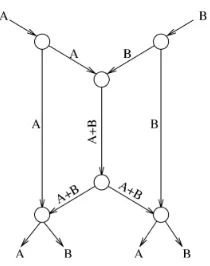
In this section, we briefly discuss the concept and notations of network coding. The network is modelled by a directed graph. There is a source node and several sink nodes. In network coding, the source node generates the data packets that she wishes to deliver to the sink nodes over the net-work. To do so, the source node encodes her data and transmits the encoded data via its outgoing edges, according to some encoding algorithm that we will discuss later. Each intermediate node receives data packets from its incoming edges, combines them by some encoding algorithms, and transmits the encoded data via its outgoing edges. Note that the node may transmits different data packets on different outgoing edges. The advantage of network coding is showed in the Figure 1 from [2]. In this Figure, we assume that the source node has two data packetsAandBand wants to deliver them to the two sink nodes at the bottom. Assuming that all links have a capacity of one packet per unit of time, for traditional copy-and-forward network communication, there is no possibility for the source node to deliver these two packets to the two sink nodes in one unit time. However, if the upper intermediate node XORs the received packets and forwardA⊕B to the middle link, both sink nodes obtain two distinct packets in every unit of time.
Figure 1: Network coding
Without loss of generality, we assume that the source node generates the messagesw1, . . . , wt∈ Fpn−t, whereFp is the finite field. In another word, eachwi consists ofn−telements fromFp. First, the source node pads the messages with thet×tidentity matrixI as follows:
M1 M2 · · · Mt = w1 w2 · · · wt I
Thus we can consider the messages asM1, . . . , Mt∈Fpn.
For one message transmission session, each node withkincoming edges receivesv1,· · ·, vk∈ Fpn from itskincoming edges respectively. For each outgoing edge, the node chooses random
α1, . . . , αk ∈Fpand transmitsα1v1+· · ·+αkvkon this outgoing edge.
Without loss of generality, we also assume that there aretvirtual nodes which transmits the valuesM1, . . . , Mtto the source node. So the source node transmits random linear combinations of these messages to its outgoing edges instead of the original messages.
Note that if one sink node receives vi = (ui,1, . . . , ui,n−t, βi,1, . . . , βi,t), then we have the
following property
vi= (βi,1, . . . , βi,t) M1 M2 . . . Mt
Thus if the receiver node could collecttpacketsv1, . . . , vt, she could recover the original message
as M1 M2 . . . Mt =
β1,1 · · · β1,t
· · · ·
βt,1 · · · βt,t
−1
v1 v2 . . . vt
3
Information Theoretic Approach to Network Coding
Cai and Yeung [5, 7, 8] have proposed a general framework and obtained theoretical bounds for network error correction. Based on these theoretical bounds, Cai and Yeung [9] designed al-gorithms for achieving network coding based secure communication against passive adversaries (wire tappers). Jaggi, Langberg, Katti, Ho, Katabi, and Medard [12] studied network coding based secure communication techniques against Byzantine adversaries. It should be noted that in these two papers, the adversary model is based on the number of communication links that are con-trolled by the adversary. This is very different from the more powerful model based on the number of nodes that are controlled by the adversary. Thus the application could be limited. For exam-ple, Dong, Curtmola, and Nita-Rotaru [10] pointed out that this model is not realistic in sensor networks.
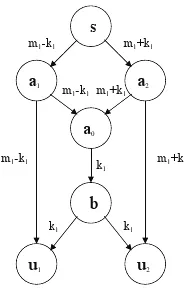
For example, in the Figure 2 from Cai and Yeung [9], the sender sgenerates a random key
(m1−k1) + (m1+k1) = 2m1. In another word, the protocol proposed by Cai and Yeung [9] is not secure against one single corrupted node.
Figure 2: Cai and Yeung’s private network coding
The same model is used by Jaggi, Langberg, Katti, Ho, Katabi, and Medard [12] to design secure message transmission protocols in network coding against active (Byzantine style) adver-saries. Since the adversary model is based on the maximum number of links controlled by the adversary, these message transmission protocols are not secure against an adversary who controls only one node and is able to generatet-outgoing corrupted messages.
Though the link based adversary models used in [9] and [12] may be sufficient in some appli-cations where it is hard for the adversary to control one single node, these models are not valid in many applications where the adversary could control several nodes. Thus it is preferred to study information theoretic message transmission network coding protocols in the node based adversary models.
4
Probabilistic approach to secure network coding
In addition to the information theoretic approaches for secure network coding that we have dis-cussed in the previous section. Several efforts have been made to design cryptographic protocols for secure network coding. In this section, we describe these efforts and discuss their security.
4.1 Signature Scheme from Infocom 08
Yu, Wei, Ramkumar, and Guan [18] designed a homomorphic digital signature scheme for net-work coding against pollution attacks. The homomorphic signature scheme was designed with the purpose that:
• Each intermediate node can verify whether a received packet has a valid signature.
Specifically, their signature scheme is as follows. The source node has an RSA private key
d, and public key(N, e). Without loss of generality, we assume that these parameters are chosen securely and meets the security requirements (e.g.,N is at 1024 bits or 2048 bits). Furthermore, letpandqbe two primes such thatq|(p−1)andg1,· · ·, gn ∈Zp be randomly chosen numbers
with order q (modp). We assume that all nodes in the network have an authentic copy of the system parameters(N, e), p, q, g1,· · ·, gn.
In one session, the source node generates the digital signatures for messages M1, . . . , Mtas
follows. The signature onMi= (mi,1,· · ·, mi,n)is computed as:
S(Mi) =
n Y
j=1
gjmi,j
d
modN
Now assume that an intermediate node receives message-signature pair(v, S(v)), wherev = (u1, . . . , un), it can verify the digital signature as follows:
S(v)e=
n Y
j=1
gjuj modp modN
Furthermore, assume that the intermediate node receives(v1, S(v1)),· · ·,(vk, S(vk))from its
kincoming edges respectively, whereS(vk)is the digital signature onvk. For each outgoing edge,
the node chooses randomα1, . . . , αk ∈ Fp and computes the digital signature on the combined
messagev =α1v1+· · ·+αkvkas follows:
S(v) =
n Y
j=1
S(vj)αj
The correctness of the signature scheme is straightforward and omitted here. The authors in [18] have provide a security proof for the above signature scheme. In the following, we show a few attacks on this signature scheme.
4.1.1 Attack 1
This attack is derived from the “batch verification” properties provided by the authors in their original paper [18]. Assume that the adversary observes a message-signature pair(M0, S(M0)) from session one and a message-signature pair(M00, S(M00))from session two. For any random numbers β1, β2, the adversary can generate the “digital signature”S(M) on the message M =
β1M0 +β2M00 asS(M0)β1S(M00)β2. It should be noted that this messageM belongs neither to session one nor to session two. One may propose that a session ID could be embedded into the message space, but there is no easy way to do that. One may also propose that the system parametersg1,· · ·, gn be changed for each session. That is, different sessions do not share the
4.1.2 Attack 2
Assume that the adversary observes a digital signatureS(M)on the messageM = (m1, m2,· · ·, mn). For any messageM0 = (m, m2,· · ·, mn)chosen by the adversary, she may compute a numberx
such thatm =m1+e·x. Then the signature on the messageM0 isS(M0) = S(M)·gx1. The reason is due to the following fact:
S(M0)e=S(M)eg1e·x =ge1·x n Y
j=1
gjmj =gm1+ex
1 · · ·gnmn
Similarly, the adversary can generate a digital signatureS(M00)for any messageM00= (m01,· · ·, m0n) at her choice. This attack shows that even if the source node distributes different system parame-ters for different session, it still does not work!
4.2 Digital signature on orthogonal vectors from ISIT 07
Zhao, Kalker, Medard, and Han [19] introduce a different scheme to authenticate messages in network coding. Roughly speaking, their technique is based on the following ideas:
• In order for the source node to authenticate messagesM1,· · ·, Mt, the source node finds a vectoruwhich is orthogonal to all these messages (that is,Mi·u= 0for all1≤i≤t) and digitally signu. The intermediate and receiver nodes will accept a received messageM if and only ifM·u= 0.
The intuition for this scheme is that a received message M should be accepted if only if it be-longs to the linear space spanned by the vectorsM1,· · ·, Mt. The authors [19] think that this is “equivalent” to the fact thatM·u= 0. Unfortunately, this argument is not valid. There are many vectorsM0 with the propertyM0·u = 0butM0 does not belong to the linear space spanned by the vectorsM1,· · ·, Mt. In the following, we describe the signature scheme and simple attacks on the scheme.
The parameters for the system consists of a generatorgfor the groupGof orderp. The private key for the source node is nrandom elements {α1,· · ·, αn} from Fp. The public key for the source node is{gα1,· · ·, gαn}. We assume that all nodes in the network have an authentic copy
of the system parameters(g, G, p)and the public key of the source node.
For the source node to sign the messagesMi = (mi,1,· · ·, mi,n) (1≤i≤t), the source node finds a nonzero vectoru∈Fpnwith the property that
u·Mi = 0 i= 1,· · ·, t
Then the digital signature isx= (u1α−11,· · ·, unαn−1)together with a standard signature onx
To verify whetherxis a valid signature on a messageM = (m1,· · ·, mn), one needs to check whether
n Y
i=1
(gαi)ximi = 1
4.2.1 Attack 1
This attack was noticed by the authors in their original paper [19]. Assume thatxis the digital signature for session one (of file F) andx0 is the digital signature for session two (of fileF0). Furthermore, assume that the messageM = (m1, . . . , mn) is from session one. Then one can construct a messageM0 = (m01,· · ·, mn0) for session two, where m0i = ximi/x0i. This is true since
n Y
i=1
(gαi)x0im
0
i =
n Y
i=1
(gαi)ximi = 1.
Obviously,M0 is not a valid message for session two. This attack shows that each session needs the secure deployment of a different public/private keys, which could use too much of the network coding capacity.
4.2.2 Attack 2
It is straightforward that if the adversary can collecttmessages, then she will be able to recover the original message. At the same time, the adversary will also be able to compute the original orthogonal vectoru. Here we assume that the implementation for computingufrom the messages is public soucan be uniquely recovered. By the fact thatx= (u1α1−1,· · ·, unα−n1), the adversary
will be able to recover the private key of the source node. Thus she will be able to create any signature on any chosen message.
4.2.3 Attack 3
This attack shows that the digital scheme based on orthogonal vectors are completely infeasible for practical purposes.
LetM1,· · ·, Mtbe the message vectors whereMi= (mi,1,· · ·, mi,n−t,0,· · ·,0,1,0, . . . ,0).
It is straightforward to check that the following vectoruis orthogonal to all of these messages and satisfies the requirements for the orthogonal signature.
(11,· · ·,1n−t,− n−t X
j=1
m1,j,− n−t X
j=1
m2,j, . . .− n−t X
j=1
mt,j)
Now letMi0 = (m0i,1,· · ·, m0i,n−t,0,· · ·,0,1,0, . . . ,0)wheremi,01,· · ·, m0i,n−tis any permutation ofmi,1,· · ·, mi,n−t. It is clear thatMi0 is orthogonal tou. Thus it will be accepted as a valid
message. However,Mi0is not a linear combination of the original messages. The reason why this attack is successful is as follows:
• The linear space spanned by the original messagesM1,· · ·, Mtist-dimensional.
• Assume thatu be any fixed vector which is orthogonal to the message space. Then u is orthogonal to a subspace of dimensionn−1which contains the message space. Thus, for
n−1> t, there is a huge room for the adversary to generate fake messages.
4.3 Charles, Jain, and Lauter’s signature scheme
4.3.1 Bilinear maps and the bilinear Diffie-Hellman assumptions
In the following, we briefly describe the bilinear maps and bilinear map groups. The details could be found in Joux [14] and Boneh and Franklin [3].
1. G1,G2, andGT are three (multiplicative) cyclic groups of prime orderq.
2. g1, g2are generators ofG1, G2respectively.
3. ˆe:G1×G2 →GT is a bilinear map.
A bilinear map is a mapˆe:G×G→G1with the following properties: 1. bilinear: for allx, y∈Z, we haveeˆ(g1x, gy2) = ˆe(g1, g2)xy.
2. non-degenerate:eˆ(g1, g)2 6= 1.
We say thatG1, G2 are bilinear groups if the group action inG1, G2 can be computed efficiently and there exists a groupGT and an efficiently computable bilinear mapeˆ: G1×G2 → GT as above. Concrete examples of bilinear groups are given in [14, 3]. For convenience, throughout the paper, we viewG1, G2, andGT as multiplicative groups though the concrete implementation of G1, G2could be additive elliptic curve groups.
4.3.2 The signature scheme
We first briefly discuss the network coding signature scheme by Charles, Jain, and Lauter [6]. The system parameter consists of the bilinear groupG=hG, G, GT,eˆiand(n+ 1)elements g1,· · ·, gn, g ∈ Gthat are chosen by the source node. Note that here we assume thatG=G1 =
G2for the bilinear groups.
For each session, the source node chooses secret key(s1,· · ·, sn). Then the signature on the
messageMi = (mi,1,· · ·, mi,n)is(gs1,· · ·, gsn, S(Mi))where
S(Mi) =
n Y
j=1
gmj i,jsj
Now assume that an intermediate node receives message-signature pair(v,(h1,· · ·, hn, S(v))), wherev= (u1, . . . , un), it can verify the digital signature as follows:
n Y
j=1 ˆ
e(gjuj, hj) = ˆe(S(v), g)
Furthermore, assume that the intermediate node receives (v1,(h1,· · ·, hn, S(v1))),· · ·, and (vk,(h1,· · ·, hn, S(vk)))from itskincoming edges respectively, whereS(vi)is the digital
sig-nature onvi = (ui,1,· · ·, ui,n). For each outgoing edge, the node chooses randomα1, . . . , αk ∈ Fp and computes the digital signature on the combined message v = α1v1 +· · · +αkvk as
(h1,· · ·, hn, S(v))where
S(v) =
n Y
j=1
gsj
Pt i=1αiui,j
j =
t Y
i=1
n Y
j=1
gαisjui,j
j =
t Y
i=1
S(vi)αi
4.3.3 Attacks
Our first analysis shows that the values(gs1,· · ·, gsn)have to be distributed to all nodes in a secure
channel for each session. The reason is as follows.
• Assume that the adversary observes one signature(gs1,· · ·, gsn, S(M
i))on the message Mi = (mi,1, mi,2,· · ·, mi,n). For any message M0 = (m, mi,2,· · ·, mi,n) chosen by the adversary, the adversary can compute a number β such that m = mi,1β−1. Then
gβs1,· · ·, gsn, S(M
i)
is a signature for M0. It is straightforward for the adversary to generate signatures on any messageM00by modifying the values of(gs1,· · ·, gsn).
Boneh, Freeman, Katz and Waters [4] observed that, for this signature scheme, if both sessions share(gs1,· · ·, gsn), then the adversary can easily combine the signatures on messages from two
sessions to generate a new signature on a fake message:
• Assume thatM0is from session one andM00is from session two. The signatures on the two messages areh1,· · ·, hn, S(M0)andh1,· · ·, hn, S(M00).
• For any β1 and β2, one can compute the signature on the message β1M0 +β2M00 as
S(M0)β1S(M00)β2.
Combining these attacks, it is clear that the network coding signature in [6] requires a secure channel for each session. This may be achieved by letting the source node digital sign the value (gs1,· · ·, gsn)using a traditional digital signature scheme. But this will certainly introduce
ex-tra overhead for the network ex-traffic which may significantly reduce the performance of network coding.
4.4 Boneh, Freeman, Katz and Waters signature schemes
In previous sections, we show that all these signature schemes are either secure or non-practical. In this section, we briefly describe a recent effort by Boneh, Freeman, Katz and Waters [4]. They designed two provable secure digital signature schemes NCS1 and NCS2 for network coding. However, the first scheme NCS1 is based on bilinear maps, which may require more powerful computing capabilities for the intermediate nodes (could be routers). Thus it may be impractical for some applications (see, e.g., [10] for some discussions) though may be acceptable for systems with relatively powerful routers.
The signature scheme NCS2 requires longer signatures to be delivered for each session, which could reduce the advantage of the network coding if the session message is relatively smaller, which is often true in wireless communications such as sensor networks.
References
[1] http://www.ifp.illinois.edu/∼koetter/NWC/
[2] R. Ahlswede, N. Cai, S.-Y. R. Li and R. W. Yeung. Network information flow.IEEE Trans. on Information Theory46:1204–1216, 2000.
[4] D. Boneh, D. Freeman, J. Katz, and B. Waters. Signing a Linear Subspace: Signature Schemes for Network Coding. InPublic Key Cryptography, PKC 2009, pages 68–87, LNCS 5443, Springer Verlag, 2009.
[5] N. Cai and R. Yeung. Network coding and error correction. In:Proc. 2002 IEEE Information Theory Workshop 2002, pages 119–122.
[6] D. Charles, K. Jain, and K. Lauter. Signatures for network coding.Int. J. Information and Coding Theory,1(1):3–14. An abstract of this paper has appeared in: 40th Annual Conf. on Information Sciences and Systems 2006. Microsoft has also a patent on this technique, see http://www.wipo.int/pctdb/en/wo.jsp?wo=2007056038
[7] R. Yeung and N. Cai. Network Error Correction, I: Basic Concepts and Upper Bounds. Com-mun. Inf. Syst.6(1):19–35, 2006
[8] N. Cai and R. Yeung. Network Error Correction, II: Lower Bounds. Commun. Inf. Syst.
6(1):37–54, 2006
[9] N. Cai and R. Yeung. Secure network coding. In: Proc. International Symposium on In-formation Theory (ISIT ’02), June 2002. http://iest2.ie.cuhk.edu.hk/∼whyeung/publications/
secure.pdf
[10] J. Dong, R. Curtmola, and C. Nita-Rotaru. Practical defenses against pollution attacks in intra-flow network coding for wireless mesh networks. In: Proc. ACM WiSec 2009, ACM Press.
[11] T. Ho, R. Koetter, M. Medard, D. Karger, and M. Effros. The benefits of coding over rout-ing in a randomized settrout-ing. In Proc. 2003 IEEE International Symposium on Information Theory, pages 442, 2003.
[12] S. Jaggi, M. Langberg, S. Katti, T. Ho, D. Katabi, M. Medard Resilient network coding in the presence of Byzantine adversaries. InProc. 26th Annual IEEE Conf. on Computer Commun., INFOCOM, pages 616–624, 2007.
[13] S. Jaggi, P. Sanders, P. A. Chou, M. Effros, S. Egner, K. Jain, and L. Tolhuizen. Polynomial time algorithms for multicast network code construction.IEEE Transaction on Information Theory, 2003.
[14] A. Joux. A one round protocol for tripartite Diffie-Hellman. In: Algorithmic number theory symposium, ANTS-IV, LNCS 1838, pages 385–394, 2000.
[15] R. Koetter and M. Medard. An algebraic approach to network coding.IEEE/ACM Transac-tions on Networking, 2003.
[16] S. -Y. R. Li, R. W. Yeung, and N. Cai. Linear network coding.IEEE Transaction on Infor-mation Theory, 2003.
[18] Z. Yu, T. Wei, B. Ramkumar, and Y. Guan. An Efficient Signature-based Scheme for Securing Network Coding against Pollution Attacks. InProc. 27th Annual IEEE Conf. on Computer Commun., INFOCOM, pages xxx-xxx, 2008.