PARTNER MAIL VS
®Voice Messaging System
Release 4
Installation and Programming
585-322-521
Comcode 107970212
Issue 1
March 1997
Notice
Every effort was made to ensure that the information in this book was complete and accurate at the time of printing. However, information is subject to change.
Your Responsibility for Your System’s Security
Toll fraud is the unauthorized use of your telecommunications system by an unauthorized party, for example, persons other than your company’s employees, agents, subcontractors, or persons working on your company’s behalf. Note that there may be a risk of toll fraud associated with your telecommunications system, and if toll fraud occurs, it can result in substantial additional charges for your telecommunications services.
You and your System Manager are responsible for the security of your system, such as programming and configuring your equipment, to prevent unauthorized use. The System Manager is also responsible for reading all installation, instruction, and system administration documents provided with this product in order to fully understand the features that can introduce risk of toll fraud and the steps that can be taken to reduce that risk.
Lucent Technologies does not warrant that this product is immune from or will prevent unauthorized use of common-carrier telecommunication services or facilities accessed through or connected to it. Lucent Technologies will not be responsible for any charges that result from such unauthorized use.
Federal Communications Commission Statement
This equipment has been tested and found to comply with the limits for a Class A digital device, pursuant to Part 15 of the FCC Rules. These limits are designed to provide reasonable protection against harmful interference when the equipment is operated in a commercial environment. This equipment generates, uses, and can radiate radio frequency energy and, if not installed and used in accordance with the instruction manual, may cause harmful interference to radio communications. Operation of this equipment in a residential area is likely to cause harmful interference, in which case the user will be required to correct the interference at his own expense.
Canadian Department of Communications (DOC) Interference Information
This digital apparatus does not exceed the Class A limits for radio noise emissions set out in the radio interference regulations of the Canadian Department of Communications.
Le Présent Appareil Numérique n’émet pas de bruits radioélectriques dépassant les limites applicable aux appareils numériques de la class A préscrites dans le reglement sur le brouillage radioélectrique édicté par le ministère des Communications du Canada.
Trademarks
PARTNER, PARTNER MAIL VS, PARTNER MAIL, MLS-34D, MLS-18D, MLS-12D, MLS-12, MLS-6, MLC-6, MDC 9000, MDW 9000, MDW 9010, and MDW 9030P are registered trademarks of Lucent Technologies in the U.S. and other countries.
Ordering Information
Call: Lucent Technologies Publications Center
Voice 1 800 457-1235 International Voice 317 361-5353 Fax 1 800 457-1764 International Fax 317 361-5355
Write: Lucent Technologies Publications Center P.O. Box 4100
Crawfordsville, IN 47933
Order: Document No. 585-322-521, Issue 1, March 1997, Comcode 107970212
Support Telephone Number
In the continental U.S., Lucent Technologies provides a toll-free customer helpline 24 hours a day. Call the Lucent Technologies Helpline at 1 800 628-2888 or your Lucent Technologies authorized dealer if you need assistance when installing, programming, or using your system. Consultation charges may apply. Outside the continental U.S., contact your local Lucent Technologies authorized representative.
Lucent Technologies Fraud Intervention
If you suspect you are being victimized by toll fraud and you need technical support or assistance, call Technical Service Center Toll Fraud Intervention Hotline at 1 800 643-2353.
WWW Home Page
WARNING:
The following list provides basic safety precautions that should always be followed when using the system:
1 .
2 .
3 .
4 .
5 .
6 .
7 .
8 .
9 .
10.
Read and understand all instructions.
Follow all warnings and instructions marked on the product.
Unplug all telephone connections before cleaning. DO NOT use liquid cleaners or aerosol cleaners. Use a damp cloth for cleaning.
This product should be serviced by (or taken to) a qualified repair center when service or repair work is required.
DO NOT use this product near water, for example, in a wet basement location.
DO NOT place this product on an unstable cart, stand, or table.
Never push objects of any kind into slots or openings as they may touch dangerous voltage points or short out parts that could result in a risk of fire or electric shock. Never spill liquid of any kind on the product.
Avoid using this product during an electrical storm. There may be a remote risk of electric shock from lightning.
DO NOT use the telephone to report a gas leak in the vicinity of the leak.
The product is provided with a three-wire grounding type plug. This is a safety feature. DO NOT defeat the safety purpose of the grounding type plug. DO NOT staple or otherwise attach the AC power supply cord to building surfaces.
CAUTION:
DO NOT block or cover the ventilation slots and openings. They prevent the product from overheating. DO NOT place the product in a separate enclosure unless proper ventilation is provided.
About This Guide
xi■ Purpose xi
■ Terminology xi
■ Key Sequences xii
■ How to Use This Guide xiii
■ Reference Materials xiv
1
Overview
1-1■ Tutor Feature 1-3
■ Languages 1-4
■ Voice Messaging Services 1-4
■ Security 1-15
2
Installation
2-1■ Before You Start 2-1
■ Installing the PARTNER MAIL VS Module 2-2
3
Understanding Programming
3-1■ Cmmunications System Programming 3-1
■ Voice Messaging System Programming 3-4
4
Initial Programming
4-1■ Overview 4-1
■ Voice Mail System Configurations 4-2
■ Initial Communications System Setup 4-3
■ Voice Messaging System Programming 4-6
■ Communications System Programming 4-19
5
System Management
5-1■ General Information 5-2
■ Language 5-8
■ Automated Attendant Service 5-18
■ Modifying Mailboxes 5-36
■ Line Coverage 5-52
■ Telephone Button Programming 5-60
6
Troubleshooting
6-1■ When You Need Help 6-1
■ Automated Attendant Service 6-2
■ Call Answer Service 6-6
■ Voice Mail Service 6-7
■ Language 6-11
A
Specifications
A-1B
FCC Information
B-1■ Federal Communications Commission (FCC)
Interference Information B-1
■ IC Notification and Repair Information B-3
C
Warranty Information
C-1■ Repair Information C-1
■ Lucent Technologies Warranty and Limitation of
D
Voice Messaging System Planning Forms
D-1E
Communications System Planning Forms
E-1F
Case Studies
F-1■ Purpose F-1
■ Case Study #1 F-2
■ Case Study #2 F-21
GL
Glossary
GL-1IN
Index
IN-1Menu Map
Programming Flowchart
1
Overview
1-11-1. Voice Messaging Services 1-5
1-2. Immediate and Delayed Call Handling 1-9
2
Installation
2-12-1. Voice Messaging System Extensions for
PARTNER Plus, PARTNER II, and PARTNER 48 2-3
2-2. Sample Voice Messaging System Extensions for
PARTNER Advanced Communications Systems 2-4
2-3. Installing the Mailbox Expansion Card 2-5
3
Understanding Programming
3-13-1. Programming Menus 3-6
5
System Management
5-15-1. Language Menu 5-8
5-2. Automated Attendant Service Menu 5-19
5-3. Modifying Mailboxes 5-37
5-4. Dial Plan for PARTNER Plus, PARTNER II, and
PARTNER 48 5-39
5-5. Dial Plan for PARTNER Advanced
Communications Systems 5-40
Purpose
This guide provides instructions for installing, upgrading, programming,
and managing the PARTNER MAIL VS®
Voice Messaging System on the PARTNER®
Plus, PARTNER II, PARTNER 48, or PARTNER Advanced
Communications System (ACS). It is intended for the technician who installs the hardware and programs the initial system settings and for the System Manager, the person who is responsible for managing the system on an on-going basis.
Terminology
This guide uses the following terms:
■
■ ■
■
Voice messaging system (VMS): the PARTNER MAIL VS Voice Messaging System.
Subscribers: a user who has a mailbox on the voice messaging system.
Communications system (CS): in most countries, Release 3.1 or later of the PARTNER Plus, PARTNER II, and PARTNER 48 systems, or Release 1.0 of the PARTNER Advanced Communications System. In the U.K., Release 2.0 or later of the PARTNER Plus and PARTNER 48 systems.
Key Sequences
This guide instructs you to press key sequences on the telephone’s dialpad to perform tasks. Each sequence includes a number. If the keys on your dialpad also have letters, the number in the sequence is equivalent to a letter
associated with the task in English. For example, to delete a message from your mailbox, you press [ ★ ] [ 3 ], which is equivalent to [ ★ ] [ D ] on the dialpad. The numerical key sequences and their associated letter sequences are listed below for your reference:
Delete [ ★ ] [ 3 ] [ ★ ] [ D ]
Help [ ★ ] [ 4 ] [ ★ ] [ H ]
Restart [ ★ ] [ 7 ] [ ★ ] [ R ]
Transfer [ ★ ] [ 8 ] [ ★ ] [ T ]
How to Use This Guide
lf you are the technician, refer to the appropriate chapters to help you:
■
■
■
■
Install the voice messaging system hardware. Chapter 2 provides
instructions for installing and upgrading the voice messaging system module in the communication system’s control unit. It also provides instructions for installing the Mailbox Expansion Card.
Refresh your memory about programming. Chapter 3 offers general
programming information for both the communications system and the voice messaging system.
Perform initial programming. Chapter 4 provides step-by-step
programming instructions for integrating the voice messaging system with the communications system. It also provides test procedures that you should use after installation to ensure that the system is working properly.
Solve problems. Chapter 6 provides information to help you identify
and correct problems you may have with the voice messaging system.
If you are the System Manager, refer to the appropriate chapters to help you:
■
■
■
■
Learn about the voice messaging system. Chapter 1 describes the
voice messaging system’s features and services.
Learn about programming. Chapter 3 offers general programming
information for both the communications system and the voice messaging system.
Manage the voice messaging system. Chapter 5 provides instructions
for changing system settings to accommodate the changing needs of the business. It also offers guidelines for setting up and using the
receptionist’s extension.
Solve problems. Chapter 6 provides information to help you identify
and correct problems you may have with the voice messaging system.
After you are experienced with the system, use the Table of Contents or Index to locate the information you need.
This guide contains some information about communications system features as well as voice messaging system features. For detailed information about a specific communications system feature, refer to the Programming and Use guide for the communications system.
Product Safety Statements
Product safety statements are identified in this guide by a
CAUTION:
Indicates the presence of a hazard that will or can cause minor personal injury or properly damage if the hazard is not avoided.
WARNING:
Indicates the presence of a hazard that can cause severe or fatal personal injury if the hazard is not avoided.
How to Comment on This Guide
A feedback form is located at the end of this guide, after the appendixes. If the form is missing, send your comments and recommendations for
Reference Materials
In addition to this guide, the following materials are available (the order numbers are in parentheses) for the voice messaging system:
■ Using the PARTNER MAIL VS Voice Messaging System (585-322-523)
■ Tutor Labels (585-322-510)
To order these materials, call the Lucent Technologies’ BCS Publications Center at 1 800 457-1235 in the continental U.S. or at 1 317 361-5353.
1
Contents
Tutor Feature
Languages
Voice Messaging Services
■ Automated Attendant Service
Communications System Features Affecting Automated Attendant Service
Group Call Distribution VMS Hunt Schedule VMS Hunt Delay
Transfer Return Extension
Automated Attendant Service Scenarios Music On Hold
■ Call Answer Service
Communications System Features Affecting Call Answer Service
VMS Extension Coverage
Immediate VMS Extension Coverage (Do Not Disturb) Line Coverage
Voice Mailbox Transfer
■ Voice Mail Service
Mailboxes Guest Mailboxes
Security
■ System Security Guidelines
■ Security Policy and User Education
1-3
1-4
1-4 1-6
1-8 1-8 1-8 1-9 1-10 1-10 1-11 1-11
1
The PARTNER MAIL VS Voice Messaging System is designed to work with the communications system to automate the call handling needs of the business.
The voice messaging system:
■
■
■
■
■
■
Expands easily and supports four configurations to accommodate growth and ensure optimal performance. The basic system configuration
consists of 2 voice channels (ports) and 10 mailboxes. Any one of three optional Mailbox Expansion Cards may be installed to increase the number of ports and/or subscribers. These configurations include: 2 ports and 20 mailboxes, 4 ports and 20 mailboxes, and 4 ports and 40 mailboxes.
Handles up to two calls (in the 2-port configuration) or four calls (in the 4-port configuration) simultaneously and provides service for a
predetermined number of subscribers.
Answers outside calls, plays a customized message prompting the caller to press digits for the party with whom the caller wants to speak, and efficiently routes the call to the appropriate party—all without the aid of a receptionist.
Allows outside callers to hear all voice prompts and customized messages in the language selected for the system. And in bilingual mode, callers can choose between two languages selected for the system.
Allows you to create up to two Automated Attendant Announcements (in each language selected for the system). For example, you can offer callers a choice of a standard business hours/location announcement or a frequently updated announcement featuring special offers.
■
■
■
■
■
Allows subscribers to retrieve messages from any touch-tone phone on the premises or from a remote location. And the system informs
subscribers how many of these messages are new and how many are old (previously saved) messages.
Allows subscribers to forward messages with comment to one or more mailboxes on the system.
Allows System Managers to implement the language that subscribers choose for their own mailbox use.
Allows subscribers to have the system “outcall” a specific telephone or pager number according to a predefine schedule whenever a new message is received. (Note that this feature is available to subscribers only when it is administered for them by their System Manager.)
Provides after-hours service in addition to daytime service.
NOTE:
Outcalling, Automated Attendant Announcements, and Message Forward features are introduced with this new release of PARTNER MAIL VS. The ability to expand the standard 2-port, 10-mailbox configuration to any one of three other configurations with the installation of the appropriate
Mailbox Expansion Card is also a new feature of Release 4.
Tutor Feature
Tutor is an “on-line help” feature that allows users to easily access and listen to information about commonly-used communications system features. Any user can access the Tutor—users do not have to be voice messaging system subscribers.
Tutor provides information about the following subjects:
■
■
■
System phone features such as ringing patterns, volume control, speakerphone, display, buttons, and lights.
Various types of internal calls including group paging calls, voice interrupt on busy calls, and hands-free answer on intercom calls.
System features such as Conference, Transfer, Auto Dialing, Personal Speed Dialing, Last Number Redial, and Save Number Redial.
To access the Tutor menu, users simply make a call to the voice messaging system. The system plays:
Welcome to PARTNER MAIL VS. Please enter extension
and #. Otherwise, to access PARTNER Tutor, press * 4.
When users dial [ ★ ] [ 4 ], they hear instructions for using Tutor, followed by a list of topics and subtopics. The user can then enter the topic and subtopic numbers of their choice. Refer to “Using the Tutor Feature” in Chapter 5 for a list of topic and subtopic numbers.
Languages
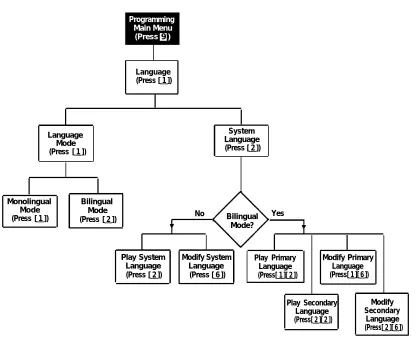
The voice messaging system supports multiple languages. You can choose to have outside callers hear all voice prompts and customized messages in one of the supported languages (Monolingual Mode) or you can let outside callers choose between two languages preselected for the system by the System Manager (Bilingual Mode).
When the system operates in Monolingual Mode, the language you choose for voice prompts is referred to as the System Language. When the system operates in Bilingual Mode, the language you choose for voice prompts when calls are first answered is referred to as the Primary Language. Outside callers then have the option of switching to the Secondary Language for the remainder of the call.
Voice Messaging Services
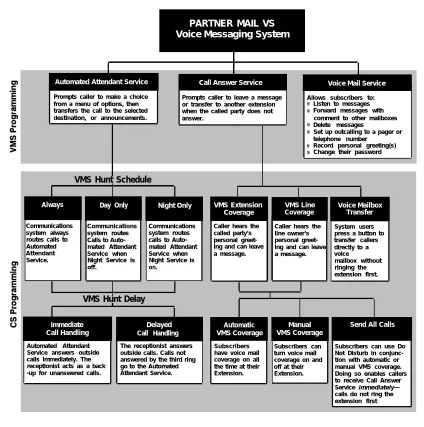
The voice messaging system provides three types of service:
■
■
■
Automated Attendant Service. Answers outside calls and transfers
them to the destination selected by the caller or plays an Announcement selected by the caller.
Call Answer Service. Allows the caller to leave a message or to transfer
to another extension if the called party is busy or does not answer.
Voice Mail Service. Allows subscribers to listen to messages and
manage their own mailbox.
PARTNER MAIL VS Voice Messaging System
Automated Attendant Service Call Answer Service Voice Mail Service
Prompts caller to make a choice Prompts caller to leave a message Allows subscribers to: from a menu of options, then or transfer to another extension ■Listen to messages transfers the call to the selected when the called party does not ■Forward messages with destination, or announcements. answer. comment to other mailboxes
■Delete messages
■ ■ ■
telephone number Record personal greeting(s) Change their password
VMS Hunt Schedule
Always Day Only Night Only VMS Extension
Coverage
VMS Line
Coverage Voice MailboxTransfer
Communications Communications system always system routes routes calls to Calls to Auto-Automated mated Attendant Attendant Service when Service. Night Service is
Communications system routes calls to Auto-mated Attendant Service when Night Service is
off. on.
VMS Hunt Delay
Immediate Call Handling Delayed Call Handling Automatic VMS Coverage Manual VMS Coverage
Send All Calls
Automated Attendant The receptionist answers Service answers outside outside calls. Calls not calls immediately. The answered by the third ring receptionist acts as a back go to the Automated -up for unanswered calls. Attendant Service.
Set up outcalling to a pager or
Caller hears the called party’s personal greet-ing and can leave a message.
Caller hears the System users line owner’s press a button to personal greet- transfer callers ing and can leave directly to a a message. voice
mailbox without ringing the extension first.
Subscribers have voice mail coverage on all the time at their Extension.
Subscribers can turn voice mail coverage on and off at their Extension.
Subscribers can use Do Not Disturb in conjunc-tion with automatic or manual VMS coverage. Doing so enables callers to receive Call Answer Service immediately— calls do not ring the extension first
Automated Attendant Service
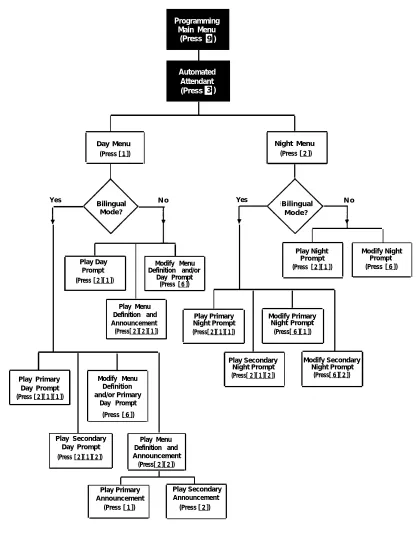
The Automated Attendant Service can answer and route outside calls without assistance from a receptionist. After an outside call is answered, the Automated Attendant Service plays a customized message (called the menu prompt). Typically the message welcomes callers—to let them know they have reached the correct number—then offers callers a menu of options for transferring to the desired party or listening to an Announcement. (It is recommended that the menu offer not more than five options to avoid confusing callers.)
You can record up to two Announcements in Monolingual Mode (or up to two Announcements for each language in Bilingual Mode). Announcements are often used to answer frequently asked questions, such as business hours and location, emergency service, special offers, etc. Each Announcement can be up to four minutes in length. Callers can choose to listen to these Announcements, so your staff has more time to answer other calls and perform other tasks.
You can customize the menu prompt for use during normal business hours (called the Day Menu Prompt) and for use after normal business hours (called the Night Menu Prompt). For example, you can set up Automated Attendant Service so that callers hear the following prompt during the day if the system is set for Monolingual Mode and the System Language is U.S. English:
Thank you for calling the ANY Travel Agency. If you
know the extension you want, dial it now or press 0 to
speak with the receptionist. For information on this
month’s special travel package, press 3. For directions
to ANY Travel Agency, press 4. To speak to an agent
about Corporate Travel, press 5. Press * 4 to replay
this message.
Note that callers who want general information regarding the current discount travel package or agency location can choose to listen to an Announcement. For example, when callers press [ 3 ] they hear the following Announcement:
Are you tired of battling the ice, snow, and
after-Christmas sale crowds? Take advantage of our January
sunny escape package-3 days and 2 nights in San Juan, Puerto Rico for $439 per person, including hotel and
airfare. To speak to an agent about this package or
other winter getaways, press * 8 and extension 13.
For after-hours callers, you can set up Automated Attendant Service to play this prompt:
You have reached the ANY Travel Agency. Our hours are 8
to 5, Monday through Friday. Please press 9 to leave a
For a system set for Bilingual Mode, the Day Menu Prompt should let callers know that they can switch from the Primary Language to the Secondary Language. Note that callers can also press [ ★ ] [ 1 ] while listening to an Automated Attendant Announcement to switch between the Primary and Secondary Languages. In the following example, the Primary Language is Latin American Spanish and the Secondary Language is U.S. English:
Gracias por llamar a Software México. For English,
press * 1. Si usted tiene teléfono de tonos y conoce
el número de extensión, marquelo ahora. De lo contrario, espere a ser atendido por nuestra operadora.
For after-hours callers, you can set up Automated Attendant Service to play this prompt:
Gracias por llamar a Software México. For English, press
* 1. Nuestro horario de oficina es de 9 a 14:30 horas y
de 16 a 18 horas. Si usted tiene teléfono de tonos y
conoce el número de la extensión a la que desea llamar,
marquelo ahora. De lo contrario, espere y deje un
mensaje con la operadora.
NOTE:
When the system is installed initially, Automated Attendant Service has this factory-set Day Menu Prompt:
Hello, welcome to PARTNER MAIL VS. Please enter the
extension number of the person you wish to reach or press 0 to reach the receptionist.
ln addition, Automated Attendant Service has this factory-set Night Menu Prompt:
Good Evening. Welcome to PARTNER MAIL VS. Please enter
the extension number of the person you wish to reach, or press 9 to leave a message with the receptionist.
Automated Attendant Service is useful for many businesses, such as car dealerships, insurance agencies, and stores. For example, a car dealership can use Automated Attendant Service to allow its customers to reach the customer service department directly. This frees sales people to handle customer
Communications System Features Affecting
Automated Attendant Service
When planning Automated Attendant Service, you must choose settings for the following communications system features:
■
■
■
■
Group Call Distribution. Specifies the outside lines that are to be
answered by Automated Attendant Service.
VMS Hunt Schedule. Specifies when the communications system is to
route calls to the Automated Attendant Service.
VMS Hunt Delay. Specifies whether the Automated Attendant Service is
to provide immediate or delayed call handling.
Transfer Return Extension. Specifies how unanswered calls are
transferred by the voice mail system.
Each of these features is explained briefly below. For more information about these communications system features, see the Programming and Use guide for your communications system.
Group Call Distribution
This feature lets you specify the outside lines for which you want Automated Attendant Service coverage. You can specify some or all of your lines.
VMS Hunt Schedule
This feature determines when the communications system is to route calls to the Automated Attendant Service. VMS Hunt Schedule works in conjunction with the communication system’s Night Service feature so that the voice messaging system can play the appropriate menu prompt. In other words, the menu prompt the caller hears depends on the VMS Hunt Schedule setting you select and the status of the Night Service button at the receptionist’s extension.
You can choose one of the following VMS Hunt Schedule settings:
■
■
■
Always (factory setting). Routes outside calls to Automated Attendant
Service all the time. When Night Service is off, the Day Menu Prompt plays; when Night Service is on, the Night Menu Prompt plays.
Day Only. Routes outside calls to Automated Attendant Service only
when Night Service is off. The Day Menu Prompt plays.
Night Only. Routes outside calls to Automated Attendant Service only
VMS Hunt Delay
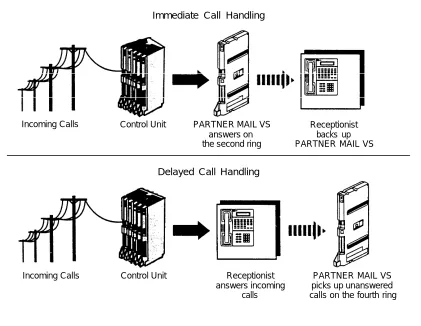
This option specifies either immediate or delayed call handling(see Figure 1-2):
■ Immediate (factory setting). The Automated Attendant Service answers
outside calls on the second ring and plays the Day or Night Menu Prompt. The receptionist can act as backup. Callers using rotary phones or callers requesting assistance can be transferred to the receptionist’s extension.
■ Delayed. The Automated Attendant Service answers outside calls after
the fourth ring. This delay gives the receptionist time to answer the call.
The VMS Hunt Delay setting you select is used for both day and night operation.
Immediate Call Handling
Incoming Calls Control Unit PARTNER MAIL VS Receptionist answers on backs up the second ring PARTNER MAIL VS
Delayed Call Handling
Incoming Calls Control Unit Receptionist PARTNER MAIL VS answers incoming picks up unanswered calls calls on the fourth ring
Transfer Return Extension
For extensions associated with the mail system unit, this option specifies how unanswered calls are transferred by the voice mail system.
If the mail system transfers a call to an extension that has no Voice Mail
coverage, or if Voice Mail coverage is Off, and that extension does not answer, the communications system transfers the call to the Transfer Return Extension.
For extensions that do not have Voice Mail coverage, this option can be programmed to ensure that unanswered calls transferred by the mail system return to the designated extension, where they ring until answered.
Automated Attendant Service Scenarios
The following sample scenarios illustrate typical ways in which Automated Attendant Service is set up with the communications system features:
■
■
■
Case 1: The receptionist is the primary call handler. Automated Attendant Service handles overflow.
a.
b.
c.
Use Group Call Distribution (#206) Setting 1 to identify the lines to be answered by Automated Attendant Service.
Set VMS Hunt Schedule (#507) to Always.
Set VMS Hunt Delay (#506) to Delayed.
Case 2: Automated Attendant Service is the primary call handler.
a.
b.
c .
d.
Use Group Call Distribution (#206) Setting 1 to identify the lines to be answered by Automated Attendant Service.
Set VMS Hunt Schedule (#507) to Always.
Set VMS Hunt Delay (#506) to Immediate.
Set Automatic Extension Privacy (#304) to Assigned for all PARTNER MAIL VS extensions. (When VMS Hunt Delay is set to Immediate, you can use this feature to prevent users from accidentally picking up calls sent to the voice mail system.)
Case 3: The receptionist answers calls during the day; Automated Attendant Service answers calls at night.
a.
b.
c.
Use Group Call Distribution (#206) Setting 1 to identify the lines to be answered by Automated Attendant Service.
Set VMS Hunt Schedule (#507) to Night Only.
Music On Hold
If you use Automated Attendant Service, you also may want to use the communications system’s Music On Hold feature. When Music On Hold is Active and an audio source is connected to the system, callers waiting to be transferred hear music or recorded material. If Music On Hold is Not Active, callers hear tones, ringing, or silence (depending on how the communications system is set up) while they are being transferred.
For more information, see Music On Hold and Ring on Transfer in the Programming and Use guide for the communications system.
Call Answer Service
This service offers callers the following options when they reach an extension that is unable to answer their call:
■
■ ■ ■
If the system is in Bilingual Mode, press [ ★ ] [ 1 ] while listening to the personal greeting to switch between the Primary and Secondary Languages.
Leave a detailed, confidential message in the called party’s mailbox.
Press [ 0 ] to transfer to the receptionist’s extension for assistance.
Press [ ★ ] [ 8 ] to transfer to another system extension.
Callers can press [ 0 ] or [ ★ ] [ 8 ] before, during, or after leaving a message.
NOTE:
Until subscribers record a personal greeting for their mailbox, outside callers hear this factory-set message in either the System Language (Monolingual Mode) or the Primary Language (Bilingual Mode):
Extension XX is not available. To leave a message,
wait for the tone. After recording hang up or press 1
Communications System Features Affecting Call
Answer Service
Call Answer Service works with the following communications system features:
■ VMS Extension Coverage
■ Do Not Disturb ■ Line Coverage
■ Voice Mailbox Transfer
Each of these features is explained briefly below. For more information on these communications system features, see the Programming and Use guide for your communications system.
VMS Extension Coverage
VMS Extension Coverage may be either automatic or manual.
■
■
Automatic VMS Coverage: When the communications system’s
Automatic VMS Cover feature is Assigned for an extension, intercom and transferred callers can leave messages or transfer to another extension when the called person does not answer by the fourth ring (or by the number of rings specified with the communications system’s VMS Cover Rings (#117)* feature). The system greets the caller with the subscriber’s personal greeting (or with the system greeting if a personal greeting is not recorded). If the system is in Bilingual Mode and the subscriber recorded a personal greeting in two languages, the caller can switch between the two languages by pressing [ ★ ] [ 1 ].
Manual VMS Coverage: Regardless of the Automatic VMS Cover
setting, the communications system allows subscribers to press a programmed button to turn voice mail coverage on and off at their extension. To make this possible, the VMS Cover feature must be programmed on a button with lights on the subscriber’s system phone.
Do Not Disturb
The Do Not Disturb button can be used to prevent calls for the extensions from audibly alerting (lights still flash). Subscribers (with communications system 4.0 or later) who have VMS Extension Coverage—either automatic or manual—can use this communications system feature when they want calls sent to their mailboxes immediately.
Line Coverage
Line Coverage lets callers who call in on a covered line leave messages in the mailbox of a specific subscriber (known as the owner of the covered line). When a call comes in on a covered line, the system routes the caller directly to the line owner’s mailbox if the call is not answered. The caller has the option of leaving a message or transferring to another extension.
Line ownership typically is assigned to personal lines or to lines to be used for outside access to the voice messaging system when Automated Attendant Service is not used. (Lines in the system can be assigned either Line Coverage or Automated Attendant Service coverage—a single line cannot be assigned both types of coverage.)
Voice Mailbox Transfer
A Voice Mailbox Transfer button can be programmed on a user’s phone to transfer callers directly to a subscriber’s mailbox without ringing the extension first. This feature is useful when a user is handling calls for a subscriber who is not at his or her desk.
Voice Mail Service
This service allows subscribers to manage their own mailboxes. With it, a subscriber can:
■ ■
■
■ ■
■
Listen to messages, then save or delete them.
Record a personal greeting (in Bilingual Mode, the user may record his or her personal greeting in both the Primary and Secondary Languages)
Change the default password for his or her mailbox to ensure that messages are kept confidential.
Forward messages with comment to another subscriber’s mailbox
Have the system outcall a specified telephone or pager number according to a predefined schedule whenever a new message is received.
Transfer to another extension or to the receptionist’s extension.
A subscriber’s extension number and mailbox number are the same. When a caller leaves a message, the voice messaging system places the message in the subscriber’s mailbox and turns on the message light (if available) at the subscriber’s phone. If the subscriber has Outcalling privileges, the system will call the programmed telephone or pager number if the message is received during the hours specified in the subscriber’s Outcalling schedule and Outcalling is turned on.
Subscribers can retrieve messages at their convenience from any touch-tone phone either while on-site or from an off-site location. The system informs subscribers of the number of new and old (saved) messages in their mailboxes, and plays new messages first. Subscribers can refer to Using PARTNER MAIL VS®
for instructions on recording a personal greeting, changing a password, forwarding a message, specifying a telephone or pager number and schedule for Outcalling, and performing other Voice Mail Service procedures.
When subscribers call into the Voice Mail Service, they hear this factory-set prompt in either the System Language (Monolingual Mode) or the Primary and Secondary Language (Bilingual Mode):
Welcome to PARTNER MAIL VS. Please enter extension
and #. Otherwise, to access PARTNER Tutor, press * 4.
The System Manager can change, on a per mailbox basis, the language subscribers hear after they access their mailboxes. The Mailbox Language is used for voice prompts for recording a personal greeting, retrieving messages, and other Voice Mail services. The Mailbox Language can be different from the System Language selected in Monolingual Mode or the Primary and Secondary Languages selected in Bilingual Mode.
Mailboxes
The voice messaging system provides a predetermined number of mailboxes which are assigned to extensions in order beginning with extension 10. For example, the system may have 10 default mailboxes for extensions 10 through 19. If a Mailbox Expansion Card is installed, the number of default mailboxes is increased; for example, installation of a Mailbox Expansion Card could increase the number of default mailboxes to 20, for extensions 10 through 29. Mailbox Expansion Cards can also allow for configurations consisting of four ports and 20 mailboxes, and four ports and 40 mailboxes.
The System Manager can change default mailbox assignments. First, delete mailboxes for any extensions that do not require voice mail coverage. Then, create mailboxes for extensions that need them. Note that the mailbox assigned to extension 10, the receptionist’s extension, cannot be deleted.
NOTE:
Mailboxes should be deleted from extensions that connect auxiliary equipment (such as fax machines or doorphones) to keep the maximum number of mailboxes available for users and to safeguard system security.
Guest Mailboxes
Security
The System Manager is responsible for the security of the system. It is important that you fully understand and appropriately administer this product to reduce your risk of incurring charges that result from unauthorized use of the system. Under the law, you, the customer are responsible for paying part or all of those unauthorized calls.
Be aware that criminals called hackers may attempt to gain unauthorized access to your communications system and your voice mail system. Hackers often try to trick a company’s employees into providing them with access to an outside line or an outside operator. They may also concentrate their activities in two areas related to the mail system:
■ They try to dial into a mailbox, then execute a transfer by dialing [ ★ ] [ 8 ]. Then they dial an access code, followed by a digit string to either direct dial or access a network operator to complete the call.
■ They try to locate unused or unprotected mailboxes and use them as
drop-off points for their own messages.
System Security Guidelines
To reduce the risk of unauthorized use of your communications and voice mail systems, you should
■
■ ■
■
■
■
■
require that the System Manager’s Password be changed from the factory setting. Use a hard-to-guess value.
delete any unused mailboxes immediately.
require all employees who have voice mailboxes to use passwords to protect their mailboxes.
permit no Outcalling or permit this privilege only for those with legitimate business need.
advise subscribers to change their passwords (a 4-digit password is recommended) when they log into the Voice Mail Service for the first time and frequently thereafter. Subscribers can refer to the instructions for changing their passwords in Using the PARTNER MAIL VS®
.
familiarize yourself with the impact of the Outcalling feature on system performance and security. If Outcalling is not permitted on the system, Outgoing Call Restriction should be set to Inside Only for the voice mail system extensions. It is strongly recommended that you use the communications system Call Restriction features (that is, Outgoing Call Restriction used with Allowed and Disallowed Lists) to restrict Outcalling numbers. See “Outgoing Call Restriction” in Chapter 4 for details.
You should also
■
■
provide effective physical security for the room containing your
telecommunications equipment and the room with administrative tools, records, and System Administration information. These areas should be locked when unattended.
provide a secure trash disposal for all sensitive information, including your company’s telephone directories, call accounting records, or
anything that may supply information about your communications system. This trash should be shredded.
Security Policy and User Education
As part of your responsibility for protecting system security, you should establish and communicate security policies for all system users. You should let users know what measures they should take to protect system security and explain how hackers may try to gain access to the system. In particular, you should provide users with the following information:
■
■
■
All reports of trouble, requests to move extensions, or any other
administrative details associated with the communications system or the voice mail system should be handled by one person (the System
Manager) or within one department. Anyone claiming to be a telephone company representative should be referred to this person or department.
If a caller claims to be an authorized telephone company representative, verify his or her identity before permitting that person any access to the system.
Establish well-controlled policies for passwords:
— Establish a specific date for changing passwords (for example, the first of each month) and help users remember to do it.
— Advise subscribers to use a 4-digit password.
— Tell users that passwords should not be recycled. They should be hard to guess and should not contain:
■ all the same numbers (for example, 4444) ■ sequential characters (for example, 1234)
■ personal information that can be associated with them (such as
their name, birthdate, telephone number, or social security number)
— Discourage the practice of writing down passwords. If a password needs to be written down, keep it in a secure place and never discard it while it is still active.
— Tell users never to program passwords onto Auto Dial buttons. Display phones reveal the programmed numbers.
Educate employees that hackers may try to trick them into providing them with dial tone or dialing a number for them.
■
■
■
■ ■
■
Ask users to tell you if any of the following suspicious activity occurs:
— inability to log into Voice Mail
—
—
—
—
—
—
—
—
lost mail messages or altered greetings
inability to get an outside line
series of calls where there is silence on the other end or the caller hangs up
sudden increase in wrong numbers
caller complaints that your lines are busy
callers claiming to represent the “phone” company. Ask for a callback number.
callers trying to obtain sensitive information or asking for assistance in placing outside or long-distance calls. Ask for a callback number.
increases in internal requests for assistance in making outside calls (particularly international calls or requests for dial tone).
Make users with Outcalling privileges aware of the potential risks and their responsibilities.
Never distribute the office telephone directory to anyone outside the company.
Collect old office telephone directories and shred them.
Never discuss your telephone system’s numbering plan with anyone outside your company.
2
Contents
Before You Start
Installing the PARTNER MAIL VS Module
2-1
2
This chapter provides instructions for installing the voice messaging system’s hardware in the communications system’s control unit.
Before You Start
Refer to Appendix A to verify that you have the appropriate voice messaging system and communications system hardware. Then
■
■
Make sure the communications system control unit, processor module(s), and line/extension modules have been installed.
Installing the PARTNER MAIL VS
Module
To install the voice messaging system module in the communications system’s control unit:
1.
2.
Turn off power to the communications system’s control unit: either pull out the main circuit breaker on the upper right rear corner of the control unit or move the on/off switch to the “off” position, or remove the power cord from the AC outlet.
CAUTION:
Failure to turn off power may damage the control unit and/or the voice messaging system.
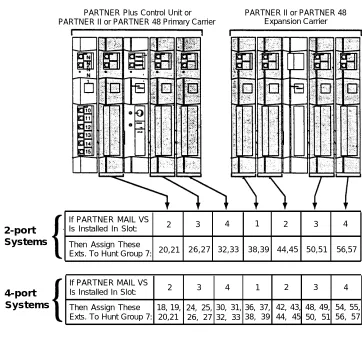
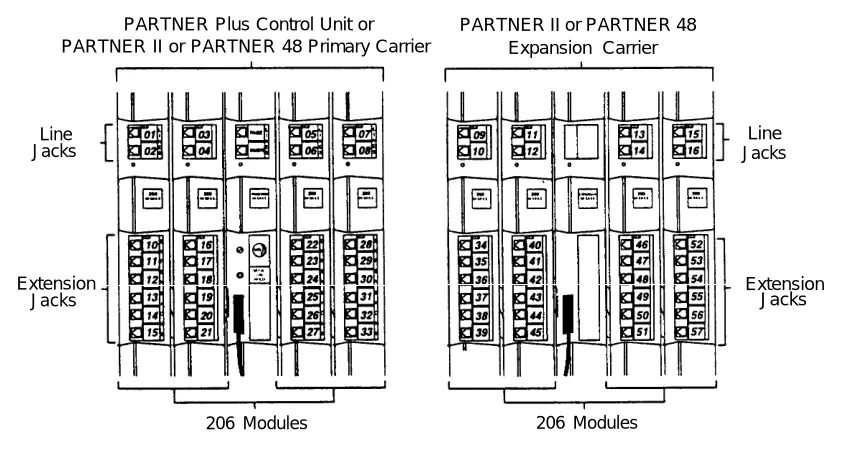
Install the voice messaging system module in the first available slot to the right of the last installed 206 or 400 module. Do not install the voice messaging system module in the first slot of the PARTNER Plus system control unit or the PARTNER II or PARTNER 48 system primary carrier (see Figure 2-1).
NOTE:
The voice messaging system module should always be installed after the 206 and 400 modules to ensure consecutive extension numbering. If the control unit is upgraded with more 206 or 400 modules, the voice messaging system module should be removed, the new modules should be installed, and the voice messaging system module should be replaced in the first available slot after the 206 and 400 modules. The VMS Hunt Group Extensions and Transfer Return Extensions must then be reprogrammed (see Chapter 4).
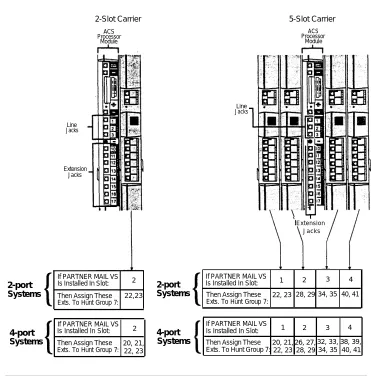
On the PARTNER Advanced Communications System, you must install the voice messaging system module in the slot to the right of the PARTNER ACS module in the 2-slot carrier. If your system has a 5-slot carrier, you may install the voice messaging system module in any slot except the center slot (see Figure 2-2).
Push slowly but firmly in the center of the module until the module locks into place, and is attached to the rear of the backplane. Do not force the module. If it does not insert easily, remove the module, clear any
3 . Refer to Figure 2-1 or Figure 2-2 for your system, then record the
extensions associated with the PARTNER MAIL VS module on Form B1 of the System Planner for the communications system.
PARTNER Plus Control Unit or PARTNER II or PARTNER 48 Primary Carrier
PARTNER II or PARTNER 48 Expansion Carrier
If PARTNER MAIL VS
2-port Is Installed In Slot: 2 3 4 1 2 3 4
Systems Then Assign These
Exts. To Hunt Group 7: 20,21 26,27 32,33 38,39 44,45 50,51 56,57
4-port Systems
If PARTNER MAIL VS
Is Installed In Slot: 2 3 4 1 2 3 4
Then Assign These Exts. To Hunt Group 7:
18, 19, 20,21
24, 25, 26, 27
30, 31, 32, 33
36, 37, 38, 39
42, 43, 44, 45
48, 49, 50, 51
54, 55, 56, 57
5-Slot Carrier
ACS Processor
Module
Extension J a c k s
If PARTNER MAIL VS
Is Installed In Slot: 1 2 3 4
2-port
Systems Then Assign These
Exts. To Hunt Group 7: 22, 23 28, 29 34, 35 40, 41
If PARTNER MAIL VS Is Installed In Slot:
4-port Systems
Line Jacks
Extension Jacks
2-Slot Carrier
ACS Processor
Module
If PARTNER MAIL VS
Is Installed In Slot: 2
Then Assign These 22,23
Exts. To Hunt Group 7:
2-port Systems
2
4-port Systems
Line Jacks
If PARTNER MAIL VS
Is Installed In Slot: 1 2 3 4
Then Assign These 20, 21, 26, 27, 32, 33, 38, 39,
Exts. To Hunt Group 7: 22, 23 28, 29 34, 35 40, 41 Then Assign These
Exts. To Hunt Group 7: 20, 21,22, 23
(Reserved for Future Use)
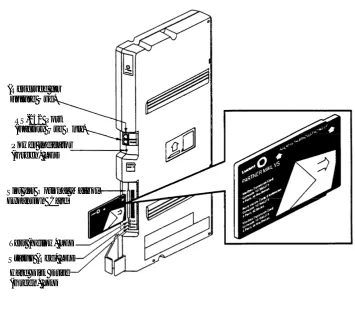
RS-232 Port (Factory Use Only) Power Indicator (Green) LED
Slot for Optional Mailbox Expansion Card
Test (Yellow) LED Status (Red) LED Hard Disk Drive (Green) LED
Figure 2-3. Installing the Mailbox Expansion Card
4.
5.
6.
To install the Mailbox Expansion Card, insert the card in the vertical slot on the lower front of the voice messaging system module
(see Figure 2-3). Make sure the arrows on the Mailbox Expansion Card label face up and in. Also make sure the card is pushed in all the way.
Turn on power to the control unit. The green Power LED should light—if it does, skip to Step 6. If the green Power LED does not light, power down the control unit, reseat the voice messaging system module, then power up the control unit again. If the green Power LED still does not light, call for support as indicated on the inside front cover of this guide.
Next, the voice messaging system module performs self-diagnostic tests. The LEDs work as follows:
LED S t a t e
Green Power ON
Yellow Test ON
7.
8.
After approximately 10 seconds when the tests are completed, the yellow Test LED goes off. When this occurs, check the red Status LED:
— If the red Status LED is not lit, the module passed the tests. Continue with Step 8.
— If the red Status LED is lit, power down the control unit, re-install the Mailbox Expansion Card if it was installed in Step 4, then power up the control unit again. If the red Status LED comes on again, call for support as indicated on the inside front cover.
3
Contents
Communications System Programming
■ Planning Forms
■ Using System Programming
The Programming Overlays Programming Mode
Voice Messaging System Programming
■ Planning Forms
■ Using System Programming
The Programming Main Menu
Accessing the Programming Main Menu Programming Guidelines
3
This chapter provides general programming information for the communications system and the voice messaging system. Both systems must be programmed so they can work together as an integrated unit. Before you begin any
programming, you must ensure that all required communications system and voice messaging system planning forms described in this chapter are completed. You will refer to these forms during programming.
Communications System
Programming
When the communications system is installed, it uses factory settings that reflect the most common usage of the equipment. You can change these settings as required to customize them for the business.
You can program the communications system from extension 10. Some systems also allow programming from extension 11. Check the Programming and Use guide for the communications system for more information. If your system supports programming from both extensions, you may find it more convenient to program from extension 11. This capability allows the receptionist to continue handling calls at extension 10 while you program.
System Programming changes settings for the system as a whole, or for individual lines or extensions. (Refer to the Programming and Use guide for the communications system for more information about System Programming options.)
Planning Forms
Refer to the communications system’s System Planner when you are changing system settings, and be sure to record any changes you make. The following forms from the System Planner contain information about the voice messaging system:
■
■
■
■
Form A: System Configuration. Contains basic information about the
system including the line number and type of voice messaging service required for each line.
Form B1: System Extensions. Contains basic information about each
extension. This includes the type of phone or auxiliary equipment at the extension, and the name of the user or a description of how the extension is used.
Form B2: Customized Extension Settings. Contains feature settings,
such as Automatic VMS Cover and Automatic Extension Privacy, and group assignments for each extension.
Form C: Button Assignments. Specifies which features are
programmed on buttons for each extension. This includes VMS Cover, Do Not Disturb, Voice Mailbox Transfer, and Voice Mail Messages buttons.
Samples of these forms and instructions for completing them are included in Appendix E.
Using System Programming
System Programming requires a system display phone at extension 10 (or 11 if available), with a programming overlay placed over the phone’s dialpad. System Programming procedures are identified by # and a 3-digit code (for example, the procedure code for System Date is #101).
You can program the system in one of two ways:
■
■
Direct Method. You access a programming procedure directly by
dialing the code for that procedure. This method works best when you are using only a few procedures during the programming session, and you know the codes. For example, press [ # ] [ 1 ] [ 0 ] [ 1 ] to change the system date.
Cycle Method. You cycle through a sequence of procedures in
numerical order by pressing [ Next Procedure ] or [ Prev Procedure ]. You should use this method when programming the communications system for the first time, or when you are changing a series of related settings.
However, procedures #399, #609, and #728 are skipped when you cycle through procedures.
NOTE:
The Programming Overlays
During System Programming, the normal functions of several buttons on the phone at extension 10 (or 11 if available) change. For example, left [ Intercom ] becomes [ System Program ], which is the button used to enter programming mode. To identify these buttons while programming, place the appropriate
programming overlay provided with the system over the dialpad of the phone at extension 10 or 11.
Use the following special buttons while programming:
■
■
■
■ ■
■ ■
■
[ Next Procedure ] and [ Prev Procedure ] cycle forward and backward through the
programming procedures.
[ Next Item ] and [ Prev Item ] cycle forward and backward through a procedure's
parameters. A parameter is typically an outside line, an extension, or a telephone list entry.
[ Next Data ] and [ Prev Data ] cycle forward and backward through the valid list
entries. These buttons work only for fixed data, such as a line or
extension number. They do not work for variable data such as date, time, password, telephone numbers, or doorphone assignments.
[ Remove ] returns the current setting to the factory setting.
[ Enter ] ends an entry of variable length, such as a telephone number in an
Allowed Phone Number List.
[ System Program ] starts the System Programming process.
[ Central Tel Program ] starts the Centralized Telephone Programming process
(that is, customizing individual telephones from extension 10, or 11 if available).
[ Feature ], when followed by [ 0 ] [ 0 ], enters or exits programming mode.
Programming Mode
To enter programming mode:
1. At extension 10 (or 11 if available), make sure the programming overlay is in place over the system phone’s dialpad.
2. Press [ Feature ] [ 0 ] [ 0 ].
3. Press [ System Program ] [ System Program ].
4. Enter the System Password, if required.
Voice Messaging System
Programming
Before you program the voice messaging system, obtain completed copies of planning forms for the communications system and the voice messaging system. These forms provide the names, extensions, mailboxes and other information required to program the voice messaging system.
Planning Forms
You need the following forms for the voice messaging system:
■
■
■
■
■
■
■
■
Form 1: Language. Shows the Language Mode, Monolingual or
Bilingual. Also specifies the System Language for Monolingual Mode or the Primary and Secondary Language for Bilingual Mode.
Form 2: Mailbox Assignments. Shows factory-set mailbox assignments
with and without the Mailbox Expansion Card. Allows you to change mailbox assignments, to indicate whether Outcalling capability is assigned, and to identify the language used for each mailbox.
Form 3: Menu Definition. Shows transfer options for Automated
Attendant Service. Allows you to specify the extension or group number for a selector code transferor announcement number and to provide a description of that extension or group.
Form 3A: Automated Attendant Announcement—System Language or Primary Language. Shows the announcement number(s) and the
script used to record the associated announcement(s) in the System Language for Monolingual Mode or the Primary Language for Bilingual Mode. You can record up to two announcements in Monolingual Mode and in the Primary Language for Bilingual Mode.
Form 3B: Automated Attendant Announcement—Secondary
Language. Used only if the system is set for Bilingual Mode. Shows the
announcement number(s) and the script used to record the associated announcement(s) in the Secondary Language for Bilingual Mode. You can record up to two announcements in Bilingual Mode.
Form 4: Day Menu Prompt—System Language or Primary Language.
Shows the script used to record the Day Menu Prompt in the System Language for Monolingual Mode or the Primary Language for Bilingual Mode.
Form 4A: Day Menu Prompt—Secondary Language. Used only if the
system is set for Bilingual Mode. Shows the script used to record the Day Menu Prompt in the Secondary Language.
Form 5: Night Menu Prompt: System Language or Primary
Language. Shows the script used to record the Night Menu Prompt in
■
■
Form 5A: Night Menu Prompt: Secondary Language. Used only if the
system is set for Bilingual Mode. Shows the script used to record the Night Menu Prompt in the Secondary Language.
Form 6: Line Ownership. Identifies the lines assigned VMS Line
Coverage. Also shows for each owned line, the associated telephone number, the name of the subscriber who owns the line, and the owner’s mailbox number.
Samples of these forms and instructions for completing them are included in Appendix D.
Using System Programming
A special login number is required to program the voice messaging system. The following information applies to this login:
■ ■ ■ ■
■
The login number is 99.
99 is not an extension number.
This login does not have an associated mailbox.
The language associated with this login is either the System Language chosen for Monolingual Mode or the Primary Language chosen for Bilingual Mode; it cannot be changed.
This login’s factory-set Password is 1234. If you are the System Manager, refer to “Changing Your Password” in Chapter 5 to change the password before you begin to program the system.
NOTE:
Although this login has a Password, it does not have an associated mailbox.
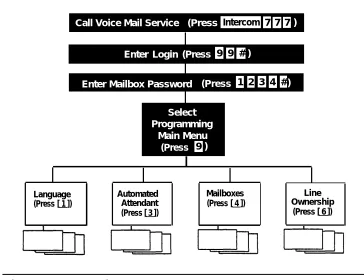
The Programming Main Menu
The Programming Main Menu allows you to access the Language Mode and the language(s) associated with that mode, the Automated Attendant Service Menu, mailbox assignments, and line ownership assignments.
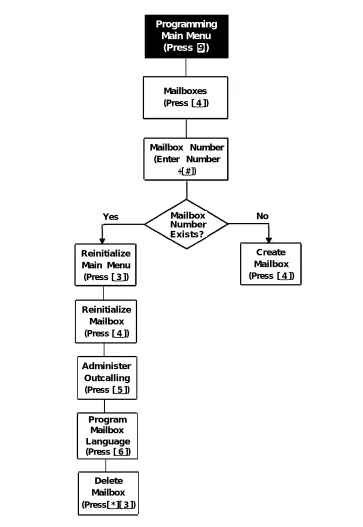
Call Voice Mail Service (Press Intercom 7 7 7 )
Enter Login (Press 9 9 #)
Enter Mailbox Password (Press 1 2 3 4 #)
Select Programming
Main Menu (Press 9 )
Language (Press [ 1 ])
Automated Attendant (Press [ 3 ])
Mailboxes (Press [ 4 ])
Line Ownership
(Press [ 6 ])
Figure 3-1. Programming Menus
Accessing the Programming Main Menu
To access the Programming Main Menu:
1.
2.
Press [ Intercom ] [ 7 ] [ 7 ] [ 7 ] or a programmed VMMsgs button.
The system plays:
Welcome to PARTNER MAIL VS. Please enter extension and #. Otherwise, to access PARTNER Tutor, press * 4.
Press [ 9 ] [ 9 ] [ # ].
The system plays:
Enter the Password and press #. (The factory-set Password is 1234.)
The system plays:
System Manager. PARTNER MAIL VS Release 4.
The system plays the available programming options. It does not play option 9 (the Programming Main Menu), which only the System Manager can access.
3.
4. Press [ 9 ] to access the Programming Main Menu.
The system plays:
To program the System Language press 1, for Automated Attendant press 3, for mailboxes press 4, for line
ownership press 6. If finished press * #.
Programming Guidelines
Once you are familiar with the voice messaging system, use these shortcuts to save time while programming:
■
■ ■ ■
■
■
■
You do not have to wait for a prompt to play before entering digits for the next step.
Press [ ★ ] [ # ] to return to the previous menu.
Press [ ★ ] [ 4 ] to repeat the current menu options.
Press [ ★ ] [ 7 ] at any point during programming to restart at the Programming Main Menu.
Use the handset rather than the speakerphone to record prompts and greetings to avoid background noise in your recordings.
To ensure that you hear voice prompts, turn off your microphone when programming the system using the speakerphone.
4
Contents
Overview
Voice Mail System Configurations
■ Upgrading Your Voice Mail System
Initial Communications System Setup
■ VMS Hunt Group Extensions
■ Transfer Return Extensions ■ Outgoing Call Restriction
Voice Messaging System Programming
■ Language
Monolingual Mode Bilingual Mode
■ Automated Attendant Service
Monolingual Mode
Menu Definition, Day Menu Prompt, and Announcements
Night Menu Prompt Bilingual Mode
Menu Definition, Day Menu Prompts, and Announcements
Night Menu Prompt
■ Voice Mail Service
Deleting a Mailbox Creating a Mailbox
Modifying a Mailbox’s Language Assigning Outcalling Privileges
■ Line Ownership
Assigning Line Ownership
4-1
4-2 4-2 4-3 4-3 4-4 4-4 4-6 4-6 4-6 4-7 4-8 4-8
4-8 4-10 4-11
■ Automated Attendant Service
Group Call Distribution VMS Hunt Delay
Automatic Extension Privacy VMS Hunt Schedule
Night Service Music On Hold
Disallowed Phone Numbers
Creating a Disallowed Phone Number List Assigning the Disallowed Phone Number List Allowed Phone Numbers
Creating an Allowed Phone Number List Assigning the Allowed Phone Number List
■ Call Answer Service
Line Coverage
VMS Line Coverage Line Coverage Extension Automatic VMS Cover VMS Cover Rings
■ Telephone Button Programming
VMS Cover Do Not Disturb
Voice Mailbox Transfer Voice Mail Messages
Verifying System Operation
■ Voice Mail Service
■ Automated Attendant Service
Day Menu Night Menu
■ Call Answer Service
VMS Extension Coverage VMS Line Coverage Line Coverage Extension
4
Overview
This chapter identifies the four possible voice messaging system configurations. It tells you how to perform initial programming of the voice messaging and communications systems. The first two procedures allow you to access and program the voice messaging system—you must perform these procedures first for every installation. The next set of procedures covers voice messaging system programming. The last section covers how to program the communications system.
The order of the procedures in this chapter enables you to program the Menu Definition and to record the Day and/or Night Prompts and Automated
Attendant Announcements before the voice messaging system begins to handle calls—this order is recommended for voice messaging systems that are being added to existing communications systems. If this is a new installation, however, you can program the communications system first, then the voice messaging system if you prefer.
In addition, you can either follow the step-by-step instructions or use the
flowchart at the end of this manual as a quick guide. If you use the step-by-step instructions, note that Step 1 of each procedure for the voice messaging system is logging in. However, if you are already logged in, you can skip Step 1.
Voice Mail System Configurations
The PARTNER Mail VS supports the following configurations:
■ 2 voice channels (ports), 10 mailboxes (standard)
■ 2 ports, 20 mailboxes (requires a Mailbox Expansion Card) ■ 4 ports, 20 mailboxes (requires a Mailbox Expansion Card) ■ 4 ports, 40 mailboxes (requires a Mailbox Expansion Card)
Figures 2-1 and 2-2 (in Chapter 2) show the possible extension numbers for all configurations.
Upgrading Your Voice Mail System
If you are upgrading your voice mail system with the addition of a Mailbox Expansion Card, when you return power to the system the appropriate number of mailboxes is activated. For example, if you are upgrading to a 4-port, 20-mailbox configuration, the first 20 mailboxes are activated. And previously existing programming (including existing mailbox assignment information, personal greetings, and passwords) is saved. You do not need to reprogram the system; however, you should:
■
■
Delete any unused mailboxes and create new ones following the procedures in “Voice Mail Service,” later in this chapter.
NOTE:
Numbering of existing mailboxes should be detailed on Form 2 for the voice messaging system. You can also play existing mailbox numbers and receive information on the number of existing mailboxes, as well as the maximum mailbox capacity for the current system configuration. At the Programming Main Menu, press [ 4 ] to receive the message indicating how many mailboxes currently exist and how many are allowed. For more information, see “Checking a Mailbox’s Status,” in Chapter 5.
For 4-port configurations: Add two extensions to the VMS Hunt Group
Initial Communications System Setup
You must perform the first two procedures for every installation. The procedure for Outgoing Call Restriction is strongly recommended to ensure system security. For the following procedures, you need to know the extension numbers associated with the PARTNER MAIL VS system module. Figures 2-1 and 2-2 (in Chapter 2) show the possible extension numbers. For the extension numbers appropriate to this installation, locate Form B1 of the System Planner for the communications system.
VMS Hunt Group Extensions
You must use this procedure to assign the extensions associated with the voice messaging system module to Hunt Group 7. This Hunt Group, which is called the VMS Hunt Group, is used exclusively for the voice messaging system.
To assign the PARTNER MAIL VS extensions specified on Form B1 to Hunt Group 7:
1 .
2 .
3 .
4 .
5 .
6 .
7 .
8 .
9 .
10.
At extension 10*, press [ Feature ] [ 0 ] [ 0 ] [ System Program ] [ System Program ].
Enter the System Password, if required.
Press [ # ] [ 5 ] [ 0 ] [ 5 ].
At the Group: prompt, press [ 7 ].
At the Extension: prompt, enter the first PARTNER MAIL VS extension number specified on Form B1.
Press [ Next Data ] until the display reads 1 Assigned.
Press [ Next Item ] or [ Prev Item