R E S E A R C H A R T I C L E
Open Access
Combination of conditional random field
with a rule based method in the extraction
of PICO elements
Samir Chabou and Michal Iglewski
*Abstract
Background:Extracting primary care information in terms of Patient/Problem, Intervention, Comparison and Outcome, known as PICO elements, is difficult as the volume of medical information expands and the health semantics is complex to capture it from unstructured information. The combination of the machine learning methods (MLMs) with rule based methods (RBMs) could facilitate and improve the PICO extraction. This paper studies the PICO elements extraction methods. The goal is to combine the MLMs with the RBMs to extract PICO elements in medical papers to facilitate answering clinical questions formulated with the PICO framework. Methods:First, we analyze the aspects of the MLM model that influence the quality of the PICO elements extraction. Secondly, we combine the MLM approach with the RBMs in order to improve the PICO elements retrieval process. To conduct our experiments, we use a corpus of 1000 abstracts.
Results:We obtain an F-score of 80% for P element, 64% for the I element and 92% for the O element. Given the nature of the used training corpus where P and I elements represent respectively only 6.5 and 5.8% of total sentences, the results are competitive with previously published ones.
Conclusions:Our study of the PICO element extraction shows that the task is very challenging. The MLMs tend to have an acceptable precision rate but they have a low recall rate when the corpus is not representative. The RBMs backed up the MLMs to increase the recall rate and consequently the combination of the two methods gave better results.
Keywords:PICO, MLMs, CRF, RBMs, Information extraction, NLP
Background
One of the keys to successful information extraction in the medical domain is to define the clinical question as accurate as possible. A question in natural language without any structure is very difficult to analyse. Evidence-Based Medicine (EBM) [1] is a widely-accepted methodology for medical practice that emphasises the importance of evidence from patient-centered clinical research in the health care process. EBM suggests that a clinical question should be structured in terms of four anatomic parts: patient problem or population (P), inter-vention (I), comparison (C) and outcome (O). These
anatomic parts, known as the PICO elements, facilitate the search for answers to clinical questions.
Even though there was some controversy around the use of PICO [2], there is a consensus that the PICO is a good framework for clinical questions and some authors [3] have proven that these elements are frequently exist-ent in medical abstracts. Formulating a question compli-ant with the PICO framework facilitates the search for answers to clinical questions. However, extracting PICO elements from non-structured information such as a collection of medical abstracts is challenging task. The trend is to use the machine learning methods (MLMs), known for their robustness, to extract PICO elements rather than rule based methods (RBMs). In this paper, we propose a novel approach that combines the MLM methods and the RBM methods to optimize the extraction
* Correspondence:[email protected]
Computer Science and Engineering Department, Université du Québec en Outaouais, Gatineau J8Y 3G5, Canada
of PICO elements within medical abstracts. Our MLM method is designed after the analysis that we carried on the aspects that influence the quality of the PICO ele-ments extraction. Our RBM method relies on rules that use the MLM features to facilitate the integration of the both methods.
Related work
There is a significant body of research on extracting PICO elements from abstracts of clinical documents , [3–12]. The recent trend is toward using machine-learning methods that apply a statistical model to classify sentences according to PICO framework [2]; this trend is motivated by the robustness of the MLMs and their high degree of learning.
The accuracy of the PICO statistical model depends heavily on the quality of the training corpus. Though it is difficult to specify the minimal quality requirements, we consider that most of the training corpora used in the literature are either not representative in terms of size [8,10,13] or not well balanced in terms of:
the distribution of PICO elements [11,12,14] or
the abstract types (structured, unstructured) [5–7,9]
Table1shows an overview of the corpora used in the lit-erature; the training corpus is usually built manually by medical experts who label the training corpus with differ-ent PICO elemdiffer-ents. A corpus is mixed when it contains a mixture of structured and unstructured abstracts.
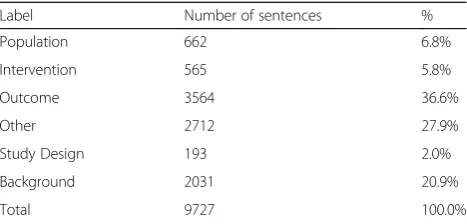
The sizes of the corpora used in [8, 10, 13] are small and it is difficult to generalize these results. In [11,12,14] the distribution of PICO elements is not balanced; the P element sentences represent only 6.8%, whereas the I sen-tences are only 5.8%; the O sensen-tences are more dominant with 36.6%. Such a distribution has a significant impact on
the recall rate because the model did not learn enough about P and I elements. In [5–7] and [9], the authors got around the difficulty of constructing manually a large training corpus. They used the information encapsulated in MEDLINE structured abstracts that contain headings corresponding to the PICO elements. In this case, we do not have to depend on an expert of the medical domain, but we restrict the learning process to certain headings. Recently [4] proposed a novel approach for PICO extrac-tion based on an improved Distant Supervision [15, 16]. The learning model is based on a big structured database (Cochrane), lots of unstructured data and a small amount of manually labeled unstructured data used to reduce the noise in distantly derived annotations. Notably, their Supervised Distant Supervision model automatically ex-tracts PICO sentences from full texts compared to the lit-erature review where the PICO extraction was limited to paper abstracts.
Most of the researches on PICO element extraction with MLMs use a non-realistic data collection, consequently the extraction performance is affected and the results are not consistent. For example, some researches state that the usage of medical semantics features is useful [7,8,17] while others deny the pertinence of semantic features [12,14]. In addition, the proposed MLM methods perform inad-equately with unstructured abstracts.
Generally, most of these researchers reported a precision over 70% (Table 2); however, we observed that the recall measure is usually not as high as the precision, especially when the training corpus is unbalanced in terms of PICO elements or the MLM features are not rigorous enough.
In order to reduce the impact of the unavailability of a representative and balanced corpus and the lack of well-designed MLM aspects, we propose a PICO element extraction system based on:
1. a MLM (CRF [18]) with well-designed aspects, these aspects include CRF parameters setting, infor-mation redundancy, type of feature value, features concordance, standardization of the abstract structure,
2. a new set of RBM rules based on the MLM features to facilitate the integration of the two methods.
Table 1Literature review summary of used corpora
Reference Training Corpus Testing Corpus
[8] 275
Manual and mixed
358 Mixed
[10] 148
Manual and mixed
75 Mixed
[13] 50
Manual and mixed
156 Mixed
[12] 800
Manual and mixed
200 Mixed
[11,14,30,31] 1000
Manual and mixed
200 Mixed
[9] 1575 to 2280 Automatic and only structured abstracts
318 Mixed
[5–7] 2394 to 14,279 Automatic and only structured abstracts
2394 to 14,279 Only structured
Table 2Examples of reported precisions and recalls from review of the literature
Population Intervention
Ref. Precision % Recall % Precision % Recall %
[9] 56–77 37–40 77–87 71–80
[13] NA NA 76–89 58–65
[17] 70 24 74-78 56-58
[10] 97 74 NA NA
RBMs can have a high degree of PICO element coverage; therefore, they can complement the MLMs to improve the recall rate,
3. a hybrid combination of MLMs and RBMs. Some authors suggested the combination of the two methods. In [8], the authors extract the I and P elements using a set of RBMs that rely heavily on the UMLS concepts while they use MLMs to extract the O element because the O element does not have corresponding UMLS concept and makes it difficult to craft an efficient extracting rule. In [19], the authors use the two methods to extract the key characteristics of clinical trials from full-text journal articles reporting on RCTs. In a first stage, they use an MLM based on SVM algorithm to lo-cate the sentences that have the highest probability of describing a trial characteristic; in the second stage, they apply simple rules to these sentences to extract text fragments containing the target answer. In our case, we complement the MLM method with RBMs to extract PICO elements. We take advantage of the robustness of the MLM method to extract the majority of the potential PICO sentences (coarse-grained), then we apply a set of RBM rules (fine-grained) designed with MLM features to ex-tract the PICO sentences that are missed by the MLM stage.
4. cTAKES (Apache clinical Text Analysis and Knowledge Extraction System) medical pipeline [20]. cTAKES is an open source natural language processing system for information extraction from clinical natural text. It provides a type system based on the Clinical Element Model (CEM) [21] that targets and facilitates the deep semantics of the medical field. For example, it can identify the clinical named entities from various dictionaries including the UMLS.
The proposed system improves the PICO extraction process and facilitates the validity of the answers to clin-ical questions formulated with the PICO framework.
Methods
First, we conduct several experiments to analyze the as-pects that influence the generation of a CRF model and improve them in order to enhance the quality of the pre-dictions generated by the model. This analysis is even more relevant when we are constrained with the unavail-ability of a balanced and representative training corpus.
Secondly, we propose a set of RBM rules based on the MLM features to facilitate the integration of the two methods.
Finally, we combine MLMs and RBMs to carry out a novel hybrid approach in two iterations. In the first
iteration, we apply an MLM method to take advantage of the robustness of the MLMs. In the second iteration, we apply an RBM method on the abstracts that failed the MLM labeling process in order to refine the results.
Experiments data
To validate our results we have used the same corpus as in [12] and [11]. This corpus was extracted by the authors of [14] from MEDLINE, in order to extract rele-vant abstracts; the authors used queries from two insti-tutions that develop systematic reviews of the literature: The Global Evidence Mapping Initiatives (GEM) [22] and The Agency for Healthcare Research and Quality (AHRQ) [23]. A corpus of 1000 abstracts was extracted; to assure the diversity, 500 of them were randomly se-lected from a list of queries available in the GEM, the other 500 abstracts were randomly sampled from an-other set of AHRQ queries.
The 1000 abstracts were annotated manually by a medical student with the collaboration of a senior med-ical expert [14].
We used the same subset of abstracts as in [12] and [11] for the training and testing:
The training set consists of 800 abstracts of which 486 are unstructured and 314 are structured.
The test set consists of 200 abstracts of which 120 are unstructured and 80 structured.
We evaluated our MLM model using the information retrieval (IR) measures Precision (P), Recall (R) and F-Score defined as follows:
Precision¼TP=ðTPþFPÞ
Recall¼TP=ðTPþFNÞ
F−score¼2PR=ðPþRÞ
where TP meanstrue positive, FP false positive, and FN
false negative.
The distribution of PICO elements (Table 3) in this corpus is not balanced. There is a low number of sen-tences labeled with P and I compared to sensen-tences labeled with Outcome, Other or Background. In this context, it becomes challenging to create a CRF model that enables us to predict adequately I and P sentences. Even more, the presence of the Background label adds noise to the train-ing data; in fact, Background sentences could overlap with Population and Intervention sentences.
CRF (MLM) stage
System description
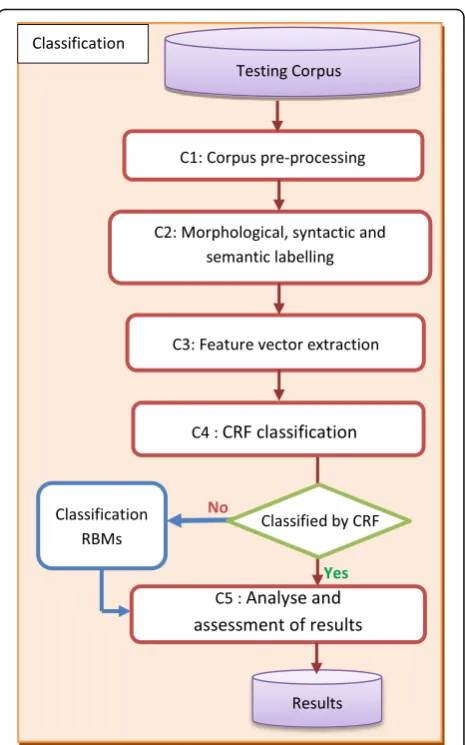
The system is composed of a training phase and a classi-fication phase (Fig.1).
T1: Corpus pre-processing rectifies or eliminates ir-regularities that may exist either in the content of ab-stracts or in the implementation of some cTAKES classes (segmentation and POS). For example, it
removes the characters that can be confused with the end of sentence such as vs., %, E.g.,
corrects invalid decimal point numbers that cTAKES could consider as the end of sentence,
standardizes section headers.
These irregularities can greatly affect the quality of PICO element extraction.
T2: Morphological, syntactic and semantic labelling recognizes sentences, POS tags, canonical form of word, UMLS semantic tags, medical entities, predicate-argument relations, the context of the medical entity, etc. We use cTAKES medical pipeline to achieve this task.
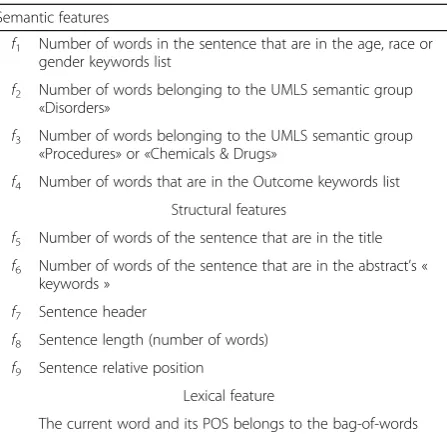
T3: Feature vector extraction extracts the various feature values to generate feature vectors, one vector by sentence. We distinguish three types of features: seman-tic, structural and lexical (Table4).
T4: Regeneration of original labelsfinalizes the cre-ation of the training corpus that is based on the 10 fea-tures (semantic, structural and lexical). T4 reuses the labels of the original training corpus [12].
T5: CRF model creation generates the CRF model. CRFs assign the sequence of the most probable labels Y to a sequence of observations X using the conditional probability P (Y | X) which takes the form [18]:
P(Y|X) = 1
Zxexp ( P t¼1
TP
kλkfkðyt−1;yt;x;tÞ).
and can be expressed as: given an input sentence (X), what is the probability that this sentence would be classified as a PICO element (Y); Y=P, I, C or O;ʎkis a weight associated
with the feature fk and it captures how closely the given feature function is related to the given label Y. The set of weights ʎk represents the CRF model. T5 uses
Mallet [18] to generate the CRF model based on the values of fk which are stored in the feature vector.
Table 3Training corpus analysis
Label Number of sentences %
Population 662 6.8%
Intervention 565 5.8%
Outcome 3564 36.6%
Other 2712 27.9%
Study Design 193 2.0%
Background 2031 20.9%
Total 9727 100.0%
The choice of the CRF algorithm is motivated by the fact that CRFs perform well for sentence classifi-cation with PICO labels ([9, 12, 14]). We also choose CRFs in order to validate our results against the results of [12] and [11].
The classification phase in the system architecture (Fig.1) has the same steps as the training phase with the exception of C4 and C5.
C4: CRF classificationapplies the CRF model on the test corpus to classify sentences according to PICO elements. C4 calculates the conditional probability P (Y | X) on each sentence previously converted to a feature vector. This step uses the model picoCRFModel.mallet in the Mallet environment to predict the PICO labels of the sentences.
C5: PICO element assessment and selection identi-fies the most potential sentence for each PICO element. At the classification phase (C4), different sentences can be classified under the same PICO element, e.g. element P. We need to assess the pertinence of each sentence that competes for the same PICO element. In the review of literature some of the authors have only used the pos-itional aspect as a main criterion [5,8, 24]; others have used a baseline [9,25], cross-validation [14,17] or voting between many MLM classifier [7]. In our case, we sug-gest some rules to assess the pertinence of the sentence against the PICO elements. These rules are based on the positional features, the semantic features and the coex-istence of different PICO elements in the same phrase. For example, we define the following rule to assess the most potential sentence for the P element:
wTotalPopulation¼wPoMþwPoTþwCoþwSe
• wPoM is a positional weight which depends on the positional feature f7:
if f7 = Method, then wPoM = 2; otherwise, wPoM = 0.
In the case of unstructured abstracts:
if f7is in the first third of the abstract, then wPoM = 2;
otherwise, wPoM = 0.
The P sentences are generally placed in the Method sec-tion (or the first third of the abstract); hence, we used ar-bitrary weights of 2 and 0 to favour the sentences in the Method section over the others placed elsewhere. The choice of 2 and 0 is to slightly favour the position in the Method section over the others without marginalizing this position by assigning to it a higher weight. Similar reason-ing is used in [8] and the authors [5] and [24] have con-cluded in their research that PICO element are potentially located in the first third or the last third of the abstract.
• wPoT is another positional weight and is equal to the value of feature f5. The bigger f5is, the richer is the
sentence with the semantics of the P element therefore the more likely the sentence is to represent this element.
• wCo is a weight that depends on the coexistence of the P and I elements in the same sentence.
If P and I coexist, then wCo = 2; otherwise, wCo = 0.
As in the case of wPoM, 0 and 2 are arbitrary weights to favour sentence that cover both elements: P and I
wSe is a weight which depends on the presence of
semantic features of the P element in the sentence: wSe = f1+ f2.
Similar rules are defined for the I and O elements. For I:
wTotalIntervention¼wPoMþwPoTþwCoþwSe
wSe, in this case, is equal to the semantic feature f3.
We use a similar rule for the O element.
We sort the P, I and O sentences by their total weight and select the sentence with the highest weight respectively.
Analysis of MLM aspects
Our objective is to analyze the aspects that could influence the CRF model performance. This analysis is even more useful when CRF is trained with a non-representative cor-pus. To validate our results, we use the same training and test corpus as in [12].
Experiments setting Given the non-balanced nature of the corpus, we have conducted many experiments to analyze the aspects that affect the CRF.
These experiments allow us to discover which experi-ment gives the best F-scores. They are crucial for us to
Table 4Types of features
Semantic features
f1 Number of words in the sentence that are in the age, race or gender keywords list
f2 Number of words belonging to the UMLS semantic group «Disorders»
f3 Number of words belonging to the UMLS semantic group «Procedures» or «Chemicals & Drugs»
f4 Number of words that are in the Outcome keywords list Structural features
f5 Number of words of the sentence that are in the title
f6 Number of words of the sentence that are in the abstract’s « keywords »
f7 Sentence header
f8 Sentence length (number of words)
f9 Sentence relative position
Lexical feature
f10
study the aspects that can influence the quality of a CRF model and to suggest their improvements. We consider the following aspects:
Model setting: Gaussian prior and training-proportion parameters
Training information layout: standard structure vs. information redundancy structure
Mixing different features
Type of feature values: binary vs. natural vs. categorical
Standardisation or not of section headings
Grouping structural features vs. non grouping
Mixed abstracts vs. only structured ones
Balancing of PICO element distribution
These aspects are mutually independent; a set (1, 2 or 3) of experiments for each aspect is sufficient to evaluate the different choices. For example, to evaluate the aspect of «type of feature values», we conduct three experi-ments, one for each type of values: binary, natural and categorical.
We iterate over all aspects. We identify the impact of each one of them on the CRF model and we choose the best value.
In each experiment, we use the corpus of 1000 abstracts and the same subset for the training and testing as in [12] and [11]. We use Mallet [18] to train the CRF model.
We generate four sets of results:
the MLM results, so we can validate our CRF model
with one of those used in [12] and [11],
the RBM results to analyse how the RBM stage
performed on the abstracts that are not labelled by the MLM stage,
the combined MLM and RBM results to compare
them with the results in the literature review,
the 5-fold cross validation to assess overfitting and robustness of the model.
Model setting We set the CRF model with different values of the Gaussian prior such as 0.1, 1, 10, and 100. We have obtained the best results with a variance value of 10. We found that the Gaussian prior value is influ-enced by the quality of the training corpus; the higher the quality of the training corpus, the more advanta-geous to generate the model with low Gaussian prior is; this means that the model can predict reliable PICO la-bels that do not deviate much from the exact lala-bels. However, as described in the Section 3.1, the training corpus does not have a good distribution of PICO ele-ments (Table3), and some of the annotations are incon-sistent. For these reasons, we adjusted the choice of the Gaussian prior to the quality of the training corpus. We set the Gaussian prior to an average of 10 to allow vari-ous possible predictions and we repeated 3 times every sentence in the test file to increase the chances that a good prediction is among one of three repetitions. The choice of three repetitions is motivated by the number of classes of interest which are P, I and O.
The training-proportion parameters of Mallet can be set to different values; by default, they are set to 50% for training and 50% for testing. Since we will test the model with an external test corpus, we set the training propor-tion to 100% in order to let Mallet train the model on the full training set.
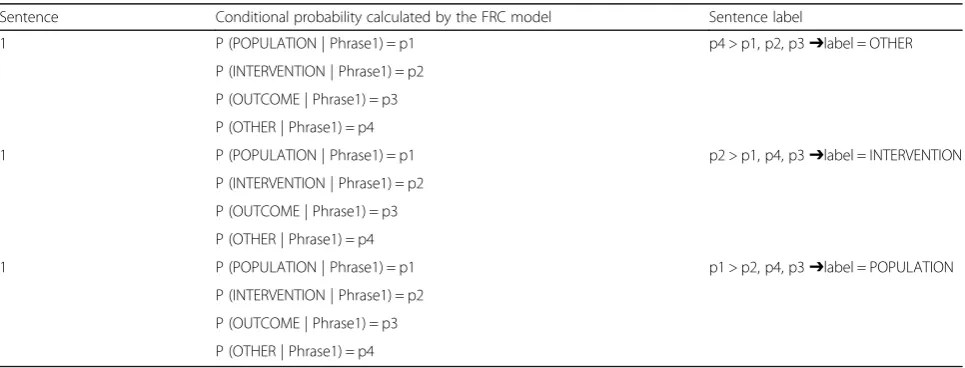
Table5shows how the CRF model operates on the test file to predict the sentence labels.
This setting has improved the results of PICO extraction and facilitated the detection of cases when a sentence can be classified with multiple labels (P and I for example).
Training information layoutWe compared the method that repeats the entries with the standard method
Table 5Label prediction by the CRF model on the test file
Sentence Conditional probability calculated by the FRC model Sentence label
1 P (POPULATION | Phrase1) = p1 p4 > p1, p2, p3➔label = OTHER
P (INTERVENTION | Phrase1) = p2
P (OUTCOME | Phrase1) = p3
P (OTHER | Phrase1) = p4
1 P (POPULATION | Phrase1) = p1 p2 > p1, p4, p3➔label = INTERVENTION
P (INTERVENTION | Phrase1) = p2
P (OUTCOME | Phrase1) = p3
P (OTHER | Phrase1) = p4
1 P (POPULATION | Phrase1) = p1 p1 > p2, p4, p3➔label = POPULATION
P (INTERVENTION | Phrase1) = p2
P (OUTCOME | Phrase1) = p3
without duplications (Table6). We evaluated the effects of information redundancy that some authors [18] propose as a means to improve the model.
In the training file with information redundancy, each entry contains the features, the label and the prediction of the sentence. The sentence is classified for each of the possible labels. The example shows that the sentence S1 is a POPULATION sentence since the label prediction value is 1, contrary to 0 indicating that the sentence is not qualified for the corresponding label. The informa-tion redundancy method did not give the best results.
Mixing different features We made several tests to as-sess the impact of the feature choice. For example, we combined structural features with lexical features, seman-tic features with lexical features and the three types of fea-tures together. The combination of the three feafea-tures trained better the CRF model and allowed it to capture how closely a given sentence is related to a PICO element.
Type of feature values Unlike the other researchers who use either binary or natural values of features, we suggest using semantic features with categorical values:
MPt category represents the characteristics of the Patient element like“patient”,“age”,“adult”, etc.
MP category represents the characteristics of the Problem element belonging to a UMLS semantic type such asGold Syndrome Disease,Injury or Poisoning,Anatomical Abnormality, etc.
MI category represents the characteristics of the Intervention element belonging to a UMLS semantic type likeProcedures,Chemicals and Drugs,Devices, etc.
MT category contains the words of the title of the abstract.
To enrich the semantic features, we used the categorical value type associated with its frequency in the sentence; e.g., MPt_3, MP_2, MI_4. The association of the two types of values has improved the CRF model as compared to the usage of natural or binary values only. The generated se-quence of numerical values disperses the model especially when the sentence bag of words also contains numbers.
In addition, we use the unigram technique combined with the POS information ([9, 12,14]) to enrich the ex-traction of lexical features. The lexical features are repre-sented by a bag-of-words and their corresponding POS.
Standardization of section headers Structured ab-stracts do not follow a standard for the section headers. For example, different headers such as Population, Par-ticipants, Subjects, Method or Patients are used for the P element. We identified over 60 different headers within 310 structured abstracts. Using these headers in the training corpus could impair the effectiveness of the CRF learning model. To remedy this situation, we have used the most common headers proposed in [26], which are Objective, Method, Result and Conclusion, and we have extended the mapping list between these common headers and other headers (Table7).
Grouping structural features The structural features are simple to generate and are effective in training the model. Examples of those features are section header and sentence number. To our knowledge, these two fea-tures have not been reconciled before. We propose to align them as follows:
If the sentence header is OBJECTIVE, then all the sentences in this section will have number 3; the number 3 is an arbitrary number close to the
Table 6Training information layout
Training file with information redundancy layout
Sentence Features Label Prediction
S1 f1 f2 f3 INTERVENTION 0
S1 f1 f2 f3 POPULATION 1
S1 f1 f2 f3 OUTCOME 0
S1 f1 f2 f3 OTHER 0
S2 f1 f2 f3 INTERVENTION 1
S2 f1 f2 f3 POPULATION 1
S2 f1 f2 f3 OUTCOME 0
S2 f1 f2 f3 OTHER 0
Training file standard layout
Sentence Features Label
S1 f1 f2 f3 … POPULATION
S2 f1 f2 f3 … INTERVENTION
S2 f1 f2 f3 … POPULATION
Table 7Header mapping
Common header Mapped header Total
OBJECTIVE AIM, OBJECTIVE, BACKGROUND AND OBJECTIVES, CONTEXT,… 37
METHOD DESIGN, DESIGN AND METHODS, PATIENT(S), INTERVENTION,… 30
RESULTS FINDINGS, MAIN RESULTS, OUTCOME MEASURES,… 13
average size of the Objective section; its role is to standardize the structural feature.
If the header of the sentence is METHOD, then all
the phrases in this section will have number 6 that is an arbitrary number close to the average size of the METHOD section plus the average size of the OBJECTIVE section.
If the header of the sentence is RESULT, then all the phrases in this section will have number 12.
If the header of the sentence is CONCLUSION, then
all the sentences in this section will have number 14.
The grouping promotes uniformity of features and consequently facilitates the training of the model and improves its accuracy. In fact, the features are processed as a bag of words in the CRF training; the more clus-tered these bag of words are, the better the CRF is su-pervised. For example, the following three combinations: (Objective 1), (Objective 2) and (Objective 3) will all be represented by the single combination (Objective 3).
Mixing structured and unstructured abstracts Struc-tured abstracts are favoured in the learning process of the CRF model, because they contain section headers that are an effective way to train the CRF model; for example, Population and Intervention elements tend to be in the Method section while the Outcome element is often placed in the Result section. However, in the train-ing corpus, there are more unstructured abstracts than structured ones. Even more, most of Intervention and Population elements are in the unstructured abstracts of this corpus. To extract them correctly we should assign
heading section to the sentences in unstructured ab-stracts, creating“pseudo”structured abstracts as follows:
OBJECTIVE section for the sentences labeled
“Background”;
METHOD section for the sentences labeled
“Population”,“Intervention”or“StudyDesign”;
RESULT section for the sentences labeled“Outcome”;
CONCLUSION section for the sentences labeled
“Other”.
Other factors influencing the prediction We had to reconcile the choice of the Gaussian prior with the qual-ity of the training corpus. We set the Gaussian prior to 10 and introduced a redundancy indicating both the presence and absence of classes of interest: P, I and O.
RBM stage
RBMs are different from MLMs. MLMs are driven by a learning phase and probabilistic prediction at the sen-tence level (coargrained). RBMs can explore the se-mantics within the sentence (fine-grained) to extract
PICO elements. RBMs can complement the MLMs to raise the accuracy above the thresholds (see 4.2 section). Figure2 shows how we incorporate RBMs in the MLM classification process.
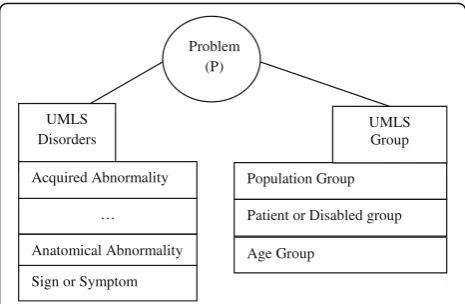
In our earlier research [27] we conceptualized the P element as a relationship between the semantic UMLS groups Disorders and Group [28] as shown in Fig.3.
In addition, we conceptualized the elementIas a rela-tion between UMLS Semantic Group and UMLS Sematic Network (Fig.4).
We also specified RBM rules to extract the PICO ele-ments; for example:
However, we found that these rules are not effi-cient; for example, the pattern <value> covers too many combinations. In addition, the pattern <Rela-tion of UMLS Semantic Network > is ineffective (cTAKES covers only a few UMLS Semantic Rela-tions) and the rule is too rigid (the pattern order creates an unnecessary dependency). We simplified these rules and based them on the MLM features to facilitate the integration of the two methods. There-fore, the rule that detects the presence of the P element is as follows:
f1> = 3 or f2> = 3 or.
(f1> = 1 or f2> = 1) and f9=“METHOD”or.
f2> = 1 and f9=“NOHEADING”and numSen < 4.
f1and f2are the semantic features of the MLM model
and f9is the positional feature (Table4). Features f1and
f2 assess respectively the presence of the disorder part
and the population part of the P element in the sen-tence, whereas f9 is the positional feature; when f9 is
equal to the header METHOD, the constraint on f1
and f2 is relaxed. In fact, the P and I elements are
usually in the section METHOD (Table 7). In the case of non-structured abstracts, the Intervention and Population elements are usually inside the first three sentences [8].
This rule is flexible; we could relax the constraint on f1 and f2by choosing value smaller than 3. The value 3
represents the average value found in the sentence la-belled as P in the MLM classification. For f3, the average
was 2, but we kept the value 3 to enhance the quality of the results.
We specified the rule for the I element as follows: f3> = 3 or f3> = 1 and f9=“METHOD”or.
f3> = 1 and f9=“NOHEADING”and numSen < 4. Results
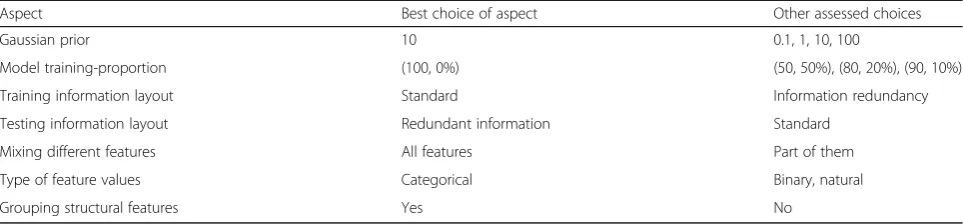
Through the experiments, we were able to identify the best set of aspects (Table 8) that optimized the CRF model to reach the best F-scores (60% for the P element and 40% for the element I).
Assessment of the CRF model
We applied the CRF model generated with the best choices of aspects on the test corpus of [12] in order to
Problem (P)
…
Anatomical Abnormality UMLS
Disorders
Acquired Abnormality
Sign or Symptom
Population Group
Age Group
Patient or Disabled group UMLS Group
Fig. 3Conceptualization of the element P as a relationship between two UMLS groups: Disorders and Group
cross-validate our model against the results obtained in the Australian Language Technology Association (ALTA) Shared Task [12]. The test corpus consisted of 200 ab-stracts, 80 structured and 120 unstructured. The CRF model was applied in Mallet environment and the ex-tracted PICO elements were evaluated according to the evaluation rules specified in phase C4 (Fig. 1). The best F-score was 60% for the P element and 40% for the elem-ent I. The CRF stage missed 73 of 200 abstracts in the case of the P element and 79 abstracts in the case of the I element. This is explained mainly by:
1. The CRF performed worse on the unstructured abstracts due to the structural features that are less precise in the unstructured abstracts than in the structured ones. In fact, the sentence header feature is always‘NOHEADING’in the case of an
unstructured abstract, whereas it has a specific heading in the structured abstracts. In the missed abstracts for P, 21% of them are structured and 79% are unstructured. In the missed abstracts for I, 20% of them are structured and 80% are unstructured. 2. In the case of the I element, some of the missed
abstracts are not related to therapeutic domain, but rather related to prognostic, etiologic and socio-medical researches.
In the ALTA shared task [12], ten different systems were evaluated using the same training and testing cor-pus. All these systems relied on MLM methods, namely Support Vector Machines (SVM), Stacked Logistic Re-gression, Maximum Entropy, Random Forests, and CRF. The reported F-scores of these systems vary from a est of 30% to a highest of 58% for the P and from a low-est 18% to a highlow-est of 35% for the I.
In addition, we compared our results with the ones published in [11], the authors of this paper reported an F-score = 81% for the P element and a promising F-score = 81% for the I element.
We used ALTA training and test files. The comparison of the different models is based on the F-score because it compromises between the Precision and the Recall
and because we do not always have the Precision and Recall from other researches. The distribution of PICO elements in the training corpus has a major impact on the F-score quality. For example, in the case of the P and I elements the training percentage is less than 7% and the average F-score of different models is of 49.75% for P and 32.43% for the I; whereas the training percent-age of the O element is close to 36% and the averpercent-age F-score is 88.28%. In this context, it is difficult to qualify a model by “good” or by “poor” based on a low percentage F-score threshold. For example, a model with F-score of 45% for the I element is not necessarily poor. However, we can compare the model quality against the average F-score for a sample of 10 models (Fig. 5).
Our model performed 1.47 better than the average for the P element, 1.33 better than the average for the I element and 1.02 better than the average for the O elem-ent. This is mainly attributed to the choice of our fea-tures; they are more exhaustive compared to [12], their standardization and harmonization contributed to make the CRF model learn efficiently.
Two other choices could affect our results:
using cTAKES instead of MetaMap [29] as a tool for extracting UMLS concepts in a text,
using CRF as a MLM algorithm.
More research is needed to assess the impact of these two elements on the results. In the case of the reference [11], the results may not be directly comparable. In fact, it is not clear to us if the results have been directly validated against the sentence labels provided in the test file. Based on the distribution of PIBOSO elements [11] and the number of abstracts used in the training phase (1000), it seems that the authors have used the sentences of the test file in the training phase, which could bias the results and set them higher. Neverthe-less, the authors provided several results based on different techniques as shown in Table 9 and they reported F-scores of 81.32% for the P element and 81.06% for the I element.
Table 8Set of aspects that produced the best recall for P and I
Aspect Best choice of aspect Other assessed choices
Gaussian prior 10 0.1, 1, 10, 100
Model training-proportion (100, 0%) (50, 50%), (80, 20%), (90, 10%)
Training information layout Standard Information redundancy
Testing information layout Redundant information Standard
Mixing different features All features Part of them
Type of feature values Categorical Binary, natural
We executed a 5-fold cross validation to assess overfitting and robustness of the model. In each set, we formed a subset (800 abstracts) for training and another subset (200 abstracts) as a blind test set. The 5-fold cross-validation sets shows that our model is stable and does not deviate dramatically from one fold to another.
During the validation of our results against the test file, we noticed a considerable number of abstracts in the test file that were not labeled with P or I (27 and
53% respectively) although some of them were a poten-tial candidate for that.
Table 10shows some examples of potential sentences for P and I elements, each sentence belonging to a dif-ferent abstract. We thoroughly re-evaluated the results to exclude effects that may bias the results and under-estimate the performance of our MLM model.
After re-evaluating the results, we were able to im-prove the F-scores of the P, I and O elements. The F-score increased from 73 to 79% for P, from 43 to 60% for I and from 90 to 92% for O.
Fig. 5F-score quality for different models
Table 9Comparison of our MLM results with the literature review results. Bold values show the best obtained F-scores
P I O
Number of sentences in training (%) 662 (6.8) 565 (5.9) 3565 (36.6)
Our MLM stage - blind test corpus
F-score 73% 43% 90%
The best F-scores in ALTA shared task [12]
System 1 58% 34% 89%
System 2 51% 35% 86%
The best F-scores in paper [11]
CRF 81% 81% 98%
SVM 31% 21% 90%
Nave Bayes 34% 10% 86%
Multinomial Logistic Regression 41% 28% 90%
Other papers F-score results using the same training and test corpora
Kim et al. [14] 48% 16% 83%
Verbek et al. [30] 29% 21% 85%
Sarker et al. [31] 52% 34% 86%
Table 10Examples of potential sentences that are not considered in the test file of the ALTA shared task [12]
Examples of potential P sentences that are not considered in the test file “An estimated 20% of all breast cancer or ovarian and breast cancer cases have familial aggregation.”[32]
“Clinical trials such as the Sudden Cardiac Death Heart Failure Trial (SCD-HeFT) are currently underway to investigate the role of the implantable defibrillator in patients with heart failure.”[33]
Examples of potential I sentences that are not considered in the test file “Tizanidine hydrochloride is a very useful medication in patients suffering from spasticity caused by MS, acquired brain injury or spinal cord injury.”[34]
“Here we describe the influence of local anesthesia and back-muscle-training therapy on subjective and objective pain parameters in 21 low-back-pain patients who had similar clinical status and neurophysiologic findings and whose recurrent low back pain.”[35]
“Laparoscopy is highly accurate and effective in the management of peritoneal dialysis catheter dysfunction and results in prolongation of catheter life.”[36]
RBM stage results
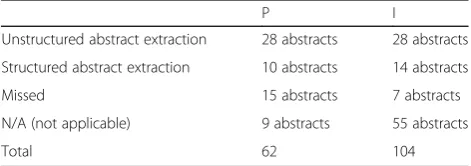
We run the RBM stage on the missed abstracts by the CRF for P and I elements. Table11shows the results.
The RBM stage was able to improve the overall results. Especially it performed well on the unstructured abstracts where the MLMs had failed. Most of N/A abstracts for the I element are not related to therapeutic domain; rather they treat an etiologic or prognostic domain and some of them are a socio-medical study. The number of N/A abstracts in the case of the P element is smaller, because the P element medical scope is larger in comparison with the I element. It can be related to an etiologic or prognos-tic domain or to a socio-medical study. If a disorder part or a demographic part of the P element is missing, the P extraction is partial.
The RBMs have a good recall rate and can comple-ment the MLMs by improving the performance on the unstructured abstracts. However, the number of N/A (Not Applicable) abstracts affects their precision. The RBM coverage of the P and I elements is high so it has a tendency to label the N/A abstracts, which would lower the precision. The RBMs stage achieved an F-score of 66% for the P element and 55% for the I element.
In order to increase the RBM precision we should:
Pre-filter the abstracts. In the context of these experiments the abstracts of the training and testing corpora were randomly sampled from the GEM [22] and AHRQ [23] institutions which explains the presence of the high number of the N/A abstracts for the I element. However, in the medical
Question-Answer-System (QAS) context, the docu-ment filtering step of the QAS reduces the N/A ab-stracts; in fact, a filter is applied on the abstracts based on the question key words or the question type (therapy, etiology, prognosis,…).
Tighten the constraints on the features f1, f2 and f3 in the RBM rules.
The good recall rate of the RBM rules allow them to back up the MLMs. Table 12 summarize our MLM, RBM and combined approach results, and compares them with those in the literature review.
The MLMs and RBMs complement each other and the combined approach improves the F-scores of the P element
from 79 to 80% and from 60 to 64% for the I element. We were able to match the F-score of reference [11] for the P element, but were not able to reach the same F-score for the I element, despite the improvement of the overall re-sults. However, at this stage, the comparison with refer-ences [12] and [11] may not be relevant and legitimate anymore since the evaluation of the results is not necessar-ily based on the same criteria.
Discussion
In this paper, we present a novel hybrid clinical NLP sys-tem using both MLMs and RBMs for PICO elements ex-traction. First, we evaluate the aspects involved in the creation of MLM model. Fine tuning these aspects helps us to improve the results despite the fact the corpus was not well balanced in terms of PICO element distribution. Next, we propose a set of RBM rules based on the MLM features. The performance achieved by our combined approach is competitive with previously published re-sults. The MLM methods tend to be precise but they have a low rate of recall when the corpus is not repre-sentative or balanced. The RBMs support the MLMs in increasing the recall rate due to their efficiency with the unstructured abstracts where the MLMs failed to per-form adequately.
We observed that the several PICO elements extraction projects do not rely on realistic environment setting; this is due mainly to the non-availability of representative training corpora. One of the avenues would be an agreement be-tween researchers on constructing a representative and well-balanced PICO medical corpus like the ones used for Named-Entity recognition (NER), POS recognition and
Table 11RBM results on missed abstracts
P I
Unstructured abstract extraction 28 abstracts 28 abstracts
Structured abstract extraction 10 abstracts 14 abstracts
Missed 15 abstracts 7 abstracts
N/A (not applicable) 9 abstracts 55 abstracts
Total 62 104
Table 12Results of MLM, RBM and combined approach
Element P Element I
Precision
MLM 85% 65%
RBM 61% 40%
Combined (MLM & RBM) 77% 51%
Recall
MLM 74% 57%
RBM 72% 86%
Combined (MLM & RBM) 83% 86%
F-score
MLM with CRF 79% 60%
RBM 66% 55%
Combined (MLM & RBM) 80% 64%
ALTA [12] best F-scores
MLM with CRF 58% 35%
Paper [11] best F-scores
sentence recognition. This kind of corpus would foster a representative number (thousands) of sentences labelled by experts and require an agreement on the type of features, their specification, the tools and thesaurus to use for medical labelling, the type of extraction methods to use. In this context, our work could be of value in sug-gesting the features, the tool and the extraction methods to use.
We also observed that both P and O elements could overlap between primary question types as therapy, diag-nosis, etiology or prognosis. However, the meaning of I element depends on the question type. In fact, the error rate for the I element classification is highly related to non-therapeutic abstracts. Training the I element with them creates a lot of noise in the learning process. Our team is currently investigating question type dependent models that are more effective for retrieving I elements.
We also noticed that the model reacts positively when we try to normalize the bags of words, for example, by grouping structural features, standardizing section headers, or using semantic features with categorical values. We think that it might be beneficial to do more work in analysing the model features to find bags of words that could be more efficient in the training phase.
In our study we did not take in consideration the impact of the tools used neither the choice of the ML methods (CRF vs other supervised algorithms); for example we do not know to which extent the usage of cTAKES instead of MetaMap would have affected the results.
Conclusions
In this paper, we present a novel hybrid clinical NLP sys-tem using both MLMs and RBMs for PICO elements ex-traction. Our study of the PICO element extraction shows that the task is very challenging. The MLMs tend to have an acceptable precision rate but they have a low recall rate when the corpus is not representative. The RBMs backed up the MLMs to increase the recall rate and consequently the combination of the two methods gave better results. The performance achieved by our combined approach is competitive with previously published results.
Abbreviations
AHRQ:Agency for Healthcare Research and Quality; ALTA: Australasian Language Technology Association; CEM: Clinical Element Models; CRF: Conditional Random Fields; cTAKES: Clinical Text Analysis and Knowledge Extraction System; EBM: Evidence-Based Medicine; FN: False Negatives; FP: False Positives; GEM: Global Evidence Mapping Initiatives; Mallet: MAchine Learning for LanguagE Toolkit; MLMs: Machine Learning Methods; NER: Named Entity Recognition; PIBOSO:“Problem, Intervention, Background, Study Design and Other”; PICO:“Problem, Intervention, Comparison and Outcome”; POS: Part-Of-Speech; QAS: Question-Answering System; RBMs: Rule Based Methods; RCT: Randomized Controlled Trial; SVM: Support Vector Machine; TN: True Negatives; TP: True Positives; UMLS: Unified Medical Language System
Acknowledgements
We are grateful to W. Michalowski and V. Levasseur for their suggestions after an early reading of this paper. We are also grateful to I. Amini for his help in configuring the CRF and to the reviewers for their valuable comments and suggestions to improve the quality of the paper.
Availability of data and material
The dataset used in this study was obtained from the Australian Language Technology Association (ALTA) Shared Task [13]. The dataset is available at https://www.kaggle.com/c/alta-nicta-challenge2/data.
Funding Not applicable.
Authors’contributions
SC and MI contributed to interpretation of findings, writing of the manuscript, and take responsibility for the integrity of the work and the accuracy of the data analysis. Both authors read and approved the final manuscript.
Ethics approval and consent to participate Not applicable.
Consent for publication
Not applicable; the manuscript does not contain individual level of data.
Competing interests
The authors declare that they have no competing interests.
Publisher’s Note
Springer Nature remains neutral with regard to jurisdictional claims in published maps and institutional affiliations.
Received: 17 July 2017 Accepted: 26 October 2018
References
1. Sackett DL, Rosenberg WM, Gray JAM, Haynes RB, Richardson WS. Evidence based medicine: what it is and what it isn’t. BMJ. 1996;312.
2. Huang X, Lin J, Demner-Fushman D. Evaluation of PICO as a Knowledge Representation for Clinical Questions. AMIA 2006 Symp Proc. 2006. 3. Dawes M, Pluye P, Shea L, Grad R, Greenberg A, Nie JY. The identification of
clinically important elements within medical journal abstracts: Patient– Population–Problem, Exposure–Intervention, Comparison,
Outcome,Duration and Results (PECODR). Inform Prim Care. 2007;15(1):9–16. 4. Wallace BC, Kuiper J, Sharma A, Zhu M, Marshall IJ. Extracting PICO
Sentences from Clinical Trial Reports using Supervised Distant Supervision. J Mach Learn Res. 2016;17(1):4572–96.
5. Boudin F, Nie JYN, Clinical DM. Information Retrieval using Document and PICO Structure. Paper presented at: HLT‘10 Human Language Technologies; 2010. 6. Boudin F, Shi L, Nie JY. Improving Medical Information Retrieval with PICO
Element Detection. Proceedings of the ECIR 2010 Conference; 2010. 7. Boudin F, Nie JY, Bartlett JC, Grad R, Pluye P, Dawes M. Combining
Classifiers for robust PICO element detection. BMC Med Inform Decis Mak. 2010;10:29.
8. Demner-Fushman D, Lin J. Answering Clinical Questions with Knowledge-Based and Statistical Techniques. Computational Linguistics. 2007;33(1):63–103. 9. Chung GY. Sentence retrieval for abstracts of randomized controlled trials.
BMC Med Inform Decis Mak. 2009;9:10.
10. Hansen MJ, Rasmussen NO, Chung G. A method of extracting the number of trial participants from abstracts describing randomized controlled trials. J Telemed Telecare. 2008;14(7):354–8.
11. Hassanzadeh H, Groza T, Hunter J. Identifying scientific artefacts in biomedical literature: The Evidence Based Medicine use case. J Biomed Inform. 2014;49:159–70.
12. Amini I, Martinez D, Molla D. Overview of the ALTA 2012 Shared Task. Paper presented at: Proc. of the Australasian Language Technology Association Workshop 2012; 2012.
14. Kim SN, Martinez D, Cavedon L, Yencken L. Automatic Classification of Sentences to Support Evidence Based Medicine. BMC Bioinformatics. 2011; 12:S2–5.
15. Craven M, Kumlien J. Constructing biological knowledge bases by extracting information from text sources. Paper presented at. Proc Int Conf Intell Syst Mol Biol. 1999.
16. Mintz M, Bills S, Snow R, Jurafsky D. Distant supervision for relation extraction without labeled data. The Joint Conference of the Association of Computational Linguistics (ACL) and the International Joint Conference on Natural Language Processing (IJCNLP); 2009.
17. Zhao J, Kan MY, Procter PM, Zubaidah S, Yip WK, Li GM. Improving Search for Evidence-based Practice using Information Extraction. Paper presented at. AMIA Annu Symp Proc. 2010.
18. Sutton C, McCallum A. An Introduction to Conditional Random Fields. Foundations Trends® Mach Learn. 2012;4(4):267–373.
19. Kiritchenko S, de Bruijn B, Carini S, Martin J, Sim I. ExaCT: automatic extraction of clinical trial characteristics from journal publications. BMC Med Inform Decis Mak. 2010;10:56.
20. The Apache Software Foundation. Apache cTAKES. 2014. Available at:http:// ctakes.apache.org/.
21. Coyle J, Heras Y, Oniki T, Huff S. Clinical Element Model. OpenCEM Browser. 2008. Available at:http://www.opencem.org/#/.
22. Bragge P, Clavisi O, Turner T, Tavender E, Collie A, Gruen RL. The Global Evidence Mapping Initiative: Scoping research in broad topic areas. BMC Med Res Methodol. 2011;11:92.
23. Agency for Healthcare Research and Quality. Available at:http://www.ahrq.gov/. 24. Boudin F, Nie JY, Dawes M. Positional Language Models for Clinical
Information Retrieval. Paper presented at: Proc. of the 2010 Conference on Empirical Methods in Natural Language Processing; 2010.
25. McKnight L, Srinivasan P. Categorization of Sentence Types in Medical Abstracts. Paper presented at. Proc. of AMIA Annual Symp. 2003. 26. Hirohata K, Okazaki N, Ananiadou S, Ishizuka M. Identifying Sections in
Scientific Abstracts using Conditional Random Fields. Paper presented at: Proceedings of the 3rd International Joint Conference on Natural Language Processing; 2008.
27. Chabou S, Iglewski M. PICO Extraction by combining the robustness of machine-learning methods with the rule-based methods. Paper presented at. Hammamet: The World Congress on Information Technology and Computer Applications (WCITCA);June; 2015.
28. The UMLS Semantic Groups. Available at:https://semanticnetwork.nlm.nih.gov/. 29. MetaMap - A Tool For Recognizing UMLS Concepts in Text. Available at
2018:https://mmtx.nlm.nih.gov/.
30. Verbeke M, Van Asch V, Morante R, Frasconi P, Daelemans W, De Raedt L. A statistical relational learning approach to identifying evidence based medicine categories. Paper presented at: Proceedings of the 2012 Joint Conference on Empirical Methods in Natural Language Processing and Computational Natural Language Learning. Jeju Island; 2012. 31. Sarker AMDPC. An approach for automatic multi-label classification of
medical sentences. Paper presented at: Proceedings of the 4th international Louhi workshop on health document text mining and information analysis. Sydney; 2013.
32. Pineda-Del Villar L. Familial predisposition to breast cancer. Review. Invest Clin. 1998;39(1):53–65.
33. Peters RW, Gold MR. Pacing for patients with congestive heart failure and dilated cardiomyopathy Familial predisposition to breast cancer. Review. Cardiol Clin. 2000;18(1):55–66.
34. Malanga G, Reiter RD, Garay E. Update on tizanidine for muscle spasticity and emerging indications. Expert Opin Pharmacother. Aug 2008;9(12):2209–15. 35. Sihvonen T, Lindgren KA, Airaksinen O, Leino E, Partanen J, Hänninen O.
Dorsal ramus irritation associated with recurrent low back pain and its relief with local anesthetic or training therapy. J Spinal Disord. 1995;8(1):8–14. 36. Brandt CP, Ricanati ES. Use of laparoscopy in the management of
malfunctioning peritoneal dialysis catheters. Adv Perit Dial. 1996;12:223–6. 37. Franck H, Boszczyk BM, Bierschneider M, Jaksche H. Interdisciplinary


![Table 10 Examples of potential sentences that are notconsidered in the test file of the ALTA shared task [12]](https://thumb-us.123doks.com/thumbv2/123dok_us/492266.1543900/11.595.296.544.511.731/table-examples-potential-sentences-notconsidered-test-alta-shared.webp)