ISSN No: 2456
International
Research
The Effect of Organizat
Commitment, Job Satisfaction and Work Performance
in Select Public Services
David Memorial Institute of Management, Osmania
ABSTRACT
Organization learning denotes a change in organization knowledge. Organizational learning typically adds to, transforms, or reduces organizational knowledge. Hence we examine the relationship among these variables using a sample of select public services managers in Telangana. Organization learning was found positively related to organizational commitment, job satisfaction, and work performance. Organizational commitment and job satisfaction are also positively related with work performance and these variables partially mediate the relationship between organizational learning and work performance.
Keywords: Organization learning, organization
commitment, job satisfaction, work performance
Introduction
Organizational learning is a process of increasing the capacity for effective organizational action through knowledge and understanding. The learning “process” is a cycle of action an reflection that is, doing and thinking, performing and conversing. What is being learned, made more effective, and disseminated are “routines” for conducting work that accomplishes goals. Routines evolve over time as individuals get experience with tasks, people come and go, technologies change, priorities and polic
and best practices are shared. In health care, typical goals include improving patient well being, handling a greater case load with lower costs, attracting and retaining top quality staff, training residents, getting research grants, and enhancing reputation. Serving
ISSN No: 2456 - 6470 | www.ijtsrd.com | Volume
International Journal of Trend in Scientific
Research and Development (IJTSRD)
International Open Access Journal
The Effect of Organizational Learning on Organization
ommitment, Job Satisfaction and Work Performance
in Select Public Services – A Study
Adevally Soujanya
David Memorial Institute of Management, Osmania University, Hyderabad
Organization learning denotes a change in organization knowledge. Organizational learning typically adds to, transforms, or reduces organizational knowledge. Hence we examine the among these variables using a sample of select public services managers in Telangana. Organization learning was found positively related to organizational commitment, job satisfaction, and work performance. Organizational commitment and e also positively related with work performance and these variables partially mediate the relationship between organizational learning and work
: Organization learning, organization commitment, job satisfaction, work performance
Organizational learning is a process of increasing the capacity for effective organizational action through knowledge and understanding. The learning “process” is a cycle of action an reflection that is, doing and . What is being learned, made more effective, and disseminated are “routines” for conducting work that accomplishes goals. Routines evolve over time as individuals get experience with tasks, people come and go, technologies change, priorities and policies shift, and best practices are shared. In health care, typical goals include improving patient well being, handling a greater case load with lower costs, attracting and retaining top quality staff, training residents, getting
ing reputation. Serving
these goals are numerous work routines including patient admissions, delivery of care, billing, hiring of personnel, buying equipment, buildings maintenance, and creation of a mission and strategic plan. Some routines are simple and are carried out by one
while other routines require coordinated action from many.
Objectives of the study:
To examine the effect of organization learning on organization commitment in the select public services
To examine the effect of organization learning on job satisfaction in the select public services.
To examine the effect of organization learning on work performance in the select public services.
To assess the relationship between organization learning on organization commitment, job satisfaction and work pe
public services
The Hypotheses of the Study:
H01: There is no significant relationship between the organization learning on organization commitment, job satisfaction and work performance in the select public services
H02: There is no significant effect of organization learning on organization commitment in the select public services
| www.ijtsrd.com | Volume - 2 | Issue – 1
Scientific
(IJTSRD)
International Open Access Journal
ional Learning on Organization
ommitment, Job Satisfaction and Work Performance
these goals are numerous work routines including patient admissions, delivery of care, billing, hiring of personnel, buying equipment, buildings maintenance, and creation of a mission and strategic plan. Some routines are simple and are carried out by one person, while other routines require coordinated action from
To examine the effect of organization learning on organization commitment in the select public
To examine the effect of organization learning on satisfaction in the select public services.
To examine the effect of organization learning on work performance in the select public services.
To assess the relationship between organization learning on organization commitment, job satisfaction and work performance in the select
The Hypotheses of the Study:
H01: There is no significant relationship between the organization learning on organization commitment, job satisfaction and work performance in the select
H03: There is no significant effect of organization learning on job satisfaction in the select public services
H04: There is no significant effect of organization learning on work performance in select public services.
Limitations of the study:
This study is limited to one region in India, namely Telangana. It does not take into account other regions. Hence this may place some constraints on drawing inferential conclusions. Therefore, it would be useful in further studies to consider other variables to assess organization learning in select public services.
Review of Literature
In recent years, performance management has come to the fore as organizations seek constantly to optimize their human resources in the face of growing competitive pressures (Suliman, 2001). The general consensus in the learning organization literature is that learning at the organizational level is a prerequisite for successful organizational change and performance (Garvin, 1993; Hendry, 1996). According to Watkins and marsick (1996) learning could enhance the intellectual capabilities of the employees; as such organizations will eventually be better off through having learned employees. Organizational learning can be regarded as a dynamic process of creation, acquisition and integration of knowledge aimed at development of resources and capabilities that contribute to better performance (Chonko et al., 2003; Choe, 2004; Gonzales, 2001; Lopez et al., 2005; Wu and Cavusgil, 2006).
Garver (1996) shows that there is significant positive relationship between measure of learning activities and performance at work indicating higher performers are involved in greater volume of learning activities. Jashapara (1993) reported that learning in an organization have a positive impact on organizational performance. Skerlavaj, Stemberger, Skrinjar and Dimovski (2006) reported from their study that organizational learning has a positive direct impact on performance.
Research Methodology: The data was collected from 100 employees using self-administered questionnaire. The final response rate was 87 %( 100); based on this the analysis was carried out. The Statistical Package for Social Science (SPSS) is used.
Findings and Discussion
Respondents’ background: Majority of the respondents (64%) is male. In terms of age distribution, 63% of the respondents were less than 40 years old, 20% were between the ages of 41 to 50 years, and 17% of the respondents were 51 years and above. The wide age range indicates a diverse sample. From the data on educational level, 70% of the respondents were bachelor’s degree holders, 29% were masters’ degree holders, and only 1% had obtained PhD qualification. For job category or ranking of the respondents, 52% are lower level managers, 41% middle level managers and 7% top level managers. In term of work experience, 56% of the respondents had less than 10 years work experience, 8% had 11 to 15 years work experience, and 36% had 16 years or more work experience. The following subsection discussed the relationship and mediating effects between the constructs.
Organizational Learning and Work Performance:
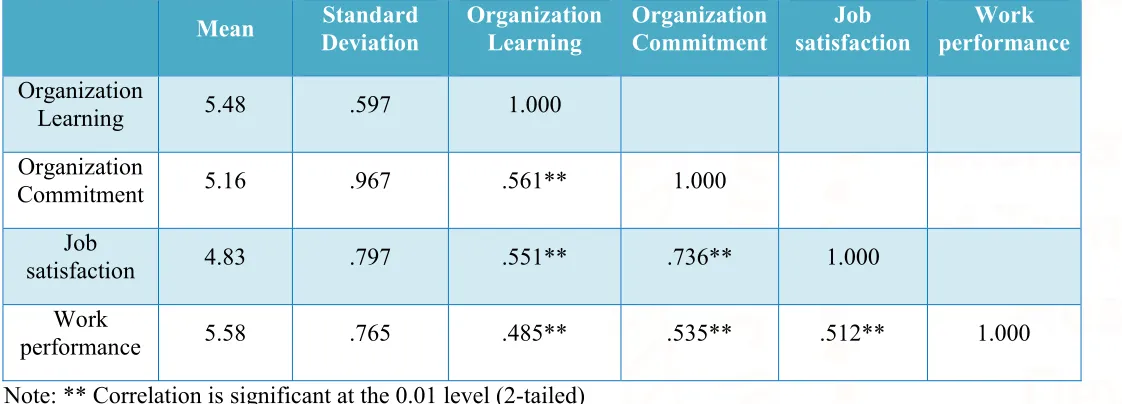
From Table 1 and based on Cohen (1988) guideline, there is a positive moderate relationship at the corrected alpha ≤0.0125 level between organizational learning and work performance (r= .484, n= 100, p ≤0.0001). The result indicates that organizational learning has a positive moderate linear relationship with work performance. Improvement in the organizational learning activities among the public service managers increases knowledge, improves capabilities and skills thereby enhance their work performance. The present result supports the findings of earlier studies (Correa, Morales, and Pozo, 2007; Ellinger et al., 2003; Garver, 1996; Jashapara, 1993; Jimenez and Navarro, 2006).
Organizational Learning and Organizational Commitment
organizational learning culture, job satisfaction, and organizational commitment in native Organizational Learning and Job Satisfaction
There is a positive high linear relationship at the corrected alpha ≤ 0.0125 level between organizational learning and job satisfaction (r= .551, n= 100, p ≤ 0.0001). Improvement in organizational learning activities increases job satisfaction among the public service managers. This finding is in line with research result conducted by Wright (1997), and Egan et al. (2004) where they reported that organizational
learning is associated with employees’ job satisfaction. Result of the study by Egan et al. (2004) suggests that organizational learning is associated with job satisfaction and although these constructs are highly correlated, they tend to be conceptually distinct. Yang et al. (2003) reported that organizational learning culture acted as a predictive variable to the job satisfaction variable. Wang (2005) reported in his study that organizational learning culture has positive strong relationship with employee job satisfaction.
Table 1: Pearson’s Correlation Coefficient between the selected constructs
Mean Deviation Standard Organization Learning Organization Commitment satisfaction Job performance Work
Organization
Learning 5.48 .597 1.000
Organization
Commitment 5.16 .967 .561** 1.000
Job
satisfaction 4.83 .797 .551** .736** 1.000
Work
performance 5.58 .765 .485** .535** .512** 1.000
Note: ** Correlation is significant at the 0.01 level (2-tailed)
Organizational Commitment, Job Satisfaction and Work Performance
Table 1 indicate a positive strong linear relationship at the corrected alpha ≤ 0.0125 level between organizational commitment and work performance (r= .535, n= 100, p≤0.0001). With improvement in the organizational commitment, therefore it increased work performance among the public service managers. Table 1 also indicate a positive moderate linear relationship at the corrected alpha ≤ 0.0125 level between job satisfaction and work performance (r= .512, n= 435, p ≤ 0.0001). This clearly indicates that satisfied employees perform better on their job and vice versa.
Organizational Commitment as Mediator
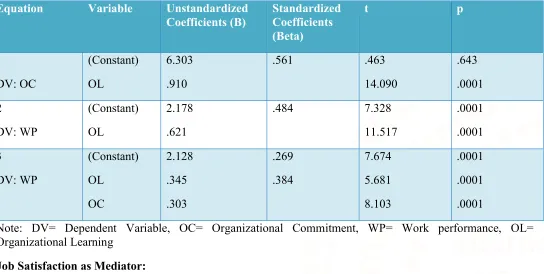
Table 2: Three Steps Separate Regression Equations for Organizational Commitment
Equation Variable Unstandardized
Coefficients (B)
Standardized Coefficients (Beta)
t p
1
DV: OC
(Constant)
OL
6.303
.910
.561 .463
14.090
.643
.0001
2
DV: WP
(Constant)
OL
2.178
.621
.484 7.328
11.517
.0001
.0001
3
DV: WP
(Constant)
OL
OC
2.128
.345
.303
.269
.384
7.674
5.681
8.103
.0001
.0001
.0001
Note: DV= Dependent Variable, OC= Organizational Commitment, WP= Work performance, OL= Organizational Learning
Job Satisfaction as Mediator:
The results from Table 3 indicate that all the conditions as advocated by Baron and Kenny (1986) were met. The result in the first equation indicates that organizational learning significantly affects job satisfaction (t=13.757; p=0.0001). In the second equation, organizational learning significantly affects work performance (t=11.157; p=0.0001) and in the third equation job satisfaction has a significant unique effect on work performance (t=7.392; p=0.0001). The beta value in the second equation (0.484) is larger than the beta value in the third equation (0.351). Therefore, in this study it can be concluded that job satisfaction partially mediates the relationship between organizational learning and work performance. Organizational learning (antecedent) predicts job satisfaction, and job satisfaction in turn predicts the work performance (consequence) of the public service managers
Table 3: Three Steps Separate Regression Equations for Job Satisfaction
Equation Variable Unstandardized
Coefficients (B)
Standardized Coefficients (Beta)
t p
1 DV: JS
(Constant) OL
.797 .736
.551 2.700
13.757
.007 .0001 2
DV: WP (Constant) OL 2.178 .621 .484 7.328 11.517 .0001 .0001 3
DV: WP (Constant) OL JS
1.909 .372 .337
.290
.351 6.753 6.109 7.392
.0001 .0001 .0001
CONCLUSION
The results of the study suggest that organizational learning plays an important role and significantly contributes to organizational commitment, job satisfaction, and work outcomes of public service.
Besides, the findings present empirical evidence that organizational commitment and job satisfaction partially mediate the relationship between organizational learning and work performance of the public service managers. The result of the present this study contributes to the literature on organizational learning and work outcomes from the Telangana perspective. More specifically this study enhances and supports the findings of the earlier research regarding the role of organizational commitment and job satisfaction as mediator variables. This study represents original research of these mediating effects.
Public services managers have many roles and responsibilities in the work place, such as managing learning. Strategic organizational initiatives aimed at improving workplace and professional development need to have top-level support, therefore top management need to have motivation, commitment, knowledge, and ability to create and enhance the learning atmosphere in the organization. Top management need to understand and identify what factors or elements contribute to the effectiveness of organizational learning activities and what factors hinder the learning processes among the public service managers. By doing that, organizations at the same time will be able to achieve benefits such as increased organizational commitment, job satisfaction and work performance among the public service managers.
REFERENCES
1) Allen, T. and Rush, M. (1998). The effect of organizational citizenship behavior on performance judgments: a field study and a laboratory experiment. Journal of Applied Psychology. 83(2), 247-260.
2) Arnett, D.B., Laverie, D.A. and McLane, C. (2002). Using job satisfaction and pride as internal-marketing tools. Cornell Hotel and Restaurant Administration Quarterly, 43(2),
3) Bartleet, K.R. (2001). The relationship between training and organizational commitment. a study in the health care field. Human Resource Development Quarterly. 12(4), 335-352.