Volume 2, Issue 7, July 2013
Page 372
ABSTRACT
Multiprocessor Task Scheduling Problem is a very challenging problem in computer world. Multiprocessors have emerged as a powerful computing means for running real time applications; especially that a uni-processor system would not be sufficient enough to execute all the tasks. In such practical problems that require a task to go through more t han one stage where each stage have several parallel processors, the processing environment requires an efficient algorithm to determine when and on which processor a given task should execute. The Multiprocessor task scheduling problem is a NP-hard problem, hence it is very important to find its solution in minimum time. Many heuristic methods have been given by various researchers to solve this problem. Genetic algorithm is a powerful optimization tool used to solve this problem. The present work considers the multiprocessor task scheduling problem where number of processor as well as number of tasks are taken as variable with an objective to minimize the make span (completion time of the last task). In the present work we considered a problem consisting of 5 processors and 10 processes. All the permutations of task are sequenced on 10 different randoml y generated sequences of processors separately. The objective function was to find the optimal sequence of processor and sequence of processes that gave minimum make span with different randomly generated burst times. It was found that a particular sequence of processor gives minimum make span with most of the burst times although the task sequence was different in most of the cases.
Keywords: Genetic algorithm, Multiprocessor, Task scheduling, optimization.
1. INTRODUCTION
Multiprocessor task scheduling is a generalization of classical processor scheduling problem that allows the task to run on more than one processor. Generally the task scheduling is done to overcome the drawbacks of the uni-processor systems [1]. When all task run on uni-processor systems it is very slow. So a number of processors are used to get parallelism and pipelining. The purpose of general task scheduling is fairness which means that the computer’s resources must be shared out equitably among users [2].
1.1 GENETIC ALGORITHM
The GA is a stochastic global search method that mimics the metaphor of natural biological evolution. GAs operates on a population of potential solutions applying the principle of survival of the fittest to produce (hopefully) better and better approximations to a solution[3]. At each generation, a new set of approximations is created by the process of selecting individuals according to their level of fitness in the problem domain and breeding them together using operators borrowed from natural genetics. This process leads to the evolution of populations of individuals that are better suited to their environment than the individuals that they were created from, just as in natural adaptation [4].Genetic Algorithm (GA) is based on the basic phenomena of chromosome gene code interchange. A process fully based on random selection of data and modification. In most of the cases we use fitness function to select the best suited chromosomes[5].
1.2 WORKING PRINCIPLE OF A SIMPLE GA 1. Begin
2. INITIALIZE population with random candidasolutions. 3. EVALUATE each candidate
4. REPEAT UNTIL (TERMINATION CONDITION satisfied) 5. DO
a. SELECT parents;
b. RECOMBINE pairs of parents; c. MUTATE the resulting offspring; d. EVALUATE new candidate;
e. SELECT individuals for the next generation; 6. DO
7. END
A Genetic Approach for Multiprocessors
Task Scheduling
Savita Narang1, Sunita Dhingra2
1M. Tech Student,Department of CSE, UIET, MDU Rohtak, Haryana (India) 2
Volume 2, Issue 7, July 2013
Page 373
In genetic algorithm we initialize the population by some sequence of tasks or schedules these are called chromosomes. From this population we select the best fit schedules and apply GA operators on them called crossover and mutation. The offsprings produced as a result of this are evaluated for their fitness and suitable offsprings are added to the population list. In this way after every generation we get a population more suited to the fitness function. When we get a schedule having a minimum makespanstoping criteria is met and GA stops[6]
2. PROPOSED WORK
The work deals with the multiprocessor task scheduling problem(MPTS) where number of processors as well as number of processes both are taken as variable. The work is based on the deterministic model i.e. the number of processors execution of task on different processors is known in advance. In addition to it , the communication cost between two task is considered to be negligible and the multiprocessor system is non-pre-emptive. The processors are homogeneous and each processor completes the current task before the new one starts its execution. The assumptions for the MPTS are given below:
2.1 Assumptions:
1. Processors are kept homogeneous. 2. No pre-emption is allowed.
3. All the jobs and machines are available at time Zero. 4. Machines never break down.
5. The processing time of each task on all the machine are known. 6. Each machine is continuously available for assignment.
7. The first machine is assumed to be ready whichever and whatever job is to be processed on it first. 8. Processors may remain idle.
9. Task cannot be cancelled or broken down into smaller tasks.
The present work is the special case of multiprocessor task scheduling in which the processes and processors both are taken as a variable and our goal is to get an optimal schedule for the n tasks on m processors.
2.2 Problem Statement
In multiprocessor task scheduling, there are n number of processes denoted as Ji , where i=1,2,.. n, that are to be processed on m processors denoted as Mk, where k= 1,2,..,m. Number of processors as well as number of processes both are taken as variable. Operation of ith process on kth processor will be denoted by Oki with the processing time Pki. Operation sequence is same for all the processes on all the processors.
We are to find a sequence of the processes on a sequence of processor that give minimum makespan.Once a machine starts to process a job, no interruption is allowed. The time required for all operations to complete their processes is called make span. Our intention is to minimize this makespan value. All the jobs and machines are available at time Zero.
2.3 Methodology:
We have generated 10 random permutation sequences of processors. These processor sequences were fixed in a processor sequence list(PL). We selected processor sequences one by one from the PL and applied the following procedure on each sequence. We took a randomly generated processing time pki for task i and processor k. Picked one processor sequence from the PL x1 , x2 , x3 ,....xm. . Different permutations of n tasks (j=1, 2, 3 , ...n) are sequenced through these m processors x1 , x2 , x3 ,....xm. Then the problem was to find best sequence of task for the given sequence of processor.
Given the processing time pki for task i and processor k , and a task permutationπ1, π2, π3 ....πn and a processor permutation x1 , x2 , x3 ,....xm.where n tasks (j=1, 2, 3 , ...n) are sequenced through m processors(k=1, 2, 3 , ...m) using the same permutations. The completion time C(xk, πi) for ith task of the given permutation π and the kth processor of the given permutation x can be calculated as:
C(x1,π1 ) = (1)
C(x1,πi ) = C(x1,πi-1 ) + i=2,…,n (2)
C(xk,π1 ) = C(xk-1,π1) + k=2,…,m (3)
C(xk,πi ) = max{C(xk,πi-1),C(xk-1,πi)}+ i=2,…,n, k=2,…,m (4)
Under these specifications, the value of the objective function, the makespanC max is: C max = C(xm, πn)
Volume 2, Issue 7, July 2013
Page 374
Similarlysequence of task and minimum C max for all other 9 sequences of processors from the PL were calculated for the same processing time pk,i.
The sequence of processor with the sequence of processes and makespan corresonding to` the minimum out of all minimum C max for that processing time pkiis displayed as the result for that processing time.
The whole process is repeated with different processing times(also callled burst time) and we are to find best processor sequence that give best results with most of the processing times.
In this present work , multiprocessor task scheduling is implemented using GA, in which following work is to be done:
Initial population generation.
Fitness function to evaluate each individual of the feasible solution
Crossover and mutation for reproduction.
Selection of individuals for the next generation.
Fitness of an individual is defined by the makespan of the schedule(i. e.completion time of the latest task). To minimize the makespan the basic criteria is the the time, when the processor finishes the last task[6].
In this way the individuals from the current population are selected based on their fitness and mating pool is created for the reproduction stage.
3.
EXPERIMENTAL RESULTS
Experiment has been performed taking following Number of Processors=5
Number of Tasks=10
First of all random burst time matrices is generated for 5 processor and 10 tasks then, 10 random permutations of processors are found and fixed. GA is applied on each permutation of processor with all permutation of tasks separately. For every permutation of processor we run GA 6 times and minimum make span for each combination of
processor is found then same is done for the other combination of processors and at the end we come to know processor combination that gives minimum make span .
Various GA options used are:
crossover probability= 0.8
elite count=2
no. of generations = 20
population size = 5
popinit range = num of tasks
Crossover operator = PMX crossover
Mutation = Swap mutation
Table1:The randomly generated combinations of processors: Number of the
processor sequence
Processor sequence
1 2 1 5 4 3
2 2 4 3 1 5
3 1 2 5 4 3
4 3 1 2 5 4
5 3 2 1 4 5
6 1 5 3 2 4
7 4 5 3 1 2
8 5 3 2 4 1
9 2 4 5 3 1
10 5 1 4 2 3
Volume 2, Issue 7, July 2013
Page 375
Table 2: Result of Burst time 1
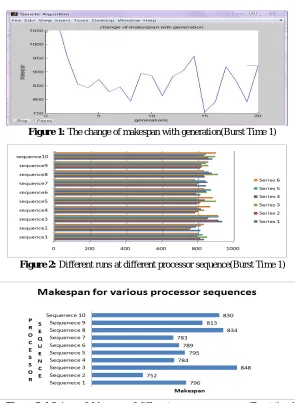
Result:Minimum makespan:752, Processor sequence: 2 4 3 1 5, Task sequence: 8 7 6 4 10 1 3 9 2 5
Figure 1: The change of makespan with generation(Burst Time 1)
Figure 2: Different runs at different processor sequence(Burst Time 1)
Figure 3: Minimum Make span of different processor sequences(Burst time1) Processo
r Sequence
Makespa n
#Run1
Makespa n
#Run2
Makespa n
#Run3
Makespa n
#Run4
Makespa n
#Run5
Makespa n
#Run6
Minimum
Makespa n Value
1 833 811 851 796 825 803 796
2 813 752 760 788 814 831 752
3 935 914 848 857 914 912 848
4 784 800 835 816 797 867 784
5 797 813 900 838 795 881 795
6 813 789 849 844 873 835 789
7 844 795 799 852 840 783 783
8 837 834 911 877 860 834 834
9 813 822 857 818 845 857 813
Volume 2, Issue 7, July 2013
Page 376
Table 3: Result of Burst time 2 Processo
r Sequence
Makespa n #Run1
Makespa n #Run2
Makespa n #Run3
Makespa n #Run4
Makespa n #Run5
Makespa n #Run6
Minimum Makespa n Value
1 795 788 863 842 838 762 762
2 807 847 797 814 810 790 790
3 914 845 914 873 846 868 845
4 793 810 944 771 808 783 771
5 848 861 851 859 806 776 776
6 849 898 826 828 880 810 810
7 769 817 840 789 816 844 826
8 827 849 859 859 838 857 827
9 841 843 802 857 841 972 802
10 845 959 959 872 995 841 841
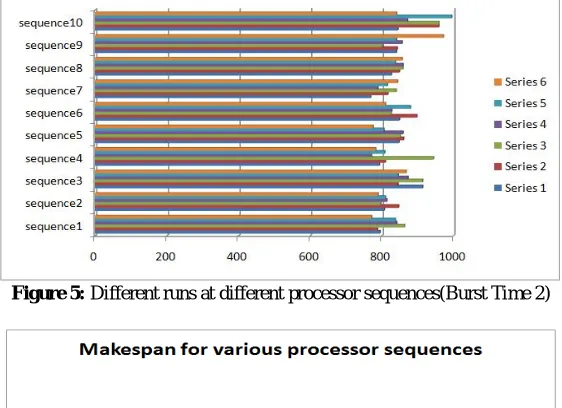
Result:Minimum makespan: 762, Processor sequence: 2 1 5 4 3, Task sequence: 10 3 6 12 4 5 9 7 8
Figure 4: The change of makespan with generation(Burst Time 2)
Figure 5: Different runs at different processor sequences(Burst Time 2)
Volume 2, Issue 7, July 2013
Page 377
Table 4: Result of Burst time 3
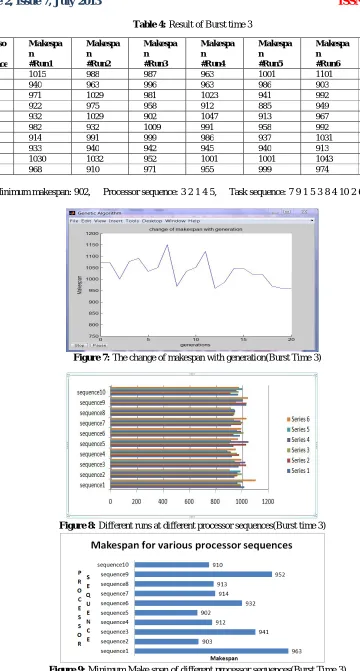
Result:Minimum makespan: 902, Processor sequence: 3 2 1 4 5, Task sequence: 7 9 1 5 3 8 4 10 2 6
Figure 7: The change of makespan with generation(Burst Time 3)
Figure 8: Different runs at different processor sequences(Burst time 3)
Figure 9: Minimum Make span of different processor sequences(Burst Time 3) Processo
r Sequence
Makespa n #Run1
Makespa n #Run2
Makespa n #Run3
Makespa n #Run4
Makespa n #Run5
Makespa n #Run6
Minimum Makespa n Value
1 1015 988 987 963 1001 1101 963
2 940 963 996 963 986 903 903
3 971 1029 981 1023 941 992 941
4 922 975 958 912 885 949 912
5 932 1029 902 1047 913 967 902
6 982 932 1009 991 958 992 932
7 914 991 999 986 937 1031 914
8 933 940 942 945 940 913 913
9 1030 1032 952 1001 1001 1043 952
Volume 2, Issue 7, July 2013
Page 378
Table 5: Result of Burst time 4
Processo r Sequence
Makespa n #Run1
Makespa n #Run2
Makespa n #Run3
Makespa n #Run4
Makespa n #Run5
Makespa n #Run6
Minimum Makespa n Value
1 868 866 765 842 866 873 765
2 831 854 841 829 784 821 794
3 864 806 777 767 793 795 767
4 849 865 775 851 866 866 775
5 808 828 792 795 799 829 792
6 806 843 798 799 793 814 793
7 853 803 882 873 871 876 803
8 818 779 795 842 836 833 779
9 804 790 837 871 779 818 779
10 780 841 780 851 835 828 780
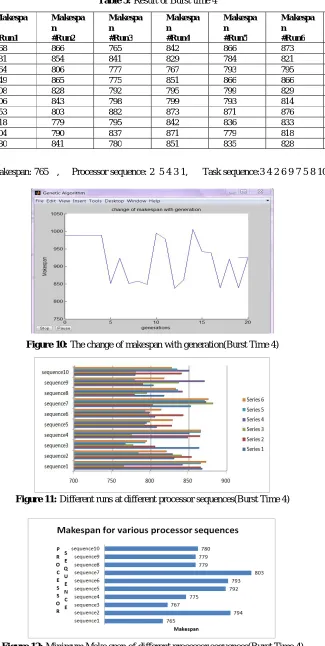
Result:Minimum makespan: 765 , Processor sequence: 2 5 4 3 1, Task sequence:3 4 2 6 9 7 5 8 10 1
Figure 10: The change of makespan with generation(Burst Time 4)
Figure 11: Different runs at different processor sequences(Burst Time 4)
Volume 2, Issue 7, July 2013
Page 379
Table 6: Result of Burst time 5 Processo
r Sequence
Makespa n #Run1
Makespa n #Run2
Makespa n #Run3
Makespa n #Run4
Makespa n #Run5
Makespa n #Run6
Minimum Makespa n Value
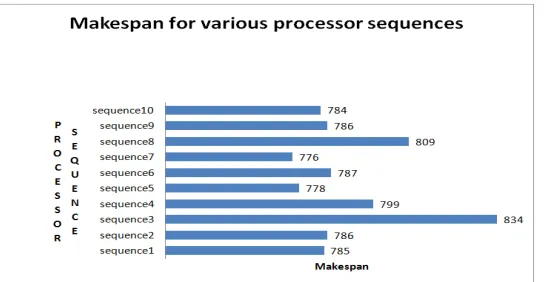
1 805 790 850 785 840 805 785
2 816 808 841 858 786 827 786
3 834 827 831 834 834 831 834
4 799 839 782 825 822 801 799
5 799 807 778 793 822 822 778
6 834 849 825 787 826 787 787
7 776 783 826 816 839 796 776
8 809 815 832 828 847 850 809
9 786 802 811 805 787 809 786
10 784 827 811 813 828 800 784
Result: Minimum makespan: 776, Processor sequence: 4 5 3 1 2, Task sequence:3 6 5 2 8 9 4 1 7 10
Figure 13: The change of makespan with generation(Burst Time 5)
Figure14:Different runs at different processor sequences(Burst Time 5)
Volume 2, Issue 7, July 2013
Page 380
4.
COMBINED ANALYSIS
Sequence of processor 2 1 5 4 3 gives minimum makespan twice i.e. 762 and 765.In all other Burst times the processor sequence give the makespan approximately equal to the overall minimum makespan except one case as in burst time 3. So we can conclude that processor sequence 1 i.e. 2 1 5 4 3 gives best results with most of the burst times.Although the minimum makespan values and combination of tasks may be different with different burst times.
5.
CONCLUSIONS
In the present work, Multiprocessor task scheduling problem has been implemented using Genetic algorithm. Some of the major conclusions from the present work have been found which are explained below:
1.Makespan of multiprocessor scheduling problem vary with combination of processors as well as combination of processes.
2.Different task combination give different results with different processors combinations
3.Different combination of tasks can give same Makespan values with the same combination of processors. 4.With the same burst time minimum makespan of different combination of processors is different.
Variability of the processors is kept limited to some extent in future all permutations of processors can be considered. In this way performance can further be increased.
REFERENCES
[1.]T.L.Adam , K.M. Chandy, And J.R. Dicson, “ A Comparison Of List Schedules For Parallel Processing Systems”, Communication OftheAcm, Vol.17,PP.685-690, December 1974.
[2.]Kohler, W.H., “A Preliminary Evaluation Of The Critical Path Method For Scheduling Tasks On Multiprocessor Systems” IEEE Trans. Computers, Vol. C-24, Dec. 1975.
[3.]M.R.GareyAnd D.S. Johnson, Computers And Intractability: A Guide To The Theory Of NP Completeness, San Francisco, CA, W.H. Freeman, 1979.
[4.]Kenneth A. De Jong And William M. Spears, “Using Genetic Algorithms To Solve NP-Complete Problems” Proceedings Of The Third International Conference On Genetic Algorithms, George Mason University, June 4-7, 1989.
[5.]E. Hou, R. Hong, And N. Ansari, "Multiprocessor Scheduling Based On Genetic Algorithms", Dept Of Ece, New Jersey Institute Of Technology, Technical Report, Aug. 1990
[6.]Sandeep Jain And ShwetaMakkar, “Multiprocessor Environment Using Genetic Algorithm” Volume 2, Issue 5, May 2012.
[7.]KirtiNagpal, ShephyBatraAndVaishaliWadhwa, “Proposed Algorithm For Optimization Of Job Scheduling In Multiprocessor Systems Using Genetic Approach” International Journal Of Computer Applications & Information Technology Vol. I, Issue III, November 2012.