Annals of Pure and Applied Mathematics
Vol. 2, No. 1, 2012, 33-39
ISSN: 2279-087X (P), 2279-0888(online)
Published on 11 December 2012
www.researchmathsci.org
33
Annals of
Antimagic Labeling in the Context of Switching of a
Vertex
S. K. Vaidya1 and N. B. Vyas2
1Department of Mathematics, Saurashtra University,
Rajkot – 360005, Gujarat, INDIA. E-mail: [email protected]
2Department of Mathematics, Atmiya Institute of Technology & Science,
Rajkot – 360005, Gujarat, INDIA. E-mail: [email protected]
Received
30 November 2012
; accepted 10 December2012
Abstract. A graph with q edges is called antimagic if its edges can be labeled with 1, 2,…,q such that the sums of the labels of the edges incident to each vertex are distinct. Here we prove that the graphs obtained by switching of a pendant vertex in path Pn, switching of a vertex in cycle Cn, switching of a rim vertex in wheel Wn,
switching of an apex vertex in helm Hn and switching of a vertex of degree 2 in fan fn admit antimagic labeling.
AMS Mathematics Subject Classification (2010): 05C78, 05C38
Keywords: Switching of a vertex, Antimagic labeling, Antimagic graphs.
1. Introduction
We begin with a finite, connected and undirected graph G = (V(G),E(G))
without loops and multiple edges. Throughout this paper |V(G)| and |E(G)| respectively denote the number of vertices and number of edges in G. For any undefined notation and terminology we rely upon Gross and Yellen[3]. A brief summary of definitions and existing results is provided in order to maintain the compactness.
Definition 1.1. A graph labeling is an assignment of integers to the vertices or edges or both subject to certain condition(s). If the domain of the mapping is the set of vertices (or edges) then the labeling is called a vertex labeling (or an edge labeling).
34
Definition 1.2. A graph with q edges is called antimagic if its edges can be labeled with 1, 2,…,q such that the sums of the labels of the edges incident to each vertex are distinct.
The concept of antimagic graph was introduced by Hartsfield and Ringel[4]. They showed that paths Pn(n ≥ 3), cycles, wheels, and complete graphs Kn(n ≥ 3) are
antimagic. They conjectured that (i) all trees except K2 are antimagic,
(ii) all connected graphs except K2 are antimagic.
These conjectures are unsettled till today.
Definition 1.3. A vertex switchingGv of a graph G is the graph obtained by taking a
vertex v of G, removing all the edges to v and adding edges joining v to every other vertex which are not adjacent to v in G.
Definition 1.4. The wheel graph Wn is defined to be the join K1+Cn. The vertex
corresponding to K1 is known as apex vertex and vertices corresponding to cycle are
known as rim vertices while the edges corresponding to Cn are known as rim edges.
We continue to recognize apex of wheel as the apex of the respective graphs obtained from wheel.
Definition 1.5. The helm Hn is the graph obtained from a wheel Wn by attaching a
pendant edge to each rim vertex.
Definition 1.6. A fan graph fn is obtained by Pn+K1.
In the following section we will investigate some new results on Antimagic labeling of graphs.
2. Main Results
Theorem 2.1. Switching of a pendant vertex in a path Pn is antimagic.
Proof: Let v1,v2,…,vn be the vertices of Pn and Gv denotes the graph obtained by
switching of a pendant vertex v of G = Pn. Without loss of generality let the switched
vertex be v1. We note that
| (
V G
v1) |
=
n
and| (
E G
v1) | 2
=
n
−
4
. We define( )
1{
}
:
v1, 2,..., 2
4
f E G
→
n
−
as follows:For 2≤ ≤ −i n 1:
1
(
i i)
1
f v v
+= −
i
; For 3≤ ≤i n:1
(
i)
4
f v v
= + −
n i
,35
Illustration 2.2. In Figure 1 the graph obtained by switching of a vertex v1 in path
P5 and its antimagic labeling is shown.
Figure 1
Theorem 2.3. Switching of a vertex in cycle Cn is antimagic.
Proof. Let v1,v2, …,vn be the successive vertices of Cn and Gv denotes graph
obtained by switching of vertex v of G= Cn. Without loss of generality let the
switched vertex be v1. We note that V G
( )
v1 =n and E G( )
v1 =2n−5. We define( )
1{
}
:
v1, 2,..., 2
5
f E G
→
n
−
as follows:For 3≤ ≤i n:
1
(
i) 2(
2)
f v v
=
i
−
;1
(
i i) 2
5
f v v
−= −
i
,Above defined edge labeling function will generate all distinct vertex labels as per the definition of an antimagic labeling. Hence the graph obtained by switching of a vertex in a cycle Cn is antimagic.
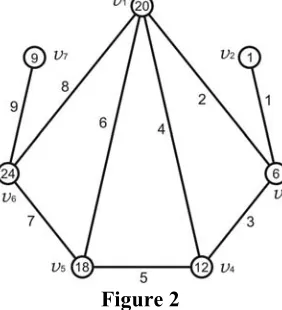
Illustration 2.4. In Figure 2 the graph obtained by switching of a vertex v1 in cycle
C7 and its antimagic labeling is shown.
Figure 2
Theorem 2.5. Switching of a rim vertex in a wheel Wn is antimagic.
Proof. Let v as the apex vertex and v1,v2, … ,vn be the rim vertices of wheel Wn. Let
1
v
36
( )
v1 1V G = +n and
( )
1 3 6
v
E G = n− . We define
( )
{
}
1
:
v1, 2,...,3
6
f E G
→
n
−
as follows. For2≤ ≤ −i n 1:
1
(
i i)
1
f v v
+= −
i
; For 2≤ ≤i n:(
i) 2
1
f vv
=
n i
− −
; For 3≤ ≤ −i n 1:1
(
i) 2
5
f v v
=
n i
+ −
,Above defined edge labeling function will generate all distinct vertex labels as per the definition of an antimagic labeling. Hence the graph obtained by switching of a rim vertex in a wheel Wn is antimagic.
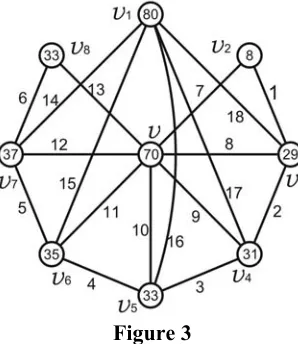
Illustration 2.6. In Figure 3 the graph obtained by switching of a vertex v1 in wheel
W8 and its antimagic labeling is shown.
Figure 3
Theorem 2.7. Switching of an apex vertex in helm Hn is antimagic.
Proof. Let Hn be a helm with v as the apex vertex, v1,v2,…,vn be the vertices of cycle
and u1,u2,…,un be the pendant vertices. Let Gv denotes graph obtained by switching
of an apex vertex v of G=Hn. We note that
V G
( )
v=
2
n
+
1
andE G
( )
v=
3
n
. Wedefine f E G:
( ) {
v → 1, 2,...,3n}
as follows.Case 1: n≡ 0 ( mod 3 ); n ≠ 3
1
(
) 2
f vu
=
;1 1
(
) 1
f v u
=
;1 2
(
) 3
37
(
i) 3
2
f vu
= −
i
;(
i i) 3 1
f v u
= −
i
;1
(
i i) 3
f v v
+=
i
where(
v
n+1=
v
1)
The case when n = 3 is to be dealt separately and the graph is labeled as shown in
Figure 4.
Figure 4
Case 2: n≡ 1, 2 ( mod 3 ) For 1≤ ≤i n:
(
i) 3
2
f vu
= −
i
;(
i i) 3 1
f v u
= −
i
;1
(
i i) 3
f v v
+=
i
where(
v
n+1=
v
1)
Above defined edge labeling function will generate all distinct vertex labels as per the definition of an antimagic labeling. Hence the graph obtained by switching of an apex vertex in a helm Hn is antimagic.
38
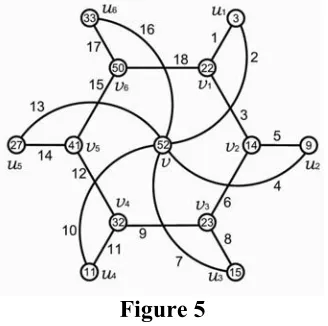
Illustration 2.8. In Figure 5 the graph obtained by switching of an apex vertex v in helm H5 and antimagic labeling is shown.
Theorem 2.9. Switching of a vertex having degree 2 in fan fn is antimagic.
Proof. Let v as the apex vertex and v1, v2, … , vn be the vertices of fan fn. Let
G
v1denotes graph obtained by switching of a vertex v1 having degree 2 of G = fn. We
note that
( )
1 1
v
V G = +n and
( )
1 3 5
v
E G = n− .
We define
( )
{
}
1
:
v1, 2,...,3
5
f E G
→
n
−
as follows. For2≤ ≤i n:(
i)
1
f vv
= −
i
; For 2≤ ≤ −i n 1:1
(
i i)
2
f v v
+= + −
n i
; For 3≤ ≤i n:1
(
i) 2
5
f v v
=
n i
+ −
;Above defined edge labeling function will generate all distinct vertex labels as per the definition of an antimagic labeling. Hence the graph obtained by switching of a vertex having degree 2 in fan fn is antimagic.
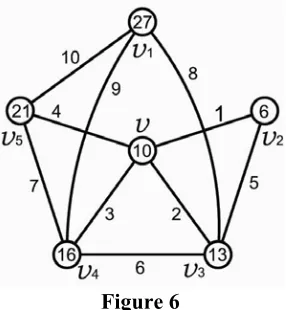
Illustration 2.10. In Figure 6 the graph obtained by switching of a vertex v1 having
degree 2 in fan f5 and its antimagic labeling is shown.
Figure 6 3. Concluding Remarks
39
REFERENCES
1. L. W. Beineke and S. M. Hegde, Strongly Multiplicative graphs, Discuss. Math. Graph Theory, vol. 21, pp. 63-75, 2001.
2. J. A. Gallian, A Dynamic Survey of Graph Labeling, The Electronics Journal of Combinatorics, vol. 18 (#DS6), 2011.
Available: http://www.combinatorics.org/Surveys/ds6.pdf
3. J. Gross and J. Yellen, Graph Theory and its Applications, CRC Press, 1999. 4. N. Hartsfield and G. Ringel, Pearls in Graph Theory, Academic Press, Boston,