128
Formulation and Evaluation of Caffeine Loaded Floating Tablets
Mohit Tomar
*, Neha Tomar, Neha Gulati, Upendra Nagaich, Amit Chaudhary, Bhavya
Rastogi
Department of Pharmaceutics, School of Pharmacy, Bharat Institute of Technology, By-Pass
Road, Partapur, Meerut-250103, Uttar Pradesh, India
*Corresponding author: [email protected]
ABSTRACT
The aim of the present work was to fabricate and characterize caffeine loaded floating
tablets loaded as sustained release dosage forms. Several formulations were prepared by
varying the concentrations of sodium bicarbonate and citric acid. Floating tablets were
prepared using HPMC as a binder and sodium bicarbonate as gas generating agents. The
prepared floating tablets were evaluated for tablet properties such as hardness, thickness,
friability, weight variation and floating property.
In vitro
dissolution was conceded out for
about 16 hrs in 0.1N HCl at 37±0.5 °C using USP paddle type dissolution apparatus. It was
noted that, all the prepared formulations had desired floating lag time and constantly
floated on dissolution medium. The drug release from floating tablets was found that the
varying concentration of the polymer affected the drug release. In the present surveillance
that floating drug delivery system can be prepared and evaluated.
Keyword
:
Floating Tablets, Caffeine, Hydrodynamically balance system, Effervescence,
Sustain Release, Sodium bicarbonate.
INTRODUCTION
Floating drug delivery system (FDDS), also called hydrodynamically balanced system, is an
effective technology to prolong the gastric residence time in order to improve the
bioavailability of the drug. This technology is suitable for drugs with an absorption window
in the stomach or in the upper part of the small intestine, drugs acting locally in the stomach
and for drugs that are poorly soluble or unstable in the intestinal fluid [1,2]. Effervescent
129
remain buoyant in the stomach for a prolonged period of time and released the drug slowly
at a desired rate. The effervescent system utilizes matrices prepared with swellable
polymers and effervescent components, e.g. sodium bicarbonate and citric acid. This
produces an upward motion of the dosage form and maintains its buoyancy. [3,4] Floating
systems having low density systems that have sufficient buoyancy to float over the gastric
contents and remain in the stomach without affecting the gastric emptying rate for a
prolonged period. While the system floats over the gastric contents, the drug is released
slowly at the desired rate, which results in increased gastric retentive time and reduces
fluctuation in the plasma drug concentration.[5]
Gastric retention systems are important for drugs that are degraded in the intestine, drugs
with local action in the stomach, drugs with poor solubility in intestine due to alkaline pH,
drugs with rapid absorption from gastrointestinal tract to produce transient peaks in serum
drug levels. [6] Caffeine acts as a central nervous system stimulant, temporarily warding off
drowsiness and restoring alertness. It produces increased wakefulness, faster and clearer
flow of thought, increased focus, and better general body coordination. Effervescent floating
tablet of Caffeine retain in stomach improves solubility, bioavailability, reduces drug waste.
Floating dosage delivery systems (FDDS) is important technological drug delivery systems
which offer several advantages in the drug delivery as they improved drug absorption,
because of increased GRT so that dosage form spent more time at its absorption site. FDDS
have mechanism of Controlled release drug delivery system. They have the local action such
as drug deliver in the stomach. They minimize the mucosal irritation due to drugs, by drug
releasing slowly at controlled rate. FDDS may be used in the treatment of gastrointestinal
disorders such as gastro-esophageal reflux. There is better patient compliance and ease of
administration. This is site-specific drug delivery system [7].
MATERIALS AND METHODS
Materials
Caffeine was purchased from Merck Lab Mumbai, India. HPMC, Carbapol, Sodium
bicarbonate, Citric acid, poly vinyl pyrrolidine, tartaric acid and Talc tablets were purchased
130
Methodology
Formulation of Floating Tablet
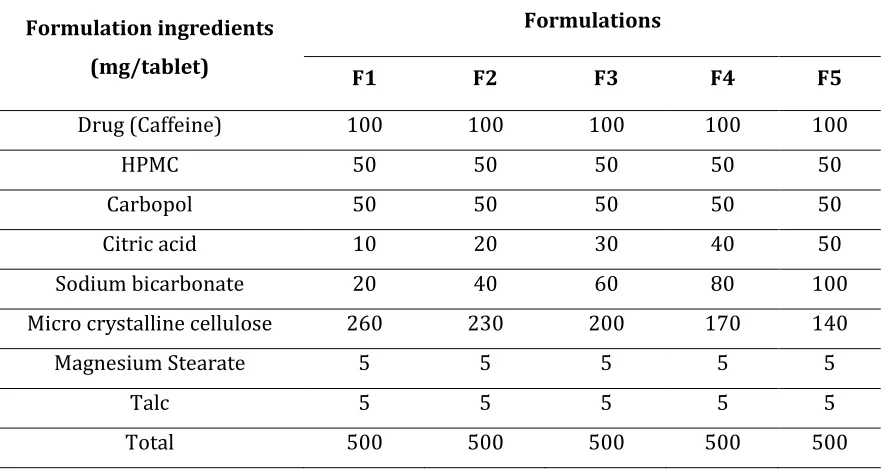
The matrix floating tablets of Caffeine were prepared by wet granulation technique. All the
powders were passed through 80 mesh sieve. The required quantity of drug, polymer and
filler were mixed thoroughly, and granules were prepared by using starch solution. The
granules were dried at 60 ºC in a oven. Talc and magnesium stearate were finally added and
the granules were compressed on single punch tablet compression machine to formulate
the floating tablets Table 1 [8].
Table 1: Formulation of Caffeine Loaded Floating tablets
Formulation ingredients
(mg/tablet)
Formulations
F1
F2
F3
F4
F5
Drug (Caffeine)
100
100
100
100
100
HPMC
50
50
50
50
50
Carbopol
50
50
50
50
50
Citric acid
10
20
30
40
50
Sodium bicarbonate
20
40
60
80
100
Micro crystalline cellulose
260
230
200
170
140
Magnesium Stearate
5
5
5
5
5
Talc
5
5
5
5
5
Total
500
500
500
500
500
Characterization of floating tablet
Shape of Tablets
Compressed tablets were examined by using the magnifying lens for the shape of the tablet
[7].
Tablet Dimensions
Thickness and diameter can be measured by using a calibrated varniear caliper. Three
tablets of each formulation were selected randomly and average thickness was measured
131
Friability
Friability of tablets was determined in Roche friabilator. It was expressed in percentage
(%). Ten tablets were initially weighed (W initial) and transferred into friabilator. The
friabilator was operated at 25rpm for 4 minutes or run up to 100 revolutions. Tablets were
dusted and re-weighed. % Friability of tablets less than 1% was considered acceptable [7].
The % friability was then calculated by –
%F = 100 (1-W0/W)
Hardness
Hardness indicates the ability of a tablet during handling to withstand with the mechanical
shocks. The hardness of the tablets was tested using a Monosanto hardness tester. It was
expressed in kg/cm
2. Three tablets were randomly picked and hardness of the tablets was
determined [9].
Weight variation Test
Ten tablets were selected randomly from each batch and weighed individually to check for
weight variation from electronic precision balance (CTG 302B-300). A little variation is
allowed in the weight of tablet by U.S. Pharmacopoeia. In all formulations, the tablet weight
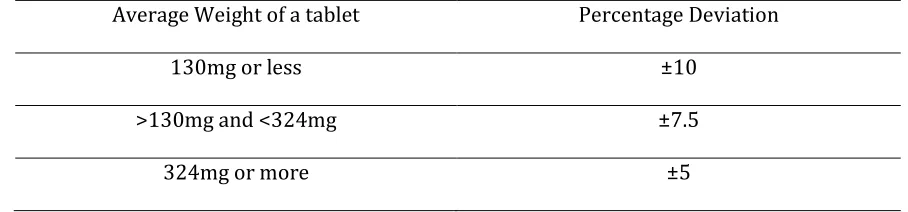
is 500mg. hence 5% maximum difference allowed (Table 2) [10].
Table 2: Standard limit value in weight variation test
Average Weight of a tablet
Percentage Deviation
130mg or less
±10
>130mg and <324mg
±7.5
324mg or more
±5
Floating Test
The time between introduction of dosage form and its buoyancy on simulated gastric fluid
132
for dosage form to emerge on surface of medium called floating Lag Time (FLT) or
Buoyancy Lag Time (BLT) and total duration of time (TFT) [10].
Swelling Characteristics (Water Uptake Study) :
The swelling properties of tablet containing drug were determined by placing the tablet
matrices in the dissolution test apparatus, in 900 ml of 0.1 N HCl at 37± 0.5 C. The tablets
were removed periodically from dissolution medium. After draining free from water tissue
paper, these were measured for weight gain [11].
Swelling characteristics were expressed in terms of percentage water uptake (WU %)
Weight of swollen tablet – Initial weight of the tablet
WU % = --- x 100
Initial weight of the tablet
In vitro
dissolution study
In vitro
dissolution of caffeine loaded fast dissolving tablets was studied in USP type-II
dissolution test apparatus (LABINDIA, DS 8000) employing a paddle stirrer at 50 RPM using
900 ml of pH 6.8 phosphate buffer as dissolution medium at 37±0.5˚C. One tablet was used
in each test. Aliquots of dissolution medium (5 ml) were withdrawn at specified intervals of
time and analyzed for drug content by measuring the absorbance. The volume withdrawn at
each time interval was replaced with fresh quantity of dissolution medium. Cumulative
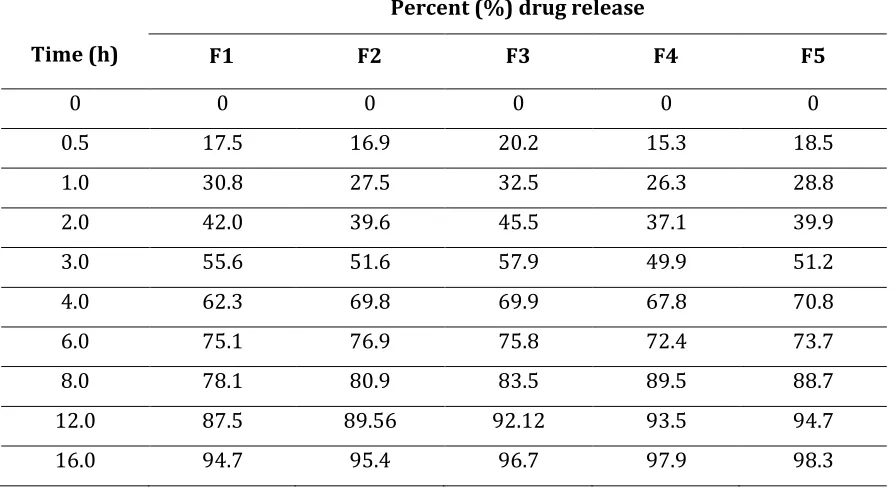
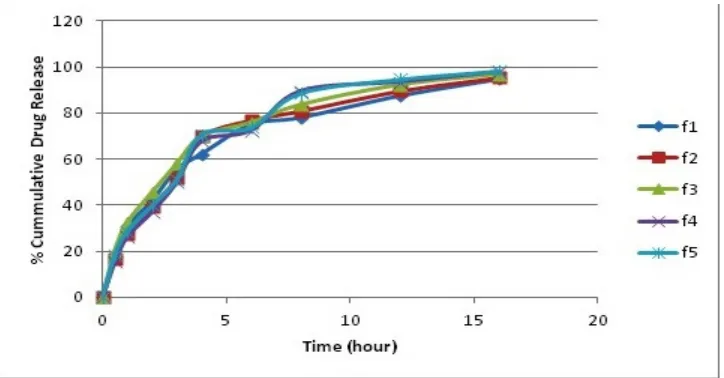
percent of caffeine released was calculated and plotted against time [8].
Drug content
For the drug content twenty tablets were weighed, crushed and powdered. An amount of
the powder equivalent to 100 mg of caffeine was taken and dissolved in 100 ml of pH 6.8
buffer, filtered, diluted suitably and analyzed for drug content at 271 nm using UV-Visible
double beam spectrophotometer (UV 2201 SYSTRONICS) [12] .
Accelerated stability studies
The promising formulation was tested for a period of 3 months at different temperature of
133
Table 3: Evaluation Parameters
Evaluation
Parameter
Formulation batch
F1
F2
F3
F4
F5
Thickness (mm)
2.9±0.09
3.0±0.12
3.2±0.15
2.9±0.13
3.1±0.18
Diameter(mm)
10.8±0.02
10.9±0.14
11.1±0.15
10.9±0.16
11.2±0.23
Shape
Circular
Circular
Circular
Circular
Circular
Hardness (kg/cm
2)
5.4±0.15
5.6±0.13
5.8±0.09
4.1±0.05
4.2±0.02
Friability (%)
0.52±0.10
0.60±0.10
0.71±0.09
0.50±0.07
0.66±0.06
Weight variation
503±1.51
503±1.18
502±1.45
501±1.59
499±0.58
Total Floating
Time (h)
>8
>10
>11
>9
>14
Buoya-ncy lag time
(s)
68
58
52
48
40
Drug content (%)
94.62±0.51
92.68±0.25
96.71±0.28
97±0.35
99.12±0.28
n =3
Table 4:
In vitro
cumulative percent drug release of caffeine loaded Floating Tablets
Time (h)
Percent (%) drug release
F1
F2
F3
F4
F5
0
0
0
0
0
0
0.5
17.5
16.9
20.2
15.3
18.5
1.0
30.8
27.5
32.5
26.3
28.8
2.0
42.0
39.6
45.5
37.1
39.9
3.0
55.6
51.6
57.9
49.9
51.2
4.0
62.3
69.8
69.9
67.8
70.8
6.0
75.1
76.9
75.8
72.4
73.7
8.0
78.1
80.9
83.5
89.5
88.7
12.0
87.5
89.56
92.12
93.5
94.7
16.0
94.7
95.4
96.7
97.9
98.3
134
In vitro cumulative percent drug release of caffeine loaded Floating Tablets