Strongly Secure Revocable ID-based Signature without Random Oracles
Ying-Hao Hung, Tung-Tso Tsai, Yuh-Min Tseng
*, Sen-Shan Huang
Department of Mathematics, National Changhua University of Education, Jin-De Campus, Chang-Hua 500, Taiwan, R.O.C.
e-mail: [email protected]
http://dx.doi.org/10.5755/j01.itc.43.3.5718
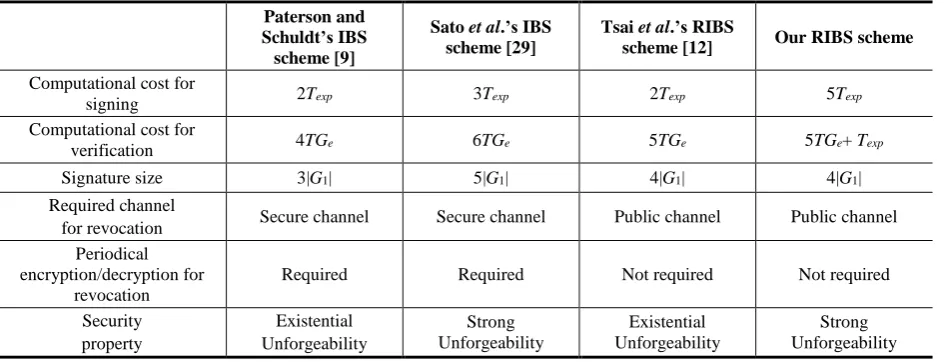
Abstract. In 2012, Tseng and Tsai presented a novel revocable ID (identity)-based public key setting that provides an efficient revocation mechanism with a public channel to revoke misbehaving or compromised users from public key systems. Subsequently, based on Tseng and Tsai’s revocable ID-based public key setting, Tsai et al. proposed a new revocable ID-based signature (RIBS) scheme in the standard model (without random oracles). However, their RIBS scheme possesses only existential unforgeability under adaptive chosen-message attacks. In the article, we propose the first strongly secure RIBS scheme without random oracles under the computational Diffie-Hellman and collision resistant assumptions. Comparisons with previously proposed schemes are made to demonstrate the advantages of our scheme in terms of revocable functionality and security property.
Keywords: strong unforgeability; revocation; identity-based signature; standard model.
1. Introduction
Digital signature, one important cryptographic primitive, provides the integrity, authentication and non-repudiation of messages. In traditional public key systems, before verifying a signature, a user must obtain the corresponding authenticated public key (i.e. certificate) from public directories. In such a case, efficient public key management becomes an important issue. In 1984, to simplify public key management, Shamir [1] introduced the concept of identity (ID)-based cryptography (IBC), in which a user’s public key is determined by his/her identity information such as social security number, e-mail address, telephone number, name, etc. Moreover, a trusted third party, called private keygenerator (PKG), is responsible to produce private keys which are distributed to users via secure channels. As opposed to traditional public key systems, IBC eliminates the requirement of certificates. Shamir’s system was ingenious but not practical, how-ever. In 2001, Boneh and Franklin [2] adopted Shamir’s idea to propose a new ID-based public key system and the first practical ID-based encryption (IBE) based on modification of bilinear pairings defined on elliptic curves. Since then, a numerous primitives for IBC have been published such as ID-based authentication protocols [3-5], ID-based key agreement protocols [6-8], ID-based signature schemes [9-13] and ID-based encryption schemes [14-17].
*Corresponding author
In 2002, according to Boneh and Franklin’s ID-based public key setting [2], Paterson [18] proposed an ID-based signature (IBS) scheme by making use of bilinear pairings. Later, Cha and Cheon [10] proposed a new IBS scheme that improved Paterson’s scheme on both efficiency of computation and signature size while the security of their scheme was based on the gap Diffie-Hellman assumption. In 2009, Tseng et al. [19] and Shim [20], independently, proposed efficient IBS schemes that are provably secure and support variant kinds of batch verifications. Both schemes significantly improve the verification performance for many coope-rative and distributed applications. The four IBS schemes mentioned above have been shown to be secure in the random oracle model. However, when random oracles are instantiated with concrete hash functions, those IBS schemes could be insecure. In 2006, to overcome this problem, Paterson and Schuldt [9] proposed an IBS scheme without random oracles which is computationally efficient and has short signa-ture size. In 2008, Narayan et al. [21] further improved Paterson and Schuldt’s scheme by reducing the size of the public parameters.
signatures of the IBS scheme on some message m is unable to generate a new signature on m. Strong unforgeability ensures that an adversary cannot genera-te a new signature for a previously signed message. Therefore, strongly unforgeable IBS schemes are important for constructing ID-based cryptographic schemes such as chosen-ciphertext secure ID-based cryptosystems and ID-based group signatures. In the past, several strongly unforgeable non-ID-based signa-ture schemes [22-25] without random oracles have been proposed. Furthermore, the work in [26-28] provi-ded several transformation methods to construct strongly unforgeable IBS schemes out of strongly unforgeable non-ID-based signature schemes. Re-cently, without applying any transformation ways, Sato et al. [29] proposed a strongly unforgeable IBS scheme without random oracles based on Paterson and Schuldt’sIBS scheme [9]. Their scheme offered better performance in terms of signature size and computation cost when compared with the schemes in [26-28].
A public key system construction must provide a revocation mechanism to revoke misbehaving or com-promised users from the system. In 2001, Boneh and Franklin [22] presented a revocation mechanism for ID-based public key systems, in which the PKG gene-rates and sends new private keys for non-revoked users periodically. To do so, the PKG must establish a secure channel with each non-revoked user to transmit the new private key. The key update size is equal to the number of non-revoked users. Boldyreva et al. [30] applied a binary tree structure to construct a revocable ID-based encryption (RIBE) which reduces the key update size to the logarithmof the number of users. However, both revocation methods mentioned above need secure channels to transmit the users’ new private keys periodically. This causes enormous computational load for both of encryption and decryption procedures.
In order to resolve the “secure channel” problem above, Tseng and Tsai [31] proposed a new RIBE sche-me and offered a practical revocation sche-mechanism with a “public channel”. In their scheme, the PKG and non-revoked users can significantly reduce computational burden due to the absence of encryption/decryption via secure channels. Subsequently, based on Tseng and Tsai’s revocable ID-based public key setting, Sun et al. [32] proposed a revocable ID-based signature (RIBS) scheme in the random oracle model. Although the scheme [32] based on the random oracle model can offer better performance, the resulting scheme could be insecure when random oracles are instantiated with concrete hash functions [33, 34]. Furthermore, Tsai et al. [12] proposed the first RIBS scheme in the standard model (without random oracles). However, their RIBS scheme possesses only existential unforgeability under adaptive chosen-message attacks. In this article, we first present a new framework and security notions for strongly unforgeable RIBS schemes with revocation via public channels. We then propose the first strongly unforgeable RIBS scheme without random oracles. Under the computational Diffie–Hellman and collision
resistant assumptions, we demonstrate that our RIBS scheme possesses strong unforgeability under adaptive chosen-message attacks. When compared with previously proposed IBS and RIBS schemes without random oracles, our scheme provides better perfor-mance in terms of computational cost and revocable functionality while possessing strong unforgeability.
The remainder of the article is organized as follows. Preliminaries are given in Section 2. In Section 3, we present the framework and security notions for strongly unforgeable RIBS schemes. Section 4 presents our concrete scheme. In Section 5, we analyze the security of our scheme. Comparisons are presented in Section 6. Conclusions are given in Section 7.
2. Preliminaries
In the section, we will briefly review some properties of bilinear pairings. We also introduce the computational Diffie-Hellman (CDH) and collision resistant (CRH) assumptions.
2.1. Bilinear pairings
Let G1 and G2 be two multiplicative cyclic groups
of large prime order p. Let g be a generator of G1.A
mapping ê: G1G1 G2 is an admissible bilinear map
if it satisfies the following properties: 1. Bilinearity: For every ga, gb G
1, ê(ga, gb)
ê(g, g)ab, where a, b Z p*.
2. Non-degeneracy: ê(g, g) 1.
3. Computability: There exists an efficient algorithm to compute the value ê(ga, gb).
2.2. Security assumptions
Two hard problems and their corresponding assumptions are presented here.
Definition 1 (Computational Diffie-Hellman (CDH) Problem and Assumption). Let G1 be a cyclic
multiplicative group of large prime order p with generator g. Given ga, gbG
1 with unknown a, bZp*,
the computational Diffie-Hellman (CDH) problem in G1 is to compute gab. We say that the (ε, t)-CDH
assumption holds in the group G1 if nopolynomial-time
adversary A can solve the CDH problem in G1 with
non-negligible probability ε within time t. Here, the successful probability (advantage) of the adversary Ais presented as
Pr[A(g, ga, gb) =gab],
where the probability is over the random choice consumed by the adversary A.
Definition 2. Collision-resistant hash (CRH) assumption. Let Hk:{0, 1}*{0, 1}n be a
running in time at most t can break the collision-resistance of Hk with probability ε. Here, the successful
probability (advantage) of the adversary Ais presented as
Pr[A(k) =(m0, m1) : m0 ≠ m1, Hk(m0)= Hk(m1)],
where the probability is over the random choice consumed by the adversary A.
Remark 1. In this paper, we use collision resistant hash (CRH) functions to construct our RIBS scheme, in which the CRH functions can be easily constructed based on the CDH assumption [23].
3. Framework and security notions of strongly
unforgeable RIBS
In this section, we present the framework and security notion for strongly unforgeable RIBS schemes. The framework of strongly unforgeable RIBS schemes is identical to that of Tsai et al.’s RIBS scheme [12]. We also define a new security notion for strongly unforgeable RIBS schemes based on the notions in [9, 21, 28, 29].
Definition 3. A strongly secure RIBS scheme consists of five algorithms:
Setup algorithmG is a probabilistic algorithm run by the PKG that takes as input a security parameter
and the total number z of all periods, and outputs a system secret key s and public parameters Parms. The public parameters Parms are made public and the secret key s is kept for the PKG itself. Initialkey extract algorithmIKE is a deterministic algorithm run by the PKG that takes as input the system secret key s and a user’s identity ID, and returns the user’s initial secret key DID.
Time key update algorithm TKU is a deterministic algorithm run by the PKG that takes as input the system secret key s, a user’s identity ID and a period t, and then returns the user’s time update key TID,t.
Then, the user can combine the initial secret key DID
and the time update key TID,t to obtain the signing
key SID,t.
Signing algorithmS is a probabilistic algorithm that takes as input a period t, a user’s signing key SID,t
and a message M, and returns a signature on M.
Verification algorithm V is a deterministic algorithm that takes as input a signature pair (t,), a message M and a user’s identity ID, and outputs “accept” if (t,) is a valid signature on the message M for ID, and “reject” otherwise.
Definition 4. A strongly secure RIBS scheme possesses strong unforgeability against adaptive chosen-message attacks (RID-SUF-ACMA) if no probabilistic polynomial-time adversary A has a non-negligible
advantage in the following RID-SUF-ACMA game played with a challengerB.
Setup. The challenger B runs the setup algorithm G
to generate a system secret key s and public parameters Parms. The public parameters Parms are sent to the adversary A and the system secret key s is kept by B itself.
Queries. The adversary A performs the following queries adaptively:
- Initial key extract query (ID). When Arequests the initial secret key on an identity ID, the challenger B runs the initial key extract algorithmIKEto obtain DID and returns it to the
adversary A.
- Time key update query (ID, t). When Arequests the time update key on (ID, t), the challenger B
runs the time key update algorithm TKU to obtain the time update key TID,tand returns it to
the adversary A.
- Signing queries (M, ID, t). When A requests a signature on the message M for an identity ID and a period t, the challenger B runs the initial key extract algorithm IKE and time key update algorithmTKU to obtain the user’s signing key SID,t. Then B runs the signing algorithm S to
generate a signature on the message M using SID,t and returns to A.
Forgery. We say that the adversary A wins the RID-SUF-ACMAgame if A generates a tuple (M*, ID*,
t*,*) which satisfies the following conditions:
1. The response of the verification algorithm V
on (M*, ID*, t*,*) is “accept”.
2. * has not been outputted in the signing query
on (M*, ID*, t*).
3. Either ID* or (ID*, t*) has not appeared in the
initial key extract queries or the time key update queries, respectively.
The adversary A’s advantage is defined as the probability that A wins the RID-SUF-ACMAgame.
Remark 2. An RIBS scheme is said to be strongly unforgeable if it is existentially unforgeable and an adversary who is given signatures of the RIBS scheme on some message m is unable to generate a new signature on m. Strong unforgeability ensures that an adversary cannot generate a new signature for a previously signed message.
4. Strongly unforgeable RIBS scheme
Setup: Given a security parameter
and the total number z of all periods, the PKG chooses two cyclic groups G1 and G2 of sufficiently large prime orderp >2𝛿. Let g be a generator of G
1 and ê: G1G1
G2 be an admissible bilinear map. The PKG sets the
system secret key and the public parameters by performing the following tasks.
1. Select two secret values α, βZp* at random
and compute 𝑔1 gα+βG1. Select a random
𝑔2G1 and compute 𝑔2𝛼 and 𝑔2 𝛽.
2. Set four collision-resistant hash functions
H1:{0, 1}*{0, 1}m, H2:{0, 1}*{0, 1}n and
H3, H4:{0, 1}*{0, 1}l, where m, n and l are
fixed lengths. Here, we assume p > 2m, p > 2n
and p > 2l so that the outputs of these hash
functions can be directly viewed as elements of Zp without modulo p.
3. Randomly choose three values u′, t′, w′G1
and three vectors U = (ui), T = (tj), W = (wk),
where ui, tj, wkG1 for i = 1, 2,…, m, j = 1,
2,…, n and k = 1, 2,…, l.
Finally, the PKG sets the system secret key s = (𝑔2𝛼,
𝑔2 𝛽
) and the public parameters Parms = <G1, G2, ê, g, 𝑔1, 𝑔2, H1, H2, H3, H4, u′, U, t′, T, w′, W>.
Initial key extract: Given a user’s identity ID {0, 1}*, the PKG computes a string v = H
1(ID) of length
m. Let vi denote the i-th bit of the string v and let
U⊂ {1, 2,…, m} be the set of indices i such that vi
= 1 for i = 1, 2,…, m. Finally, the PKG chooses a random value rvZp*, computes the user’s initial
secret key DID = (D1, D2) = (𝑔2𝛼 (u′
U
i i
u
)rv , 𝑔𝑟𝑣)and sends DID to the user via a secure channel.
Time key update: Given a user’s identity ID{0,1}*
and a period t, the PKG computes a string vt = H2(ID, t) of length n. Let vtj denote the j-th bit of the
string vt and let T ⊂ {1, 2,…, n} be the set of indices j such that vtj = 1 for j = 1, 2,…, n. Finally,
the PKG chooses a random value rt Zp* and
computes the user’s time update key TID,t = (T1, T2)
= (𝑔2𝛽 (t′
T
j j
t
)rt , 𝑔𝑟𝑡). The PKG sends TID,tto theuser via a public channel. Upon receiving TID,t, the
user combines it with his/herinitial secret key DID
= (D1, D2) to generate the signing key SID,t= (S1, S2,
S3) =(D1T1, D2, T2) =(𝑔𝛼+𝛽 rv
i i
u
u'
)
(
U
(t′
T
j j
t
)rt ,𝑔𝑟𝑣, 𝑔𝑟𝑣).
Signing: For a period t, given a non-revoked user’s identity ID {0, 1}*, a message M {0, 1}*, the
user first computes a string vm = H3(M) of length l.
Let vmk denote the k-th bit of the string vm and let
W⊂ {1, 2,…, l} be the set of indices k such that vmk = 1 for k = 1, 2,…, l. Then the user chooses a
random number rm Zp* and computes 𝑔𝑟𝑚 and h=
H4(M||𝑔𝑟𝑚). Finally, the user generates a signature
𝜎 on the message M as follows:
𝜎= (𝜎1, 𝜎2, 𝜎3, 𝜎4)
= ((𝑆1)ℎ rm
k k
w
w'
)
(
W
, (𝑆2)ℎ, (𝑆3)ℎ, 𝑔𝑟𝑚)
= ((𝑔2𝛼+𝛽 rv
i i
u
u'
)
(
U
h r
j j
t
t t' ) )
(
T
m
r
k k
w
w'
)
(
W ,
𝑔𝑟𝑣ℎ, 𝑔𝑟𝑡ℎ,𝑔𝑟𝑚),
where (S1, S2, S3)
is the signing key
SID,t obtainedabove.
Verification: Given a signature𝜎 = (𝜎1 , 𝜎2 , 𝜎3 ,
𝜎4) for an identity ID on a message M in a period t, a verifier computes h = H4(M||𝜎4) and validates the signature as follows:
) , ( ˆ1 g
e =eˆ(g2,g1)he
ˆ
( u′
U
i i
u
, 𝜎2)e
ˆ
(
T
j j
t t' ,
𝜎3).
e
ˆ
(
W
k k
w
w'
, 𝜎4).The algorithm outputs “accept” if the checking equation above holds, and “reject” otherwise.
In the following, we show the correctness of the checking equation in the Verification algorithm as follows:
) , ( ˆ1 g
e =
e
ˆ
((𝑔2𝛼+𝛽 rvi i
u
u'
)
(
U
h r
j j
t
t
t'
)
)
(
T
m
r
k k
w
w'
)
(
W
, g)
=
e
ˆ
( ( ) 2
h
g
, g)e
ˆ
( rh ii
v
u
u'
)
(
U
, g)
e
ˆ
( rh jj
t
t t' )
(
T
, g)
e
ˆ
( rmk k
w
w'
)
(
W
, g)
=
e
ˆ
h) , ( 2
g
g
e
ˆ
((
)
Ui i
u
u'
, 𝑔𝑟𝑣ℎ)e
ˆ
((
)T
j j
t
t' , 𝑔𝑟𝑡ℎ)
e
ˆ
((
)
W
k k
w
w'
, 𝑔𝑟𝑚)=
e
ˆ
h)
,
(
g
2g
1e
ˆ
((
)
U
i i
u
u'
, 𝜎2)e
ˆ
((
)T
j j
t
t' , 𝜎3)
e
ˆ
((
)
W
k k
w
5. Security analysis
In this section, we give the security analysis of our RIBS scheme. In order to simplify the security analysis, we consider two types of adversaries, namely, outside adversary and inside adversary (or revoked user). We adopt a technique similar to that used in [12] to show that the proposed scheme possesses strong unforgeabi-lity against adaptive chosen-message attacks for both types of adversaries under the CDH and CRH assump-tions. Note that if the adversary is an outsider, it is allowed to issue all queries in the RID-SUF-ACMA game (mentioned in Section 3) except for the initial key extract query on the target identity ID*. If the adversary
is an inside adversary, it is allowed to issue all queries in the RID-SUF-ACMA game except for the time key update query on (ID*, t*).
Theorem 1. Under the CDH and CRH assumptions, the proposed RIBS scheme is strongly secure against adaptive chosen-message attacks (RID-SUF-ACMA) for an outside adversaryA. More precisely,assume that there is an outsider A, with an advantage ε against the proposed RIBS scheme, which can make at most qE> 0 initial key
extract queries,
q
U > 0 time key update queries andq
S> 0 signing queries within a running time τ. Then there is an algorithm B that has an advantageε′ ≥ ε [
) 1 ( ) 1 )( ( 16
1
q m q l
qE S S
]
to solve the CDH problem or
𝜀
′′≥
𝜀4
to violate the CRH assumption within a running time τ′ = τ +O( (mqE+ n
q
U+ (m + n+ l)q
S)τ1 + (qE+U
q +qS)τ2),
in which τ1 and τ2, respectively, denote the executing
time of a multiplication in G1 and the executing time of
an exponentiation in G1.
Proof. We assume that there exists an outside adversary
A which succeeds in attacking the proposed RIBS scheme. We will construct an algorithm B to solve the CDH problem or violate CRH assumption. Assume that the algorithm B is given <G1, G2, ê,g, ga, gb> as an
instance of the CDH problem, where a and b are unknown to B. To compute gab, the algorithm B
simulates a challenger for A in the RID-SUF-ACMA game as follows.
Setup. The challenger (algorithm) B first sets four collision-resistant hash functions as follows: H1:{0,
1}*{0, 1}m, H2:{0, 1}*{0, 1}n and H3, H4:{0,
1}*{0, 1}l, where m, n and l are fixed lengths.
Note that the employed collision-resistant hash
functions are not seen as random oracles in our security proofs. The challenger B sets lv = 2(qE +
S
q ) and lm = 2qS, and chooses two integers kv and
km at random, where 0 ≤ kv ≤ m and 0 ≤ km ≤ l. We
assume that lv(m + 1) < p and lm(l + 1) < p for the
given values of qE, qS, m and l. The challenger B
chooses a random value βZp as the secret value of
the time update key, and assigns 𝑔1= gagβ and 𝑔2=
gb. The challenger B selects x′, x
1,…, xm𝑍𝑙𝑣 , y′,
y1,…, ymZp, and computes u′ = 𝑔2
−𝑙𝑣𝑘𝑣+𝑥′𝑔𝑦 ′ and
a vector U = (ui), where ui =𝑔2𝑥𝑖𝑔𝑦𝑖 for1 ≤ i ≤ m. In
addition, the challenger B selects z′, z1,…, zn Zp,
and computes t′ =
g
z' and a vector T= (tj), where tj
=𝑔𝑧𝑗 for 1 ≤ j ≤ n. Moreover, the challenger B
selects c′, c1,…, cl 𝑍𝑙𝑚 , d′, d1,…, dl Zp, and
computes w′ = 𝑔2−𝑙𝑚𝑘𝑚+𝑐′𝑔𝑑 ′ and a vector W = (w
k),
where wk =𝑔2
𝑐𝑘𝑔𝑑𝑘 for1 ≤ k ≤ l. Now, the challenger
B has constructed a set of public parameters as Parms = <G1, G2, ê, g, 𝑔1, 𝑔2, H1, H2, H3, H4, u′,
U, t′, T, w′, W>.
Before performing Queries and Forgery between A
and B, we define three sets U, T and W, and five functions F, J, E, K and L.
1. Let v=H1(ID) which is a bit string of length
m. Let U⊂ {1, 2,…, m} be the set of indices
i such that vi = 1, where vi denotes the i-th bit
of the string v, for i = 1, 2,…, m. Define the functions F and J by
F(v) = -lvkv + x′ +
U
i i
x
and J(v) = y′ +
U
i i
y
.2. Let vt = H2(ID, t) which is a bit string of length
n. Let T ⊂ {1, 2,…, n} be the set of indices j
such that vtj = 1, where vtj denotes the j-th bit
of the string vt, for j = 1, 2,…, n. Define the function E by
E(vt) = z′ +
T
j j
z
.3. Let vm = H3(M) which is a bit string of length
l. Let W⊂ {1, 2,…, l} be the set of indices k
such that vmk = 1, where vmk denotes the k-th
bit of the string vm, for k = 1, 2,…, l. Define the functions K and L by
K(vm) = -lmkm+ c′ +
W
k k
c
and L(vm) = d′ +
W
k k
d
.( ) ( ) 2
F v J v
i i
u'
u
Ug
g
, E vt( )j j
t'
t
g
T
and
( ) ( ) 2
K vm L vm
k k
w'
w
Wg
g
. Queries. The adversary A may make a number of queries in an adaptive manner as follows.
- Initial key extract query (ID): Consider a query for the initial secret key of an identity ID. The challenger B first computes v = H1(ID) and then
F(v) and J(v). If F(v) = 0 mod p, the challenger
B aborts. Otherwise, the challenger B chooses a random rvZp and computes the initial secret
key DID by
DID = (D1, D2) = ( rv
i i v
F v J a
u
u'
)
(
)
(
()/ ()
U
g
,v
r v F
a g
g 1/() )
( ).
Now, we are convinced that DID = (D1, D2) is a valid
initial secret key by
D1 = rv
i i v
F v J
a
)
(
u'
u
)
(
( )/ ()
U
g
= vv i i rvi y x y' x' k l v F v J
a
)
(
)
(
()/ ( ) 2
2
U
g
g
g
g
g
= ( )/ ( )
2 2
(
)
(
v v i i i i)
vx y
l k x' r
J v F v y'
a
g
g
g g
Ug
U = v v i i i i rvy y' x x' k l v F a v J
)
(
)
(
g
() / ()g
2 Ug
U= ( ) ( ) / ( ) ( ) ( )
2
(
2)
(
2)
v
r
a F v J v a F v F v J v
g g
g
g
g
= () () / ()2
2( )
v F a r v J v F
a g g v
g
= r'
i i
a
(
u'
u
)
v2
U
g
and
D2 = (ga)1/F(v)grv =
g
rva/F(v)=g
rv', wherer
v'
r
v
a
/
F
(
v
)
.- Time key update query (ID, t): Consider a query for the time update key of an identity ID and a period t. The challenger B first computes vt = H2(ID, t) of length n. The challenger B then
cho-oses a random rtZp and uses the secret value β
to compute the time update key as follows:
TID,t = (T1, T2) = ( rt
j j
t
t'
)
(
2
T
g
, 𝑔𝑟𝑡).- Signing query (M, ID, t): Consider a query for an identity ID, a period t and a message M. The challenger B first computes v = H1(ID) and then
F(v) and J(v). Next, we consider two cases.
Case 1: If F(v) ≠ 0 mod lv, the challenger B can
compute the initial secret key and the time update key as in the initial key extract query and the time key update query, respectively, and B then uses the signing algorithm to create a signature on M.
Case 2: If F(v) = 0 mod p, the challenger B first computes vm = H3(M) and then K(vm) and L(vm). If
K(vm) = 0 mod p, the challenger B aborts. Otherwise, the challenger B chooses random values rv, rt, rmZp
and computes R= 𝑔𝑟𝑚. The challenger B then computes
h = H4(M||R) and constructs the signature as follows:
= (
1,
2,
3,
4)( ) / ( ) h/ ( ) 2
(
h(
) (
r hv) (
r ht)
L vm h K vm(
) ,
rm h,
h, (
)
K vm rm)
i j k
i j k
u'
u
t'
t
w'
w
g
g
a
g
rvg
rtg
ag
U T W
/ ( ) ( ) / ( )
2 2 2
(
h(
) (
r hv)
r ht(
L vm)
h K vm(
) ,
rm h,
h,
rm ah K vm)
i j k
i j k
u'
u
t'
t
w'
w
g
g g
ah -ahg
a
g
rvg
rtg
U T W
/ ( ) ( ) ( ) / ( ) ( ) ( )
2 2 2 2
(
h(
) (
r hv)
r ht(
K vm L vm)
K vm(
K vm L vm) ,
rm h,
h,
rm ah K vm)
i j
i j
u'
u
t'
t
g
g g
ahg
ahg
g
g
rvg
rtg
U T
/ ( ) / ( ) ( ) ( )
2 2 2
(
h(
) (
r hv)
r ht(
K vm L vm)
rm K vm,
h,
h,
rm ah K vm)
i j
i j
u'
u
t'
t
g
g g
ahg
ahg
rvg
rtg
U T
/ ( ) / ( ) ( ) ( )
2 2 2
(
h(
) (
r hv) (
r ht K vm L vm)
rm K vm,
h,
h,
rm ah K vm)
i j
i j
u'
u
t'
t
g g
ah
g
g
ahg
rvg
rtg
U T
2
((
(
) (
rv) ) (
rt h) ,
r 'm h,
h,
r 'm)
i j k
i j k
u'
u
t'
t
w'
w
g
a
g
rvg
rtg
U T W ,
Forgery. Assume that the adversary A generates a valid signature * = (𝜎
1∗, 𝜎2∗, 𝜎3∗, 𝜎4∗) for (ID*, t*) on M*, where ID*, t* and M* are the target identity,
period and message, respectively. We discuss two cases.
Case 1: If (M*, ID*, t*) did not appear in the signing
query, the challenger B computes v* = H
1(ID*), vt* =
H2(ID*, t*), vm* = H3(M*), F(v*) and K(vm*). If F(v*) ≠
0 mod p or K(vm*) ≠ 0 mod p, the challenger B aborts.
Otherwise, the challenger B computes h = H4(M|| 𝜎4∗) and outputs 𝑔𝑎𝑏 as follows:
2 1 ) ( ) ( ) ( 1 2 2 1 ) ( 4 1 ) ( 3 1 ) ( 2 1 1 * * * * * *)
)
(
)
)
(
)
(
((
)
(
)
(
)
(
)
(
g
g
g
g
g
g
rv rt rma h vm L vt E v J h r k k h r j j r i i h vm L h vt E h v J h m t
v
t'
t
w'
w
u
u'
U T W 2 1 ) ( ) ( ) ( 1 ) ( ) ( 2 ) ( ) ( ) ( 2 2 * * * * * * * *
)
(
)
(
)
(
g
g
g
g
g
g
g
g
g
g
m tv r r
r J v Evt Lvm h
h r vm L vm K r vt E r v J v F a m t v
* * * * * * 10 ( ) ( ) 0 ( )
2 2 2
1 ( ) ( ) ( )
2
(
) (
v) (
t)
mr
r r
a J v E vt L vm h
L vm
J v E vt h
m v t r r rg
g g
g
g g
g
g
g
g
a
2
g
g
ab.This resolves the computational Diffie-Hellman (CDH) problem.
Case 2: If (M*, ID*, t*) has appeared in the signing
query, adversary A owned a previously queried signature 𝜎 = (𝜎1 , 𝜎2 , 𝜎3 , 𝜎4 ) of (ID*, t*) on M*. If
𝜎2≠ 𝜎2∗ or 𝜎3≠ 𝜎3∗, the challenger B can output 𝑔𝑎𝑏 as in Case 1. Otherwise, if 𝜎2= 𝜎2∗ and 𝜎3 = 𝜎3∗ , then, since 𝜎2 =𝑔𝑟𝑣ℎ , 𝜎2∗ =𝑔𝑟𝑣ℎ
∗
,
3 =𝑔𝑟𝑡ℎ and 𝜎3∗ =,𝑔𝑟𝑡ℎ
∗
, we have h*=h, namely, H
4(M||𝑔𝑟𝑚 ) =H4(M|| * m
r
g
) where 𝜎4=𝑔𝑟𝑚and 𝜎4∗=* m
r
g
. This causes a collision of H4 which violates the CRH assumption.Now, we analyze the probability of the event that the challenger B does not abort. In the phase of initial key extract query, if F(v) ≠ 0 mod p, the challenger B
can correctly answer queries without aborting. In the phase of signing query, if F(v) ≠ 0 mod p or K(vm) ≠ 0 mod p, the challenger B can correctly respond queries without aborting. Note that by the previously mentioned assumptions lv(m + 1) < p and lm(l + 1) < p,
we have 0 ≤ lvkv ≤ p, 0 ≤ x′ +
U
i i
x
≤ p, 0 ≤ lmkm ≤ p and0 ≤ c′ +
W
k k
c
≤ p. Thus, F(v) = 0 mod p implies F(v) =0 mod lv and K(vm) = 0 mod p also implies K(vm) = 0
mod lm. Equivalently, F(v) ≠ 0 mod lvimplies F(v) ≠ 0
mod p and K(vm) ≠ 0 mod lm also implies K(vm) ≠ 0
mod p. Since the probability that F(v) = 0 mod lv and
K(vm) ≠ 0 mod lm occur is negligible, it suffices to
consider the case F(v) ≠ 0 mod lv in the phase of signing
query. Obviously, the probability that both F(v) ≠ 0 mod lv and K(vm) ≠ 0 mod lm occur is a lower bound for
the probability that the challenger B does not abort in the phase of signing query. Furthermore, we discuss a case of the challenger B not aborting in the phase of Forgery. The case is that F(v*) = 0 mod p and K(vm*) =
0 mod p must occur if (M*, ID*, t*) did not appear in the signing query. Let
v
1,…,I q
v
be the identities appearing in either initial key extract queries or signing queries not involving the challenge identity ID* and let𝑣𝑚1,…, 𝑣𝑚𝑞𝑀 be the messages in the signing queries
involving the challenge identity ID*. Clearly, we have
I
q <qE +qS and qM <qS . In order to simplify the
analysis, we define the events as follows: Ai: F(vi) ≠ 0 mod lv, A*: F(v*) = 0 mod p,
Bk: K(vmk) ≠ 0 mod lm, B*: K(vm*) = 0 mod p.
Hence, the probabilities of the challenger B not to abort for Cases 1 and 2 are presented as follows:
Pr[¬abortCase1] ≥ Pr[qI
i1 *
A
A
i
Mq
k1 *
B
B
k
] =Pr[A*]·Pr[qI
i1 *
|
A
A
i ]·Pr[B*]·Pr[qMk1 *
|
B
B
k ]and
Pr[¬abortCase2] ≥ Pr[qI
i1Ai
qMk1Bk
]=Pr[qI
i1
i
A]·Pr[
M
q
k1Bk
].
Here, we discuss the probabilities of the events A*
and B*, respectively. We have that F(v) = 0 mod p
implies F(v) = 0 mod lv and K(vm) = 0 mod p also
+ 1) < p. If F(v) = 0 mod lv and K(vm) = 0 mod lm, there
will be a unique choice of kv with 0 ≤ kv ≤ m and km with
0 ≤ km ≤ l such that F(v) = 0 mod p and K(vm) = 0 mod
p. Since kv, x′, X, and km are chosen randomly, we have
the probabilities of the events A* and B*as follows:
Pr[A*] = Pr[F(v*) = 0 mod p] = Pr[F(v*) = 0 mod p
F(v*) = 0 mod lv]= Pr[F(v*) = 0 mod lv]·Pr[F(v*) = 0 mod p |
F(v*) = 0 mod l
v] = 1 1 1 m lv and
Pr[B*] = Pr[K(vm*) = 0 mod p]= Pr[K(vm*) = 0
mod p
K(vm*) = 0 mod lm]
= Pr[K(vm*) = 0 mod l
m]·Pr[K(vm*) = 0
mod p | K(vm*) = 0 mod lm]
= 1 1 1 l lm .
We then have that
Pr[qI
i1 *
|
A
A
i ] = 1 − Pr[qIi1
*
|
A
A
i
] ≥ 1 −
I q i iA
A
1 *]
|
Pr[
= 1 −v I
l q ≥ 1 −
v S E l q q and
Pr[qM
k1 *
|
B
B
k ] = 1 − Pr[qMk1
*
|
B
B
k
] ≥ 1 −
M q k k B B 1 * ] |Pr[ = 1 −
m M
l
q ≥ 1 −
m S
l q .
We also have Pr[ qI
i1 Ai
] = Pr[ qI
i1 *
|
A
A
i ] andPr[qM
k1
B
k] = Pr[qM
k1 *
|
B
B
k ] by independency, hence wecan obtain both
Pr[qI
i1 *
A
A
i
] = Pr[A*]·Pr[qIi1 *
|
A
A
i ] ≥
E v S
v l
q q m
l 1 1
1 1
and
Pr[qS
k1
* B
Bk ] = Pr[B*]·Pr[
S
q
k1
* |B
Bk ] ≥
m S m l q l
l 1 1
1
1 .
We have set lv = 2(qE +
q
S ) and lm = 2q
S , so theresulting probabilitiesof the challenger B not aborting for Cases 1 and 2in Forgery phase respectively are
Pr[¬abortCase1] ≥ Pr[qI
i1 *
A
A
i
Mq
k1 *
B
B
k
]= Pr[A*]·Pr[qI
i1 *
|
A
A
i ]·Pr[B*]·Pr[qMk1 *
|
B
B
k ]≥
)( 1) 4( 1) ( 4 1 l q m q
qE S S
and
Pr[¬abortCase2] ≥ Pr[qI
i1Ai
qMk1Bk
]=Pr[qI
i1
i
A]·Pr[
M
q
k1 k
B
]≥1 4.Since the adversary A has an advantage ε against the proposed strongly unforgeable RIBS scheme, the challenger B has an advantage
ε′ ≥
)( 1) ( 1) ( 16 1 l q m q
qE S S
to solve the CDH problem or
ε′′ ≥ 4
to violate the CRH assumption.
According to the descriptions above, B requires O(m) multiplications and O(1) exponentiations in the initial key extract queries. Also, B requires O(n) multiplications and O(1) exponentiations in the time key update queries as well as O(m +n + l) multiplications and O(1) exponentiations in the signing queries. So, the total running time required for B is
τ′ = τ +O((mqE+ n
q
U+(m+n+l)qS)τ1+(qE+q
U+q
S)τ2),
where τ, τ1 and τ2 denote A’s running time, the executing
time of a multiplication in G1 and the executing time of
an exponentiation in G1, respectively.
Theorem 2. Under the CDH and CRH assumptions, the proposed RIBS scheme is strongly secure against adaptive chosen-message attacks (RID-SUF-ACMA) for an inside adversaryA. More precisely,assume that there is an inside adversary A, with an advantage ε against the proposed RIBS scheme, which can make at most qE > 0
initial key extract queries,
q
U> 0 time key update queries andq
S> 0 signing queries within a running time τ.Thenthere is an algorithm B that has an advantageε′ ≥ ε
)( 1) ( 1) ( 16 1 l q n q
qU S S
to solve the CDH problem or
ε′′ ≥ 4
τ′ = τ +O ((mqE+ n
q
U+ (m + n+ l)q
S)τ1 + (qE+U
q
+q
S)τ2),in which τ1 and τ2, respectively, denote the executing
time of a multiplication in G1 and the executing time of
an exponentiation in G1.
Proof. We assume that there exists an inside adversary
A which succeeds in attacking the proposed RIBS scheme. We will construct an algorithm B to solve the CDH problem or violate CRH assumption. Assume that the algorithm B is given <G1, G2, ê,g, ga, gb> as an
instance of the CDH problem, where a and b are unknown to B. To compute gab, thealgorithm B must
simulate a challenger for A in the RID-SUF-ACMA game as follows.
Setup. The challenger (algorithm) B sets four collision-resistant hash functions as follows: H1:{0,
1}*{0, 1}m, H
2:{0, 1}*{0, 1}n and H3, H4:{0,
1}*{0, 1}l, where m, n and l are fixed lengths.
Note that the employed collision-resistant hash functions are not viewed as random oracles in our security proofs. The challenger B first sets lvt = 2(
U
q
+q
S) and lm = 2q
S, and chooses two integers kvtand km at random, where 0 ≤ kvt ≤ n and 0 ≤ km ≤ l.
We assume that lvt(n + 1) < p and lm(l + 1) < p for
the given values of
q
U,q
S, n and l. The challengerB chooses a random value αZp as the secret value
of the initial secret key and assigns 𝑔1= gαga, 𝑔2=
gb. The challenger B selects z′, z
1,…, zm Zp, and
computes u′ =𝑔𝑧 ′ and a vector U = (u
i), where ui
=𝑔𝑧𝑖
for 1 ≤ i ≤ m. In addition, the challenger B selects x′, x1,…, xn 𝑍𝑙𝑣𝑡 , y′, y1,…, yn Zp , and
computes t′ = 𝑔2−𝑙𝑣𝑡𝑘𝑣𝑡+𝑥′𝑔𝑦′ and a vector T= (t
j) ,
where tj =𝑔2
𝑥𝑗
𝑔𝑦𝑗 for 1 ≤ j ≤ n. Moreover, the
challenger B selects c′, c1,…, cl𝑍𝑙𝑚, d′, d1,…, dl
Zp, and computes w′ = 𝑔2
−𝑙𝑚𝑘𝑚+𝑐′𝑔𝑑′ and a vector
W = (wk), where wk =𝑔2
𝑐𝑘𝑔𝑑𝑘 for1 ≤ k ≤ l. Now, the challenger B has constructed a set of public parameters as
Parms = <G1, G2, ê, g,
g
1,g
2, H1, H2, H3, H4, u′,U, t′, T, w′, W>.
Before performing Queries and Forgery between A
and B, we define three sets U, T and W, and five functions E, F, J, K and L.
1. Let v=H1(ID) which is a bit string of length
m. Let U⊂ {1, 2,…, m} be the set of indices
i such that vi = 1, where vi denotes the i-th bit
of the string v, for i = 1, 2,…, m. Define the function E by
E(v) = z′ +
U
i i
z
.2. Let vt = H2(ID, t) which is a bit string of length
n. Let T ⊂ {1, 2,…, n} be the set of indices j
such that vtj = 1, where vtj denotes the j-th bit
of the string vt, for j = 1, 2,…, n. Define the functions F and J by
F(vt) = -lvtkvt + x′ +
T
j j
x
and J(vt) = y′ +
T
j j
y
.3. Let vm = H3(M) which is a bit string of length
l. Let W⊂ {1, 2,…, l} be the set of indices k
such that vmk = 1, where vmk denotes the k-th
bit of the string vm, for k = 1, 2,…, l. Define the functions K and L by
K(vm) = -lmkm + c′ +
W
k k
c
and L(vm) = d′ +
W
k k
d
. Queries. The adversary A may make a number of queries in an adaptive manner as follows.
- Initial key extract query (ID): Consider a query for the initial secret key of an identity ID. The challenger B first computes v = H1(ID) of length
m. The challenger B then chooses a random rvZp and uses the secret value αZp to compute
the initial secret key by
DID = (D1, D2) = ( rv
i i
u
u'
)
(
2
U
g
,g
rv).- Time key update query (ID, t): Consider a query for the time update key of an identity ID and a period t. The challenger B first computes vt = H2(ID, t) and then F(vt) and J(vt). If F(vt) = 0
mod p, the challenger B aborts. Otherwise, the challenger B chooses a random rtZp and
computes the time update key TID,t by
TID,t = (T1, T2) = ( rt
j j vt
F vt J a
t
t'
)
(
)
(
( )/ ( )
T
g
,t
r vt F
a g
g 1/ ( ) )
( ).
Now, we are convinced that TID,t = (T1, T2) is a valid
initial secret key as follows:
T1 = rt
j j vt
F vt J a
t
t'
)
(
)
(
( )/ ( )
T
g
= vtvt j j rtj
y x y' x' k l vt F vt J a
)
(
)
(
( )/ ( ) 2
2
T
g
g
g
g
g
= vtvt j j j j rt
y x y' x' k l vt F vt
J