AN EMPIRICAL MATHEMATIC MODEL OF DRUMS
CUTTING TORQUE
KUI-DONG GAO, CHANG-LONG DU, SONG-YONG LIU
College of Mechanical and Electrical Engineering, China University of Mining and Technology, Xuzhou
221008, Jiangsu, China
ABSTRACT
The cutting experiments with different drums (seven types of drums) and picks (eight types of picks) were done, which to acquire the empirical mathematic model of the cutting torque of the shearer drum. According to the existed research results, the structure of the empirical mathematic model of the cutting torque was formed, and regression analysis of the test date was performed to get the suitable date for empirical mathematic model solution by using BP neural network. Based on this, the unknown coefficients of the model were solved, and the empirical mathematic model was acquired, too. To verify the reliability of the empirical mathematic model, the five different experiments were done. The research results indicated that the error of the built empirical mathematic model was smaller than 10%, which satisfied the needs of engineer design.
Keywords: Shearer Drum, Cutting Torque, BP Neural Network, Empirical Mathematic Model Building
1. INTRODUCTION
Cutting torque is considered as the most important index for evaluating the performance of shearer drum, and it is influenced by not only coal hardness but also drum’s structure and motion. The work of predict different drum’s cutting torque is very important, which can provide support and reference for shearer’s dynamics characteristic research, reliability analysis research and structure design and modification. For this reason, the vast majority of research works have been done by the scholars.
The neural network model among rock breaking effect and pick distance, cutting thickness were built by researching the influence of the drum structure parameters on the rock breaking effect [1]. The relationship between drum’s cutting torque and cutting thickness was obtained with the model test method, which indicated that the performance of vibration cutting with sine wave form was better than the triangular wave [2].The influence of the drum vane wrap angle on the drum cutting performance was studied, which indicated that the cutting force and the cutting performance would be decreased if the wrap angle was increased[3].The influence of pick arrangement of drum on the cutting performance was researched, which indicated that there was no difference on the cutting force when the pick circumference was arranged with equal angle or varied angle[4]. The cutting experiments with different-structure rocks were done, which indicated the cutting performance of
the pick was affected mainly by the rock compressive strength, and explained basic rules governing the relationships between specific energy and chip sizes [5−7]. With the help of cutting test bed, the effects of drum’s structure parameters and kinematic parameters on drum’s cutting torque were studied systematically, and the cutting performance of different drums in specific conditions were obtained [8−13]. The computer simulation technique was used to research the difference of four type drums cutting torque in specific conditions, which indicated that aberrance 1 drum and punnett square drum have more advantages to enhance lump coal rate, aberrance 2 drum was suitable for reducing impact force[14].
2. DATE OBTAIN AND DETERMINATION OF MODEL FORM
According to the former scholars researches, drum’s cutting torque (T)was influenced by coal compressive strength (σ), alloy head diameter(d), angle between picks(θ), pick taper(β), impact angle(δ), cutting web(B), cutting line spacing(t), rotating speed of drum(n), hauling speed(v), cutting depth(h) and blade helical angle(α). Cutting
depth(h), rotating speed of drum(n) and hauling speed(v) satisfy h=1000 /v nz, z is blade number, so rotating speed of drum(n) and hauling speed(v)can be expressed by h. Therefore, cutting experiments of seven type sequence model drums and eight type model picks were studied on σ, d, θ,
β, δ, B, t , h, α in this paper, and tests results were
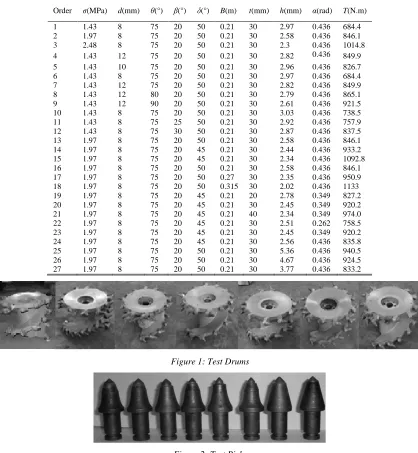
[image:2.612.95.512.220.669.2]shown in Table 1. Tests drums and picks were shown in Fig 1 and Fig 2.
Table 1 : Test Results
Order σ(MPa) d(mm) θ(°) β(°) δ(°) B(m) t(mm) h(mm) α(rad) T(N.m)
1 1.43 8 75 20 50 0.21 30 2.97 0.436 684.4
2 1.97 8 75 20 50 0.21 30 2.58 0.436 846.1
3 2.48 8 75 20 50 0.21 30 2.3 0.436 1014.8
4 1.43 12 75 20 50 0.21 30 2.82 0.436 849.9
5 1.43 10 75 20 50 0.21 30 2.96 0.436 826.7
6 1.43 8 75 20 50 0.21 30 2.97 0.436 684.4
7 1.43 12 75 20 50 0.21 30 2.82 0.436 849.9
8 1.43 12 80 20 50 0.21 30 2.79 0.436 865.1
9 1.43 12 90 20 50 0.21 30 2.61 0.436 921.5
10 1.43 8 75 20 50 0.21 30 3.03 0.436 738.5
11 1.43 8 75 25 50 0.21 30 2.92 0.436 757.9
12 1.43 8 75 30 50 0.21 30 2.87 0.436 837.5
13 1.97 8 75 20 50 0.21 30 2.58 0.436 846.1
14 1.97 8 75 20 45 0.21 30 2.44 0.436 933.2
15 1.97 8 75 20 45 0.21 30 2.34 0.436 1092.8
16 1.97 8 75 20 50 0.21 30 2.58 0.436 846.1
17 1.97 8 75 20 50 0.27 30 2.35 0.436 950.9
18 1.97 8 75 20 50 0.315 30 2.02 0.436 1133
19 1.97 8 75 20 45 0.21 20 2.78 0.349 827.2
20 1.97 8 75 20 45 0.21 30 2.45 0.349 920.2
21 1.97 8 75 20 45 0.21 40 2.34 0.349 974.0
22 1.97 8 75 20 45 0.21 30 2.51 0.262 758.5
23 1.97 8 75 20 45 0.21 30 2.45 0.349 920.2
24 1.97 8 75 20 45 0.21 30 2.56 0.436 835.8
25 1.97 8 75 20 50 0.21 30 5.36 0.436 940.5
26 1.97 8 75 20 50 0.21 30 4.67 0.436 924.5
[image:2.612.96.514.221.674.2]27 1.97 8 75 20 50 0.21 30 3.77 0.436 833.2
Figure 1: Test Drums
Figure 2: Test Picks
According to the previous research, we could get that: the relationship between drum’s cutting torque and coal compressive strength is linear, and the torque increases with the increasing of coal
exponential form, and cutting torque is positive index correlation with angle between picks, pick taper and cutting web, negative index correlation with the other structure parameters; cutting torque would grow in power function along with the increase of helical angle[8~13]. According to above research results, the relationship of T with σ, d, θ, β,
δ, B, t, h and α could be confirmed, and its
mathematical expression could be expressed as Eq(1) form.
3
1 2 4
5 6 7
1 2 3 4
2
5 6 7 8 9 10
b
b d b b
b B b t b h
K a e a e a e a e
T K
a e a e a e a a a
β θ δ σσ α α + + + + + = + + + + + (1)
Where, K means proportional coefficient which is determined by modeling similarity ratio; the rest of unknown parameters are unknown coefficient.
3. MODEL SOLUTION
According to Eq(1): the relationship of drum’s cutting torque and its influential parameters is multivariate nonlinear, the test result would be influenced by some uncontrollable factors, so , great errors would be taken to solving result if using the test date directly. For this reason, a new solution method becomes particularly important. Taking sampling data of metal elements content in a mine point as the example, Xin analyzed and pointed out the advantage of BP neural network in multivariate nonlinear regression analysis than traditional regression method[15]. BP neural network prediction of cutting force when cutting on rocks were studied, which achieved ideal results[16-18]. As one kind of MLP network structure based on error back propagation algorithm, BP neural network can approximate any continuous functions with arbitrary precision, so it can be widely used in nonlinear model building, functional
approximation, pattern recognition and classification, etc. Its main idea is that: input learning samples, and use back propagation algorithm to train the network weights and bias repeatedly until actual output vector as close as possible to the expected output vector; The training would be finished until the network output layer’s sum of square error is less than the specified error; And then, network weights and bias would be saved. Therefore, in this paper, test date parameters would be optimized by using automatic adjustment training function of BP neural network weights and bias. In other words, the torque value which was forecasted by BP neural network and its corresponding input parameter value were taken to Eq(1) solving unknown coefficient.
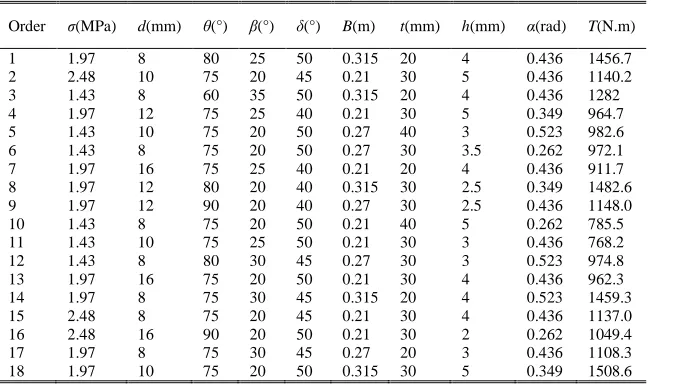
The each test conditions were chosen as the input, and the test torque value were chosen as the output in the BP neural network regression analysis. In order to guarantee the prediction accuracy and prediction speed, a 3 layers neural network that contain 13 nodal points in the hidden layer was used in this paper which referenced to previous work. In Eq(1), there are 18 unknown factors except proportional coefficient K, so 18 times training are needed by using BP neural network. The input parameter value and the forecast value as shown in Table 2.
The drum torque empirical mathematical model could be obtained by substituting the value of Table 2 into Eq(1), and it was shown in Eq(2) .
3
1 2 4
5 6 7
1 2 3 4
2
5 6 7 8 9 10
2.56 0.22
1.26 0.008 0.064
2 1.4
0.35 312.46 0.0065 0.00032
10.44 0.00035 0.0015
0.00038 0.008 4.15
jh zj
cj j
b
b d b b
b B b t b h
d
ym jj
S B
h
K a e a e a e a e T K
a e a e a e a a a
e e
K e e e
e β θ δ σ α α σ α α σ α α α − − − + + + + + = + + + + + − + + + = + + −
+ + 0.43
−
[image:3.612.145.494.538.730.2] (2)
Table 2 : Predicted Result Of BP Neural Network
Order σ(MPa) d(mm) θ(°) β(°) δ(°) B(m) t(mm) h(mm) α(rad) T(N.m)
1 1.97 8 80 25 50 0.315 20 4 0.436 1456.7
2 2.48 10 75 20 45 0.21 30 5 0.436 1140.2
3 1.43 8 60 35 50 0.315 20 4 0.436 1282
4 1.97 12 75 25 40 0.21 30 5 0.349 964.7
5 1.43 10 75 20 50 0.27 40 3 0.523 982.6
6 1.43 8 75 20 50 0.27 30 3.5 0.262 972.1
7 1.97 16 75 25 40 0.21 20 4 0.436 911.7
8 1.97 12 80 20 40 0.315 30 2.5 0.349 1482.6
9 1.97 12 90 20 40 0.27 30 2.5 0.436 1148.0
10 1.43 8 75 20 50 0.21 40 5 0.262 785.5
11 1.43 10 75 25 50 0.21 30 3 0.436 768.2
12 1.43 8 80 30 45 0.27 30 3 0.523 974.8
13 1.97 16 75 20 50 0.21 30 4 0.436 962.3
14 1.97 8 75 30 45 0.315 20 4 0.523 1459.3
15 2.48 8 75 20 45 0.21 30 4 0.436 1137.0
16 2.48 16 90 20 50 0.21 30 2 0.262 1049.4
17 1.97 8 75 30 45 0.27 20 3 0.436 1108.3
4. VALIDATION OF MODEL CORRECTNESS
[image:4.612.116.492.219.288.2]To validate the correctness of the cutting torque empirical mathematical model, five new combined tests of picks and drums were carried out in cutting test bed. The test results and the calculation results were shown in Table 3.
Table 3: Comparison Of Test Results And Calculation Results
Order σ
(MPa)
d
(mm)
θ
(°)
β
(°)
δ
(°)
B
(m)
t
(mm)
h
(mm)
α
(rad) Test (N.m)
Calculation (N.m)
Error (%)
1 1.97 12 90 20 45 0.315 30 2.34 0.262 1367.2 1477 8.03
2 1.97 12 90 20 45 0.25 30 3.16 0.262 1132.6 1081.5 -4.51
3 1.97 12 90 20 45 0.315 20 3.01 0.349 1486.3 1460 -1.77
4 1.97 10 75 20 45 0.315 40 4.22 0.349 1421.5 1521.9 7.06
5 1.97 10 75 20 45 0.315 20 3.79 0.349 1405.7 1455.2 3.52
Form Table 3, we can see that: certain error was exist between the forecast value and test results which is not more than ±10%, and the relationship between cutting torque and other parameters was basically correctly reflected by the empirical mathematical model. The correctness of the empirical model was proved from above research.
5. CONCLUSION
(1)The experiments of seven type sequence model drums with eight type picks were carried out in cutting test-bed, and the mean of cutting torques were obtained, which can provide reference for the future researches.
(2)Regression analysis of cutting torque was performed to optimize the date, which would be used in drum’s empirical mathematical solution, by using BP neural network; The accuracy of the drum’s empirical mathematical model was verified by this work; This solving method bring a new way for complicated data processing and formula solution.
(3)Empirical mathematical model of the sequence drum’s cutting torque was obtained, which will provide some theoretical guidance in drum structure design and working parameter optimization.
ACKNOWLEDGEMENTS
This work was supported by the National High Technology Research and Development Program of China (863 Program)(No. 2012AA062104 ), China Postdoctoral Science Foundation (20100481176), Jiangsu post-doctoral fund project (1101106C), Jiangsu ordinary university graduate students
scientific research innovation project (CXZZ11-0289).
REFERENCES:
[1] D. Mazurkiewicz, “Empirical and analytical models of cutting process of rock”, Journal of
Mining Science, Vol. 36, No. 5, 2000, pp.
481−486.
[2] T. Muro, D.T. Tran, “Regression analysis of the characteristics of vibro-cutting blade for tuffaceous rock”, Journal of Terramechanics, Vol. 40, No. 1, 2004, pp. 191-219.
[3] O.Z. Hekimogly, L. Ozdemir, “Effect of angle of wrap on cutting performance of drum shearers and continuous miners”, Transactions of the
Institutions of Mining and Metallurgy, Vol. 113,
No. 2, 2004, pp. 118−122.
[4] E.M. Eyyuboglu, N. Bolukbasi, “Effects of circumferential pick spacing on boom type roadheader cutting head performance”,
Tunneling and Underground Space Technology,
Vol. 20, No. 5, 2005, pp. 418−425.
[5] N. Bilgin, M.A. Demircm, H. Copur, C. Balcia, H. Tuncdemira, N. Akcin, “Dominant rock properties affecting the performance of conical picks and the comparison of some experimental and theoretical results”, International Journal of
Rock Mechanics & Mining Sciences, Vol. 43,
No. 1, 2006, pp. 139−156.
[6] C. Balci, N. Bilgin, “Correlative study of linear small and full-scale rock cutting tests to select mechanized excavation machines”,
International Journal of Rock Mechanics & Mining Sciences, Vol. 43, No. 3, 2007, pp.
468−476.
size”, International Journal of Rock Mechanics
& Mining Sciences, Vol. 45, No. 2, 2008, pp.
278−288.
[8] S.Y. Liu, C.L. Du, X.X. Cui, X. Chen, “Model Test of the Cutting Properties of a Shearer Drum”, Mining Science and Technology, Vol. 19, No. 1, 2009, pp. 74-78.
[9] S.Y. Liu, C.L. Du, X.X. Cui, “Research on the cutting force of a pick”, Mining Science and
Technology, Vol. 19, No. 4, 2009, pp. 514-517.
[10] S.Y. Liu, C.L. Du, X.X. Cui, N.N. Li, “Cutting experiment of the picks with different conicity and carbidetip diameters”, Journal of China
Coal Society, Vol. 34, No. 9, 2009, pp.
1276-1280. (in Chinese)
[11] S.Y. Liu, C.L. Du, X.X. Cui, K.D. Gao, “Characteristics of different rocks cut by helical cutting mechanism”, Journal of Central South
University of Technology, Vol. 18, No. 5, 2011,
pp. 1518-1524.
[12] S.Y. Liu, X.X. Cui, C.L. Du, L. Fu, “Method to determine installing angle of conical point attack pick”, Journal of Central South
University of Technology, Vol. 18, No. 6, 2011,
pp. 1994-2000.
[13] S.Y. Liu, K.D. Gao, C.L. Du, L. Fu, “Experiment Research on Cutter Arrangement of Helical Cutting Mechanism”, Advanced
Science Letters, Vol. 4, No. 4, 2011, pp.
1424-1429.
[14] L.J. Zhao, J.Q. He, J. Xu, W. Liu, “Effect of pick arrangement on the load of shearer in the thin coal seam”, Journal of China Coal Society, Vol. 36, No. 8, 2011, pp. 1401-1406. (in Chinese)
[15] D.X. Xin , C.Y. Wang , F. Xiao, “A study on the BP neural network applied to regression analysis”, Journal of Xi’an Institute of
Technology, Vol. 22, No. 2, 2002, pp. 129-135.
(in Chinese)
[16] J. Jonak, J. Gajewski, “Identifying the cutting tool type used in excavations using neural networks”, Tunneling and Underground Space
Technology, Vol. 21, 2006, pp. 185–189.
[17] B. Tiryakin, J.N. Boland, X.S. Li, “Empirical models to predict mean cutting forces on point-attack pick cutters”, International Journal of
Rock Mechanics & Mining Sciences, Vol. 47,
2010, pp. 858–864.
[18] J. Gajewski, J. Jona, “Towards the identification of worn picks on cutterdrums based on torque and power signals using Artificial Neural
Networks”, Tunneling and Underground Space