Technology (IJRASET)
Ant Lion Optimization for Optimum Power
Generation with valve point effects
Shivani Mehta1, Meenakshi Mahendru Nischal2 1
Assistant Professor, DAVIET, Jalandhar, 2M.Tech Student, DAVIET, Jalandhar
Abstract-This paper presents Ant lion optimization (ALO) technique to solve Optimum Power Generation problem. Ant lion optimization (ALO) is a novel nature inspired algorithm. The ALO algorithm mimics the hunting mechanism of antlions in nature. Five main steps of hunting prey such as the random walk of ants, building traps, entrapment of ants in traps, catching preys, and re-building traps are implemented. Optimum Power Generation is a method of determining the most efficient, low-cost and reliable operation of a power system by dispatching available electric generation resources to supply load on the system. The primary objective of is to minimize total cost of generation while honoring operational constraints of available generation resources. The proposed technique is implemented on13 & 40 unit test system for solving the . Numerical results show that the proposed method has good convergence property and better in quality of solution than other algorithms reported in recent literature.
Keywords—ALO; Optimum Generation Scheduling; transmission loss
Nomenclature:
ai, bi, ci : fuel cost coefficient of ith generator, Rs/MW2 h, Rs/MW h, Rs/h
F(Pg ) : total fuel cost, Rs/h n : number of generators
: Minimum generation limit of ith generator, MW
: Maximum generation limit of ith generator, MW
Pl : Transmission losses, MW
Pd : Power demand, MW
I. INTRODUCTION
Electrical power plays a pivotal role in the modern world to satisfy various needs. It is therefore very important that the electrical power generated is transmitted and distributed efficiently in order to satisfy the power requirement. Optimum power generation problem is the most significant problem of optimization in forecasting the generation amongst thermal generating units in power system. The OGS problem is to plan the output power for each devoted generating unit such that the cost of operation is minimized along with matching power operating limits, load demand and fulfilling diverse system limitations. The operating cost of a power plant mainly depends on the fuel cost of generators and is minimized via optimum power generation. Optimum Power Generation problem can be defined as determining the least cost power generation schedule from a set of on line generating units to meet the total power demand at a given point of time [1]. The main objective of problem is to decrease fuel cost of generators, while satisfying equality and inequality constraints. In this problem, fuel cost of generation is represented as cost curves and overall calculation minimizes the operating cost by finding a point where total output of generators equals total power that must be delivered plus losses. In the past years many meta-heuristic techniques such as Genetic algorithm [2,3], Tabu search [4],Evolutionary programming (EP) techniques [5], Differential evolution [6] , particle swarm optimization (PSO) [7-10],gravitational search algorithm (GSA) [11] ,Biogeography based optimization[12], Seeker optimization algorithm [13],Firefly algorithm [14],Simulated annealing (SA)[15],Harmony search[16,17],Shuffled frog leaping algorithm(SFLA) [18],Hybrid genetic algorithm(HGA) [19],Binary bat algorithm[20] etc. have been used to solve ELD with valve loading effect.
II. PROBLEM FORMULATION
Technology (IJRASET)
2 min
1
( )
(
)
sin( (
))
n
g i gi i gi i i i gi gi i
F P
a P
b P
c
d
e P
P
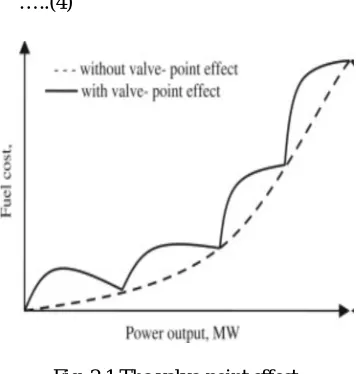
…….. (1)where fuel-cost coefficient’s of the ith unit are ai , bi, and ci, and di & ei are the fuel-cost coefficient’s of the ith unit with valve-point
effects[5].
The total fuel cost has to be minimized with the following constraints:
A. Power Balance Constraint
The sum of power demand (Pd) and power loss ( ) should be equal to power generation (Pgi).
∑ − − ….. (2)
The power loss Pl calculated by:
=∑ ∑ +∑ + .… (3)
B. Generator Limit Constraint
Each generator’s real power generation is to be controlled within its respective lower operating limits and upper operating
limits .
[image:3.612.217.395.351.538.2]≤ ≤ i=1,2,...,ng …..(4)
Fig. 2.1 The valve-point effect
III. ANT LION OPTIMIZATION
Ant Lion Optimizer (ALO)[21] is a novel nature-inspired algorithm proposed by Seyedali Mirjalili in 2015.The ALO algorithm copies the hunting mechanism of ant lions in nature. Five main stages of killing kill such as the arbitrary walk of ants construction trap setup of ants in traps, catch victims, and re-building traps are implemented.
Ant lions (doodlebugs) belong to class of net winged insects. The lifecycle of ant lions includes two main phases: larvae and adult. A natural total lifespan can take up to 3 years, which mostly occurs in larvae (only 3–5 weeks for adulthood). Ant lions undergo metamorphosis in a cocoon to become adult. They mostly hunt in larvae and the adulthood period is for reproduction. An ant lion larvae digs a cone-shaped pit in sand by moving along a circular path and throwing out sands with its massive jaw.After digging the trap, the larvae hides underneath the bottom of the cone and waits for insects (preferably ant) to be trapped in the pit. The edge of the cone is sharp enough for insects to fall to the bottom of the trap easily.
Technology (IJRASET)
Random walks of ants: Random walks are all based on the Eq. below :
( ) = [0, (2 ( )−1), (2 ( )−1), … … . . , (2 ( )−1)] ……(5)
Where cumsum calculates the cumulative sum, n is the maximum number of iteration, t shows the step of random walk and r(t) is a stochastic function defined as follows:
( ) = 1 > 0.5
0 ≤0.5 ……(6)
however, above Eq. cannot be directly used for updating position of ants. In order to keep the random walks inside the search space, they are normalized using the following equation (min–max normalization):
=( )×( )
( ) + ……(7)
Where ai is the minimum of random walk of ithvariable, bi is the maximum of random walk in ithvariable, is the minimum of
ithvariable at tth iteration, and indicates the maximum of ith variable at tth iteration
Trapping in ant lion's pits: random walks of ants are affected by antlions’ traps. In order to mathematically model this assumption, the following equations are proposed:
= + ….(8) = + …(9)
where is the minimum of all variables at tth iteration, indicates the vector including the maximum of all variables at tth
iteration, is the minimum of all variables for ith ant, is the maximum of all variables for ithant, and Antliont j shows the
position of the selected j-th antlion at tthiteration
Building trap:In order to model the ant-lions’s hunting capability, a roulette wheel is employed. The ALO algorithm is required to utilize a roulette wheel operator for selecting ant lions based of their fitness during optimization. This mechanism gives high chances to the fitter ant lions for catching ants.
Sliding ants towards ant lion:With the mechanisms proposed so far, ant lions are able to build traps proportional to their fitness and ants are required to move randomly. However, ant lions shoot sands outwards the center of the pit once they realize that an ant is in the trap. This behavior slides down the trapped ant that is trying to escape. For mathematically modelling this behavior, the radius of ants' random walks hyper-sphere is decreased adaptively. The following equations are proposed in this regard:
= …(10)
= …(11)
where I is a ratio, ct is the minimum of all variables at t-th iteration, and dt indicates the vector including the maximum of all variables at t-th iteration.
Catching prey and re-building the pit:The final stage of hunt is when an ant reaches the bottom of the pit and is caught in the antlion’s jaw. After this stage, the antlion pulls the ant inside the sand and consumes its body. For mimicking this process, it is assumed that catching prey occur when ants becomes fitter (goes inside sand) than its corresponding antlion. An antlion is then required to update its position to the latest position of the hunted ant to enhance its chance of catching new prey. The following equation is proposed in this regard:
= ( ) > …(12)
where t shows the current iteration, Antliont j shows the position of selected j-th antlion at t-th iteration, and Antti indicates the position of i-th ant at t-th iteration.
Elitism: Elitism is an important characteristic of evolutionary algorithms that allows them to maintain the best solution(s) obtained at any stage of optimization process. Since the elite is the fittest antlion, it should be able to affect the movements of all the ants during iterations. Therefore, it is assumed that every ant randomly walks around a selected antlion by the roulette wheel and the elite simultaneously as follows:
= … (13)
Technology (IJRASET)
elite at t-th iteration, and indicates the position of i-th ant at t-th iteration
IV. RESULTS & DISCUSSIONS
ALO has been used to solve the problems in three different test cases for exploring its optimization potential, where the objective function was limited within power ranges of the generating units and transmission losses were also taken into account.
The iterations performed for each test case are 2000 and number of search agents (population) taken in both test cases is 40.
A. Test system I: Thirteen generating units
The input data for Test case I (13-UNIT CASE)with Valve point loading. a, b, c, e, and f are cost coefficients in fuel cost [5]. The economic load dispatch for 13 generators system is solved with power demand of 1800 MW.
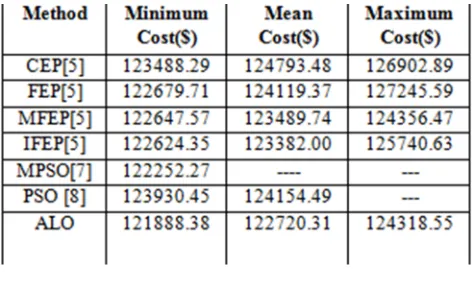
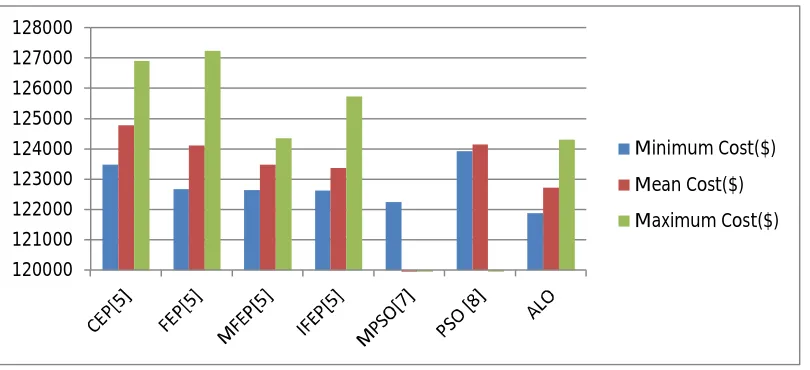
[image:5.612.188.426.268.432.2]The minimum cost, mean cost and maximum cost among 50 runs of solutions obtained from ALO for test system 1 is given in table 4.1 and bar chart is plotted in fig 4.2.
Table 4.1: Comparison results of ALO for 13-Unit system
B. Test system II: Forty generating unit
The input data for Test caseII (40-UNIT CASE) with Valve point loading. a, b, c, e, and f are cost coefficients in fuel cost. [5] The economic load dispatch for 40 generators is solved with 10,500 MW power demand. The minimum cost, mean cost and maximum cost among 50 runs of solutions obtained from ALO for test system 2 is given in table 4.2 below.
[image:5.612.187.423.522.665.2]Technology (IJRASET)
[image:6.612.97.509.103.261.2]The comparison of the results obtained with ALO for 40 units is shown in table 4.2 and bar chart is plotted in fig 4.3
Fig. 4.2: Comparison chart showing the minimum, mean and maximum cost for 13 generators with different algorithms
Fig-4.3: Comparison chart showing the minimum, mean and maximum cost for 40 generators with different algorithms
V. CONCLUSION
In this paper Optimum Power Generation problem has been solved by using ALO. The results of ALO are compared for thirteen & forty generating unit systems with other techniques. The algorithm is programmed in MATLAB(R2009b) software package. The results display efficacy of ALO algorithm for solving the Optimum Power Generation problem. The advantage of ALO algorithm is its simplicity, reliability and efficiency for practical applications.
REFERENCES
[1] A.J Wood and B.F. Wollenberg, Power Generation, Operation, and Control, John Wiley and Sons, New York, 1984.
[2] David C. Walters and Gerald B. Sheble. Genetic algorithm solution of economic dispatch with valve point loading. IEEE Transactions on Power Systems. 1993: 8.
[3] Chiang, Chao-Lung. "Improved genetic algorithm for power economic dispatch of units with valve-point effects and multiple fuels." Power Systems, IEEE Transactions on 20, no. 4 (2005): 1690-1699.
[4] S. Khamsawang, C. Boonseng and S. Pothiya. Solving the economic dispatch problem with Tabu search algorithm. IEEE Int Conf Ind Technol. 2002; 1: 274– 8.
[5] Nidul Sinha, R. Chakrabarti, and P. K. Chattopadhyay. Evolutionary programming techniques for economic load dispatch. IEEE Transactions on Evolution
17000 17200 17400 17600 17800 18000 18200 18400 18600
CEP[5] FEP[5] MFEP[5] IFEP[5] PSO[8] ALO
[image:6.612.105.510.294.479.2]Technology (IJRASET)
[6] N. Noman and H. Iba. Differential evolution for economic load dispatch problems. Electric Power Systems Research. 2008; 78: 1322-31.
[7] J. Park, K. Lee and J. Shin. A particle swarm optimization for economic dispatch with non-smooth cost functions. IEEE Transactions on Power Systems. 2005; 20: 34-42.
[8] T. Aruldoss Albert Victoire and A. Ebenezer Jeyakumar. Hybrid PSO-SQP for economic dispatch with valve-point effect. Electric Power Systems Research. 2004; 71: 51-9.
[9] L. D. S. Coelho, V. C. Mariani, Particle swarm approach based on quantum mechanics and harmonic oscillator potential well for economic load dispatch with valve-point effects, EnergyConversion and Management, vol. 49, 2008, pp. 3080-3085.
[10] Niu, Qun, Xiaohai Wang, and Zhuo Zhoua. "An Efficient Cultural Particle Swarm Optimization for Economic Load Dispatch with Valve-point Effect." Procedia Engineering 23 (2011): 828-834.
[11] Duman, S., U. Güvenç, and N. Yörükeren. "Gravitational search algorithm for economic dispatch with valve-point effects." International Review of Electrical Engineering 5, no. 6 (2010): 2890-2895.
[12] Bhattacharya, Aniruddha, and Pranab Kumar Chattopadhyay. "Solving complex economic load dispatch problems using biogeography-based optimization." Expert Systems with Applications 37, no. 5 (2010): 3605-3615.
[13] Shaw, B., S. Ghoshal, V. Mukherjee, and S. P. Ghoshal. "Solution of Economic Load Dispatch Problems by a Novel Seeker Optimization Algorithm." International Journal on Electrical Engineering and Informatics 3, no. 1 (2011): 26-42.
[14] Yang, Xin-She, Seyyed Soheil Sadat Hosseini, and Amir Hossein Gandomi. "Firefly algorithm for solving non-convex economic dispatch problems with valve loading effect." Applied Soft Computing 12, no. 3 (2012): 1180-1186.
[15] Vishwakarma, Kamlesh Kumar, Hari Mohan Dubey, Manjaree Pandit, and B. K. Panigrahi. "Simulated annealing approach for solving economic load dispatch problems with valve point loading effects." International Journal of Engineering, Science and Technology 4, no. 4 (2013): 60-72.
[16] Wang, Ling, and Ling-po Li. "An effective differential harmony search algorithm for the solving non-convex economic load dispatch problems." International Journal of Electrical Power & Energy Systems 44, no. 1 (2013): 832-843.
[17] Hatefi, A., and R. Kazemzadeh. "Intelligent tuned harmony search for solving economic dispatch problem with valve-point effects and prohibited operating zones." Journal of Operation and Automation in Power Engineering 1, no. 2 (2013).
[18] Roy, Priyanka, Pritam Roy, and Abhijit Chakrabarti. "Modified shuffled frog leaping algorithm with genetic algorithm crossover for solving economic load dispatch problem with valve-point effect." Applied Soft Computing 13, no. 11 (2013): 4244-4252.
[19] Kherfane, R. L., M. Younes, N. Kherfane, and F. Khodja. "Solving Economic Dispatch Problem Using Hybrid GA-MGA." Energy Procedia 50 (2014): 937-944.
[20] Bestha, Mallikrjuna, K. Harinath Reddy, and O. Hemakeshavulu. "Economic Load Dispatch Downside with Valve-Point Result Employing a Binary Bat Formula." International Journal of Electrical and Computer Engineering (IJECE) 4, no. 1 (2014): 101-107.