Procedia Computer Science 85 ( 2016 ) 891 – 898 Available online at www.sciencedirect.com
1877-0509 © 2016 The Authors. Published by Elsevier B.V. This is an open access article under the CC BY-NC-ND license (http://creativecommons.org/licenses/by-nc-nd/4.0/).
Peer-review under responsibility of the Organizing Committee of CMS 2016 doi: 10.1016/j.procs.2016.05.279
ScienceDirect
International Conference on Computational Modeling and Security (CMS 2016)
Analysis of routing and forwarding protocols in opportunistic
networks
Chander Prabha
a*, Surender Kumar
b, Ravinder Khanna
c aResearch Scholar, Computer Sc. & Engineering, M.M. University, Ambala, 134007, India
bAssistant Professor,Computer Application, GTB College, Bhawanigarh, Sangrur, 148026, India cProfessor, Electronics & Communication Engineering, M.M.University, Ambala,134007, India
Abstract
The role of opportunistic networks can be crucial in data transmission. Here message forwarding depends solely on node co-operation. Opportunistic networks use store-and-carry forward mechanism. The frequent disconnection of nodes is very common in these networks because of dynamic nature of mobile nodes. Therefore use of suitable routing protocol is very important in message delivery. In this paper, three social context aware routing protocols that support message forwarding in opportunistic networks i.e. HiBop, Propicman and CAOR are analysed in terms of performance metrics viz. delivery probability, overhead ratio, number of hops and delay. The results show that CAOR outperform the other two protocols in all these aspects. The delivery probability of CAOR is higher whereas the overhead ratio, number of hops and delay are less than those for HiBop and Propicman routing protocols.
© 2015 The Authors. Published by Elsevier B.V.
Peer-review under responsibility of organizing committee of the 2016 International Conference on Computational Modeling and Security (CMS 2016).
Keywords:Opportunistic networks; HiBop; Propicman; CAOR; Delivery Probability; Forwarding.
1.Introduction
The Opportunistic networks are temporarily associated mobile ad-hoc networks. They are extension of wireless multi-hop mobile ad-hoc networks and a part of delay tolerant networks (DTN)1. In these networks, the probability _________________
* Chander Prabha Tel.:+91-9316150049.
E-mail address: [email protected], [email protected]
© 2016 The Authors. Published by Elsevier B.V. This is an open access article under the CC BY-NC-ND license (http://creativecommons.org/licenses/by-nc-nd/4.0/).
of end-to-end path establishment is very low for message forwarding to take place that is establishing and maintaining end-to-end path is not feasible at all times because of mobility of nodes and entry/exit of nodes in the general area of interest. Mainly, the forwarding of messages takes place in a hop-by-hop manner2. Each node is
responsible for selection of next hop for forwarding the message. Today’s wireless devices, for example smart
phones, have inherently variable performance characteristics in terms of bandwidth, radio range, reliability, battery usage etc due to several network interfaces3,4. However, none of these interfaces are really designed for opportunistic communication. The issues here are device mobility, discovery of contact opportunities, message forwarding, energy efficiency and exploitation of short encounters between devices. This is because the devices (nodes) need to be powered most of the time. When we are considering the use of multiple interfaces, either simultaneously or for separate functions (transferring data using Wi-Fi, Bluetooth etc.) the system needs to decide which interface to use and for which purpose, and/or how to split and schedule traffic on the available communication links. This makes implementing opportunistic mobile networks applications a complex task.
In opportunistic networks the traditional routing approaches (like proactive and reactive routing approaches) cannot be applied since these assume a proper end-to-end route from source to destination. Routing of messages in opportunistic networks5 is a time consuming task since it does not rely only on finding optimal routes but also to exploit the better contact opportunities to increase delivery probability and to minimize delay6. Routing of messages in these networks depends on the contact opportunity among the nodes that become apparent because of mobility, store-and-carry forwarding techniques and the local forwarding between nodes. Messages are delivered to their destination in a hop-by-hop fashion by means of intermediate nodes. Therefore each node must be intelligent enough to make forwarding decisions. Routing decision is taken by each node which will decide the suitable forwarders of messages based on criteria employed by the protocol.
Variety of routing protocols has been suggested for opportunistic network. In this paper, three social context aware routing protocols have been analysed. These are History based opportunistic routing protocol (HiBop), Propicman routing and Community aware opportunistic routing (CAOR). These protocols have been compared on various parameters like delivery probability, overhead ratio, number of hops and delay. Section 2 describes each of these protocols/strategies briefly. Section 3 discusses evaluating strategy, performance metrics and assumptions made. Section 4 analyses the results followed by conclusion in section 5.
2.Routing strategies in opportunistic networks
In opportunistic networks the routing protocols can be divided in three types, viz. Context-oblivious; Mobility based and Social context aware routing protocols. Each of these types further has a number of routing protocols7. Context oblivious routing basically use flooding mechanism i.e. each node in the network has favourable chance to route the message to their destination node. Examples of context oblivious routing are Epidemic, Spray and Wait, Network Coding based routing, etc. Mobility based routing strategies utilize the mobility information of nodes to route the message to its destination. Mobility information includes the current position of node (which has the information/message), the mobility pattern and how long the node having the message is connected to the network etc. Examples of mobility based routing are Prophet routing, Moby-space routing, Max-prop routing etc. The third category that is social context aware routing protocols use the forwarding metric based on contact history and the social properties of a node. The social context aware routing protocols exploit the context information and also consider the social aspects of the nodes as a crucial parameter to route the messages. Social properties of a node
include the information related to group of information representing the area or the environment where the user’s
resides and also its history of social relationships. Examples of social context aware routing protocols are Simbet, Bubble Rap, HiBop, Propicman, CAOR, etc. As compared to context oblivious and mobility based routing the social category of routing protocols do not surge the network with message duplicates thus it minimizes congestion in the network. Since social alliance of mobile users generally have long term features and are less stable than node mobility therefore social context aware routing protocols perform better8. This section further describes the three social context aware routing protocols that are HiBop, Propicman and CAOR in brief.
2.1.History based routing protocol
HiBop9 is a wholly context-aware routing protocol and exploits any type of context information which is suitable
for message forwarding. The context-information represents the complete information about the node profile, its present, past and future location to take routing decision. The node profile consists of personal information of node say name, surname, address information, system information like IP address, MAC address, interface etc. The HiBop protocol also illustrates the ways to handle all this information. Every node shares their own data when they come together and also learn the context of other nodes. Nodes having higher probability of sharing the context would be seen as good forwarders of messages. The copies of messages are only retained by sender node. Rest of the nodes only calculate the delivery probabilities of nodes that came across each other but do not retain the copies of forwarded message. Thus HiBop controls and minimizes message replication. This is a major advantage of this protocol. This reduces overheads.
All this information of the node is stored in two tables i.e. history table and identity table. The current context information of a node is the information about its local environment. It also includes the personal information. This
is stored in identity table. This information indicates the node’s instantaneous fitness to be a forwarder. When nodes
communicate with each other they exchange their identity tables. Further, nodes should also recognize information about other nodes that they encountered in the past (as a sender or receiver of messages) as well as chance of meeting other nodes in the near future. This information is contained in the history table. This information allows HiBop to attain the resemblance between encountered users and destinations. At each exchange of information these tables have to be updated. On the basis of information available in the history table, identity table and the current context, the delivery probability is calculated as (1)
(1)
where = Delivery Probability = History Probability
= Probability of Current Context = Probability of Identity table
α= Smoothing factor weight , default value=0.98
= Weighting factor between
2.2.Propicman routing protocol
Hoang10 describes Propicman as another social-context aware routing strategy. Its aim is to efficiently distribute
the messages in a probabilistic manner to minimize resources utilized in delivering messages. In this protocol, sender node need not have any information of remaining nodes in the network. Its routing decision is based particularly on the information it has about the destination. This protocol effectively exploits mobility of the nodes and reduces the number of hops. It also deals with security aspects of nodes. Personal profile of the participating nodes is kept in the hidden format but is used for routing. Intermediate nodes are not provided this personal profile of the source/destination nodes. Specifically the destination node can read and understand the content of message. Delivery probability is calculated using a set of evidence value pairs and using a hash function which gives a hash value. Every node tries to prefer the best route to route the message. The delivery probability is given by (2)
(2)
Where = sum of the weights of the evidences of source with hashed values10
From all delivery probabilities of its neighbours the source is having the ability to find out the node with highest delivery probability10. The sender node uses this knowledge to forward the message to the forwarder.
2.3.CAOR
The existing social aware routing strategies believe that each and every node has few unique social characteristics. Every node has the capability to exploit these characteristics to direct the routing decision. There are two fundamental concepts in social network analysis that is centrality and community. Community is a class of individuals with social relations. Centrality denotes social relations between a node and other nodes in the community. Centrality value is computed for each node by detecting the communities. Nodes having good centrality value are used to deliver the messages. Mingjun et al 12 focus on single copy routing problem in mobile social networks (MSNs). These are specific type of delay tolerant networks (DTNs), to which mobile users move from one place to another and correspond with one another via their carried short-distance wireless communication devices. In reality the mobile users that have same interests normally visit some location that is relevant to their interest, like friends having interest in sharing certain type of information, customers having interest in type of shopping will visit common shopping complex, and so on. Persons having similar interests form a community (shopping community, friend’s community etc. Based on such information, a home aware community model was proposed. In this the mobile users with similar interest, autonomously, build a community, in which the most often visited location becomes their common home. Each of the home acts as a temporary store to buffer and transmit messages. Routing is first between community homes. Then it follows optimal opportunistic routing scheme between nodes within the community to deliver messages to the encountered relay set that has a minimal expected delay to the destination. This scheme selects better relays to forward the message to achieve the optimal performance.
The delivery probability is defined using minimum expected delivery delay, inter-community between-ness and optimal between-ness set for a relay set. The inter-community between-ness is the expected delivery delay for a relay set to co-operatively transfer messages between community homes. The optimal between-ness is the relay set with the smallest between-ness for the transfer of message from one community home to another. These optimal between-ness set is used to deliver/transfer the messages13.
3.Evaluating routing strategies
Since the nodes may unite or exit the network at any time, we have defined six different categories of mobile node groups. These are cars, pedestrians, buses/trams, another group of pedestrians, another group of vehicles etc. Each of these groups has different speeds. For example pedestrians move at irregular speeds between 0.5 to 1.5 m/s. Cars move on roads exclusively at speeds between 10-60 Km/h and have wait times of 0-120 seconds14. Some groups were assigned Bluetooth interfaces with the transmit speed of 2 Mbps and transmit range of 10 meters while some other groups were given high speed interfaces with transmit speed of 10 Mbps and transmit range of 1000 meters. Each of the group has its own interface and they move with different speeds. Each group of nodes was given different buffer size varying between 5 Mb to 50 Mb. Initial time-to-live (TTL) was kept at 300 min. This is sufficient time to mimic the SMS like behaviour. In an opportunistic environment it is necessary to ensure that all protocols have sufficient amount of time to deliver the message. Large TTL value ensures this. The analysis was carried out using different time intervals number of nodes in the network.
This analysis was carried out using ONE simulator14 which is specifically designed for opportunistic networks and it supports external event generator. It generates messages every 25 to 35 seconds with different message sizes (from 500 kb to 1Mb). The protocols are evaluated and compared on the following metrics: delivery probability, overhead ratio, number of hops and delay.
4.Performance analysis 4.1.Delivery probability
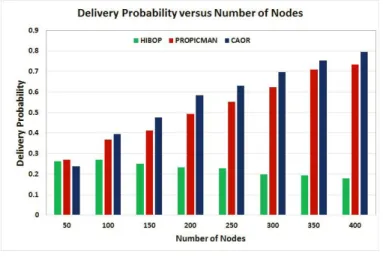
Fig. 1. shows the variation of delivery probability with change in the number of nodes for each of the three protocols (HiBop, Propicman and CAOR). It has been seen that the CAOR has highest delivery probability while HiBop has the lowest. It is observed that when 50 nodes are used the packet delivery probability is approximately the same for all the three routing protocols. However, when the scalability in terms of nodes increases in the network, the packet delivery probability decline for HiBop while it increases in case of other two protocols.
Fig. 1. Delivery Probability
This is because of periodical broadcasting and exchange of messages by nodes in HiBop which causes network overheads to increase. This is a major drawback of HiBop. Propicman routing utilizes less network resources to deliver a message thus increasing delivery probability. CAOR utilizes least amount of network resources therefore its delivery probability is the highest. Variation of delivery probability versus delivery time period (in hours) for fixed node strength (100 nodes) is shown in Fig. 2. Messages were generated at randomly selected source nodes and for randomly selected destination nodes. Numbers of community homes were set to six, while time-to-live (TTL) was set to 5 hours.
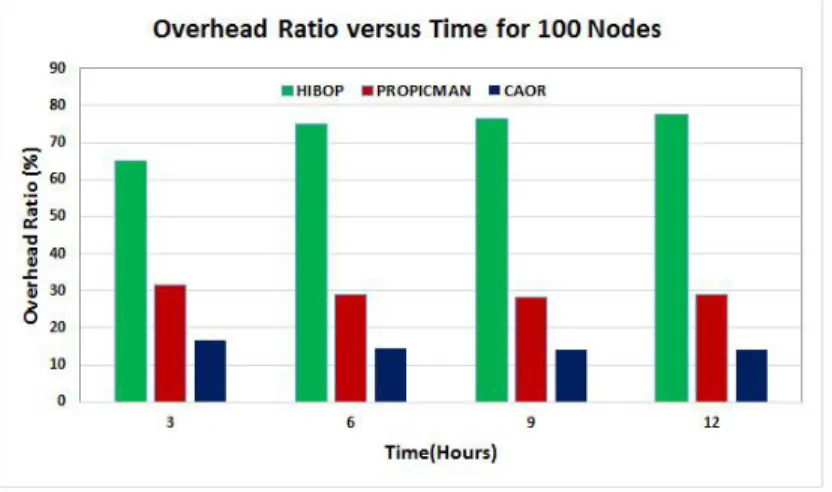
The results are shown in figs. 2 and 3. It is observed that the CAOR has a significantly higher delivery probability (Fig. 2) and lower overhead ratio (Fig. 3) as compared to other two protocols. This is because message deliveries primarily depend on the nodes in optimal relay set in CAOR that comes from optimal between-ness in CAOR.
4.2.Overhead ratio
The comparison of overhead ratio for three protocols is shown in Fig. 3. CAOR protocol exhibits lowest overhead ratio. Overhead ratio of HiBop protocol increases sharply with an increase nodes that is when scalability of network increases. For 50 nodes the overhead ratio experienced by all the three protocols is nearly same. Propicman protocol has larger overhead ratio as compared to CAOR. CAOR protocol has least overhead ratio.
Fig. 3. Overhead Ratio
Figure 4 shows the variation of overhead ratio for 100 nodes for time in hours. The overhead ratio is least for CAOR, a little higher for Propicman and highest in case of HiBop protocol. Table 1 shows the overhead ratio of network for 100 nodes. CAOR protocol is better than the other two protocols as observed in Table 1 and Fig. 4.
Table 1.Overhead Ratio of 100 Nodes
Time\Protocol HiBop Propicman CAOR
3 Hours 64.9884 31.6325 16.6930
6 Hours 75.1616 28.8701 14.6067
9 Hours 76.5403 28.1130 14.1749
12 Hours 77.6389 28.9777 14.0641
4.3.Number of hops
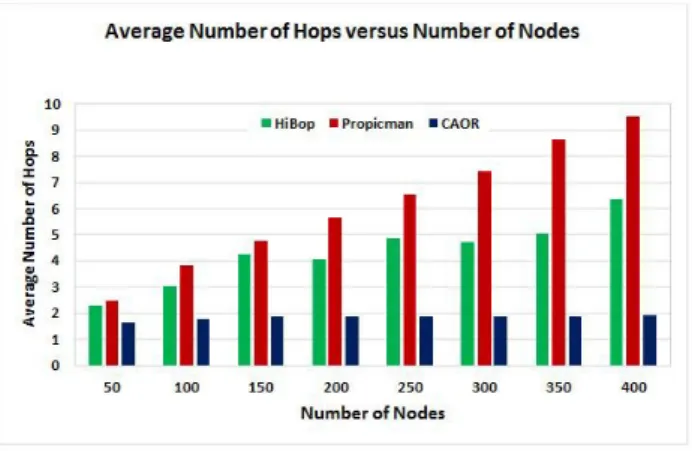
Fig. 5 shows the average number of hops with respect to nodes. It is observed that hop-count increases as the number of nodes increase in case of HiBop and Propicman while the variation is significantly less for CAOR. It indicates that COAR delivered messages in minimum number of hop-counts as the scalability of network (nodes) increases.
Fig. 5. Average number of Hops
4.4.Average delay
Variation of average end-to-end delay with nodes varies is shown in Fig. 6 for the three protocols under consideration.
It is seen that for comparatively lesser number of nodes (in our case 50), the CAOR has the least end-to-end delay while delivering messages. When nodes increases, there is a variation in the values of average delay for all three protocols. For HiBop this value does not change much. For Propicman, it decreases gradually but in case of CAOR it decreases significantly. Overall CAOR exhibits least delay as compared to other two protocols.
5.Conclusion and future scope
The aim of opportunistic networks is to support dependable communication in sporadically connected environment. In this paper we have evaluated three social context aware opportunistic routing protocols. It is seen that variation in nodes and time duration impact the performance of network. Routing is an important part of any routing protocol. An efficient protocol is a desirable requirement in any network scenario. From the results, it is found that the CAOR outperform the HiBop and Propicman with respect to delivery ratio, overhead ratio, number of hops and average delay. Performance of these three protocols also needs to be evaluated in terms of other parameters like buffer occupancy, network throughput etc.
References
1. Frederic and J. Haillot, "Toward a Use-net like discussion system for users of Disconnected MANET's," IEEE Computer Society, pp. 1678-1683, 2008.
2. Chander Prabha, Surender Kumar and Ravinder Khanna, "Wireless Multi-hop Ad-hoc Networks: A Review," International organisation of Scientific Research, vol. 16, no. 2, pp. 54-62, 2014.
3. R.A.Smith, "Measuring efficiency in Opportunistic Networks," Journal of Interconnection Networks, vol. 12, no. 3, pp. 189-203, 2011. 4. M. Conti and M. Kumar, "Opportunities in Opportunistic Computing," IEEE Computer Society, vol 43, Issue no.1, pp. 42-50, Jan
2010.
5. Li Liu and Yanfang Jing, “ A survey of social based routing and forwarding protocol in opportunistic networks”, IEEE 12th
International conference on CIT, pp. 635-639, Oct 2012.
6. Dimitrios J. Vergados, “Capacity optimization in TDMA Ad hoc Networks”, Wireless Personal Communication, 29-7-2010.
7. Xi Chen, Li Guangsong, Tian Youliang ans Ma Jianfeng, “Security In opportunistic Networks”, International Conference on Industrial control and Electronics Engineering, pp. 2006-2007, Aug 2012.
8. Comaniciu Cristina, Katia Jaffers and Mary Schurgot, "Beyond traditional DTN routing: Social networks for opportunistic communication," IEEE Communication Magazine, Vol 50, No.7, pp. 155-162, July 2012.
9. M. Conti, A. Passeralla and Chiara Boldrini, "Exploiting user's social relations to forward data in opportunistic networks: The HiBop solution," Pervasive and Mobile Computing , vol. 4, Issue 5, pp. 633- 657, Oct 2008.
10. Silvia Giordano, A. Passeralla and Hoang Anh Nguyen, "Prabablistic Routing Protocol for intermittently Connected Mobile Ad hoc Network," IEEE Internationl Symposium on WoWmOm, pp.1-6, June 2007.
11. Silvia Giodano, “PROSAN”, Proceeding of Ist ACM workshop on SANET Sep, 2007.
12. Mingjun Xaong and L. Huang, "Community -Aware Opportunistic Routing in Mobile Social Networks," IEEE Transaction on Computers, vol. 63, Issue 7, July 2014.
13. Daru Pan, Zhaohua Ruan et.al. , “ A Comprehensive integrated buffer management strategy for opportunistic networks”, Eurasip
Journal on Wireless Communications and Networking, Dec 2013.