Proceedings of the 23rd Conference on Computational Natural Language Learning, pages 482–492 482
A General-Purpose Algorithm for Constrained Sequential Inference
Daniel Deutsch,∗†Shyam Upadhyay,∗‡ and Dan Roth†
†Department of Computer and Information Science, University of Pennsylvania
‡Google, New York
{ddeutsch,danroth}@seas.upenn.edu
Abstract
Inference in structured prediction involves finding the best output structure for an input, subject to certain constraints. Many current approaches use sequential inference, which constructs the output in a left-to-right man-ner. However, there is no general framework to specify constraints in these approaches. We present a principled approach for incorporat-ing constraints into sequential inference algo-rithms. Our approach expresses constraints
us-ing anautomaton, which is traversed in
lock-step during inference, guiding the search to
valid outputs. We show that automata can
express commonly used constraints and are easily incorporated into sequential inference. When it is more natural to represent con-straints as a set of automata, our algorithm
uses an active set method for demonstrably
fast and efficient inference. We experimentally show the benefits of our algorithm on con-stituency parsing and semantic role labeling. For parsing, unlike unconstrained approaches, our algorithm always generates valid output, incurring only a small drop in performance. For semantic role labeling, imposing con-straints using our algorithm corrects common
errors, improving F1by 1.5 points. These
ben-efits increase in low-resource settings. Our ac-tive set method achieves a 5.2x relaac-tive
speed-up over a naive approach.1
1 Introduction
The key challenge in structured prediction
prob-lems (like sequence tagging and parsing) is
infer-ence (also known as decoding), which involves
identifying the best output structure y for an
in-put instancexfrom an exponentially large search
1All code available at https://cogcomp.seas.
upenn.edu/page/publication_view/884
∗
Equal contribution, authors listed alphabetically
Work done while at University of Pennsylvania.
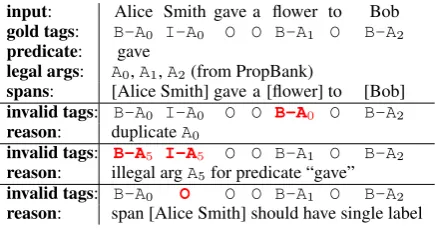
input: Alice Smith gave a flower to Bob gold tags: B-A0 I-A0 O O B-A1 O B-A2 predicate: gave
legal args: A0,A1,A2(from PropBank)
spans: [Alice Smith] gave a [flower] to [Bob] invalid tags: B-A0 I-A0 O O B-A0 O B-A2 reason: duplicateA0
[image:1.595.310.528.221.336.2]invalid tags: B-A5 I-A5 O O B-A1 O B-A2 reason: illegal argA5for predicate “gave” invalid tags: B-A0 O O O B-A1 O B-A2 reason: span [Alice Smith] should have single label
Figure 1: An example SRL instance (input, predicate, gold tags) with different invalid tag sequences and the
constraints they violate (details in §4.2).
space Y (Taskar, 2004; Tsochantaridis et al.,
2005). The search is restricted to set of valid
y∈ Yx⊆ Yforxby imposingconstraintsduring
inference. Figure1shows examples of constraints
used in Semantic Role Labeling (SRL) (Gildea
and Jurafsky,2002).
Currently, inference for most structured
pre-diction problems is solved sequentially,
predict-ing the output in a left-to-right manner (Sutskever
et al.,2014;Luong et al.,2016). Suchsequential inferenceapproaches enforce constraints in differ-ent ways. For example, a shift-reduce parser con-sults a stack to determine which action sequences
produce valid trees (Nivre et al.,2014), while an
SRL model penalizes tag sequences which violate
constraints during inference (Punyakanok et al.,
2008;T¨ackstr¨om et al.,2015).
At present, inference algorithms are designed to handle task-specific constraints, and there is no general formulation for constrained sequential in-ference. This contrasts with the state of affairs in NLP before deep learning, when constrained in-ference approaches used general formulations like
Integer Linear Programming (ILP) (Roth and Yih,
O
B-ORG
I-ORG
O
B-PER B-LOC
B-LOC
I-LOC
O
B-PER
B-ORG
B-PER
I-PER
O
B-LOC
B-ORG
(a) A FSA for BIO tag sequences for NER.
(S/(NP/(VP, push$
XX
,
do
nothing
(S/(NP/(VP, push( XX, do nothing
), if)then pop
(S/(NP/(VP, push( ), if$then pop
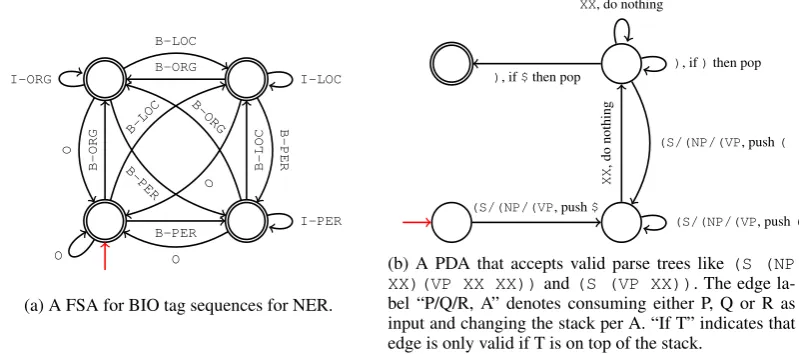
[image:2.595.106.506.67.244.2](b) A PDA that accepts valid parse trees like(S (NP XX)(VP XX XX))and(S (VP XX)). The edge la-bel “P/Q/R, A” denotes consuming either P, Q or R as input and changing the stack per A. “If T” indicates that edge is only valid if T is on top of the stack.
Figure 2: An example FSA and PDA. Red arrows mark start states, and double circles mark accepting states.
anautomatonexpressing the constraints as input, and outputs a structure that satisfies the constraints
(§2.2). The automaton guides the inference to
always produce a valid output by reshaping the model’s probability distribution such that actions deemed invalid by the automaton are not taken.
In some situations, it is more natural to express
the constraints as a set of automata. However,
naively enforcing multiple automata by fully in-tersecting them is potentially expensive. Instead, our algorithm lazily intersects the automata us-ing an efficient active set method, reminiscent of
the cutting-plane algorithm (Tsochantaridis et al.,
2005) (§2.4).
The choice of using automata to express
con-straints has several benefits. First, automata
are capable of expressing constraints used in a
wide variety of NLP tasks. Indeed, in §3, we
show that task-specific constrained inference ap-proaches implicitly use an automaton. Second, au-tomata can be naturally incorporated into any se-quential inference algorithm such as beam search. Finally, automata make enforcing multiple con-straints straightforward — only the automata for individual constraints need to be specified, which are then intersected at inference time.
Our algorithm is a principled approach for en-forcing constraints and has many desirable prop-erties. It decouples the constraints from the in-ference algorithm, making it generally applicable to many problems. Further, it guarantees valid output and allows for the seamless addition of constraints at inference time without modifying the inference code. We experimentally demon-strate the benefits of our algorithm on two
struc-tured prediction tasks, constituency parsing (§5.1)
and semantic role labeling (§5.2). Our results in
constituency parsing show that our algorithm al-ways outputs valid parses, incurring only a small
drop in F1. In SRL, constrained inference using
our algorithm corrects common errors produced
by unconstrained inference, resulting in a 1.5 F1
improvement. This increase in performance is
more prominent in low-resource settings. Finally, the active set method for enforcing multiple con-straints achieves a 5.2x speed-up over the naive ap-proach of fully intersecting the relevant automata.
2 Constrained Inference with Automata
We briefly review automata that we use for repre-senting constraints in our algorithm.
2.1 Brief Review of Automata Theory
For the purposes of this work, an automaton is a (possibly weighted) directed graph that compactly
encodes a set of strings, known as its language.
The two types of automata used in this work are finite-state automata (FSA) and push-down
au-tomata (PDA).2
In an FSA, each edge is labeled with a
sym-bolyfrom an alphabetΣ, and any traversal from
the starting state to the final state(s) represents a
unique string y in the language. A PDA is an
extension of an FSA in which the traversal can maintain a stack that is used for computation, and the edges may manipulate or examine the state of the stack. Any language that can be expressed us-ing regular expressions or context-free grammars
has an equivalent accepting FSA or PDA,
respec-tively (Sipser,1997). An example of each type of
automata is depicted in Figure2.
Our inference algorithm views an automaton as
an abstract stateful function, denoted asA, which
accepts strings from its languageL(A). After
con-suming the prefixy1:i of a stringy,Aprovides a
scoreA(yi+1 |y1:i)for every symboly ∈Σ.
In-vokingA.accepts(s) tests if a stringsis inL(A).
2.2 Sequential Inference
The traditional inference problem for structured prediction can be formalized as solving
ˆ
y= argmax
y∈Yx
logpθ(y|x) (1)
wherexandyare the input and output structures,
Yxis the set of valid output structures forx, and
θ are the parameters of the modelpθ(y | x). A
common way to solve this problem is to decom-pose the objective as follows:
ˆ
y= argmax
y∈Yx
X
i
logpθ(yi |x,y1:i−1) (2)
This decomposition is adopted by
popu-lar approaches, such as seq2seq models,
SEARN (Daum´e et al., 2009), etc. Under this decomposition, the inference problem is often solved by an inexact sequential inference algorithm, such as beam search.
2.3 Imposing Constraints with Automata
We are interested in versions of Equation 2 in
which the output space is described by the lan-guage of an automaton. Formally,
ˆ
y= argmax
y X
i
logpθ(yi |x,y1:i−1)
such that y∈L(Ax)
(3)
whereL(Ax)is the language of an automatonAx
describing the valid output space for instance x.
This framework is capable of expressing many constraints which are common in NLP
applica-tions, described in detail in §3.
Equation3can be rewritten as:
ˆ
y= argmax
y X
i
log ˜pθ(yi |x,y1:i−1) (4)
log ˜pθ(yi |x,y1:i−1),logpθ(yi |x,y1:i−1)
+Ax(yi|y1:i−1)
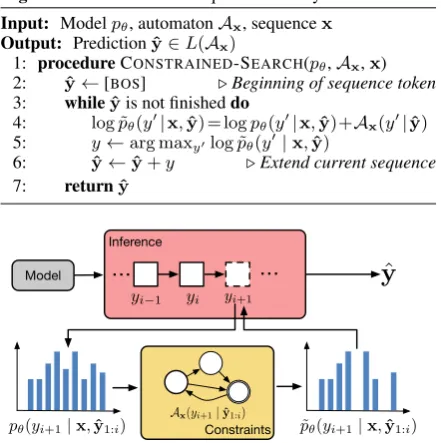
Algorithm 1Constrained Sequential Greedy Inference
Input: Modelpθ, automatonAx, sequencex
Output: Predictionˆy∈L(Ax)
1: procedureCONSTRAINED-SEARCH(pθ,Ax,x) 2: ˆy←[BOS] .Beginning of sequence token 3: whileˆyis not finisheddo
4: log ˜pθ(y0|x,ˆy) = logpθ(y0|x,ˆy)+Ax(y0|yˆ)
5: y←arg maxy0log ˜pθ(y0|x,ˆy)
6: ˆy←yˆ+y .Extend current sequence 7: returnyˆ
Inference
yi+1
<latexit sha1_base64="ue18fuwzYNKaZZT5v9WT2QLrWMI=">AAAB7nicbVBNS8NAEJ3Ur1q/qh69LBZBEEqigh6LXjxWsLbQhrLZTtqlm03Y3Qgh9Ed48aCIV3+PN/+N2zYHbX0w8Hhvhpl5QSK4Nq777ZRWVtfWN8qbla3tnd296v7Bo45TxbDFYhGrTkA1Ci6xZbgR2EkU0igQ2A7Gt1O//YRK81g+mCxBP6JDyUPOqLFSO+vn/Myb9Ks1t+7OQJaJV5AaFGj2q1+9QczSCKVhgmrd9dzE+DlVhjOBk0ov1ZhQNqZD7FoqaYTaz2fnTsiJVQYkjJUtachM/T2R00jrLApsZ0TNSC96U/E/r5ua8NrPuUxSg5LNF4WpICYm09/JgCtkRmSWUKa4vZWwEVWUGZtQxYbgLb68TB7P695F3b2/rDVuijjKcATHcAoeXEED7qAJLWAwhmd4hTcncV6cd+dj3lpyiplD+APn8wcA949X</latexit>
yi 1
<latexit sha1_base64="6yO3IUclX4/tm74nTaF9Ym+08fg=">AAAB7nicbVBNS8NAEJ3Ur1q/qh69LBbBiyVRQY9FLx4rWFtoQ9lsJ+3SzSbsboQQ+iO8eFDEq7/Hm//GbZuDtj4YeLw3w8y8IBFcG9f9dkorq2vrG+XNytb2zu5edf/gUcepYthisYhVJ6AaBZfYMtwI7CQKaRQIbAfj26nffkKleSwfTJagH9Gh5CFn1FipnfVzfuZN+tWaW3dnIMvEK0gNCjT71a/eIGZphNIwQbXuem5i/Jwqw5nASaWXakwoG9Mhdi2VNELt57NzJ+TEKgMSxsqWNGSm/p7IaaR1FgW2M6JmpBe9qfif101NeO3nXCapQcnmi8JUEBOT6e9kwBUyIzJLKFPc3krYiCrKjE2oYkPwFl9eJo/nde+i7t5f1ho3RRxlOIJjOAUPrqABd9CEFjAYwzO8wpuTOC/Ou/Mxby05xcwh/IHz+QMEA49Z</latexit> y<latexit sha1_base64="fA+ZJK1EyQbvufKNnkf6r0xzIAs=">AAAB7HicbVBNS8NAEJ3Ur1q/qh69LBbBU0lU0GPRi8cKpi20oWy2m3bpZhN2J0IJ/Q1ePCji1R/kzX/jts1BWx8MPN6bYWZemEph0HW/ndLa+sbmVnm7srO7t39QPTxqmSTTjPsskYnuhNRwKRT3UaDknVRzGoeSt8Px3cxvP3FtRKIecZLyIKZDJSLBKFrJn/RzMe1Xa27dnYOsEq8gNSjQ7Fe/eoOEZTFXyCQ1puu5KQY51SiY5NNKLzM8pWxMh7xrqaIxN0E+P3ZKzqwyIFGibSkkc/X3RE5jYyZxaDtjiiOz7M3E/7xuhtFNkAuVZsgVWyyKMkkwIbPPyUBozlBOLKFMC3srYSOqKUObT8WG4C2/vEpaF3Xvsu4+XNUat0UcZTiBUzgHD66hAffQBB8YCHiGV3hzlPPivDsfi9aSU8wcwx84nz8nn47n</latexit> i
ˆ
y
<latexit sha1_base64="cKmPPdsLA9KyE329ijh5al0YHK8=">AAAB+XicbVDLSsNAFL2pr1pfUZduBovgqiQq6LLoxmUF+4AmlMl00g6dTMLMpBBC/sSNC0Xc+ifu/BsnbRZaPTBwOOde7pkTJJwp7ThfVm1tfWNzq77d2Nnd2z+wD496Kk4loV0S81gOAqwoZ4J2NdOcDhJJcRRw2g9md6Xfn1OpWCwedZZQP8ITwUJGsDbSyLa9Kda5F2E9DcI8K4qR3XRazgLoL3Er0oQKnZH96Y1jkkZUaMKxUkPXSbSfY6kZ4bRoeKmiCSYzPKFDQwWOqPLzRfICnRlljMJYmic0Wqg/N3IcKZVFgZksI6pVrxT/84apDm/8nIkk1VSQ5aEw5UjHqKwBjZmkRPPMEEwkM1kRmWKJiTZlNUwJ7uqX/5LeRcu9bDkPV832bVVHHU7gFM7BhWtowz10oAsE5vAEL/Bq5daz9Wa9L0drVrVzDL9gfXwDWDWUHQ==</latexit>
Model … …
p✓(yi+1|x,ˆy1:i)
<latexit sha1_base64="ZaKfDt4t2ZNOVcZXF2PYOFfdmdk=">AAACInicbVDJSgNBEO2JW4xb1KOXxiBElDCjgssp6MVjBLNAJgw9nZ6kSc9Cd404DPMtXvwVLx4U9ST4MXYWRBMfdPN4r4qqem4kuALT/DRyc/MLi0v55cLK6tr6RnFzq6HCWFJWp6EIZcsligkesDpwEKwVSUZ8V7CmO7ga+s07JhUPg1tIItbxSS/gHqcEtOQUzyPHhj4DUk6clB9YGbZ93tUfgb7rpffZ4Q+3+wTSJMuc1Lrg2b5TLJkVcwQ8S6wJKaEJak7x3e6GNPZZAFQQpdqWGUEnJRI4FSwr2LFiEaED0mNtTQPiM9VJRydmeE8rXeyFUr8A8Ej93ZESX6nEd3XlcF017Q3F/7x2DN5ZJ+VBFAML6HiQFwsMIR7mhbtcMgoi0YRQyfWumPaJJBR0qgUdgjV98ixpHFWs44p5c1KqXk7iyKMdtIvKyEKnqIquUQ3VEUUP6Am9oFfj0Xg23oyPcWnOmPRsoz8wvr4Bu+ikaQ==</latexit> Constraints <latexit sha1_base64="bAs4JQ0t0NT2RFEW9FikJClOLb8=">AAACKnicbVDJSgQxEE27O26jHr0EB0FRhm4VFE8uF48KjgrTQ5NOVzth0gtJtdiE/h4v/ooXD4p49UPMjIO4PUh4vFdFVb0wl0Kj6746I6Nj4xOTU9O1mdm5+YX64tKlzgrFocUzmanrkGmQIoUWCpRwnStgSSjhKuyd9P2rW1BaZOkFljl0EnaTilhwhlYK6kc+ChmByavAxy4gWy8DIza9ivqJiOzHsBvG5q7a+uJ+l6Epqyow3oGoNoJ6w226A9C/xBuSBhniLKg/+VHGiwRS5JJp3fbcHDuGKRRcQlXzCw054z12A21LU5aA7pjBqRVds0pE40zZlyIdqN87DEu0LpPQVvbX1b+9vvif1y4w3u8YkeYFQso/B8WFpJjRfm40Ego4ytISxpWwu1LeZYpxtOnWbAje75P/ksvtprfTdM93G4fHwzimyApZJevEI3vkkJySM9IinNyTR/JMXpwH58l5dd4+S0ecYc8y+QHn/QPbzKgf</latexit>p˜✓(yi+1|x,ˆy1:i)
[image:3.595.307.528.72.294.2]A<latexit sha1_base64="zELc0MiJaBdSSkCg4kh4vLzZCEM=">AAACJXicbVDLSgMxFM34rPVVdekmWISKUGZEUMRF1Y3LCvYBnWHIpJk2NPMgyYhDmJ9x46+4cWERwZW/YqYdQVsPBE7OuZd77/FiRoU0zU9jYXFpeWW1tFZe39jc2q7s7LZFlHBMWjhiEe96SBBGQ9KSVDLSjTlBgcdIxxvd5H7ngXBBo/BepjFxAjQIqU8xklpyK5d2gOQQI6auMldNPp6vHrOslrqKHluZHdA+/NHtIZIqzXSldUGzI7dSNevmBHCeWAWpggJNtzK2+xFOAhJKzJAQPcuMpaMQlxQzkpXtRJAY4REakJ6mIQqIcNTkygweaqUP/YjrF0o4UX93KBQIkQaerszXFbNeLv7n9RLpnzuKhnEiSYing/yEQRnBPDLYp5xgyVJNEOZU7wrxEHGEpQ62rEOwZk+eJ+2TumXWrbvTauO6iKME9sEBqAELnIEGuAVN0AIYPIEX8AbGxrPxarwbH9PSBaPo2QN/YHx9A8bupp4=</latexit><latexit sha1_base64="zELc0MiJaBdSSkCg4kh4vLzZCEM=">AAACJXicbVDLSgMxFM34rPVVdekmWISKUGZEUMRF1Y3LCvYBnWHIpJk2NPMgyYhDmJ9x46+4cWERwZW/YqYdQVsPBE7OuZd77/FiRoU0zU9jYXFpeWW1tFZe39jc2q7s7LZFlHBMWjhiEe96SBBGQ9KSVDLSjTlBgcdIxxvd5H7ngXBBo/BepjFxAjQIqU8xklpyK5d2gOQQI6auMldNPp6vHrOslrqKHluZHdA+/NHtIZIqzXSldUGzI7dSNevmBHCeWAWpggJNtzK2+xFOAhJKzJAQPcuMpaMQlxQzkpXtRJAY4REakJ6mIQqIcNTkygweaqUP/YjrF0o4UX93KBQIkQaerszXFbNeLv7n9RLpnzuKhnEiSYing/yEQRnBPDLYp5xgyVJNEOZU7wrxEHGEpQ62rEOwZk+eJ+2TumXWrbvTauO6iKME9sEBqAELnIEGuAVN0AIYPIEX8AbGxrPxarwbH9PSBaPo2QN/YHx9A8bupp4=</latexit><latexit sha1_base64="zELc0MiJaBdSSkCg4kh4vLzZCEM=">AAACJXicbVDLSgMxFM34rPVVdekmWISKUGZEUMRF1Y3LCvYBnWHIpJk2NPMgyYhDmJ9x46+4cWERwZW/YqYdQVsPBE7OuZd77/FiRoU0zU9jYXFpeWW1tFZe39jc2q7s7LZFlHBMWjhiEe96SBBGQ9KSVDLSjTlBgcdIxxvd5H7ngXBBo/BepjFxAjQIqU8xklpyK5d2gOQQI6auMldNPp6vHrOslrqKHluZHdA+/NHtIZIqzXSldUGzI7dSNevmBHCeWAWpggJNtzK2+xFOAhJKzJAQPcuMpaMQlxQzkpXtRJAY4REakJ6mIQqIcNTkygweaqUP/YjrF0o4UX93KBQIkQaerszXFbNeLv7n9RLpnzuKhnEiSYing/yEQRnBPDLYp5xgyVJNEOZU7wrxEHGEpQ62rEOwZk+eJ+2TumXWrbvTauO6iKME9sEBqAELnIEGuAVN0AIYPIEX8AbGxrPxarwbH9PSBaPo2QN/YHx9A8bupp4=</latexit><latexit sha1_base64="zELc0MiJaBdSSkCg4kh4vLzZCEM=">AAACJXicbVDLSgMxFM34rPVVdekmWISKUGZEUMRF1Y3LCvYBnWHIpJk2NPMgyYhDmJ9x46+4cWERwZW/YqYdQVsPBE7OuZd77/FiRoU0zU9jYXFpeWW1tFZe39jc2q7s7LZFlHBMWjhiEe96SBBGQ9KSVDLSjTlBgcdIxxvd5H7ngXBBo/BepjFxAjQIqU8xklpyK5d2gOQQI6auMldNPp6vHrOslrqKHluZHdA+/NHtIZIqzXSldUGzI7dSNevmBHCeWAWpggJNtzK2+xFOAhJKzJAQPcuMpaMQlxQzkpXtRJAY4REakJ6mIQqIcNTkygweaqUP/YjrF0o4UX93KBQIkQaerszXFbNeLv7n9RLpnzuKhnEiSYing/yEQRnBPDLYp5xgyVJNEOZU7wrxEHGEpQ62rEOwZk+eJ+2TumXWrbvTauO6iKME9sEBqAELnIEGuAVN0AIYPIEX8AbGxrPxarwbH9PSBaPo2QN/YHx9A8bupp4=</latexit> x(yi+1|ˆy1:i)
Figure 3: At each time step, the automata Ax
re-shapes the model’s probability distribution pθ to p˜θ,
from which the next output labelyi+1is determined.
where Ax reshapes pθ to p˜θ at each time step.
To impose hard constraints, we set this score to
−∞ for invalid yi and constant for all validyi.3
Equation4allows natural extensions of sequential
inference algorithms, where an automaton is tra-versed in lock-step to guide the search to always output a valid structure. The necessary extension
of greedy search is presented in Algorithm1.
Con-cretely, when predictingyi, the inference selects
the most probable action under the reshaped
prob-ability distributionp˜θ(line5). It is straightforward
to similarly extend other sequential inference al-gorithms.
2.4 Imposing Multiple Constraints
The formulation above assumes that the con-straints are described using a single automaton. However, in some scenarios, it is more natural to impose multiple constraints by representing them as a set of automata.
A Motivating Example. Consider Figure 1
which illustrates the SRL problem. The following constraints should be obeyed by the tag sequence: the predicate cannot have multiple arguments of
the same type (A0–A5), each predicate may only
accept a certain set of argument types, and certain spans derived from a constituency parse should
ceive the same label.4 Each of these constraints can be easily expressed using a separate ton. In contrast, directly writing a single automa-ton to enforce these constraints simultaneously could be impractical and difficult.
Issues with Naive Approaches. Naively ex-tending sequential inference algorithms to impose a set of constraints by traversing multiple au-tomata in parallel fails. There is no guarantee that a valid structure will be found, even if the intersec-tion of the automata’s languages is non-empty (a proof by counter-example is provided in Appendix A). The alternative solution of intersecting the au-tomata into a single automaton may be intractable, as the size of the intersected automaton grows
ex-ponentially in the number of constraints (Hopcroft
and Ullman,1979).
An Active Set Method. Intuitively, intersecting all of the automata may not be necessary because it is possible for a constraint to be satisfied
with-out it being enforced. This is the basis for
ac-tive set methods (such as the cutting-plane
algo-rithm (Kelley,1960;Tsochantaridis et al.,2005)),
which maintain a set during inference that contains currently active (i.e., enforced) constraints. When a constraint is violated by the current output, it en-ters (i.e., is added to) the active set.
We present an active set method for imposing multiple constraints represented by a set of
au-tomata Sx in Algorithm 2. Our algorithm is
in-spired by the active set algorithm ofTromble and
Eisner(2006) for finite-state transducers.
For an instancex, Algorithm2maintains a
ac-tive set5 W corresponding to all violated
con-straints so far.Wis represented by the intersection
AW of the relevant automata, which is initialized
with an automata Σ∗ that accepts any sequence
(line 1). On each iteration, the algorithm runs
a constrained inference algorithm (such as
Algo-rithm1) that usesAW (line3) to find an outputyˆ.
Then, FIND-VIOLATIONchecks ifyˆviolates any
of the constraints that are not currently in the
ac-tive set,Sx\ W (line4). Ifˆyis accepted by all of
the automata (line5), it is valid and subsequently
returned (line6). Otherwise, the first violated
con-straint is added to W (line 8), its automaton A0
intersected withAW (line9), and constrained
in-ference is re-run (line3).
4
These constraints are described in detail in §4. 5Also known as aworking set.
Algorithm 2An Active Set Method for Multiple Constraints
Input: Modelpθ, set of automataSx, sequencex
Output: Predictionˆy∈T
A∈SxL(A)
1: W ← ∅,AW←Σ∗
2: whileTruedo
3: ˆy←CONSTRAINED-SEARCH(pθ,AW,x)
4: A0←
FIND-VIOLATION(Sx\ W,ˆy) 5: ifA0
is nullthen .No constraint is violated 6: returnyˆ .return current output 7: else
8: W ← W ∪ {A0}
.update working set 9: AW← AW∩ A0 .automata intersection
10: procedureFIND-VIOLATION(K,y) 11: foreachAin Kdo
12: ifnotA.accepts(y)then
13: returnA .the first violated constraint 14: returnnull
Algorithm 2 is guaranteed to terminate with a
valid output. In the worst case, all of the con-straints will be eventually enter the active set and inference will run with a fully intersected au-tomata. Although the cost of this worst case is exponential in the number of constraints, this oc-curs infrequently in practice. Moreover, we found
that Algorithm2is faster than naively computing
the full intersection despite running inference mul-tiple times.
3 Representing Constraints as Automata
We now illustrate the expressibility of automata by showing how they can represent commonly used constraints in various NLP applications.
Text Generation. Text generation tasks like im-age captioning, machine translation, sentence sim-plification, etc., often require that the output must
contain specific words or phrases (Anderson et al.,
2017; Hokamp and Liu, 2017; Post and Vilar,
2018; Zhang et al., 2017) in order to incorpo-rate prior knowledge (e.g., the caption must have the word “chair” as the object was detected in
the image). Similarly, constraints can disallow
invalid sequences, such as words which do not
rhyme (Ghazvininejad et al., 2016, 2018) or do
not appear in a dictionary (Deutsch et al.,2018).
Sequence Tagging. Many sequence tagging problems (such as NER, shallow parsing, etc.) re-quire that the output tags are valid under the spe-cific tagging scheme, such as BIO, which marks each token as beginning, inside, or outside of a phrase. One can easily write an FSA that recog-nizes the language of valid tag sequences for these
schemes, such as the automaton in Figure2a.
Other constraints commonly applied to se-quence tagging are specific to the particular task. In SRL, each argument type can appear exactly
one time. For instance, for the label A0, an FSA
with 3 states (before-A0, emitting-A0 and
after-A0) can be written to enforce this constraint. See
Tromble and Eisner(2006) for examples.
Syntactic Parsing. Syntactic parsing (depen-dency or constituency) tasks require that the out-put forms a valid tree, a constraint commonly
en-forced using the shift-reduce algorithm (Zhu et al.,
2013;Nivre et al.,2014;Dyer et al.,2016). Shift-reduce inference inspects the state of a stack to de-cide which next actions are valid (e.g., if the stack is empty, reduce is invalid). Shift-reduce inference is implicitly using an automaton which is the inter-section of a PDA (that counts how many shift and reduce actions have occurred) and an FSA (that restricts the maximum number of actions based on the input sentence length).
Semantic Parsing and Code Generation. In semantic parsing and code generation, constraints ensure both the syntactic validity and the exe-cutability of the output. For instance, for the
predi-cate ISADJACENT(which compares two countries
for adjacency) the syntactic constraint ensures the predicate receives two arguments, whereas the ex-ecutability ensures they are properly typed (e.g.,
that they are countries). Krishnamurthy et al.
(2017) use a type-constrained grammar to ensure
the output logical form is well-typed. Similarly,
Ling et al. (2016) use a stack while decoding to ensure the validity of the generated code. Both these constraints can be encoded in a PDA derived
from the grammar of the language (Sipser,1997).
4 Experimental Setup
We elaborate on two constrained inference tasks from the previous section, constituency parsing and semantic role labeling, which serve as case studies for showing the applicability and versa-tility of our approach. Our goal is not to beat
the state-of-the-art, but to illustrate the practical-ity and benefits of our approach.
4.1 Models, Datasets, and Evaluation
Constituency Parsing. We follow the
experi-mental setup of Vinyals et al. (2015) and train a
seq2seq model with attention using standard splits on the Penn Treebank. This setup was chosen to ensure that no constraints are built into the model for a truly unconstrained baseline. The input is a sequence of tokens, and the model outputs a
lin-earized parse tree (“gold parse” in Figure4).
We compare our approach (CONSTRAINED)
to unconstrained inference (UNCONSTRAINED),
which runs beam search and selects the
highest-scoring output. We also compare to Vinyals
et al. (2015)’s inference approach (henceforth POSTHOC). Vinyals et al.(2015) removes parses without the correct number of preterminals at the end of beam search and adds parentheses to
almost-valid parses.6 The algorithms are
evalu-ated using F1 as reported by EVALB, a standard
evaluation toolkit.7 However, because EVALB
ig-nores invalid trees during evaluation (which can artificially improve the performance of models which violate constraints), we also report cover-age, the percentage of valid outputs. We use a beam size of 10.
Semantic Role Labeling. For SRL, the uncon-strained model is an off-the-shelf implementation of He et al. (2017). The input to the model is the sentence and the predicate for which the ar-guments need to be identified, and the model
out-puts a tag sequence (such as Figure 1). To
iso-late the effect of constraints, we assume the gold
predicates are available, unlike He et al. (2017).
We use the standard train and development splits from the CoNLL 2005 shared task and the same
model parameters asHe et al. (2017). We report
the CoNLL F1score8computed for the core
argu-ments (namelyA0–A5) and use greedy inference.
4.2 Constraints
Constituency Parsing. The constraints used in parsing disallow invalid parses, such as the
ex-amples in Figure 4. The constraints ensure
that (i) the parentheses are balanced (BAL), (ii)
there is exactly one preterminal per input token
6
personal communication withVinyals et al.(2015) 7
nlp.cs.nyu.edu/evalb/ 8
input: John kissed Mary
gold parse: (S (NP XX)(VP XX (NP XX)))
invalid parse: (S (NP )(VP XX XX (NP XX)))
reason: empty phrase
invalid parse: (S (VP XX (NP XX)))
reason: incorrect number of preterminals invalid parse: (S (NP XX)(VP XX (NP XX))))
[image:6.595.314.516.60.199.2]reason: unbalanced parentheses
Figure 4: An example parsing instance with different invalid parses and the constraints they violate (details
in §4.2).XXdenotes POS tags.
(#PRETERM), and (iii) every phrase contains at
least one preterminal (NONEMPTY).
Semantic Role Labeling. The constraints used in SRL disallow invalid sequences, such as the
ones in Figure 1. The constraints ensure that (i)
a predicate cannot have multiple arguments of the
same type (NODUP). This constraint is expressed
using one FSA per argument label for a total of
5 automata; (ii) a predicate can only take a
cer-tain set of argument types (LEGALARGS),
accord-ing to PropBank v3.1 (Palmer et al., 2005). This
constraint is expressed using one FSA;(iii)certain
spans in the sentence should be assigned the same
argument label type (SPANLABEL). These spans
are identified from the predicate and the con-stituency parse of the sentence using the
heuris-tic ofXue and Palmer(2004).9 This constraint is
expressed using one FSA.
Ease of Implementation. All of the constraints were expressed using an FSA, with the exception
of BALwhich requires a PDA. The automata were
implemented using Pynini (Gorman, 2016). We
use the same inference code for both tasks, except for the automata generation.
5 Experimental Results
We show the practicality of our approach and the benefits over unconstrained inference in the exper-iments below. In order to illustrate the benefits of constrained inference in low-resource settings, we simulate different levels of supervision.
5.1 Constituency Parsing
We experimentally show the need for constraints and compare inference strategies for parsing.
Necessity of Constraints. In order to demon-strate that constraints are necessary to guarantee
9We useKitaev and Klein(2018)’s parser.
0 20 40 60 80 100
40 60 80 100
Percentage of Training Data
Percent
Satisfied
NONEMPTY
BAL
#PRETERM
[image:6.595.75.290.62.148.2]All
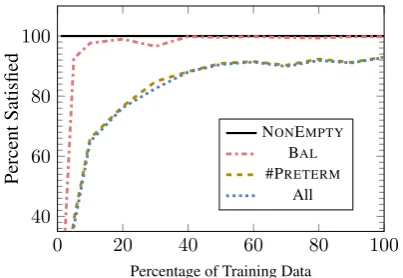
Figure 5: Percentage of output test parses that satisfy
the constituency parsing constraints in §4.2when
us-ing unconstrained inference as the amount of trainus-ing data is increased. “All” measures the percent of parses which satisfy all of the constraints. Even with 100% of the training data, the model fails to always output the correct number of preterminals.
structurally valid output, we vary the amount of training data for a seq2seq model and measure how frequently the output is an invalid parse tree.
The results in Figure 5 show that while the
model learns some constraints with little data, oth-ers are frequently violated even with full supervi-sion. For instance, the model outputs parse trees with balanced parentheses for over 94% of in-stances, after training on as little as 5% of the training data. However, the model frequently
vi-olates the #PRETERMconstraint, outputting an
in-correct number of preterminals on about 7% of parses even after training on 100% of the data. Therefore, we cannot expect seq2seq models to learn to produce valid outputs, even when it has access to 40k labeled parse trees, let alone in low-resource settings.
Comparing Inference Approaches. Figure 6
shows the performance of all the three inference
techniques discussed in §4.1, namely, UNCON
-STRAINED, POSTHOC, and CONSTRAINED.
At first glance, it appears that UNCON
-STRAINED is slightly better than both POSTHOC
and CONSTRAINED at 100% supervision.
How-ever, EVALB ignores any invalid parse trees when
computing F1, and therefore it is necessary to take
coverage (the percent of valid output parses) into account when comparing inference approaches.
It is evident from Figure 6 (left) that CON
-STRAINED always ensures 100% coverage, and
POSTHOConly reaches near-100% coverage with
0 20 40 60 80 100 0
20 40 60 80 100
Percentage of Training Data F1
/
Percent
Coverage F1
UNCONSTRAINED
CONSTRAINED
POSTHOC
0 20 40 60 80 100
0 20 40 60 80 100
Percentage of Training Data F1
/
Percent
Coverage F1
UNCONSTRAINED
CONSTRAINED
[image:7.595.82.520.60.234.2]POSTHOC
Figure 6: F1and coverage (# valid output parses / # test instances) for UNCONSTRAINED, POSTHOC, and
CON-STRAINED on the entire test data (left) and test sentences of length≥30 (right). The UNCONSTRAINED and
POSTHOCinference algorithms have a harder time producing valid parse trees for the longer input sentences.
achieves consistently low coverage, with the best
model reaching 7% lower coverage than the CON
-STRAINED.
The increased coverage explains the apparent
drop in F1for constrained approaches. Intuitively,
longer sentences are inherently harder to parse. CONSTRAINED and POSTHOC produce a valid, but potentially incorrect parse for these sentences
and get penalized. In contrast, UNCONSTRAINED
is more likely to produce invalid parses for these sentences, and is thus effectively evaluated on a test set containing short sentences. To verify this, we re-evaluated the inference approaches on test
sentences which are≥30 tokens (Figure6, right).
Under this setting, every approach has worse F1
and coverage at all levels of supervision (Figure6
left vs right).
5.2 Semantic Role Labeling
We show that we can improve the performance of a trained model by incorporating constraints at
in-ference time which address common errors (Daza
and Frank,2018) made by SRL models. This ex-periment also shows the efficiency of the active set method in enforcing multiple constraints.
Correcting Common Errors. We now show how some common SRL errors like the ones
discussed in Figure 1, can be corrected using
constraints added at inference time.
Start-ing with an unconstrained baseline model
(UNCONSTRAINED), we successively add the
NODUP, LEGALARGS and SPANLABEL
con-straints, in that order.
10 20 30 40 50 60 70 80 90 100 65
70 75 80
Percentage of Training Data
CoNLL
F1
UNCONSTRAINED
+NODUP
+LEGALARGS
+SPANLABEL(Fully Constrained)
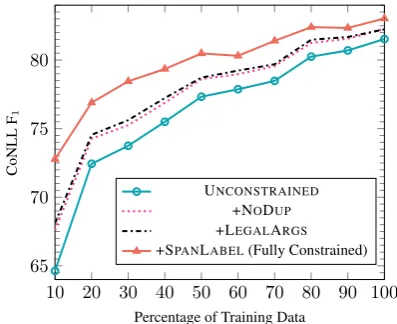
Figure 7: Learning curve for SRL. Starting with un-constrained inference, we incrementally add NODUP,
LEGALARGSand SPANLABEL constraints. The
con-straints improve performance at all levels of supervi-sion, with the largest improvements in low supervision settings.
Figure 7 shows that using the constraints
im-proves performance over UNCONSTRAINEDin all
settings. Constraints like NODUPand SPANLA
-BEL give significant gains, demonstrating their
value. At 100% supervision, fully constrained
in-ference improves by 1.5 F1 points over
unstrained inference (83.03 vs 81.53). In fact, con-strained inference at only 50% data achieves
sim-ilar F1 score as UNCONSTRAINEDat 100%, with
larger gains in low supervision regimes (≤40%).
Active Set Size and Efficiency. For SRL, the
maximum possible size of the active set W is 7
[image:7.595.315.514.299.461.2]10 20 30 40 50 60 70 80 90 100
60 65 70 75 80 85 90 95 100
Percentage of Training Data
Size
Distrib
ution
of
W
0 violation 1 violation 2 violation 3 violation 4 violation 5 violation
10 20 30 40 50 60 70 80 90 100 3.5x
4x
5x
5.5x
5.2x
Percentage of Training Data
[image:8.595.83.284.61.345.2]speed-up
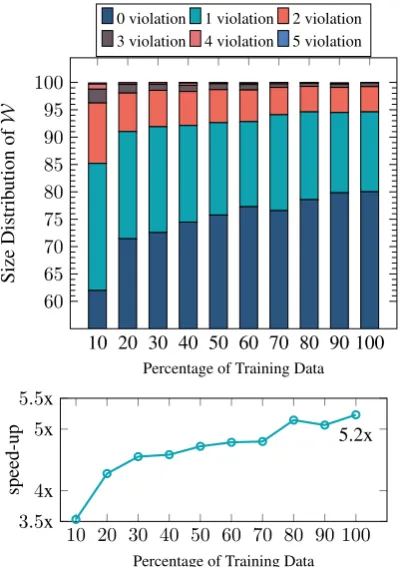
Figure 8:Top: Size distribution of the final working set
for the active set method. With a model trained on 30% of the data, 72% of the test instances have an empty
fi-nal working set (i.e., with 0 violations). Bottom:
Rel-ative speed-up in decoding time using the active set method over naively computing the full intersection.
2022 arcs. We now measure the size of the active set observed in practice.
Figure8shows the size distribution of the final
Wunder different amounts of supervision. With a
fully supervised model, 80% of the test instances
had an emptyW when inference terminated (i.e.,
no constraints entered W). Under the same
set-ting,Wcontains 1 and 2 constraints for 10.6% and
8.6% of the instances, respectively. Under any
set-ting,W was empty for>60% of the instances. On
average, the active set automaton had 34 states and 66 arcs, a 30x reduction over the full intersection.
To evaluate the efficiency of Algorithm 2,
Fig-ure8(bottom) plots the relative decoding times of
the active set method over naively computing the full intersection. The active set method is consis-tently faster, with the largest speed-up (5.2x) at the highest level of supervision as the average active set size is the smallest at this setting.
Factors Affecting Speed-up. In general, the amount of speed-up provided by the active set method depends on several factors, including the
number of constraints, the size of the constraint automata, and the cost of computing the softmax
during inference. The largest gains will come
when the former two factors are most expensive, as the active set will only incur the intersection cost as needed. If the output vocabulary is large, softmax computation may outweigh the cost of fully intersecting the constraint automata.
6 Related Work
Traditional Constrained Inference. Tradi-tional constrained inference approaches enforced constraints using general combinatorial
opti-mization frameworks, for instance linear (Taskar
et al., 2004) and integer linear programs (Roth and Yih, 2005, 2007; Clarke and Lapata, 2008;
Martins et al., 2009), SAT solvers (Richardson and Domingos,2006;Poon and Domingos,2008), etc. Unlike these approaches which find the best output that satisfies a set of constraints, our work attempts to provide a similar general framework for sequential inference algorithms that will find the approximate-best output.
Unconstrained Data-driven Approaches.
Many sequential inference approaches do not enforce constraints at all, in the hope that they will
be learned from data (Lample et al., 2016;Choe
and Charniak,2016;Suhr et al.,2018). While the model can potentially “impose” some constraints which are well-represented in the data, there is no guarantee that the output structure will be valid. In contrast, our work guarantees valid output.
Post-Hoc Constraint Satisfaction. Some ap-proaches first run unconstrained inference to find
the top-k structures and then identify valid
struc-tures in a post-hoc manner (Andreas et al.,2013;
Vinyals et al., 2015;Kiddon et al., 2016; Upad-hyay et al., 2018). Such techniques also cannot guarantee validity of the output structure when all
top-kstructures are invalid, whereas our model
en-sures all top-kare valid.
Our Work. We draw from work in NLP that
uses automata (Mohri,1997;Karttunen,2000,
in-ter alia) and recent work in constrained text
gen-eration (discussed in §3). Our work is also
re-lated toAnderson et al.(2017) who impose
lexi-cal constraints for image captioning by
maintain-ing a beam foreachstate in an FSA, an
impracti-cal strategy for automata with thousands of states
was the inspiration for the active set method. A
very recent work, Lee et al. (2019), also impose
constraints in sequential inference by including them in the objective function and modifying the model’s weights until the constraints are satisfied.
7 Conclusion and Future Work
We presented a principled, general-purpose con-strained sequential inference algorithm. Key to our algorithm is using automata to represent con-straints, which we showed are capable of express-ing popularly used constraints in NLP. Our ap-proach is an attractive alternative to task-specific constrained inference approaches currently in use. Using a fast active set method, we can seamlessly incorporate multiple constraints at inference time without modifying the inference code. The exper-imental results showed the value of our approach over unconstrained inference, with the gains be-coming more prominent in low-resource settings.
Acknowledgments
The authors would like to thank Sampath Kannan, Caleb Stanford, Jordan Kodner, and the anony-mous reviewers for their useful comments and suggestions.
This work was supported by Contract HR0011-15-C-0113 and Contract HR0011-18-2-0052 with the US Defense Advanced Research Projects Agency (DARPA). Approved for Public Release, Distribution Unlimited. The views expressed are those of the authors and do not reflect the official policy or position of the Department of Defense or the U.S. Government.
References
Peter Anderson, Basura Fernando, Mark Johnson, and
Stephen Gould. 2017. Guided Open Vocabulary
Image Captioning with Constrained Beam Search.
In Proceedings of the 2017 Conference on
Empiri-cal Methods in Natural Language Processing, pages 936–945, Copenhagen, Denmark. Association for Computational Linguistics.
Jacob Andreas, Andreas Vlachos, and Stephen Clark.
2013. Semantic Parsing as Machine Translation. In
Proceedings of the 51st Annual Meeting of the As-sociation for Computational Linguistics (Volume 2: Short Papers), pages 47–52, Sofia, Bulgaria. Asso-ciation for Computational Linguistics.
Do Kook Choe and Eugene Charniak. 2016. Parsing
as Language Modeling. InProceedings of the 2016
Conference on Empirical Methods in Natural Lan-guage Processing, pages 2331–2336, Austin, Texas. Association for Computational Linguistics.
James Clarke and Mirella Lapata. 2008. Global in-ference for sentence compression: An integer linear
programming approach. Journal of Artificial
Intelli-gence Research, 31:399–429.
Hal Daum´e, John Langford, and Daniel Marcu. 2009.
Search-based Structured Prediction.Machine
learn-ing, 75(3):297–325.
Angel Daza and Anette Frank. 2018. A
Sequence-to-Sequence Model for Semantic Role Labeling. In Proceedings of The Third Workshop on Representa-tion Learning for NLP, pages 207–216. AssociaRepresenta-tion for Computational Linguistics.
Daniel Deutsch, John Hewitt, and Dan Roth. 2018. A
Distributional and Orthographic Aggregation Model for English Derivational Morphology. In Proceed-ings of the 56th Annual Meeting of the Association for Computational Linguistics (Volume 1: Long Pa-pers), pages 1938–1947. Association for Computa-tional Linguistics.
Chris Dyer, Adhiguna Kuncoro, Miguel Ballesteros,
and Noah A. Smith. 2016. Recurrent neural network
grammars. InProceedings of the 2016 Conference of the North American Chapter of the Association for Computational Linguistics: Human Language Technologies, pages 199–209, San Diego, Califor-nia. Association for Computational Linguistics.
Marjan Ghazvininejad, Yejin Choi, and Kevin Knight.
2018. Neural Poetry Translation. InProceedings of
the 2018 Conference of the North American Chap-ter of the Association for Computational Linguistics: Human Language Technologies, Volume 2 (Short Papers), pages 67–71, New Orleans, Louisiana. As-sociation for Computational Linguistics.
Marjan Ghazvininejad, Xing Shi, Yejin Choi, and
Kevin Knight. 2016. Generating Topical Poetry.
In Proceedings of the 2016 Conference on
Empiri-cal Methods in Natural Language Processing, pages 1183–1191, Austin, Texas. Association for Compu-tational Linguistics.
Daniel Gildea and Daniel Jurafsky. 2002. Automatic
Labeling of Semantic Roles. Computational
Lin-guistics, 28(3):245–288.
Kyle Gorman. 2016. Pynini: A Python Library for
Weighted Finite-state Grammar Compilation. In Proceedings of the SIGFSM Workshop on Statistical NLP and Weighted Automata, pages 75–80, Berlin, Germany. Association for Computational Linguis-tics.
Luheng He, Kenton Lee, Mike Lewis, and Luke
Zettle-moyer. 2017. Deep Semantic Role Labeling: What
473–483. Association for Computational Linguis-tics.
Chris Hokamp and Qun Liu. 2017. Lexically
Con-strained Decoding for Sequence Generation Using Grid Beam Search. InProceedings of the 55th An-nual Meeting of the Association for Computational Linguistics (Volume 1: Long Papers), pages 1535– 1546, Vancouver, Canada. Association for Compu-tational Linguistics.
John E Hopcroft and Jeffrey D Ullman. 1979.
Intro-duction to automata theory, languages, and compu-tation. Addison-Wesley.
Lauri Karttunen. 2000. Applications of finite-state
transducers in natural language processing. In
In-ternational Conference on Implementation and Ap-plication of Automata, pages 34–46. Springer.
James E Kelley, Jr. 1960. The Cutting-Plane Method
for Solving Convex Programs. Journal of the society
for Industrial and Applied Mathematics, 8(4):703– 712.
Chlo´e Kiddon, Luke Zettlemoyer, and Yejin Choi.
2016.Globally Coherent Text Generation with
Neu-ral Checklist Models. In Proceedings of the 2016 Conference on Empirical Methods in Natural Lan-guage Processing, pages 329–339, Austin, Texas. Association for Computational Linguistics.
Nikita Kitaev and Dan Klein. 2018. Constituency
Parsing with a Self-Attentive Encoder. In Proceed-ings of the 56th Annual Meeting of the Association for Computational Linguistics (Volume 1: Long Pa-pers), pages 2676–2686. Association for Computa-tional Linguistics.
Jayant Krishnamurthy, Pradeep Dasigi, and Matt Gard-ner. 2017. Neural semantic parsing with type
con-straints for semi-structured tables. InEMNLP.
Guillaume Lample, Miguel Ballesteros, Sandeep Sub-ramanian, Kazuya Kawakami, and Chris Dyer. 2016.
Neural Architectures for Named Entity Recognition.
InProceedings of the 2016 Conference of the North
American Chapter of the Association for Computa-tional Linguistics: Human Language Technologies, pages 260–270, San Diego, California. Association for Computational Linguistics.
Jay Yoon Lee, Sanket Vaibhav Mehta, Michael Wick, Jean-Baptiste Tristan, and Jaime G. Carbonell. 2019. Gradient-based inference for networks with output
constraints. InAAAI 2019.
Wang Ling, Phil Blunsom, Edward Grefenstette, Karl Moritz Hermann, Tom´aˇs Koˇcisk´y, Fumin
Wang, and Andrew Senior. 2016. Latent predictor
networks for code generation. InProceedings of the 54th Annual Meeting of the Association for Compu-tational Linguistics (Volume 1: Long Papers), pages 599–609. Association for Computational Linguis-tics.
Minh-Thang Luong, Quoc V Le, Ilya Sutskever, Oriol Vinyals, and Lukasz Kaiser. 2016. Multi-task
Se-quence to SeSe-quence Learning. InProc. of ICLR.
Andr´e FT Martins, Noah A. Smith, and Eric P. Xing. 2009. Concise Integer Linear Programming
Formu-lations for Dependency Parsing. InProceedings of
the Annual Meeting of the Association for Computa-tional Linguistics (ACL).
Mehryar Mohri. 1997. Finite-state Transducers in
Lan-guage and Speech Processing. Computational
lin-guistics, 23(2):269–311.
Joakim Nivre, Yoav Goldberg, and Ryan McDonald. 2014. Constrained Arc-Eager Dependency Parsing. Computational Linguistics, 40(2).
Martha Palmer, Daniel Gildea, and Paul Kingsbury.
2005. The proposition bank: An annotated
cor-pus of semantic roles. Computational linguistics,
31(1):71–106.
Hoifung Poon and Pedro Domingos. 2008. Joint
Unsupervised Coreference Resolution with Markov
Logic. In Proceedings of the Conference on
Em-pirical Methods for Natural Language Processing (EMNLP), pages 650–659.
Matt Post and David Vilar. 2018. Fast Lexically
Con-strained Decoding with Dynamic Beam Allocation for Neural Machine Translation. InProceedings of the 2018 Conference of the North American Chap-ter of the Association for Computational Linguistics: Human Language Technologies, Volume 1 (Long Pa-pers), pages 1314–1324. Association for Computa-tional Linguistics.
Vasin Punyakanok, Dan Roth, and Wen tau Yih. 2008. The Importance of Syntactic Parsing and Inference
in Semantic Role Labeling.Computational
Linguis-tics, 34(2).
Matthew Richardson and Pedro Domingos. 2006.
Markov Logic Networks. Machine Learning Jour-nal, 62(1-2):107–136.
Dan Roth and Scott Wen-tau Yih. 2004. A linear
programming formulation for global inference in
natural language tasks. In Proc. of the
Confer-ence on Computational Natural Language Learning (CoNLL), pages 1–8. Association for Computational Linguistics.
Dan Roth and Scott Wen-tau Yih. 2005. Integer Lin-ear Programming Inference for Conditional Random
Fields. InProc. of the International Conference on
Machine Learning (ICML), pages 737–744.
Dan Roth and Wen-tau Yih. 2007. Global Inference for Entity and Relation Identification via a Linear Programming Formulation.
Michael Sipser. 1997. Introduction to the Theory of
Alane Suhr, Srinivasan Iyer, and Yoav Artzi. 2018.
Learning to Map Context-Dependent Sentences to Executable Formal Queries. InProceedings of the 2018 Conference of the North American Chapter of the Association for Computational Linguistics: Hu-man Language Technologies, Volume 1 (Long Pa-pers), pages 2238–2249. Association for Computa-tional Linguistics.
Ilya Sutskever, Oriol Vinyals, and Quoc V Le. 2014. Sequence to Sequence Learning with Neural
Net-works. InAdvances in neural information
process-ing systems, pages 3104–3112.
Oscar T¨ackstr¨om, Kuzman Ganchev, and Dipanjan Das. 2015. Efficient inference and structured
learn-ing for semantic role labellearn-ing. Transactions of the
Association for Computational Linguistics, 3:29–41.
B. Taskar. 2004.Learning Structured Prediction
Mod-els: A Large Margin Approach. Ph.D. thesis, Stan-ford University. Computer Science TR-280.
B. Taskar, C. Guestrin, and D. Koller. 2004.
Max-margin markov networks. In The Conference on
Advances in Neural Information Processing Systems (NIPS).
Roy Tromble and Jason Eisner. 2006. A fast
finite-state relaxation method for enforcing global con-straints on sequence decoding. In Proceedings of the Human Language Technology Conference of the NAACL, Main Conference, pages 423–430, New York City, USA. Association for Computational Lin-guistics.
I. Tsochantaridis, T. Joachims, T. Hofmann, and Y. Al-tun. 2005. Large margin methods for structured and
interdependent output variables. Journal of Machine
Learning Research, 6:1453–1484.
Shyam Upadhyay, Jordan Kodner, and Dan Roth. 2018.
Bootstrapping Transliteration with Constrained Dis-covery for Low-Resource Languages. In Proceed-ings of the 2018 Conference on Empirical Methods in Natural Language Processing, pages 501–511. Association for Computational Linguistics.
Oriol Vinyals, Łukasz Kaiser, Terry Koo, Slav Petrov, Ilya Sutskever, and Geoffrey Hinton. 2015.
Gram-mar as a Foreign Language. InAdvances in Neural
Information Processing Systems, pages 2773–2781.
Nianwen Xue and Martha Palmer. 2004. Calibrating
Features for Semantic Role Labeling. In
Proceed-ings of the Conference on Empirical Methods for Natural Language Processing (EMNLP), pages 88– 94, Barcelona, Spain.
Yaoyuan Zhang, Zhenxu Ye, Yansong Feng, Dongyan Zhao, and Rui Yan. 2017. A Constrained Sequence-to-Sequence Neural Model for Sentence
Simplifica-tion. CoRR, abs/1704.02312.
Muhua Zhu, Yue Zhang, Wenliang Chen, Min Zhang,
and Jingbo Zhu. 2013. Fast and accurate