998
Adversarial Training for Weakly Supervised Event Detection
Xiaozhi Wang1∗, Xu Han1∗, Zhiyuan Liu1†, Maosong Sun1, Peng Li2
1Department of Computer Science and Technology, Tsinghua University, Beijing, China Institute for Artificial Intelligence, Tsinghua University, Beijing, China
State Key Lab on Intelligent Technology and Systems, Tsinghua University, Beijing, China 2Pattern Recognition Center, WeChat, Tencent Inc, China
{xz-wang16, hanxu17}@mails.tsinghua.edu.cn {liuzy, sms}@tsinghua.edu.cn
Abstract
Modern weakly supervised methods for event detection (ED) avoid time-consuming human annotation and achieve promising results by learning from auto-labeled data. However, these methods typically rely on sophisticated pre-defined rules as well as existing instances in knowledge bases for automatic annotation and thus suffer from low coverage, topic bias, and data noise. To address these issues, we build a large event-related candidate set with good coverage and then apply an adversar-ial training mechanism to iteratively identify those informative instances from the candi-date set and filter out those noisy ones. The experiments on two real-world datasets show that our candidate selection and adversarial training can cooperate together to obtain more diverse and accurate training data for ED, and significantly outperform the state-of-the-art methods in various weakly supervised sce-narios. The datasets and source code can be obtained fromhttps://github.com/ thunlp/Adv-ED.
1 Introduction
Event detection (ED) aims at detecting event trig-gers, which are often words or phrases evoking events in instances, and then identifying their spe-cific event types. For example, we can extract the trigger “married” of the event “Marry” from the text “Mark Twain and Olivia Langdon married in 1870”. Detecting and identifying events is an important subtask of event extraction and also beneficial for various downstream NLP applications, such as question answering (Yang et al., 2003), information retrieval (Basile et al., 2014), and reading comprehension (Cheng and Erk, 2018). Hence, many efforts have been de-voted to detecting event triggers and types.
∗
indicates equal contribution †
Corresponding author: Z.Liu([email protected])
Most prior methods for ED are based on feature engineering, such as the token-level features (Ahn, 2006;Ji and Grishman, 2008) and the structured features (Li et al., 2013; Araki and Mitamura, 2015). As the rapid development of neural net-works, various neural models have been proposed to directly embed textual semantic information into a low-dimensional space and then detect event triggers based on those feature vectors (Chen et al., 2015;Nguyen and Grishman,2015;Nguyen et al., 2016; Ghaeini et al., 2016; Feng et al., 2016). These methods follow a supervised learning ap-proach to train models on human-annotated data, and their requirement of human-annotated data is a bottleneck in practice. Considering weak su-pervision is widely adopted to take full advan-tages of large-scale raw data, especially some spe-cific work for information extraction (Mintz et al., 2009;Riedel et al., 2010;Zeng et al.,2015;Cao et al.,2018), weak supervision has been explored to automatically label training data for ED (Chen et al.,2017;Zeng et al.,2018;Yang et al.,2018; Araki and Mitamura,2018). Compared with those supervised ED methods, the weakly supervised methods can be generalized to real-world ED ap-plications efficiently without intensive labor.
Although promising results have been achieved by these weakly supervised methods, there are still some severe problems for these weakly super-vised ED models: (1) Weakly supersuper-vised meth-ods naturally suffer from the inevitable noise in data. (2) Current weakly supervised ED mod-els adopt sophisticated pre-defined rules and in-complete knowledge bases to automatically obtain data, which results in the auto-labeled data with low coverage and topic bias.
D Bob [contacted]Lily by post. E
...
...
...
Reliable Set
Unreliable Set
G Bob [wrote]to Lily. E
Bob [wrote]a novel. E
...
...
...
...
...
...
Encoder
[image:2.595.81.509.66.253.2]E G Generator D Discriminator
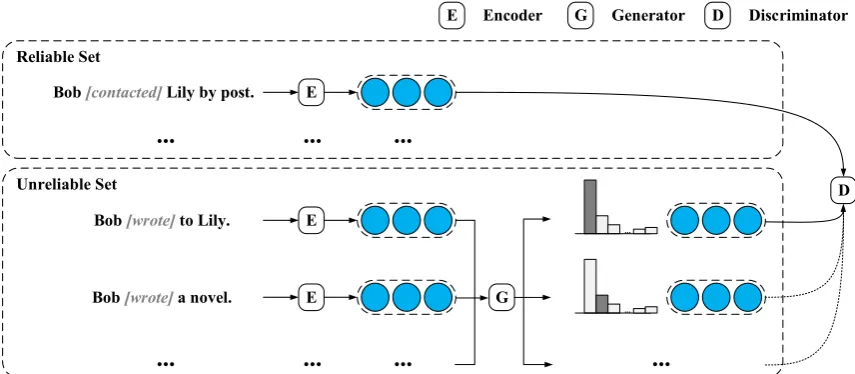
Figure 1: The overall architecture of adversarial training method for ED. The event type isContact.
we propose a simple trigger-based latent instance discovery strategy, by applying an assumption that if a given word1 serves as the trigger in a known event instance, all instances mentioning this word may also express an event. As compared with the sophisticated rules, this strategy is less restrictive in the correlation among words, triggers and event types. Hence, our strategy can obtain a candidate set covering more topics and instances without any manual design.
We further propose an adversarial training mechanism likeGoodfellow et al.(2014);Radford et al.(2016), which can not only distill those infor-mative instances from the candidate set but also improve the performance of ED model on a noisy scenario such as distant supervision. As shown in Figure1, we split the dataset into a reliable set and an unreliable set respectively, and design a dis-criminator and a generator. The disdis-criminator is applied to judge whether a given instance is in-formative and annotated correctly, and the gener-ator is used to select the most confusing instances from raw data to fool the discriminator. The dis-criminator is trained with the reliable data as pos-itive instances and the data selected by the gener-ator as negative ones. Meanwhile, the genergener-ator is trained to select data to fool the discriminator. During the training process, the generator can pro-vide large amounts of latent noisy data to enhance the discriminator, and the discriminator can influ-ence the generator to select those more informa-tive data. Since noisy data makes no effect on op-timizing both the generator and the discriminator,
1We treat phrases as words in this paper.
when the generator and the discriminator reach a balance, the discriminator can boost resistance to noise and better categorize events, and the gener-ator can effectively select informative instances to the discriminator.
We conduct experiments on both
semi-supervised and distantly semi-supervised scenarios. The experimental results demonstrate that our trigger-based latent instance discovery strategy and adversarial training method can cooperate to obtain more diverse and accurate training data as well as reduce the side effect of the noise problem, and thus significantly outperform the state-of-the-art ED models.
2 Related Work
ED has attracted wide attention recently. Tradi-tional feature-based methods (Ahn, 2006; Ji and Grishman,2008;Gupta and Ji,2009;Riedel et al., 2010;Hong et al., 2011;McClosky et al., 2011; Huang and Riloff,2012a,b;Araki and Mitamura, 2015; Li et al., 2013; Yang and Mitchell, 2016; Liu et al., 2016b) rely on manually designed fea-tures to detect the event triggers and event types. With the development of neural networks, various neural methods have also been proposed (Chen et al.,2015;Nguyen and Grishman,2015;Nguyen et al.,2016;Duan et al.,2017;Nguyen et al.,2016; Ghaeini et al.,2016;Lin et al.,2018).
2018) and multimodal integration (Zhang et al., 2017). Some advanced architectures have also been applied, such as attention mechanism (Liu et al., 2017, 2018a), graph convolutional net-works (Nguyen and Grishman, 2018) and gener-ative adversarial networks (Hong et al.,2018).
All the supervised methods above rely on human-annotated data, and the data is often re-stricted to a small scale due to the expensive human annotation. Hence, unsupervised meth-ods (Huang et al.,2016;Yuan et al.,2018) and var-ious weakly supervised methods on ED are pro-posed.Muis et al.(2018) adopt distant supervision to create training instances for low-resource lan-guage. Araki and Mitamura(2018) adopt Word-Net (Miller et al., 1990) and rule-based meth-ods to generate open-domain data without event-type labels. Chen et al. (2017) and Zeng et al. (2018) use distant supervision to generate large-scale data from existing structured event knowl-edge in knowlknowl-edge bases. Liao and Grishman (2010a),Huang and Riloff (2012a) and Ferguson et al. (2018) conduct semi-supervised ED with bootstrapping. Nevertheless, due to the low cov-erage of existing knowledge bases as well as lack of advanced denoising mechanism, those weakly supervised methods still suffer from the problem of low coverage and noisy data.
Inspired by Szegedy et al. (2013) and Good-fellow et al.(2014), adversarial training has been explored for several NLP applications recently to resist noise, such as text classification (Miyato et al.,2016) and text generation (Xie et al.,2017; Chen et al.,2018). Adversarial training has also been adopted for information extraction (Wu et al., 2017;Hong et al., 2018;Qin et al., 2018; Wang et al., 2018;Han et al.,2018). These adversarial information extraction methods either generate ad-versarial instances by adding simple noise pertur-bation to embeddings (Wu et al.,2017;Hong et al., 2018), or mainly adopt models to denoise data and neglect to discover more training instances from raw data (Qin et al.,2018;Han et al.,2018). Com-pared with these methods, our adversarial method samples adversarial examples from the real-world data rather than generating pseudo noisy pertur-bations. Furthermore, our method not only de-noises auto-labeled data but also labels unlabeled instances to extend datasets for higher coverage. Hence, our method can effectively alleviate low coverage, topic bias, and noise problem in ED.
3 Methodology
In this section, we introduce the overall framework of our proposed models for weakly supervised ED.
3.1 Framework
As shown in Figure1, the overall framework con-sists of three modules, including instance encoder, adversarial training strategy, and their adaption for various weakly supervised ED scenarios.
The instance encoder is applied to encode the instances into its corresponding embeddings to provide semantic features for the other mod-ules of our models. Given an instance x = {w1, . . . , t, . . . , wn}consisting ofnwords and its
candidate triggert, we adopt several effective neu-ral models to represent the semantic features of the instancex with the embedding x. Details of the instance encoder are shown in Section3.2.
After representing instances into their embed-dings by the instance encoder, an adversarial train-ing strategy is applied, which aims at highlight-ing those informative instances and filterhighlight-ing out those noisy instances from a large-scale unreliable dataset U under the guidance of another reliable datasetR. The adversarial training strategy is the core module of our framework, and we will intro-duce its details in Section3.3.
Each instancexinU andRwill be labeled with a trigger wordt and an event type e ∈ E. If an instance does not have a trigger and cannot ex-press any definite events, it will be labeled with a special eventNA, which indicates that the event of this instance is not available. Before applying adversarial training,UandRare automatically la-beled. The details of splitting and automatically labeling U and R for various weakly supervised ED scenarios, as well as utilizing adversarial train-ing strategy to extend datasets, will be introduced in Section3.4.
3.2 Instance Encoder
In this paper, we select CNN (Chen et al.,2015) and BERT (Devlin et al.,2018) as representative encoders to encode the given instances.
follows,
{h1, . . . ,hn}=CNN w1, . . . , t, . . . , wn
. (1)
BERT Similar to CNN, after summing word piece (Wu et al.,2016), segment and position em-beddings of all words in the instance x as input embeddings, BERT adopt a multi-layer bidirec-tional transformer encoder (Vaswani et al.,2017) to get hidden embeddings as follows,
{h1, . . . ,hn}=BERT w1, . . . , t, . . . , wn
. (2)
Because the candidate trigger t splits the in-stance x into two parts, we follow Chen et al. (2015) to adopt a dynamic multi-pooling opera-tion over the hidden embeddings to achieve the in-stance embeddingx,
[←x−]j = max{[h1]j, . . . ,[hi]j},
[−→x]j = max{[hi+1]j, . . . ,[hn]j}, x= [←−x;−→x],
(3)
where[·]j is thej-th value of a vector andiis the
position of the triggert. As CNN and BERT adopt a dynamic multi-pooling operation, we name them “DMCNN” and “DMBERT” in this paper.
3.3 Adversarial Training
As shown in Figure 1, the overall framework of our adversarial strategy consists of a discriminator and a generator. The discriminator is adopted to detect event triggers and identify event types for each instance in datasets. When given a noisy in-stance, the discriminator is also expected to resist noise and explicitly point out that there are no trig-gers and events. The generator is used to select instances from the unreliable datasetU to confuse the discriminator as much as possible.
Each instance x ∈ R is assumed to explic-itly express its labeled trigger t and event type e. In contrast, each instance x ∈ U is assumed to be untrustworthy during the adversarial train-ing, i.e., there is a certain probability that it is la-beled incorrectly. Hence, we design the discrimi-nator to judge whether a given instance can expose its labeled event type, which aims at maximizing the conditional probabilityP(e|x, t), x ∈ R and
1 −P(e|x, t), x ∈ U. The generator is trained to select the most confusing instances fromU to fool the discriminator, i.e., selecting the instances by P(e|x, t), x ∈ U. The training process is an
adversarial min-max game as follows,
φD = max Ex∼PR
log P(e|x, t)
+Ex∼PU
log 1−P(e|x, t) ,
φG= maxEx∼PU
log P(e|x, t), (4)
wherePRis the reliable data distribution, and the
generator samples adversarial examples from the unreliable data according to the probability distri-bution PU. AlthoughφD andφG are conflicting,
noisy data inU has the side effect for bothφD and φG. Hence, when the generator and the
discrim-inator reaching a balance after sufficient training, the generator tends to select those informative in-stances with a higher probability compared with those noisy ones, and the discriminator boosts re-sistance to noise and can better categorize events.
Discriminator
Given an instancex and its labeled triggert and event typee, the discriminator is responsible for judging whether the given instance exposes its la-beled trigger and event type. After representing the instance x with its embedding x, we imple-ment the discriminator as follows,
D(e|x, t) =e·x,
P(e|x, t) = exp D(e|x, t)
P
ˆ
e∈Eexp D(ˆe|x, t)
,
(5)
whereeis the embedding of the event typee∈ E. An optimized discriminator will assign high scores to those instances inR, and meanwhile dis-trust those instances and their labels inU. Hence, in practice, we formalize the loss function to opti-mize the discriminator as follows,
LD =−
X
x∈R
1
|R|log P(e|x, t)
−X
x∈U
PU(x) log 1−P(e|x, t)
.
(6)
When optimizing the discriminator, we regard the component of the encoder andD(e|x, t)as param-eters for updating. This loss functionLDis corre-sponding toφDin Eq. (4).
Generator
The generator aims at selecting the most confus-ing instances from U to cheat the discriminator. We design the generator to optimize the probabil-ity distributionPU to select instances. The
Uto evaluate their perplexity and further computes the confusing probabilityPU as follows,
f(x) =W·x+b,
PU(x) =
exp f(x) P
ˆ
x∈Uexp f(ˆx)
.
(7)
wherexis the embedding of the instancex com-puted by the encoder.Wandbare parameters for a separating hyperplane.
We regard that the higher scores computed by the discriminator the instances have, the more con-fusing the instances are, because they are more likely to fool the discriminator to make a wrong decision. We expect that an optimized generator pays more attention to those most confusing in-stances. Hence, given an instancex ∈ U and its unreliable-labeled trigger t and event typee, we formalize the loss function to optimize the gener-ator as follows,
LG=−X
x∈U
PU(x) log P(e|x, t), (8)
where P(e|x, t) is computed by the discrimina-tor. When optimizing the generator, we regard the component to compute PU(x) as parameters for
updating. This loss functionLGis corresponding
toφGin Eq. (4).
There may be some instances in U labeled NA and these instances are always wrongly predicted into some other events. Thus we specifically use the average scores over all feasible events to re-place theirP(e|x, t)in Eq. (8) as follows,
P(NA|x, t) = 1 |E| −1
X
e∈E,e6=NA
P(e|x, t), (9)
whereEindicates the set of event types.
Training and Implementation Details
Because there may be large amounts of instances in R and U, directly computing LD and LG
is time-consuming, and frequently traversing the whole dataset of R and U also accordingly be-comes difficult. For improving training efficiency, we sample subsets ofRandU to approximate the essential probability distribution, and formalize a
new loss function for optimization,
˜
LD =−
X
x∈R˜
1
|R|˜ log P(e|x, t)
−X
x∈U˜
PU˜(x) log 1−P(e|x, t)
,
˜
LG=−X
x∈U˜
PU˜(x) log P(e|x, t)
,
(10)
where R˜ andU˜ are the subsets sampled fromR
andU, andPU˜ is the approximation to Eq. (7),
PU˜(x) =
exp f(x)α P
ˆ
x∈U˜exp f(ˆx)α
. (11)
αis a hyperparameter that controls the sharpness of the probability distribution to avoid the weights concentrating on some specific instances. Finally, the overall optimization function is,
L= ˜LD+λL˜G, (12)
where λ is a harmonic factor. In practice, L˜D
and L˜G in adversarial training are optimized al-ternately, andλis also integrated into the learning rate ofL˜Gto avoid adjustingλadditionally.
3.4 Adaption for Weakly Supervised Scenarios
In this section, we introduce the adaption of ad-versarial training strategy for various weakly su-pervised ED scenarios (semi-susu-pervised scenarios and distantly supervised scenarios), as well as the method to automatically label and split the reliable set and unreliable set used for adversarial training.
Trigger-based Latent Instance Discovery
rules used in existing weakly supervised ED mod-els, our trigger-based latent instance discovery is simple, without the need of considering the corre-lation among words, triggers, and event types. Be-cause our strategy is less restrictive, it is effective and efficient to obtain a large-scale candidate set without any special manual design. Meanwhile, the candidate set can cover much more instances and topics than the existing strategies.
Semi-supervised Scenarios
When adapting our adversarial training strategy for semi-supervised scenarios, we first use the small-scale labeled data to pretrain the encoder and discriminator to let them gain the ability to detect event triggers and identify event types to a certain extent. Then, we construct a large-scale latent candidate set based on our instance discov-ery strategy with the trigger words in the labeled data as heuristic seeds. We use the pretrained encoder and discriminator to automatically label triggers and event types for all instances in the can-didate set to build noisy large-scale data. With the small-scale labeled data as the reliable setRand the large-scale auto-labeled data as the unreliable set U, we can optimize the encoder, discrimina-tor, and generator together to carry out adversarial training. During the adversarial training, when the discriminator and generator reach a balance after certain training epochs, all instances from the un-reliable setU recommended by the generator and regarded as being labeled correctly by the discrim-inator will be adjusted fromU toR. Conducting adversarial training iteratively can identify infor-mative instances and filter out noisy instances in
U, and accomplish utilizing large-scale unlabeled data to enrich small-scale labeled data.
Distantly Supervised Scenarios
The adaption for distantly supervised scenarios is similar to the adaption for semi-supervised sce-narios. We first use the whole auto-labeled data to pretrain the encoder and discriminator. Then, the encoder and discriminator are used to com-pute confident scores for all instances in the auto-labeled set. By setting a particular threshold, we can split the whole auto-labeled set into two parts. The instances with scores higher than the thresh-old will be added into the reliable setR, and the other instances with lower scores will be added into the unreliable set U. After the whole auto-labeled set being split intoRandU, we can
con-duct adversarial training to reduce the side effect of those noise inU and enhance the discriminator for better identifying events. Intuitively, the reli-able setR isolated from the auto-labeled set can be used as seeds to utilize more raw data in a sim-ilar way applied in semi-supervised scenarios.
4 Experiments
We evaluate our models on both semi-supervised and distantly supervised scenarios. Before intro-ducing the detailed experimental settings and re-sults, we list the hyperparameters first.
4.1 Hyperparameter Settings
For DMCNN, following the settings of previous work, we use the pre-trained word embeddings learned by Skip-Gram (Mikolov et al.,2013) as the initial word embeddings. We implement DMCNN by ourselves and follow the same hyperparameters used in Chen et al. (2015) for fair comparisons. For DMBERT, we follow the same hyperparam-eters used for BERTBASE inDevlin et al. (2018)
and apply the pre-trained model2 to initialize the parameters. We list the essential hyperparameters of the discriminator and the generator for adver-sarial training in Table1.
Dropout Probabilityp 5×10⁻¹
Learning Rateαgcfor the generators (DMCNN) 5×10⁻³ Learning Rateαdcfor the discriminators (DMCNN) 2×10⁻² Learning Rateαgbfor the generators (DMBERT) 2×10⁻⁵ Learning Rateαdbfor the discriminators (DMBERT) 1×10⁻⁴
Table 1: Hyperparameter settings.
4.2 Distantly Supervised Scenarios
Dataset and Evaluation
For distantly supervised scenarios, we utilize the distantly supervised dataset developed by Chen et al. (2017) with FreeBase (Bollacker et al., 2008). The dataset contains142,611labeled in-stances and 21 event types. Following previous work (Mintz et al., 2009;Chen et al., 2017), we evaluate our adversarial training mechanism by held-out evaluation. We report the precision-recall curves of recall under0.7 since we mainly focus on the performance of those top-ranked results. To give a complete view of the overall performance, we also report the area under the curve (AUC).
2https://github.com/google-research/
0.0 0.1 0.2 0.3 0.4 0.5 0.6 0.7 Recall
0.60 0.65 0.70 0.75 0.80 0.85 0.90 0.95 1.00
Precision
[image:7.595.357.474.62.157.2]DMCNN+ADV DMCNN+NA DMCNN+MIL DMCNN
Figure 2: The aggregated precision-recall curves of DMCNN models.
0.0 0.1 0.2 0.3 0.4 0.5 0.6 0.7 Recall
0.60 0.65 0.70 0.75 0.80 0.85 0.90 0.95 1.00
Precision
DMBERT+ADV DMBERT+NA DMBERT+MIL DMBERT
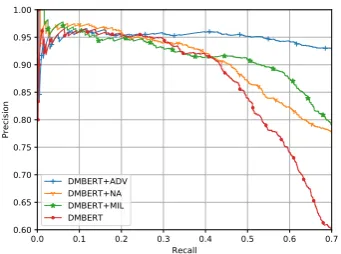
Figure 3: The aggregated precision-recall curves of DMBERT models.
To evaluate the effectiveness of our proposed models, we compare our adversarial training mod-els (DMCNN+ADV,DMBERT+ADV) with var-ious neural baselines, including: (1)DMCNNand DMBERT proposed in Chen et al. (2015) and this paper respectively, which are the basic models without any adaption to the noisy distant supervi-sion. (2) +MIL models, which improve the ba-sic models with multi-instance learning proposed inChen et al. (2017) to alleviate the noise prob-lem. (3)+NAmodels, which simply treat the in-stances in the unreliable set as negative inin-stances with the labelNA. This method could be regarded as a simplified version of our adversarial training to conduct ablation study. In this experiment, we separate the reliable and unreliable set by the con-fidence of the basic models following Section3.4.
Overall Evaluation Results
The precision-recall curves of DMCNN models and DMBERT models are shown in Figure2and Figure3, and the results of AUC are shown in Ta-ble2. From the results, we can observe that: (1)
Method AUC
Micro Macro
DMCNN 67.6 38.7
DMCNN+MIL 75.7 43.3
DMCNN+NA 70.6 25.8
DMCNN+ADV 85.5 50.7
DMBERT 70.6 42.2
DMBERT+MIL 79.4 47.3
DMBERT+NA 74.0 38.6
[image:7.595.94.263.75.202.2]DMBERT+ADV 91.5 67.6
Table 2: The AUC results (%) of various models.
BERT-based models significantly outperform the CNN-based models, which is due to the ability to capture contextual information as well as large-scale pre-training of BERT. And benefiting from the effective pre-trained parameters, the BERT-based models all have high precision when the re-call is under 0.3. (2) The +NA models achieve similar performance with+MILand even outper-form them in low-recall range, but +NA models have the worst macro AUC. It indicates that the separation of reliable and unreliable set is effec-tive but also have severe side effects, and our ad-versarial training method works well to overcome the side effect. (3) Our adversarial training method significantly outperforms all the baselines in every metric. This demonstrates the strong ability of our method to alleviate the noise problem on distantly supervised scenarios.
4.3 Semi-supervised Scenarios
Dataset and Evaluation
For semi-supervised scenarios, we conduct exper-iments on a widely-used benchmark dataset ACE-2005 (Walker et al., 2006) containing 599 docu-ments annotated with8 types and 33subtypes of events. Following the previous work (Liao and Gr-ishman,2010b;Li et al.,2013;Chen et al.,2015), we use the same test set containing40 newswire documents, development set with30randomly se-lected documents and training set with the remain-ing529documents.
[image:7.595.91.262.256.383.2]orig-inal test set. Our models trained on the orig-inal training set are named DMCNN and DM-BERT, and our bootstrapped models trained on the extended dataset are named DMCNN+Boot andDMBERT+Boot.
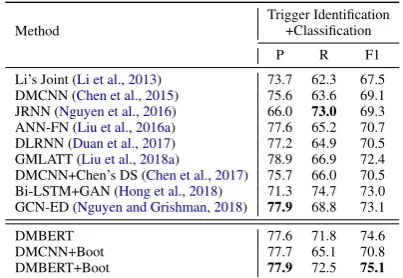
We compare our bootstrapped models with var-ious state-of-the-art methods on the ACE-2005 dataset, including: (1) The feature-based mod-els. We select Li’s joint (Li et al., 2013) as the representative, which achieves the best per-formance among feature-based models. (2) The vanilla neural network models, including the DM-CNN (Chen et al., 2015) and JRNN (Nguyen et al., 2016). (3) The neural network mod-els with external information, including ANN-FN(Liu et al., 2016a) leveraging the information of FrameNet (Baker et al.,1998),DLRNN(Duan et al., 2017) using document-level information, GMLATT (Liu et al., 2018a) utilizing multi-lingual attentions, and the bootstrapped model DMCNN+Chen’s DS(Chen et al.,2017) trained with additional data distantly supervised by Free-Base (Bollacker et al., 2008). (4) The neural network models with advanced architecture, in-cluding: Bi-LSTM+GAN (Hong et al., 2018) utilizing GAN to conduct self-regulation, GCN-ED(Nguyen and Grishman,2018) utilizing graph convolutional network to model dependency trees.
Overall Evaluation Results
The results are shown in Table 3. From the re-sults, we have the following observations: (1) As compared with the basic DMCNN and DM-BERT, the bootstrapped models achieve signifi-cant improvement (+1.7%and+0.5%). Further-more, our DMCNN+Boot model achieves simi-lar performance with the ANN-FNandDLRNN which design complex architectures to utilize the additional information. These results indicate that our methods can construct high-quality dataset without sophisticated rules and large-scale knowl-edge bases, and can effectively collect diverse in-stances which will benefit training models. (2) DMBERTandDMBERT+Bootachieve the best performance among all the models. This is bene-fiting from the effective architecture and the large-scale pre-training information of BERT, as well as the dynamic multi-pooling mechanism for ED. Our methods augment the training data to further enhance BERT, which achieve better performance and demonstrate the effectiveness of our models.
Method
Trigger Identification +Classification
P R F1
Li’s Joint (Li et al.,2013) 73.7 62.3 67.5 DMCNN (Chen et al.,2015) 75.6 63.6 69.1 JRNN (Nguyen et al.,2016) 66.0 73.0 69.3 ANN-FN (Liu et al.,2016a) 77.6 65.2 70.7 DLRNN (Duan et al.,2017) 77.2 64.9 70.5 GMLATT (Liu et al.,2018a) 78.9 66.9 72.4 DMCNN+Chen’s DS (Chen et al.,2017) 75.7 66.0 70.5 Bi-LSTM+GAN (Hong et al.,2018) 71.3 74.7 73.0 GCN-ED (Nguyen and Grishman,2018) 77.9 68.8 73.1
DMBERT 77.6 71.8 74.6
DMCNN+Boot 77.7 65.1 70.8
[image:8.595.315.517.62.201.2]DMBERT+Boot 77.9 72.5 75.1
Table 3: The overall performance (%) of different mod-els on ACE-2005.
Method Average Precision Fleiss’s Kappa
Chen et al.(2017) 88.9
-Zeng et al.(2018) 91.0
-Our First Iteration 91.7 61.3
Our Second Iteration 87.5 52.0
Table 4: The human evaluation results (%) of auto-labeled data in different iterations.
Manual Evaluation
To perform a fine-grained evaluation for the qual-ity of the dataset constructed with our trigger-based instance discovery strategy and adversarial training strategy, we manually evaluate the preci-sion of the constructed dataset. To be specific, we randomly select150instances from the newly con-structed dataset and recruit four well-trained anno-tators to annotate the instances independently. We ask the annotators to label an instance as correct if and only if the trigger and event-type are both correct. We use the Fleiss’ kappa (Fleiss,1971) to measure the annotation consistency among these annotators. The results of the data distilled in different iterations during adversarial training are shown in Table 4. From the results, we can ob-serve that the precision of the dataset constructed with our models is comparable to existing dis-tant supervision methods (Chen et al.,2017;Zeng et al., 2018) using sophisticated human-designed rules and knowledge bases, and even outperforms them in the first iteration. It indicates that our models can distill informative instances with high precision.
Case Study
Event-Type:JusticeSubtype:Sue
In ACE-2005 Dellsuedfor ”bait and switch” and false promises.
Discovered
1. The lawyers for the four former state officials who have beensuedtold the jurors. . .
2. Butlitigationheld up the project until. . ..
Table 5: The examples with highlighting triggers.
events, and the two instances in the “Discovered” row are sampled from the dataset constructed with our methods. In the “Discovered” row, the first in-stance is with an existing trigger in ACE-2005 but different in syntax, and the second instance is with a newly discovered trigger which is not contained in ACE-2005. In our extended dataset, there are
1.2%of the triggers are newly discovered. This demonstrates that our methods can not only find new instances from the unlabeled data which is similar to those instances in the labeled data, but also discover new triggers and extend the coverage of datasets substantially.
5 Conclusion and Future Work
In this paper, we take advantages of adversar-ial training and propose an effective method for weakly supervised ED. To be specific, our method is able to denoise and enhance distantly supervised ED models, as well as automatically construct more diverse and accurate training data for semi-supervised ED models. The experiments on two real-world datasets show that our method achieves the state-of-the-art results on the settings of both distant supervision and semi-supervision. In the future, we plan to explore the following directions: (1) We will extend our method to further extract event arguments and perform event extraction. (2) We will develop a large-scale and clean dataset for ED based on our method, which will benefit fur-ther research in this field.
Acknowledgments
This work is supported by the National Key Re-search and Development Program of China (No. 2018YFB1004503), the National Natural Science Foundation of China (NSFC No. 61572273) and China Association for Science and Technology (2016QNRC001). Wang is also supported by the Tsinghua University Initiative Scientific Research Program.
References
David Ahn. 2006. The stages of event extraction. In
Proceedings of ACL Workshop on Annotating and Reasoning about Time and Events, pages 1–8.
Jun Araki and Teruko Mitamura. 2015. Joint event trigger identification and event coreference
resolu-tion with structured perceptron. InProceedings of
EMNLP, pages 2074–2080.
Jun Araki and Teruko Mitamura. 2018. Open-domain
event detection using distant supervision. In
Pro-ceedings of COLING, pages 878–891.
Collin F Baker, Charles J Fillmore, and John B Lowe. 1998. The Berkeley FrameNet project. In Proceed-ings of COLING, pages 86–90.
P Basile, A Caputo, G Semeraro, and L Siciliani. 2014.
Extending an information retrieval system through
time event extraction. In Proceedings of DART,
pages 36–47.
Kurt Bollacker, Colin Evans, Praveen Paritosh, Tim Sturge, and Jamie Taylor. 2008. Freebase: a collab-oratively created graph database for structuring
hu-man knowledge. InProceedings of SIGMOD, pages
1247–1250.
Yixin Cao, Lei Hou, Juanzi Li, Zhiyuan Liu, Chengjiang Li, Xu Chen, and Tiansi Dong. 2018.
Joint representation learning of cross-lingual words
and entities via attentive distant supervision. In
Pro-ceedings of EMNLP, pages 227–237.
Hongge Chen, Huan Zhang, Pin-Yu Chen, Jinfeng Yi, and Cho-Jui Hsieh. 2018.Attacking visual language grounding with adversarial examples: A case study
on neural image captioning. InProceedings of ACL,
pages 2587–2597.
Yubo Chen, Shulin Liu, Xiang Zhang, Kang Liu, and Jun Zhao. 2017. Automatically labeled data
genera-tion for large scale event extracgenera-tion. InProceedings
of ACL, pages 409–419.
Yubo Chen, Liheng Xu, Kang Liu, Daojian Zeng, and Jun Zhao. 2015. Event extraction via dynamic
multi-pooling convolutional neural networks. In
Proceedings of ACL-IJCNLP, pages 167–176.
Pengxiang Cheng and Katrin Erk. 2018.Implicit
argu-ment prediction with event knowledge. In
Proceed-ings of ACL, pages 831–840.
Jacob Devlin, Ming-Wei Chang, Kenton Lee, and Kristina Toutanova. 2018. BERT: Pre-training of deep bidirectional transformers for language
under-standing.arXiv preprint arXiv:1810.04805.
Shaoyang Duan, Ruifang He, and Wenli Zhao. 2017.
Exploiting document level information to improve
event detection via recurrent neural networks. In
Xiaocheng Feng, Lifu Huang, Duyu Tang, Bing Qin, Heng Ji, and Ting Liu. 2016. A
language-independent neural network for event detection. In
Proceedings of ACL, pages 66–71.
James Ferguson, Colin Lockard, Daniel Weld, and Hannaneh Hajishirzi. 2018. Semi-supervised event
extraction with paraphrase clusters. InProceedings
of NAACL, pages 359–364.
Joseph L Fleiss. 1971.Measuring nominal scale
agree-ment among many raters. Psychological bulletin,
76(5):378.
Reza Ghaeini, Xiaoli Fern, Liang Huang, and Prasad Tadepalli. 2016. Event nugget detection with
forward-backward recurrent neural networks. In
Proceedings of ACL, pages 369–373.
Ian J Goodfellow, Jonathon Shlens, and Christian Szegedy. 2014. Explaining and harnessing
adversar-ial examples. InProceedings of ICLR, pages 2574–
2582.
Prashant Gupta and Heng Ji. 2009. Predicting un-known time arguments based on cross-event
propa-gation. InProceedings of ACL-IJCNLP, pages 369–
372.
Xu Han, Zhiyuan Liu, and Maosong Sun. 2018. De-noising distant supervision for relation extraction via
instance-level adversarial training. arXiv preprint
arXiv:1805.10959.
Yu Hong, Jianfeng Zhang, Bin Ma, Jianmin Yao, Guodong Zhou, and Qiaoming Zhu. 2011. Using
cross-entity inference to improve event extraction.
InProceedings of ACL-HLT, pages 1127–1136.
Yu Hong, Wenxuan Zhou, Guodong Zhou, Qiaoming Zhu, et al. 2018. Self-regulation: Employing a gen-erative adversarial network to improve event detec-tion. InProceedings of ACL, pages 515–526.
Lifu Huang, Taylor Cassidy, Xiaocheng Feng, Heng Ji, Clare R. Voss, Jiawei Han, and Avirup Sil. 2016.
Liberal event extraction and event schema induction.
InProceedings of ACL, pages 258–268.
Ruihong Huang and Ellen Riloff. 2012a. Bootstrapped
training of event extraction classifiers. In
Proceed-ings of EACL, pages 286–295.
Ruihong Huang and Ellen Riloff. 2012b. Modeling
textual cohesion for event extraction. In
Proceed-ings of AAAI, pages 1664–1670.
Heng Ji and Ralph Grishman. 2008.Refining event
ex-traction through cross-document inference. In
Pro-ceedings of ACL, pages 254–262.
Qi Li, Heng Ji, and Liang Huang. 2013. Joint event extraction via structured prediction with global
fea-tures. InProceedings of ACL, pages 73–82.
Shasha Liao and Ralph Grishman. 2010a. Filtered
ranking for bootstrapping in event extraction. In
Proceedings of COLING, pages 680–688.
Shasha Liao and Ralph Grishman. 2010b. Using doc-ument level cross-event inference to improve event
extraction. InProceedings of ACL, pages 789–797.
Hongyu Lin, Yaojie Lu, Xianpei Han, and Le Sun. 2018. Nugget proposal networks for Chinese event
detection. In Proceedings of ACL, pages 1565–
1574.
Jian Liu, Yubo Chen, Kang Liu, and Jun Zhao. 2018a.
Event detection via gated multilingual attention
mechanism. In Proceedings of AAAI, pages 4865–
4872.
Shaobo Liu, Rui Cheng, Xiaoming Yu, and Xueqi Cheng. 2018b. Exploiting contextual information
via dynamic memory network for event detection.
InProceedings of EMNLP, pages 1030–1035.
Shulin Liu, Yubo Chen, Shizhu He, Kang Liu, and Jun Zhao. 2016a. Leveraging Framenet to improve
auto-matic event detection. InProceedings of ACL,
vol-ume 1, pages 2134–2143.
Shulin Liu, Yubo Chen, Kang Liu, and Jun Zhao. 2017.
Exploiting argument information to improve event
detection via supervised attention mechanisms. In
Proceedings of ACL, pages 1789–1798.
Shulin Liu, Kang Liu, Shizhu He, and Jun Zhao. 2016b.
A probabilistic soft logic based approach to exploit-ing latent and global information in event classifica-tion. InProceedings of AAAI, pages 2993–2999.
David McClosky, Mihai Surdeanu, and Christopher D Manning. 2011. Event extraction as dependency
parsing. InProceedings of ACL, pages 1626–1635.
Tomas Mikolov, Kai Chen, Greg Corrado, and Jeffrey Dean. 2013. Efficient estimation of word
represen-tations in vector space. InProceedings of ICLR.
George A Miller, Richard Beckwith, Christiane Fell-baum, Derek Gross, and Katherine J Miller. 1990. Introduction to WordNet: An on-line
lexi-cal database. International journal of lexicography,
3(4):235–244.
Mike Mintz, Steven Bills, Rion Snow, and Dan Juraf-sky. 2009. Distant supervision for relation
extrac-tion without labeled data. InProceedings of
ACL-IJCNLP, pages 1003–1011.
Takeru Miyato, Shin-ichi Maeda, Masanori Koyama, Ken Nakae, and Shin Ishii. 2016. Distributional
smoothing with virtual adversarial training.
Pro-ceedings of ICLR.
Aldrian Obaja Muis, Naoki Otani, Nidhi Vyas, Ruochen Xu, Yiming Yang, Teruko Mitamura, and Eduard Hovy. 2018. Low-resource cross-lingual event type detection via distant supervision with
minimal effort. InProceedings of COLING, pages
Thien Nguyen and Ralph Grishman. 2018. Graph con-volutional networks with argument-aware pooling
for event detection. InProceedings of AAAI, pages
5900–5907.
Thien Huu Nguyen, Kyunghyun Cho, and Ralph Gr-ishman. 2016. Joint event extraction via recurrent
neural networks. In Proceedings of NAACL, pages
300–309.
Thien Huu Nguyen and Ralph Grishman. 2015. Event detection and domain adaptation with convolutional
neural networks. InProceedings of ACL-IJCNLP,
pages 365–371.
Pengda Qin, Weiran Xu, and William Yang Wang. 2018. DSGAN: Generative adversarial training for
distant supervision relation extraction. In
Proceed-ings of ACL, pages 496–505.
Alec Radford, Luke Metz, and Soumith Chintala. 2016. Unsupervised representation learning with
deep convolutional generative adversarial networks.
InProceedings of ICLR.
Sebastian Riedel, Limin Yao, and Andrew McCallum. 2010. Modeling relations and their mentions
with-out labeled text. InProceedings of ECML-PKDD,
pages 148–163.
Evan Sandhaus. 2008. The New York Times annotated
corpus. Linguistic Data Consortium, Philadelphia,
6(12):e26752.
Christian Szegedy, Wojciech Zaremba, Ilya Sutskever, Joan Bruna, Dumitru Erhan, Ian Goodfellow, and Rob Fergus. 2013. Intriguing properties of neural
networks.arXiv preprint arXiv:1312.6199.
Ashish Vaswani, Noam Shazeer, Niki Parmar, Jakob Uszkoreit, Llion Jones, Aidan N Gomez, Łukasz Kaiser, and Illia Polosukhin. 2017. Attention is all
you need. In Proceedings of NIPS, pages 5998–
6008.
Christopher Walker, Stephanie Strassel, Julie Medero, and Kazuaki Maeda. 2006. ACE 2005
multilin-gual training corpus. Linguistic Data Consortium,
Philadelphia, 57.
Xiaozhi Wang, Xu Han, Yankai Lin, Zhiyuan Liu, and Maosong Sun. 2018. Adversarial multi-lingual
neu-ral relation extraction. InProceedings of COLING,
pages 1156–1166.
Yi Wu, David Bamman, and Stuart Russell. 2017.
Ad-versarial training for relation extraction. In
Proceed-ings of EMNLP, pages 1778–1783.
Yonghui Wu, Mike Schuster, Zhifeng Chen, Quoc V Le, Mohammad Norouzi, Wolfgang Macherey, Maxim Krikun, Yuan Cao, Qin Gao, Klaus Macherey, et al. 2016. Google’s neural ma-chine translation system: Bridging the gap between
human and machine translation. arXiv preprint
arXiv:1609.08144.
Ziang Xie, Sida I Wang, Jiwei Li, Daniel L´evy, Aiming Nie, Dan Jurafsky, and Andrew Y Ng. 2017. Data noising as smoothing in neural network language
models. Proceedings of ICLR.
Bishan Yang and Tom Mitchell. 2016. Joint extraction
of events and entities within a document context. In
Proceedings of NAACL, pages 289–299.
Hang Yang, Yubo Chen, Kang Liu, Yang Xiao, and Jun Zhao. 2018. DCFEE: a document-level Chinese fi-nancial event extraction system based on
automati-cally labeled training data. InProceedings of ACL,
pages 50–55.
Hui Yang, Tat-Seng Chua, Shuguang Wang, and Chun-Keat Koh. 2003. Structured use of external knowl-edge for event-based open domain question answer-ing. InProceedings of SIGIR, pages 33–40.
Quan Yuan, Xiang Ren, Wenqi He, Chao Zhang, Xinhe Geng, Lifu Huang, Heng Ji, Chin-Yew Lin, and Ji-awei Han. 2018. Open-schema event profiling for
massive news corpora. In Proceedings of CIKM,
pages 587–596.
Daojian Zeng, Kang Liu, Yubo Chen, and Jun Zhao. 2015.Distant supervision for relation extraction via
piecewise convolutional neural networks. In
Pro-ceedings of EMNLP, pages 1753–1762.
Ying Zeng, Yansong Feng, Rong Ma, and Zheng Wang. 2018. Scale up event extraction learning via
auto-matic training data generation. In Proceedings of
AAAI, pages 878–891.
Tongtao Zhang, Spencer Whitehead, Hanwang Zhang, Hongzhi Li, Joseph Ellis, Lifu Huang, Wei Liu, Heng Ji, and Shih-Fu Chang. 2017. Improving event
extraction via multimodal integration. In
Proceed-ings of MM, pages 270–278.
Yue Zhao, Xiaolong Jin, Yuanzhuo Wang, and Xueqi Cheng. 2018. Document embedding enhanced event
detection with hierarchical and supervised attention.