Youth Guarantee Implementation Plan
Luxembourg
2
Contents
1. The general context... 3
2. Implementing the Youth Guarantee Scheme in Luxembourg... 12
2.1 Formulation of the Youth Guarantee ... 12
2.2 Partnership approaches ... 18
2.3 Early intervention and activation ... 22
2.4 Supportive measures for labour market integration ... 27
3. Funding the Youth Guarantee ... 35
4. Assessment and continuous improvement of schemes ... 36
3
1. The general context
In early 2013, the EU adopted a Council Recommendation to member states on the Youth Guarantee. The Recommendation encourages member states to:
“ensure that all young people under the age of 25 years receive a good-quality offer of employment, continued education, an apprenticeship or a traineeship within a period of four months of becoming unemployed or leaving formal education”.
In order to put the Youth Guarantee in a general context, we start by presenting some statistics about youth unemployment, the NEETs (not in employment, education or training) and school dropouts in Luxembourg.
Youth unemployment in Luxembourg
In January 2014, Luxembourg counts 2 627 young persons (aged less than 25) who are registered as unemployed at the Public Employment Service (“Agence pour le développement de l’emploi” - Adem). Within the pool of all unemployed persons (i.e. of all ages), they represent 13%.
The number of young unemployed has increased over the last 8 years, shifting from an average stock of around 1 500 persons at the end of each month before the crisis of 2008 to an average of around 2 000 persons after 2009 (cf. graph 1).
Graph 1. Evolution of youth unemployment (2006-2014)
4
The number of unemployed as reflected in graph 1 refers to the stock of young people at any given point in time. For the implementation of the Youth Guarantee Plan it is also insightful to look at the new registrations of young people at the Public Employment Service (graph 2). Over the last 3 years, around 460 young persons of our target population (15-24 years of age) have signed up on average every month at the Public Employment Service. As can be seen, this number fluctuates over time and is particularly high in September, after the summer school holidays.
Graph 2. Number of new registrations of the young at the Public Employment Service
Source: Eurostat.
The youth unemployment rate is 15.5% (in 2013), meaning that, of those young persons who want to work, 1 out of 6 does not find a job. This situates Luxembourg among those countries with the lowest youth unemployment rates in Europe (average unemployment rate of 23% in EU-countries) but the youth rate is still relatively high compared to the overall Luxembourgish unemployment rate of 7%.
As can be seen in the following graph (graph 3), the youth unemployment rate has been relatively stable over the last ten years (2003-2013), fluctuating around 16%.
5
Graph 3. Evolution of the youth unemployment rate (2003-2013)
Source: Eurostat.
Before 2003, the youth unemployment rate has however been much lower (4% in 1992, 7% in 2002). The main explanation for the increase of the unemployment rate over the last thirty years is however not to be found in a considerable increase of the number of young unemployed persons. It is true that the number of young unemployed has increased from 2 300 in 1983 to 2 600 in 2014 but the overall population has increased by the same rate. Proportionally the share of unemployed in the overall population has therefore almost stayed constant, as can be seen by looking at the unemployment ratio, which has only slightly increased from 4% in 1983 to 5% in 2014.
The increase in the youth unemployment rate must rather be explained by a considerable decrease of the number of young persons who are on the labour market. The number of young persons on the labour market, working or looking for a job, was 34 100 in 1983 and dropped to 16 300 in 2012, a drop of 52%. This drop of the active labour force is illustrated in the following graph and can mostly be explained by the prolonged stay of the young in the schooling system.
6
Graph 4. Share of the young who are employed, unemployed or inactive (15 – 24 years)
Source: Eurostat.
It is important to remember that the unemployment rate does not take into account all young persons living in Luxembourg. Indeed, it excludes those who are not actively looking for a job and in this group we can specifically identify those who are in education.
In 2012, the general situation for the young is the following (data from the European Labour Force Survey): Luxembourg counts 61 000 young residents under the age of 25; 13 000 of these are in employment (21%); 45 000 are “inactive/in education” (74%); 3 000 are unemployed (5%).
These shares do however vary with age, as can be seen from the following graph (graph 5).
Graph 5. Share of the young in education and/or on the labour market
7
If we look at this overall picture, including all the young, the unemployment situation looks slightly less dramatic: the unemployment ratio is 5% (3 000 unemployed among the 61 000 young), meaning that 1 young out of 20 living in Luxembourg is registered as unemployed at the Public Employment Service. The unemployment ratio does give another perspective of the situation but, in the end, each of these 3 000 young persons deserves to get help in order to avoid them staying in a precarious situation.
This help does however need to be tailor-made because the 2 627 young persons registered at the Public Employment Service in January 2014 are not a homogenous group: 42% of them are registered less than 3 months, another 40% between 3 and 12 months and 19% have been at the Public Employment Service for more than 12 months; only 5% have qualifications above the Baccalaureate (A-level); almost half of them only have the obligatory schooling level; 43% of them are women; about 5% have a work-reducing handicap; 50% are of non-Luxembourgish nationality which often goes along with differences in language skills (for most job offers on the Luxembourgish labour market employers request that candidates speak several languages, most commonly French, German and English).
This diversity needs to be kept in mind when tailoring the Youth Guarantee implementation plan, so that specific needs of sub-groups can be addressed in an efficient and effective way.
Young people not in employment, education or training (NEET)
Next to the young who register at the Public Employment Service, and next to those young who are currently in the schooling system, particular attention needs to be paid to those young who are outside of the official statistics. Some of these NEETs (not in employment, education or training) have chosen not to participate actively in the labour market, but some others might just be outside of the regular system because of various difficult moments in their life. Some young persons might be lost, not knowing where to turn to or what direction to give their life: should they go back to school, or look for a job? For some it is important to further reflect on their possibilities before taking such an important decision. And for these young it is very important that the public services can offer them guidance, not to let them alone, so to keep them from drifting off to despair and maybe even delinquency. This is why a strong strategy for outreaching is needed that consists in proactively contacting the NEETs and offering them contact points where they can get further information and guidance.
According to Eurostat data, Luxembourg has a NEET rate of 5% for the 15-24 year-old in 2013. This rate has been relatively stable over the last 10 years (graph 6). It is considerably lower than in other countries of Europe where the average rate is around 13%.
8 Graph 6. Evolution of the NEET rate (2003-2013)
Source: Eurostat.
A recent report by researchers from the University of Luxembourg has shown that the group of NEETs is very heterogeneous, requiring special attention to the various aspects of the difficulties faced by these young1. Policy therefore needs to be tailor-made to the specific issues at hand.
In 2013, a European Social Fund project has been launched on the NEETs by the National Youth Service (“Service national de la jeunesse” - SNJ) together with the National social security administration (“Inspection générale de la Sécurité sociale” - IGSS) and CEPS/INSTEAD, a socio-economic research centre in Luxembourg. The objective is to quantify and qualify the NEET population. First results are expected for the end of 2014.
In this context, it should be remembered that some inactive young that we might classify as NEETs due to lack of detailed data, might not at all consider themselves as NEETs, simply because they have chosen to be out of the labour market and out of the schooling system and are perfectly fine with this decision. We could for example think of young mothers who decide to invest their time in the upbringing of their children and whose spouse has an income allowing them to cover their cost of living. On the other hand there is an important phenomenon of immigration. Young immigrants have not all reached a qualification and some of them are not registered in the school system or elsewhere. Also, those young residents who have been in a secondary school in one of the neighbouring countries and have left school sometimes are missing from official Luxembourgish registers. One aim of the study is to better evaluate the number of the NEETs.
1
9 School dropouts
School dropouts are among the populations that are most likely to slip into a NEET situation. According to the Labour Force Survey, early school leaving (ESL) rates are low in Luxembourg compared to other countries. Having decreased from 7.7% in 2009 to 6.2% in 2011, they are significantly lower than the EU average of 13.5%.
However, it has been observed that the ESL as defined in Eurostat and measured by the Labour Force Survey may not give an accurate picture of the situation in Luxembourg. In response, the Luxembourgish educational authorities have sought to produce annual statistics on ESL at the secondary level (including those in a technical and vocational education and training - TVET), based on administrative data and on a survey of ESL. During the school year 2010/2011 a total of 1 888 young people (including 644 considered as permanent ESL) have left secondary school in Luxembourg without acquiring a qualification.
Based on the figures, the ‘theoretical rate of permanent ESL’ calculated for a cohort of pupils entering secondary education in 2010/2011, i.e. the probability that they will leave school without a qualification is 9.0%. This number has remained stable since 2008/2009 (Annual Report of the Ministry of Education, Children and Youth, 2013).
Main actors for the implementation of the Youth Guarantee
The statistics that have been presented set the general context in which the Youth Guarantee will have to be implemented. Unemployment has been increasing for some years now in Luxembourg and many policies, actions and institutions have already been put in place and reformed to tackle this social and economic problem. In what follows, the main actors that are implicated in this process will be presented. Most of these actors have been in place for some time now. It could however be argued that the Youth Guarantee serves as a coordinating instrument, bringing all actors together and making sure that the target population is followed over time by different actors who exchange information about the past, the present and the future of the young persons2.
Because the target population is very diverse, the Youth Guarantee involves many actors. They will only be described very briefly in what follows, given that section 2.2 gives a more detailed presentation of all actors.
2
A major challenge with respect to this coordination will be to set up a common database that will allow all administrations to be informed about actions that have already previously been taken for a young person by some other administration. This exchange of information will however first have to be validated by the national data protection commission.
10
The Youth Guarantee is coordinated by the Ministry of Labour, Employment and the Social and Solidarity Economy.
Helping unemployed people to find a job and to adapt their qualification to specific needs of the labour market is the mission of the Public Employment Service (“Agence pour le développement de l’emploi” - Adem). The Public Employment Service is closely collaborating with many training centres (public and private) and non-profit organisations that offer specific training and psychosocial guidance to improve the employability of the unemployed young, especially those who are vulnerable and therefore are far from fulfilling the requirements of an ever more competitive economy.
Reaching out and reintegrating early school leavers by systematically contacting each and every early school leaver from a national school (based on an official register) is the mission of the Local Action for Youth (“Action Locale pour Jeunes” - ALJ), that is part of the department of Vocational Education and Training (“Service de la Formation Professionnelle” - SFP) of the Ministry of Education, Children and Youth.
Validating the education and training content of apprenticeships which offer a mix of school-based teaching and practical training in firms is one of the missions of the department of Vocational Education and Training (SFP) of the Ministry of Education, Children and Youth. There is a close collaboration with the Public Employment Service which organises the placement of the young in firms.
Organising lifelong training courses for the young who have already worked and want to get further training (sometimes to reorient their career) is another mission of the SFP, for some courses in cooperation with the department for adult learning (“Service de la Formation des Adultes” – SFA) of the Ministry of Education, Children and Youth.
Offering school dropouts to go back to school and finish their secondary education in a specific school tailor-made to the fact that they are older and have specific needs, is the mission of the School of a second chance (“Ecole de la deuxième chance”- E2C) of the Ministry of Education, Children and Youth.
Reaching out to young people who are in transition from school to work and more specifically reaching out to young NEETs is the mission of the Department “Transitions” of the National Youth Service (“Service National de la Jeunesse” - SNJ), which is a public administration under the authority of the Ministry of Education, Children and Youth.
Listening to the requests and ideas of the youth organisations, and thereby receiving valuable input from the young themselves in the Youth Guarantee implementation process, is the mission of the Department of Children and Youth (“Département Enfance et Jeunesse”) of the Ministry of Education, Children and Youth.
Centralising the comments of social partners through tripartite meetings bringing together representatives of the government, the firms and the trade unions is the mission of the Permanent Committee for Work and Employment (“Comité Permanent du Travail et de
11
l’Emploi” - CPTE), under the responsibility of the Ministry of Labour, Employment and the Social and Solidarity Economy.
Coordinating the various guidance services offered to the young in one central place (in a one-stop-shop) is the mission of the Centre for Guidance (“Maison de l’Orientation” - MO) by physically regrouping representatives of most of the above-mentioned departments and service-providers in one building in Luxembourg-city, easily accessible to all young in the country, due to the short geographical distances within the country.
Other partners will be presented in section 2.2.
As has already been mentioned above, none of the listed partners has been put in place specifically for the Youth Guarantee. All actors existed previously. However, the Youth Guarantee has already led the different actors to collaborate more closely. Of course, thanks to the existence of the Centre for Guidance, this coordination had already been considerably improved since the opening in 2012. But the Youth Guarantee approach has allowed the elaboration of a global concept that is not department-based or service-based but rather focuses on the young person. Indeed, the services are structured around the young persons’ intentions and requirements. In order to set up this concept, presented in detail in section 2.1, monthly meetings have been organised since March 2013, with the participation of representatives of the two Ministries (the Ministry of Labour, Employment and the Social and Solidarity Economy on one side and the Ministry of Education, Children and Youth on the other side) who, as can be seen from the list above, are the Ministries most implicated in the implementation of the Youth Guarantee3. This close collaboration has allowed for a good coordination of the common objectives of the Youth Guarantee.
Major legislative or organizational barriers do not really exist in succeeding in this implementation process, even though some smaller legislative reforms will be needed and existing departments/services will need to be reorganized and reinforced with more staff.
Timing of the Implementation of the Youth Guarantee in Luxembourg
The Luxembourgish government has announced an official start of the Youth Guarantee in June of 2014. In what follows, we describe the implementation plan for the Youth Guarantee, starting off with a general overview of the strategy and then describing in detail the partnership approaches, the early intervention and activation approaches and finally the supportive measures for labour market integration. We finish by looking at the funding approach and the assessment and continuous improvement of schemes4.
3
Other Ministries are not excluded from the process but are currently more peripheral in the conceptual framework. In later stages a stronger collaboration will be set up, especially in closely related topics such as access to housing, health problems, poverty, social exclusion or discrimination. 4 The structure of the document follows the Youth Guarantee building blocks as identified in the Council
12
2. Implementing the Youth Guarantee Scheme in Luxembourg
2.1 Formulation of the Youth Guarantee
Following the Council Recommendation of 22 April 2013, the Youth Guarantee ensures that all young people up to the age of 25 receive a good quality offer of employment, continued education, an apprenticeship or a traineeship within four months of leaving formal education or becoming unemployed.
Luxembourg will follow this guideline in the implementation process.
Implementation scheme in 4 phases
As outlined in the following diagram, the implementation scheme consists of 4 phases. These phases correspond to the different stages of the process through which a young person will be guided in order to offer him/her a new perspective in life. In what follows in this section, a general overview will be given of this process. Detailed description of specific intervention instruments will be given in sections 2.3 and 2.4.
Phase 1 is the outreaching and information phase.
The objective is to widely spread information about the various possibilities that are available to the young in order to get help. It is also in this phase that the outreaching strategy is implemented by systematically contacting every young school-dropout and by trying to be more visible to the various NEET target populations. Many partners participate in this phase (cf. section 2.3) and multiple communication means will be used (flyers, documentation, Internet portal, social media). It is planned to set up an Internet portal specifically for the Youth Guarantee that will give a web-based access point to all the available information to the young.
Phase 2 is the orientation phase.
The objective is to make sure that the young person is guided/directed to the right actor given his/her intentions for the future. This guidance can be done directly by one of the actors in phase 1 or through the Centre for Guidance (“Maison de l’Orientation”). Three main intentions of the young have been identified and structure the Youth Guarantee implementation plan:
- Some of the young intend to work. Their first contact point will be the Public Employment Service (PES). The PES will make a profiling exercise with the young in
13
order to identify his/her needs. If yes, the PES will continue to work with this person and the procedure goes to phase 3 of the implementation plan, to the job-oriented trajectory. In case the young person is not ready for the job-market, the PES will help him/her to either resolve primary problems, or assist him/her in defining his project and by guiding him/her through the process towards a professional career.
- Some of the young intend to return to school. They will find assistance in the department of Vocational Education and Training (“Service de la Formation Professionnelle” - SFP) and the Local Youth Action (“Action locale pour jeunes” - ALJ) within the Ministry of Education, Children and Youth. ALJ will make a profiling exercise with the young in order to clarify the intentions of the person and to make sure that his/her project is realistic. If yes, the ALJ will continue to work with this person and the procedure goes to phase 3 of the implementation plan, to the school-oriented trajectory. If no, the SFP/ALJ will organise a meeting with one of the other actors of the Youth Guarantee in order to find the best other options for the person, given his/her profile.
- Some of the young need to define a life/work-project. They are unsure about whether and when to work or they might even consider returning to school. They need guidance about their future options. They will be oriented towards the National Youth Service (“Service National de la Jeunesse” - SNJ) within the Ministry of Education, Children and Youth. The SNJ will make a profiling exercise with the young in order to clarify the intentions of the person and to make sure that his/her project is realistic. If yes, the SNJ will continue to work with this person and the procedure goes to phase 3 of the implementation plan, to the activation-oriented trajectory. If no, the SNJ will organise a meeting with one of the other actors of the Youth Guarantee in order to find the best other options for the person, given his/her profile.
At the end of phase 2, the young will have been guided towards the right actor that will then be responsible for implementing the young person’s personal Youth Guarantee.
Phase 3 is the contract phase.
This is where the young person signs a formal commitment-agreement with the administration that has been identified in phase 2 as the best-suited administration to offer serious help to fulfill the now considered to be realistic intentions of the young. The contract is a key component of the Youth Guarantee process because it formalises the strategy that the young will pursue, together with the help of the administration, over the months to come. It clearly specifies the offer that the young will receive, whether it is in the job-oriented trajectory, the school-oriented trajectory or the activation-oriented trajectory. But it also clearly specifies the commitment that the young signs up for. There are indeed also obligations for the young that mainly consist in respecting the contract that he/she has signed up for. For example, he/she needs to show up for fixed meetings, attend the training sessions to which he/she has initially agreed to, follow the rules when in apprenticeship, etc. These rules are fixed according to the
14
specific profile of the young and are therefore supposed to be realistic and attainable. This formal contract has mainly as purpose to make the young feel responsible for the outcome of the process and should thereby improve the success of the implementation of the Youth Guarantee Plan.
Phase 4 is the implementation phase.
Starting from the signature of a bilaterally-agreed contract in phase 3, the administration that is in charge of the trajectory chosen by the young must start to implement at least some parts of the contractual agreement within 4 months after the signature of this contract (Please refer to the following box “A note on the 4-month implementation clause” for further discussion of this point).
The main intervention activities that will constitute an offer in the Youth Guarantee contract that the young will be proposed are: employment, various active labor market policy instruments, training offers, traineeship, education, vocational and educational training (apprenticeship), and activation instruments. They will be described in sections 2.3 and 2.4. The most important point here is that the offer needs to be of good quality. It will in no way be acceptable to offer a short-term proposal that might get the young off the unemployment or the NEET statistics but that, in the end, fails because the young will get back to a precarious situation very quickly. Such a short-term intervention would only be acceptable if it was considered to be a stepping-stone towards employment. The objective however is to give a credible perspective to each young person that is realistic for the profile at hand and that can, step by step, be achieved. For some, this offer might consist of several steps, for example a language class offer followed by a training class offer followed by a job offer at a later stage. For these young the process will be quite long and sometimes only some initial steps of the longer plan will be implemented within 4 months. For some it will be a job offer straight away because the person is ready for the labor market and because jobs in that domain are available. Therefore the Youth Guarantee should be seen as an engagement of the public services to get the young permanently out of precarity.
Timing of the implementation of the Youth Guarantee in Luxembourg
The Youth Guarantee in Luxembourg will be implemented in June 2014, meaning that, from that moment onwards, every young person who gets in touch with one of the administrations to get help will be guided through phases 1 to 4 of the implementation plan, as outlined above.
Even though the Youth Guarantee is intended, in the medium to long run, to cover the whole population of the young under the age of 25, it is expected that current infrastructural constraints will make it very difficult, in the short run, to attain this objective and it is therefore more realistic to believe that in the first months after implementation the needs of about 75%
15
of the target population will be satisfied. This estimation will of course also depend on the share of NEETs that will declare themselves once the Youth Guarantee will be officially launched. The objective will however be to readjust and extend the current infrastructure in a way that, as soon as possible, the Youth Guarantee can be applied universally.
The following diagram summarizes the 4-phases implementation scheme of the Youth Guarantee.
16
Diagram of the Youth Guarantee Implementation Plan for a young person in Luxembourg
Pop. of interest (age) 16 17 18 19 20 21 22 23 24 Internetportal “ANELO” Partners of the Center for Guidance Adem Youth organizations Youth houses
Child care office
Local social offices The young person intends to work Adem Job-oriented trajectory Definition of an employment offer or of a training allowing access to the labor market “Youth guarantee” contract
SFP/ALJ
School-oriented trajectory
Definition of an offer to return to education or training “Youth guarantee” contract
SNJ
Activation-oriented trajectory
Definition of an activation project
“Youth guarantee” contract
Adem Profiling and redirection if needed SFP/ALJ Profiling and redirection if needed SNJ Profiling and redirection if needed Phase 1 Outreaching and Information Phase 2 Orientation Phase 3 Contract Partners of the Center for
Guidance (Maison de l’Orientation) Phase 4 Implementation Employment Training offers Active labor market
policy instruments Traineeship Education Vocational and educational training (apprenticeship) Activation instruments The young person intends to return to school The young person needs to define a life-work-project Glossary
Adem = "Agence pour
le développement de l’emploi" = Public Employment Service
ALJ = “Action locale
pour jeunes” = Local action for youth
SFP = "Service Formation Professionnelle" = Department of Vocational education and training SNJ = “Service National de la Jeunesse” = National Youth Service
Offer within 4 months, starting with signature of contract in phase 3
17 A note on the 4-month implementation clause
It is important to note that phases 1 and 2 are preparatory phases to make sure that every young person gets the information and is (re-)directed towards the administration that is best suited to propose a serious and realistic perspective with offers specific to the needs of each young person. Since no formal commitment-agreement has been signed at these two stages between the young and the administrations, the timing of actions will depend a lot on the young person him-/her-self. The administrations will propose to provide the profiling services within a very short timeframe (not exceeding four weeks after they have been contacted by the young) but they have no means to force the young to get in touch in the first place or to make him/her react as quickly as they would like once the profiling procedure has been finished. Some young do prefer to spend some extra time to reflect upon the advice they have been given during these two first stages of the process. The administrations should therefore be available for any further actions, but they should not be made accountable if the young takes some “time off” to take important decisions on his/her own.
This is a very important point when it comes to respecting the timeframe of 4 months that has been fixed in the Youth Guarantee Recommendation. This is why the 4-months period is considered, in the Luxembourgish implementation plan, to start only in phase 3, when a formal contract is being signed between the young person and one of the administrations. Once the two parties have agreed upon the next steps to undertake, and formally put this plan down on paper in the form of a contract, then the counter of 4 months will start for the administration and it will be considered that the Youth Guarantee has failed for this person if he/she does not receive the contractually proposed offer within 4 months.
It should also be clear that, in case of a breach of contract due to the fact that the young did not respect the contract as initially signed (for example not showing up to training sessions or other agreed-upon steps in his/her Youth Guarantee contract), the contract between the administration and the young will be canceled and the administration will not be made accountable for not having satisfied the personal implementation plan within 4 months.
18
2.2 Partnership approaches
This section gives a presentation of the main actors that participate in the implementation process of the Youth Guarantee. For each actor, the areas of responsibility will be described5.
Overall coordination - Ministry of Labour, Employment and the Social and Solidarity Economy
The Ministry of Labour, Employment and the Social and Solidarity Economy is in charge of the general coordination of the Youth Guarantee Implementation Plan.
Since the start of the Youth Guarantee initiative (March 2013), it has organized monthly meetings with other key actors in Luxembourg that have led to the development of the implementation strategy outlined in the previous and following sections of this report.
In the implementation phase that starts in June 2014, the Ministry will be responsible for collecting and centralising data (creation of a common database), collecting and updating statistics about the Youth Guarantee and it will be in charge of setting up an evaluation procedure.
The Ministry of Labour, Employment and the Social and Solidarity Economy is also in charge of collecting the input from the Youth Organisations, with the help of the Department of Children and Youth at the Ministry of Education, Children and Youth. This process will culminate, in a first stage, in an official meeting between the Minister of Labour, Employment and the Social and Solidarity Economy, the Minister of Education, Children and Youth and representatives of the four major Youth Organisations in May 2014 where the Youth Organisations will give their recommendations for further developments of the Youth Guarantee.
The Ministry of Labour, Employment and the Social and Solidarity Economy will also integrate input from employers and trade union representatives through the organisation of tripartite meetings and collection of official statements by the representatives of these social partners.
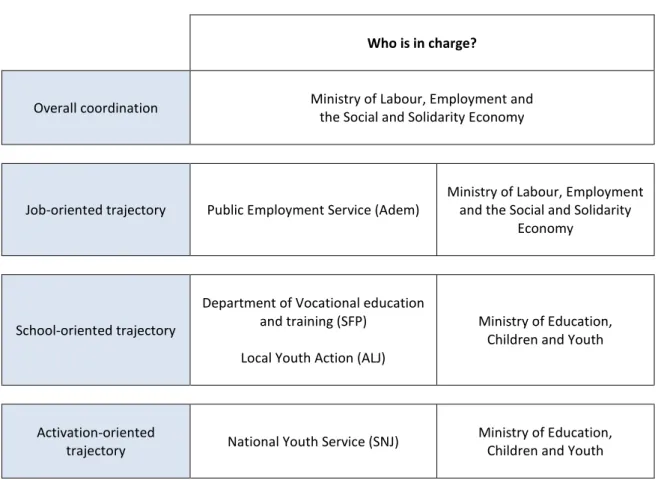
As has been outlined in the previous section, the Youth Guarantee Implementation Plan for Luxembourg is structured around the initial intention of the young person. It can be an intention of the young to work, to go back to school or to define a life-work-project. Based on this, and after validation that consists in verifying that the initial intentions correspond to the profile of the young, three main trajectories have been identified: a job-oriented trajectory, a school-oriented trajectory and an activation-oriented trajectory. Each of these trajectories has been assigned to a specific administration that will be responsible for the implementation of the given trajectory (as illustrated in table 1).
5 Table 2.2. in the appendix gives a listing of all major partners in the Youth Guarantee Implementation Strategy.
19
Table 1. Responsibilities according to the three trajectories in the Implementation Plan
Who is in charge?
Overall coordination Ministry of Labour, Employment and the Social and Solidarity Economy
Job-oriented trajectory Public Employment Service (Adem)
Ministry of Labour, Employment and the Social and Solidarity
Economy
School-oriented trajectory
Department of Vocational education and training (SFP)
Local Youth Action (ALJ)
Ministry of Education, Children and Youth
Activation-oriented
trajectory National Youth Service (SNJ)
Ministry of Education, Children and Youth
Job-oriented trajectory - Public Employment Service (Adem)
The Public Employment Service (“Agence pour le Développement de l’Emploi” - Adem) is in charge of all registered unemployed people. It has recently been fundamentally reorganised, with a change of management and reinforcement of staff. This restructuring process is still in progress and will modernise the services that the Public Employment Service can offer its clients that are both the unemployed themselves and the employers looking for a candidate. The Public Employment Service is responsible for active labour market policies, among which the subsidised jobs, either in the private or the public sector. It also manages the unemployment benefits and offers training courses in cooperation with external providers (language courses, computing skills, specific skills for occupations that are looked for by employers). It closely collaborates with the National centre for continuous (Vocational) training (“Centre national de formation professionnelle continue” - CNFPC)”, a centre directed by the Department of Vocational education and training (SFP) at the Ministry of Education, Children and Youth. The Public Employment Service is also in charge of placing the unemployed in apprenticeships, the content of which has beforehand been validated by the Department of Vocational education and training (SFP) of the Ministry of Education, Children and Youth.
20
School-oriented trajectory - Department of Vocational education and training (SFP) and the Local Youth Action (ALJ)
The Local Youth Action (ALJ) “Action Locale pour Jeunes (ALJ)” within the Department of Vocational education and training (SFP) of the Ministry of Education, Children and Youth, is focusing on early school leavers and are in charge of organising the return to school and apprenticeships of the young, in collaboration with the Public Employment Service. Since 2003, the ALJ has adopted a proactive approach to systematically follow up young people identified as early school leavers (based on monthly listings provided by the Ministry of Education, Children and Youth). The main objective is to understand, through a holistic approach, the current situation of the young person. They offer advice, individual accompaniment and coaching as well as workshops for groups during this transition. Workshops cover areas such as building up, confirming by traineeships and realising new educational or professional projects. The ALJ also offers this individual coaching for all students who have to find an apprenticeship in order to continue their education in VET.
Activation-oriented trajectory -National Youth Service (SNJ)
The National Youth Service (“Service National de la Jeunesse” - SNJ) at the Ministry of Education, Children and Youth focuses on young people that do not have a clear idea about their life project, more specially young NEETs. The five regional contact points, which cooperate with youth houses and local structures, allow young people – especially those who have dropped out of the systems - to get information about possible life projects and meaningful activities. This is the place most NEETs will turn to in order to get directed to a possible way out of their difficult situation. Next to redirecting them to more appropriate departments if needed, the SNJ offers measures to activate the young. Most importantly, they have a programme called “voluntary service” where the young can get some practical experience and key skills in social projects and are accompanied/ guided in order to set up their life project after the voluntary service. They are developing measures around the label „Level Up“, offering concrete and low-threshold activities in order to activate long term NEETs. The projects turn around 4 pillars: mobility, peer-mentoring, information sessions and practical workshops.
Cross-trajectories and orientation coordination
As outlined in the implementation plan (cf. diagram in section 2.1), the orientation phase (phase 2) is a very important stage in the implementation procedure. It is at this stage that a young person is oriented towards the right trajectory. This is where coordination between the main actors of the Youth Guarantee is crucial because a young person who contacts an administration that is not best suited given the profile of the young (administration A) needs to be re-oriented towards another administration (administration B). It is of utmost importance
21
that the transfer of the person is coordinated between these two administrations and that a meeting for the young at administration B is directly fixed by administration A. If this transfer fails, and no follow-up meeting is being fixed, it will be very likely that the young person might not contact administration B after having left administration A.
This coordination between administrations has already been simplified thanks to the one-stop-shop approach implemented in Luxembourg City since 2012 at the Centre for Guidance “Maison de l’Orientation” (MO). In this building many of the actors of the Youth Guarantee Implementation have already been physically regrouped. This approach will further be strengthened in the months to come. The Public Employment Service is represented within the “Maison de l’Orientation” by its department for apprenticeship placement but, next to that, PES is also very closely collaborating with the other actors of the MO, for those who want to find a job or those who require an active labour market policy.
22
2.3 Early intervention and activation
One of the main objectives of the Youth Guarantee in Luxembourg consists in supporting young vulnerable people facing multiple barriers to access the labour market and give them a long-term perspective of a stable job and a non-precarious living standard. This approach presents two major challenges. First, there needs to be a strategy to reach out to those, the NEETs, who are so far away from the labour market that they themselves doubt about being able to join the market. Second, vulnerable people have often a multitude of psychological, social and personal problems, going beyond the sole lack of labour market related competences. The specific situation and needs of the different sub-groups and individuals have to be taken into account through early intervention and activation.
Phase 1: Outreaching and information phase
In phase 1 of the individual implementation plan (cf. diagram in section 2.1.), the information phase, the strategy to support vulnerably people (mostly the NEETs) consists of two approaches: an outreaching approach and an information approach.
An outreaching approach:
Based on exhaustive administrative registers of school dropouts, the Local Youth Action (ALJ) contacts each and every young person who has dropped out of the Luxembourgish school system. This proactive approach has been systematically implemented for 10 years already in Luxembourgish schools. It is planned to extend this approach also to young people studying at international schools in Luxembourg as well as to early school leavers living in Luxembourg but having dropped out of a secondary school outside of Luxembourg. The main objective of the approach is to try and get the young back to school or to help them get reoriented towards the labour market. Various different social difficulties are being addressed in order to get the young back on track. ALJ-staff provides individual mentoring and coaching through face-to-face meetings with the young person using a holistic approach (solving private problems if necessary, finding a traineeship, writing a CV, preparing the cover letter, improving presentation skills or writing down a life project with the objective to find the best way to get back to school or into a job). They also offer coaching in small peer groups. In the spirit of a cross-sector, multi-agency approach, ALJ staff mobilises external resources and refers young people to other services when appropriate. Young people interested in applying for an apprenticeship placement and who require additional support are also monitored by ALJ staff from the third quarter of the academic year until they find a placement or another solution. For placements into apprenticeship, ALJ is closely collaboration with the Public Employment Service that is in charge of creating the contact between the employer and the young person.
23
The National Youth Service (SNJ), with the support of the network of local youth houses reaches out to those inactive young people who do not know whether to continue training or school or to start working life, the young NEETs. The SNJ offers meaningful activities such as manual workshops, mobility projects, individual coaching or voluntary service encouraging and enabling the young people to develop realistic personal plans for their own future. In order to improve the outreaching strategy for NEETs, a study on NEETs is being conducted with longitudinal administrative databases. It is a European Social Fund project that will yield first results end of 2014. The idea is to identify the trajectories of the NEETs in the administrative databases, and thereby being able to pinpoint some of the difficulties that they face. This quantitative approach will be followed by qualitative interviews with some NEETs. These interviews should allow for a better understanding of the requirements of this target group and to develop new strategies to reach out to them.
There also exists an outreaching approach of a completely different form that consists in outreaching to the employers in Luxembourg. This is a continuous effort to raise the awareness of employers that there exist many competent young persons, whether they are school dropouts, unemployed or other types of NEETs, who are looking for a job, an apprenticeship or another type of work experience. The department of Vocational Education and Training (SFP) of the Ministry of Education, Children and Youth has been very active in this area for some years now. The Public Employment Service has also recently organised meetings with hundreds of employers to present to them the many different active labour market policies in which firms can participate (and usually receive financial support). This should give firms incentives to reach out to the target population of the NEETs and registered unemployed by showing them the existing possibilities and by reducing the fear of administrative burdens.
An information approach:
For those young NEETs who have not recently dropped out of the Luxembourgish school system and for whom there consequently does not exist any administrative contact database, outreaching will be done through providing a multitude of easily accessible information points.
One of the key information points is the Centre for Guidance, “Maison de l’orientation”, a one-stop-shop for people needing orientation help in Luxembourg City. As already previously explained, this building has been opened in 2012 and regroups representatives of most of the actors that are participating in the implementation of the Youth Guarantee in one physical location in the centre of the country’s capital. The idea is that a young person goes to this Centre and will be directed from the reception straight to the office that correspond best to his/her needs. Since the offices are closely interconnected, the young person can be redirected from one office to another if complementary information or help is necessary. Based on the past two years’ experience, internal organisation of the Centre is currently being improved and will lead
24
to a reform in the months to come. One part of the reform will concern the regionalisation of the offer of the “Maison de l’orientation”.
The idea of a physical one-stop-shop has been adapted, through a European Social Fund project, to the Internet. “Anelo.lu” is a centralised Internet platform that will be extended, in the months to come, to the special requirements of the Implementation of the Youth Guarantee. The objective is to provide information about all available programs and contact points on the web. This might encourage those NEETs who are afraid to get in touch with a person at an administration to get an overview of what exists and to think about possible perspectives. Currently this information is scattered over the Internet sites of the various administrations. If technically and legally possible, it might also be considered to set up an online contact form that will allow the young to directly fix a meeting with the Centre for Guidance.
Other information-related strategies will also exist and will be reinforced to provide the best possible information to the young and especially the NEETs. The National Youth Service together with ALJ and PES provides, for example, information sessions for the young and their parents to give them an overview of existing possibilities and to build up confidence between the young and the public services. The Centre for Guidance provides computers with detailed descriptions of the various jobs and occupations that exist in Luxembourg (Information Centre for Professions).
Phase 2: Orientation phase
Early intervention and activation of the vulnerable young is also central to the second phase of the individual implementation plan (cf. diagram in section 2.1.).
Due to the multiple difficulties that vulnerable groups have to face, it is very important to put special emphasis on the profiling approach. The orientation towards the right trajectory of the Youth Guarantee Plan can indeed only be successful if the profile of the young has been correctly established in the first place.
Given the special requirements of the vulnerable young, it is likely that they need multiple different actions to bring them closer to the labour market or back to school. This process might implicate not just one single public service but many administrations. That is why it is very important to set up a well-coordinated referral system between administrations, making sure that the young can be transferred from one administration to another without him/her having to make any administrative procedure that might discourage him/her from continuing the process.
In order to optimise this orientation phase and the referral of the vulnerable young over a series of several consecutive initiatives and actors, there is a need for a centralised database allowing the administrations to coordinate their actions. This database currently does not exist. Its creation will require the validation by the national data protection agency.
25
Finally, looking at the orientation phase from a broader point of view, there have been recent efforts to get accurate statistics about the areas of the economy where jobs are being created. This will give better guidance to the young about their orientation in education and later on about possibilities for apprenticeship. The Employment Observatory “RETEL” at the Ministry of Labour, Employment and the Social and Solidarity Economy will, in the months to come, collect more information about transitions on the labour market and will, through a longitudinal analysis of administrative data, give better insight in the long-term perspectives of the vulnerable young.
Phases 3 and 4: Contract and Implementation phases
After the information and orientation phases, specific initiatives exist and will be reinforced specifically with respect to the early intervention for the vulnerable young. These initiatives take into account a broad range of difficulties that these young face. They mostly concern the school-oriented and activation-oriented trajectories of the Youth Guarantee Implementation Plan (cf. diagram in section 2.1.)6. A listing of all programmes and projects is given in the appendix, table 2.3.
Several programmes and projects exist with the objective to motivate the vulnerable young to go back to school. They are coordinated by the Ministry of Education, Children and Youth.
Transition classes need to be organised for school-dropouts who want to get back to school several months before the official start of the school year in September of each year. It would indeed not be satisfactory if these young would be left without help while waiting for the school year to start again. There exist already some of these transition classes and the Ministry of Education, Children and Youth is currently rethinking existing legal procedures. This reinforcement of the system will require new infrastructures and a larger teaching staff.
The school of the second chance (“Ecole de la deuxième chance”) allows school dropouts aged less than 25 years to go back to school and finish their secondary education in a specific school tailor-made to the fact that they have specific needs because they have been out of the school system for some time already.
Professional initiation classes (“Cours d'orientation et d'initiation professionnelle” – COIP) are classes to reintegrate into the school system those students who do not fulfill the criteria to get access to the professional regime and/or an apprenticeship. Starting from 2014/2015, the Adult Education service “Formation Adulte” will also offer classes during the day (not only in evenings) to catch up and get a basic education level that gives adults access to apprenticeships.
6 In the following section, section 2.4, we will look at interventions that focus more on the job-oriented trajectory.
26
The project “Yes, ech well” (“Yes, I want to”) has just been started in spring 2014 and plans on working each year with 4 groups of 15 early school leavers. It is based on the idea of meetings in peer groups, developing and realising a (new) professional project and getting back to school or VET at the start of the next school year.
Several programmes and projects exist with the objective to offer an activation plan for the NEETs. They are coordinated by the Ministry of Education, Children and Youth, mostly the National Youth Service (SNJ).
Voluntary services propose young people to get some life and work experience in an organisation either in Luxembourg or abroad. It is an activation programme that aims at helping the young to reflect on their current situation and to define objectives for their future.
Workshops give NEETs a low threshold opportunity to tie in with an activity. They give the young a flexible framework that allows the NEETs to find back to a structured rhythm of life and to connect again to society. Two pilot projects have successfully been implemented in 2013 and will be continued in 2014. The mobility projects allow young people to get out of their usual (often
difficult) family context and give them an opportunity to discover new own talents. A pilot project has been implemented in 2013 and it will be continued in 2014.
The Peer mentoring programme addresses the young people at risk of dropping out of the school system or the labour market an individual support by a peer. A first group of peer coaches is currently being trained.
27
2.4 Supportive measures for labour market integration
In this section we focus on labour market integration and therefore more specifically on the instruments available to implement the job-oriented trajectory of the Youth Guarantee7. We only discuss the phase 4, the implementation phase, of the individual implementation plan that is offered to each young (cf. diagram in section 2.1). The phases 1 to 3, from outreaching and information to orientation and finally to the signature of a contract are the same as already presented in the previous section for early intervention and activation. For the job-oriented trajectory there do however exist other implementation instruments than in the school-oriented and activation-oriented trajectories. These specific instruments will be presented in what follows.
To be clear, the young who are the focus of this section are those who intend to work and for whom, in phase 2, the profiling procedure has shown that the school-oriented and the activation-oriented trajectories would be less conclusive.
Even though all of the young considered in this section have the same intention to join the labour market, they do not constitute a homogeneous group. Indeed, some of the young are almost ready to join the labour market but they simply need some help in the matching process with the right employer. Others have most competences required but need some short-term levelling-up in a specific competence, maybe a language levelling-up, maybe a computing levelling-up or maybe they have a good general competence level but need some help with competences required in a specific occupation. Some others yet do need some more intensive preparation before they would be ready for the labour market. For this latter group, some young need a psychological accompaniment, some need to be prepared for working in a group (social competences), some others even to get used to a regular working rhythm. For all of these sub-groups there exist a whole range of intervention instruments that can be used in the implementation process of the Youth Guarantee.
In what follows, we distinguish between
instruments that prepare the young for a job by helping him/her to acquire the competences needed on the labour market, and
instruments that put the young in a real working-environment in a company, sometimes with a dual system of school-work combination.
7 The two other trajectories, the school-oriented and the activation-oriented trajectories, have been presented in the previous section 2.3.
28
Instruments that prepare the young for a job by helping him/her to acquire the competences needed on the labour market
There exist a large variety of instruments the objective of which is to get the young ready for the labour market. The following description will provide an overview of these instruments. Most of them are coordinated by the Public Employment Service.
Workshops for improved job search
The Public Employment Service organises on a regular basis workshops that cover several important aspects of job search. They are mostly addressing those young unemployed who only need a little help in getting ready for a job interview. These workshops cover, among others, the following topics:
How to improve the CV
How to write a letter of motivation How to prepare a job interview How to best look for a job
How to improve the social competences How to define a professional project.
It should be noted that these workshops are of short duration and, as such, will never be considered, on their own, to fulfil the quality offer of the Youth Guarantee. However, they can constitute a first element of the Youth Guarantee Contract and sometimes represent an important steppingstone towards successful labour market integration.
Language courses
In terms of language requirements, the Luxembourgish labour market is very particular due to the fact that most employers will ask job candidates to speak/write several languages. Luxembourgish, French and German, as well as more and more often English, are the standard elements of a job offer in the Grand Duchy. Luxembourgish is mostly a spoken language that is very important in jobs with a strong customer relation. For many job candidates who have recently immigrated to Luxembourg, the lack of some basic knowledge of this language is a real disadvantage. To help these young immigrants, the Public Employment Service offers language courses in Luxembourgish.
Training courses for specific occupations
The Public Employment Service is closely collaborating with external training providers in order to offer job seekers a possibility to get a professional training for occupations where the Luxembourgish labour market offers many job opportunities. Some of the occupations that are
29
covered are: receptionist, administrative assistant, secretary assistant, production assistant, cleaning professional, housekeeping assistant or assistant to older and health-reduced people8.
In the months to come, the training courses will be reinforced and adapted to the ever-changing needs of the market. Currently there are preparatory meetings to set up a training programme for green jobs, an expanding area in Luxembourg where many jobs are expected to be created in the years to come. Another training programme will be implemented in the area of logistics, another key economic focus of the Luxembourgish economy in the years to come. This will be done in close collaboration with the employers and the Ministry of education, Children and Youth in order to specifically focus on their needs. This will be complementary to an existing training programme in the financial market, another of the major job-creation sectors of Luxembourg. Some of these programs will be tested through the implementation of European Social Fund projects.
Training courses for specific sectors and specific firms
Whereas the previously described training programs focus on the needs of the unemployed, there exist also training programs that address the specific needs of a given sector of activity or a given firm. The Public Employment Service is in close contact with employers and if a firm or a whole sector of activity is recruiting and has a need for a large number of employees with a specific competence, the PES will proceed to a pre-selection of candidates within the pool of unemployed and will offer those job-seekers a training specifically tailored to the needs of the recruiting firm or sector. This process is done in very close collaboration between the employers and the PES and has been positively evaluated over the past years.
Life-long learning programs
Training courses are also being offered to young people already in a job but who need to acquire new skills or who want to move to a new area of activity. They are offered by the Centre for Continued Professional Training (“Centre National de la Formation Professionnelle Continue” – CNFPC) from the Department for Vocational education an training at the Ministry of Education, Children and Youth. These life-long training courses are not strictly to be considered as part of the instruments of the Youth Guarantee Implementation Plan because they do not only have the unemployed as a target population. It can however be argued that they should be mentioned here because they are part of a general training and employment strategy that can contribute to the overall purpose because they are a prevention mechanism
8
A scientific evaluation of these training courses using counterfactual propensity score methods has shown in 2012 that the unemployed who followed these training sessions have better higher chances to find a job than those who did not receive this kind of treatment.
30
so that the young do not even have to get unemployed in the first place because of a lack of skills.
Support for entrepreneurship
Some young unemployed have the ambition to set up their own business. It is important to encourage them to pursuit this intention but it is also very important to offer them advice on how to go about launching their business. For these young persons, the Public Employment Service has put in place a special department that helps the future entrepreneur to think through the whole process of becoming independent. They validate the business plan, offer training sessions for administrative and financial aspects and guide the unemployed through the process of obtaining financial help9. This programme is currently being revised and reinforced with a possible extension to give additional financial support through micro-financing mechanisms.
Competence assessment - “Bilan de competence”
A pilot project has been started in 2013 with 48 unemployed (not only young) that offers a coaching procedure consisting in 4 coaching sessions. The objective is to identify the hidden competences of the unemployed and to allow them to be aware of their strengths and reinforce them. Participants have confirmed that this is an important exercise in personal development. This pilot project will be continued in the years to come and can further be adapted more specifically to the young within the Youth Guarantee Implementation Process.
Support for vulnerable groups
Some young are in a more difficult situation than others. They might have a physical or mental disadvantage, a psychological disorder or have a social integration difficulty. The reasons for this are numerous and are often independent of the young themselves. For many of these young, helping them to get a job is helping them to find a structured life and getting out of a downward spiral that can lead to undesirable situations. The job-oriented trajectory of the Youth Guarantee is often the most appropriate trajectory, even if this means that they might not be ready for the labour market in the short run. They first need to be prepared for the labour market before getting a job opportunity at a firm. They need a very intensive assistance that sometimes will bear fruits only after several months. The Youth Guarantee consists in offering them this assistance within 4 months at the latest but one needs to keep in mind that the real success of this offer will only be measured after a longer period.
9 The unemployed who receive unemployment benefit can finance part of their start-up equipment with the remaining benefits that they would have received if they had not become independent.
31
In order to provide the most appropriate assistance to these vulnerable young, the Public Employment Service collaborates with the Socio-Professional Orientation Centre (“Centre d’Orientation Socio-Professionnelle”- COSP) that is specialised in helping people with a strong social and psychological disadvantage10. The objective is to help the persons get back to a structured working life rhythm. For a period of two months the young spend eight hours a day in this Centre where they work in groups in several manual workshops that have been designed to teach important social concepts that are necessary for a good integration in the labour market. All along this two-months period, the qualified staff realises one-on-one interviews with each young and writes reports about the competences of each person. These reports are then transferred back to the Public Employment Service and are the basis for the next steps that are undertaken to bring the young closer to the labour market.
In 2012 a pilot project has been set up that has since been considerably extended in 2013 and 2014. This project that has been labelled “Youth Project” builds upon the important work that is being done in the Professional Orientation Centre (“Centre d’Orientation Socio-Professionnelle”- COSP), described above. After the two months in the Centre, the young receive a one-month traineeship in a firm, followed by a one year subsidised job during which the young can choose to go back to school for one to two days per week giving him/her thus the required qualification to get access to a proper apprenticeship in the firm11. If all goes well, the young is taken from a non-qualified unstable situation to a qualification and a long-term job. This project has been elaborated in close collaboration between the actors that are today the key actors of the Youth Guarantee. It is too early to evaluate this project since most of the candidates are still in the programme but first results look very promising.
If the administrators of the Socio-Professional Orientation Centre think that the young is not ready yet for a job-trial with a firm after the initial two-month preparation period, the unemployed person can be offered a two-year contract in one of thirty non-profit organizations that the government subsidises specifically for this purpose. These organisations, called “social initiatives”, are realising local and regional public-utility projects with the unemployed. The unemployed have a proper work-contract with a wage corresponding to the Luxembourgish minimum wage but their work rhythm is adapted to their weaknesses. The social initiatives are often considered to represent a protected labour market where the vulnerable are not exposed to the harsh competitive environment that might exist on the real labour market. The social initiatives are responsible for training the unemployed and finding them a proper job as soon as they think that the candidate is ready to leave the protected market. It should be noted however that this instrument should not be the priority instrument for the young. Indeed it will only be used for those young where the Public Employment Service judges that other instruments will not be suitable. This could be true for young persons
10
It should be noted that we do not talk here about people with a psychological disorder that would not allow them to integrate the labour market. The people we talk about usually can get back to a normal working life if they get some professional assistance for some time. Some of them have had an alcohol or a drug problem; others have lost the purpose to pursue a normal working life due to some other difficult moment in their personal life.
11 The young selected for this programme initially have a qualification level that is not high enough to give them access to an apprenticeship.