R E S E A R C H
Open Access
Pre- and post-bronchodilator lung function as
predictors of mortality in the Lung Health Study
David M Mannino
1,2*, Enrique Diaz-Guzman
2and Sonia Buist
3Abstract
Background:Chronic obstructive pulmonary disease (COPD) is supposed to be classified on the basis of post-bronchodilator lung function. Most longitudinal studies of COPD, though, do not have post-post-bronchodilator lung function available. We used pre-and post bronchodilator lung function data from the Lung Health Study to determine whether these measures differ in their ability to predict mortality.
Methods:We limited our analysis to subjects who were of black or white race, on whom we had complete data, and who participated at either the 1 year or the 5 year follow-up visit. We classified subjects based on their baseline lung function, according to COPD Classification criteria using both pre- and post-bronchodilator lung function. We conducted a survival analysis and logistic regression predicting death and controlling for age, sex, race, treatment group, smoking status, and measures of lung function (either pre- or post-bronchodilator. We calculated hazard ratios (HR) with 95% confidence intervals (CI) and also calculated area under the curve for the logistic regression models.
Results:By year 15 of the study, 721 of the original 5,887 study subjects had died. In the year 1 sample survival models, a higher FEV1% predicted lower mortality in both the pre-bronchodilator (HR 0.87, 95% CI 0.81, 0.94 per 10% increase) and post-bronchodilator (HR 0.84, 95% CI 0.77, 0.90) models. The area under the curve for the respective models was 69.2% and 69.4%. Similarly, using categories, when compared to people with“normal”lung function, subjects with Stage 3 or 4 disease had similar mortality in both the pre- (HR 1.51, 95% CI 0.75, 3.03) and post-bronchodilator (HR 1.45, 95% CI 0.41, 5.15) models. In the year 5 sample, when a larger proportion of subjects had Stage 3 or 4 disease (6.4% in the pre-bronchodilator group), mortality was significantly increased in both the pre- (HR 2.68, 95% CI 1.51, 4.75) and post-bronchodilator (HR 2.46, 95% CI 1.63, 3.73) models.
Conclusions:Both pre- and post-bronchodilator lung function predicted mortality in this analysis with a similar degree of accuracy. Post-bronchodilator lung function may not be needed in population studies that predict long-term outcomes.
Keywords:COPD, mortality, epidemiology, bronchodilator responsiveness
Background
COPD is a chronic disease of the lungs and is character-ized by irreversible airflow limitation, and is currently the third leading cause of death in the United States [1-3]. GOLD defines COPD as a preventable and treata-ble disease with airflow limitation that is usually pro-gressive and associated with an abnormal inflammatory response of the lung to noxious particles or gases [4]. Both the American Thoracic Society (ATS) and the
European Respiratory Society (ERS) have, in large part, adopted this definition [5].
Response to a bronchodilator is thought to be impor-tant in COPD diagnosis and guidelines suggest that clas-sification of COPD be made using spirometry performed after bronchodilator administration [4]. While asthma generally has more reversibility to a bronchodilator than COPD, the presence of reversibility does not distinguish asthma from COPD [6].
According to the 2008 GOLD guidelines “Spirometry should be performed after the administration of an ade-quate dose of an inhaled bronchodilator (e.g., 400μg
* Correspondence: [email protected]
1University of Kentucky, College of Public Health, Lexington, KY, USA Full list of author information is available at the end of the article
salbutamol) [7] in order to minimize variability. In a random population study to determine spirometry refer-ence values, post-bronchodilator values differed from pre-bronchodilator values [8]. Furthermore, post-bronchodilator lung function testing in a community setting has been demonstrated to be an effective method to identify individuals with COPD [9,10]. However, most longitudinal studies looking at the effect of impaired lung function on outcomes such as mortality and hospi-talizations have used pre-bronchodilator lung function [11-14].
The purpose of this study is to determine whether pre- or post-bronchodilator lung function differentially predict mortality in cohorts over time. Data from the Lung Health Study [15] was used in this analysis.
Methods
The Lung Health Study (LHS) was a randomized multi-center clinical trial that was carried out from October 1986 through April 1994 [15,16]. A detailed description of the LHS design has been previously published [16]. Briefly,“healthy”current smokers between the ages of 35 and 60 were enrolled if their forced expiratory volume in one second (FEV1) to forced vital capacity (FVC) was less than 70% and their FEV1was between 55% and 90% of the predicted normal value. Subjects were randomized into three groups: a control group receiving“usual care”, a smoking intervention group receiving placebo, and a smoking intervention group receiving the bronchodilator ipratroprium. Lung function was measured before and after two inhalations (200-μg total dose) of isoproteronol from a metered-dose inhaler.
We used data from the year 1(one year following baseline) and year 5 (5 years following baseline) visits and included subjects who had complete data and both pre- and post-bronchodilator lung function measure-ments at these visits. The rationale for using these visits was that the inclusion criteria limited the range of lung disease severity at baseline to mild and moderate COPD, whereas a broader range could be seen in subse-quent visits. In addition, prior work has demonstrated that bronchodilator responsiveness was larger in year 1 and subsequent years than it was at baseline [17].
About 75% of the original cohort of 5887 participants were followed continuously for 10 years beyond the 5-year time frame of Lung Health Study I (these subjects were mostly participants in Lung Health Study III) by biannual phone contacts (to ascertain vital status, smok-ing status, morbidity and mortality). Our primary end-point was all-cause mortality at up to 14.5 years of follow-up from baseline [18]. The time metric used was time from the year 1 examination to the time of death or the end of the study or from the year 5 examination to the end of the study.
Study Measures
Predicted values from the Third National Health and Nutrition Examination Survey (NHANES III) were used in the analysis [19]. We used age, sex, height and race to determine the predicted values. The study partici-pants were classified, using the pre- and post-bronchodi-lator lung function, into five lung function categories based on a modification of COPD classification criteria: Normal (no airflow obstruction or restriction), restricted (FEV1/FVC≥70% and FVC < 80% of predicted), Stage 1 (FEV1/FVC < 70% and FEV1 ≥ 80% predicted), Stage 2 (FEV1/FVC < 70% and 50% ≤ FEV1 < 80% predicted), and Stage 3 or 4 (FEV1/FVC < 70% and FEV1 < 50% predicted) [4].
Definitions
Demographic data included in this analysis were sex, age, body mass index (BMI), smoking status, race, and educational status. Age was classified at baseline, the year 1, and year 5 examinations and was categorized for use in tables (35-39, 40-49, 50-50, and 60 and older), and was used as a continuous variable in the survival analyses. BMI was categorized at baseline and was cate-gorized into 3 categories (< 25, 25-29, and > = 30 kg/ m2), and was used as a continuous variable in the survi-val analyses. All subjects were smokers at baseline, so smoking status was classified based on their second through fifth follow-up visits as current smokers for those who never stopped smoking, former smokers for those who successfully quit, and intermittent smokers for those whose status varied [20]. Education status was stratified into three levels (< 12 years, 12 years, and > 12 years). Race was classified as White or Black, with peo-ple of other races excluded. The original design of the study was incorporated by stratifying the subjects by randomization group: Intervention with ipratroprium, Intervention with placebo, and Control.
Statistical Analysis
the date of death certificate or date the participant was last known to be alive. Plots of the log-log survival curves for each covariate were produced to evaluate the proportional hazards assumptions. Age, sex, race, smok-ing status, education level, body mass index and rando-mization cohort were included in the adjusted models.
Results
There were a total of 5,887 participants in the Lung Health Study, of whom 721 died by the end of the fol-low-up period of up to 15 years. The major causes of death at follow-up were lung cancer and cardiovascular disease with comparatively fewer deaths due to non-malignant respiratory disease. At baseline, the mean age of the cohort was 48.5 years and the mean FEV1 was 74.7%. Of these, we had complete data on 5,307 who participated in the examination at year 1 (there were 13 deaths before the year 1 visit). Among the 5,307 on whom we had complete data at year 1, we had 65,472 person years of follow-up, with a median and maximum follow-up time of 12.8 and 14.0 years, and 628 deaths (Table 1). Among the 5,320 on whom we had complete data at year 5 (there were 149 deaths prior to the year 5 visit), we had 45,808 person years of follow-up, with a median and maximum follow-up time of 8.8 and 10.0 years, and 500 deaths (Table 2).
Table 1 provides additional detail on the covariates of the cohort at year 1, including the total follow-up time and the mortality rate per 1,000 person-years of follow-up. As would be expected, age was the strongest predic-tor of mortality. Similar data for the Year 5 cohort is displayed in Table 2.
Changes in the COPD classification stages between pre- and post-bronchodilator lung function measure-ments for the year 1 and the year cohort is shown in Table 3. At year 1, 3,804 of 5,307 (71.7%) remained in the same category for both pre- and post-bronchodilator FEV1and at year 5, 4,079 of 5,320 (76.7%) remained in the same category for both pre- and post-bronchodilator FEV1. The mean FEV1, as a percentage of predicted, increased from 74.1% (Standard deviation [SD] 10.3%) to78.1% (SD 10.0%) at year 1 and from 70.3% (SD 12.5%) to 74.3% (SD 12.1%) at year 5.
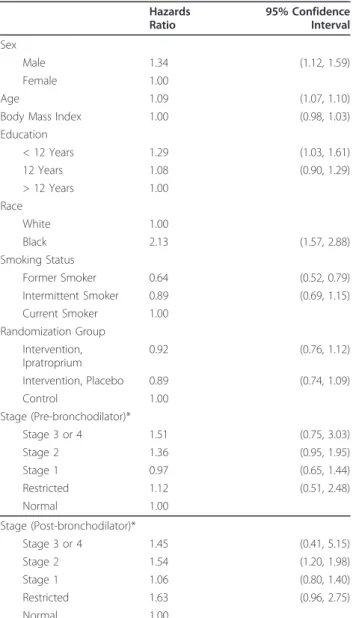
The Cox proportional hazards models for the year 1 cohort are shown in Table 4. Age, sex, education level, race, and smoking status were significant predictors of mortality, but in these models COPD classification stage reached statistical significance in only stage 2 of the post-bronchodilator model. The area under the curve, from the PROC logistic model, was 69.2% for the pre-and 69.6% for the post- bronchodilator model. In paral-lel models that used pre- and post-bronchodilator FEV1, as a percentage of predicted, a higher FEV1 % predicted lower mortality in both the pre- (HR 0.87, 95% CI 0.81,
0.94 per 10% increase) and post-bronchodilator (HR 0.84, 95% CI 0.77, 0.90) models. The area under the curve for the respective models was 69.2% and 69.4%.
Similar models for the year 5 follow-up data are shown in Table 5. The main difference seen between the year 1 and year 5 models is that the latter now show an increased risk of Stage 3 or 4 COPD on mortality in both the pre- (HR 2.68, 95% CI 1.51, 4.75) and post-bronchodilator (HR 2.46, 95% CI 1.63, 3.73) models. The area under the curve was 69.0% for the pre- and 69.5% for the post-bronchodilator models. Similar mod-els using FEV1 showed that a higher FEV1 % predicted lower mortality in both the pre-bronchodilator (HR 0.84, 95% CI 0.75, 0.87 per 10% increase) and post-bronchodilator (HR 0.78, 95% CI 0.73, 0.90) models. The area under the curve for the respective models was 69.4% and 69.8%.
Discussion
This analysis examined data from the Lung Health Study to determine whether post-bronchodilator lung function predicts mortality. Overall, we found that the pre- and post-bronchodilator measures of lung function, whether used categorically (as stages of COPD) or con-tinuously (as FEV1 % predicted) predicted mortality similarly. This finding suggests that post-bronchodilator lung function data may not be needed for studies that look at long term outcomes in COPD.
Most guidelines defining COPD say that spirometry should be performed after the administration of an ade-quate dose of an inhaled bronchodilator in order to minimize variability [4,21]. These same guidelines, how-ever, state that “neither bronchodilator nor oral gluco-corticosteroid reversibility testing predicts disease progression, whether judged by decline in FEV1, dete-rioration of health status, or frequency of exacerbations in patients with a clinical diagnosis of COPD and abnor-mal spirometry. Sabnor-mall changes in FEV1 (e.g., < 400 ml) after administration of a bronchodilator do not reliably predict the patient’s response to treatment" [4]. Others have suggested that one cannot use prebronchodilator lung function to define COPD, the reason being that airflow limitation can be variable and that this compo-nent can be easily reverse with a bronchodilator [22]. Other research, though, has suggested that bronchodila-tor responsiveness is highly variable and that“over half the patients initially classified as reversible by the ATS/ GOLD definition would be reclassified had they attended on another occasion”[23].
14% [24]. In our analysis the prevalence of severe COPD was lower in the post- compared to the pre-bronchodi-lator lung function in both the year 1 (0.4% vs. 1.3%)
and the year 5 (3.4% vs. 6.4%) cohorts. The finding of a lower prevalence, however, does not necessarily mean that this is the correct prevalence.
Table 1 Characteristics of Analyzed Population at Year 1 (n = 5,307) with 628 deaths at up to 15 years of follow-up
N % Person-Years of
Follow-up
Deaths per 1,000 Person Years
Sex
Female 1993 37.6 24,764 8.3 Male 3314 62.4 40,708 10.4 Age Group, Years
35-39 522 9.8 6,610 3.8
40-49 2099 39.6 26,350 5.5 50-59 2494 47.0 30,267 13.7
60+ 192 3.6 2,245 18.7
Body Mass Index, kg/m2
< 25 2528 47.6 31,168 9.5 25- 30 2082 39.2 25,791 9.1 > = 30 697 13.1 8,513 11.5 Education, Years
< 12 632 11.9 7,720 13.0
12 1592 30.0 19,629 10.0
> 12 3083 58.1 38,123 8.7 Race
White 5108 96.3 63,117 9.2
Black 199 3.7 2,355 20.8
Smoking Status
Former 1439 27.1 17,966 7.0 Intermittent 628 11.8 7,752 9.5 Current 3240 61.1 39,754 10.8 Randomization
Group
Intervention, Ipratroprium
1793 33.8 22,141 8.9
Intervention, Placebo
1785 33.6 22,108 9.0
Control 1729 32.6 21,223 11.0 Stage
(pre-bronchodilator)*
Stage 3 or 4 67 1.3 799 15.0 Stage 2 3432 64.7 42,208 10.7 Stage 1 1354 25.5 16,852 7.3 Restricted 69 1.3 840 9.5 Normal 385 7.3 4,773 6.7 Stage
(post-bronchodilator)*
Stage 3 or 4 19 0.4 224 13.4 Stage 2 2540 47.9 31,126 12.1 Stage 1 1565 29.5 19,386 7.8 Restricted 125 2.4 1,487 12.1 Normal 1058 19.9 13,249 5.8
*Modified chronic obstructive pulmonary disease stage, as defined in methods
Table 2 Characteristics of Analyzed Population at Year 5 (n = 5,320) with 500 deaths at up to 10 years of follow-up
N % Person-Years
of Follow-up
Deaths per 1,000 Person Years
Sex
Female 1,992 37.4 17,221 9.4 Male 3,328 62.6 28,587 11.8 Age Group, years
35-39 25 0.5 214 9.3
40-49 1,708 32.1 14,995 4.7 50-59 2,436 45.8 20,954 11.4 60+ 1,151 21.6 9,644 19.7 Body Mass Index, kg/
m2
< 25 2,536 47.7 21,849 10.7 25- 30 2,098 39.4 18,075 10.6 > = 30 686 12.9 5,884 12.7 Education (years)
< 12 639 12.0 5,496 14.0 12 1,595 30.0 13,735 11.5 > 12 3,086 58.0 26,577 10.0 Race
White 5,136 96.5 44,226 10.6 Non-White 184 3.5 1,582 19.6 Smoking Status
Former 1,386 26.1 12,063 7.5 Intermittent 627 11.8 5,403 10.2 Current 3,307 62.2 28,342 12.5 Randomization Group
Intervention, Ipratroprium
1,791 33.7 15,470 9.6
Intervention, Placebo
1,770 33.3 15,271 10.5
Control 1,759 33.1 15,067 12.7 Stage
(pre-bronchodilator)*
Stage 3 or 4 341 6.4 2,831 21.5 Stage 2 3,587 67.4 30,875 11.3 Stage 1 995 18.7 8,674 7.3 Restricted 92 1.7 768 15.6 Normal 305 5.7 2,659 5.6 Stage
(post-bronchodilator)*
Stage 3 or 4 183 3.4 1,475 29.8 Stage 2 3,048 57.3 26,237 12.0 Stage 1 1,242 23.3 10,775 7.2 Restricted 126 2.4 1,059 13.2 Normal 721 13.6 6,262 7.8
Others have looked at this problem in different ways. For example, Hansen et al studied 985 patients with COPD and found that the response to a bronchodilator was a positive prognostic factor along with FEV1at base-line. However, if baseline FEV1was substituted with post-bronchodilator FEV1, the bronchodilator reversibility became nonsignificant [25]. Compared to our population, that population had much lower lung function (mean FEV138.5% of predicted compared to our mean FEV1of 74.7%) and was much older (mean age 61.8 years at base-line compared to our mean age of 48.5 years). Still, the predictive value for FEV1in their study was similar in the pre- (relative risk [RR] 0.60, 95% CI 0.54, 0.81) and post-bronchodilator (RR 0.62, 95% CI 0.56, 0.69) models.
Burrows acknowledged the complexity of the relation between bronchodilator responsiveness and outcomes in obstructive lung disease [26]. He noted that different studies had varying results [27,28] and suggested that several factors, such as how baseline lung function is determined, how responsiveness is measured, and the prevalence of “asthma” in the studied population, may be important determinants of outcomes. His conclusion that mortality is“related to age and to a low initial post-bronchodilator FEV1“ provides, in part, the historic rationale for using post-bronchodilator lung function to define COPD.
This study has limitations that are important to its interpretation. The most important was that it was not a true “population-based” study but was a clinical intervention trial that targeted early COPD. Study par-ticipants had to be current smokers at entry with lung function that was mildly abnormal, and subjects who
regularly used bronchodilators were excluded. Although asthma history was not a specific exclusion criterion, excluding people with regular bronchodilator use had the net effect of eliminating subjects with clinically significant asthma from the population. Thus, these findings may not necessarily apply to a popula-tion that includes never smokers or where a large pro-portion of the population has asthma that is symptomatic. Also, a more inclusive population of smokers where reversibility is more common may have yielded different results. This limitation is decreased by our study design that looked at data from the year 1 and year 5 follow-up, at which point some subjects had stopped smoking and many developed symptoms consistent with asthma or COPD. In addition, one would not expect the post-bronchodilator FEV1 of never smokers (in the absence of asthma) to differ sig-nificantly from the pre-bronchodilator value. Finally, the dose of bronchodilator used in this study (two inhalations, 200-μg total dose, of isoproterenol) is less than what has been used in other clinical trials, some of which have used 400μg of isoproterenol and 400μg of albuterol [29]. Thus, it is unknown whether the findings would be similar if a “maximal bronchodilita-tion” protocol was used.
Another limitation was the absence of other important measures of COPD, such as an impaired exercise test-ing, impaired diffusion capacity or abnormal imaging. Recent work [30-32] in COPD has highlighted that mea-sures other than lung function are important predictors of impaired function and poor outcomes. Lung function remains, however, the primary means of diagnosing and Table 3 Comparison of pre- and post-bronchodilator classifications from Year 1 and Year 5 visits
Year 1 Post-Bronchodilator
Pre-Bronchodilator Stage 3 or 4* Stage 2 Stage 1 Restricted Normal Total
Stage 3 or 4* 17 50 0 0 0 67
Stage 2 1 2442 578 76 335 3432
Stage 1 0 28 959 0 367 1354
Restricted 1 10 0 44 14 69
Normal 0 10 28 5 342 385
Total 19 2540 1565 125 1058 5307
Year 5
Post-Bronchodilator
Pre-Bronchodilator Stage 3 or 4* Stage 2 Stage 1 Restricted Normal Total
Stage 3 or 4* 172 168 0 1 0 341
Stage 2 10 2823 482 67 205 3587
Stage 1 0 27 748 0 220 995
Restricted 1 18 1 56 16 92
Normal 0 12 11 2 280 305
Total 183 3048 1242 126 721 5320
The rows represent the pre-bronchodilator values and the columns represent the post-bronchodilator values (i.e. at year one 67/5307 were stage 3 or 4 pre- and 19/5307 were stage 3 or 4 post-bronchodilator). Year 1 Post-Bronchodilator
classifying COPD at the present time and this is unlikely to change in the foreseeable future.
Conclusion
We found that is this cohort both pre- and post-bronch-odilator lung function predicted mortality with similar accuracy. This validates the approach taken in a number of long-term studies where only prebronchodilator lung function is available, although studies that include simi-lar data in never smokers and subjects with asthma are needed.
Acknowledgements
The authors thank the staff and participants in the Lung Health Study for their important contributions. The LHS was conducted and supported by the National Heart Lung and Blood Institute (NHLBI). This Manuscript was not prepared in collaboration with investigators of the LHS and does not necessarily reflect the opinions or views of the LHS or the NHLBI. The authors would also like to thank Ms. Susan Mittenzwei and Ms. Rebecca Copeland for their assistance in this project. The analysis and development of this manuscript was supported by a research grant from GlaxoSmithKline Pharmaceuticals.
Author details
1
University of Kentucky, College of Public Health, Lexington, KY, USA. 2University of Kentucky College of Medicine, Lexington, KY, USA.3Oregon Health Sciences University, Portland, OR, USA.
Table 4 Results from Cox Proportional hazards survival models on year 1 sample- Mortality follow-up of up to 15 years
Hazards Ratio
95% Confidence Interval
Sex
Male 1.34 (1.12, 1.59)
Female 1.00
Age 1.09 (1.07, 1.10)
Body Mass Index 1.00 (0.98, 1.03) Education
< 12 Years 1.29 (1.03, 1.61)
12 Years 1.08 (0.90, 1.29)
> 12 Years 1.00 Race
White 1.00
Black 2.13 (1.57, 2.88)
Smoking Status
Former Smoker 0.64 (0.52, 0.79) Intermittent Smoker 0.89 (0.69, 1.15) Current Smoker 1.00
Randomization Group Intervention, Ipratroprium
0.92 (0.76, 1.12)
Intervention, Placebo 0.89 (0.74, 1.09)
Control 1.00
Stage (Pre-bronchodilator)*
Stage 3 or 4 1.51 (0.75, 3.03)
Stage 2 1.36 (0.95, 1.95)
Stage 1 0.97 (0.65, 1.44)
Restricted 1.12 (0.51, 2.48)
Normal 1.00
Stage (Post-bronchodilator)*
Stage 3 or 4 1.45 (0.41, 5.15)
Stage 2 1.54 (1.20, 1.98)
Stage 1 1.06 (0.80, 1.40)
Restricted 1.63 (0.96, 2.75)
Normal 1.00
Results for post-bronchodilator lung function measurement is displayed without showing results for the other covariates.
*Modified chronic obstructive pulmonary disease stage, as defined in methods
Table 5 Results from Year 5 sample, mortality follow-up of up to 10 years
Hazards Ratio
95% Confidence Interval
Sex
Male 1.36 (1.12, 1.64)
Female 1.00
Age 1.09 (1.07, 1.10)
Body Mass Index 1.01 (0.98, 1.03) Education
< 12 Years 1.24 (0.96, 1.59)
12 Years 1.10 (0.90, 1.34)
> 12 Years 1.00 Race
White 1.00
Black 1.77 (1.22, 2.56)
Smoking Status
Former Smoker 0.63 (0.50, 0.80) Intermittent Smoker 0.85 (0.64, 1.13) Current Smoker 1.00
Randomization Group Intervention, Ipratroprium
0.86 (0.69, 1.07)
Intervention, Placebo 0.91 (0.74, 1.13)
Control 1.00
Stage (Pre-bronchodilator)*
Stage 3 or 4 2.68 (1.51, 4.75)
Stage 2 1.60 (0.94, 2.69)
Stage 1 1.12 (0.63, 1.98)
Restricted 2.25 (1.04, 4.86)
Normal 1.00
Stage (Post-bronchodilator)*
Stage 3 or 4 2.46 (1.63, 3.73)
Stage 2 1.11 (0.82, 1.51)
Stage 1 0.74 (0.52, 1.06)
Restricted 1.36 (0.74, 2.47)
Normal 1.00
Authors’contributions
DMM and EDG participated in the design of the study, drafting the manuscript, and interpreting the results. ASB assisted in acquiring the data, drafting the manuscript, and interpreting the results. All authors have read and approved the final manuscript.
Competing interests
DMM has served on advisory boards for Boehringer Ingelheim, Pfizer, GlaxoSmithKline, Sepracor, Astra-Zeneca, Novartis and Ortho Biotech and has received research grants from Astra-Zeneca, GlaxoSmithKline, Novartis and Pfizer. This work was sponsored by a research grant from GlaxoSmithKline. EDG and ASB declare no conflicts of interest.
Received: 14 July 2011 Accepted: 12 October 2011 Published: 12 October 2011
References
1. Mannino DM, Buist AS:Global burden of COPD: risk factors, prevalence, and future trends.Lancet2007,370:765-773.
2. Mannino DM, Homa DM, Akinbami LJ, Ford ES, Redd SC:Chronic obstructive pulmonary disease surveillance–United States, 1971-2000. MMWR Surveill Summ2002,51:1-16.
3. Minino AM, Xu J, Kochanek KD:Death in the United States, 2008.National Vital Statistics Reports2010,59:1-72.
4. Rabe KF, Hurd S, Anzueto A, Barnes PJ, Buist SA, Calverley P, Fukuchi Y, Jenkins C, Rodriguez-Roisin R, van WC,et al:Global strategy for the diagnosis, management, and prevention of chronic obstructive pulmonary disease: GOLD executive summary.Am J Respir Crit Care Med 2007,176:532-555.
5. Celli BR, MacNee W:Standards for the diagnosis and treatment of patients with COPD: a summary of the ATS/ERS position paper.Eur Respir J2004,23:932-946.
6. Wenzel SE:Asthma: defining of the persistent adult phenotypes.Lancet 2006,368:804-813.
7. Pellegrino R, Viegi G, Brusasco V, Crapo RO, Burgos F, Casaburi R, Coates A, van der Grinten CP, Gustafsson P, Hankinson J,et al:Interpretative strategies for lung function tests.Eur Respir J2005,26:948-968. 8. Johannessen A, Lehmann S, Omenaas ER, Eide GE, Bakke PS, Gulsvik A:
Post-bronchodilator spirometry reference values in adults and implications for disease management.Am J Respir Crit Care Med2006,
173:1316-1325.
9. Johannessen A, Omenaas ER, Bakke PS, Gulsvik A:Implications of reversibility testing on prevalence and risk factors for chronic obstructive pulmonary disease: a community study.Thorax2005,
60:842-847.
10. Global Strategy for the Diagnosis, Management, and Prevention of Chronic Obstructive Pulmonary Disease (2008 Update).[http://www. goldcopd.org].
11. Mannino DM, Buist AS, Petty TL, Enright PL, Redd SC:Lung function and mortality in the United States: data from the First National Health and Nutrition Examination Survey follow up study.Thorax2003,58:388-393. 12. Mannino DM, Doherty DE, Buist AS:Global Initiative on Obstructive Lung
Disease (GOLD) classification of lung disease and mortality: findings from the Atherosclerosis Risk in Communities (ARIC) study.Respir Med 2006,100:115-122.
13. Engstrom G, Hedblad B, Nilsson P, Wollmer P, Berglund G, Janzon L:Lung function, insulin resistance and incidence of cardiovascular disease: a longitudinal cohort study.J Intern Med2003,253:574-581.
14. Mannino DM, Buist AS, Vollmer WM:Chronic obstructive pulmonary disease in the older adult: what defines abnormal lung function?Thorax 2007,62:237-241.
15. Anthonisen NR, Connett JE, Kiley JP, Altose MD, Bailey WC, Buist AS, Conway WA, Enright PL, Kanner RE, O’Hara P,et al:Effects of smoking intervention and the use of an inhaled anticholinergic bronchodilator on the rate of decline of FEV1. The Lung Health Study.JAMA1994,
272:1497-1505.
16. Connett JE, Kusek JW, Bailey WC, O’Hara P, Wu M:Design of the Lung Health Study: a randomized clinical trial of early intervention for chronic obstructive pulmonary disease.Control Clin Trials1993,14:3S-19S.
17. Anthonisen NR, Lindgren PG, Tashkin DP, Kanner RE, Scanlon PD, Connett JE:Bronchodilator response in the lung health study over 11 yrs.Eur Respir J2005,26:45-51.
18. Anthonisen NR, Skeans MA, Wise RA, Manfreda J, Kanner RE, Connett JE:
The effects of a smoking cessation intervention on 14.5-year mortality: a randomized clinical trial.Ann Intern Med2005,142:233-239.
19. Hankinson JL, Odencrantz JR, Fedan KB:Spirometric reference values from a sample of the general U.S. population.Am J Respir Crit Care Med1999,
159:179-187.
20. Scanlon PD, Connett JE, Waller LA, Altose MD, Bailey WC, Buist AS:Smoking cessation and lung function in mild-to-moderate chronic obstructive pulmonary disease. The Lung Health Study27.Am J Respir Crit Care Med 2000,161:381-390.
21. Celli BR, MacNee W, Agusti A, Anzueto A, Berg B, Buist AS, Calverley PMA, Chavannes N, Dillard T, Fahy B,et al:Standards for the diagnosis and treatment of patients with COPD: a summary of the ATS/ERS position paper.European Respiratory Journal2004,23:932-946.
22. Sterk PJ:Let’s not forget: the GOLD criteria for COPD are based on post-bronchodilator FEV1.Eur Respir J2004,23:497-498.
23. Calverley PM, Burge PS, Spencer S, Anderson JA, Jones PW:Bronchodilator reversibility testing in chronic obstructive pulmonary disease.Thorax 2003,58:659-664.
24. Perez-Padilla R, Hallal PC, V+ízquez-Garc+¡a JC, Mui+¦o A, M+íquez Ma, L +¦pez MaV, de Oca MaM, T+ílamo C, Valdivia G, Pertuz+¬ J,et al:Impact of Bronchodilator Use on the Prevalence of COPD in Population-Based Samples.COPD: Journal of Chronic Obstructive Pulmonary Disease2007,
4:113-120.
25. Hansen EF, Phanareth K, Laursen LC, Kok-Jensen A, Dirksen A:Reversible and irreversible airflow obstruction as predictor of overall mortality in asthma and chronic obstructive pulmonary disease.Am J Respir Crit Care Med1999,159:1267-1271.
26. Burrows B:Predictors of loss of lung function and mortality in obstructive lung diseases.Eur Respir Rev1991,1:340-345. 27. Postma DS, de VK, Koeter GH, Sluiter HJ:Independent influence of
reversibility of air-flow obstruction and nonspecific hyperreactivity on the long-term course of lung function in chronic air-flow obstruction. Am Rev Respir Dis1986,134:276-280.
28. Kanner RE:The relationship between airways responsiveness and chronic airflow limitation.Chest1984,86:54-57.
29. Tashkin DP, Celli B, Decramer M, Liu D, Burkhart D, Cassino C, Kesten S:
Bronchodilator responsiveness in patients with COPD.Eur Respir J2008,
31:742-750.
30. Lederer DJ, Enright PL, Kawut SM, Hoffman EA, Hunninghake G, van Beek EJ, Austin JH, Jiang R, Lovasi GS, Barr RG:Cigarette smoking is associated with subclinical parenchymal lung disease: the Multi-Ethnic Study of Atherosclerosis (MESA)-lung study.Am J Respir Crit Care Med 2009,180:407-414.
31. Agusti A, Calverley PM, Celli B, Coxson HO, Edwards LD, Lomas DA, MacNee W, Miller BE, Rennard S, Silverman EK,et al:Characterisation of COPD heterogeneity in the ECLIPSE cohort.Respir Res2010,11:122. 32. Han MK, Agusti A, Calverley PM, Celli BR, Criner G, Curtis JL, Fabbri LM,
Goldin JG, Jones PW, MacNee W,et al:Chronic obstructive pulmonary disease phenotypes: the future of COPD.Am J Respir Crit Care Med2010,
182:598-604.
doi:10.1186/1465-9921-12-136