*Correspondence to Author:
Yishuai Tian
College of Hydraulic & Environmen-tal Engineering, China Three Gprg-es University, Yichang 443002, China.
How to cite this article:
Yishuai Tian, Mingxuan Lou, Xinhai Zhao, Yalong Zheng. Motor Vehicle Maintenance Scheduling Model Based on Genetic algorithm. International Journ-al of Natural Science and Reviews, 2020; 5:13
eSciPub LLC, Houston, TX USA. Website: https://escipub.com/
Yishuai Tian et al., IJNSR, 2020; 5:13
International Journal of Natural Science and Reviews
(ISSN:2576-5086)
Research Article IJNSR (2020) 5:13
Motor Vehicle Maintenance Scheduling Model Based on Genetic
algorithm
To solve the problem of EMU maintenance planning time, we established a hybrid linear programming model based on adaptive genetic algorithm. According to the different levels of bullet train maintenance and the different arrival time, the constraint conditions are found, and the overall minimum maintenance time is taken as the objective function. Then the problem is transformed into a hybrid Flow-shop scheduling problem with unique process constraints, and an adaptive genetic algorithm is used to solve it again. It is concluded that the total maintenance takes 1125 minutes, and no blockage occurred in all EMU during the maintenance period. To provide a consistent basis for bullet train maintenance time and scheduling.
Keywords: Linear programming; Genetic algorithm; Hybrid;
Flow-shop; Train maintenance
Yishuai Tian1*, Mingxuan Lou1, Xinhai Zhao1, Yalong Zheng1
1College of Hydraulic & Environmental Engineering, China Three Gorges University, Yichang
443002, China.
ABSTRACT
IJNSR: https://escipub.com/international-journal-of-natural-science-and-reviews/ 1. Introduction
Full and high efficiency is the fundamental re-quirement of high-speed railway EMU operation [1].EMU maintenance is an essential means to ensure the safe and efficient service of EMU. The optimization of the EMU maintenance plan is of great significance to improve the EMU op-eration efficiency and reduce the EMU mainte-nance cost. at the same time, it can provide a decision-making basis for the optimal allocation of maintenance capacity and the number of spare cars. The place responsible for the main- tenance and maintenance of the bullet train is called the EMU operation group, and 50 EMU have been built in China [2]. the support of EMU is divided into different maintenance levels, dif-ferent grades correspond to difdif-ferent processes, and each method of different types of EMU takes different time [1-3].
To dispatch the incoming train, to minimize the time required. For this reason, this paper estab-
lished a train maintenance scheduling model based on a genetic algorithm, obtained the ob-jective function and constraint conditions ac-cording to the requirements, and used a genetic algorithm to solve it to provide a relevant basis for bullet train maintenance time and scheduling [4, 5].
2. Problems to be solved
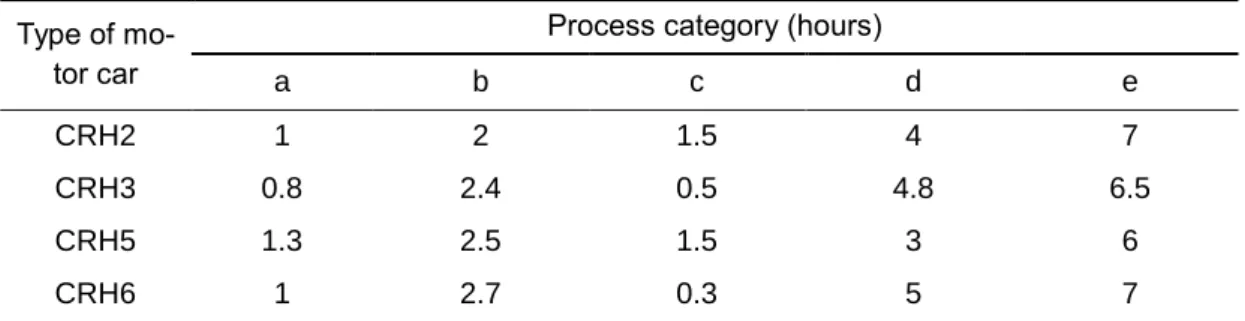
According to the running time, course and maintenance cycle of the train, the maintenance of EMU is divided into different maintenance lev-els, and various maintenance levels correspond to different process combinations, as shown in Table 1. There is 1 workshop in the process a, b and c, 3 workshops in process d and 2 work-shops in e, and time consumption is the same in different workshops in the same process. The time required for each operation of different types of motor cars is given. The total time re-quired to overhaul these trains is calculated ac-cording to the information of the trains arrived [6].
Table 1 Arrival information of motor cars, types of maintenance and combination of working procedures
Arrival time Type of motor car Maintenance type Corresponding process combination
0:16 CRH2 Ⅳ a→c→d→e
0:47 CRH5 Ⅱ a→b→c
1:22 CRH2 Ⅱ a→b→c
2:00 CRH6 Ⅰ a→b
2:20 CRH3 Ⅲ a→b→d
3:05 CRH6 Ⅱ a→b→c
3:31 CRH2 V a→b→c→d→e
Table 2 Time required for various types of motor cars in different processes
Type of mo-tor car
Process category (hours)
a b c d e
CRH2 1 2 1.5 4 7
CRH3 0.8 2.4 0.5 4.8 6.5
CRH5 1.3 2.5 1.5 3 6
CRH6 1 2.7 0.3 5 7
3. Establishment of mixed Linear program-ming Model
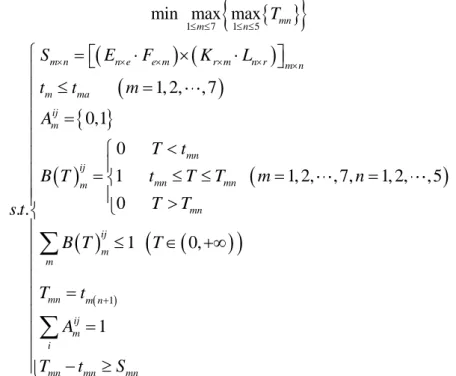
3.1 Determination of objective function Let o p q, , , be the number of workshops in the three processes of, a b c, , , among which
1, 2, 3.
o= p=1, 2, ,8. q=1, 2, , 5 ,
1, 2, 3, 1, 2
IJNSR: https://escipub.com/international-journal-of-natural-science-and-reviews/
1, 2, , 7, 1, 2, , 5
m= n= . To improve the overall
maintenance efficiency of the incoming mainte-nance EMU of different types of bullet trains at different levels of maintenance, the objective function is determined as the shortest maintena-
nce time of the whole EMU. Among them, Tmn indicates the end time of the EMU in the nth maintenance workshop [7],and the formula is as follows:
1 7 1 5
min max max mn
m n T
3.2 Establishment of constraints
Establishment of bullet train type 0-1 matrix
r m
K coach Kr m means that the m-th EMU is an r-type bullet train r=1, 2, 3, 4 denotes the
model of each type of motor car, for example,
1
r= , which is indicated as CRH2 EMU Krm =0
indicates that the m EMU is not a type r bullet train, and Krm =1 is an r type bullet train The
specific formula is as follows:
11 1
(
1, 2, , 4, 1, 2, , 7)
r m r r m
K = K K r= m=
Establishment of Ln r repair data Matrix for var-ious types of Motor cars. Let Lnrdenote the pro-cessing time of the r-type motor car in the nth
process According to the given data, the corre-sponding matrix is established as follows:
11 1
(
1, 2, 5, 1, 2, , 4)
n r r n r
L = L L n= r=
The establishment of the relation matrixEn e re-pair between maintenance type and workshop 0-1Since motor cars with different maintenance levels enter different workshops in a different or-der, in which e=1, 2, 3, 4, 5 denotes the
corresponding maintenance level Example:
1
e= indicates the maintenance level of grade I As some workshop repairs may not be carried out at different levels take Ene like 0 or 1, and the formula is as follows:
11 1
(
1, 2, , 5, 1, 2, , 5)
n e e n e
E = E E e= n=
Where Ene=1 means that workshop n will be
used in the maintenance of level e, Ene=0
which means that workshop n will not be used in the maintenance of level e
Establishment of vehicle serial number and maintenance 0 to 1 type matrix Fe m repair
Be-cause the bullet trains entering the station at dif-ferent times are not only difdif-ferent in time and
model, but also have different types of mainte-nance Therefore, a two-dimensional matrix of vehicle serial number and maintenance type is established, where Fem =0 means that the
maintenance type of m-th motor car is not grade
e
,Fem =1 indicates that the type ofmainte-nance of the m-th motor car is grade
e
The for-mula is as follows
11 1
(
1, 2, , 5, 1, 2, , 7)
e m m e m
F = F F e= m=
The establishment of a time constraint Sm n
ma-trix Because the time of the bullet train entering the inspection and repair station is not only dif-ferent, its maintenance grade is difdif-ferent, and the maintenance time in each workshop is
different due to different models Therefore, the time constraint matrix is established according to the above four matrices and represents the cessing time of the m-th measuring car in pro-cess n, and the formula is as follows:
(
) (
)
(
, , ,)
m n n e e m r m n r m n
S E F K L n r m e
=
Establishment of constraints for entering the maintenance process. Let tm
(
t t1, ,2 tm, t7)
IJNSR: https://escipub.com/international-journal-of-natural-science-and-reviews/ need to queue up before entering the
mainte-nance station Therefore, the constraints can be
established as follows:
(
1, 2, , 7)
m ma
t t m= Whether the bullet train has entered the inspec-tion stainspec-tion. Let ij
m
A denote whether the m-th car
enters the j-th workshop of the I-th process, where means that the m-th car does not enter
the j-th workshop of the I-th process, and when 1
ij m
A = indicates that the m-th car will enter the
j-th workshop of the I-th process Get the follow-ing constraints:
0,1ij m A = Whether the bullet train occupies the inspection station Let the value of ij
m
B indicating whether
the m-th car T occupies the j-th workshop of the I-th process at any time Get the constraint con-dition Bmij =
0,1 , When means that the m-th car T does not occupy the j-th workshop of the I-th process at any time; WhenBkij =1means that them-th car occupies the j-th workshop of the i-th process at any time According to the actual sit-uation, there is Bmij =0 when the train has not entered or has been overhauled tij T denotes
the entry time of m EMU in the nth maintenance workshop, T represents any time,T +(0, ) So the ij
m
B constraint is as follows:
( )
(
)
0
1 1, 2, , 7, 1, 2, , 5
0 mn ij mn mn m mn T t
B T t T T m n
T T = = =
Restrictions on the number of motor cars in the workshop ForTat any time, there will be at most one set of bullet trains in each workshop in the
three types of maintenance procedures of
, , , ,
a b c d e, so the constraints can be established
as follows:
( )
ij 1(
(
0,)
, 1, 2, ,5,)
m m
B T T + i= j
The constraint of time cohesion. According to the requirements of the topic, the switching time between EMU is ignored. For any group of EMU,
the end time of m in the previous workshop is the entry time of entering the next workshop. There-fore, the constraints are established as follows:
( )1 mn
(
1, 2, , 7, 1, 2,3, 4)
m nT + =t m= n=
The restriction of EMU entering the station. Any EMU m can only enter one workshop after each maintenance process, and some workshops caused by different maintenance levels do not
pass through. We regard it as still passing, but the maintenance time is 0. Therefore, the in-bound constraints are established as follows:
(
)
1 1, 2, 7,
ij m i
A = m= j
,Maintenance time constraint. Smn indicates the processing time of the m-th EMU in process n As different types of motor cars spend different time in different workshops in the same process, and different maintenance workshops with differ-ent maintenance levels, if the workshop in the
next process is full, we need to wait in the origi-nal workshop. For any group of motor cars, it can be found that the stay time in different processes may exceed the maintenance time. Therefore, constraints can be established as follows:
(
1, 2, , 7, 1, 2, , 5)
mn mn mn
T −t S m= n=
IJNSR: https://escipub.com/international-journal-of-natural-science-and-reviews/
1 7 1 5
min max max mn
m n T
(
) (
)
(
)
( )
(
)
( )
(
(
)
)
( 1)
1, 2, , 7
0,1
0
1 1, 2, , 7, 1, 2, , 5
0 . .
1 0,
1
m n n e e m r m n r m n
m ma ij m mn ij mn mn m mn ij m m
mn m n
ij m i
mn mn mn
S E F K L
t t m
A
T t
B T t T T m n
T T
s t
B T T
T t
A
T t S
+ = = = = = = + = = −
3.3 Application of Genetic Algorithm in Cal-culation of Motor Vehicle Maintenance Time At present, this kind of NP problem is mainly solved by high-end algorithms[8] An intelligent algorithm is needed to solve the problem The neural network, simulated annealing algorithm,
and genetic algorithm are all algorithms to solve this problem Among them, the genetic algorithm is widely used Therefore, a genetic algorithm is used as a method to solve the problem The flow chart is shown in Fig 1
Meet the final conditions? Start
Generate initial population
Calculating the fitness value of the human body
Output optimal solution Select
Cross
Variation
End
Fig 1 Flow chart of the genetic algorithm
4. Results and result analysis
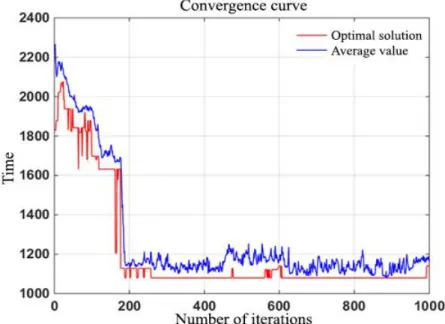
Based on the MATLAB platform, input the pro-cessing time and propro-cessing level of different types and different processes The population size is N=50, the mutation probability is P=0 1,
IJNSR: https://escipub.com/international-journal-of-natural-science-and-reviews/ Fig 2 Convergence result of genetic algorithm
As shown in Fig 2, when the solution obtained by the number of iterations is the optimal solu-tion The last one leaves at 7:01 pm, and the
total maintenance time is 1125 minutes The Gantt chart was drawn using the genetic algo-rithm, as shown in Fig 3
Fig. 3 Gantt chart of motor car maintenance time
As shown in Fig.3, the rectangles of seven dif-ferent colors represent seven difdif-ferent EMU. The process of the motor car is explained by tag-ging m-n, where m represents the serial number of the motor car, and n represents the serial number of the process Numbers represent the sequence of processes The y-axis represents the 21 workshop serial numbers of 5 processes The length of the color block in the Gantt chart represents the stay time of all types of motor cars in each process The solution to the F-TSP
problem under the genetic algorithm needs to constantly change the number of iterations to find a globally optimal solution
5. Conclusion
IJNSR: https://escipub.com/international-journal-of-natural-science-and-reviews/ Flow-shop scheduling problem with special
pro-cess constraints, and the adaptive genetic algo-rithm is used to solve it again It is concluded that the total maintenance takes 1125 minutes, and no blockage occurred in all EMU during the maintenance period To provide a consistent ba-sis for bullet train maintenance time and sched-uling
References
1. Fei Gao, Yu Pan Beijing EMU maintenance base and EMU maintenance[J] Railway rolling stock, 2010,30 (04): 77-81
2. Meihua Zhu Research on optimization of the
use of EMU under passenger dedicated line[D] Lanzhou Jiaotong University, 2013
3. Jian Li Research on the comprehensive
optimi-zation method of EMU operation and mainte-nance plan [D] Beijing Jiaotong University, 2017
4. Maroti G, Kroon L. Maintenance routing for train
units: The interchange model[J]. COMPUTERS
& OPERATIONS RESEARCH,2007,34(4):1121-
1140.
5. Zhang D, Hu H, Liu Y, et al. Railway Train Wheel
Maintenance Model and Its Application[J].
TRANSPORTATION RESEARCH RECORD,
2014(2448):28-36.
6. Hani Y, Amodeo L, Yalaoui F, et al. Simulation
based optimization of a train maintenance
facil-ity[J]. JOURNAL OF INTELLIGENT
MANUFAC-TURING, 2008,19(3):293-300.
7. Reich D. A linear programming approach for
lin-ear programs with probabilistic constraints[J].
EUROPEAN JOURNAL OF OPERATIONAL
RESEARCH, 2013,230(3):487-494.
8. Ding C, Chen L, Zhong B. Exploration of
intelli-gent computing based on improved hybrid
ge-netic algorithm[J]. CLUSTER
COMPUTING-THE JOURNAL OF NETWORKS SOFTWARE
TOOLS AND APPLICATIONS, 2019,224:S9037