Cover Page
The following handle holds various files of this Leiden University dissertation:
http://hdl.handle.net/1887/59459
Author: Spasic, J.
Title: Improved hard real-time scheduling and transformations for embedded Streaming
Applications
Improved Hard Real-Time
Scheduling and Transformations
for Embedded Streaming Applications
Improved Hard Real-Time
Scheduling and Transformations
for Embedded Streaming Applications
PROEFSCHRIFT
ter verkrijging van
de graad van Doctor aan de Universiteit Leiden, op gezag van Rector Magnificus Prof.mr. C.J.J.M. Stolker,
volgens besluit van het College voor Promoties te verdedigen op dinsdag 14 november 2017
klokke 13:45 uur
door
Jelena Spasi´c
Promotion Committee: Prof. dr. Alix Munier Kordon Université de Paris - LIP6
Prof. dr. Petru Eles Linköpings Universitet
Dr. Andy Pimentel Universiteit van Amsterdam
Prof. dr. Aske Plaat Universiteit Leiden
Prof. dr. Jaap van den Herik Universiteit Leiden
Prof. dr. Harry Wijshoff Universiteit Leiden
Improved Hard Real-Time Scheduling and Transformations for Embedded Streaming Applications
Jelena Spasi´c.
-Dissertation Universiteit Leiden. - With ref. - With summary in Dutch.
Copyright c○2017 by Jelena Spasi´c. All rights reserved.
Cover designed by Miloš Aˇcanski.
This dissertation was typeset using LATEX.
ISBN 978-94-6299-783-7
Contents
Table of Contents vii
List of Figures xi
List of Tables xiii
List of Abbreviations xv
1 Introduction 1
1.1 Trends in the Design of Embedded Streaming Systems . . . . 3
1.1.1 Platform Trend: Multi-Processor System-on-Chip (MPSoC) 3 1.1.2 Design Trend: Model-based Design Methodology . . . 5
1.2 Design Requirements and Basic Approaches to Meet the Re-quirements . . . 7
1.2.1 Timing Requirements . . . 7
1.2.2 Energy Requirements . . . 9
1.3 Problem Statement . . . 10
1.3.1 Problem 1 . . . 10
1.3.2 Problem 2 . . . 10
1.3.3 Problem 3 . . . 11
1.3.4 Problem 4 . . . 12
1.4 Research Contributions . . . 13
1.5 Thesis Outline . . . 15
2 Background 17 2.1 Dataflow Models-of-Computations (MoCs) . . . 17
2.1.1 Cyclo-Static Dataflow (CSDF) . . . 18
2.1.2 Polyhedral Process Network (PPN) . . . 20
2.2 Real-Time Scheduling Theory . . . 22
2.2.2 System Model . . . 23
2.2.3 Real-Time Scheduling Algorithms . . . 23
2.2.4 Uniprocessor Schedulability Analysis . . . 24
2.2.5 Multiprocessor Schedulability Analysis . . . 27
3 Hard Real-Time Scheduling Framework 31 3.1 Problem Statement . . . 32
3.2 Contributions . . . 32
3.3 Related Work . . . 33
3.4 Motivational Example . . . 35
3.5 Improved Hard Real-Time Scheduling of CSDF . . . 37
3.5.1 Deriving Periods of Tasks . . . 37
3.5.2 Deriving the Earliest Start Time of Actor’s First Phase . . 41
3.5.3 Deriving Channel Buffer Sizes . . . 44
3.5.4 Hard Real-Time Schedulability . . . 46
3.5.5 Performance Analysis . . . 47
3.5.6 Deriving the Number of Processors . . . 52
3.6 Evaluation . . . 54
3.6.1 Performance of theISPSApproach . . . 55
3.6.2 Time Complexity of theISPSApproach . . . 59
3.6.3 Reducing Latency underISPS . . . 61
3.7 Discussion . . . 63
4 Exploiting Parallelism in Hard Real-Time Systems to Maximize Per-formance 65 4.1 Problem Statement . . . 66
4.2 Contributions . . . 67
4.3 Related Work . . . 67
4.4 Motivational Example . . . 69
4.5 New Unfolding Transformation for SDF Graphs . . . 72
4.6 The Algorithm for Finding Proper Unfolding Factors . . . 75
4.7 Evaluation . . . 78
4.7.1 Efficiency of the Proposed Unfolding Transformation . 79 4.7.2 Performance of Algorithm 4 . . . 80
4.7.3 Time Complexity of Algorithm 4 . . . 82
4.8 Discussion . . . 82
Contents ix
5.2 Contributions . . . 87
5.3 Related Work . . . 87
5.4 Motivational Example . . . 90
5.5 System Model . . . 93
5.6 Energy Model . . . 94
5.7 The Proposed Energy Minimization Approach . . . 95
5.7.1 The Data-Parallel Energy Minimization Algorithm . . 95
5.7.2 Task Classification for Energy Minimization . . . 98
5.7.3 Task Mapping for Energy Minimization . . . 99
5.8 Evaluation . . . 103
5.8.1 Comparison with [CKR14], [LSCS15], [SDK13] on Het-erogeneous MPSoCs . . . 104
5.8.2 Comparison with [Lee09] on Heterogeneous MPSoCs . 106 5.8.3 Comparison on Homogeneous MPSoC . . . 107
5.8.4 Overhead and Time Complexity Analysis . . . 109
5.9 Discussion . . . 110
6 An Accurate Energy Modeling of Streaming Systems 111 6.1 Problem Statement . . . 111
6.2 Contributions . . . 112
6.3 Related Work . . . 113
6.4 System Model . . . 115
6.4.1 Application Model . . . 115
6.4.2 Platform Model . . . 116
6.4.3 Application-to-Platform Mapping . . . 117
6.5 Energy Model . . . 118
6.5.1 Model Formulation . . . 118
6.5.2 Derivation of Model Parameters . . . 121
6.6 Evaluation of the Energy Model . . . 127
6.7 Discussion . . . 130
7 Summary and Conclusions 133
Bibliography 137
Samenvatting 153
List of Publications 156
List of Figures
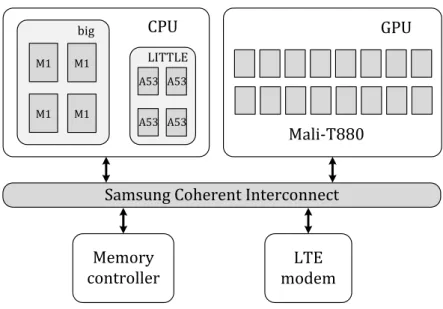
1.1 An MPSoC platform example. . . 4
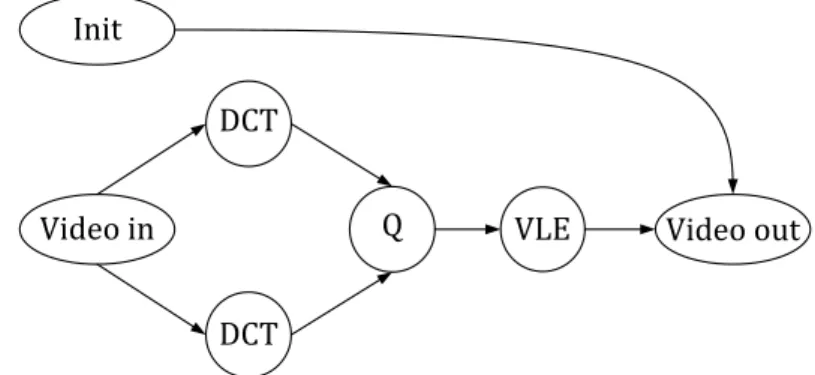
1.2 Motion JPEG encoder application. . . 6
2.1 A CSDF graphG. . . 19
2.2 Example of a PPN (a) and the structure of processP3 (b). . . 21
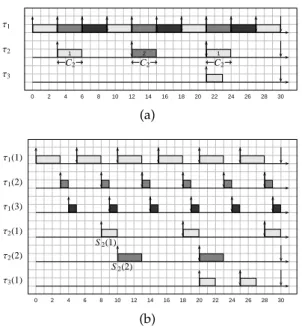
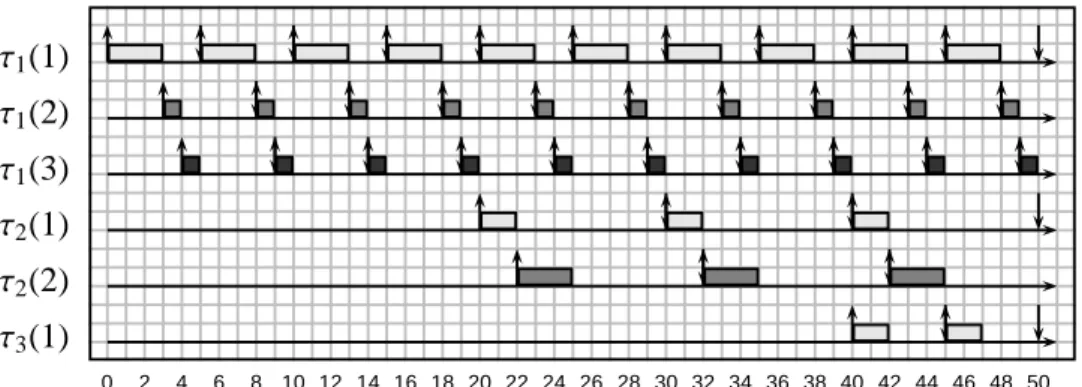
3.1 (a) TheSPSand (b)ISPSof graphGin Figure 2.1. . . 36
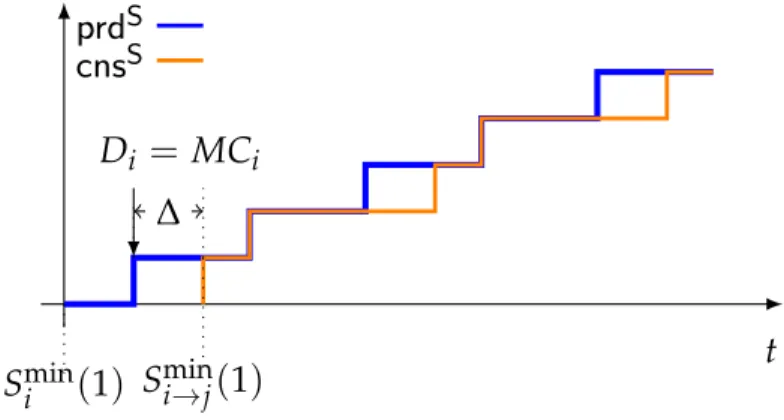
3.2 The periodic scheduleσfor the CSDF graphGshown in Figure 2.1. 41 3.3 Production and consumption curves on edgeeu = (vi,vj). . . 50
4.1 An SDF graphG. . . 69
4.2 Equivalent graphs of the SDF graph in Figure 4.1 by unfolding actorv2by factor 2 andv3by factor 3. . . 70
4.3 Unfolding channele2 from the graph in Figure 4.1 by using Algorithm 3 when~f = [1, 2, 3, 1, 1]. . . 74
4.4 Comparison of our unfolding transformation to the approaches in [KM08], [FKBS11], [SLA12], [ZBS13]. . . 80
4.5 Results of performance evaluation of our proposed approach in comparison to the approach in [ZBS13]. . . 81
4.6 Results of time evaluation of our proposed approach in com-parison to the approach in [ZBS13] . . . 83
5.1 An SDF graphG. . . 91
5.2 A CSDF graphG′ obtained by unfolding SDF graphGin Fig-ure 5.1 with~f = [1, 2, 2, 1]. . . 91
5.3 Comparison of our proposed DPEM approach with related ap-proaches on heterogeneous MPSoCs. . . 105
5.4 Comparison between DPEM and WYL on heterogeneous MP-SoCs. . . 107
List of Tables
2.1 Summary of mathematical notations . . . 17
3.1 Throughput, latency and number of processors for G under different scheduling schemes. . . 36
3.2 Benchmarks used for evaluation. . . 54
3.3 Comparison of different scheduling approaches. . . 58
3.4 Time complexity (in seconds) of different scheduling approaches. 58 3.5 Time complexity (in seconds) for the calculation of number of processors. . . 58
3.6 Performance of theISPSapproach under different latency con-straints. . . 63
4.1 Results forGtransformed by different transformation approaches. 71 4.2 Results forGtransformed and mapped on 2 processors by dif-ferent approaches. . . 71
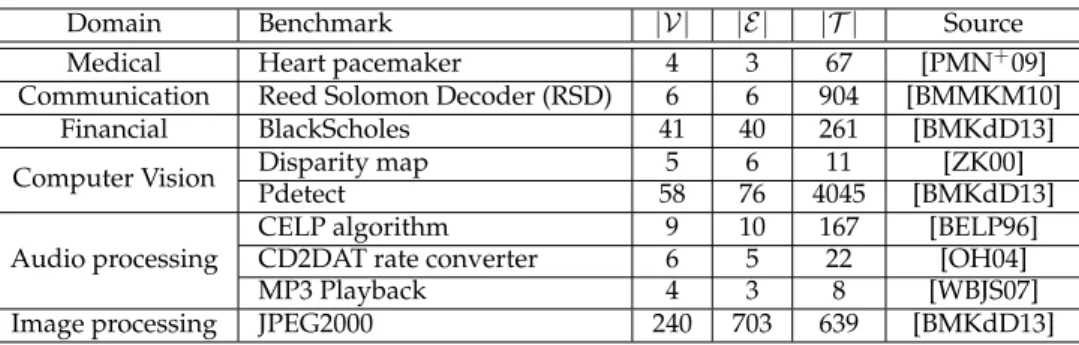
4.3 Benchmarks used for evaluation. . . 79
5.1 Different MPSoC designs forGin Figure 5.1. . . 91
5.2 Benchmarks used for evaluation. . . 103
6.1 Accuracy of the energy model for CB, ShB and P2P MPSoC platforms . . . 129
List of Abbreviations
ADF Affine Dataflow
BF Best-Fit
BFD Best-Fit Decreasing
CDP Constrained-Deadline Periodic
CPU Central Processing Unit
CSDF Cyclo-Static Dataflow
DCT Discrete Cosine Transform
DLP Data-Level Parallelism
DM Deadline Monotonic
DPEM Data Parallel Energy Minimization
DSE Design Space Exploration
EDF Earliest Deadline First
EE Energy Efficient
ESL Electronic System-Level
FF First-Fit
FFD First-Fit Decreasing
FFID First-Fit Increasing Deadlines
FIFO First-In First-Out
FPGA Field-Programmable Gate Array
GPU Graphics Processing Unit
HSDF Homogeneous SDF
ICP Integer Convex Programming
IDP Implicit-Deadline Periodic
ILP Integer Linear Programming
ISA Instruction-Set Architecture
ISPS Improved Strictly Periodic Scheduling
ISS Instruction Set Simulators
ITRS International Technology Roadmap for Semiconductors
KPN Kahn Process Network
LLF Least Laxity First
LP Linear Programming
LTE Long-Term Evolution
MIDCP Mixed Integer Disciplined Convex Programming
MJPEG Motion JPEG
MoC Model of Computation
MPSoC Multi-Processor System-on-Chip
NoC Network-on-Chip
NP Non-deterministic Polynomial-time
PE Performance Efficient
PLP Pipeline-Level Parallelism
PM Power Management
List of Tables xvii
PS Periodic Scheduling
RM Rate Monotonic
RSD Reed Solomon Decoder
RTA Response Time Analysis
RTL Register-Transfer-Level
SDF Synchronous Data Flow
SPS Strictly Periodic Scheduling
STS Self-timed Scheduling
TLP Task-Level Parallelism
VFS Voltage-Frequency Scaling
VLE Variable Length Encoder
WCET Worst-Case Execution Time
WF Worst-Fit
Chapter 1
Introduction
I
N the modern-day world, electronics is not only a tool for survival but an integral part of almost every aspect of human lives. Everything from our home appliances, cars, tablets to our cell-phones uses electronics or electronic components in some way. Constantly improving, the electronics technology is making life faster, easier and more convenient for people. Modern electronics technology is rapidly changing the way people communicate and transmit data and information. Thus, it is possible and common today to execute work related tasks remotely. Health-care systems have also benefited a lot from electronics technology. There, electronics technology is helping doctors accurately diagnose and treat illnesses in a timely manner. For example, in Philips Healthcare, live image guided intervention has been used in treatment of structural heart diseases. Using electronics in home automation received popularity in the past decades. People have the capability to control almost everything in their “smart homes” from heating, air conditioning, and lighting, to kitchen appliances and security systems.An important class of embedded systems areembedded streaming sys-tems. Embedded streaming systems process a long, potentially infinite, stream of input data coming from the environment. Each data item is processed for a limited time. The processing operations on different data items are self-contained and there is little control flow between the operations. The result of the processing is a long, potentially infinite, stream of output data fed into the environment. Usually, streaming applications must process a large amount of data within short periods of time. Thus, efficiency, in terms of both through-putandlatency, is of primary concern in the design of embedded streaming systems. The throughput represents the rate at which output data items are produced, while the latency represents the time interval between the arrival of a data item to the application input and the production of the correspond-ing data item at the application output. Examples of streamcorrespond-ing applications include audio beamforming, video encoding and decoding, image and signal processing, network protocol processing, navigation, computer vision, and others.
One of the key properties of embedded streaming systems is that their correct functionality depends not only on the correct result but also on the time at which the result is produced. Such systems, where the timing is critical to the correct functionality, are calledreal-time systems. Real-time systems can be classified intohardandsoftsystems. A hard real-time system is one where not meeting the timing requirements leads to a system failure, which, in life-critical systems, may have catastrophic consequences. In contrast, in soft real-time systems, not meeting the timing requirements does not lead to a failure but to degraded system performance that can be tolerated given that the timing miss rates are below a certain threshold. Classifying a system into hard or soft real-time depends usually on the overall system requirements and the environment where the system is deployed.
in-1.1. Trends in the Design of Embedded Streaming Systems 3
ertial, position and heat sensors. The large amount of data which should be collected and (pre-)processed, the battery-powered operation nature, and the need to react in a short time create demand for designing a high-performance energy-efficient real-time embedded streaming systems. In the next section, we discuss the current trends in designing such systems.
1.1
Trends in the Design of Embedded Streaming
Sys-tems
As introduced earlier, there is a demand in modern embedded streaming systems for high performance, in terms of high application throughput and short application latency, and a demand for real-time and energy-efficient execution. In addition, the complexity of applications running on embedded platforms increases [EJ09]. Therefore, we discuss below the trends in designing such complex embedded streaming systems to meet all the demands.
1.1.1 Platform Trend: Multi-Processor System-on-Chip (MPSoC)
CPU
big
M1 M1
M1 M1
A53 A53
A53 A53 LITTLE
GPU
LTE modem
Mali-T880
Memory controller
Samsung Coherent Interconnect
Figure 1.1:An MPSoC platform example.
1.1. Trends in the Design of Embedded Streaming Systems 5
1.1.2 Design Trend: Model-based Design Methodology
Driven by constant improvements in the semiconductor technology, MPSoC platforms integrate more and more processing elements on a chip. On the other hand, the complexity of embedded software also increases [EJ09]. In order to design such a complex embedded streaming system in an efficient manner in terms of system quality, design effort and time, designers had to raise the level of design abstraction from Register-Transfer-Level (RTL)to
system-level[KMN+00], [NSD08]. At the system-level, a hardwareplatformis modeled as a set of primitive blocks describing, at a high-level of abstraction, processing elements, memories and interconnects. Anapplicationis modeled as a set of tasks which can be allocated to hardware resources in many different ways, which means that there are many possible mappings of tasks to platform resources. Once it is determined how the application tasks are going to be allocated to the hardware resources such that all designconstraintsare met, that is, once we have amappingspecification, an Electronic System-Level (ESL) synthesis tool [GHP+09] generates in an automated way the hardware description at a lower level of abstraction and the software for each processor in a platform.
In order to achieve the desired performance, the applications which are going to execute on the MPSoC platform have to be specified in a way which utilizes theparallelprocessing elements in the platform. In general, identifying parallelism in an application is a difficult step. In addition, designers should determine the mapping and execution order, that is, scheduling, of application tasks to a platform, and code should be generated for each used processor in the platform. In order to perform all these design steps in an efficient way, designers raise the level of abstraction, as introduced earlier, by building high-level models of applications. Then, the designer can use these models to analyze the performance of different applications-to-platform mappings. Such design approach is calledModel-based designand the models used in such an approach are calledModels of Computation (MoCs). A MoC describes in a formal way how an application works. In this thesis, we consider onlyparallel
MoCs because they are suitable for expressing parallelism in an application which is going to be executed on an MPSoC platform. In a parallel MoC, an application is decomposed into tasks which can be executed in parallel. The parallel MoC defines how tasks communicate and synchronize with each other.
Video in
DCT
VLE Q
DCT
Video out Init
Figure 1.2:Motion JPEG encoder application.
1. Task-Level Parallelism (TLP): an application is split into set of tasks which can execute concurrently;
2. Data-Level Parallelism (DLP): a task of an application executes in parallel on multiple processing elements where each copy of the task processes its own data stream;
3. Pipeline-Level Parallelism (PLP): different iterations of a pair of data producer and consumer tasks execute in parallel.
Usually, an application contains more than one type of parallelism. Task-level parallelism is typically considered first when specifying an application as a set of concurrent tasks. Data-level parallelism is usually used by replicating tasks in an application in order to process more data in parallel and, hence, increase the application performance. However, if consecutive executions of a task depend on each other, data-level parallelism cannot be exploited and pipeline parallelism comes as an important form of parallelism to exploit. Figure 1.2 shows a Motion JPEG (MJPEG) encoder application represented as a set of communicating tasks which can execute concurrently. Here, we can identify examples of all three types of parallelism introduced above: 1) TLP between
Video inand Init; 2) DLP between the twoDCTtasks; and 3) PLP between different iterations ofVLEandVideo out.
It has been identified thatdataflow MoCs are the most suitable parallel MoCs to express parallelism in streaming applications [TA10]. In a dataflow MoC, an application is represented as a directed graph, with graph nodes representing the application tasks and graph edges representing data depen-dences among the tasks. Thus, the parallelism is explicitly specified in the model. Dataflow MoCs differ among each other in theirexpressivenessand
1.2. Design Requirements and Basic Approaches to Meet the Requirements 7
decidability of a model represents the extent to which designers can analyze liveness and performance of an application at compile-time. In general, expres-siveness and decidability of MoCs are inversely related, meaning that more expressive MoCs are less decidable, and the opposite; hence the choice of a suitable MoC depends on the problem being addressed. For example, within the DaedalusRT [BZNS12] design methodology, the Cyclo-Static Dataflow MoC [BELP96] is used as an analysis model, to analyze design non-functional properties such as throughput, latency, hard real-time behavior, while the Polyhedral Process Network MoC [VNS07] is used as an implementation model. The MoCs considered in this thesis to represent streaming appli-cations are Synchronous Data Flow (SDF) [LM87], Cyclo-Static Dataflow (CSDF)[BELP96] andPolyhedral Process Network (PPN)[VNS07], given in the order of increased expressiveness, hence decreased analyzability. Because of their very good analyzability, we use the SDF and CSDF MoCs to analyze the application throughput, latency, hard real-time behavior and calculate the required size of buffers used to implement inter-task communication. On the other hand, we use the PPN MoC to generate efficient code for processors in an MPSoC and build highly accurate energy model to analyze the energy consumption. A more detailed and complete comparison of different dataflow MoCs is given in [SGTB11].
1.2
Design Requirements and Basic Approaches to
Meet the Requirements
In Section 1.1.2, it has been explained that model-based design methodologies have been used to design embedded streaming MPSoCs to provide the desired system performance. In this section, we introduce the requirements which are usually put on embedded streaming MPSoCs and the basic approaches proposed by research communities to meet these requirements.
1.2.1 Timing Requirements
ap-plications. Beside performance requirements, many embedded streaming systems have to process data within a certain time interval, that is, before a
deadline, meaning that they have hard real-time requirements.
In general, to provide timing guarantees for streaming applications, re-searchers proposed either analysis approaches on the dataflow MoCs, or they specified applications as periodic real-time tasks, or devised techniques which are mixture of the previous two. In the first case, techniques are devised to provide timing guarantees for streaming applications by performing analysis on a dataflow MoC, for example, techniques proposed in [GGS+06], [SGB08], [MB07] and [BMKdD13]. The approach in [GGS+06], [SGB08] analyzes an application modeled using the (C)SDF MoC [LM87] by performing state-space exploration of the (C)SDF graph in order to find the application throughput and latency. On the other hand, the approach in [MB07] converts an initial SDF application specification into an equivalent homogeneous SDF (HSDF) specification, and does the performance analysis on the HSDF. However, the state-space of an SDF graph is exponential in the worst case, and the conversion from an SDF into an equivalent HSDF results in an application graph which size grows exponentially in the worst case, hence the analysis approaches in [GGS+06] and [MB07] have high time complexity. The approach in [BMKdD13] does application performance analysis on a CSDF graph by for-mulating the problem of finding performance guarantees as an Integer Linear Programming (ILP) problem. Thus, that approach has high time complexity given that ILP-based approaches suffer from severe scalability issues. All the approaches [GGS+06], [MB07] and [BMKdD13], do not provide temporal isolation among applications and need complex design space exploration to find the minimum number of processors in a platform required to provide timing guarantees.
Another way of providing timing guarantees is by specifying applications asclassical real-time tasks[DB11]. The classical real-time task model [LL73] spec-ifies applications asindependent tasks. The invocations of tasks are periodic, with constant execution time for each invocation and constant interval be-tween invocations. By using the hard real-time schedulability theories [DB11], the minimum number of processors needed to schedule applications while providing timing guarantees, and temporal isolation between the applications can be determined in a fast analytical way. However, this classical real-time task model does not model data dependencies among tasks usually found in streaming applications.
ap-1.2. Design Requirements and Basic Approaches to Meet the Requirements 9
proaches by converting an application specified using a dataflow MoC, hence modeling data dependencies, to real-time tasks, thus enabling temporal iso-lation and fast calcuiso-lation of the minimum number of processors to provide timing guarantees. Therefore, in this thesis, we utilize benefits of both dataflow MoCs and real-time task models to further improve the system timing guaran-tees and the utilization of hardware resources.
1.2.2 Energy Requirements
As indicated in Section 1.1.1, one of the main reasons for the flattening of the performance curve across different generations of uniprocessors was the increased power consumption due to the increased clock frequency to boost performance, and the technology scaling. The idea of using MPSoC platforms partially solved the power consumption issue by allowing performance boost through parallel execution while running processors at a lower frequency. Given that the technology scaling is still one ongoing process which provides more parallel processing resources but also results in larger power dissipation, it has been identified by the International Technology Roadmap for Semicon-ductors (ITRS) [fSI] that the power and energy consumption are the main problems in the system design. This results in a need for design techniques which target more performance and functionality at constant power density, constrained by thermal issues, and constant energy consumption, constrained by the battery capacity. The inability to manage power dissipation limits the amount of switched-on logic content in a SoC, known as the "dark silicon" issue [EBSA+11].
the cores [Mit15]. However, with the advent of many-core systems, per-core VFS becomes impractical due to the high hardware cost and area requirement [HM07]. Therefore, to balance the energy saving and the hardware cost, cores are grouped into clusters and cores in each cluster run at the same voltage and frequency level. In addition, it has been recognized by ITRS that the accuracy of power modeling and estimation has to be improved in order to manage the power consumption to extreme limits [Kah13].
1.3
Problem Statement
After introducing the trends and requirements in the design of embedded streaming systems in Section 1.1 and Section 1.2, in this section, we formulate the problems addressed in this thesis concerning the design of embedded streaming systems.
1.3.1 Problem 1
Meeting the timing requirements is one of the most important design objectives when designing embedded streaming MPSoCs. As explained in Section 1.2.1, there are several research approaches on how to guarantee the timing behav-ior of streaming applications. Among them, the most appropriate one is the research approach which combines the benefits of dataflow MoC-based analy-sis and hard real-time analyanaly-sis. The existing works [BS11], [BS13], [BTV12], following this approach, assume that each execution of an application task takes the same amount of time. However, a common behavior in streaming applications is that different executions of the same application task differ in execution time. When such changing execution nature of an application is hidden by considering one and the same value for the execution time of an application task, the application throughput is underestimated, the applica-tion latency overestimated, while the processors in an MPSoC platform are underutilized. Thus, the first problem addressed in this thesis is:
Problem 1: Can we apply the hard real-time scheduling theory for real-time periodic tasks to streaming applications while considering different exe-cution times among different exeexe-cutions of an application task to obtain tighter bounds on throughput and latency and better utilize processors?
1.3.2 Problem 2
How-1.3. Problem Statement 11
ever, the initial parallel application specification often is not the most suitable one for a given MPSoC platform. This is because application developers mainly focus on realizing certain application behavior while the computa-tional capacity and power consumption profile of the MPSoC platform is often not fully taken into account. That is, the initial parallel specification does not expose enough parallelism, particularly in the form of DLP, to better exploit the platform to satisfy timing and energy requirements. To better utilize the underlying MPSoC platform, the initial specification of an application, that is, the initial task graph, should be transformed to an alternative one that exposes more DLP while preserving the same application behavior. This can be achieved through an unfolding transformation where the tasks from the initial graph are replicated, in an equivalent graph, a certain number of times. Special care should be taken during the unfolding transformation to avoid all unnecessary overheads caused by data management among replicas. Moreover, having more tasks’ replicas than necessary results in an inefficient system due to overheads in code and data memory, scheduling and inter-tasks communication. Thus, the right amount of DLP, depending on the underlying MPSoC platform, should be determined in a parallel application specification to achieve maximum performance and timing guarantees. Therefore, the second problem we address in this thesis consists of two sub-problems. The first sub-problem is:
Problem 2a: How to convert an initial application graph into input-output equivalent graph while avoiding unnecessary overheads caused by data management among task replicas?
The second sub-problem follows as:
Problem 2b: How many times to replicate each task in the initial appli-cation graph, such that the obtained equivalent graph exposes the right amount of parallelism that maximizes the utilization of the available pro-cessors in an MPSoC platform while meeting all timing requirements?
1.3.3 Problem 3
SoC [Samb], nVidia Tegra X1 [NVI15], which include ARM big.LITTLE [Gre11] integrating high-performance cores into big clusters and low-power cores into LITTLE clusters. As mentioned in Section 1.3.2, when developing an applica-tion, application designers often do not have the timing and energy behavior of a platform in mind. Hence, it may happen that an application consists of highly imbalanced tasks in terms of the task workload, that is, task utilization. Especially, in cluster heterogeneous MPSoCs, when several tasks are mapped onto the same cluster, the task with the heaviest utilization will determine the required voltage and frequency of the whole cluster and will significantly in-crease the energy consumption of the other tasks mapped on the same cluster. When task replication, that is, DLP, is applied to application tasks with heavy utilization, their utilization can be decreased while still providing the same application performance. Thus, the third problem, we address in this thesis is: Problem 3: How to map embedded streaming applications under timing re-quirements by utilizing per-cluster VFS and task replication to reduce the energy consumption of a system?
1.3.4 Problem 4
It was pointed out by ITRS that the accuracy of power/energy modeling is very important for efficient power/energy management [Kah13]. Model accu-racy is usually traded-off for modeling and evaluation effort. Energy models used with more analyzable functional models, that is, MoCs, are usually more abstract in order to be more efficient in terms of modeling and evaluation effort and time, hence they try to capture the worst-case energy consumption. Such a model of the energy consumption results in safe but not very accurate estimates when compared with the actual energy consumption measurements on real implementations. Hence, an energy model should be more closely related to the actual running system yet be enough efficient in terms of model-ing and evaluation effort and time. More expressive MoCs, as the PPN MoC for example, can give better insight of the final implementation of application tasks on a platform, hence they are often used as implementation models. However, providing timing guarantees by doing analysis on the PPN MoC is rather difficult, if not impossible [Zha15], hence the PPN MoC is used in systems where the timing requirements are not necessarily specified but it is required that the system runs at the best of its capacity (best-effort systems). Therefore, as the forth problem, we investigate:
1.4. Research Contributions 13
1.4
Research Contributions
By addressing the research problems outlined in Section 1.3, in this section, we summarize the research contributions of this thesis.
Contribution 1: Proposing a scheduling approach which converts data-flow MoCs to real-time periodic tasks while considering different execu-tion times for different execuexecu-tions of an applicaexecu-tion task.
To address the first problem, namely, Problem 1 in Section 1.3.1, we propose a scheduling approach, published in [SLCS15] and [SLCS16], and presented in Chapter 3, to schedule streaming applications modeled as acyclic CSDF graphs on an MPSoC platform. The proposed approach converts each task in a CSDF graph to a set of real-time periodic tasks by deriving task parameters (periods, start times, and deadlines) while considering different execution times for different executions of each task in the CSDF graph. The conversion enables application of many hard real-time scheduling algorithms which offer fast calculation of the required number of processors for scheduling the tasks with a certain guaranteed throughput and latency. In addition, the proposed approach calculates the minimum buffer sizes of the communication channels between the tasks in the CSDF graph such that the converted tasks can be scheduled as periodic real-time tasks. As part of our scheduling approach, we propose a method to reduce the graph latency by carefully selecting the deadlines of the converted real-time periodic tasks. We show, on a set of real-life streaming applications, that our approach leads to equal or higher application throughput and shorter application latency while reducing the number of processors required to schedule a given application, compared to a related approach which does not consider different execution times for dif-ferent executions of CSDF tasks. However, our approach results in increased memory requirements to implement the communication among the tasks.
Contribution 2: Proposing a graph transformation and an approach that uses the transformation to exploit the right amount of parallelism that max-imizes the utilization of the available processors in an MPSoC platform while meeting all timing requirements.
graph transformation carefully distributes data among task replicas, enabling more parallel execution of tasks, and our algorithm determines simultaneously which SDF tasks and how many times to replicate them, and the allocation of tasks to processors in the MPSoC. We show, on a set of real-life streaming ap-plications, that our unfolding graph transformation for SDF graphs results in graphs with the same application throughput, shorter application latency and smaller communication memory compared to related approaches. In addition, we show that our algorithm delivers, in 98% of the conducted experiments, a solution with a shorter latency, smaller communication memory and smaller values for task replication factors compared to a related approach while the same performance and timing requirements are satisfied.
Contribution 3: Proposing an approach that exploits the right amount of parallelism in an application and per-cluster VFS to map the application onto a cluster heterogeneous MPSoC such that the energy consumption is minimized and all timing requirements met.
In our third contribution which addresses Problem 3 in Section 1.3.3, we propose a novel algorithm [SLS16a], presented in Chapter 5, to efficiently map real-time streaming applications onto cluster heterogeneous MPSoCs, which are subject to throughput constraints, such that the energy consumption of the cluster heterogeneous MPSoC is reduced by using task replication and per-cluster VFS. By using the hard real-time scheduling approach of CSDF graphs, we devised within Contribution 1, we propose an efficcient way to determine a suitable processor type for each task in an (C)SDF graph such that the energy consumption is minimized and the throughput constraint is met. Then, by using our unfolding graph transformation, devised within Contribution 2, we propose a method to determine a replication factor for each task in an SDF graph such that the distribution of the workload on the same type of processors is balanced, which enables processors to run at a lower frequency, hence reducing the energy consumption. We show, on a set of real-life streaming applications, that our proposed energy minimization approach outperforms related approaches in terms of energy consumption while meeting the same throughput constraints.
1.5. Thesis Outline 15
values of important model parameters are obtained by real measurements. In addition, our energy model can model different types of communication infras-tructures: with and without contention. The accuracy of the proposed energy model is evaluated on FPGA-based MPSoC platforms running two real-life streaming applications against real measurements of the energy consumption from the FPGA. The model and its accuracy and efficiency is presented in Chapter 6.
1.5
Thesis Outline
Below we give an outline of this thesis, summarizing the contents of the following chapters.
Chapter 2 gives an overview of the dataflow MoCs considered in this thesis, and some techniques from hard-real time scheduling theories relevant for this thesis.
Chapters 3 to 6 contain the contributions of this thesis. Each chapter is organized in a self-contained way, meaning that each chapter contains more specific introduction to the problem addressed, related work, the proposed solution approach, experimental evaluation, and concluding discussion.
Chapter 3 presents our hard real-time scheduling approach for streaming applications modeled as acyclic CSDF graphs.
Chapter 4 describes our unfolding graph transformation for SDF graphs and our algorithm for finding proper replication factors for each task in an SDF graph, which uses our scheduling framework described in Chapter 3, such that the processing resources are utilized as best as possible, while providing hard real-time guarantees.
Chapter 5 presents our energy-minimization approach which uses our scheduling framework described in Chapter 3 and our unfolding transforma-tion described in Chapter 4 to find task-to-processor type assignment and task replication factors such that the energy consumption is minimized.
Chapter 6 presents our accurate energy model for streaming applications modeled using the PPN MoC and mapped onto MPSoC platforms.
Chapter 2
Background
T
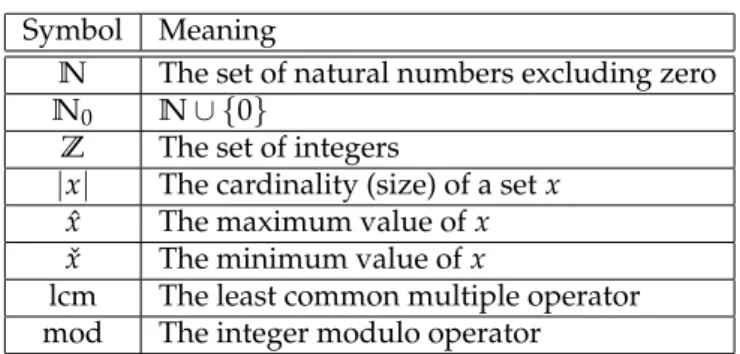
HIS chapter introduces the background necessary to understand thecontribution of this thesis presented in the following chapters. First, we give in Table 2.1 a summary of the mathematical notations used throughout the thesis. Then, we present the dataflow models considered in this thesis in Section 2.1, while some results from the hard real-time scheduling theory relevant for this thesis are presented in Section 2.2.
Table 2.1:Summary of mathematical notations
Symbol Meaning
N The set of natural numbers excluding zero N0 N∪ {0}
Z The set of integers
|x| The cardinality (size) of a setx
ˆ
x The maximum value ofx
ˇ
x The minimum value ofx
lcm The least common multiple operator mod The integer modulo operator
2.1
Dataflow Models-of-Computations (MoCs)
real-time scheduling framework proposed in Chapter 3. The SDF MoC is used to specify the input streaming applications in the techniques which exploit parallelism in streaming applications to maximize the resource utilization and minimize the energy consumption, presented in Chapters 4 and 5, respectively. The PPN MoC is used to specify streaming applications within the solution for highly accurate modeling of energy consumption, presented in Chapter 6.
2.1.1 Cyclo-Static Dataflow (CSDF)
An application modeled as a CSDF [BELP96] is a directed graphG= (𝒱,ℰ) that consists of a set of actors𝒱 which communicate with each other through a set of communication channelsℰ. Actors represent a certain functionality of the application, while communication channels are first-in first-out (FIFO) buffers representing data dependencies and transferringdata tokensbetween the actors. A data token is an atomic data object belonging to a stream of data transferred between the actors. We can associate each actorvi ∈ 𝒱in a
graph with two sets of actors, thepredecessors set, denoted by prec(vi), and the
successors set, denoted by succ(vi). These sets are given by:
prec(vi) ={vj ∈ 𝒱 :∃eu= (vj,vi)∈ ℰ } (2.1)
succ(vi) ={vj ∈ 𝒱 :∃eu = (vi,vj)∈ ℰ } (2.2)
In addition, we can define for each actorvi ∈ 𝒱in a graph two sets of
commu-nication channels, theinput set, denoted by inp(vi), and theoutput set, denoted
by out(vi). Theinput setcontains all the input channels tovi, while theoutput
setcontains all the output channels fromvi. If an actorvi receives an input
data stream from the environment thenvi is calledinput actor, andvi does not
have input channels, that is, inp(vi)=∅. Similarly, if an actorvi produces an
output data stream for the environment thenvi is calledoutput actor, andvi
does not have output channels, that is, out(vi)= ∅. Apath wi→jbetween actors
vi andvjis an ordered sequence of channels connectingvi andvjdenoted as
wi→j ={(vi,vk),(vk,vl),· · · ,(vm,vj)}.
Every actor vi ∈ 𝒱 has an execution sequence [Fi(1), Fi(2), · · ·, Fi(φi)]
of lengthφi, that is, it has φi phases. The kth time that actorvi is fired, it
executes the function Fi(((k−1)modφi) +1). As a consequence, the
ex-ecution time of actorvi is also a sequence [CiC(1), CiC(2), · · ·, CCi (φi)]
con-sisting of the worst-case computation time values for each phase. Simi-larly, every output channel eu of an actor vi has a predefined token
pro-duction sequence [xiu(1),xiu(2),· · · ,xui(φi)]of length φi. Analogously, token
se-2.1. Dataflow Models-of-Computations (MoCs) 19
[3,1,1]
υ
1[2,3]
[2]
υ
3υ
2[1,1,1] [1,0,0]
[1,1] [0,2]
[3] [1]
e
1e
2e
3Figure 2.1:A CSDF graph G.
quence[yui(1),yui(2),· · · ,yui(φi)], calledconsumption sequence. The total
num-ber of tokens on a channeleu produced byvi during its firstn invocations
and the total number of tokens consumed on the same channel by vj
dur-ing its first n invocations are Xiu(n) = ∑nl=1xui(((l−1)modφi) +1) and
Yju(n) =∑nl=1yuj(((l−1)modφj) +1), respectively.
Figure 2.1 shows an example of a CSDF graph. For instance, actorv1has 3
phases, that is,φ1 = 3, its execution time sequence (in time units) is[CC1(1),
CC
1(2),CC1(3)] = [3, 1, 1]and its token production sequence on channele1is
[1, 0, 0].
An acyclic CSDF graph can be partitioned into a number oflevels, denoted byL, in a way similar to topological sort. In that way, all input actors belong to level-1, the actors from level-2 have all immediate predecessors in level-1, the actors from level-3 have immediate predecessors in level-2 and can also have immediate predecessors in level-1, and so on.
An important property of the CSDF model is the ability to derive, at design time, a schedule for the actors. In order to derive a valid static schedule for a CSDF graph at design time, it has to be consistent and live.
Theorem 2.1.1(From [BELP96]). In a CSDF graph G, a repetition vector~q =
[q1,q2,· · · ,qN]T is given by
~q=Φ·~r, with Φjk =
(
φj if j=k
0 otherwise (2.3)
where~r= [r1,r2,· · · ,rN]Tis a positive integer solution of the balance equation
Γ·~r =~0 (2.4)
and where thetopology matrixΓ∈Z|ℰ |×|𝒱 |is defined by
Γuj=
Xuj(φj) if actor vjproduces on channel eu
−Yu
j (φj) if actor vjconsumes from channel eu
0 otherwise.
A CSDF graph G is said to be consistent if a positive integer solution
~r = [r1,r2,· · · ,rN]T exists for the balance equation, Equation (2.4). We call
~r aggregated repetition vector. The smallest non-trivial aggregated repetition vector~ris calledbasic aggregated repetition vector~r. Its corresponding repetition vector~qis called basic repetition vector~q. If a deadlock-free schedule can be found,Gis said to be live.
Definition 2.1.1. For a consistent and live CSDF graphG, anactor iteration is the invocation of an actorvi ∈ 𝒱 for qi times, a phase iteration is the
invocation of one phase of an actorvi ∈ 𝒱forri times, and agraph iteration
is the invocation ofevery actor vi ∈ 𝒱forqitimes, whereqi ∈~q, andevery phase
ofevery actor vi ∈ 𝒱 forri times, whereri ∈~r.
For the example CSDF graphG shown in Figure 2.1, we can compute
the basic repetition vectors~rand~qby using the equations in Theorem 2.1.1, namely, Equations (2.3), (2.4) and (2.5), as follows:
Γ=
1 −2 0
3 0 −3
0 2 −1
,~r= 2 1 2
,Φ=
3 0 0 0 2 0 0 0 1
, and~qˇ= 6 2 2 .
Two important subsets of the CSDF MoC are the Synchronous Data Flow (SDF) MoC [LM87] and the Homogeneous Synchronous Data Flow (HSDF) MoC [LM87]. All actors in an SDF graphG= (𝒱,ℰ)have only one phase, that is, for eachvi ∈ 𝒱,φi =1. In an HSDF graphG= (𝒱,ℰ), in addition to∀vi ∈
𝒱,φi =1, all channels have production and consumption sequences equal to
1, that is, for eacheu= (vi,vj)∈ ℰ,xui = [xui(1)] =1,yuj = [yuj(1)] =1.
2.1.2 Polyhedral Process Network (PPN)
An application modeled as a PPN [VNS07] is a directed graphG = (𝒫,𝒞) that consists of a set of processes 𝒫, which communicate with each other via a set of communication channels𝒞. Processes in𝒫 represent tasks of an application. Channels in𝒞are bounded FIFOs and represent one direction of data communication between two processes, that is, a channelCHl = (Pi,Pj)
represents a data dependency between processesPi andPj, wherePi is the
producer andPjis the consumer process. An example of a PPN consisting of 4
processes which communicate with each other through 5 channels is given in Figure 2.2(a). Each PPN process has a set ofinput portsit reads from and a set ofoutput portsit writes to. ProcessP3in the PPN example in Figure 2.2(a) has
2.1. Dataflow Models-of-Computations (MoCs) 21
P
1P
2P
3P
4 CH1 CH2 CH3 CH4 CH5IP1 IP2
IP3 OP1
OP2
(a)
1 for (i=1; i<=16; i++) { 2 for (j=1; j<=8; j++) {
3 READ(IP2, in2, size_d2);
4 if (j <= 3)
5 READ(IP1, in1, size_d1);
6 else
7 READ(IP3, in1, size_d1);
8 out = F(in1, in2); 9 if (i <= 12 && j <= 4) 10 WRITE(OP2, out, size_d1);
11 else
12 WRITE(OP1, out, size_d1);
} } CH2 CH3 CH4 CH5 (b)
Figure 2.2:Example of a PPN (a) and the structure of process P3(b).
processPiconnected to its input ports areinput channelsofPi, while channels
connected to the output ports ofPi areoutput channelsofPi.
The synchronization mechanism between the processes in the PPN MoC isblocking read from an empty FIFO andblocking write to a full FIFO. The execution of a PPN process is defined by using nestedfor loops, that is, the process execution is a set of iterations, calledprocess domain. The process domain is represented using the polytope model [Fea96a]. Each PPN process has a precisely defined structure: the process reads data from a subset of its input ports depending on the values of loop iterators; then, it performs a computation on input data that generates output data; and finally, the process writes the output data through a subset of its output ports depending on the values of loop iterators.
Figure 2.2(b) shows the structure of processP3in the PPN example given in
Figure 2.2(a). ProcessP3reads data from and writes data to channels through
read and write primitives READ(· · ·) andWRITE(· · ·), respectively. The computation behavior of processP3is represented by a functionF(· · ·) in Line
8 in Figure 2.2(b). The process domain of processP3is given as the polytope
DP3 = {(i,j)∈ Z
2 |1≤ i≤ 16∧1≤ j≤ 8}. Accessing an input port of the
PPN process is represented as a subset of the process domain, calledinput port domain. Similarly, accessing an output port of the PPN process is represented throughoutput port domain. Process P3 in Figure 2.2 reads data from input
to process domainDP3, while the input port domain of portIP1is given as
DIP1 ={(i,j)∈ Z2|1≤i≤16∧1≤j≤3}. ProcessP3writes data to output
portsOP1andOP2. Domain DOP2 = {(i,j)∈Z
2|1 ≤i≤12∧1 ≤ j≤4}is
the output port domain of portOP2.
2.2
Real-Time Scheduling Theory
In this section, we introduce the real-time periodic task model [DB11] and some important real-time scheduling concepts [DB11] instrumental to the approaches we present in Chapters 3, 4 and 5 of this thesis.
2.2.1 Task Model
The majority of the research on real-time scheduling considers a simple model to represent applications running on a hardware platform. In this simple model applications are modeled as a task set𝒯 = {τ1,τ2,· · · ,τn}ofnperiodic
tasks, which can be preempted at any time. A periodic taskτi ∈ 𝒯 is defined
by the 4-tupleτi = (Si,Ci,Di,Ti), whereSi is the start time ofτi in absolute
time units,Ciis the worst-case execution time (WCET),Diis the deadline ofτi
in relative time units, andTi is the task period in relative time units, where
Ci ≤ Di ≤ Ti. Each taskτi executes periodically through a sequence of task
invocations, that is,job releases, atsi,k =Si+kTi,k ∈N0. Once released, each jobτi,k,k∈N0, of a taskτi must executeCitime units beforesi,k+Di, that is,
the job must finish its execution before its deadlineDi. IfDi = Ti, thenτiis
said to have animplicit-deadline. Otherwise, ifDi < Ti, thenτiis said to have a
constrained-deadline. If all the tasks in a task set𝒯 are implicit-deadline periodic tasks, then task set𝒯 is animplicit-deadline periodic (IDP) task set. Otherwise, task set𝒯 is aconstrained-deadline periodic (CDP) task set. Similarly, if all the tasks in a task set𝒯 have the same start time, then task set𝒯 issynchronous. Otherwise, task set𝒯 isasynchronous. In this thesis, we consider asynchronous task sets.
The utilization of taskτi, denoted as ui, where ui ∈ (0, 1], is defined
as ui = Ci/Ti. For a task set 𝒯, u𝒯 is the total utilization of 𝒯 given by
u𝒯 = ∑τi∈𝒯 ui. Similarly, thedensity of taskτi is δi = Ci/Di and the total density of𝒯 isδ𝒯 = ∑τi∈𝒯 δi. The worst-case response time of taskτi, denoted asRi, is defined as the longest time interval from the arrival of a job of taskτi
to the completion of job’s execution.
2.2. Real-Time Scheduling Theory 23
and completed in the time interval[t1,t2], and is given by [BRH90]:
db f(𝒯,t1,t2) =
∑
τi∈𝒯max{0,jt2−Si−Di
Ti
k
−max{0,lt1−Si
Ti
m
}+1} ·Ci.
(2.6)
2.2.2 System Model
To present the important results from the real-time scheduling theory relevant for this thesis, we consider a system composed of a setΠ={π1,π2,· · · ,πm}
ofmidentical processors. However, our contribution approaches, presented in this thesis, are applicable to both homogeneous and heterogeneous MPSoCs, because the processor heterogeneity is captured within the WCET of a task, which will be explained in more detail in Chapter 5. Thus, the results presented in the following section, Section 2.2.3, are applicable to heterogeneous MPSoCs as well.
2.2.3 Real-Time Scheduling Algorithms
In this section, we present some important scheduling concepts for scheduling applications modeled as real-time periodic tasks, introduced in Section 2.2.1, on a system modeled as described in Section 2.2.2.
Real-time scheduling algorithms for multiprocessors try to solve two prob-lems [DB11]:
∙ Theallocation problem, that is, on which processor a task should execute.
∙ Thepriority problem, that is, when and in which order each job of a task should execute with respect to jobs of other tasks.
Depending on how they solve theallocation problem, scheduling algorithms are classified into:
∙ No migration. Each task is allocated to one processor and no migration is allowed.
∙ Task-level migration. The jobs of a task can execute on different processors. However, each job can execute only on one processor.
Depending on how they solve thepriority problem, scheduling algorithms are classified into:
∙ Fixed task priority. Each task has a single fixed priority shared by all its jobs. Examples of this class are the Rate Monotonic (RM) [LL73] and the Deadline Monotonic (DM) [LW82] scheduling algorithms.
∙ Fixed job priority. The jobs of a task may have different priorities, but each job has a single static priority. An example of this class is the Earliest Deadline First (EDF) scheduling algorithm [LL73].
∙ Dynamic priority. A single job may have different priorities during its execution. An example of this class is the Least Laxity First (LLF) scheduling algorithm [Leu89], [DK89].
A task set𝒯 isfeasibleon a systemΠif there exist a scheduling algorithm that can construct a schedule of tasks such that all task deadlines are met. A task τi ∈ 𝒯 isschedulableon Πby using a scheduling algorithm𝒜if its
worst-case response timeRiunder𝒜is less than or equal to its deadlineDi. If all tasks in𝒯 are schedulable onΠunder𝒜, then task set𝒯 isschedulableon Πunder𝒜. Finally, a scheduling algorithm𝒜isoptimalwith respect to a task model and a system if it can schedule all task sets that comply with the task model and are feasible on the system.
The real-time scheduling theory provides various schedulability tests to check a schedulability of a task set on a system under a given scheduling algorithm. A schedulability test is termedsufficientif all of the task sets that are deemed schedulable according to the test are in fact schedulable [DB11]. A schedulability test is termednecessaryif all of the task sets that are deemed unschedulable according to the test are in fact unschedulable [DB11]. Finally, a schedulability test that is both sufficient and necessary is anexactschedulability test.
2.2.4 Uniprocessor Schedulability Analysis
In this section, we will present the most used scheduling algorithms and their schedulability tests for real-time periodic tasks on uniprocessors. These scheduling algorithms are the Earliest Deadline First (EDF), Rate Monotonic (RM) and Deadline Monotonic (DM) scheduling algorithm.
Earliest Deadline First (EDF)
2.2. Real-Time Scheduling Theory 25
periodic task set on a uniprocessor under EDF can be verified through the processor utilization. In particular, the following theorem gives a schedula-bility test for an implicit-deadline periodic task set on a uniprocessor under EDF [LL73]:
Theorem 2.2.1. A set of periodic tasks𝒯 with implicit deadlines is schedulable under EDF if and only if
∑
τi∈𝒯ui ≤1. (2.7)
This schedulability test on uniprocessors under EDF isexact. In addition, the EDF scheduling algorithm is anoptimalscheduling algorithm for periodic tasks on uniprocessors.
The exactschedulability test for constrained-deadline periodic tasks on uniprocessors under EDF is given by the following lemma [BRH90]:
Lemma 2.2.1. A periodic task set𝒯 is feasible on one processor if and only if
1. ∑τi∈𝒯 ui ≤1, and
2. db f(𝒯,t1,t2)≤ (t2−t1)for all0≤ t1 <t2<Sˆ+2H,
whereSˆ=max{S1,· · · ,Sn}and H =lcm{T1,· · · ,Tn}.
However, this schedulability test is known to be co-NP-hard in the strong sense [BRH90], hence performing the schedulability test is very time con-suming. To improve, that is, reduce, the schedulability test time, researchers proposed severalsufficientschedulability tests for (asynchronous) constrained-deadline periodic tasks on uniprocessors under EDF, such as [ZB09], [AS04] and [BF05]. These algorithms either check smaller number of time points to determine the schedulability of a task set [ZB09] or approximate the proces-sor demand bound function to simplify the computation when checking the schedulability of a task set [AS04], [BF05].
Rate Monotonic (RM)
Theorem 2.2.2. A set of periodic tasks𝒯 = {τ1,τ2,· · · ,τn}with implicit deadlines
is schedulable under RM if
∑
τi∈𝒯ui ≤n(21/n−1). (2.8)
When the size of the task set is significantly big (n→∞), then∑τi∈𝒯 ui =
ln(2) u 0.693. That means that any implicit-deadline task set with total utilization less than 0.69 is schedulable using RM scheduling algorithm. It has been shown in [LL73] that RM is optimal among all fixed-priority assignments in the sense that no other fixed-priority algorithms can schedule an implicit-deadline task set that cannot be scheduled by RM. However, RM is in general not optimal on uniprocessors for real-time periodic task sets.
Deadline Monotonic (DM)
The DM algorithm [LW82] extends the RM algorithm by considering tasks with deadlines less than or equal to their period, that is,constrained dead-lines. According to the DM algorithm, higher priorities are given to tasks with shorter relative deadlines. The schedulability of a task set with constrained deadlines can be checked by using the utilization based test given by Rela-tion (2.8), where instead of putting the sum of task utilizaRela-tions on the left-hand side, we put the sum of task densities. However, such a test would be quite pessimistic, because the workload on the processor would be overestimated. A less pessimistic schedulability test has been proposed in [ABRW91], [ABR+93] based onResponse Time Analysis (RTA). That test is formulated in the following theorem:
Theorem 2.2.3. A periodic taskset𝒯 is schedulable using DM priority scheduling if and only if
∀τi ∈ 𝒯 :Ri ≤Di (2.9)
where the total response time Ri is given by solving the following fixed-point equation:
Ri =Ci+
∑
∀τj∈𝒯hp(τi)
Ri
τj
Cj (2.10)
and𝒯hp(τi)represents the set of tasks with priorities higher than the priority ofτi.
2.2. Real-Time Scheduling Theory 27
2.2.5 Multiprocessor Schedulability Analysis
Given a system consisting ofmhomogeneous processors, and a task set con-sisting ofnperiodic tasks, multiprocessor schedulability analysis should deter-mine whether the tasks can be scheduled on the processors. In the following subsections we will present some scheduling algorithms on multiprocessors with regard to how they solve the allocation problem, as introduced earlier in Section 2.2.3.
Global Scheduling Algorithms
Global scheduling algorithms schedule tasks on processors while allowing task migration. Some of these algorithms are optimalfor implicit-deadline periodic tasks, such as Pfair [BCPV96], LLREF [CRJ06], and SA [KS97]. In the case when these algorithms are used, anexactschedulability test for a set𝒯 of implicit-deadline periodic tasks onmprocessors is:
∑
τi∈𝒯ui ≤m. (2.11)
From Equation (2.11) the absolute minimum number of processors needed to schedule a set𝒯 of implicit-deadline periodic tasks can be computed as:
mOPT=
∑
τi∈𝒯ui
. (2.12)
In the case of constrained-deadline periodic tasks, there are no optimal online (nonclairvoyant) algorithms for the preemptive scheduling of these tasks on multiprocessors [Fis07].
Partitioned Scheduling Algorithms
Although global scheduling algorithms can be optimal for implicit-deadline periodic tasks, they introduce high migration and preemption overhead. To avoid these overheads, researchers proposed another class of scheduling al-gorithms, namely,partitionedalgorithms. As soon as a set of tasks has been
partitioned into subsets that will be executed on individual processors, the uniprocessor real-time scheduling and analysis techniques can be applied to each processor, which is the main advantage of using partitioning approaches to multiprocessor scheduling.
tasks, withx≤ m. The schedulablex-partition is a partition: 1) which subsets contain different tasks among each other, that is, a task is allocated to only one processor, 2) where all tasks are partitioned into subsets of tasks, and 3) that guarantees that each subset of the partition is schedulable on one processor under the considered uniprocessor scheduling algorithm.
The task allocation problem in a partitioned multiprocessor scheduling approach is analogous to thebin packingproblem [DB11], where items corre-sponds to tasks and bins correcorre-sponds to processors. The bin packing problem is known to be NP-hard [GJ79]. Therefore, many heuristics have been pro-posed to approximately solve the bin packing problem [Joh74], [CGJ96]. Below, we present the most used bin packing heuristics.
The capacity of each bin, that is, processor in a system, is equal to the maximum possible processor utilization, that is, 1. The size of each item, that is, taskτi, is equal to task utilizationui. Let𝒯kdenote the set of tasks currently
assigned to processorπk anduπk = ∑τi∈𝒯kui denote the total utilization cur-rently assigned to processorπk. At the beginning of the task partitioning no
task is assigned to a processor, that is, 𝒯k = ∅ anduπk = 0 for allπk. The heuristics assign each taskτi ∈ 𝒯 to a certain processorπk ∈Πfollowing a
certain, heuristic-specific, rule till the task is schedulable on a processor by a certain (selected) scheduling algorithm𝒜, considering one task at a time.
∙ First-Fit (FF).A taskτiis assigned to the lowest-indexed processorπk
that can contain the task such that all the tasks assigned so far toπkare
schedulable. That is
k= min
j∈[1···m]{j:ui+uπj ≤1∧ 𝒯jschedulable by𝒜onπj}. (2.13)
If the condition is not satisfied by any processor used so far, taskτiis
assigned to an unused processor in the platform. If no such processor exists, task set𝒯 is not schedulable on systemΠ.
∙ Best-Fit (BF).A taskτi is assigned to a processorπk such thatπk has
the minimal remaining utilization after the task assignment and all the tasks assigned so far toπkare schedulable. That is
k= min
j∈[1···m]{j:ui+uπj is closest to, without exceeding 1
∧ 𝒯jschedulable by𝒜onπj}. (2.14)
If the condition is not satisfied by any processor used so far, taskτiis
2.2. Real-Time Scheduling Theory 29
∙ Worst-Fit (WF).A taskτiis assigned to a processorπksuch thatπkhas
the maximal remaining utilization after the task assignment and all the tasks assigned so far toπkare schedulable. That is
k = min
j∈[1···m]{j : ui +uπj is minimal∧ 𝒯j schedulable by𝒜onπj}.
(2.15)
If the condition is not satisfied by any processor used so far, taskτi is
assigned to an unused processor in the platform. If no such processor exists, task set𝒯 is not schedulable on systemΠ.
Often a preprocessing step is performed on tasks before performing a heuristic to improve the performance of the heuristic. The preprocessing step represents task sorting according to certain criteria, such us, increasing or decreasing task utilization, increasing or decreasing task density, and so on. Usually, the tasks are sorted in decreasing order of their utilization. When adding this preprocessing step to the previously presented partitioning heuris-tics, we obtain the First-Fit Decreasing (FFD), Best-Fit Decreasing (BFD), and Worst-Fit Decreasing (WFD)heuristics.
The partitioning heuristics can be compared among each other by using theirapproximation ratiometric. The approximation ratio of a heuristic says how much more processors are required to schedule a set of tasks when tasks are partitioned by using the corresponding partitioning heuristic in comparison to an optimal partitioning algorithm. For example, the approximation ratios for FF and BF are 17/10 [CGJ96], [GJ79], while approximation ratio for FFD is 11/9 [Yue91].
The minimum number of processors needed to schedule a task-set𝒯 by a partitioned scheduling algorithm is given by:
mPAR=min
x∈N{x|∃x-partition of𝒯 ∧ ∀k∈[1,x]:𝒯kis schedulable onπk}. (2.16) Note thatmOPTis the lower bound on the number of processorsmPARneeded
by partitioned scheduling algorithms.
Hybrid Scheduling Algorithms
scheduling approaches, researchers proposed hybrid approaches which com-bine elements of both. Hybrid scheduling approaches can be divided into semi-partitioned and clustering (hierarchical) approaches [DB11].
In the semi-partitioned scheduling approaches, a small number of tasks is allowed to migrate between certain processors to utilize better the processing resources. Examples of semi-partitioned scheduling algorithms which split some tasks into two components that execute at different times on different processors are EKG [AT06], Ehd2-SIP [KY07] and EDF-fm [ABD08].
Chapter 3
Hard Real-Time Scheduling
Framework
Jelena Spasic, Di Liu, Emanuele Cannella, Todor Stefanov, “On the Improved Hard
Real-Time Scheduling of Cyclo-Static Dataflow”,ACM Transactions on Embedded
Computing Systems (TECS), vol. 15, Issue 4, Article 68, August 2016.
Jelena Spasic, Di Liu, Emanuele Cannella, Todor Stefanov, “Improved Hard Real-Time
Scheduling of CSDF-modeled Streaming Applications”,In Proceedings of the
IEEE/ACM/IFIP International Conference on HW/SW Codesign and System Synthesis (CODES+ISSS’15), pp. 65–74, Amsterdam, The Netherlands, October 4-9, 2015.
I
N this chapter, we present a scheduling approach to provide timing guar-antees for streaming applications mapped on MPSoCs. In particular, we describe in more detail our solution approach, introduced in Section 1.4, to the research problem,Problem 1, described in Section 1.3.3.1
Problem Statement
Recently, the authors in [BS13] proposed a framework to schedule streaming applications modeled as acyclic CSDF graphs as a set of real-time periodic tasks on an MPSoC platform. They also derive the minimum number of processors needed to schedule the applications on a platform. However, in that framework, the authors use one and the same worst-case execution time (WCET) value for all execution phases of a task in the CSDF graph, although a task in the CSDF graph may have a different WCET value for every phase. The authors simply take and use the maximum WCET value among the WCET values for all phases of a task. By doing this, the cyclically changing execu-tion nature of an applicaexecu-tion modeled by the CSDF model is hidden, which leads to underestimation of the throughput, overestimation of the latency, and underutilization of processors. In another recent work [BMKdD13], the authors proposed a framework to evaluate a lower bound of the maximum throughput of a periodically scheduled CSDF-modeled application. However, the authors do not provide a method to determine the number of processors required for scheduling the application. Moreover, their approach does not ensure temporal isolation among applications, that is, the schedule of appli-cations has to be recalculated once a new application comes in the system and hence it may be possible that the previously calculated throughput of an application can no longer be reached. Thus, in this chapter, we investigate the possibility toschedule streaming applications modeled as acyclic CSDF graphs as real-time periodic taskson an MPSoC platform while consider-ing different WCET values for task’s phasesin an acyclic CSDF graph and providing temporal isolation of applications and hard real-time guarantees.
3.2
Contributions
In order to address the problem described in Section 3.1, we propose a schedul-ing approach which contributions are summarized as follows:
∙ We prove that considering a different WCET value for each execution phase of a task we can convert the execution phases of each task in an acyclic CSDF graph to strictly periodic real-time tasks. This enables the use of many hard real-time scheduling algorithms to schedule such tasks with a certain guaranteed throughput and latency. (Theorem 3.5.2)
![Figure 2.1 shows an example of a CSDF graph. For instance, actor v 1 has 3 phases, that is, φ 1 = 3, its execution time sequence (in time units) is [ C C 1 ( 1 ) , C 1 C ( 2 ) , C 1 C ( 3 )] = [ 3, 1, 1 ] and its token production sequence on channel e 1 is](https://thumb-us.123doks.com/thumbv2/123dok_us/8243869.2184708/38.748.260.535.140.279/figure-example-instance-execution-sequence-production-sequence-channel.webp)