Michael T. Peper. The Effect of Remote Storage on the Use of Books. A Master’s Paper for the M.S. in L.S degree. April, 2008. 41 pages. Advisor: Barbara B. Moran
Remote storage has become an increasingly popular response to the overcrowding of open-stack areas in academic libraries. While many institutions have chosen this option and there has been much discussion about administration of such facilities, its impact on patrons is still unclear. Some potential user limitations of remote storage considered by this study are delayed retrieval, loss of browsability, and the barrier of making a retrieval request.
The current study was conducted at the Chemistry and Art Libraries at the University of North Carolina at Chapel Hill. It observed the use of materials that had been selected for transfer to remote storage, where half of these selected materials were transferred to remote storage and the other half remained on open library stacks. After an average of approximately two months of observation, none of the selected books had circulated, suggesting that their selection for remote storage was appropriate.
Headings:
Storage of books, periodicals, etc.
THE EFFECT OF REMOTE STORAGE ON THE USE OF BOOKS
by
Michael T. Peper
A Master’s paper submitted to the faculty of the School of Information and Library Science of the University of North Carolina at Chapel Hill
in partial fulfillment of the requirements for the degree of Master of Science in
LibraryScience.
Chapel Hill, North Carolina April 2008
Approved by
Table of Contents
Introduction ... 1
Remote Storage Issues ... 2
The State of Usage of Print Materials ... 4
Principle of Least Effort... 8
Context of the Current Study ... 9
Importance and Implications of the Research ... 10
Research Question ... 11
Literature Review... 12
Loss of Browsability ... 12
Effect of Delayed Retrieval ... 13
Effect of Request Requirement ... 14
Methodology ... 17
Use of Circulation Data ... 18
Method Rationale ... 20
Discussion of the Method’s Merits ... 21
Ethical Issues ... 22
Sample Population and Materials Selection ... 23
Data Collection ... 27
Data Analysis ... 27
Results and Discussion ... 28
Discussion of Study Results ... 28
Suggestions for Further Research ... 30
Summary and Conclusion ... 32
Bibliography ... 35
Introduction
There are many factors that contribute to the popularity of the use of remote storage space for print materials. Many libraries have redesigned their physical space to be a “destination place” rather than a place to house a collection. Stacks have been replaced with comfortable furniture, computer labs and coffee shops. Concurrently, the quantity of published materials has increased, with correspondingly greater space
demands. The third factor has provided some resolution to the conflict created by the first two factors listed above. This is the steady migration of materials from print to electronic format.
In libraries, and certainly in academic environments, however, there is still a sense of “knowledge preservation,” which compels institutions to create repositories for print materials. Presently, many publications are not available in an electronic format (especially literature published prior to 1995 or so), and researchers searching for these materials are dependent upon access to print materials to conduct a comprehensive survey of the literature.
item from remote storage, and the item is delivered to the public area of the library 24 to 72 hours following the request.
As some of the central terms of this study are not always used precisely by practitioners, the current study will use them interchangeably. Common terms used to describe the concept of remote storage include “remote,” “off-site,” “closed,” and “inaccessible.” This study does not intend any negative association with any of these terms by seeming to suggest that “closed” stacks are attempting to block users from access to these materials.
Remote Storage Issues
Despite the focus on user interests and behavior for this study, it is still important to understand the general issues and concerns related to remote storage facilities. Most of the literature written about various issues related to remote storage facilities often has been only peripherally concerned with their impact on users (Hanzen 2000, Agee and Naper 2006, Seaman 2003). O’Connor’s (1994) extensive bibliography of remote storage facilities is one excellent example of this type of literature. The headings in the
bibliography are “The Classical Studies,” “Planning the Storage Facility,” “Selecting Materials for Storage” and “Implementing the Storage Program.” While one would hope that functions such as facility planning and item selection would aim to optimize patron benefit, this objective is often not explicit, and the focus is on the facility systems and not on its impact to the users’ work.
Harvard University in 1902 illustrates how many of this issue’s current questions are still unresolved after more than one-hundred years. At Harvard, the university's president insisted that he was not “proposing a crematorium for dead books”, while the university librarian worried about the physical treatment of volumes as well as their accessibility (185). This case illustrates the continuing tension between those that believe that remote storage is an integral part of a collection and those who feel that materials moved to remote storage are no longer truly accessible to users.
Periodic building booms during economic prosperity, such as in the 1960s, allowed institutions to create additional library shelving areas. This allowed libraries to keep materials primarily in open-stack areas and avoid the question of remote storage. By the 1980s, however, many institutions reached the capacity of their on-campus facilities and other options became necessary. Some institutions built on-campus closed-access facilities, but these were exceptions to the rule of high-density, climate-controlled, remote units such as the Harvard Depository or the North California Regional Facility (186). Even though trends may be observed, the variety of facilities suggests that no one option has emerged as the ideal for all cases.
Others, however, have proposed alternate motivations for employing a remote storage facility. Hanzen (2000) discussed the motivation to remotely store materials, including the rationalization of physical space in the library, preservation of materials due to climate control, less handling, etc. and as a way to facilitate cooperative arrangements. This enumeration conspicuously contradicted Block's assertion that economic necessity is and has historically been the only reason to store materials off-site.
Hanzen included no discussion of the economic merits of remote storage. Instead, he discussed the methods of successful remote storage projects, paying special attention to the criteria for selecting items for remote storage including practical guidelines for this process. He stressed the importance of consulting users in making decisions and
considering their behavior as part of these decisions. He placed special emphasis on the political ramifications of this process and the importance of securing user support for any venture with significant impact on a collection.
Hanzen’s study looked beyond the details of selection decisions and facility design to examine how the entire process affected library services. The key point of his analysis was that bibliographic access and control is essential for materials to be
continually available and a reliable resource for patrons. He concluded by addressing the disadvantages of loss of direct physical access to collections. He described these as "hurdles" for users and suggested tactics to minimize this problem.
The State of Usage of Print Materials
electronic resources are also available. This aspect is important as many remote storage selection decisions are informed by electronic availability.
Brady, McCord, & Galbraith (2006) were concerned with the relationship between print and electronic usage, and especially the effect of the introduction of electronic journals on the use of the corresponding print version. This 2006 publication was a continuation of the research first reported in a previous 2004 publication
(Siebenberg, Galbraith, & Brady 2004). The 2004 article counted “accesses” to journals in the fields of chemistry, physics and materials engineering in 1998, when there were no holdings of electronic journals at Washington State University, and 2001, after electronic journal subscriptions had begun. The 2006 publication includes counts from 2003 to further track the trend.
The authors found that print usage increased between 1998 and 2001 with the introduction of electronic journals. In the following years, however, they identified a “cultural shift”, which transferred electronic resources the overwhelming share of journal usage in these subject areas. The portion of journal usage belonging to electronic journals rose from 0% in 1998 to 71% in 2001 to 94% in 2003. In addition, print usage no longer rose, but instead dropped dramatically between 2001 and 2003, with usage in 2003 only 37% of that in 2001(Brady et al. 356). This shift seems to reinforce the notions of many practitioners that journal use is largely coming from electronic formats.
The authors highlighted a few interesting limitations of the study. They cite a 2003 study by Obst, which suggested that statistics for print journals may have
subscriptions in favor of collecting electronic formats. Of the journals considered for this study, only 45% were available in print format, compared to 94% which were available in electronic format (360). Format comparison is problematic if availability or access is limited for one format but not the other. In the final paragraph the authors speculated that use patterns may change as libraries convert from a model of immediate, open access to print materials to one where materials are kept remotely and delivered for a specific use (363).
Tyler and Zillig (2003) mainly addressed the issue of how age of a given material affects the use of print materials. The study was conducted at the University of Nebraska at Lincoln, where the authors moved print volumes published prior to 1980, which were available in electronic format through JSTOR. The limitations of Brady et al. were further compounded, however, in this case, by the use of circulation statistics as the measure of print journal usage. The authors stated that there may have been much
additional use of journals that did not involve circulation. The results, however, showed a progression of decreasing circulation for older materials. With one exception, “each decade’s journals produced as a group around one-half as many circulations each year as the next decade’s” (21).
possibility that users could not access the journal on the stacks, were unaware of availability through JSTOR and whose attempts to access the journal were ultimately unsuccessful.
It is also important to understand how print and electronic resources may be used for different tasks and in different ways. While their stated aims of Sathe, Grady, & Giuse (2002) were to investigate the implications of electronic journals, they did so by
examining the different purposes for which patrons used print and electronic journals. This is of great interest when investigating the continuing use of print materials when an online equivalent is available. The study method was to conduct a “print-use” and “electronic-use” survey at the Biomedical Library at the Vanderbilt University Medical Center. Fifteen “high-use” journals were available only from the circulation desk. A survey was given to all those requesting print volumes of the selected journals. The electronic-use surveys were distributed from 9:00 a.m. to 5:00 p.m. to “random” patrons on library computers who appeared to be searching for or reading electronic journals.
Principle of Least Effort
The principle of least effort has been an influential idea within library and
information science, but it was first formally articulated by linguist George Kingsley Zipf in his 1949 book. In this book, Zipf defines least effort “as meaning that each individual will adopt a course of action that will involve the expenditure of the probable least average of his work.” This principle has been largely embraced by librarians as a formalization of their professional observations.
An editorial by Bierbaum in 1990 even called for this principle to become the unifying principle of the discipline of library and information science. She suggested that this model had been observed by professionals for a long time without being formally expressed. Additionally, she cited Poole’s 1985 work which was a “content analysis of journal articles about the information behavior of scientists.” Forty-three of the 51 studies included in the analysis “directly exemplified least effort and pain avoidance.”
More recently, Liu and Yang (2004) surveyed multidisciplinary distance learners at Texas A&M University to investigate their resource selection behavior. Users were asked to rate 16 criteria on a four-level scale for importance when selecting an
Context of the Current Study
This study was conducted at the Academic Affairs Library (AAL) at the
University of North Carolina at Chapel Hill (UNC). This library system is composed of the main library (Davis), the House Undergraduate Library, special collections housed within Wilson Library as well as several departmental libraries scattered across the university campus, such as the Chemistry Library and the Art Library.
Remote storage of print materials has become an increasingly popular collection management option at the AAL. The primary purpose of the Wilson Library Annex is to store library materials. As materials are sent from open-stack areas to make room for new materials, they are sent to this storage area, which is remote from the original collection, but is still technically on-site because it is on the campus of UNC. In 2006, the AAL began leasing space in the Library Service Center, owned by Duke University. This removes materials an additional degree from their original place on open shelves, as they are no longer on UNC’s campus.
Importance and Implications of the Research
Some of the many factors that have contributed to the increasing use of remote storage for print materials have been discussed above. Remote storage has become a very common solution to the problem of space limitations in libraries. The importance of the current study is its focus upon the impact of this trend on library users. Users are essential enough to the practice of librarianship to be the first in Ranganathan’s (1931) laws of Library Science, some of the founding principles of the discipline. This law stated simply, “Books are for use.” While this law seems obvious, its simplicity should not obscure its continued importance to librarianship. Decisions regarding library materials should consider the effect of such decisions on those who use the materials. As such, this study placed the question of remote storage in the context of users.
More specifically, this study attempted to discover more about how certain barriers affect users’ assessment of resource utility. It considered barriers of geography, time and effort that separate users from their information needs. Practically, the
In addition to the practical considerations discussed above, the field may gain new understanding of this topic on a higher level. The study provides insights into the
importance of geographic barriers on users’ utility assessments and how this barrier affects users’ information retrieval behavior. Finally, it is also important that library industry vendors are able to design products and services that meet their customers’ needs. Storage retrieval systems should reflect the needs of library users and this research informs what users need and expect from such systems.
Research Question
The practical problem that this research attempted to address is that libraries have made decisions about the remote storage of print materials with an incomplete
understanding of the effect of these decisions on users. This effect likely depends on the time considerations of researchers for a given project as well as user expectations of storage retrieval systems. Other factors impacting users’ interaction with remote storage are the importance of browsing physical volumes, the effect of delivery delay and the barrier of a storage retrieval request process.
Literature Review
There has been little research investigating the research questions of the current study. Remote storage systems have been discussed in detail, but there is still uncertainty about how these systems affect use of library materials. This review of relevant literature focuses upon the key elements that may affect this question: the loss of browsability, the effect of delayed retrieval, and the effect of a request requirement to retrieve materials. Loss of Browsability
The issue of browsability was discussed in an article reporting the views of users about a compact shelving installation in an open-stack environment (East 1994). This study predates the mass migration to electronic formats, but is still valid as the primary relevant issue of limitations on browsing print materials is not likely to have significantly changed for users. Similar to the studies on remote storage facilities, East spent
significant time discussing the planning and construction of the facility. The concerns at the focus of the study were “patron reactions to reduced browsing capability, delay in retrieval of material, and difficulty in learning how to use the new form of shelving.”
being in the stacks, and what they liked and disliked about the shelving. Because only three of the useful 69 questionnaires were completed by non-students, the results of the study were generalizable only to graduate and undergraduate students.
Limited browsing was one of the primary concerns for the planning committee, but the survey instrument did not directly address this issue, so its importance was somewhat unexplored. However, two open-ended responses did address this aspect as one patron mentioned that his/her “initial reservation” was related to the limitation on browsing, while another patron stated that his/her greatest dislike of the installation was that one doesn’t “feel free to browse anymore for fear of getting in someone’s way.” The issue of browsability seems anecdotally important for this patron group, but the lack of direct question about this issue suggests additional study.
Effect of Delayed Retrieval
The East study investigated the issue of delay as well. Looking at graduate students alone (n=30), 80% of them reported being inconvenienced or delayed by the compact shelving installation in the past four months. In addition, 40% of graduate students reported being inconvenienced or delayed six or more times during the four month period. Subjects rated their satisfaction on a five-point scale, and 66% of graduate students rated their satisfaction in the top-three marks of that scale despite the level of delay listed above. This is not an overwhelming rate of satisfaction, but there were certainly graduate students who experienced delay – often regularly – who still expressed an overall satisfaction with the installation. When asked about the features of the
patrons dislike being delayed, but its impact on their research behavior or resource use is not clear.
Curl (2004) researched within the context of a four-college consortium within a state-wide storage consortium. Within this environment, the study tested two main questions. 1) Is it possible for libraries to decrease delivery time through improved operations? 2) Is it necessary to improve delivery time in order to increase patron satisfaction? To address the first question, circulation supervisors were interviewed and asked to estimate the staff time spent on incoming loan requests and to analyze the workflow involved in fulfilling these requests. For the second question, faculty and senior-class undergraduate students were surveyed about their awareness and use of a patron-initiated borrowing system and their perceptions of the current system’s delivery time and their corresponding satisfaction with the system. The study found that
respondents had high awareness of the system and generally positive feelings about its speed, but that they would have higher levels of satisfaction with reduced delivery time. The results of the interviews suggested, however, that delivery time could not realistically be reduced throughout the consortium.
Effect of Request Requirement
Requiring patrons to make a request to a library system for print materials places an additional burden on patrons. There has been little research to investigate the effect of this barrier on user behavior. Two studies discussed above mention this aspect of the research question and suggest the need for further study. The study done by Sathe et al.
on the strengths and use of print and electronic formats created an experimental
open-stack area were placed behind the service desk. This caused a short delay in retrieval as well as forced the patron to make a request before retrieving the item. The authors state that “changing the way patrons accessed journals by removing them from their usual locations resulted in drastic changes in the number of uses” (237). They also list this invasive experiment as a study limitation which may have affected user behavior, saying “though we received just one complaint during the study, we might have lost regular print or electronic browsers or alienated patrons who did not elect to request journals at the circulation desk” (241).
Tyler and Zillig studied the use of print journals as they age. Their study made assumptions that do not appear to have been tested. They assumed that patrons were aware of JSTOR, would seek assistance or would file erroneous ILL requests (23). The study did not investigate the possibility that patrons would simply give up on a given resource if forced to request material to retrieve it. Further research is required to see how the request act can impact the use of materials.
material. One key flaw in the study’s methodology, which was acknowledged by the authors, is that a given volume will become less sought as it ages, which could explain some of the decrease in use after its move to remote storage.
Methodology
This study observed the use of print materials, in both a remote storage location and on open stacks. The environment for the study was the Academic Affairs Library at the University of North Carolina at Chapel Hill. The research observed circulation of a selected portion of the collections of the William Rand Kenan, Jr. Chemistry Library and the Joseph Curtis Sloane Art Library (references to the two libraries may appear simply as “Chemistry” or “Art”). These are two of the branch libraries that operate in remote locations on the university’s campus apart from the main library, Walter Royal Davis Library. These two collections were chosen to provide a contrast of patron groups and materials between a physical sciences and a fine arts collection.
spectroscopic data, etc. are also highly valued.
The Art Library is located in Hanes Art Center, an academic building of the Department of Art. The previous head of the library retired during the summer of 2007 and the new head arrives in May 2008. Like Chemistry, the Art Library is staffed by one full-time paraprofessional staff member, three graduate assistants and several
undergraduate student workers. Patrons of this library utilize a wide variety of materials for their research, but generally, they utilize books and materials that do not age as quickly as those for the discipline of chemistry.
Broadly defined, this study observed the circulation of print books that had been selected for remote storage in each of these two libraries. Once selected for storage, approximately half of the volumes in each location were moved to the storage location in Wilson Library Annex and half remained in their original location on the open shelves of their respective library. After their selection, the use of each group of materials was observed by tracking the circulation of volumes from each group.
This was an experiment where the items under observation were controlled, but the subjects of the study (the users) were not. The subjects for the study were anyone who used materials in the Chemistry or Art collections. The study was not interested in
observing any characteristics or behavior of the patrons besides their request or circulation of the selected items. It was hoped that the circulation would measure the effect of the movement of print materials to remote storage locations on patrons’ use. Use of Circulation Data
analysis as being “one of the traditional approaches to use studies and collection evaluation in libraries.” Additionally, they cite a 1984 Wiemars Jr. et al. publication, stating that a high level of circulation indicates an active and functioning collection because patrons’ information needs are being met. Their study observed the interaction and competition between print books and e-books and assessed the use of each format. The authors used circulation data as a way to suggest the utility of each format to users. One weakness of this method noted by the authors is that it does not consider in-library use; the authors cite a study done at Fresno State University that suggests that there is approximately one in-library use for each circulation. This reality is an important
consideration for the current study because these in-library uses are impossible for items that are relocated to storage.
Knievel, Wicht, & Connaway (2006) used extensive ILL and circulation data to assess the quality and activity of various subject collections at the University of Colorado at Boulder. While the objectives of their study were dissimilar to those of the current study, their method suggests that circulation data can be an important indicator of the utility of library materials.
Morris study does suggest an opportunity to enhance catalog records for stored materials to increase utility and access despite their remote location.
Method Rationale
To discuss the appropriateness of the current research method, it is illustrative to consider the approaches of previous studies. Others have examined the question of closed-stack arrangements (Ajayi 2003, East 1994), satisfaction with patron-initiated borrowing requests (Curl 2004), and journal usage patterns (Sathe et al. 2002) by survey method. This method is limited for this subject because social desirability could
encourage patrons to want to appear respectful of library policy or library materials. In the same way, patrons might want to present themselves as serious researchers not deterred by any delay or inconvenience while searching for information (Babbie 250). The method of the current study avoided any subject awareness of the study by being unobtrusive, ensuring that subjects behave “normally.” The method of Hill et al. (2000), which used the most similar method to that of the current study, measured use of the same materials at two different times – before and after being moved to remote storage. The current study measured the use of similar materials, at the same time, and at the same stage in their life cycle. In doing so, it mitigated the maturation of materials during the study period, the most problematic element of the Hill study.
treatment from the research. The final merit of this method is that it did not deviate much from current library practice and workflow. The conditions which existed for this
research were exactly as they would have been in the “real world” of the UNC Library system, and library staff did not substantially alter their work behavior.
Discussion of the Method’s Merits
There are some disadvantages to the method which do not involve the study’s validity or reliability, but which may limit its usefulness. The first was the uncertainty regarding the amount of circulation during the study period and consequently the amount of data available for comparison. All materials selected for remote storage from each library had low use and were selected for storage on this basis. Additionally, the sample was somewhat small and the study period was certainly abbreviated. If there had been more time to conduct this research, a larger sample of books could have been selected and the period of observation could have been extended.
waiting for the delivery of the item. This study could not have explained why use was affected by location.
In terms of internal validity, however, there were very few problems with this method. Because the subjects of the observation were not aware of the study, none of the problems of maturation, mortality, compensatory rivalry, etc. affected the results. The sole concern for internal validity was bias in the selection of the materials. It is hoped, however, that the random assignment of materials to one group or another minimized any bias.
In addition, external validity should be strong for this study because it was taking place in the natural environment. It simply observed normal patron behavior for each of the libraries. The only limitation was that the materials were limited to the subject areas inherent in the collections of these two libraries, but this shortcoming is obvious to all readers and they may consider its potential limitations.
Finally, this method has both advantages and disadvantages in terms of reliability. The limited time and sample of books both decrease the reliability of the study. If the study were allowed to continue over a longer period of time or with a larger selection of books, it might yield different results. The measurement, however, is not impacted by subjectivity or complexity. The measurement of use in this case was very straightforward and would be expected to be replicated in any similar study.
Ethical Issues
circulate were not pertinent information. Therefore, no patron information was disclosed as a result of this study. In addition, there could be some concern among authors or publishers of any of these materials to be associated with unpopular or unused materials because of their lack of circulation in these two libraries. To further avoid this issue, no data on specific book titles were revealed for this study, especially since it is immaterial to the research question.
The final ethical concern for this study was that the circulation data could somehow be artificially and intentionally manipulated. It was possible for someone to check out the books selected for this study to alter the results of this study. Because the author did not wish to investigate patrons using each material, there was no way to monitor this possibility. The motivation for this kind of manipulation was unclear, however, so the author simply assumed that this type of action did not take place. Sample Population and Materials Selection
While the current study measured users’ behavior, there was little attention paid to selection of the sample population. Users of each of the collections were “observed” in this method, but the study did not control these groups. Rather, the probable users of the selected materials were those of the library collections generally. Users of these materials could have been anyone with UNC Library borrowing privileges, including students, faculty or staff of any department at UNC, affiliates from North Carolina State
The selection of books to be included in the study was a more exacting and precise process. Each library has unique, if similar, criteria for selecting books for remote storage. These respective processes continued during the study without influence from the researcher. Chemistry selected books that had not circulated in the past ten years, without separating multi-volume sets. Art used the same initial past use criteria, but additionally, the Library Technical Assistant (LTA) and a graduate student formally inspected each volume for its potential use based on their informed opinion. During this study, Chemistry and Art selected books from various subject areas within their
respective collections.
Each library typically made approximately 40 selections for remote storage each week, although this number varied. After selections for remote storage had been made by the staff of each library, the researcher used a random number generator to assign each of the volumes to either the “shelf group” (books to remain on open stacks in their original location) or the “storage group” (books to be sent to remote storage as usual). The books were assigned to groups by randomization because the sample was expected to be quite large (around 600 books in total), because probability statistics are ideally designed for randomization and because there was little knowledge of the key variables that could have determined use (Babbie 228). To emphasize, both the books in the storage group and the shelf group were selected for storage by library staff (and were presumed to be of equal value to patrons) and the researcher randomly assigned each volume to either the shelf or storage group.
since this number uniquely identified each item with consideration to volume number, copy number, etc. No two physical items have identical barcodes. There were four groups in the study: Chemistry-Shelf, Chemistry-Storage, Art-Shelf, Art-Storage. All this
information, and the date that the books were selected were included in the documentation for the study.
At this point, those in the shelf group in both libraries were re-shelved on open stacks according to their call number. Those in the storage group in the Chemistry Library were processed by the Chemistry LTA and their catalog records were changed to reflect their new location in remote storage. The LTA then processed the books
physically and shelved the items in the remote storage facility in Wilson Library Annex. In Art, the books were sent to the Catalog Management Department of UNC Library where they were processed, their catalog records were updated and they were shelved in the remote storage facility by the staff of the Circulation Department of Davis Library. Typically this process was completed in both libraries in one business week.
The goal to select 600 titles was determined solely by the possibilities within the limitations of the study. Selections began at the end of November 2007 and ended at the end of January 2008.
randomly assigned to the shelf or storage group, but some that were selected for the storage group were not included in the study.
CHEMISTRY ART
SELECTION Shelf Storage Shelf Storage
11/30/07 53 54
12/03/07 110 92
12/07/07 16 16
12/14/07 24 23
12/17/07 33 29
01/18/08 46 47
01/25/08 40 37
TOTAL 143 121 179 177
Chemistry Total: 264 Art Total: 356
Shelf Total: 322 Storage Total: 298 Overall Total: 620 Figure 1: Book selections for each library and experimental group
Data Collection
Data collection was a straightforward task. After selecting books for either the storage or shelf group, the sole measurement of use for this study was circulation. The integrated library system used by UNC Library, Millennium, includes data on many aspects of library materials, including circulation. Collecting circulation data involved searching for an item by its barcode and recording any circulation during the study period. This was done for all books included in this study, in both shelf and storage groups in both libraries. The author recorded statistics during the study period only once, at the end of the study period, on March 3, 2008.
Data Analysis
Because these materials were all “low-use” and there was not likely to be high circulation during the study period, there was no need to analyze circulation at the title level. The study would have used univariate analysis, with the circulation data as the single variable in the study. In addition, subgroup comparison would have been made between Chemistry and Art to see if there was any observable difference between the use of the two collections.
NOTES
1
Results and Discussion
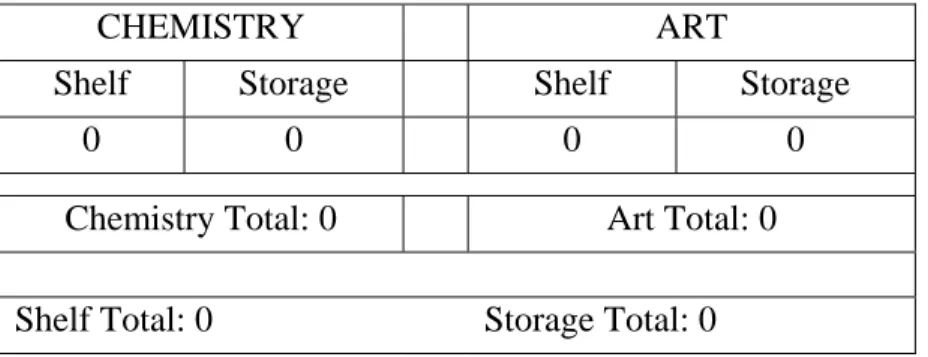
As stated above, the researcher collected circulation data for all books selected for this study on March 3, 2008. As of this date, none of the books had circulated during the study period. That is, none of the books on the shelf that were included in the study were checked out by a library patron. In addition, none of those sent to remote storage were requested for retrieval and checked out by a library patron. The results are summarized in Figure 2 below. As such, no analysis of the data was done. Nevertheless, this does not mean that nothing was learned through the study and a discussion of the findings follows below.
CHEMISTRY ART
Shelf Storage Shelf Storage
0 0 0 0
Chemistry Total: 0 Art Total: 0
Shelf Total: 0 Storage Total: 0
Figure 2: Circulation for each library and experimental group Discussion of Study Results
least 10 years old and low-use. The results could have been different in a context with newer, higher-use materials and might have been different if journals or other materials had been considered.
That said, the discussion will continue within the context of the current study. While it is impossible to compare use of the two groups of books under observation, the results suggest that leaving these items on the shelf would not have increased their use. The study did not observe any difference between the use of materials on the shelf and those in remote storage.
Two studies from the literature review observed a trend towards diminishing print usage. Brady et al. discussed the new environment of journal use in which they observed a “cultural shift” with the majority of use changing from print to electronic formats. Tyler and Zillig in 2003 found that this shift was greater with older materials. This new
environment, coupled with the result of the current study, suggest that print usage, especially for older materials, is diminishing. In this context, it may be possible for librarians to more confidently send low-use print materials to remote storage.
In addition, the study suggests UNC library staff have been making good choices in selections for remote storage. Although the study period was brief, the current study suggests that the characterization of the selected items as low use is accurate. There was
Suggestions for Further Research
In addition to these conclusions, this study has been instructive in terms of future research that could help to answer the research question. A review of the literature on this topic suggested that there was more to learn about how remote storage affects users. The large number of case studies about remote storage projects coupled with little to no investigation into how these initiatives impact users suggest that more research be done in this area.
Certainly, additional research could be done with higher-use materials. While the current study was instructive in terms of libraries’ abilities to identify materials with low likelihood for circulation, additional research could be done to assess the impact of remote storage on higher use materials. In a situation where a researcher had more control of the transfer of materials, s/he could select materials likely to circulate. In this way, the effect of the remote location on circulation could be better observed and more completely understood.
The current study only observed the circulation of books. Additional research could be done in this area to investigate the impact of remote storage on journal use as well. Especially in the discipline of chemistry, there is more extensive use of journals than of books. Studying journals could increase circulation as well as illuminating any differences in user behavior between journal and book use. This method could create additional complications (many libraries do not circulate journals, additional
In addition to the type of materials, richer data would be possible with more time to conduct research. With more time to select materials, a greater number could be selected to increase the variety of materials and also to increase the probability of circulation. The observation period of the current study was brief and with additional time, one might see more circulation, or at least be able to comment more conclusively about the effect of remote storage on circulation if circulation within the study remained low. Indeed, if either the Chemistry or Art Libraries were interested, the current study could be extended and the observation period lengthened to twelve months or more.
Finally, some consideration should be given to alternate methods of
Summary and Conclusion
Moving materials to a remote storage facility has become a very popular option for overcrowded shelves, especially in academic environments. Because library spaces have changed, publication has continued to increase and because most institutions have been prevented from building additional shelf space because of economic or physical space limitations, more materials are being moved to remote storage. While this
alternative has been widespread and become well documented, its effect on users has not been fully explored. As remote storage has become more common and institutions shift their construction budgets from traditional spaces to remote facilities, it is important to understand the full implications of this trend.
Relevant literature has provided documentation of previous studies and suggests further refinements of this question. In the past five years, there has been a shift from use of print materials to those in electronic formats. This trend has been especially dramatic as materials age. Another relevant finding is that patrons use print and electronic formats in slightly different ways, illustrating that formats are not exactly equivalent.
movement of materials to remote storage does, in fact, reduce use. It was the aim of the current study to demonstrate this more clearly.
The current study observed the use of similar group of books in the shelf and storage groups. The study utilized current library practice of selecting books for transfer to a remote storage facility to create a sample of materials. By selecting similar samples of books and observing their use during the same period, it was hoped that the
relationship between location and use would become clearer.
In the case of the current study, 620 books were selected from the Chemistry and Art collections and observed for approximately two months. During the study period none of the books circulated, meaning, in the context of this study, that there was no use. While this did not allow for detailed analysis of the effect of the storage location on use of materials, this result can still be instructive to the field. The fact that there was no circulation of these books is meaningful. At least in this case, library staff made accurate assessments of the collection to make selections of low-use materials. In addition, the books moved to remote storage were not used any less than those on the shelf, suggesting that storage is a viable option that does not reduce use of materials.
Libraries are charged with helping to inform the public and enhance the
Bibliography
Agee, J., & Naper, S. (2006). Off-site storage: An analysis. Collection Building, vol.26,
no.1, pp.20-25, doi:10.1108/01604950710721566.
Ajayi, N. A. (2003). Closed-access policy as a solution to library crime: Perception and view of students. Libri, 53(3), 221-225.
Babbie, E. R. (2004). The practice of social research (10th ed.). Belmont, CA: Wadsworth Thomson Learning.
Bierbaum, E. G. (1990). A paradigm for the 90's. American Libraries, 21(1), 18-19. Block, D. (2000). Remote storage in research libraries: A microhistory. Library
Resources & Technical Services, 44(4), 184-189.
Brady, E. E., McCord, S. K., & Galbraith, B. (2006). Print versus electronic journal use in three sci/tech disciplines: The cultural shift in process. College & Research Libraries, vol.67, no.4, pp.354-363.
Curl, M. W. (2004). Delivery time of materials and patron satisfaction with patron-initiated borrowing in a library consortium. Collection Management, 29(2), 15-31. East, D. (1994). User views of compact shelving in an open access library. Collection
Management, 18(3/4), 71-88.
Fisher, P. A., & Jones, L. M. (2004). Books in active retirement: Selection issues for remote storage. Technical Services Quarterly, 22(1), 1-8.
Hazen, D. (2000). Selectingfor storage: Local problems, local responses, and an
emerging common challenge. Library Resources and Technical Services, 44(4), 176-183.
Hill, J. B., Madarash-Hill, C., & Hayes, N. (2000). Remote storage of serials: Its impact on use. Serials Librarian, 39(1), 29-39.
Johns, C. (2003). Collection management strategies in a digital environment. Serials
Knievel, J. E., Wicht, H., & Connaway, L. S. (2006). Use of circulation statistics and interlibrary loan data in collection management. College & Research Libraries, 67(1), 35-49.
Littman, J & Connaway, L. S. (2004). A circulation analysis of print books and e-books in an academic research library. Library Resources and Technical Services, 48(4), 256-262.
Liu, Z., & Yang, Z. Y. (. (2004). Factors influencing distance-education graduate students' use of information sources: A user study. The Journal of Academic
Librarianship, 30(1), 24-35.
Morris, R. C. (2001). Online tables of contents for books: Effect on usage. Bulletin of the
Medical Library Association, 89(1), 29-36.
O'Connor, P. (1994). Remote storage facilities: An annotated bibliography. Serials
Review, 20(2), 17.
Poole, H. (1985). Theories of the middle range. Norwood, N.J.: Ablex Pub. Corp.
Ranganathan, S. R. (1931). The five laws of library science. Madras: The Madras Library Association.
Sathe, N. A., Grady, J. L., & Giuse, N. B. (2002). Print versus electronic periodicals: A preliminary investigation into the effect of periodical format on research processes.
Journal of the Medical Library Association ( JMLA ), 90(2), 235-243.
Seaman, S. (2003). High-density off-site storage: Document delivery and academic library research collections. Journal of Interlibrary Loan, Document Delivery and
Information Supply, 13(3), 91-103.
Shlomo, E. T. (2003). Nicholson Baker wasn't all wrong: A collection development policy for remote storage facilities. Acquisitions Librarian, (30), 117-130.
Siebenberg, T. R., Galbraith, B., and Brady, E. E. (2004). Print versus Electronic Journal Use in Three Sci/Tech Disciplines: What's Going on Here? College & Research
Libraries 65(5), 427-38.
Tyler, D. C., & Zillig, B. L. P. (2003). Caveat relocator: A practical relocation proposal to save space and promote electronic resources. Technical Services Quarterly, 21(1), 17-29.
Wiemars, E. Jr, et al. (1984). Collection Evaluation : A Practical Guide to the Literature.
Zipf, G. K. (1949). Human behavior and the principle of least effort; an introduction to
Appendix A: Data Collection Instrument
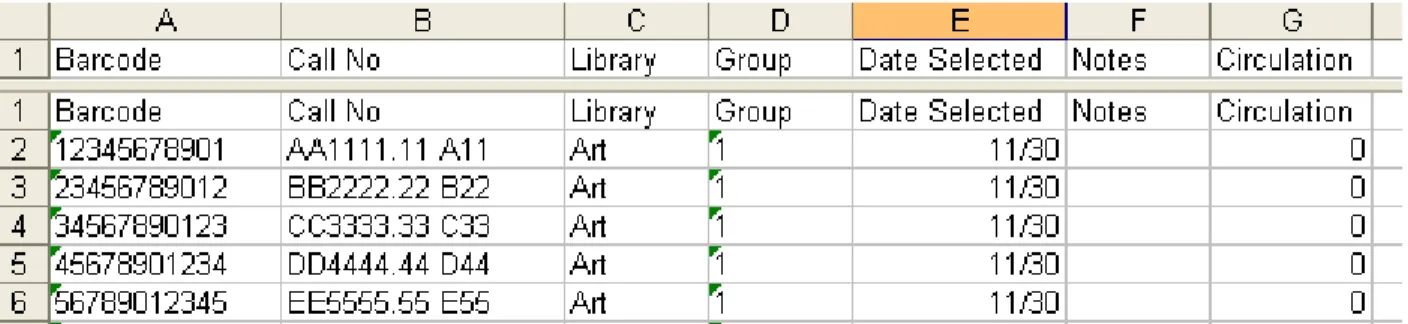
Below is a screenshot of a mockup of the spreadsheet used to document the selected books and their circulation during the study period. The barcodes and call numbers in this screenshot are fabricated to avoid identifying any of the actual materials used in the study.