Review: Wind Power Forecasting & Grid
Integration
Prabhas Kumar1,Vishavdeep Jindal2
Research Scholar, Dept. of Electrical Engineering, GZS PTU Campus, IKGPTU, Jalandhar, Punjab, India1 Assistant Professor, Dept. of Electrical Engineering, GZSCCET Campus, MRSPTU, Bathinda, Punjab, India2
ABSTRACT: The world today is facing energy crisis as well as serious environmental issues in terms of global warming and depletion of Ozone layer. Adequate use of renewable energy sources like wind, solar, biomass etc is the only credible alternatives available with us to bridge the gap between energy demand & supply without adversely affecting the earth environment. Amongst, wind power generation is very promising subject to accurate wind power prediction is made. In addition. Intermittency is the great challenge while integrating the wind power in the power system. Large intermittent generation in this regard has developed an influence on the grid security, system operation & market economics. Accordingly, the improvement of the performance of wind power forecasting tool has significant impact penetration. The wind power has caused many transformations in grid codes review & energy market. The target of this paper is to present a critical Literature review on wind forecasting technologies/methods and its integration to the grid. These technologies dependent on artificial neural networks (ANN), Statistical methods, numeric weather prediction (NWP), and hybrid forecasting approaches.
KEYWORDS: Wind Power Forecasting (WPF), artificial neutral network (ANN), Numeric weather prediction (NWP), Fuzzy logic, Wind turbines, Grid Integration
I.INTRODUCTION
Wind is one of the promising sources of obtaining energy which is renewable and abundant. No greenhouse emission is produced during production of energy from wind resources. Currently, in the world, there are 83 countries that produce energy from the wind power. Some countries are satisfying significant portion of their energy demand from wind resources. To cite an instance, Denmark is generating more than a quarter of their electricity needs from wind [2]. The energy obtained from wind resources constitutes more than 2.5% of the total electricity usage worldwide, and this figure is expected to increase in the near future. It is indicated that the amount of electricity produced from wind has been growing rapidly (i.e., 25% annual growth during the last 6 years), and this trend is expected to persist in the near future [3].
reliability of the power system. The impacts of wind power penetration on system reliability, stability, power quality and security are usually studied from two aspects such as system operation and system planning.
In the latest power systems, wind power integration is one of the key issues. Wind energy is the most promising source of energy in the present modern world. Presently wind energy is fast emerging among the renewable sources. The chaotic behaviour of wind is a great challenge to the power system reliability & stability. Accurate forecast of wind power is very useful for unit commitment, economic dispatch and power system operations [5]. Wind power forecast depends on following factors- direction of wind, humidity, temperature etc. With the increase of the wind power penetration in the power system, poses a great challenge to its operation. Wind forecasting is important for power system reliability and it reduces the unit cost of the power system [6]. To convert available wind power to actual power the curve varies non linearly as shown in power curve in Fig 1. The Fig 1 shows the relationship between wind speed (m/s) and output power curve depicts that change in wind speed causes the variation of output power. Below a minimum speed, which is called the threshold speed (around 3 m/sec), output power is zero. It is evident that output power growth of machine is only till nominal power is achieved (around 15 m/sec). Beyond this speed of 15 m/sec, the output power of machine is almost constant up to cut off speed (around 25 m /sec) [7],[8].
Wind turbine rotor produces wind energy & theoretically it is represented by
Pr= 0.5 ρ π R2 Cp ( , β) V3 (1)
Where
Pr = Wind Power of the Rotor Ρ = Air density
R= Rotor Radius V= wind speed
Cp = Rotor power Coefficient
= Blade Pitch angle
Β = Tip speed ratio
The conversion of the available wind power into actual power for utilization varies nonlinearly, as seen in the power curve (Fig. 1), due to the transfer functions of available generators. The power has zero output below a minimum speed i.e. threshold speed (around 3 m/s), a rapid growth in output until the wind speed is around 15 m/s and the output power is constant once the wind speed is above the cut-off level (around 25 m/s) [9].
Fig-1 Power Curve for VESTAS V66-1.65 MW Wind Turbine
to time series method for a horizon larger than a few hours ahead [19]. No matter what methods are employed so far, the errors of predictions can not be ignored.
As one of the most fundamental aspect of wind power integration, wind power forecasting accuracy is directly tied to the need for balancing energy and system security maintenance. Researchers have made significant efforts on wind power forecasting, and a number of methods are well established. State of the art wind power forecasting methodology is based on statistical models, physics-based methods, or their combination. As a stochastic process, more sophisticated methods are being proposed for the purpose of accurate wind power forecasting. The objective of this paper is to present the development of different techniques in this area.
Fig-2 Performance of different prediction methods
II. WIND POWER FORECASTING
A. Forecast Objectives
Forecast objectives are defined by its applications. Power plant scheduling, power balancing, determination of wind speed and power, grid operation and congestion management are the applications of wind power forecast [20].
B. Forecast Horizons
An important feature of a forecasting system is its time horizon. The time horizon is defined as the time period in future for which the wind generation will be forecasted. Depending on the time horizon, wind power forecasting can be categorized into three types: very short term, short term and long term power prediction. Look-ahead periods that span from few minutes up to an hour are defined as very short term forecasting [21]. A span of 1 to 12 hours ahead is termed as short term horizon and a span of 3-84 hours ahead as long term horizon [4].
C. Forecast Data
The data required for wind power prediction are collected from wind farms with dozens of turbines. The Supervisory Control And Data Acquisition (SCADA) systems installed at each wind turbine can be used to obtain the necessary data. Data for weather forecasting can also be obtained from National Weather Service Forecast Models. Data for various locations in the neighboring locality of the wind farm can be obtained from these models. The type of data required depends on the time horizon used for wind power forecasting. Wind speed (ms-1), wind direction ( ), air
D. Forecast Accuracy
The quality of a wind power forecast is determined by its accuracy. A long time period should be considered to measure the quality of a forecasting system, as the accuracy of forecast changes with time. The different metrics used to evaluate the prediction accuracy are Mean Absolute Error (MAE), Mean Square Error (MSE), Root Mean Square Error (RMSE) etc.
III. WIND POWER FORECASTING APPROACHES
The wind industry is in need of accurate models for prediction of output power and health monitoring of wind farms. These models require large number of parameters and building such models is a challenging task [22]. Hence new modeling approaches are the need of the hour to cater to the high dimensional and random nature of wind. The wind power forecasting techniques are classified mainly into three main groups: Physical Approach, Statistical Approach and Learning Approach [20]. The physical approach comprises of several submodels, which translate the Numerical Weather Prediction (NWP) forecast at a certain grid point and model level, to forecast the power at the considered site and at turbine hub height. The mathematical description of the physical processes relevant to the translation is contained in each submodel. In the statistical approach, the relation between historical measurements, meteorological predictions and generation output is realized through statistical models whose parameters are estimated from the data, without taking into account any physical phenomena. The learning approach makes use of soft computing techniques like neural networks, fuzzy logic etc to learn the relationship between the forecasted wind and power output from the time series of the past [9]. The physical approach consists of a group of models of the different physical processes involved including wind conditions at the site and hub height of the turbines, wind turbine power curve etc. In statistical approach, the relationship between weather forecasts and output power production from the time series of the past is analysed and described such that it could be used in future. The models developed using Artificial Intelligence (AI) techniques learn the relationship between input data (NWP model predictions) and output data (power output), using algorithms.
A. Persistence method:
Persistence Model for wind power forecasting assumes that the wind power at a certain future time will be the same as it is when the forecast is made, i.e., pt+k|t = pt. At a functional level, the latest available measurements of wind power should be used, as provided by the SCADA system [9]. The persistence method is the most simplest of all forecasting methods and serves as a reference to evaluate the performance of other advanced methods. Any advanced forecasting technique is worth implementing, only if it outperforms the persistence model.
B. Physical Approach
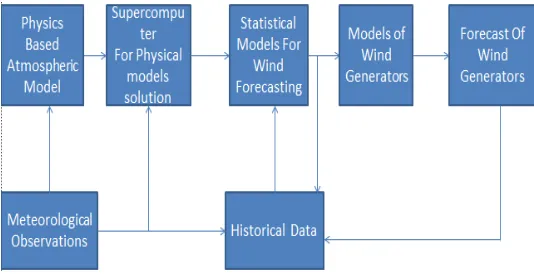
All the wind power forecast models depend on the weather forecasts from NWP models as their essential input. A model chain of various hierarchical levels with different NWP models is used. Meteorological observations carried out by meteorologists, weather monitoring stations, satellites etc. throughout the world, mark the starting point of the model chain.
C. Statistical Approach
Statistical methods are easy to model and economical in comparison with the others. Statistical methods use the previous history of wind data to forecast the next few hours. It is good for the short time period. The disadvantage of the Statistical method is that error increases with the increase of prediction period. Statistical time series models are used to predict wind power output up to six hours in advance. The auto regressive moving average (ARMA) is a well known time series statistical model. It is based on time series analysis[32].
This model shows the good forecasting results within 1 to 2 hours. Auto regressive integrated moving average (ARIMA) models have three components as auto regressive, integrated, and moving average. Once the integration term is absent then the model is known as ARMA mode.
Statistical approach consists of a single step which involves the direct transformation of the input variables into wind generation. The inputs of speed, direction, etc. from various NWP models are combined together with the online measurements of wind speed, direction, power and others in the statistical block.
A direct approximation of the regional wind power from the input parameters is made possible in a single step [9]. This approach involves the application of statistical methods such as Auto Regression (AR), Auto Regressive Moving Average (ARMA) method, linear prediction, probability density function, Gaussian distribution function etc. An overview of few statistical approaches implemented for wind power forecasting is presented here.
A linear time varying AR process to model and forecast wind speed, considering its non-stationary nature was proposed by Huang and Chalabi in [23]. Smoothed integrated random walk processes were used to model the time varying parameters of the AR model. A technique for wind power forecasting based on ARMA modeling was developed by Rajagopalan and Santoso in [33]. The relationship between the accuracy of the forecast and the variability of wind power was also studied. The model coefficients were determined using Burg and Shanks algorithms. Accurate forecasts were obtained for a look-ahead period of one hour, but the accuracy declined further ahead in time. Wind speed on the day-ahead (24 h) and two-day-ahead (48 h) horizons have been modeled and forecasted using fractional-ARIMA (Auto Regressive Integrated Moving Average) or f-ARIMA models in [24]. The forecasting accuracy of the developed model was significantly higher than the persistence method. Short-term wind speed forecasting using a new kernel machine method was presented by H. Mori and E. Kutara in [25]. The prediction model was constructed using Gaussian Process (GP) with Bayesian estimation. The developed model reduced the average error of Multi-Layer Perceptron (MLP) and Radial Basis Function Network (RBFN) by 27% and 12% and the maximum error by 13% and 7.8% respectively.
A method to calculate wind power forecast in a particular area employing an aggregate prediction method was proposed by M.G. Lobo and I. Sanchez in [26]. This method used the distances
between wind speed forecasts for a set of selected coordinates and its accuracy was also tested in comparison with other methods and found to be significantly higher.
A comprehensive evaluation of a well-designed power model, including the description of the method and its comparative performance with a standard power model is provided in Reference [27]. The impact of short-term wind power forecasting in Romania has been presented in [28]. The prediction of wind speed signals using linear prediction with Finite Impulse Response (FIR) and Infinite Impulse Response (IIR) filtering has been developed in [29]. The speed signals are transformed from Weibull to Normal Probability Density
[D] Hybrid / Combination Approach
In general, combination of different approaches such as physical and statistical approaches or combining short term & medium term models, etc, is referred to as a hybrid approach. Below Fig 3 shows the pictorial view of Hybrid/Combination Approach.
Fig 3. Hybrid Approach of Wind Power Forecasting
E. Learning Approach
Artificial Neural Networks (ANN) do not use explicit derivation of model equation but they learn using input-output mapping of variables. They are used in various areas of research including pattern recognition, prediction and forecasting, optimization and control. Mohandes et.al., introduced a neural network based technique for prediction of wind speed and compared its performance with an Auto- Regressive (AR) model [34]. The RMSE was used as performance indicator and the ANN technique performed better than the AR model. A neural network based technique for the forecasting on mean hourly wind speed time analysis has been presented by Steftos in [35]. The method was based on the fact that, when the averaging interval lies within an interval of 10 minutes, the wind speed was more predictable. A locally recurrent neural network for prediction of wind speed using spatial correlation was developed by Barbounis and Theocharis [36]. This technique outperformed the performance of previously used methods. Mabel and Fernandez developed an ANN architecture for wind speed prediction [37]. The monthly average wind speed, relative humidity and monthly generation hours were used as input to the ANN model and the output variable was the wind energy output of wind farms (Fig. 4). The MSE and MAE were calculated both for the training and testing data sets. The predicted wind energy output showed good coherence with the actual values. Accurate prediction of wind speed using two structures of neural network banks was proposed in [38]. This technique showed remarkable improvement in the performance of the hybrid physical-statistical wind speed forecasting models, better than those that used single neural network structures. Generally, the ANN based methods of wind speed prediction outperformed the statistical models.
Support Vector Machines (SVM) are a set of related supervised methods used for classification and regression.Neural Network models for short term wind speed prediction were compared with SVM models by Sreelakshmi and Ramkantha kumar [39]. They observed that SVM models compute faster and give better accuracies than the ANN models.
Principles Fuzzy logic is based on of approximate reasoning and computational intelligence. A genetic algorithm based learning scheme was used to train the input data which consisted of wind speed and direction data. The fuzzy model could predict wind speed from 30 min to 2 hours ahead and it outperformed the persistent method. The spatial correlation that existed among the wind speed time series data of various measuring stations was exploited by the fuzzy expert system developed by Damousis and Dokopoulos for wind power prediction [41].
Neural Networks and Fuzzy Systems complement each other. An Adaptive Neuro-Fuzzy Inference System (ANFIS) can incorporate fuzzy if-then rules and also the fine tune the membership functions. It is basically a neural network at par with the fuzzy inference model functionally. A comparison of various forecasting approaches like the Box- Jenkins approach, Feed-Forward NN, Radial basis function network and ANFIS models on mean hourly wind speed data using time series analysis was performed by Steftos [42]. He concluded that the models based on artificial intelligence outperformed the respective linear ones. An ANFIS-based method for very short-term wind prediction technique for power generation was introduced by Potter and Negnevitsky [21]. The wind prediction system was designed to forecast wind vectors 2.5 minutes ahead. The ANFIS model was compared with a persistence model and the mean absolute percentage error was found to be 4% and 30%. A locally recurrent fuzzy neural network with application to wind speed prediction using spatial correlation was developed by Barbounis and Theocharis [43]. Wind speed is estimated for 15 min to 3 h ahead by using the NN developed model. A technique based on the combination of neural network and fuzzy logic was used to increase the accuracy of the estimated wind speed and to reduce the computation time. In the proposed model using the fuzzy logic requires a lesser number of neurons. Thus, the prediction models based on ANFIS, exploit the advantages of both neural networks and fuzzy logic. Though they appear complicated, they perform better and obtain good prediction accuracies.
The process of extracting information from bulk of data is called as data mining. It is the task of discovering interesting pattern from bulk datas stored in databases, data warehouses or other information repositories. Different data mining models including linear and non-linear models were studied and their advantages and drawbacks compared in [44]. These models comprised of neural networks, random forests and support vector machines. Algorithms for developing monitoring models used for computing wind farm power were proposed in [22]. The algorithms were developed in four different domains, namely data mining, evolutionary computation, principal component analysis and statistical process control. An evolutionary strategy algorithm was used to construct a nonlinear parametric model of the wind turbine power curve, which was used to monitor the online performance of the wind farm. Kusiak A., Zheng H., and Song Z., used the data mining approach to build time series models for the prediction of wind farm power over short (10-70 minutes) and long (1-4 hours) horizons [45,4]. The various wind farm datasets were tested using five different data mining algorithms, out of which two algorithms performed very well. Zheng and Kusiak built models to predict the power ramp rates of a wind farm using data mining algorithms, which would be of importance to the electric grid [46]. A data driven approach for maximization of power produced by wind turbines was developed in [47]. The optimal control settings of wind turbines were computed using data mining and evolutionary computation. Hence data mining is a promising approach to model wind farm performance. The models developed based on data mining algorithms can be easily updated and expanded.
IV. IMPACT OF WIND POWER GRID INTEGRATION
A. Power Quality
Power quality is related to voltage variation and harmonic distortion in the network. The integration of wind power in the system affects the quality of the supplied voltage to the end user. To minimize the affect these days, variable speed wind turbines equipped with power electronics are extensively used in the wind power plants. Power electronics increase power quality because they control the harmonic distortion .
B. Protection System
Protection system is also affected by wind farms since the incorporation of wind power injection changes the direction of power flow so that normal protection system might fail under fault situations. Power network is passive which maintains stability in majority situations. This statement is no longer valid if considering an increase of wind energy penetration. Now a days, requirement for wind units have been designed in order to keep the power system stability within limit in severe condition like low voltage ride through capability [51].
C. Transient Stability
Traditional generators try to meet the fluctuating load demand to minimize voltage & frequency fluctuations. During fault which causes the voltage dips, generators accelerates to bridge the gap between mechanical and electrical powers. When the fault is cleared they absorb reactive power lowering the network voltage, if not enough reactive power is supplied a voltage depression is must. Exciters of synchronous generators enhance the reactive power output during low voltages and thus support voltage restoration. Whereas induction generators try to impede voltage recovery. If the penetration of wind generation is more and it gets disconnected at small voltage depression it can lead to a large generation deficit, to prevent this wind farms are needed to ensure sufficient compensation fault ride through capability [52].
D. Voltage Control
Power system nodal voltage is permitted to fluctuate from ±5% to up to ±7%. Synchronous generator and other devices used as compensator to regulate the nodal voltage by supplying or absorbing reactive power. In contrast induction generators absorb reactive power and have no direct control over reactive power flows. Even variable-speed wind turbines are also not capable to keep the voltage within limit at the instant of connection, because the wind farm network is predominantly capacitive [53]. The voltage variation issue results from the wind velocity and generator torque. The voltage variation is straight way related with the changes to real and reactive power. The voltage variation is commonly classified as under [54]:
• Voltage Sag/Voltage Dips • Voltage Surge
• Short Interruptions
• Long duration voltage variation
The voltage flicker issue indicates dynamic changes in the network resulted due to wind turbine or by varying loads. Thus the power fluctuation from the wind turbines develops due to continuous operation. The amplitude of voltage fluctuation depends on grid strength, network impedance, and phase angle and power factor of the wind turbines. It is defined as a
fluctuation of voltage in a frequency 10-35 Hz.
E. Frequency control
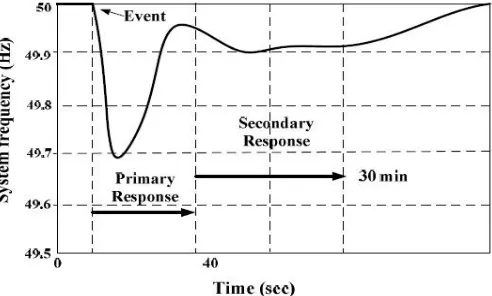
Primary Control: Subsequent to event leading to frequency deviation, during initial 30-40 sec the rotational energy stored in large synchronous machine is used to maintain the equilibrium between production and consumption through the deceleration of the rotors. Such units (often called as primary control units) generation is thus increased until the frequency is stabilized by restoring the power balance.
Fig 5. Definitions of frequency control in power systems
Secondary control: Post the primary response of the unit, a slow supplementary control function is activated in order to restore the frequency to its normal. The generators connected to the system are ordered to change their production through Automatic Generation Control (AGC) scheme or through manual request by the system operator.
V. CONCLUSION
In the present world scenario the demand of green power has increased many a fold to protect the earth environment and in the process the power systems are undergoing fundamental changes. Accordingly, there is an increased wind power generation penetration into power systems, sophisticated wind power forecasting tools associated with variety of meteorology input and their active integration into power-system operation are critically needed. Forecasting of wind speed and power serves as a very important tool to enhance the efficiency, economy and reliability of power systems which has a large share of wind power. Maintenance, planning and operation management of wind power & energy market can be effectively carried out using the prediction models for long term & short term. Trading in intraday market and real-time market is facilitated by the very-short-term power prediction models. The different techniques used for developing wind power prediction models have been highlighted in this paper. The ultimate goal for forecasting is to enhance the prediction accuracy and to develop models that could be the basis of predictive control. These predictive models will also serve as effective tools to increase the reliability of wind power as well as transforming a wind farm into a wind power plant.
ACKNOWLEDGEMENT
The authors are very thankful to IKG Punjab Technical University, Jalandhar for providing the fruitful environment and for the encouragement for the research work.
REFERENCES
[1] Fthenakis, V; Kim, H. C.; “Land Use and Electricity Generation: A Life-Cycle Analysis," Renewable and Sustainable Energy Reviews, vol. 13, pp. 1465, 2009.
[2] A. Kusiak, H. Zheng, Z. Song, “Wind Farm Power Prediction: A Data Mining Approach”, Journal of Wind Energy, Vol.12, pp. 275-293, 2009. [3] Y. K. Wu, J. S. Hong, “A literature review of wind forecasting technology in the world”, Proc. of IEEE Power Tech., pp.504- 509, 2007. [4] Yutong Zhang; Ka Wing Chan, “The impact of wind forecasting in power system reliability”, Electric Utility Deregulation and Restructuring
and Power Technologies, pp.2781-2785, 2008.
[7] C. Monteiro, H. Keko, R. Bessa, V. Miranda, A. Botterud, J. Wang, G. Conzelmann, “Wind power forecasting: state-of-the-art”, Decision and Information Sciences Division, Argonne National Laboratory, 2009.
[8] X. Kong, W. Gu, and L. Gu, “Research on the development policy of non-carbon energy-consuming industry using large-scale non-grid-
connected wind power,” in Proc. World Non-Grid-Connected Wind Power and Energy, pp. 1-4, Sep. 2009.
[9] R. P. S. Leao, F. L. M. Antunes, T. G. M. Lourenco, and K. R. Andrade Jr, “A comprehensive overview on wind power integration to the power grid,” IEEE Trans. Latin America, vol. 7, no. 6, pp. 620 - 629, Dec. 2009.
[10] A. Yazdani, and R. Iravani, “A neutral-point clamped converter system fordirect-drive variable-speed wind power unit,” IEEE Trans. Energy Conversion, vol. 21, no. 2, pp. 596-607, June 2006.
[11] D. L. Yao, S. S. Choi, K. J. Tseng, and T. T. Lie, “A statistical approach to the design of a dispatchable wind power-battery energy storage
system,” IEEE Trans. Energy Conversion, vol. 24, no. 4, pp. 916-925, Dec. 2009.
[12] Q. Wang, and L. Chang, “An intelligent maximum power extraction algorithm for inverter-based variable speed wind turbine systems,” IEEE Trans. Power Electronic, vol. 19, no. 5, pp.1242-1249, Sep. 2004.
[13] P. Pinson, and G. Kariniotakis, “Conditional prediction intervals of wind power generation,” IEEE Trans. Power Systems, vol. 25, no. 4, pp. 1845-1856, Nov. 2010.
[14] J. Shi, Y. Tang, Y. Xia, L. Ren, and J. Li, “SMES based excitation system for doubly-fed induction generator in wind power application,” IEEE Trans. Applied Superconductivity, vol. 21, no. 3, pp. 1105-1108, June 2011.
[15] J. Lee, J. H. Kim, and S. K. Joo, “Stochastic method for the operation of a power system with wind generators and superconducting magnetic
energy storages (SMESs),” IEEE Trans. Applied Superconductivity, vol. 21, no. 3, pp. 2144-2148, June 2011.
[16] G. Giebel, P. Serensen, and H. Holttinen, “Estimates of Forecast error of aggregated wind power”, TradeWind Report, 2007. [Online]. Available:http://www.trade-wind.eu/fileadm in/documents/publ ications/D 2.2
[17] B. Ernst, B. Oakleaf, M. L. Ahlstrom, M. Lange, C. Moehrlen, B. Lange,U. Focken, K. Rohrig, “Predicting the wind”, IEEE Power and Energy Magazine, pp. 78-86, November/December 2007.
[18] C. W. Potter, M. Negnevitsky, “Very short-term wind forecasting for Tasmanian power generation”, IEEE Trans. on Power Systems, Vol. 21, pp. 965-972, 2006.
[19] A. Kusiak, H. Zheng, Z. Song, “Models for monitoring wind farm power”, Journal of Renewable Energy, Vol.34, pp.583-590, 2009.
[20] Z. Huang, Z. S. Chalabi, “Use of time-series analysis to model and forecast wind speed”, Journal of Wind Engineering and Industrial Aerodynamics, Vol.56, pp. 311-322, 1995.
[21] G. K. Rajesh, K. Seetharaman, “Day-ahead wind speed forecasting using f-ARIMA models”, Journal of Renewable Energy, Vol.34, pp.1388- 1393, 2009.
[22] H. Mori, E. Kutara, “Application of gaussian process to wind speed forecasting for wind power generation”, ICSET, 2008, pp. 956 – 959. [23] M. G. Lobo, I. Sanchez, “Aggregated wind power prediction methods based on distances between weather forecasting vectors”, ICCEP, June
2009, pp. 242-247.
[24] J. Collins, J. Parker, A. Tindal, “Forecasting for utility-scale wind farms – the power model challenge”, CIGRE, July 2009, pp. 1-10.
[25] C. Dica, C. I. Dica, D. Vasiliu, Comanescu Gh., M. Ungureanu, “Windpower short-term forecasting system”, IEEE Bucharest Power Tech Conf., 28th June-2nd July, 2009.
[26] N. A. Karim, M. Small, M. Ilic, “Short-term wind speed prediction by finite and infinite impulse response filters: A state space model
representation using discrete Markov process”, IEEE Bucharest Power Tech Conf., 28th June-2nd July, 2009.
[27] J. Juban, N. Siebert, G. N. Kariniotakis, “Probabilistic short-term wind power forecasting for the optimal management of wind generation”, Power Tech, July 2007, pp. 683-688.
[28] F. Bourry, J. Juban, L. M. Costa, G. Kariniotakis, “Advanced strategies for wind power trading in short-term electricity markets”, European Wind Energy Conf., Brussels, 31st March-3rd April, 2008.
[29] Rajagopalan, S.; Santoso, S., “Wind power forecasting and error analysis using the autoregressive moving average modeling” IEEE Power &
Energy Society General Meeting,(PES '09), pp.1-6, 2009.
[30] S. Rajagopalan, S. Santoso, “Wind power forecasting and error analysis using the autoregressive moving average modeling”, IEEE Power &
Energy Society General Meeting,(PES '09), pp.1-6, July 2009.
[31] M. A. Mohandes, S. Rehman, T. Halawani, “A neural networks approach for wind speed prediction”, Journal of Renewable Energy, vol. 13, pp.345-354, 1998.
[32] A. Steftos, “A novel approach for the forecasting of mean hourly wind speed time series”, Journal of Renewable Energy, vol.27, pp. 163-174, 2002.
[33] T. G. Barbounis, J. B. Theocharis, “Locally recurrent neural networks for wind speed prediction using spatial correlation”, International Journal of Information Sciences, vol.177, pp.5775-5797, 2007.
[34] M. Carolin Mabel, E. Fernandez, “Analysis of wind power generation and prediction using ANN: A case study”, Journal of Renewable Energy, vol.33, pp. 986-992, 2008.
[35] S. Salcedo-Sanz, Bellido, Garcia, Figuras, L. Prieto, F. Correoso,“Accurate short term wind speed prediction by exploiting diversity in input
data using banks of artificial neural netwoks”, Journal of Neuro-computing , vol. 71, pp. 1336-1341, 2009.
[37] I. Damousis, M. C. Alexiadis, J. B. Theocharis, P. S. Dokopoulos, “A fuzzy model for wind speed prediction and power generation in wind
parks using spatial correlation”, IEEE Trans. on Energy Conversion, vol.19, pp. 352-360, 2004.
[38] I. G. Damousis, P. Dokopoulos, “A Fuzzy Expert System for the Forecasting of Wind Speed and Power Generation in Wind Farms”, ICPICA, May 2001, pp.63-69.
[39] A. Steftos, “A comparison of various forecasting techniques applied to mean hourly wind speed time series”, Journal of Renewable Energy, vol. 21, pp. 23-35, 2000.
[40] T. G. Barbounis, J. B. Theocharis, “A locally recurrent fuzzy neural network with application to wind speed prediction using spatial
correlation”, Journal of Neuro-computing, vol.70, pp. 1525-1542, 2007.
[41] L. Fugon, J. Juban, G. Kariniotakis, “Data mining for wind power forecasting”, European Wind Energy Conf., Brussels, 31st March-3rd April, 2008.
[42] A. Kusiak, H. Zheng, Z. Song, “Short-term prediction of wind farm power: A data mining approach”, IEEE Trans. on Energy Conversion, vol. 24, pp. 125-135, 2009.
[43] H. Zheng, A. Kusiak, “Prediction of wind farm power ramp rates: A data mining approach”, J. of Solar Energy Engineering, vol. 131, pp. 031011-1-8, 2009, DOI. 10.1115/1.3142727
[44] A. Kusiak, H. Zheng, Z. Song, “Power optimization of wind turbines with data mining and evolutionary computation”, J. of Renewable Energy, Vol. 35, pp.695-702, 2010.
[45] G. Papaefthymiou, and B. Klockl, “MCMC for wind power simulation,” IEEE Trans. Energy Conversion, vol. 23, no. 1, pp. 234-240, Mar 2008.
[46] W. Lu, and B. T. Ooi, “Multiterminal LVDC system for optimal acquisition of power in wind-farm using induction generators,” IEEETrans.
Power Electronic, vol. 17, no. 4, pp. 558-536, July 2002.
[47] S. Bhowmik, R. Spee, and J. H. R. Enslin, “Performance optimization for doubly fed wind power generation systems,” IEEE Trans. Industry
Application, vol. 35, no. 4, pp. 2394-2384, July 1999.
[48] J. Wang, M. Shahidehpour, and Z. Li, “Security-constrained unit commitment with volatile wind power generation,” IEEE Trans. Power
Systems , vol. 23, NO. 3, pp. 1319-1327, Aug. 2008.
[49] F. Bouffard, and F. D. Galiana, “Stochastic security for operations planning with significant wind power generation,” IEEE Trans. Power
Systems, vol. 23, no. 2, pp. 1-11, May 2008.
[50] J. W. Taylor, P. E. McSharry, and R. Buizza, “Wind power density forecasting using ensemble predictions and time series models,” IEEE
Trans. Energy Conversion, vol. 24, no. 3, pp. 775-782, Sep. 2009.
[51] P. S. Murthy, P. Devaki, and J. Devishree, “A static compensation method based scheme for improvement of power quality in wind generation,”
in Proc. Process Automation, Control and Computing, pp. 1-6, July 2011.
[52] G. Lalor, A. Mullane, and M. J. O. Malley, “Frequency control and wind turbine technologies,” IEEE Trans. Power Systems, vol. 20, no. 4, Nov. 2005.
BIOGRAPHY
Vishavdeep Jindal was born in Punjab, India in 1987. He is a student member of IEEE and Dielectric & Electrical insulation society (DEIS). He is also a reviewer member in International Journal of Engineering Research & Technology (IJERT). He received the B.Tech. in Electrical Engineering from the University of Kurukshetra, India 2009 and the Master degree in Electrical Engineering from Punjab Technical University, Kapurthala, India 2012. He is currently pursuing his Ph.D.degree in the Punjab Technical University Kapurthala, Punjab, India. His main research interests are Power quality, conditioning monitoring of transformer, aging effects of kraft paper, Wind power Forcasting techniques.