Transactions of the 17th International Conference on Structural Mechanics in Reactor Technology (SMiRT 17) Prague, Czech Republic, August 17 –22, 2003
Paper # K11-1
A Developing Risk-informed Design Basis Earthquake Ground Motion
Methodology
Takaaki Konno
ABSTRACT
Design basis earthquake ground motions for nuclear installations should be determined to assure the design purpose of reactor safety: that reactors should be built and operated to pose no undue risk to public health and safety from earthquake and other hazards. Regarding the influence of seismic hazard to a site, large numbers of earthquake ground motions can be predicted considering possible variability among the source, path, and site parameters. However, seismic safety design using all predicted ground motions is practically impossible. In the determination of design basis earthquake ground motions it is therefore important to represent the influences of the large numbers of earthquake ground motions derived from the seismic ground motion prediction methods for the surrounding seismic sources. Viewing the relations between current design basis earthquake ground motion determination and modern earthquake ground motion estimation, a development of risk-informed design basis earthquake ground motion methodology is discussed for insight into the on going modernization of the Examination Guide for Seismic Design on NPP’s in the Nuclear Safety Commission (NSC) of Japan.
KEY WARD: design basis earthquake, earthquake ground motion, nuclear, power plant, seismic hazard, seismic safety, risk-informed design, probabilistic seismic safety assessment.
INTRODUCTION
The seismic safety of reactor facilities is required to assure the reactor safety and radiation protection to the public health and safety by defense-in-depth philosophy for any supposed seismic load occurrences during the reactor operation. The Examination Guide for Seismic Design by the NSC requires that the safety-related structures, systems and components (SSCs) shall be designed to withstand the effects of earthquakes without loss of capability to perform their safety functions in accordance with the classification of seismic importance.
Two types of design basis earthquake ground motions for seismic design are defined. One is derived as the design basis maximum earthquake S1 specified from the past earthquake records and active faults. The other one is derived as the design basis extreme earthquake S2 that exceeds the S1 and would have the greatest effect at a proposed site. However, the sufficiency of the intensity of the current S2 earthquake determination became a controversial problem after the recent inland earthquake experiences such as 1995 Hyogo-ken Nanbu Earthquake Mj=7.2 or 2000 Tottori-ken Seibu Earthquake Mj=7.3. The disasters in the damage belt of the 1995 Hyogo-ken Nanbu earthquake Mj=7.2 that struck the densely populated city of Kobe demonstrated to the public the dangerous power of the near-fault inland earthquakes. The 2000 Tottori-ken Seibu earthquake Mj=7.3 occurred at a previously unknown active fault for which the epicenter was located approximately 45 km southeast from an existing NPP. This caused discussion about the sufficiency of the blind fault earthquake magnitude that is required in the S2 earthquake; commonly a magnitude 6.5 earthquake at the hypocenter distance of 10 km is currently used for seismic design of every exiting NPP. These recent earthquake experiences awoke public concern about the seismic safety of NPPs that the current examination guide considers necessary for review based on the state of the art knowledge of seismology, geology, and earthquake engineering to ensure the seismic safety performance of NPPs from the point of risk managements.
The method to numerically handle the total earthquake effects to the site as probabilistic events is recently evolving in seismic probabilistic safety assessments (seismic PSAs). These systematic examinations are beneficial in identifying plant-specific vulnerabilities to severe accidents to evaluate the risk involved in the seismic safety design of the reactor facilities. Previous results of seismic PSAs for Japanese NPP’s by JAERI [1] or NUPEC [2] showed that the reactor core damage occurrence frequency curve has the peak close to the design earthquake levels rather than excessively extreme earthquake level. This suggests the importance of not only the seismic safety assessment for the total earthquake hazard in identifying plant-specific vulnerabilities but also the importance of seismic design for design basis earthquakes including the risk-dominant earthquake level informed by seismic PSAs. The seismic design based on the risk-informed should confirm the integrity of structures and safety functions of the safety-related SSCs by the dynamic response analyses using design basis earthquake ground motions defined including the risk dominant level earthquake that is important to ensure the seismic safety reliability on the seismic design in the face of significant uncertainties.
that should be assured are: normal operation during high frequency occurrence earthquakes; transient incident of moderate frequency occurrence earthquakes; accidental incident of low frequency occurrence earthquakes. Based on these considerations, severe accident management should be planned for the probabilistic seismic risk. However current deterministic design practice to meet this seismic design requirement is not suitable for thoroughly explaining the relationship between the reactor safety performance and the integrities of structures, systems and components (SSCs). This is because uncertainties both of the seismic hazard among earthquake magnitude, occurrence, ground motion attenuation and of the seismic safety performance within the complex functional structures of reactor facilities.
A probabilistic approach to seismic safety assessment is important from the point of view of “How safe is safe enough.” Such an approach takes into account the ground motion from the full range of earthquake magnitudes, allowing explanation of the relationship between the reactor safety performance and the strengths of safety-related SSCs considering the uncertainties within the seismic hazard and the safety performance system. The probabilistic approach to seismic hazard characterization is very compatible with current trends in earthquake engineering and the development of building codes, which have embraced the concept of performance-based design. The objective of the performance-based design is to clarify how reactor safety performance is degrading with the increasing magnitude of earthquakes. Earthquake occurrences are probabilistic events. Design basis earthquakes (DBEs) should consider the effects of every seismic event by occurrence probability to confirm the seismic safety of reactor facilities. Earthquake ground motions are made complex by the effects of the source, path, and site conditions, that is, it can be said the same ground motion will not again.
As experienced the disasters by the near-fault earthquake ground motions of the 1995 Hyogo-ken Nanbu Earthquake, the estimation of the effects of earthquakes to structures is difficult only from the response spectra of earthquake ground motions. The seismic impacts to structures should be evaluated by time domain dynamic response analyses. The adequacy of design basis earthquake ground motions to assure the seismic safety of the complex facilities of NPPs does not suitably explained only by the envelopment response spectrum or a uniform hazard spectrum of seismic sources. The current Examination Guide is under reviewed reflecting the risk insights informed by recent study results of seismic PSAs. The task group on seismic design guide was organized on July 10, 2001 under the Special Committee on Safety Standard in the NSC. In this paper, a methodology of development the risk-informed design basis earthquake ground motions of NPPs is discussed based on the risk information by seismic PSAs compared with the risk insights by the current deterministic design basis earthquake ground motions.
SEISMIC SAFETY BY DEFENSE -IN-DEPTH PHILOSOPHY
Seismic Classification Comply The Defense-in-Depth Philosophy
The seismic safety of NPPs by defense-in-depth philosophy is usually explained in Japan that 1) prevention of abnormal event occurrence, 2) early detection of abnormal event occurrence and mitigation to reduce the influence of the event before it become the accident, and 3) at the accident occurrence, prevent the accident progress and mitigate the accident to reduce the influence by the multiple preparation with diversity and redundancy of the various safety functions of prevention and mitigation systems. If any accident is induced it will be detected quickly and managed to the safety conditions by the safety functions, which hold high reliability due to diversity and redundancy the integrity of safety functions of safe shutdown, safe cooling and containment should be maintained assuming the combination with a random failure of prevention functions and a unit failure of mitigation functions. The seismic design basis requirements defined the performance criterion for the protection against earthquakes that safety related SSCs that are important to assure reactor safety and radiation protection shall be designed to withstand the effects of any supposed earthquakes without loss of capability to perform their safety functions in the seismic design examination guide by the NSC.
Plant Safety Levels Related With Seismic Events
In general, earthquake occurrence frequency is higher in the small seismic. As shown in the Figure 1, generally speaking, plant safety conditions might be induced into from slightly abnormal conditions to highly abnormal conditions along with the intensity of earthquake events increased. These abnormal conditions induced by earthquake events should be detected quickly and settled to safety conditions by various safety functions of mitigation. Assuming the combination with a low occurrence frequency/large accident event by random failure, the safety conditions can be induced to severe condition even in a small earthquake. How much the severe earthquake events should be considered and also how much severe event combinations should be considered is therefore become important point in the deterministic seismic design relied on the risk insights. To obtain the quantitative answer to this problem, seismic PSAs might be a useful method to provide adequate solution based on the risk information. The design basis earthquakes also should be defined explicitly the relations with the probability of annual exceedance occurrence frequencies so that the event combinations considering random failures and human factors can be rationally employed for the safety managements in reactor operations.
SC SB S1 S2
SC+ R F SB+ R F S1+ R F S2+ R F
In itial state S afe sh utd o w n & safe coo lin g
N o rn al o p eratio n A b n o m al in cid en ts C o re d am ag e
P ro b ab ility o ccu rren ce o f p lan t states
E v en t co m b in atio n s
(S eism ic/R andom Failure)
P lan t states in d u ced b y E Q w ith ran d o m failure
P lan t states in d u ced b y E Q
C o n tain m en t d am ag e
Figure 1 Plant safety levels related with earthquake events. The safety level is higher when the plant states closer to the normal operation.
UNCERTAINTY IN CURRENT SEISMIC DESIGN
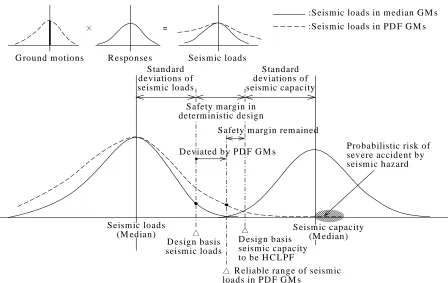
Seism ic loads
(M edian) △ D esign basis seism ic loads Standard
deviations of seism ic loads
G round m otions R esponses Seism ic loads
× =
Standard deviations of seism ic capacity
Safety m argin in determ inistic design
Safety m argin rem ained
△ R eliable range of seism ic loads in PD F G M s
Seism ic capacity (M edian)
△
D esign basis seism ic capacity to be H C LPF
:Seism ic loads in m edian G M s :Seism ic loads in PD F G M s
Probabilistic risk of severe accident by seism ic hazard D eviated by PD F G M s
Figure 2 Concept of seismic safety margin in deterministic design. The safety margin should be remained in considerations of the ground motion variability in seismically reliable range.
EARTHQUAKE GROUND MOTION DERIVED FROM SOURCE
Seismic Hazard And Source Characterization
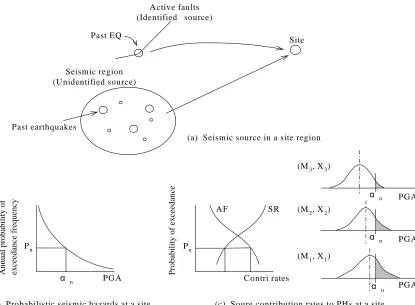
The earthquake ground motions derived from a seismic source can be predicted many variety of different ground motions. The investigation to identify the characteristics of the sources existing around a site region is important to provide a systematic and comprehensive evaluation of the seismic hazard and its effects on the safe operation of nuclear power plants. Many seismic sources might exist, from the small to large magnitudes and from known active faults to unknown blind faults around a site region. These seismic sources should be characterized based on the past earthquake records, geological and geophysical surveys, and micro earthquake observations. Some of the blind seismic sources might be still remained unknown even after the investigations. As one of the way to represent the effects of seismic sources to a site, a seismic hazard curve is made by defining the annual frequency of exceedance in terms of levels of a ground motion intensity, such as peak ground accelerations, which can be correlated with the damage of critical structures, systems, and components (SSCs) into beyond the current design basis earthquake by the probabilistic seismic hazard analysis. From the site-specific hazard curves, a set of Uniform Hazard Spectrum as recommended in US NRC, may be obtained as the seismic design spectra. One of the objectives in developing seismic design spectra is to achieve approximate uniformity of seismic risk for the safety-related SSCs designed to those spectra, across a range of seismic environments, annual probabilities, and structural frequencies.
ground motion are not explicitly explained. The relationship between individual sources and the ground motions is not clear in this method. It is not sufficient to represent the earthquake influences only by the spectrum and maximum amplitude of ground motions. The earthquake influences to structures represented by the frequency contents of the amplitudes and phase of acceleration, velocity, displacement, impact force, etc., can be changed by the dynamic characteristics of structures. The seismic capacities of structures are also influenced by the accumulation of fatigue depending on the cycles and intensities of earthquake ground motions. Therefore, earthquake ground motions should be determined to represent the varied amplitude, frequency, and phase characteristics. This can only be done by sufficient numbers of time domain earthquake ground motions.
A ctive faults (Identified source)
Site
Seismic region (U nidentified source)
(a) Seismic source in a site region
(b) Probabilistic seismic hazards at a site
α n PG A
Annu
al proba
bility of
ex
cee
d
an
ce
fr
eq
u
en
cy
(c) Soure contribution rates to PH s at a site
α n
(M3, X3)
(M2, X2)
(M1, X1)
α n
α n
Past earthquakes
PG A
PG A
PG A Past EQ
Pn
A F
Contri rates
Pr
obabilit
y of
exceedance
Pn
SR
Figure 3 Source contributions to seismic hazard at a site. The each source contribution rates are changed according with the probability of exceedance frequency changing.
DBE For Evaluation Seismic Impact On Safety Requirements
R o c k s u r f a c e
S e is m ic b a s e r o c k
I n c id e n t w a v e
( a ) S e is m ic w a v e s a t a s ite S o u r c e
( c ) E s tim a t i o n b a s e d o n m u l t i p l e u n i t s ( b ) E s tim a tio n b a s e d o n s in g le u n it
θ θ
Figure 4 Earthquake ground motions to estimate seismic impacts at a site.
RISK-INFORMED DESIGN BASIS EARTHQUAKE GROUND MOTIONS
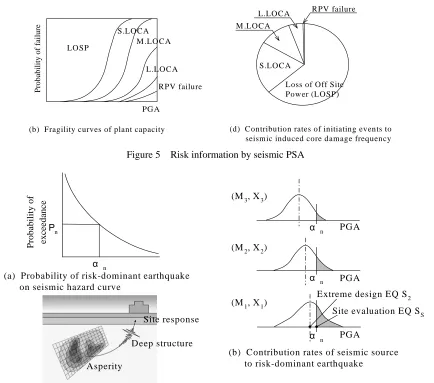
The design basis earthquake ground motions should be risk-informed by the seismic PSA on the proposed site. This is so that the necessity of assuming the extremely large earthquake beyond the design basis earthquakes that could cause the damage of reactor core by the failure of the seismic capacity of almost all safety-related SSCs, is negligible from the point of the risk. The earthquake ground motions should be derived on the source of most significant contribution rate for the risk-dominant earthquake. Identification of dominant seismic risk contributors considering the uncertainties involved are an important process in a seismic design to enhance the reliability of the seismic safety assurance. The current results of seismic PSAs for existing nuclear power plants shows a tendency that the risk of core damage frequency caused by earthquakes are largely contributed by less severe initiating events. The large contribution rate of initiating events are, in the order from larger rate: loss of the offsite power accident (LOSP); small break loss of coolant accident (S.LOCA); medium break loss of coolant accident (M.LOCA); large break loss of coolant accident (L.LOCA); and reactor pressure vessel failure as shown in the Figure 5. The result shows the seismic risk is rather dominated by the failures of less important SSCs than high important SSCs according with the relations of the seismic hazard and fragility curves. The conditional core damage frequency by the each initiating event is shown to become larger along with the seismic load increasing until to show maximum peak at the certain earthquake level and then decreasing the risk curve. It indicates the risk-dominant earthquake is derived in the range of the initiating event of loss of offsite power accident (LOSP). Current seismic PSA can confirm the necessary conditions of reactor safety by secure the success path of safety-related SSCs, but are not yet sufficient to confirm the design basis criteria of reactor safety performances that can be confirmed based on the time domain analyses of reactor behaviors on abnormal operation in seismic events. In order to assure the seismic safety of reactor facilities to the dominant earthquake events, integrities of structures and safety functions of the safety-related SSCs that are necessary to maintain reactor safety conditions in the seismic events should be evaluated by the dynamic response analyses using time domain earthquake ground motions. This is essential to confirm the reactor safety and also the safety for radiation to the public based on the estimation of radiation release derived from the failures of the SSCs.
motions should be developed based on the numerical method considering the variation of the source rapture process parameters using seismic fault model. The new, high-quality data recorded in the near-fault region of recent large earthquakes are useful to source characterization such as spatial variations of slip, slip velocity, or rupture velocity for accomplish precise strong motion prediction by modern earthquake ground motion evaluation technology. In the numerical simulation methods to estimate the ground motions, a recipe for prediction of scenario earthquake strong ground motion caused by active fault by means of numerical analysis considering the spatial distribution of fault slip and the time function of slip on the fault has been proposed (Irikura, 2000)[5]. The influences by the factor of the earthquake such as acceleration, velocity, displacement, impact force etc. to the structures are different the significance depend on the dynamic response characteristics of the objectives. The earthquake ground motions to be used in the evaluation of the seismic safety of the reactor facilities are necessary to be derived enough numbers of ground motions to represent the seismic impacts considering the many aspects required for the ground motions depend on the characteristics of objectives.
(a) Seismic hazard curve PG A
Probability of
core
damage frequency
(b) Fragility curves of plant capacity
Probability of
failure
(c) Core damage frequency curves with initating events PGA
(d) Contribution rates of initiating events to seismic induced core damage frequency
Loss of Off Site Power (LOSP) LOSP
Probability of
exceedance
S.LOCA M .LOCA
L.LOCA
LO SP
S.LOCA M .LOCA
L.LOCA
RPV failure
PG A
S.LOCA M .LOCA
L.LOCA RPV failure
α n
Pn
α n
Figure 5 Risk information by seismic PSA
(b) Contribution rates of seismic source to risk-dominant earthquake
α n (M3, X3)
(M2, X2)
(M1, X1)
α n
α n (a) Probability of risk-dominant earthquake
on seismic hazard curve
α n
(c) Risk-dominant earthquake ground motion prediction by numerical methods
Probabilit
y of
exc
eeda
n
ce
Pn PGA
PGA
PGA
Extreme design EQ S2 Site evaluation EQ SS
Asperity
Deep structure Site response
CONCLUSION
The seismic design of nuclear power plants should evolve by considering quantitatively the risk induced by earthquakes to be more consistent with the nuclear safety philosophy. Concerning the risk information in a seismic PSA, seismic design should be performed including the risk dominant level earthquake. A development of the risk-informed design basis earthquake ground motions methodology was discussed and summarized here.
First of all, the risk-dominant earthquake level should be identified by the preliminary seismic PSA at the proposed site in the site-licensing phase. If the dominant earthquake level is smaller than the extreme design earthquake the seismic vulnerability should be improved to be beyond the S2.
The extreme design earthquake S2 is not enough to explain the safety beyond DBEs. The DBE ground motions by the risk-dominant seismic source should be used to derive the two types of ground motions that are the most likely earthquake ground motion for the extreme design earthquake S2 by the median exceedance probability and the ground motion by the low exceedance probability to be the risk-dominant earthquake in order to assure the safety beyond DBEs.
The risk-dominant earthquake ground motion could be defined newly as the site evaluation earthquake Ss that could be used for the evaluation of the reactor safety by the plant seismic capacity with the criterion of high confidence low probability of failure (HCLPF), and also, for the evaluation of radiation safety to the public based on the radiation release by the failure of safety-related SSCs on the multiple units in a site.
The numerical evaluation methods are useful for determination the time domain ground motions of the site evaluation earthquake Ss consistent with the probability of exceedance occurrence rate of risk-dominant earthquake by the seismic source of most significant contribution. The time domain earthquake ground motions should be employed, with several different time histories needed to represent sufficiently the seismic impact to the safety-related SSCs.
The seismic performance confirmations by the other design basis earthquakes such as Sc, SB, and S1 defined by the current examination guide are also important for the safety management. The DBEs should be defined explicitly the relations with the probability of annual exceedance occurrence frequencies so that the event combinations considering random failures and human factors can be rationally employed for the safety managements in reactor operations.
ACKNOWLEDGEMENTS
The on going discussions for modernization of the current Examination Guide for Seismic Design on NPPs under the Special Committee on Safety Standard in the NSC inspired the author’s view that is greatly appreciated.
DISCLAIMER
The views expressed in this paper are those of author and should not be construed to reflect the official Japanese NSC position.
REFERENCES
1. Oikawa, T., Kondo, M., Watanabe, Y., Shiraishi, I., Hirose, J. and Muramatsu, K., “Sensitivity Analyses for the Effects of Uncertainty Issues on Risk Contributors in a Seismic PSA of the BWR Model Plant at JAERI,” Proceedings of the OECD/NEA Workshop on Seismic Risk, Tokyo, August 1999
2. Sakagami, M. and Hirano, M., “Comparison of Trial Seismic PSA and Seismic Margin Analysis for a BWR” Proc. of PSAM5, Osaka, 2000
3. Ishikawa, Y. and Kameda, H., “Hazard-consistent Magnitude and Distance for Extended Seismic Risk Analysis,” Proc. of 9th WCEE, Vol. II, pp.89-94, 1995
4. Takada, T., Okumura, T., Hirose, J., Muramatsu, K., Taki, S. and Ishii, K., “Probabilistic Scenario Earthquake for Seismic Design – Comparison of Two Identification Procedures” Proceedings of the OECD/NEA Workshop on Seismic Risk, Tokyo, August 1999