Speeding Up the Design of Dialogue Applications by Using Database
Contents and Structure Information
L. F. D’Haro, R. Cordoba, J. M. Lucas, R. Barra-Chicote, R. San-Segundo
Speech Technology Group
Dept. of Electronic Engineering
Universidad Politécnica de Madrid, Spain
{lfdharo, cordoba, juanmak, barra, lapiz}@die.upm.es
Abstract
Nowadays, most commercial and research dialogue applications for call centers are created using sophisticated and fully-feature development platforms. Surpris-ingly, most of them lack of some kind of acceleration strategy based on an automatic analysis of the contents or structure of the backend database. This paper describes our efforts to incorporate this kind of informa-tion which continues the work done in (D’Haro et al, 2006). Our main proposed strategies are: the generation of automatic state proposals for defining the dialogue flow network, the automatic selection of slots to be requested using mixed-initiative, the semi-automatic generation of SQL statements, and the quick generation of the data model of the application and the con-nection with the database fields. Subjective and objective evaluations demonstrate the advantages of using the accelerations and their high acceptance, both in our current proposals and in previous work.
1
Introduction
Currently, the growing demand of automatic dia-logue services for different domains, user profiles, and languages has led to the development of a large number of sophisticated commercial and re-search platforms that provide all the necessary components for designing, executing, deploying and maintaining such services with minimum ef-fort and with innovative functions that make them interesting for developers and final users.
In their effort for accelerating the design, most commercial platforms provide several high-level
tools to build multimodal and multilingual dia-logue applications using widespread standards such as VoiceXML, CCXML, J2EE, RCP, SRGS, etc. In addition, they include state-of-the-art mod-ules such as speech recognizers, high quality speech synthesizers, language identification capa-bilities, etc., that guarantees user satisfaction and interaction. In addition, they present a very user-friendly graphical interface that makes easy the development of very complex dialogues, besides the incorporation of predefined libraries for typical dialogues states such as requesting card or social security numbers, etc., and additional assistants for debugging, logging and simulate the service.
In contrast to commercial platforms, research or academic platforms (e.g. CSLU-RAD1,
Dialog-Designer2, Olympus3, Trindi-kit4, etc.) do not
nec-essary incorporate all the above-mentioned fea-tures; especially because they are limited to the number of standards that they are able to handle and to the integration level with other platforms, as well as the number of capabilities that they can offer to the users and programmers. However, they allow more complex dialogue interactions, most of them are freely available as open source, and using third party modules it is possible to extend their functionalities.
Surprisingly, these platforms do not include any kind of acceleration strategies based on the con-tents or in the structure of the backend database that, as we will show, can provide important in-formation for the design. Next, we will describe some examples of applications or dialogue systems that use data mining techniques or heuristic
1http://cslu.cse.ogi.edu/toolkit/ 2http://spokendialogue.dk/
mation extracted from the database contents in or-der to create automatic dialogue services.
In (Polifroni and Walker, 2006), different data mining techniques are used to automate the selec-tion of content data to be used in system initiative queries and to provide summarized answers. At runtime, the system automatically selects the at-tributes to constrain the prompt queries that narrow down best the interaction flow with the final users.
In (Chung, 2004), the database is used together with a simulation system in order to generate thou-sands of unique dialogues that can be used to train the speech recognizer and the understanding mod-ule, as well as to diagnose the system behaviour against problematic user’s interactions or answers.
In (Pargellis et al, 2004), a complete platform to build voice services where the database contents change constantly is described. At runtime, the system retrieves information that the user is inter-ested in according to his personal profile. In addi-tion, the system is able to create automatically dy-namic speech grammars and prompts, as well as the dialogue flow for presenting information to the user, or for solving some interaction errors through predefined dialogue templates.
Finally, (Feng et al, 2003) proposes a very dif-ferent approach, not using a database but mining the content of corporate websites for automatically creating spoken and text-based dialogue applica-tions for custom care. Although the dialogue flow is predefined, it is interesting to see that important knowledge, for the different modules of the dia-logue system, can also be extracted and used from a well-designed content.
In this work, we have solved some of the limita-tions of current platforms by incorporating suc-cessfully heuristic information into the different assistants of the platform and allowing them to collaborate between each other in several ways, as they collect the information already provided in the first stages of the design to improve and accelerate the design in the last stages. This way, the platform assistants classify which fields of the database could be relevant for the design, generate different kinds of automatic proposals according to the de-sign step, reduce the information displayed to the designer, and accelerate different typical proce-dures required to define the application.
The paper is organized as follows: section 2 provides an overview of the overall architecture of the platform, including a brief description of the
main assistants and layers that makes it up. Section 3 describes previous accelerations in the platform related with the current work; Sections 4, 5, and 6 describe in detail the new strategies and the assis-tants that include them. Section 7 describes the subjective and objective evaluations, and section 8 outlines some conclusions and future work.
2
Platform Architecture
The Application Generation Platform (AGP), cre-ated during the European project GEMINI, is an open and modular architecture made up of differ-ent assistants and tools that simplifies the genera-tion of multimodal and multilingual dialogue ap-plications with a high adaptability to different kinds of services (see Figure 4 in Appendix A). The platform consists of three main layers inte-grated into a common graphical user interface (GUI) that guides the designer step-by-step and lets him go back and forth.
In the first layer, called Framework Layer, the designer specifies global aspects related to the ap-plication and the data. This layer includes the Data Model Assistant (DMA), where the database struc-ture is created, and the Data Connector Model As-sistant (DCMA), where the application specific database access functions are created.
The next layer, called Retrieval layer, includes the State Flow Model Assistant (SFMA) and the Retrieval Model Assistant (RMA). The former is used to create the dialogue flow at an abstract level, by specifying the high-level states of the dia-logue, plus the slots to ask to the user and the tran-sitions among states. Then, the later is used to in-clude all the actions (e.g., variables, loops, if-conditions, math or string operations, conditions for making transitions between states, calls to dia-logs to provide/obtain information to/from the user) to be done in each state defined previously.
VoiceXML and xHTML scripts used by the real-time system are automatically generated.
3
Previous Acceleration Strategies
In (D’Haro et al, 2006) and (D’Haro et al, 2004), we described several acceleration strategies based on using the data model structure and applied them successfully to different assistants of the platform, with a special emphasis in the assistant for defining the actions to be done in each dialogue (i.e. RMA). The data model information was used to:
a.) Create configurable and generic dialogue proposals for obtaining (called DGet) and for showing (called DSay) information from/to the user. In this case, the assistant creates a DGet or DSay dialogue for each class and attribute defined.
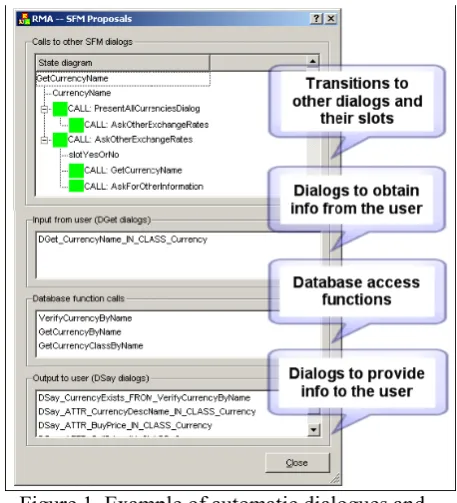
b.) Automatically propose the actions required for completing the information for each state of the dialogue flow; basically, the assistant proposes the dialogues to ask information to the user, the data-base access functions, and the dialogues to show information to the user. Figure 1 shows an example of the proposals for a banking application. In this example, the designer is editing a dialogue where given a currency name the system provides its spe-cific information (buy and sell price, general in-formation, etc.). Using the proposal window, all the designer would need to do is to select the cor-responding DGet in the window (DGet_CurrencyName_IN_CLASS_Currency),
then the database access function GetCurrencyBy-Name, and finally the DSays that provide the de-sired attributes from the currency. In order to pro-vide these proposals, we use the information of the relationships between slots and arguments of the database functions and the attributes and classes in the data model (section 5 and 6). When there is no relationship specified, we apply relaxed filters such as matching in types, similarity in names, or same number of arguments and slots in the state.
c.) Automate the process of passing information among actions/dialogues by proposing the vari-ables that best match the connections or allowing the creation of new variables when no match ex-ists. This is a critical aspect of dialogue applica-tions design. Several acapplica-tions and states have to be ‘connected’ as they use the information from the preceding dialogues. In general, most current de-sign platforms allow the same kind of functional-ity, offering the user a selectable list of all the
available variables in the dialogue. In other cases, especially considering the connections with data-base access functions, some platforms only allow the designer to define the matching by modifying by hand the script code. In this acceleration, we have tried to provide a better solution by automat-ing the connection through automatic proposals. The assistant detects the input/output variables re-quired in each action and offers the most suitable already defined variable of a compatible type; if there are more than one variable to show, the assis-tant sorts them according to the name similarity between variable and dialogue. If there is no com-patible variable already defined in the system or the name proposed is not desired, the assistant al-lows the creation of a new local/global variable. Additionally, the assistant includes a window where all this matching can be edited.
Other accelerations included in this assistant were the quick creation of mixed-initiative dia-logues, dialogues with over-answering (that do not exist in any current dialogue platform) and the quick definition of dialogue variables.
5), and into the assistant to define the states of the dialogue flow (section 6). The next sections de-scribe in detail these assistants and accelerations.
4
Strategies Applied to the Data Model
Assistant (DMA)
This assistant helps in the creation of the data model structure of the service through a visual rep-resentation of all possible fields to be requested and presented to the user, which consists of object oriented classes and attributes. The goal with these classes and attributes is to provide information to the next assistants in the platform about which fields in the database are relevant for the service and the relationships between tables and fields.
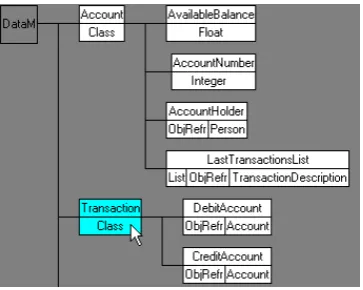
Figure 2. Example of class and attributes Each class, see Figure 2, can be characterized by a list of attributes, a description, and optionally a list of base classes (inheriting their attributes). The attributes may be: a) of atomic types (e.g., string, Boolean, float, date, etc., e.g., AvailableBalance), b) complex objects, obtained by embedding or re-ferring to an existing class (e.g., AccountHolder), or c) lists of either atomic type items or complex objects (e.g., LastTransactionList).
The main acceleration strategies, previously in-cluded in this assistant, are: a) re-utilization of li-braries with models created beforehand, which can be copied totally or partially, or used to create a new class by mixing them, b) automatic creation of a class when it is referenced as an attribute inside another one, and c) definition of classes inheriting the attributes of a base class. Since this is one of the first assistants of the platform, a significant effort was done to accelerate the creation of the database structure and to include information about the relationships between the class attributes and the fields and tables in the database. To start with,
the system generates and analyzes automatically heuristic information from the database contents. Then, with this information, the system proposes full custom classes and attributes that the designer can use when creating the data structure.
4.1 Extraction of heuristic information
The process is done using an open SQL query to retrieve information of every table, field and record in the database. This information includes the name and number of the tables and fields, and the number of records for every table. In addition, the following features for each field are also gener-ated: a) field type, b) average length, c) number of empty records, d) language dependent fields, and e) the proportion of records that are different. This information is shared among the assistants in order to simplify the design or to improve the presenta-tion of informapresenta-tion in the posterior assistants. For instance, they are used for: (a) to accelerate the creation of the data model structure (section 4.2), (b) and (e) to unify slots as mixed initiative or not (see section 6.1), (c) to sort by relevance the attrib-utes displayed by the wizard when creating the da-tabase structure (section 4.2), and (d) to not gener-ate stgener-ates for these fields in the SFMA since the dialogue flow in this assistant is language inde-pendent (section 6.1).
An important issue we found when retrieving the field type was that sometimes the metadata formation provided by the SQL function was in-correct due to: a) the driver for accessing the data-base was only able to return a limited number of types, e.g. Boolean or dates were mapped as inte-ger or string types respectively, b) the designer of the database defined the field using a generic type such as string or float when the visual inspection of the records showed that they actually corresponded to dates or integers, c) there were problems to map special types such as hyperlinks, binary, etc. into the types supported by our platform.
b) the empty type is assigned to fields with more than 95% of empty records.
In order to analyse the performance of the post-processing step, an objective evaluation was car-ried out. In this evaluation, twenty-one databases, most of them available online, were retrieved and visually inspected field by field. In total, there were 109 tables (an average of 5 tables per data-base), 767 fields and 610.506 records, which were classified by a human evaluator.
In our results, the average recognition was 89.6%, obtaining the best rates for dates, strings, and numeric quantities, which are the most com-mon types in most databases. Analyzing in detail the misrecognitions, 0.9% of floats were incor-rectly detected as integers due to values such as 2.0, 30.0, etc. which were automatically returned by the database driver without the decimal part. Another source of errors was detecting some nu-meric quantities due to special symbols such as dashes, percentages, or the euro symbol, which were incorrectly interpreted as a string type (3.3% and 1.6%). The major problems occurred for dis-tinguishing between the String type and what we called Mixed type (i.e. fields containing: URLs, emails, long strings, etc.) since they are, in prac-tice, the same. However, we wanted to separate them since for a speech recognizer they may be handled using different strategies (e.g. spelling, general grammars, etc.). The importance of these results is that they mean a reduction in the number of times the designer will need to change the pro-posed type for a given attribute when creating the classes (section 4.2).
4.2 Semi-automatic classes proposals
After collecting all the heuristics, the assistant pro-vides a wizard window that allows the designer to create the attributes for a new class from the tables and fields of the database or from already existing classes in the model. The information of the se-lected field and table is saved in the definition of the class attribute allowing future assistants in the platform to access this information easily (section 5.1 and 6.1). The heuristic information is used to set automatically the field types in the wizard, al-though it can be edited by the designer. Besides, the wizard also proposes automatic alternative names for the new class and attributes when it de-tects duplicated names with already defined ones.
Finally, if the number of tables in the database is too high the designer can select those that will be really needed during the design, this way reducing the information displayed on the screen. In addi-tion, it is also possible to customize the name of the tables in the database in order to make them more intuitive to the dialogue designer.
5
Strategies Applied to the Data
Connec-tor Model Assistant (DCMA)
This assistant allows the definition of the proto-types (i.e. only the input and output parameters) of the database access functions used in the runtime system. The advantage of using prototypes is that their actual implementation is not required during the design of the dialogue flow.
The main acceleration strategy, previously in-cluded in this assistant, was the possibility of relat-ing the input/output arguments to the attributes and classes of the data model. This information is used by the retrieval model assistant to create dialogue proposals and to automatically propose database access functions for a given dialogue in the design (section 3). In this work, we have introduced a new acceleration by incorporating a wizard window that allows the creation and debugging of the SQL statements used at run-time.
5.1 Semi-automatic generation of SQL
que-ries
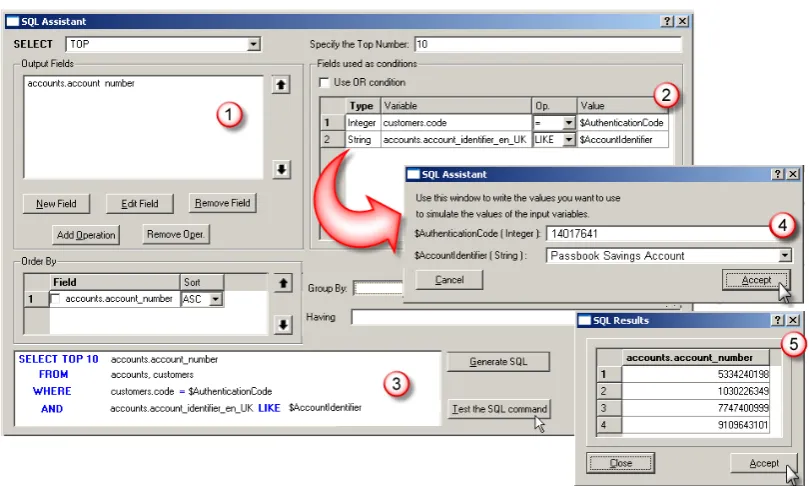
The main motivation behind this wizard window was to simplify the process of creating the function prototypes (API), reducing the necessity of learn-ing a new programmlearn-ing language (SQL), and to simplify the process of adding the query into the real-time modules and scripts. The new wizard semi-automatically creates the SQL statements for the given prototype and provides a pre-view of the results that the system would retrieve in the real-time system (see Figure 5 in Appendix A). This new acceleration is interesting since currently few development platforms include such kind of wizard forcing the designer to use third party software. Besides, current wizards only provide debugging tools, nice GUI features or support for many DB standards, but no automatic query proposals.
output arguments as returned fields for the SE-LECT clause. The assistant allows the inclusion of new input or output arguments if the function pro-totype is not complete or if the designer wants to test new combinations of arguments.
Finally, the wizard allows the designer to pre-view the records that the proposed SQL statement will retrieve at real-time. In order to debug the query, the designer specifies, using a pop-up win-dow, the values for the input arguments of the function to test the query (as acceleration, the wiz-ard automatically proposes real values retrieved from the database).
6
Strategies Applied to the State Flow
Model Assistant (SFMA)
This assistant is used to definethe dialogue flow at an abstract level, i.e. specifying only the high-level states of the dialogue, the slots to be asked to the user, and the transitions between states, but not the specific details of each state. The flow is specified using a state transition network representation that is common in this kind of platforms and dialogue modelling. The GUI allows the definition of new states using wizard-driven steps and a drag-and-drop interface. An important acceleration strategy from the previous version is the possibility of specifying the slots through attributes offered automatically from the data model. The new accel-erations are the automatic proposal of the slots to be requested using system or mixed initiative dia-logues (section 6.1) and the automatic generation of proposals of states for defining the dialogue flow (section 6.2).
6.1 Automatic unification of slots for mixed initiative
The idea of this acceleration is to allow the system to propose automatically when two or more slots must be requested one by one (using directed forms) or at the same time (using mixed initiative forms) according to the VoiceXML standard.
This functionality is only available when the slots to be analyzed have been defined from a table and field in the backend database. In this case, the assistant uses the heuristics obtained for the given fields and applies a set of customizable rules used to decide which slots can be unified and which ones cannot. Some examples of the rules applied to not propose the unification are: a) one of the slots
is defined as a string with an average length greater than 20 characters, an average number of words per record greater than 3, and the other slot is an integer/float number greater than 5 characters. In this case, the rule avoids the recognition of long strings, e.g. an address or name, plus the recogni-tion of long numeric quantities, e.g. phone or ac-count numbers, b) when two slots are defined as strings and the sum of the average length of both is greater than 20 characters; in this case, the system tries to avoid the recognition of very long sen-tences. c) there are two numeric slots with a pro-portion of different values close to one, and the total number of records of both fields is high (con-figurable value), then the system determines that these slots have a large vocabulary and a high probability of misrecognition. So, in all these cases, the system decides that it is better to ask one slot at a time (system initiative). In case there are more than two slots, the system checks different combinations of the slots in order to find those that can be requested at the same time and leaving the other one to be requested alone.
6.2 Automatic states
In this strategy, the assistant creates automatically dialogue states that include the slots to be re-quested to the user. Using the information of the database structure and the database access func-tions, the wizard allows the designer to access to the following state proposals:
Empty states and already created states: The first one allows the creation of a new empty state, with no defined slots inside, that the designer can define completely afterwards. This way, we allow a top-down design. The second one allows the de-signer to re-use already defined states.
From attributes with database dependency:
This kind of states is created from any attribute defined in the database model (DMA) that refers to a database field only if the attribute has been used as an input argument of any database access func-tion. The proposed states contain only one slot and its name corresponds to the name of the attribute in the data model. However, the designer can select several states to create states with multiple slots.
and the input arguments as slots for that state. The assistant allows the designer to select several of these proposals in order to create more complex states. For instance, in case there is a database ac-cess function called convertCurrencies, which re-ceives three input arguments (i.e. fromCurrency,
toCurrency, and Amount), the system automati-cally creates a new state proposal called convert-Currencies that includes these three slots. Apply-ing similar rules to the ones described in section 6.1 the system would propose to request the first two at the same time (mixed-initiative) and the
Amount separately (directed forms).
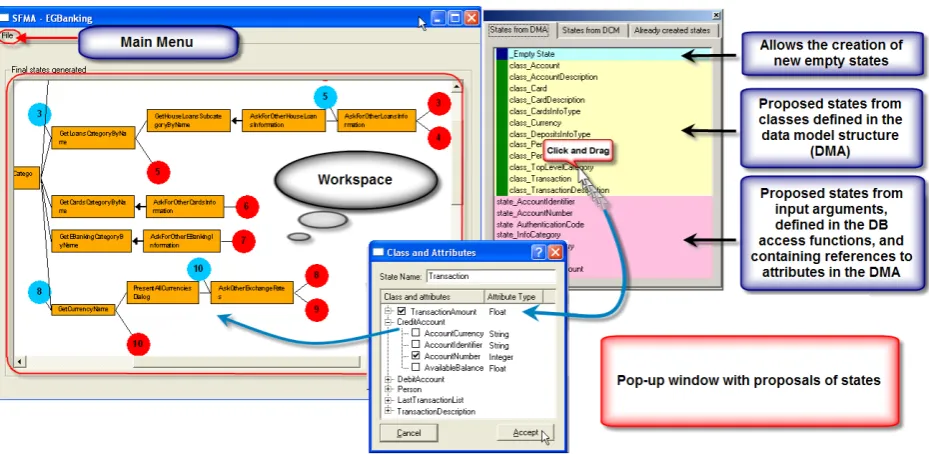
From classes defined in the data model struc-ture: In this case, the assistant creates a template that the designer can drag and drop into the work-space (see Figure 6 in Appendix A). Then, a pop-up window allows the designer to select the attrib-utes to be used as slots. The assistant expands complex attributes (with inheritance and objects) allowing only the selection of atomic attributes.
7
Evaluation
With the objective of evaluating the performance of each of the acceleration strategies and assistants described above, we carried out a subjective and objective evaluation with 9 developers with differ-ent experience levels and profiles (4 novices, 3 intermediates, and 2 experts) on designing dia-logue services. They were requested to fulfil dif-ferent typical tasks covering each of the proposed accelerations and assistants to evaluate. Further details can be obtained in (D’Haro, 2009).
For the subjective evaluation, the participants were asked to answer a questionnaire that consists of four questions per assistant and seventeen for the overall platform, with a range between 1 and 10. This subjective evaluation confirms the de-signer-friendliness of the assistants, as well as their usability, since all the assistants obtained a global score higher than 8.0, which is a nice result. In de-tail, the DMA and DCMA obtained an 8.3, the SFMA a 9.0, the RMA an 8.6, and Diagen a 4.5. Regarding the acceleration strategies, see Figure 3a, the evaluators scored the automatic states with 9.3, the SQL generation and the unification of slots for mixed initiative with 9.0, and the class propos-als with 8.9. Regarding the RMA and the accelera-tions related with the information extracted from the database (see section 3), the passing of
argu-ments between actions and the proposal of dia-logue actions obtained a 9.8 and 8.6 respectively.
For the objective evaluation, we collected the metrics proposed in (Jung et al, 2008): elapsed time, number of clicks, number of keystrokes, and number of corrections using the keyboard (key-stroke errors). We compared our assistants with a built-in editor called Diagen, created during the GEMINI project and improved later on by (Hamerich, 2008), which features fewer accelera-tions but generates the same information specified by our assistants. As accelerations, Diagen only provides default templates that the designer has to complete and a guided procedure using different pop-up windows to fulfil the templates. The results confirm that the design time can be reduced, in average for all the assistants and tasks, in more than 45%, the number of keystrokes in 81%, and the number of clicks in 40%. Especially relevant is the high reduction (85%) obtained in the RMA considering that it is the main task in the design.
8
Conclusions and Future Work
In this paper, we have described the main accelera-tions incorporated into a complete platform for designing multimodal and multilingual dialogue applications. The proposed accelerations strategies are based on using information extracted from the contents of the backend database. The proposed accelerations include the creation of automatic state proposals, the unification of slots to be re-quested using mixed-initiative dialogues, and the semi-automatic creation and debugging of SQL statements for accessing the database, among oth-ers. Subjective and objective evaluations confirm that the proposed strategies are useful and contrib-ute to simplify and accelerate the design.
As future work, we propose the extraction of new heuristic information, the creation of new rules for unifying slots for mixed-initiative dia-logues. Considering the negative values in Figure 3b, we propose to improve the GUI for defining the connections among states in the SFMA, and to improve the DCMA by offering new automated methods for creating the prototypes.
9
Acknowledgements
Figure 3. Average result for the: a) subjective evaluation for the accelerations, b) objective results
References
Chung, G. 2004. Developing a Flexible Spoken Dialog System Using Simulation. ACL 2004.
D’Haro. L. F. 2009. Speed Up Strategies for the Crea-tion of Multimodal and Multilingual Dialogue Sys-tems. PhD Thesis. Univ. Politécnica de Madrid. D’Haro, L. F., Cordoba, R., et al. 2008. Language
Model Adaptation for a Speech to Sign Language Translation System Using Web Frequencies and a MAP framework. Interspeech 2008, pp. 2119-2202. D’Haro, L. F., Cordoba, R., et al. 2006. An advanced
platform to speed up the design of multilingual dia-logue applications for multiple modalities Speech Communication Vol. 48, Issue 8, pp. 863-887. D’Haro, L. F., Cordoba, R., et al. 2004. Strategies to
reduce design time in multimodal/multilingual dialog applications. ICSLP 2004, pp IV-3057–3060.
Feng, J., Bangalore, S., Rahim, M. 2003. WEBTALK: Mining Websites for Automatically Building Dialog Systems. ASRU 2003, pp. 168-173.
Hamerich, S. 2008. From GEMINI to DiaGen: Improv-ing Development of Speech Dialogues for Embedded Systems. 9th SIGDIAL, pp. 92-95.
Jung, S., Lee, C., et. al. 2008. DialogStudio : A Work-bench for Data-driven Spoken Dialogue System De-velopment and Management. Speech Communica-tions, 50 (8-9), pp. 683-697.
Pargellis, A. N., Kuo, H. J., Lee, C. 2004. An automatic dialogue generation platform for personalized dia-logue applications. Speech Communication Vol. 42, pp. 329-351.
Polifroni, J. and Walker, M. 2006. Learning Database Content for Spoken Dialogue System Design. LREC 2006, pp. 143-148.
Appendix A. Additional Figures
Figure 4. Platform architecture. In yellow colour the assistants with the new accelerations described in this paper. In pink colour assistants with previous accelerations (section 3)
Figure 5. Wizard for creating and debugging the SQL statements for accessing the backend database. In the example, the proposed query allows the selection of all account numbers for a given customer
Figure 6. Workspace for creating the state transition network and pop up window with state proposals. In the example, the designer creates the state Transaction from the Class_Transaction template (cre-ated in the DMA, see Figure 2) and selects as slots the TransactionAmount, CreditAccountNumber and