Analysis of reduced-SHAvite-3-256 v2
∗Marine Minier1, Mar´ıa Naya-Plasencia2, and Thomas Peyrin3
1 Universit´e de Lyon, INRIA,
INSA-Lyon, CITI, F-69621, Villeurbanne, France
2 FHNW, Windisch, Switzerland 3
Nanyang Technological University, Singapore
Abstract. In this article, we provide the first independent analysis of the (2nd-round tweaked) 256-bit
version of theSHA-3candidate SHAvite-3. By leveraging recently introduced cryptanalysis tools such as rebound attack or Super-Sbox cryptanalysis, we are able to derive chosen-related-salt distinguishing at-tacks on the compression function on up to 8 rounds (12 rounds in total) and free-start collisions on up to 7 rounds. In particular, our best results are obtained by carefully controlling the differences in the key schedule of the internal cipher. Most of our results have been implemented and verified experimentally.
Keywords:rebound attack, Super-Sbox, collision, distinguisher,SHAvite-3,SHA-3
1 Introduction
In cryptography hash functions are one of the most important and useful tools. Ann-bit cryptographic hash functionHis a function taking an arbitrarily long message as input and outputting a fixed-length hash value of size nbits. One wants such a primitive to be collision resistant and (second)-preimage resistant: it should be impossible for an attacker to obtain a collision (two different messages hashing to the same value) or a (second)-preimage (a message hashing to a given challenge) in less than 2n/2 and 2ncomputations respectively. However, in many protocols hash functions are used to simulate the behavior of a random oracle [1] and the underlying security proof often requires the hash function H to be indistinguishable from a random oracle. This security notion naturally extends to a fixed-input length random oracle with a compression function.
In recent years, we saw the apparition of devastating attacks [23, 22] that broke many standardized hash functions [20, 14]. The National Institute of Standards and Technology (NIST) launched theSHA-3
competition [16] in response to these attacks and in order to keep an appropriate security margin considering the increase of the computation power or potential further cryptanalysis improvements. The outcome of this competition will be a new hash function standard, to be selected in 2012. Among the 64 candidates originally submitted and the 14 ones selected for the 2nd round of the competition, one can observe that a non negligible proportion areAES-based proposals (algorithms that reuse some parts of the AES block cipher [15, 5] or mimic its structure), as it is the case with SHAvite-3 [3] for example.
This fact motivated the academic community to improve its knowledge concerning the security of the AES block cipher or AES-like permutations in the setting of hash functions [17, 8, 13, 11, 10, 12, 7]. For an attacker, one of the major distinction between cryptanalyzing a block cipher and a hash function is that in the latter he has full access to the internal computation and thus he can optimize its utilization of the freedom degrees. In particular, the recentSHA-1attacks where made possible thanks to an improvement of the utilization of the freedom degrees. In the case ofAES-based hash functions, the rebound attack [13, 10], Start-from-the-middle [12] or Super-Sbox cryptanalysis [7] are very handy tools for a cryptanalyst, that can provide a very efficient use of the available freedom degrees.
∗
During the first round of theSHA-3competition,SHAvite-3was first analyzed by Peyrin [18] who showed that an attacker could easily find chosen-counter chosen-salt collisions for the compression function. This weakness led to a tweaked version of the algorithm for the second round. Then, recently new cryptanalysis results [4, 6] on the 512-bit version of SHAvite-3 were published, in particular a chosen-counter chosen-salt preimage attack on the full compression function of SHAvite-3-512.
Our contributions. In this paper, we give the first cryptanalysis results on the tweaked 256-bit version of SHAvite-3-256. By using the rebound attack or Super-Sbox cryptanalysis, we are able to derive distinguishers for a reduced number of rounds of the internal permutation of SHAvite-3-256. Those results can then be transformed into distinguishers or can be used to mount a free-start collision attack for reduced versions of the compression function. The number of rounds attacked can be further extended by authorizing the attacker to fully control the salt values. The results are summarized in Table 1. We emphasize that most of the attacks have been implemented and verified experimentally.
Table 1.Summary of results for theSHAvite-3-256 compression function.
rounds computational memory type section
complexity requirements
6 280 232 free-start collision Section 3
7 248 232 distinguisher Section 3
7 27 27 chosen-related-salt distinguisher Section 4.1
7 225 214 chosen-related-salt free-start near-collision Section 4.2
7 296 232 chosen-related-salt semi-free-start collision Section 4.3 8 225 214 chosen-related-salt distinguisher Section 4.2
2 The SHAvite-3-256 Hash Function
SHAvite-3-256 is the 256-bit version ofSHAvite-3[3], an iterated hash function based on the HAIFA
framework [2]. We describe here the tweaked version of the algorithm. The messageM to hash is first padded and then split into ` 512-bit message blocks M0kM1k. . .kM`−1. Then, the 256-bit internal state (initialized with an initial value IV) is iteratively updated with each message block using the 256-bit compression functionC256. Finally, when all the padded message blocks have been processed, the output hash is obtained by truncating the internal state to the desired hash size nas follows:
h0 =IV
hi =C256(hi−1, Mi−1, salt, cnt)
hash=truncn(hi)
Internally, the 256-bit compression function C256 of SHAvite-3-256 consists of a 256-bit block cipherE256 used in classical Davies-Meyer mode. The input of the compression functionC256 consists of a 256-bit chaining value hi−1, a 512-bit message block Mi−1, a 256-bit salt (denoted salt) and a 64-bit counter (denoted cnt) that represents the number of message bits processed by the end of the iteration. The output of the compression functionC256 is given by:
hi =C256(hi−1, Mi−1, salt, cnt) =hi−1⊕EMi256−1ksaltkcnt(hi−1)
where⊕ denotes the XOR function.
2.1 The block cipher E256
The internal block cipherE256of theSHAvite-3-256 compression function is composed of 12 rounds of a classical 2-branch Feistel structure. The chaining variable inputhi−1 is first divided into two 128-bit chaining values (A0, B0). Then, for each round i= 0, . . . ,11, the Feistel construction computes:
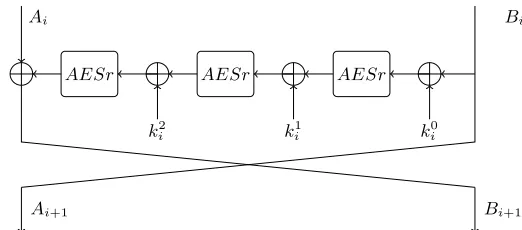
where Fi is a non-linear function composed of three full AESrounds. More precisely, if one considers
thatAESrdenotes the unkeyedAESround (i.e. SubBytesSB, ShiftRowsShRand MixColumnsM C functions in this order), then Fi is defined by (see Figure 1) :
Fi(x) =AESr(AESr(AESr(x⊕ki0)⊕k1i)⊕ki2) (1)
where ki0, ki1 and ki2 are 128-bit local keys generated by the message expansion of the compression functionC256(it can also be viewed as the key schedule of the internal block cipherE256). We denote by RKi = (ki0, ki1, k2i) the group of local keys used during round iof the block cipher.
Ai Bi
AESr
k2i
AESr
k1i
AESr
k0i
Ai+1 Bi+1
Fig. 1.Roundiof the state update ofSHAvite-3-256 compression function.
2.2 The message expansion
The message expansion ofC256 (the key schedule ofE256) takes a 512-bit message blockMi, the
256-bit salt (salt) and the 64-256-bit counter (cnt) as inputs. The 512-256-bit message block Mi is represented as
an array of sixteen 32-bit words (m0, m1, . . . , m15), the 256-bit salt as an array of eight 32-bit words (s0, s1, . . . , s7) and the counter as an array of two 32-bit words (cnt0, cnt1). 36 AES local subkeyskji
(with 0≤i≤11 and 0≤j≤2), each of 128 bits, must be generated. We view them as 144 words of 32 bits each (one word standing for one AEScolumn), represented in an array rk[0...143]:
(k0i, ki1, ki2) = (rk[12·i], rk[12·i+ 1], rk[12·i+ 2], rk[12·i+ 3]), (rk[12·i+ 4], rk[12·i+ 5], rk[12·i+ 6], rk[12·i+ 7]), (rk[12·i+ 8], rk[12·i+ 9], rk[12·i+ 10], rk[12·i+ 11])
The first 16 values of the array rk are initialized with the message block mi, i.e. rk[i] = mi with
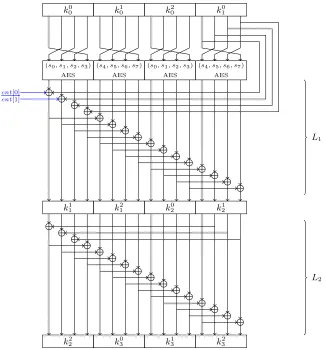
0≤i≤15. Then, the rest of the array is filled by repeating four times the step described in Figure 2. During one step, sixteen 32-bit words are first generated using parallel AES rounds and a subsequent linear expansion step L1 (the salt words are XORed to the internal state before applying the AES
rounds). Note that during each step the two counter wordscnt0 and cnt1 (or a complement version of them) are XORed with two particular 32-bits words at the output of the AES rounds. Then, sixteen more 32-bit words are computed using only another linear layerL2. For more details on the message expansion, we refer to the submission document of the tweaked version of SHAvite-3 [3].
3 Rebound and Super-Sbox Analysis of SHAvite-3-256
k0
0 k10 k02 k01
(s0, s1, s2, s3) AES
(s4, s5, s6, s7) AES
(s0, s1, s2, s3) AES
(s4, s5, s6, s7) AES
L1
L2
cnt[0]
cnt[1]
k11 k21 k20 k12
k22 k03 k31 k23
Fig. 2.The first step of the message expansion of theSHAvite-3-256 compression function. Note that the salt words are XORed to the internal state before the parallelAESrounds application. Moreover, the counters are XORed in different positions for different steps of the message expansion.
3.1 The cryptanalyst tool 1: the truncated differential path
When cryptanalyzing AES-based hash functions (or more generally byte-oriented primitives), it has been shown [17] that it is very handy to look at truncated differences [9]: instead of looking at the actual difference value of a byte, one only checks if a byte contains a difference (active byte) or not (inactive byte). In addition to simplifying the analysis, the direct effect is that the differential behavior through the non-linear Sboxes becomes deterministic. On the other hand, the differential transitions through the linear MixColumns layer will be verified probabilistically.
More precisely, the matrix multiplication underlying theAESMixColumns transformation has the interesting property of being a Maximum Distance Separable (MDS) mapping: the number of active input and output bytes for one column is always greater or equal to 5 (unless there is no active input and output byte at all). When picking random input values, the probability of success for a differential transition that meets the MDS constraints through a MixColumns layer is determined by the number of active bytes in the output: if such a differential transition contains k active bytes in one column of the output, its probability of success will approximatively be equal to 2−8×(4−k). For example, a 47→1 transition for one column has success probability of approximatively 2−24. Note that the same reasoning applies when dealing with the invert function as well.
only, one fully active diagonal only and one active byte only. All those masks are depicted in Figure 3. Considering those 4 types of differential masks seems natural because of the symmetry and diffusion properties of anAES round.
F C D 1
Fig. 3.Byte-wise truncated differential for anAESstate. Each cell represents a byte and a gray cell stands for an active byte.
We are especially interested in the truncated differential transitions through 3 rounds of theAES
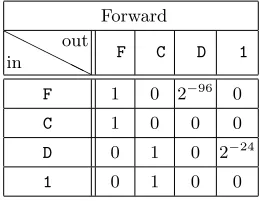
since it is the main basic primitive used in the round function of the SHAvite-3-256 compression function. We would like to know what is the probability to go from one truncated differential mask to another (both forward and backward) and the corresponding differential path. First, we can compute the approximate probability of success for a one-round transition between the four types of truncated differential states and this is given in Table 2 for both forward and backward directions. Those proba-bilities are simply obtained by studying the MixColumns transitions for oneAESround. For example, with this table one can easily check that when computing forward, going from D to F with the trail
D7→17→C7→Fhappens with probability 2−24 with randomly selected input values and active bytes difference values.
Table 2. Byte-wise truncated differential transition approximated probabilities for one round of AES. The left table shows forward transitions, while the right one gives backward transitions.
Forward
H H
H
HH
in out
F C D 1
F 1 0 2−96 0
C 1 0 0 0
D 0 1 0 2−24
1 0 1 0 0
Backward
H H
H
HH
in out
F C D 1
F 1 2−96 0 0
C 0 0 1 2−24
D 1 0 0 0
1 0 0 1 0
3.2 The cryptanalyst tool 2: the freedom degrees
the middle of the differential trail with only a few operations on average and works for any differential path. The idea is that one can view two rounds of an AES-like permutation as the parallel application of a layer of big Sboxes, named Super-Sboxes, preceded and followed by simple affine transformations. This technique can find several solutions for an average cost of 1, but there is a minimal cost to pay in any case: the complexity of the attack in the case of theAESpermutation is max{232, k}computations and 232 memory, where kis the number of solutions found verifying the controlled rounds.
3.3 Super-Sbox attacks for reduced SHAvite-3-256
Having introduced our cryptanalyst tools, we will derive distinguishing attacks for the 7-round re-ducedSHAvite-3-256 compression function, or even free-start collision attacks (collision for which the incoming chaining variable is fully controlled by the attacker) for the 6-round reduced version. We start with the 6-round truncated differential path built by removing the last round of the 7-round differential path depicted in Figure 4. First, one can check that this path is valid as it contains no im-possible MixColumns transitions. Moreover, a simple analysis of the amount of freedom degrees (as it is done in [7]) shows that we have largely enough of them in order to obtain at least one valid solution for the whole differential path: we have a probability of about 2−48that a valid pair for the differential path exists when the ∆ and the subkeys values are fixed. Randomizing those values provides much more than the 248 freedom degrees required.
first round
second round
third round
fourth round
fifth round
sixth round
seventh round
∆
∆
∆
∆ ∆
∆ ∆
∆
∆
∆
2−24
2−24
Super-Sbox
Super-Sbox
Fig. 4.The 7-round truncated differential path. The left part represents the three first rounds and the right part the four last ones. Each gray cell stands for an active byte. A hatched state denotes a fully active state obtained by applying the MixColumns function on only one active byte per column. During the path, allD128-bit words contain the difference
∆.
128-bit pair for the fourth round, mapping the difference∆to the very same difference through the 3
AESrounds. Then, we will do the same for the third round.
The subkeys used during the fourth round are k03, k13, k32. We first choose a random value for k23. Then, using the Super-Sbox technique, for a cost of max{232,232} = 232 computations and 232 memory, one can generate 232 pairs of 128-bit states verifying the truncated differential path for the 3 AES rounds in the right branch of the fourth round: D7→ C7→ F7→ D. At the present time, we did not fixk03 nork13, because we were only looking at truncated differences: for each 128-bit solution pair found, the 3 AESrounds truncated differential path will be verified whatever is the value of k0
3 or k31 (more precisely k31 will only have an incidence on the exactD-type difference value on the input of the pairs, while k03 will have no incidence on the difference at all). Note that the Super-Sbox technique allows us to directly force the exact difference value∆at the output of the 3AESrounds. Indeed, one can observe that the output of the 3 AES rounds is only a linear combination of the 4 Super-Sboxes outputs. However, the exact difference value on the four active bytes at the input of the 3AESrounds is unknown because of the SubBytes layer of the firstAESround. In order to get the desired difference value ∆ on the input as well, for each solution pair we choose accordingly the value of k31. More precisely, only the first column of k13 must be accommodated (only the first column is active when incorporating k1
3) and this can be done byte per byte independently. Exhausting all the AES Sbox differential transitions during a 216 operations precomputation phase allows us to perform this step with only four table lookups. At this moment, for a cost of 232 computations and memory, we found 232 pairs of 128-bit states that map ∆to ∆ through the 3 AES rounds of the fourth SHAvite-3-256 round. For each pair, the value ofk23 and the first column ofk13 are fixed, but the rest of the message is free to choose.
We perform exactly the same method in order to find 232 pairs of 128-bit states that map∆to∆ through the 3 AESrounds of the thirdSHAvite-3-256 round. The only difference is that we will have to fixk22 and choose the first column of k21. This can be done independently from the previously fixed values ofk23 and the first column of k13 (by setting the second column of k31, see Figure 2). We are left with two sets, each of 232 pairs, verifying independently the third and fourth rounds. The subkey material that remains free is set to a random value and the second and fifth rounds of the differential path is verified with probability 1.
Then, the rest of the path (the uncontrolled rounds) is verified probabilistically: we have one
D 7→ 1 7→ C 7→ F transition in the first round and another one in the sixth round. As already demonstrated, this happens with probability 2−2∗24 = 2−48. Overall, one can find a valid candidate for the whole 6-round truncated differential path with 248 computations and 232memory.
If the very last branch switching of the Feistel structure is removed (at the end of the sixth round) and due to the Davies-Meyer construction, one can obtain a free-start collision if the active byte differences on the input of the first round are equal to the active byte differences on the output of the sixth round. This happens with probability 2−32because we have the right 128-bit word of the internal state containing the difference ∆ on both the input and output. The left one is fully active but its differences belong to a byte subspace since only one MixColumns linear application away from a 4-byte difference (hatched states in Figure 4). Finally, by repeating the process, one can find a free-start collision for 6-round reduced SHAvite-3-256 with 248+32 = 280 computations and 232 memory.
in a subspace of 232 elements (since the message/salt/counter inputs contain no difference and the value of ∆ is fixed). This is equivalent to mapping a fixed 672-bit input difference (224 bits for the chaining variable, 256 bits for the non active incoming message chunk, 128 and 64 bits for the non active incoming salt and counter chunks respectively) to a fixed 96-bit output difference through a 704-bit to 256-704-bit compression function. According to the limited-birthday distinguishers [7], this should require 264 computations in the ideal case.1 Thus, one can distinguish a 7-round reduced version of the SHAvite-3-256 compression function with 248 computations and 232 memory.
4 Chosen-Related-Salt Distinguishers
While the previous section takes a full advantage of the Super-Sbox techniques in its analysis, this sec-tion presents an attack that uses rebound attack principle fully exploiting the message expansion. This leads to 7-round and 8-round chosen-related-salt distinguishers on the SHAvite-3-256 compression function with a complexity of 27and 225operations respectively. Also, one can find chosen-related-salt semi-free-start collisions on 7 rounds of the SHAvite-3-256 compression function with a complexity of 296 operations. In this section, we will insert differences in the message and in the salt input of the compression function. The main principle of those analyses relies on correcting the differences at the end of each round so that they are not spread afterwards. The 8-round differential path used is given in Figure 5, while the 7-round version is obtained by removing the seventh round. All the differences in the successive internal states will be canceled from state 1 to state 7. This could be done by considering differences in the first four 32-bit words of thesaltdenoted (s0, s1, s2, s3), in eight 32-bit message words (m0, m1, m2, m3) and (m8, m9, m10, m11) and differences in A0, the left part of the initial chaining value, the other parameters being taken without any difference. The notations used are the ones of Section 2:Ai denotes the left part of the state at roundi(whereigoes from 0 to
8), andBi the right part of the internal state at roundi.
The difference values in the salt words and in the message words are chosen to be identical (∆1), so that they cancel for the subkeys generated after the first round of the message expansion. Moreover, the subkeys involved in rounds 2, 3 and 4 will not contain any difference (as shown on Figure 6). We concentrated our analysis on the active rounds in the middle of the trail, i.e. rounds 5, 6 (and 7 in the case of the 8-round distinguisher). The probability of success for the rest of the differential path is one since in the first round the differences can spread freely.
We start by finding a valid pair that verifies the path for the rounds 5, 6 and 7. Let us remember that at the beginning, we have just established the truncated differential path, i.e. the actual difference values in the bytes are unknown. Thus, when required, we will fix the difference values of the active bytes and also the values themselves. We will insert differences in the first four salt words (s0, s1, s2, s3), all their bytes being active. As before, when we refer to words, we denote theAEScolumn 32-bit words in the message expansion.
For a better understanding of the distinguisher procedure, we discriminate 5 distinct kinds of ways in order to determine values and differences:
– Typeameans that we directly choose the values and the differences. This can be done when there is no previous restriction.
– Typeb are determined by the linear part of the message expansion. In this case, a linear relation of previously fixed differences or values completely determines the remaining ones.
– Typecare determined by the non-linear part of the message expansion. Here, a non linear relation of previously fixed differences and values determines the remaining ones.
1As shown in [7], if we denote byi(resp.j) the number of fixed-difference bits in the input (resp. in the output) and
∆1 0 ∆1 first round 0 0 0 second round 0 0 0 third round 0 0 0 fourth round ∆2 ∆2 ∆3 fifth round ∆3 ∆4 ∆5 sixth round ∆6 ∆7 ∆8 seventh round ? ? ? eight round
Fig. 5.The 8-round truncated differential path. The left part represents the four first rounds and the right part the four last ones. Each gray cell stands for an active byte. The ∆’s in each round denote the differences incorporated by the subkeys. For the 7-round differential path, we remove the differences control in the seventh round.
k
0,0
∆
=
∆
1
k
1,0
∆
=
0
k
2,0
∆
=
∆
1
k
0,1
∆ = 0 s0 s1 s2 s3 s4 s5 s6 s7 s0 s1 s2 s3 s4 s5 s6 s7 ∆ = ˜ ∆ 1 ∆ = ˜ ∆ 1 ∆ = 0 ∆ = 0 four parallel AES rounds first linear la y er k
1,1
∆
=
0
k
2,1
∆
=
0
k
0,2
∆
=
0
k
1,2
∆ = 0 second linear la y er k
2,2
∆
=
0
k
0,3
∆
=
0
k
1,3
∆
=
0
k
2,3
∆ = 0 s0 s1 s2 s3 s4 s5 s6 s7 s0 s1 s2 s3 s4 s5 s6 s7 four parallel AES rounds first linear la y er k
0,4
∆
=
∆
2
k
1,4
∆
=
∆
2
k
2,4
∆
=
∆
3
k
0,5
∆ = ∆ 3 second linear la y er k
1,5
∆
=
∆
4
k
2,5
∆
=
∆
5
k
0,6
∆
=
∆
6
k
1,6
∆ = ∆ 7 s0 s1 s2 s3 s4 s5 s6 s7 s0 s1 s2 s3 s4 s5 s6 s7 four parallel AES rounds first linear la y er k
2,6
∆
=
∆
8
k
0,7
∆
=?
k
1,7
∆
=?
k
2,7
∆
=?
Fig. 6.Differential cancellation and differential equalities in the message expansion for the 7-round and 8-round chosen-related-salt distinguishers on theSHAvite-3-256 compression function. ˜∆represents the difference∆after application of the column switching layer just before the salt incorporation.
– Type e are fixed by the AES rounds. This basically represents the conditions associated to the controlled rounds part.
From now on and for a better clarity, we indicate its type in brackets for each determination. When omitted, the default type is a. We will first describe the distinguisher on 7 rounds and then the one on 8 rounds.
4.1 7-Round Distinguisher with 27 computations
As partially shown on Figure 5, the aim of the 7-round distinguisher is to find a pair of plain-text/ciphertext values for the internal block cipher of SHAvite-3-256 such that there is no difference on the right part of the plaintext and on the left part of the ciphertext. As shown in [7], the corre-sponding complexity to find such a structure for a random permutation is equal to 264 computations. We show in this section how to find a pair of inputs that verifies the path with a time and memory complexity of 27 (by omitting the last branch swapping of the Feistel construction, the attack also applies to the compression function SHAvite-3-256 with the same practical and ideal complexities). In order to build this distinguisher, we would like to find values and differences of the subkeys such that the difference in the 3 AES rounds during SHAvite-3-256 rounds 5 and 6 are auto-erased. The differences generated by the subkeys in the seventh round are let completely free for the 7-round distinguisher and it will not be the case for the 8-round distinguisher. We first give in Table 3 how to fix the degrees of freedom in order to avoid any impossibility.
Fifth round: As described in Figure 5, after the fourth round, the inputs of the fifth do not contain any active byte. The differences will be injected during the fifth round through the message expansion. The idea is to erase those differences directly during the fifth round. This will be achieved by carefully choosing the actual values of the bytes.
We choose (type a) the difference in k40 to be ∆2 and this sets (type b) the difference in k41 to be ∆2 as well. Then we pick a random difference value for k24 that we denote ∆3. Note that due to the message expansion,∆2 and∆3⊕∆2 must be 128-bit output differences that can be obtained from the same input difference after application of oneAESround. Indeed, as shown in Figure 6,∆2 and∆3⊕∆2 are constructed from the∆1 difference inserted by the salt after application of oneAESround. In fact, for randomly chosen ∆2 and ∆3 values, this is verified with very high probability. Those particular differences also fix (typeb) the difference values of the 9 subkeys used in rounds 5, 6 and 7. However, note that k62 is determined after one anotherAESnon-linear round (as shown in Figure 6).
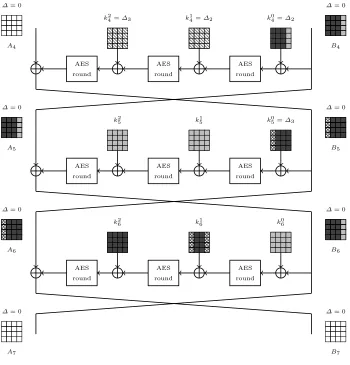
Once∆2 and ∆3 differences fixed, we need to set the values themselves in this fifth round. To do so, we choose random value forB4⊕k04 (see Figure 7) and we can compute forward the differences just before the SubBytes layer of the second AESround. We can also propagate the differences backwards from the insertion of ∆3 up to the output of this SubBytes layer. Due to the AES Sbox differential property, with a probability of 2−16, the differences before and after the second SubBytes can be matched (2−1 per Sbox). Thus, we will have to try 216values ofB4⊕k04 before finding a match. Note that this cost can be reduced to 4×24 = 26 by attacking all the columns independently. When such a solution is found, we directly pick (type e) a value ofk41 that makes this match happen.
Table 3.Order and conditions for fixing values and differences.∆2 and∆3 are chosen such that∆2 and∆2⊕∆3 can
be both generated from an AES layer with the same difference in the inputs (for randomly chosen∆2 and ∆3, this is
verified with very high probability). When going through all these steps followed in the given order, we are left with the degrees of freedom associated to the values of the words of the salts0, s1, s2, s3. Thus, we can pick a random value for
those remaining freedom degrees and finally compute the valid pair for the 7-round differential path. * represents the steps that are not executed for the distinguisher over 8 rounds.
Instant Fixed (typea) Implies Type Cost
Beginning ∆k0
4 =∆2 ∆k14=∆2 b 1
∆k42=∆3 ∆k05=∆3 b 1
∆k15=∆2⊕((∆3∧(296−1))||((∆3>>96)⊕∆2)∧(232−1)) b 1
∆k2
5=∆2⊕((∆k15∧(296−1))||((∆k51>>96)⊕∆2)∧(232−1)) b 1
∆k06=∆3⊕((∆k25∧(296−1))||((∆k52>>96)⊕∆3)∧(232−1)) b 1
∆k16=∆3⊕((∆k06∧(2 96−
1))||((∆k60>>96)⊕∆3)∧(232−1)) b 1
Round 5 B4⊕k40 k14 :AESr(AESr(B4⊕k04)⊕k14)⊕ e 26
AESr(AESr(B4⊕k04⊕∆2)⊕k14⊕∆2) =∆3
Round 6 B5⊕k50 k15 :AESr(AESr(B5⊕k05)⊕k15)⊕ e 26
AESr(AESr(B5⊕k05⊕∆3)⊕k51⊕∆k15) =∆k25
k2
5=k14⊕((k15)∧(296−1)||((k15>>96)⊕k41)∧(232−1) b 1
k40∧(232−1) = (k51∧(232−1))⊕(((k15)>>96)∧(232−1)) b 1
B4∧(232−1) = (k40∧(232−1))⊕(k40⊕B4)∧(232−1) b 1
End δs0. . . δs3=∆1 k24:AESr−1(k24⊕k14)⊕ c 1
AESr−1(k
2 4⊕k
1
4⊕∆2⊕∆3) =∆1
k0
6=k24⊕((k25∧(296−1))||((k25>>96)⊕k24)∧(232−1) b 1
* k50 (k04>>32)∧(296−1) =k50∧(296−1) b 1
k1
6=k05⊕(k06∧(296−1)||((k06>>96)⊕k05)∧(232−1) b 1
s4. . . s7:AESr−1(k40⊕cnt⊕AES−r1(k05⊕k24)⊕s4||s5||s6||s7)⊕ c 1
AES−1
r (k04⊕ct⊕AES
−1
r (k05⊕k24)⊕s4||s5||s6||s7⊕∆2) =∆1
B4=k04⊕(k04⊕B4) d 1
B5=k05⊕(B5⊕k50) d 1
The final step: Now, if we randomly fix the values and differences δs0, δs1, δs2, δs3, andk05, the values ofk24,k60,k04,k61,s4,s5,s6,s7,B4 andB5 will also be determined (as shown in Table 3). At this point, we have obtained some coherent values that verify the differential path of rounds 5 and 6, and the only degrees of freedom left are the values of s0,s1,s2 and s3. We can just pick up one and compute backward and forward, and we obtain the whole path, where the inputs have just the left part of the state active, and the output, before the Davies-Meyer, the right one.
The total cost for the distinguisher is driven by the two first steps, that is 2×26= 27operations in order to find one valid candidate. This distinguisher has been implemented and verified experimentally. We provide in Appendix A an example of such a structured input/output pair (which should not be generated with less than 264operations in the ideal case).
4.2 8-Round Distinguisher with 225 computations
AES round
AES round
AES round
k42=∆3 k14=∆2 k04=∆2
AES round
AES round
AES round
k25 k15 k05=∆3
AES round
AES round
AES round
k26 k16 k06
A4
A5
A6
A7
B4
B5
B6
B7
∆= 0
∆= 0
∆= 0
∆= 0
∆= 0
∆= 0
∆= 0
∆= 0
Fig. 7.Details of rounds 5, 6 and 7 of the 8-round chosen-related-salt distinguisher on theSHAvite-3-256 compression function. The bytes denoted with north-west lines are fixed during the fifth round. The light gray bytes are fixed during the sixth round. The dark gray bytes are fixed at the beginning of the seventh round whereas the bytes denoted with hatched cells are fixed at the end of the seventh round.
would like also that the differences inserted during the seventh round cancel themselves, whereas the differences inserted during the eighth round can freely spread. In order to fulfill this requirement, after having handled the sixth round, instead of randomly choosing the value of k05 one first chooses the values ofs0,s1,s2 and s3, which will allow us to determine the difference in k62.
Fixing the differences in the seventh round: We introduce the following notations: let S be a 128-bit
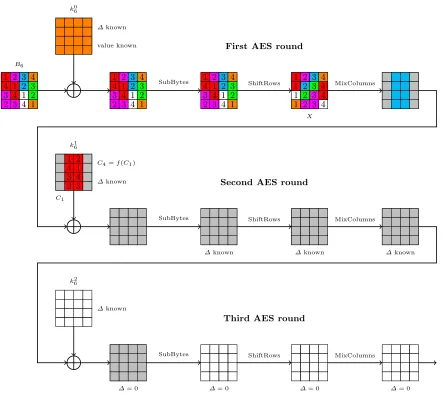
AES state, we denote (S)i the i-th column of S and (S∗)i the i-th column of ShR(S) (i.e., the i-th diagonal ofS), for i∈[0..3]. We give in Figure 8 a complete illustration of our attack.
Let us analyze the relations that link together the values already fixed and the values to be fixed. On the one hand, we have:
(B6)i =⇒ (A5)i = (B4)i =⇒ (k04)i (2)
B6
First AES round
k0 6
∆known
value known
X
SubBytes ShiftRows MixColumns
2 3 4 1 3 4 1 2 4 1 2 3 1 2 3 4
2 3 4 1 3 4 1 2 4 1 2 3 1 2 3 4
2 3 4 1 3 4 1 2 4 1 2 3 1 2 3 4
1 2 3 4 1 2 3 4 1 2 3 4 1 2 3 4
Second AES round
k16
C4=f(C1)
∆known
C1
∆known ∆known ∆known
SubBytes ShiftRows MixColumns
2 3 3 4 4 1 1 2
Third AES round
k26
∆known
∆= 0 ∆= 0 ∆= 0 ∆= 0
SubBytes ShiftRows MixColumns
Fig. 8.The 3AESrounds of the seventh round: the red bytes will determine the middle columns ofk16 (because of the
message expansion and of previous conditions); the blue bytes will determine the differences in the 2 middle columns on the input of the second round; the orange bytes are fixed (due to round 6); the white and light gray bytes are free. The green bytes are the results of an XOR between blue bytes and orange bytes whereas pink bytes are the results of an XOR between blue bytes and red bytes.
(k40)i =⇒ (k05)i+1 =⇒ (k16)i+1 fori∈ {0,1}, (3) (k40)2 =⇒ (k05)3 =⇒ (k61)3 = (k50)3⊕(k61)0. (4)
One can check that the values of column 0 and column 3 of k61 are associated by a linear relation. We recall that for the time being the difference of k1
6 is already known, but not its value.
On the other hand, we have (B6∗)i =⇒ (X)i, where X is the state represented in Figure 8 just before the firstM C. We can then write the following relation:
SB[(k60∗)i⊕(B6∗)i]⊕SB[(k06∗)i⊕∆(k06∗)i⊕(B6∗)i] =∆(X)i. (5)
values ofk61 (which are not fixed yet). From the previous equations (2), (3), (4) and (5) we obtain that for making the path to be verified over each column i, the following columns or diagonals intervene at the same time: for i= 0,{(B6∗)0,(B6)3}; for i= 1,{(B6∗)1,(B6)0}; fori= 2,{(B6∗)2,(B6)1}; for i= 3, {(B6∗)3,(B6)2}.
From the previous relations we can deduce that there are some bytes of B6 that interact in more than one way with the relations for one columni, ((3,3) fori= 0, (3,0) for i= 1, (3,1) fori= 2, (3,2) fori= 3). Thus, since we have defined the main relations that must be verified, we can now describe how to find a valid pair. A conforming pair is a pair of values that verifies the differential path of the seventh round as well as the path of the previous rounds. This can be done with a complexity of 225 in time and 214 in memory with the following process:
1. We consider 224values of the bytes of (B6∗)1 (the ones at byte positions (0,1); (1,2); (2,3); (3,0)). As the byte (2,3) has an already fixed value, because it belongs to (B6)3 which was determined in the previous steps, the 224 values are all the possible ones. Thus, the second column of the state after the first MixColumns of the 7th round will be determined by the previous values (i.e. the bytes of (B6∗)1). The values of (B6∗)1 that give us the match we are looking for are such that the differences before and after the second SubBytes match for the second column. Those differences are influenced for the first one by the already fixed differences ofk16 and for the second one by the already fixed differences of k26. In other words, at this step, the differences are mainly fixed but not the values. Due to theAESSbox differential properties, the match between the two differences will happen with a probability equal to 2−4.
We have then to consider that, when we have fixed the values for the bytes ((0,1); (1,2); (2,3); (3,0)), the value of the byte (3,1) ofk16 will also be determined due to equations (2) and (3). So, when we find a match of differences, we also need that one of the two values for (3,1) that makes the match possible, collides with the already fixed value for this byte. This will happen with a probability of 2−7. We obtain: 224·2−4·2−7 = 213 values for (B6∗)1 (bytes at positions (0,1); (1,2); (2,3); (3,0)) that make the differential path possible for the second column of the seventh round.
2. We do the same thing with the bytes of (B6∗)2 (bytes at positions (0,2); (1,3); (2,0); (3,1)), and we also obtain 213 values that make the differential path possible for the third column of the seventh round.
3. We now consider the interaction between the two previous steps in order to simultaneously find the solutions for the two middle columns. The byte at position (0,1) ofB6 has already been fixed during the first step, and it determines the value of the byte (0,2) of k61, which belong to (k16)2 that affects the second step. Analogously the byte of the position (2,0) fromB6 that was fixed at the second step determines the value of the byte (2,1) ofk16, that belongs to (k16)1 and that affects the first step. Thus if we want to compute all the valid candidate values for the two columns in the middle before the secondSB we will obtain: 213·213·2−7·2−7 = 212 possible values for fixing (B6∗)1 and (B6∗)2.
4. We consider one of the previously determined values among the 212 possibles. We consider now the yet unfixed bytes corresponding to positions (1,0); (2,1) of B6. Because of Relations (2), (3) and (4) they will determine the values of the associated bytes ofk61. Thus, since the differences are already fixed, each of these bytes has only 2 possible values that fulfill the difference match in the secondSB for bytes (1,1) and (2,2). From (B6∗)3 (i.e. the values from B6 that will influence the fourth column in the secondSB), we still have one byte, (3,2), that has no influence on the already fixed parts. Therefore this byte can go through 28 distinct values. In total, for the fourth column after the firstM C there are 28+2 = 210 possible values and differences that do not interfere with the differential path of the two middle columns in the secondSB. We can compute how many of these 212 values and differences for (B6∗)3 could satisfy the path for the fourth column:
values for (B6∗)3 make the fourth column on the second SubBytes also verify the path. The term 2−4is present because one requires a possible match of differences and the term 24 comes from the fact that we can associate 24 values of the fourth column for one fixed difference before SubBytes. 5. By applying the same method to the first column, we will obtain 210 values for (B6∗)0. We know
from Relation (4) that (k1
6)0 and (k61)3 must satisfy a linear relation. This will occur for a fixed (k61)0 and a fixed (k16)3 with a probability of 2−32. As we have 210 possible values of (k61)0 from step 5 and 210 possible values for (k16)3 from step 4, we obtain a valid couple ((k61)0,(k61)3) with probability 2−12.
6. We repeat step 5 about 212times with the different solutions of step 3, and we get a valid couple: we obtain all the valid values that verify the differential path, i.e. that have no differences after the 7th round.
Once those steps performed, all the desired values and differences that verify the path are deter-mined except the ones in the first round. The values ofs4,s5,s6 and s7 are not fixed yet and we can choose them as explained in Table 3. Thus,∆1will determine∆2and we just compute backwards until we obtain the initial state that verifies the path (and consequently, also the first round). From this input, we get a corresponding output that contains no difference after seven rounds. If we apply the Davies-Meyer transformation, the right part of the state will not contain any difference. Thus, we have exhibited a free-start near-collision attack using chosen and related salts on a 7-round reduced version of the SHAvite-3-256 compression function used in the Davies-Meyer mode with 225 computations and 214 memory. The computation cost and memory requirements are quite far from the complexity corresponding to the ideal case (264 operations).
Adding one more round at the end of the seventh round leads to a particular input/output structure (see Figure 5). More precisely, the subkeys differences of the eighth round are no more controllable, thus the right partA8of the state will contain differences but not the left sideB8which is the seventh round’s right part due to the Feistel structure. Therefore, after the Davies-Meyer transform, we will have the same difference in the left side of the input state and in the left side of the output state and we obtain a chosen-related-salt distinguisher on an 8-round reduced version of theSHAvite-3-256 compression function used in the Davies-Meyer mode with the same complexity as for the previ-ous chosen-related-salt free-start near-collisions: 225 computations and 214 memory. Finding such a structure in the ideal case should require at least 264 computations.
This 8-round distinguisher has been implemented and verified experimentally. We provide in Ap-pendix B an example of such a structured input/output pair.
4.3 7-Round semi-free-start collision attack
A similar approach can be used to derive chosen-related-salt semi-free-start collision attacks on 7 rounds of the SHAvite-3-256 compression function. The idea is to use a slightly distinct differential path in which all the salt words are active. This allows the attacker to obtain even more inactive
SHAvite-3-256 rounds as before at the expense of a much costlier process for some middle rounds.
The attack can find such collisions with 296 operations and memory. The differential path for the message expansion is given in Figure 10 and for the block cipher internal state in Figure 9.
We denote byδs0, . . . , δs7 theAEScolumn differences inserted in the salt inputss0, . . . , s7. Because of the AEScolumns switching applied just before the salt incorporation, the difference of the internal state in the message expansion corresponding to k51,k52,k60 and k16 is
δs3, δs0, δs1, δs2, δs7, δs4, δs5, δs6, δs3, δs0, δs1, δs2, δs7, δs4, δs5, δs6
∆2 0 0 second round 0 0 0 third round 0 0 0 fourth round ∆W ∆X ∆Y fifth round ∆Z ∆1 ∆2 sixth round ∆1 ∆2 0 seventh round 0 0 0 eight round 0 0 0 ninth round
Fig. 9.The 7-round truncated differential path for chosen-related-salt semi-free-collision search. The left part represents the three first rounds (from round three to round five) and the right part the four last ones. Each gray cell stands for an active byte. The∆’s in each round denote the differences incorporated by the subkeys.
k
0,0
∆
=
∆
1
k
1,0
∆
=
∆
2
k
2,0
∆
=
∆
1
k
0,1
∆ = ∆ 2 s0 s1 s2 s3 s4 s5 s6 s7 s0 s1 s2 s3 s4 s5 s6 s7 ∆ = ˜ ∆ 1 ∆ =
˜∆1
∆ = ˜ ∆ 2 ∆ =
˜∆2
four parallel AES rounds first linear la y er k
1,1
∆
=
0
k
2,1
∆
=
0
k
0,2
∆
=
0
k
1,2
∆ = 0 second linear la y er k
2,2
∆
=
0
k
0,3
∆
=
0
k
1,3
∆
=
0
k
2,3
∆ = 0 s0 s1 s2 s3 s4 s5 s6 s7 s0 s1 s2 s3 s4 s5 s6 s7 four parallel AES rounds first linear la y er k
0,4
∆
=
∆
W
k
1,4
∆
=
∆
X
k
2,4
∆
=
∆
Y
k
0,5
∆ = ∆ Z second linear la y er k
1,5
∆
=
∆
1
k
2,5
∆
=
∆
2
k
0,6
∆
=
∆
1
k
1,6
∆ = ∆ 2 s0 s1 s2 s3 s4 s5 s6 s7 s0 s1 s2 s3 s4 s5 s6 s7 four parallel AES rounds first linear la y er k
2,6
∆
=
0
k
0,7
∆
=
0
k
1,7
∆
=
0
k
2,7
∆ = 0 second linear la y er k
0,8
∆
=
0
k
1,8
∆
=
0
k
2,8
∆
=
0
k
0,9
∆
=
0
Fig. 10.Differential cancellation and differential equalities in the message expansion for the 7-round chosen-related-salt semi-free-start collision attack on theSHAvite-3-256 compression function. ˜∆represents the difference∆after application of the column switching layer just before the salt incorporation.
By forcing no difference after this salt addition and by unrolling the second linear layer, we obtain the following difference in the internal state of the message expansion:
δs3⊕δs1⊕δs4, δs0⊕δs2⊕δs5, δs1⊕δs6⊕δs7, δs2⊕δs3, (∆W)
δs0⊕δs7, δs1⊕δs4, δs2⊕δs5, δs6⊕δs7, (∆X)
δs3⊕δs4, δs0⊕δs5, δs1⊕δs6, δs2⊕δs3, (∆Y)
and by unrolling the first linear layer, we obtain at the output of the AESround layer:
δs3⊕δs1⊕δs4, δs0⊕δs2⊕δs5, δs1⊕δs6⊕δs7, δs2⊕δs3,
δs0⊕δs1⊕δs3⊕δs4⊕δs7, δs0⊕δs1⊕δs2⊕δs4⊕δs5, δs1⊕δs2⊕δs5⊕δs6⊕δs7, δs2⊕δs3⊕δs6⊕δs7,
δs0⊕δs3⊕δs4⊕δs7, δs0⊕δs1⊕δs4⊕δs5, δs1⊕δs2⊕δs5⊕δs6, δs2⊕δs3⊕δs6⊕δs7,
δs0⊕δs3⊕δs4⊕δs7, δs0⊕δs1⊕δs4⊕δs5, δs1⊕δs2⊕δs5⊕δs6, δs2⊕δs3⊕δs6⊕δs7
We represent byδcitheAEScolumni(with 0≤i≤15) of the internal state of the message expansion
at this point. For example, we haveδc3 =δs2⊕δs3. We can continue and invert the MixColumns layer as well, using coefficients 14, 11, 13 and 9 in a circular matrix. That is if we denoteδcj (with 0≤j≤3)
thej-th byte of the AEScolumn differenceδc, we obtainδc0 after inverting the MixColumns layer:
δ00
c = 14·δc0⊕11·δ1c⊕13·δc2⊕9·δ3c δ 01
c = 9·δ0c⊕14·δc1⊕11·δ2c⊕13·δc3
δc02= 13·δc0⊕9·δ1c⊕14·δc2⊕11·δ3c δ0c3 = 11·δ0c⊕13·δc1⊕9·δ2c⊕14·δc3
At the input of the four parallel AES rounds, we would like to force the difference to be exactly the one inserted by the salt addition located just before (so that no difference will be present just before this salt addition). Therefore, taking in account the ShiftRows layer, we can finally deduce what are the input and output differences required for each Sbox in the four parallelAESrounds:
δc00 ←→δ0s0||δs11||δs22||δs33 δ
0
c8 ←→δs00||δ1s1||δ2s2||δs33
δc01 ←→δ1s0||δs21||δs32||δs03 δ0c9 ←→δs10||δs21||δ3s2||δs03
δc02 ←→δ 2
s0||δ 3
s1||δ 0
s2||δ 1
s3 δ
0
c10←→δ 2
s0||δ 3
s1||δ 0
s2||δ 1
s3
δc03 ←→δ3s0||δs01||δs12||δs23 δ
0
c11←→δs30||δ0s1||δ1s2||δs23
δc04 ←→δ0s4||δs15||δs26||δs37 δ0c12←→δs04||δs15||δ2s6||δs37
δc05 ←→δ1s4||δs25||δs36||δs07 δ
0
c13←→δs14||δ2s5||δ3s6||δs07
δc06 ←→δ2s4||δs35||δs06||δs17 δ
0
c14←→δs24||δ3s5||δ0s6||δs17
δc07 ←→δ3s4||δs05||δs16||δs27 δ0c15←→δs34||δs05||δ1s6||δs27
Moreover, we also have a constraint coming from the differential path in the block cipher. Indeed, in round seven of the Feistel structure, we would like the difference ∆1 coming from k06 to be directly corrected by the next difference∆2 coming fromk16. Therefore, we have that
δ0
s3||δs10||δ2s1||δ3s2 ←→δ
0
s7 δ1s3||δs20||δs31||δ0s2←→δ
0
s4 δ2s3||δ3s0||δs01||δs12←→δ
0
s5 δs33||δ0s0||δ1s1||δs22 ←→δ
0 s6
We now need to find appropriate values of∆1 and ∆2 and our goal is twofold. First we want to choose value of differences such that the truncated differential paths for both message expansion and block cipher internal state are valid (each Sbox is either active or inactive in both of its input and output). Also, for each active Sbox, we would like the differential transition to be possible (which happens with probability 1/2 for one Sbox with randomly chosen input/output difference values).
If we assume that onlyx columns of∆1 will contain differences (fully active columns, i.e. all four bytes are active), then we can see with the latest equations thatδ0s7,δs04,δs05 and δs06 will present the same number 4.x of active bytes. In other words, we can choose ∆1 through about 232.x differences and this also applies to ∆2 since it is just one linear layer away from δs07, δ0s4,δs05 and δ0s6. Note that ∆1 contains 4xactive bytes while ∆2 is very likely to be fully active.
In the secondAESSbox layer of the message expansion, we will have 32+8.xactive Sboxes. This set of active Sboxes is directly specified when one chooses the truncated differential path (i.e. the number x of active columns of ∆1 in our case). However, we would like the very same set to be active when we compute backward the linear part from the second message expansion layer. This will happen with probability 2−8.(32−8.x)as linear conditions from the invert MixColumns application in the secondAES
expansion, and 4.xin the seventh round of the Feistel network, we have to go through 232+12.x(∆1,∆2) candidates before finding a valid one. Adding the linear conditions probability, we end up with a final probability of 2−288+52.x for randomly chosen (∆1,∆2) values. Since we can build up to 264.x distinct (∆1,∆2) candidates, this method is likely to succeed only if x= 3,4. Note that in the (∆1,∆2) search complexity, we can remove the linear conditions part since it is very easy to only test candidates that lies in that subspace. Overall, one can find a valid (∆1,∆2) candidate with complexity 232+12.x.
Once the∆1and∆2 differences obtained, we directly derive the message expansion internal values (thanks to the Sboxes differential transitions). We now need to handle the block cipher internal state. The only uncontrolled chunk is the seventh round of the Feistel network (since rounds five and six are taken care of with the Super-Sbox method), and this part is verified with probability 2−32.x. Overall, by setting x = 3 we can find a valid pair for the full differential path with 296 operations and 232 memory.
5 Conclusion
In this paper, we have presented the first analysis of the (2nd-round tweaked) 256-bit version of
the SHA-3 competition candidate SHAvite-3. As it is the case for many candidates based on the
AES round function, we showed that the Super-Sbox cryptanalysis and the rebound attacks are very efficient when analyzing reduced-round versions ofSHAvite-3-256. Namely, without using the salt or the counter inputs, one can attack up to seven rounds of the twelve rounds composing theSHAvite-3 -256 compression function. We were even able to reach eight rounds when the attacker is assumed to be able to control the salt input. Despite the attacks being quite involved, all our practical complexity results were verified experimentally.
References
1. Mihir Bellare and Phillip Rogaway. Random Oracles are Practical: A Paradigm for Designing Efficient Protocols. InACM Conference on Computer and Communications Security, pages 62–73, 1993.
2. Eli Biham and Orr Dunkelman. A Framework for Iterative Hash Functions - HAIFA. Cryptology ePrint Archive, Report 2007/278, 2007. http://eprint.iacr.org/2007/278(Accessed on 10/1/2010).
3. Eli Biham and Orr Dunkelman. The SHAvite-3 Hash Function. Submission to NIST (Round 2), 2009. http:
//www.cs.technion.ac.il/~orrd/SHAvite-3/Spec.15.09.09.pdf.
4. Charles Bouillaguet, Orr Dunkelman, Gatan Leurent, and Pierre-Alain Fouque. Attacks on Hash Functions based on Generalized Feistel - Application to Reduced-Round Lesamnta and SHAvite-3-512. Cryptology ePrint Archive, Report 2009/634, 2009. http://eprint.iacr.org/2009/634.pdf.
5. Joan Daemen and Vincent Rijmen.The Design of Rijndael. Information Security and Cryptography. Springer, 2002. ISBN 3-540-42580-2.
6. Praveen Gauravaram, Ga¨etan Leurent, Florian Mendel, Mar´ıa Naya-Plasencia, Thomas Peyrin, Christian Rechberger, and Martin Schl¨affer. Cryptanalysis of the 10-round hash and full compression function of shavite-3-512. In Daniel J. Bernstein and Tanja Lange, editors,Progress in Cryptology - AFRICACRYPT 2010, Third International Conference on Cryptology in Africa, Stellenbosch, South Africa, May 3-6, 2010. Proceedings, volume 6055 of Lecture Notes in Computer Science, pages 419–436. Springer, 2010.
7. Henri Gilbert and Thomas Peyrin. Super-Sbox Cryptanalysis: Improved Attacks for AES-like Permutations. In Fast Software Encryption – FSE 2010, volume 6147 ofLecture Notes in Computer Science, pages 365–383. Springer, 2010. Available online athttp://eprint.iacr.org/2009/531.
8. Dmitry Khovratovich. Cryptanalysis of Hash Functions with Structures. In Michael J. Jacobson Jr., Vincent Rijmen, and Reihaneh Safavi-Naini, editors,Selected Areas in Cryptography, 16th Annual International Workshop, SAC 2009, Calgary, Alberta, Canada, August 13-14, 2009, volume 5867 ofLecture Notes in Computer Science, pages 108–125. Springer, 2009.
9. Lars R. Knudsen. Truncated and Higher Order Differentials. In Bart Preneel, editor,Fast Software Encryption (FSE): Second International Workshop. Leuven, Belgium, 14-16 December 1994, Proceedings, volume 1008 ofLecture Notes in Computer Science, pages 196–211. Springer, 1994.
11. Krystian Matusiewicz, Mar´ıa Naya-Plasencia, Ivica Nikolic, Yu Sasaki, and Martin Schl¨affer. Rebound Attack on the Full Lane Compression Function. In Mitsuru Matsui, editor,Advances in Cryptology - ASIACRYPT 2009, Tokyo, Japan, December 6-10, 2009. Proceedings, volume 5912 ofLecture Notes in Computer Science, pages 106–125. Springer, 2009.
12. Florian Mendel, Thomas Peyrin, Christian Rechberger, and Martin Schl¨affer. Improved Cryptanalysis of the Reduced Grøstl Compression Function, ECHO Permutation and AES Block Cipher. In Michael J. Jacobson Jr., Vincent Rijmen, and Reihaneh Safavi-Naini, editors,Selected Areas in Cryptography, 16th Annual International Workshop, SAC 2009, Calgary, Alberta, Canada, August 13-14, 2009, volume 5867 ofLecture Notes in Computer Science, pages 16–35. Springer, 2009.
13. Florian Mendel, Christian Rechberger, Martin Schl¨affer, and Søren S. Thomsen. The Rebound Attack: Cryptanalysis of Reduced Whirlpool and Grøstl. In Orr Dunkelman, editor,Fast Software Encryption, 16th International Work-shop, FSE 2009, Leuven, Belgium, February 22-25, 2009, Revised Selected Papers, volume 5665 ofLecture Notes in Computer Science, pages 260–276. Springer, 2009.
14. National Institute of Standards and Technology. FIPS 180-1: Secure Hash Standard.http://csrc.nist.gov, April 1995.
15. National Institute of Standards and Technology. FIPS PUB 197, Advanced Encryption Standard (AES). Federal Information Processing Standards Publication 197, U.S. Department of Commerce, November 2001.
16. National Institute of Standards and Technology. Announcing Request for Candidate Algorithm Nominations for a NewCryptographic Hash Algorithm (SHA-3) Family. Federal Register, 27(212):62212–62220, November 2007. Available:http://csrc.nist.gov/groups/ST/hash/documents/FR\_Notice\_Nov07.pdf(2008/10/17).
17. Thomas Peyrin. Cryptanalysis of Grindahl. In Kaoru Kurosawa, editor, Advances in Cryptology - ASIACRYPT 2007, Kuching, Malaysia, December 2-6, 2007, Proceedings, volume 4833 of Lecture Notes in Computer Science, pages 551–567. Springer, 2007.
18. Thomas Peyrin. Chosen-salt, chosen-counter, pseudo-collision on SHAvite-3 compression function. Available online,
http://ehash.iaik.tugraz.at/uploads/e/ea/Peyrin-SHAvite-3.txt, 2009.
19. Thomas Peyrin. Improved Differential Attacks for ECHO and Grostl. In Tal Rabin, editor,CRYPTO, volume 6223 ofLecture Notes in Computer Science, pages 370–392. Springer, 2010. Available at:http://eprint.iacr.org/2010/
223.pdf.
20. Ronald L. Rivest. RFC 1321: The MD5 Message-Digest Algorithm. http://www.ietf.org/rfc/rfc1321.txt, April 1992.
21. David Wagner. A Generalized Birthday Problem. In Moti Yung, editor,Advances in Cryptology - CRYPTO 2002, 22nd Annual International Cryptology Conference, Santa Barbara, California, USA, August 18-22, 2002, Proceedings, volume 2442 ofLecture Notes in Computer Science, pages 288–303. Springer, 2002.
22. Xiaoyun Wang, Yiqun Lisa Yin, and Hongbo Yu. Finding Collisions in the Full SHA-1. In Victor Shoup, editor,
Advances in Cryptology - CRYPTO 2005: 25th Annual International Cryptology Conference, Santa Barbara, Cal-ifornia, USA, August 14-18, 2005, Proceedings, volume 3621 of Lecture Notes in Computer Science, pages 17–36. Springer, 2005.
23. Xiaoyun Wang and Hongbo Yu. How to break md5 and other hash functions. In Ronald Cramer, editor,Advances in Cryptology - EUROCRYPT 2005, 24th Annual International Conference on the Theory and Applications of Cryp-tographic Techniques, Aarhus, Denmark, May 22-26, 2005, Proceedings, volume 3494 ofLecture Notes in Computer Science, pages 19–35. Springer, 2005.
A An Example of Valid Candidate for the 7-round Chosen-Related-Salt Distinguisher
salt1 =de5cee48 24e00ef6 85b569ac 3cc70cb0 24746226 cfcaec42 3ca512 dc7a762b
salt2 =22f9a601 550922e4 1fdd88d9 4a9900da 24746226 cfcaec42 3ca512 dc7a762b
salt1⊕salt2 =fca54849 71e92c12 9a68e175 765e0c6a 0 0 0 0
mess1 =74cfc080 b108eaaa 6affa6a6 a00d6f07 b60af931 2138bb89 d2ae7d14 68cfdb38
19f5bdae 9219af27 5358f98 9b30e01c f856818a d3dfc376 3391b3be 3ccd42fa
mess2 = 291ccea 4dada2e3 1b168ab4 3a658e72 b60af931 2138bb89 d2ae7d14 68cfdb38
6fabb1c4 6ebce76e 74dca38a 1580169 f856818a d3dfc376 3391b3be 3ccd42fa
mess1⊕mess2 =765e0c6a fca54849 71e92c12 9a68e175 0 0 0 0
765e0c6a fca54849 71e92c12 9a68e175 0 0 0 0
Hash−chain1 =da25718f fade705 42b78135 367169b3 64b8d92d 66c3cd30 c7263830 d0aa09b9
Hash−chain2 =4850bce1 cfab633c 23ed0158 ca13e292 64b8d92d 66c3cd30 c7263830 d0aa09b9
Hash−chain1⊕Hash−chain2 =9275cd6e c0068439 615a806d fc628b21 0 0 0 0
output1 = 3f06171 5a88d536 31be947f e6bbdb08 ebf737ce 16e86191 f5b88d81 fea085aa
output2 = 3f06171 5a88d536 31be947f e6bbdb08 b55fae7b d0c976b4 2ec06270 7c9a514c
output1⊕output2 = 0 0 0 0 5ea899b5 c6211725 db78eff1 823ad4e6
B An Example of Valid Candidate for the 8-round Chosen-Related-Salt Distinguisher
All values are given in hexadecimal display for the following counter: cnt=0 0and the outputs are given before the Davies-Meyer transform.
salt1 =39c404b3 5e72d467 3682b238 2e3568b6 f02adfb9 cd951008 ec763fd8 50f05637
salt2 =ed46e468 be1fdbfb 3c55fb5 5e4fce9 f02adfb9 cd951008 ec763fd8 50f05637
salt1⊕salt2 =d482e0db e06d0f9c 3547ed8d 2bd1945f 0 0 0 0
mess1 =ea5a0d23 e5aa28a0 d9f8ef1 7bebb723 1114ae5c 9665bce3 70bb6bf9 a1cc8cf
defb12dd ff5c4b5f d474dae c791d0ac 5072baba 33696538 f596ed02 2cb9951
mess2 =c18b997c 3128c87b edf2816d 4eac5aae 1114ae5c 9665bce3 70bb6bf9 a1cc8cf
f52a8682 2bdeab84 ed2a4232 f2d63d21 5072baba 33696538 f596ed02 2cb9951
mess1⊕mess2 =2bd1945f d482e0db e06d0f9c 3547ed8d 0 0 0 0
2bd1945f d482e0db e06d0f9c 3547ed8d 0 0 0 0
Hash−chain1 =4ef1934c 66c6d421 6ca2f420 40f1ec6a e62f9578 c19552a3 727e1490 f999dab5
Hash−chain2 =89ec1a56 416ee1b0 b4e7d420 3dad558a e62f9578 c19552a3 727e1490 f999dab5
Hash−chain1⊕Hash−chain2 =c71d891a 27a83591 d8452000 7d5cb9e0 0 0 0 0
output1 =ef92bd88 fb270ba5 b0084bdd 5687321c e545f47b fbd1919b bea6d126 b9e1344c
output2 =ef92bd88 fb270ba5 b0084bdd 5687321c 10234427 9ee0678 60fa1132 580aef5b