Recent Advances in the Direct Synthesis of Hydrogen Peroxide Using Chemical Catalysis – a review
Sumanth Ranganathan1 & Volker Sieber1, 2, 3 & 4*
1- Technical University of Munich- Campus Straubing for Biotechnology and Sustainability, Chair of Chemistry of Biogenic Resources, Schulgasse 16, Straubing, 94315 Germany
2- Technical University of Munich, Catalysis Research Center (CRC), Ernst-Otto-Fischer Straße 1, Garching 85748, Germany
3- Fraunhofer Institute of Interfacial Engineering and Biotechnology (IGB), Bio-, Electro-, and Chemo Catalysis BioCat Branch Straubing, Schulgasse 11a, 94315, Straubing, Germany
4- The University of Queensland, School of Chemistry and Molecular Biosciences, 68 Copper Road, St. Lucia 4072, Australia
* - Corresponding author. Email: [email protected]
ABSTRACT
Hydrogen peroxide is an important chemical of increasing demand in today’s world. Currently, the
anthraquinone autoxidation process dominates the industrial production of hydrogen peroxide. Herein,
hydrogen and oxygen are reacted indirectly in the presence of quinones to yield hydrogen peroxide.
Owing to the complexity and multi-step nature of the process, it is advantageous to replace the process
with an easier and straightforward one. The direct synthesis of hydrogen peroxide from its constituent
reagents is an effective and clean route to achieve this goal. Factors such as water formation due to
thermodynamics, explosion risk, and the stability of the hydrogen peroxide produced hinder the
applicability of this process at an industrial level. Currently, the catalysis for the direct synthesis reaction
is palladium based and the research into finding an effective and active catalyst has been ongoing for
more than a century now. Palladium in its pure form, or alloyed with certain metals are some of the new
generation of catalysts that are extensively researched. Additionally, to prevent the decomposition of
hydrogen peroxide to water, the process is stabilised by adding certain promoters such as mineral acids
and halides. A major part of today’s research in this field focusses on the reactor and the mode of
operation required for synthesising hydrogen peroxide. The emergence of microreactor technology has
helped in setting up this synthesis in a continuous mode, which could possibly replace the anthraquinone
process in the near future. This review will focus on the recent findings of the scientific community in
terms of reaction engineering, catalyst and reactor design in the direct synthesis of hydrogen peroxide.
Keywords: catalyst, direct synthesis, hydrogen peroxide, Pd based catalyst, reactor engineering,
1 Introduction
Hydrogen peroxide (H2O2) is a colourless, odourless, and slightly acidic liquid used mainly as an oxidant
in chemical synthesis1-3. It is an atom efficient, benign, and eco-friendly oxidant that produces water or
oxygen as a degradation product, depending on the catalyst used4-5. Commercial H2O2 production has a
concentration range of 30% – 70% and the areas of application depend on the concentration of H2O2
used. Usually, household, medical/dental, and cosmetic applications need diluted concentrations of ca.
3 – 5 % H2O2. Higher concentrations of up to 70 % are needed for synthesis, wastewater treatment,
mining, and bleaching applications. The electronics industry needs higher H2O2 concentrations (ranging
from 70 – 90 %) for cleaning and anti-corrosion purposes. Finally, the concentrated versions of
90 – 98 % are used for military and aerospace purposes6. Given its wide range of applications in almost
every aspect of human life, the method of H2O2 production in the industry is of utmost importance. The
demand for H2O2 is always increasing with recent processes preferring H2O2 as an oxidant. H2O2
production can be done using chemical, electrochemical, enzymatic, or photocatalytic means. Of these
routes, only the chemical processes are capable of industrial production3, 7 in an economical manner and
only these will be discussed in detail in this work.
1.1 Industrial H2O2 manufacture- a historical perspective
To discuss the chronological advancements in the industrial H2O2 production, one has to split the
progress into electrochemical and chemical methods. A detailed description of the processes have been
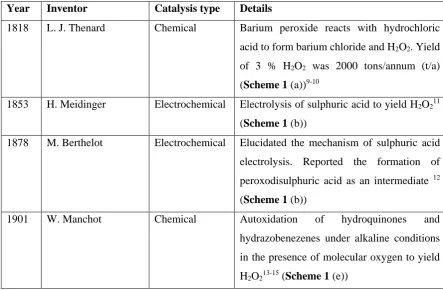
summarised in the works of Goor1, 3 and Jones8 (Table 1) and the reactions schemes are depicted in
Scheme 1.
Table 1 Historical development in the industrial manufacture of hydrogen peroxide Year Inventor Catalysis type Details
1818 L. J. Thenard Chemical Barium peroxide reacts with hydrochloric
acid to form barium chloride and H2O2. Yield
of 3 % H2O2 was 2000 tons/annum (t/a)
(Scheme 1 (a))9-10
1853 H. Meidinger Electrochemical Electrolysis of sulphuric acid to yield H2O211
(Scheme 1 (b))
1878 M. Berthelot Electrochemical Elucidated the mechanism of sulphuric acid
electrolysis. Reported the formation of
peroxodisulphuric acid as an intermediate 12
(Scheme 1 (b))
1901 W. Manchot Chemical Autoxidation of hydroquinones and
hydrazobenezenes under alkaline conditions
in the presence of molecular oxygen to yield
1908 Degussa -
Weissenstein process
Electrochemical First production plant set up in Wiessenstein,
Austria16-17
1910 Münchner Process or
the Pietzsch - Adolph
Process
Electrochemical Developed by Pietzsch and Adolph at the
Elektrochemische Werke, Munich. Used
potassium peroxodisulphate instead of
sulphuric acid to produce H2O216-17 (Scheme
1 (c))
1914 Hugo Henkel &
Walter Weber
Chemical First account of direct synthesis of hydrogen
peroxide using its constituent gases18
(Scheme 3)
1924 Reidl - Löwenstein
Process
Electrochemical Similar to the Pietzsch-Adolph Process; used
ammonium peroxodisulphate to produce
H2O2 by electrolysis (Scheme 1 (d)). Yield of
100 % H2O2 was 35 kilotons (kt) 16-17
1932 Walton and Filson Chemical
autoxidation
Published their work on the alternate
oxidation and reduction of hydrazobenzenes
to produce H2O219 (Scheme 1 (e))
1935 Pfleiderer, BASF Chemical
autoxidation
Alkaline autoxidation of hydrazobenzenes to
form sodium peroxide, later hydrolysed to
form H2O220 (Scheme 1 (f))
1935 -
1945
Riedl and Pfleiderer Chemical
autoxidation
Anthraquinone autoxidation process (AO) set
up in two different cities each with 2000 t
capacity16, 21 (Scheme 2 (a)) 1953 E. I. du Pont de
Nemors
Chemical
autoxidation
Commercial plant setup with based on the
Riedl and Pfleiderer process1, 3, 8 ((Scheme 2
(a))
1957 -
1980
Shell process Chemical
autoxidation
Oxidation of 2-propanol to yield H2O2 at a
Scheme 1 (a) L. J. Thénard method of H2O2 production from BaO2. (b) Electrolysis of sulphuric acid to produce hydrogen peroxide according H. Meidinger & M. Berthelot. (c) Münchner Process to produce H2O2 (d) Riedel - Löwenstein Process3, 8. e) Hydrazobenzene oxidation to produce H2O2 (scheme modified from Walton and Filson19). (f) Georg Pfleiderer process of producing H2O2, an adaptation of Walton and Filson process20 (g) Shell 2-propanol process to produce acetone/H2O23 1.2 State of the art in the industrial production of H2O2
On an industrial scale, the anthraquinone autoxidation (AO) process described by H. J. Riedl and
G. Pfleiderer produces H2O2 in a cyclic manner (Scheme 2).
Scheme 2 (a) Mechanism of the AO process developed by Riedl-Pfleiderer21 and (b) block diagram of the AO process steps to synthesise H2O2 (scheme modified from Campos-Martin et al.7).
(a) (b) (c)
(d) (e) (f)
(g)
Scheme 2 (a) shows the reaction mechanism of the AO process and Scheme 2 (b) depicts the practice of H2O2 manufacture in the industry. The hydrogenation chamber is usually a slurry reactor consisting
of the alkylated anthraquinone dissolved in a so-called “working solution” along with a catalyst.
Hydrogen gas is initially fed through the reactor for hydrogenation to alkyl anthrahydroquinol. After
which, the contents of the hydrogenation chamber are degassed in a separate chamber to remove traces
of hydrogen. Following this step, the alkyl anthrahydroquinol is transferred to the oxygenation chamber.
Here, oxygen or air is used to produce H2O2 and alkyl anthrahydroquninone, which is then transferred
to a second degassing chamber to remove trace oxygen. The degassed solution is then extracted with
water to yield H2O2 and the working solution is transferred to the hydrogenation chamber to complete
the synthetic cycle. In the mid-1990s, the world capacity of 100 % H2O2 was approximately 1.5 million
tons with an average plant capacity of around 20 kilotons (kt) – 40 kt per annum. By 2015, the capacity
was 5.5 million tons with a plant capacity of 300 kt per annum23. Solvay (30%), Evonik (20 %), and
Arkema (13 %) represented the global contributors of H2O224.
1.3 Why is there an increased interest in the direct synthesis of hydrogen peroxide?
Currently, the industrial manufacture of H2O2 is based on the work of Riedl and Pfleiderer, also known
as the AO process21 (Scheme 2)25 using polynuclear hydroquinones1. Although this process is capable
of meeting the world’s H2O2 demand, it does have certain drawbacks such as:
• excessive use of solvents for the process
• a negative environmental impact owing to the production of unwanted waste
• complex and multi-step process
• mass transfer limitations and low efficiency
• transport limitations of reactants between reactors
• organic contamination of H2O2 stemming from organic solvents or hydroquinones/hydroquinols
during liquid-liquid extraction26-27.
Considering environmental issues and resource conservation aspects, academia and the industry have
set out to design benign and non-polluting processes. The principles of green chemistry helps in
achieving this goal. The principles outlined around the 1990s clearly state that it is necessary to design
and execute industrial processes that are clean, benign, non-polluting, and safe28-31. Two important
terms, viz. atom utilisation and E-factor are important in assessing the greenness of a process. Atom utilisation or atom efficiency or atom selectivity (AE) maybe defined as the actual mass of reactants that actually end up in the final desired product, the rest of which is termed as “waste”. AE helps in assessing
the amounts of wastes generated by a certain process, which in turn, will determine the E-factor. The E-factor is the ratio of the amount of waste produced to the amount of desired product32-34. Considering
the AO process, the amount of solvents and the alkylated hydroquinones used in the process are waste
products, as the reaction is not atom efficient1, 3, 7-8. This brings up an important question: why is the AO
is economically feasible at a scale of 105 tons per annum producing high concentrations of H2O2, which
are diluted prior to use. For a majority of the applications mentioned previously in section Error! Reference source not found., diluted versions of H2O2 (typically 3 % - 8 %) is required, in small
amounts, and on site. To circumvent the issues mentioned above and promote a green H2O2 production
process, the direct synthesis of H2O2 from H2 and O2 was researched, but only at the laboratory scale.
Theoretically, it is clear that the direct synthesis approach is the simplest way to synthesise H2O2,
however, issues with respect to practicality limit the industrialisation of this process35-36. This review
will address the challenges and developments in the field of direct synthesis of H2O2, focussing on
chemical catalytic methods.
2 The direct synthesis approach to H2O2 production using chemical catalysis
In 1914, H. Henkel and W. Weber reported the very first process that was capable of producing H2O2
from hydrogen (H2) and oxygen (O2). The patent described the reaction of two gaseous mixtures: an
oxygen species (free and bound) and hydrogen in a pressurised vessel along with water. An important
aspect of the patent was the use of noble metals capable of fixing hydrogen as catalysts; e.g.
palladium (Pd), platinum (Pt), nickel (Ni), etc18.
2.1 Pros and Cons of the direct synthesis approach to H2O2 synthesis
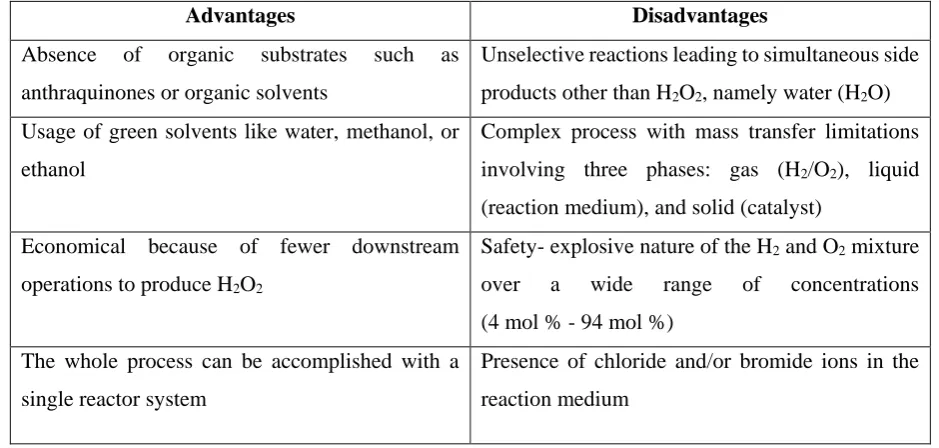
The direct synthesis has not been industrially practiced due to several technological and scientific
barriers37.
Table 2 Analysis of the advantages/disadvantages of the direct synthesis approach26, 38-41
Advantages Disadvantages
Absence of organic substrates such as
anthraquinones or organic solvents
Unselective reactions leading to simultaneous side
products other than H2O2, namely water (H2O)
Usage of green solvents like water, methanol, or
ethanol
Complex process with mass transfer limitations
involving three phases: gas (H2/O2), liquid
(reaction medium), and solid (catalyst)
Economical because of fewer downstream
operations to produce H2O2
Safety- explosive nature of the H2 and O2 mixture
over a wide range of concentrations
(4 mol % - 94 mol %)
The whole process can be accomplished with a
single reactor system
Presence of chloride and/or bromide ions in the
reaction medium
Scheme 3 depicts the direct synthesis of H2O2. As seen, the reaction produces either water H2O or H2O2
Scheme 3 The direct synthesis approach consisting of two parallel reactions (reduction and oxidation) during the production of H2O2. Scheme taken from Gervasini et al.42, Khan et al.43, and
Seo et al44.
2.2 Mechanism of the direct synthesis of H2O2
The mechanism of hydrogen peroxide synthesis using H2 and O2 is shown in Scheme 4. A possible
mechanism of such a synthesis was proposed by Bianchi et al. in 199945, based on the 1980 report
published by Zudin et al46. While Zudin et al. used palladium triphenylphosphane in a biphasic system, Bianchi et al. found out that 2,9-dimethyl-4,7-diphenyl-1,10-phenantroline ligand was the best among other ligands tested. Based on these findings, Werner published the proposed mechanism of H2O2
synthesis by the reduction of dioxygen47. Stahl et al. used a bathocuproine palladium complex in order
to catalyse the direct synthesis of H2O248. All three processes utilised acid halides such as hydrochloric
acid or hydrogen bromide to facilitate efficient catalysis45-46, 48. However, the actual mechanism was
reported in 2001 by Stahl et al.48Scheme 4 (i), which was confirmed by Chinta and Lunsford in 200449.
Scheme 4 (i) Mechanism of H2O2 formation in water with CO and O2 in the presence of palladium catalyst complexed with nitrogen ligands (Scheme from Werner et al.47 and Stahl et al.48). (ii) The
catalytic cycle of H2O2 manufacture using palladium catalysts complexed with chloride ions (Chinta & Lunsford49)
Chinta & Lunsford confirmed the mechanism of H2O2 synthesis from hydrogen and oxygen using
tetrachloropalladate (PdCl42-) that was prepared prior to use. The mechanism is shown in Scheme 4 (ii)49. All three mechanisms described in Scheme 4 follow these steps: initially, Pd0 reacts with molecular oxygen in the presence of halide ions to form PdII complex (Scheme 4 , Step II), which reacts with the H3O+ ions to yield H2O2 and PdCl24- (Scheme 4 Step III) subsequently returning the Pd to its
2.3 Series of elementary steps in H2O2 synthesis
Several accounts of the possible elementary steps during the direct synthesis of H2O2 has been described
in literature by Wilson and Flaherty39, Plauck et al.50, Yi et al.51, to name a few. Scheme 5 depicts the
series of steps that lead to the synthesis of H2O2 and H2O during the direct synthesis approach using Pd
catalysts in liquid solvents. In each of the steps in the process, bimolecular reactions exist between the
H+ and chemically adsorbed intermediates on the catalyst surface. The elementary steps are based on
the following assumptions:
• Free energies of H2 and O2 adsorption is negligible under saturation conditions • The adsorption and desorption of the H2O2 species is unrestricted
Based on these assumptions, the first step is that the hydrogen adsorbs dissociatively on to the catalyst
surface (step (1) in Scheme 5) yielding H* and is subsequently oxidised (step (2) in Scheme 5). In step (3) of Scheme 5, the molecular adsorption of O2 takes place. This initiates step (4) in Scheme 5,
wherein O2** undergoes proton-electron transfer under quasi-equilibration conditions to form OOH**
(hydroperoxy radical). Alternatively, O2** cleaves the O-O bond irreversibly to form O*, also known
as chemi-absorbed oxygen atoms (step (7) Scheme 5 ). The OOH** is then adsorbed, which then reacts further to form either H2O2** by proton-electron transfer, as shown in step (5) of Scheme 5 or
dissociates itself (step (8) of Scheme 5). This finally leads to the release of H2O2 (step (6), Scheme 5)
or H2O (step (11), Scheme 5)39, 50-51
2.4 Process conditions for the direct synthesis of H2O2 from H2 and O2
The direct synthesis of H2O2 requires certain operating conditions such as the ratio of H2 and O2, reaction
medium for the synthesis, the reactor used, additives and/or promoters, catalyst, and its supporting
material52-54. The following sections explain the influence of each of these parameters on the conversion
and yield of the direct synthesis of H2O2.
2.4.1 Ratio of the gaseous mixture
During direct synthesis, one would expect the reaction of H2 and O2 on a catalytic surface to form only
H2O2 as the product. However, unwanted side reactions also occur that reduces the productivity of this
otherwise green process. The first side reaction is the oxidation of H2 to H2O instead of H2O2 and the
second one is the reduction of H2O2 produced to H2O (Scheme 3). One can influence the selectivity of
the process by optimising the parameters mentioned previously, but it is self-explanatory that the amount
of H2 and O2 in the reaction mixture directly influences the H2O2 output. Three combinations of H2/O2
are possible for this reaction- excess H2, excess O2, and stoichiometric amounts. Using excess H2 would
favour the reduction of H2O2, while using stoichiometric amounts would increase H2O2 concentration
during synthesis. However, an excess of oxygen, up to 3 times compared to hydrogen would also
increase selectivity and yield of the direct synthesis approach55. It is worth mentioning that the
flammable and explosive nature of these two gases over a wide concentration range at 25°C and
0.1 mega Pascal (MPa) (1 atmospheric pressure) is a point of great concern. The flammability limit for
H2 in O2 is 4 % (Lower Flammability Limit) to 94 % (Upper Flammability Limit), while the detonation
limit is at 15 % to 95 %, with an increased risk of explosion with increasing pressure41, 53, 56. DuPont
faced frequent explosions in their pilot plant by feeding 10 % H2 in O2 to their process, which led to the
discontinuation of the pilot plant studies.
In order to minimise the explosion risk, it is suitable to perform the reaction at lowered feed rates of H2
and O2, diluted with inert gases53. The most common diluents are helium (He), argon (Ar), nitrogen (N2),
or carbon dioxide (CO2)24. Most of the recent literature indicates the use of either CO243, 57-58 or N238,
59-60
. The work of Wilson and Flaherty described the use of N2 and CO2 as the diluents during synthesis
using palladium catalysts (Pd) supported on silica (Si). By doing so, the researchers reported an overall
selectivity of 31 % towards H2O2 on using only CO2 as the diluent. However, the combined effect on
the overall selectivity was not reported39. Using CO
2 as a diluent is advantageous as it can expand
different solvents during the reaction and increase H2 solubility. Secondly, CO2 dissolves in water to
form carbonic acid (HCO3-), which makes the medium acidic. The acidic condition is helpful as it is the
most commonly used storage condition for H2O25. The chemists and engineers in the field have agreed
that increasing the solubility of H2 and O2 in the reaction medium would also lead to a better adsorption
of the gases on to the catalytic surface. This, in turn, would lead to a better yield of H2O261. Selinsek et al.
recently reported a process design with two separate tanks containing H2 and O2 dissolved in water with
H2 to O2 ratio in the reaction cell can be easily controlled by varying the flow rate of the pump, ensuring
that at any given point of time, the process operates in a safe manner4.
2.4.2 Reaction Medium
As mentioned previously, the direct synthesis of H2O2 from H2 and O2 in the gaseous state without any
reaction medium is highly dangerous. This is because the gases form an explosive mixture over a wide
range of concentrations62. Hence, performing the synthesis of H2O2 at lowered temperatures in highly
pressurised environments, in an appropriate reaction medium, prevents explosions and produces high
yields26. Therefore, the choice of the reaction medium is crucial to the success of the process. Most of
the existing literature uses water as the reaction solvent, with some exceptions where pure methanol or
ethanol is used. Additionally, using water with co-solvents such as methanol or ethanol favours a higher
dissolution of H2 when compared to pure water as a reaction medium55, 63. In 2001, Hâncu and Beckmann
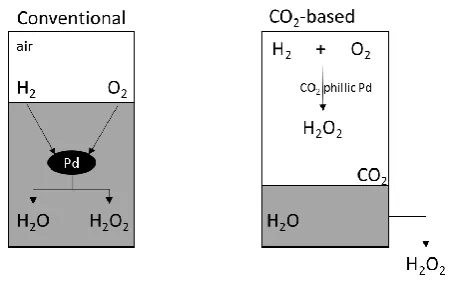
reported the use of CO2 as a reaction medium for the direct synthesis of H2O2 using a CO2 soluble
ligand-supported Pd catalyst. The researchers worked on the assumption that the H2O2 solubility in CO2 is
considerably less than the conventional working solutions of the AO process, i.e. organic solvents. Furthermore, the CO2 used was liquid under the reaction conditions (298 K, 17 MPa) and the presence
of a CO2-phillic catalyst would minimise the contact time of H2O2 on Pd, thereby increasing the
selectivity of the process (Figure 1)27, 64.
Figure 1 Comparison of direct synthesis of H2O2 in conventional (aqueous solutions) and CO2 with a modified CO2-phillic Pd catalyst (Figure taken from Hâncu and Beckmann27).
Moreno et al. reported the use of supercritical CO2 (scCO2) with methanol (MeOH) water mixture at an
operating temperature range of 283 – 318 Kelvin (K) and pressure of 16.7 mega Pascal (MPa) to
synthesise H2O2 from H2 and O2. N2 was used as a diluent in this reaction to achieve a yield between
11.6 % to 45.9 %41. Except for these works, almost every direct synthesis of H2O2 using chemical
catalysis is documented in water, alcohol, or a defined ratio of both. Landon et al. reported that at 31.1 °C, which is the critical temperature of CO2, more decomposition of H2O2 was observed than
formation. The researchers suggested that the synthesis was performed at a temperature just below the
critical temperature65. This could be one of the many reasons as to why the use of CO2 as a solvent has
operating below the triple point in the presence of a solvent to form a two-phase fluid system) as the
solvent in the presence of a Pd catalyst supported on mesoporous silica for the direct synthesis of H2O2.
The researchers reported a selectivity of 40 % towards H2O2 and a productivity of 0.11 molH2O2 m-2Pd h
-1
at the end of 3 h63.
2.4.3 Additives/Promoters
Along with the reaction medium, special additives termed promoters are often used to stabilise H2O2
production and to increase the process yield. The most commonly used promoters are acids or halides.
Edwards et al. published the effect of acids and halides on the outcome of the direct synthesis of H2O2.
In this report, the researchers classified the promoters into two groups:
(i) oxyacids such as acetic acid, perchloric acid, phosphoric acid (H3PO4), nitric acid, and sulphuric
acid (H2SO4)
(ii) halide acids such as hydrochloric acid (HCl), hydrobromic acid (HBr), and hydroiodic acid (HI).
The authors reported that the reactions could accept potassium and sodium salts of halide acids as well.
The presence of halide ions in the reaction could influence the H2O2 conversion in the following order:
KF>No halide ions>KCl>KBr and selectivity in the following order: KBr>KCl>No halide ion>KF. The
report also claimed that the presence of iodide ions eventually poisoned the catalyst54.
The next pioneering work in the field was that of Wilson and Flaherty pointing out that the presence of
protons (H+) from mineral acids such as HCl, H2SO4, H3PO4 and HNO3 aids in reducing molecular
oxygen. They also suggested that the corresponding counter ions such as Cl-, SO42-, PO42-, and NO3
-modify the structure of the metal catalyst. By adding halide groups to the Pd catalyst and performing
the synthesis in ethanol at an acidic pH would eventually increase the selectivity from 60 % to 80 %39.
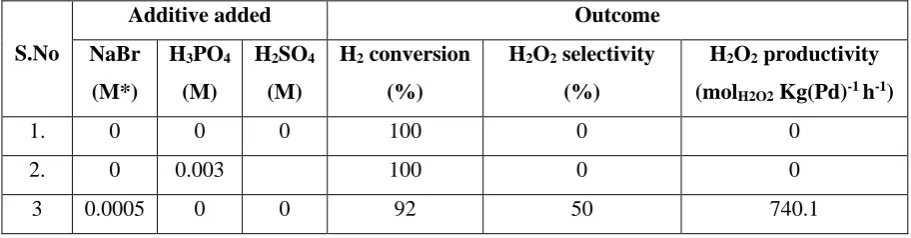
The recent report of Gallina et al. compared the roles of sodium bromide (NaBr), H3PO4, and H2SO4 on
the outcome of the direct synthesis of H2O2 by varying the concentrations of NaBr and H3PO4. The
authors conducted the experiments at 288 K, 2.0 MPa, 3 h reaction time, Pd/C, with a gas mixture
percent of H2/O2/CO2 at 4/20/76%). The table below describes the observations of Gallina et al. on
testing various combinations of the promoters.
Table 3 Effect of different promoters on H2 conversion, H2O2 selectivity, H2O2 productivity as reported by Gallina et al.66
S.No
Additive added Outcome
NaBr (M*)
H3PO4 (M)
H2SO4 (M)
H2 conversion (%)
H2O2 selectivity (%)
H2O2 productivity (molH2O2 Kg(Pd)-1 h-1)
1. 0 0 0 100 0 0
2. 0 0.003 100 0 0
4 0.0005 0.003 0 85 61 891
5 0.0005 0.005 0.025 79 65 830
* - mole (mol) / litre (L); molar
The researchers formulated that the absence of promoters (H3PO4 or NaBr) led to either (i) a much more
prominent water forming reaction than the H2O2 forming one or (ii) subsequent reaction of H2O2 further
to form H2O. The researchers also concluded that NaBr/H3PO4 had a combined effect on the leaching
of the Pd catalyst and that there was no fixed NaBr to H3PO4 ratio to improve the direct synthesis of
H2O266. The authors also suggested that a pH of 2.0 in the reaction medium would favour a better
selectivity towards H2O2 production from H2 and O266.
Another method of acidifying the reaction medium to suit the direct synthesis of H2O2 is to use solid
acid catalysts (SAC) as reported by the publication of Lewis et al56. The problem of the acidic additives and halide salts being soluble in aqueous medium making the recovery of these a tedious downstream
operation was addressed in this work. By using a SAC such as caesium substituted phosphotungstic acid
(HPA) in the presence of Pd or Au-Pd alloyed catalyst, the productivity of H2O2 could be increased and
the degradation to H2O could be decreased67.
2.4.4 Reactor design
One of the most important parameter to be discussed for the direct synthesis of H2O2 is the type of
reactor used for the reaction. Until today, slurry reactors, plugged flow reactors, microreactors, trickle
bed reactors are often used to synthesise H2O2 directly from H2 and O2. One of the major requirements
when choosing a reactor is that the vessel should withstand high pressure. It is known that the prolonged
exposure of H2O2 to H2 in the presence of a Pd catalyst would lead to the formation of water (Scheme
3). One possible way to overcome this phenomenon is to limit the exposure of H2O2 to H2 on the catalytic
surface.
Microreactors present a unique way to operate this process in a continuous manner, with defined flow
characteristics, large surface area to volume ratio, promising heat and mass transfer rates, with excellent
process safety. A microreactor is “a device that contains micro structured features with a sub millimetre dimension, in which chemical reactions are performed in a continuous manner.” The microreactors are constructed from silicon, quartz, glass, metals, polymers, and ceramics, to name a few68. The work of
Shang and Hessel describes the operational and reaction based benefits of using microreactors for the
direct synthesis of H2O2 in their work69. One drawback of using microreactor for the direct synthesis of
H2O2 is the incorporation of the metal catalyst within the capillaries of such a reactor70. Kanungo et al.
described a technique to incorporate an Au-Pd alloy on to the walls of a silica coated capillary
microreactor. The innovation in the design lies in the fact that the catalytic particles were formed in situ
on the walls of the microreactor by a layer-by-layer self-assembly creating a multi-layer catalyst. By
using this approach, the researchers were able to produce 210 molH2O2 kgcat-1 h-1 with a H2 conversion of
a production process using the same catalysts in a microchannel reactor. The researchers were able to
obtain 5 mass percent H2O2 solutions at a conversion rate of 15 % at 42 % selectivity (315 K, 2.0 MPa,
0.05 M H2SO4, 9 parts per million (ppm) NaBr, H2/O2 ratio 20 %)71. Voloshin et al. elucidated the mass
transfer mechanism that occurs in a microreactor during the direct synthesis of H2O2 (Figure 2 (b)). In
their work, the researchers claimed that flow of the fluids through the microreactor was slug-flow like.
In other words, the liquid flow pattern is interrupted by catalytic particles and the pattern resembles that
of a liquid slug being broken down. Using a set of assumptions, the researchers came up with a kinetic
model that would explain the behaviour of a packed bed microreactor during direct H2O2 synthesis72.
Hirama et al. used 32 parallel microreactors made up of silica and glass to produce H2O2 directly from
H2 and O2. The authors were able obtain H2O2 at 10 mass percent at a productivity of 0.5 kg h-1. Inoue
et al. on the other hand used four parallel microreactors to produce 4 mass percent H2O2 at 0.042 kg h -1
. Ng et al. reported the use of palladium nanoparticles immobilised on to polystyrene based polymer supports in a capillary microreactor enabling a continuous production of 1.1 mass percent H2O2 over
11 days73. The reviews of Kolehmainen et al.55 and Dittmeyer et al.52 summarise the innovations in the field of catalyst design and reactor engineering in a detailed manner.
Figure 2 (a) A general microreactor design adapted by Kanungo et al. with a magnified view of the Au-Pd packing in the capillaries of the channel (scheme adopted from Kanungo et al.70) (b) Mass transfer scheme in a packed bed microreactor (scheme taken from Voloshin et al.72)
Another technique to overcome H2O2 decomposition by reactor engineering is the use of a trickle bed
the selectivity towards H2O266, 74-78, with the maximum being 80 % using Pd on sulphated ceria (CeS)
catalyst.
Figure 3 Trickle bed reactor used by Gallina et al. to produce H2O2 directly from H2 and O2 in water in the presence of a commercial Pd/C catalyst66.
2.4.5 Influence of the catalytic material
A major hindrance in the direct synthesis approach is the process’ low selectivity, as the formation of
H2O2 is not thermodynamically favoured. Although, promoters such as H2SO4, H3PO4, NaBr, and KBr,
help enhance the selectivity of the process, one might consider the catalyst and its supporting material
to be the most influencing parameter79. Furthermore, the presence of noble metals or noble metal alloys
as catalysts aid in the hydrogenation and subsequent decomposition of H2O2 to water (Scheme 3)4. On
surveying the recent literature in the direct synthesis of H2O2, it is certain that the majority of scientists
in the field are dedicated towards developing new, robust and stable catalysts. Existent catalysts and the
newly developed versions of noble metal catalysts are characterised based on two criteria: conversion
and selectivity. Pd catalyst is almost exclusively used for such reactions either as obtained or alloyed
with other metals and/ or supports to enhance the selectivity of the process.
Edwards et al. published the importance of alloying Pd with other metals to increase the efficiency of H2O2 production. Their observation stemmed from the highly reactive nature (25 times more active) of
an Au-Pd catalyst that was capable of oxidising alcohols better than the corresponding monometallic
catalysts. They also reported that when Au-Pd alloys were attached to a titanium dioxide (TiO2) or
alumina (Al2O3) support, core-shell structures are formed. With the development of the new catalyst,
the researchers still faced the problem of H2O2 being reduced to water80. The same working group
developed a new tin-based Pd alloy to stop the hydrogenation of H2O2. With the new alloyed catalyst
accompanied by a heat treatment cycle, the hydrogenation reactions were prevented and selectivities of
more than 95 % were reported36. Ntainjua et al. used ruthenium (Ru) alloyed with Au and Pd to perform the direct synthesis of H2O2. The authors investigated the Ru-Au, Ru-Pd and Ru-Au-Pd catalyst for H2O2
synthesis. The amount of Ru added to the alloy along with the calcination conditions had an effect on
the catalyst activity and reusability. So far, this report is the only one using Ru catalyst for the direct
metals for alloying with Pd. Xu et al. reported the possible increase of H2O2 production by using
different metals such as tungsten(W), Lead (Pd), molybdenum, etc. and validated their results with
density functional theory (DFT). The researchers suggested that all these metals were superior to
platinum (Pt) as a promoter. The research was a computational model and experimental evidence to
substantiate this fact is needed85.
Tian et al. reported that by increasing the amount of Pd in the system, the H2 conversion increases as
well, which is self-explanatory. However, the selectivity and productivity increases with decreasing Pd
content. From these results, they were able to conclude that having a Pd particle size in the range of
2.5 nm to 1.4 nm would yield a selectivity of approximately 94 % with 0.5 % Pd loading86. Most
recently, Howe et al. used microwaves to prepare Au-Pd alloy supported on TiO2 for synthesising H2O2
from H2 and O2. The authors claim that the catalysts were capable of maintaining its activity for four
reaction cycles. Compared to other alloyed Pd particles, these particles have a core-shell structure and
can be prepared in 0.25 h87. The recent 2017 patent of Desmedt et al. used metallic catalysts supported on sulphate and phosphate to reduce the amount of inorganic acid content in the reaction medium. The
inventors varied the metal content between 0.001 mass % to 10 mass % (0.62 to 2 wt % Pd) to obtain
conversions ranging between 26.9 % to 46 % and selectivities between 19.9 % and 74 %88.
The table below summarises the reaction conditions and the catalysts for the direct synthesis of H2O2
Table 4 List of operating conditions in literary works involving the direct synthesis of H2O2 between 2010 and 2018
Temperature &
Pressure (K & MPa) Catalyst Reactor type Solvent(s) Promoters
Conversion & Selectivity
(%)
Literature reference
263 & 2 Palladium-CeS Trickle bed reactor
with Teflon lining Methanol None No data , 80 Biasi et al.
74
298 & 0.1 (ambient) Palladium on porous
alumina tubing Membrane reactor Water
Sulphuric acid
(H2SO4) sodium
bromide (NaBr),
phosphoric acid
(H3PO4)
No data, 50 Inoue et al.89
283 – 324 &
4.6 – 16.7 Palladium on carbon
Stirred slurry batch
reactor
Water + scCO2
and Methanol +
scCO2
H3PO4 and NaBr
No data
available Moreno et al.
41
298 & 0.1 (ambient)
Pd nanoparticles
immobilized on
polystyrene based
polymer
Capillary microreactor Methanol
No additive 47 & 0.65
Fei Ng et al.73
H2SO4, KBr 3.9 & 77
301 & 1.01
Insoluble heteropoly
acid supported on Pd
immobilized on
Mesostructured
foam (MCF) silica
298 & 4.5
Metallic Pd
deposited on
ceramic tubes
Porous tubular
membrane reactor Methanol H2SO4, NaBr No data & 83 Pashkova et al.
91
293 & 4.0 Au-Pd on TiO2 on carbon
Stainless steel
autoclave Methanol, water No data available
No data
available Pritchard et al.
92
315 & 2.06 Pd on SiO2. Microreactor Water H2SO4, NaBr No data & 85 Voloshin et al.72
263 & 1.0
Bimetallic Pd-Au
catalyst on CeS and
sulfated zirconia
Trickle-bed reactor Methanol No data available 90 Biasi et al.75
293 & 0.65
Pd on SiO2
Teflon coated steel
reactor Methanol H2SO4
No data & 21
Abate et al.63
Pd on mesoprous
silica (SBA-15) No data & 58
263 & 1.0
Pd-Au CeS
Trickle bed reactor Methanol No data available
No data & 50
Biasi et al.93
Pd-Au on ZS No data & 60
278 – 313 & 2.0 Pd/C Batch reactor Methanol H2SO4 100 & 35 Biasi et al.76
298 & 2.4 Commercial 5 %
Pd/C Batch slurry reactor Methanol None added
No data
available Gemo et al.
94
263 & 2.0 Pd on CeS Packed bed reactor Methanol H2SO4 No data & 70 Kilpiö et al.95
303 & 5
Pd nanoparticles
immobilized on a
functionalised resin
Fixed bed reactor Methanol None added No data & 73 Kim et al.96
293 & 0.1 Pd on SiO2
Glass stirred tank
reactor Methanol H2SO4 No data & 60 Menegazzo et al.
275 & 4.0 Ru-Au-Pd catalyst on TiO2 support
Stainless steel
autoclave Methanol/water None added
No data
available Ntainjua et al.
81
301 & 1.01 Palladium on zeolite
HZSM-5 Autoclave reactor methanol H3PO4 90 & 16 Park et al.
98
294 & 4.0 AuPd/C Stainless steel
autoclave Methanol/water None added
No data
available Piccinini et al.
99
298 & 2.3
Pd on sulfated
zirconia and Pd on
alumina
Batch autoclave
reactor Methanol None added
No data
available Rossi et al.
100
278 – 308 & 2.8 Commercial Pd/C Trickle bed reactor Water NaBr No data & 90 Biasi et al.77
298 & 2.4 Commercial Pd/C Stainless steel batch
autoclave Methanol None added No data & 33
Biasi et al.78
278 & no data Commercial Pd/C Trickle bed reactor Water H3PO4 and NaBr
No data
available
278 & 1.0 Au-Pd/TiO2 Microreactor Water/Methanol None 90 & 25 Freakley et al.101
273 & 3.8 Pd on activated carbon cloth (ACC)
Stainless steel
autoclave Methanol None added No data & 70 Gudarzi et al.
102
295 & 3.0 Pd-Au on carbon nanotube (CNT)
Stainless steel
autoclave with Teflon
coating
Methanol and
sulphuric acid H2SO4
(no conversion
values) &
15 – 65
depending on
H2/O2 flow
295 & 3.0 Pd on nanocarbon
Stainless steel
autoclave with Teflon
coating
Methanol H2SO4 No data & 25 Arrigo et al.104
293 & 0.1 Pd nanocubes on
silica Similar to the work of Lee et al.2011 10 & 25 Kim et al.
105
273 & 2.0 Pd on activated carbon cloth (ACC)
Stainless steel
microreactor Methanol None added No data & 23 Ratchananusorn et al.
106
278 & 2.0
Au-Pd on
nanostructured TiO2
nanotube support
Stainless steel
autoclave Methanol HCl
No data
available
Torrente-Murciano et al.107
275 & 2.0 Pd/C treated with NaBr
Custom made stainless
steel batch reactor Methanol NaBr 95 & 1 Biasi et al.
57
293 & 2.0
Pd supported metal
organic framework
(MOF)
Autoclave reactor Methanol None added No data & 26 Chung et al.59
296 & 1.0
Combination of
Pd/TiO2 and
Au-Pd/TiO2
Microreactor with
parallel packed beds
(1, 8 and 16)
Water H2SO4, H3PO4, and NaBr
Varied
depending on
no. of channels
and the flow
rate
Inoue et al.108
303 & 2.0 Supported Au, Pd
and Au-Pd Autoclave reactor
Water
NaBr
15 & 50
Paunovic et al.109
1-pentanol 20 & 80
hexane 20 & 17
Methyl isobutyl
ketone 27 & 10
1-butanol 28 & 60
2-butanol 25 & 55
isopropanol 35 & 75
methanol 45 & 47&
ethanol 50 & 47
DMSO 25 & 87
acetonitrile 32 & 100
acetone 35 & 95
t-butanol 40 & 70
303 & 2.0
Au-Pd catalyst Autoclaved slurry
reactor Water H2SO4 and NaBr
5 & no data
Paunovic et al.110
313 & 2.0 10 & no data
323 & 2.0 30 & no data
313 & 2.0 Au-Pd colloidal nanoparticles
Microchannel- Silica
capillary reactor Water H2SO4 and NaBr 80 & 85 Paunovic et al.
71
298, 2.6 Commercial Pd/C Trickle bed reactor Water H2SO4, H3PO4, and NaBr
No data
available Abejón et al.
79
333 & 0.1 Au-Pd/TiO2 Fixed bed reactor
Gas phase
synthesis
(2 % H2/air)
None No data
available Akram et al.
313 & 9.5 Pd loaded on a sulfonic acid resin
High pressure stirred
reactor Methanol
3 compounds tested
2-bromo-2-methyl
propane,
2-bromopropane,
bromobenzene
compared to NaBr
No conversion
data and
selectivity for
NaBr was 80
and for the
rest was 75
Blanco-Brieva et al.112
298 & 0.5 Au-Pd/TiO2
Stainless steel
autoclave Methanol / water None added
No data
available Crole et al.
35
275 & 3.7 Pd-Sn Stainless steel
autoclave Methanol / water None added 9 & 96 Freakley et al.
36
275 & 3.0 Pd- Ag (varying amounts)
Teflon coated stainless
steel autoclave Methanol H2SO4
Depended on
alloy ratio Gu et al.
82
303, 2.0 Porous Pd/SiO2
Teflon coated stainless
steel autoclave Methanol H2SO4 No data & 46 Sierra-Salazar et al.
113
273 – 305 & 0.1 – 3.0 Pd/SiO2
Packed-bed flow
reactor Methanol / water
HCl, H2SO4, and
sodium bicarbonate
(NaHCO3)
No data & 31 Wilson et al.39
288 & 2.0 Commercial Pd/C Trickle bed reactor Water H3PO4, H2SO4, and
NaBr 77 & 72 Gallina et al.
66
278 & 5.0 Pd particles on acidic niobia
(Nb)-silica (Si) support
Slurry reactor
Methanol
None added
38 & 78
Gervasini et al.42
293 & 0.1
Pd/SiO2
(sonochemical
approach)
Stirred glass reactor Ethanol/water KBr and H3PO4
22 & 85
Han et al.114
Pd/SiO2 (Incipient
wetness approach) 12 & 85
Pd/TiO2
(sonochemical
approach)
22 & 75
Pd/TiO2 (Incipient
wetness approach) 12 & 80
300 & 0.95 Pd/TiO2
Flow reactor
comprising of 8, 16
and 32 parallel
micropacked beds
Water H3PO4, H2SO4, and NaBr
64 & 66 (8
glass beds)
61 & 70 (8
glass + Si
beds)
Hirama et al.115
315 & 2.0 Au-Pd nanoparticles Microreactor Water H2SO4, NaBr and
acetonitrile (MeCN) 20 & 85 Kanungo et al.
70
273 & 4.0
Pd on a
hexadecyl-2-
hydroxyethyl-dimethyl ammonium
dihydrogen
phosphate
(HHDMA)
275 & 4.0
Au-Pd nanoparticles
supported on cesium
substituted
phosphotungstic acid
(HPA)
Stainless steel
autoclave Methanol / water No data available 69 & 86 Lewis et al.
67
293 & 0.1 Pd/SiO2 Glass stirred reactor Ethanol / water KBr 30 & 27 Seo et al.44
283 & 0.1 Pd on
hydroxyapatite Slurry reactor Ethanol H2SO4 2 & 94 Tian et al.
86
283 & 0.1 Pd-Tellerium (Te)/TiO2
Micro triphase reactor Ethanol H2SO4 6 & 100 Tian et al.83
283 & 0.1 Pd on mesoporous anatase TiO2
Glass triphase reactor Water H2SO4 40 & 40 Tu et al.116
275 & 3.0 Pd-zinc (Zn) on alumina (Al2O3)
Stainless steel
autoclave Methanol H2SO4 57 & 78.5 Wang et al.
84
278 & 3.0 Au-Pd supported on carbon
Stainless steel
autoclave Methanol / water None added 65 & 60 Yook et al.
117
275 & 4.0 Au-Pd/TiO2
Stainless steel
autoclave Methanol / water None added
No data
available Howe et al.
87
No data & 4.0 Ag-Pd/TiO2
Stainless steel
autoclave Methanol / water None added
No data
available Khan et al.
43
275 & 4.0 Au-Pd/mesoporous
silica (SBA-15) Autoclave Methanol / water None added
No data
available Rodrigéz-Goméz et al.
298 & 1.1 Pd/TiO2
Teflon coated reaction
cell Water NaBr
No data
available Selinsek et al.
4
3 Summary, conclusion, and future perspectives
More than a century has passed since the first documented work of Henkel and Weber in 1914 producing
H2O2 directly from H2 and O2 using Pd catalysts, and the direct synthesis has only reached to pilot plant
scale of production. This is because the synthesis needs to be operated beyond the explosive range of
H2 and O2 ratios and the thermodynamic favouring of water formation over hydrogen peroxide
formation. The conversion and selectivity of the process depends on several parameters such as the
H2/O2 ratio, diluent used in the process, reaction medium used to prevent explosion, catalyst and its
supporting material, reactor design, and the operating temperature and pressure, to name a few. From
recent literature, it is understood that it is of advantage to perform the synthesis at reduced temperature
(263 K to 283 K) and pressure (most commonly 2.0 MPa to 4.0 MPa). To synthesise H2O2 selectively
from H2 and O2, oxygen is to be used in excess to avoid hydrogenation of H2O2. With the new
developments in the microreactor technology, great advancements are being achieved in increasing the
selectivity of the process. Moreover, robust and stable catalysts have been the research focus of the
scientific community ever since this reaction was reported. The use of Pd in pure form or as an alloy
presents an opportunity towards industrialising this process. Additionally, additives such as NaBr,
H3PO4, H2SO4 etc. aid in stabilising the synthesised H2O2. Finally, with the scientific community
focussing on green and sustainable processes, ably supported by the advancements in the field of direct
synthesis, the first commercial plant producing H2O2 using direct synthesis technology is not that far
into the future.
Acknowledgements
This work was funded by the “Bayerische Staatsministerium für Wirtschaft und Medien, Energie und
Technologie” as a part of the “Gemeinsame Erforschung von Naturstoffen aus Blaualgen als
Entwicklungsmodell der grenzüberschreitenden wissenschaftlichen Partnerschaft” (Translation: Joint research on natural products from blue algae as a developmental model for cross-border scientific
cooperation), project number: 41.
References
1. Goor, G., Hydrogen Peroxide: Manufacture and Industrial Use for Production of Organic Chemicals. In Catalytic Oxidations with Hydrogen Peroxide as Oxidant, Strukul, G., Ed. Springer Netherlands: Dordrecht, 1992; pp 13-43.
2. Eul, W.; Moeller, A.; Steiner, N., Hydrogen Peroxide. In Kirk-Othmer Encyclopedia of Chemical Technology, John Wiley & Sons, Inc.: 2000.
3. Goor, G.; Glunneber, J.; Jacobi;Sylvia, Hydrogen Peroxide. In Ullmann's Encyclopedia of Industrial Chemistry, 2012.
4. Selinsek, M.; Deschner, B. J.; Doronkin, D. E.; Sheppard, T. L.; Grunwaldt, J.-D.; Dittmeyer, R., Revealing the Structure and Mechanism of Palladium during Direct Synthesis of Hydrogen Peroxide in Continuous Flow Using Operando Spectroscopy. ACS Catalysis 2018,8 (3), 2546-2557. 5. Rodríguez-Gómez, A.; Platero, F.; Caballero, A.; Colón, G., Improving the direct synthesis of hydrogen peroxide from hydrogen and oxygen over Au-Pd/SBA-15 catalysts by selective
6. Yi, Y.; Wang, L.; Li, G.; Guo, H., A review on research progress in the direct synthesis of hydrogen peroxide from hydrogen and oxygen: noble-metal catalytic method, fuel-cell method and plasma method. Catalysis Science & Technology 2016,6 (6), 1593-1610.
7. Campos-Martin, J. M.; Blanco-Brieva, G.; Fierro, J. L. G., Hydrogen Peroxide Synthesis: An Outlook beyond the Anthraquinone Process. Angewandte Chemie International Edition 2006,45 (42), 6962-6984.
8. Jones, C. W.; Clark, J. H., Introduction to the preparation and properties of hydrogen peroxide. In Applications of Hydrogen Peroxide and Derivatives, Jones, C. W.; Clark, J. H., Eds. The Royal Society of Chemistry: 1999; pp 1-36.
9. Thénard, L. J. b., Observations sur des combinasions nouvelles entre l'oxigène et divers acides. Annales de chimie et de physique 1818,8, 306-313.
10. Thènard, L. J. b., Nouvelles Observations sur les Acides et les Oxides oxigénés. Annales de chimie et de physique 1818,9, 51-56.
11. Meidinger, H., Ueber voltametrische Messungen. Justus Liebigs Annalen der Chemie 1853,88
(1), 57-81.
12. Berthelot, M., Sur la formation de l'eau oxygénée, de l'ozone et de l'acide persulfurique pendant l'électrolyse. Comptes rendus de l'Académie des Sciences 1878,86 (1), 71-76.
13. Manchot, W., Ueber Sauerstoffactivirung. Justus Liebigs Annalen der Chemie 1901,314 (1‐ 2), 177-199.
14. Manchot, W.; Herzog, J., Ueber die Oxydation des Indigweisses durch Sauerstoffgas. Justus Liebigs Annalen der Chemie 1901,316 (3), 318-330.
15. Manchot, W.; Herzog, J., Die Autoxydation des Hydrazobenzols. Justus Liebigs Annalen der Chemie 1901,316 (3), 331-332.
16. Comyns, A. E., Encyclopedic dictionary of named processes in chemical technology. CRC press: 2014.
17. Wendt, H.; Kreysa, G., Industrial Processes. In Electrochemical Engineering: Science and Technology in Chemical and Other Industries, Wendt, H.; Kreysa, G., Eds. Springer Berlin Heidelberg: Berlin, Heidelberg, 1999; pp 290-369.
18. Henkel, H.; Weber, W. Manufacture of hydrogen peroxide. 1914.
19. Walton, J. H.; Filson, G. W., The Direct Preparation of Hydrogen Peroxide in a High Concentration. Journal of the American Chemical Society 1932,54 (8), 3228-3229.
20. Von Schickh, O., Herstellung von Peroxyden durch Autoxydation. Geschichtliche Entwicklung. Chemie Ingenieur Technik 1960,32 (7), 462-462.
21. Hans-Joachim, R.; Georg, P. Production of hydrogen peroxide. 1940. 22. Rust, F. F. Manufacture of hydrogen peroxide. 1959.
23. Ciriminna, R.; Albanese, L.; Meneguzzo, F.; Pagliaro, M., Hydrogen Peroxide: A Key Chemical for Today's Sustainable Development. ChemSusChem 2016,9 (24), 3374-3381. 24. Garcia-Serna, J.; Moreno, T.; Biasi, P.; Cocero, M. J.; Mikkola, J.-P.; Salmi, T. O.,
Engineering in direct synthesis of hydrogen peroxide: targets, reactors and guidelines for operational conditions. Green Chemistry 2014,16 (5), 2320-2343.
25. Li, H.; Zheng, B.; Pan, Z.; Zong, B.; Qiao, M., Advances in the slurry reactor technology of the anthraquinone process for H2O2 production. Frontiers of Chemical Science and Engineering 2017.
26. Centi, G.; Perathoner, S.; Abate, S., Direct Synthesis of Hydrogen Peroxide: Recent Advances. In Modern Heterogeneous Oxidation Catalysis, Wiley-VCH Verlag GmbH & Co. KGaA: 2009; pp 253-287.
27. Hancu, D.; Beckman, E. J., Generation of hydrogen peroxide directly from H and O using CO as the solvent. Green Chemistry 2001,3 (2), 80-86.
28. Poliakoff, M.; Fitzpatrick, J. M.; Farren, T. R.; Anastas, P. T., Green Chemistry: Science and Politics of Change. Science 2002,297 (5582), 807-810.
29. Linthorst, J. A., An overview: origins and development of green chemistry. Foundations of Chemistry 2010,12 (1), 55-68.
30. Centi, G.; Perathoner, S., Catalysis and sustainable (green) chemistry. Catalysis Today 2003, 77 (4), 287-297.
32. Sheldon, R., Atom Utilization, E Factors and the Catalytic Solution. 2000; Vol. 3, p 541-551. 33. Li, C.-J.; Trost, B. M., Green chemistry for chemical synthesis. Proceedings of the National Academy of Sciences 2008,105 (36), 13197-13202.
34. Sheldon, R. A., Fundamentals of green chemistry: efficiency in reaction design. Chemical Society Reviews 2012,41 (4), 1437-1451.
35. Crole, D. A.; Freakley, S. J.; Edwards, J. K.; Hutchings, G. J., Direct synthesis of hydrogen peroxide in water at ambient temperature. Proceedings of the Royal Society A: Mathematical, Physical and Engineering Science 2016,472 (2190).
36. Freakley, S. J.; He, Q.; Harrhy, J. H.; Lu, L.; Crole, D. A.; Morgan, D. J.; Ntainjua, E. N.; Edwards, J. K.; Carley, A. F.; Borisevich, A. Y.; Kiely, C. J.; Hutchings, G. J., Palladium-tin catalysts for the direct synthesis of H<sub>2</sub>O<sub>2</sub> with high
selectivity. Science 2016,351 (6276), 965.
37. Flaherty, D. W., Direct Synthesis of H2O2 from H2 and O2 on Pd Catalysts: Current Understanding, Outstanding Questions, and Research Needs. ACS Catalysis 2018,8 (2), 1520-1527. 38. Wilson, N. M.; Priyadarshini, P.; Kunz, S.; Flaherty, D. W., Direct synthesis of H2O2 on Pd and AuxPd1 clusters: Understanding the effects of alloying Pd with Au. Journal of Catalysis 2018, 357, 163-175.
39. Wilson, N. M.; Flaherty, D. W., Mechanism for the Direct Synthesis of H2O2 on Pd Clusters: Heterolytic Reaction Pathways at the Liquid–Solid Interface. Journal of the American Chemical Society 2016,138 (2), 574-586.
40. Liu, Q.; Lunsford, J. H., Controlling factors in the direct formation of H2O2 from H2 and O2 over a Pd/SiO2 catalyst in ethanol. Applied Catalysis A: General 2006,314 (1), 94-100.
41. Moreno, T.; Garcia-Serna, J.; Cocero, M. J., Direct synthesis of hydrogen peroxide in methanol and water using scCO2 and N2 as diluents. Green Chemistry 2010,12 (2), 282-289. 42. Gervasini, A.; Carniti, P.; Desmedt, F.; Miquel, P., Liquid Phase Direct Synthesis of H2O2: Activity and Selectivity of Pd-Dispersed Phase on Acidic Niobia-Silica Supports. ACS Catalysis 2017, 7 (7), 4741-4752.
43. Khan, Z.; Dummer, N. F.; Edwards, J. K., Silver–palladium catalysts for the direct synthesis of hydrogen peroxide. Philosophical Transactions of the Royal Society A: Mathematical,
Physical and Engineering Sciences 2018,376 (2110).
44. Seo, M.-g.; Lee, D.-W.; Han, S. S.; Lee, K.-Y., Direct Synthesis of Hydrogen Peroxide from Hydrogen and Oxygen over Mesoporous Silica-Shell-Coated, Palladium-Nanocrystal-Grafted SiO2 Nanobeads. ACS Catalysis 2017,7 (4), 3039-3048.
45. Bianchi, D.; Bortolo, R.; D'Aloisio, R.; Ricci, M., Biphasic Synthesis of Hydrogen Peroxide from Carbon Monoxide, Water, and Oxygen Catalyzed by Palladium Complexes with Bidentate Nitrogen Ligands. Angewandte Chemie International Edition 1999,38 (5), 706-708.
46. Zudin, V.; Likholobov, V.; Ermakov, Y. I., Catalytic synthesis of hydrogen peroxide from oxygen and water in the presence of carbon monoxide and phosphine complexes of palladium. Kinet. Catal.(USSR)(Engl. Transl.);(United States) 1980,20 (6).
47. Thiel Werner, R., New Routes to Hydrogen Peroxide: Alternatives for Established Processes?
Angewandte Chemie International Edition 1999,38 (21), 3157-3158.
48. Stahl, S. S.; Thorman, J. L.; Nelson, R. C.; Kozee, M. A., Oxygenation of Nitrogen-Coordinated Palladium(0): Synthetic, Structural, and Mechanistic Studies and Implications for Aerobic Oxidation Catalysis. Journal of the American Chemical Society 2001,123 (29), 7188-7189. 49. Chinta, S.; Lunsford, J. H., A mechanistic study of H2O2 and H2O formation from H2 and O2 catalyzed by palladium in an aqueous medium. Journal of Catalysis 2004,225 (1), 249-255.
50. Plauck, A.; Stangland, E. E.; Dumesic, J. A.; Mavrikakis, M., Active sites and mechanisms for H2O2 decomposition over Pd catalysts. Proceedings of the National Academy of Sciences 2016,113
(14), E1973-E1982.
51. Yi, Y.; Xu, C.; Wang, L.; Yu, J.; Zhu, Q.; Sun, S.; Tu, X.; Meng, C.; Zhang, J.; Guo, H., Selectivity control of H2/O2 plasma reaction for direct synthesis of high purity H2O2 with desired concentration. Chemical Engineering Journal 2017,313 (Supplement C), 37-46.
53. Samanta, C., Direct synthesis of hydrogen peroxide from hydrogen and oxygen: An overview of recent developments in the process. Applied Catalysis A: General 2008,350 (2), 133-149.
54. Edwards, J. K.; Freakley, S. J.; Lewis, R. J.; Pritchard, J. C.; Hutchings, G. J., Advances in the direct synthesis of hydrogen peroxide from hydrogen and oxygen. Catalysis Today 2015,248
(Supplement C), 3-9.
55. Kolehmainen, E.; Turunen, I., Direct synthesis of hydrogen peroxide in microreactors. Russian Journal of General Chemistry 2012,82 (12), 2100-2107.
56. Lewis, B.; von Elbe, G., CHAPTER II - The Reaction between Hydrogen and Oxygen. In
Combustion, Flames and Explosions of Gases (Third Edition), Academic Press: San Diego, 1987; pp 25-77.
57. Biasi, P.; Sterchele, S.; Bizzotto, F.; Manzoli, M.; Lindholm, S.; Ek, P.; Bobacka, J.; Mikkola, J.-P.; Salmi, T., Application of the Catalyst Wet Pretreatment Method (CWPM) for catalytic direct synthesis of H2O2. Catalysis Today 2015,246 (Supplement C), 207-215.
58. Edwards, J. K.; Solsona, B.; N, E. N.; Carley, A. F.; Herzing, A. A.; Kiely, C. J.; Hutchings, G. J., Switching Off Hydrogen Peroxide Hydrogenation in the Direct Synthesis Process. Science 2009, 323 (5917), 1037-1041.
59. Chung, Y.-M.; Lee, Y.-R.; Ahn, W.-S., Direct Synthesis of Hydrogen Peroxide from
Hydrogen and Oxygen over Pd-supported Metal-Organic Framework Catalysts. Bulletin of the Korean Chemical Society 2015,36 (5), 1378-1383.
60. Lari, G. M.; Puértolas, B.; Shahrokhi, M.; López, N.; Pérez‐Ramírez, J., Hybrid Palladium Nanoparticles for Direct Hydrogen Peroxide Synthesis: The Key Role of the Ligand. Angewandte Chemie 2017,129 (7), 1801-1805.
61. Seo, M.-g.; Kim, H. J.; Han, S. S.; Lee, K.-Y., Direct Synthesis of Hydrogen Peroxide from Hydrogen and Oxygen Using Tailored Pd Nanocatalysts: A Review of Recent Findings. Catalysis Surveys from Asia 2017,21 (1), 1-12.
62. Lu, Z.; Chen, G.; Siahrostami, S.; Chen, Z.; Liu, K.; Xie, J.; Liao, L.; Wu, T.; Lin, D.; Liu, Y.; Jaramillo, T. F.; Nørskov, J. K.; Cui, Y., High-efficiency oxygen reduction to hydrogen peroxide catalysed by oxidized carbon materials. Nature Catalysis 2018,1 (2), 156-162.
63. Abate, S.; Perathoner, S.; Centi, G., Deactivation mechanism of Pd supported on ordered and non-ordered mesoporous silica in the direct H2O2 synthesis using CO2-expanded methanol. Catalysis Today 2012,179 (1), 170-177.
64. Hâncu, D.; Green, J.; Beckman, E. J., H2O2 in CO2: Sustainable Production and Green Reactions. Accounts of Chemical Research 2002,35 (9), 757-764.
65. Landon, P.; Collier, P. J.; Carley, A. F.; Chadwick, D.; Papworth, A. J.; Burrows, A.; Kiely, C. J.; Hutchings, G. J., Direct synthesis of hydrogen peroxide from H2 and O2 using Pd and Au catalysts.
Physical Chemistry Chemical Physics 2003,5 (9), 1917-1923.
66. Gallina, G.; García-Serna, J.; Salmi, T. O.; Canu, P.; Biasi, P., Bromide and Acids: A Comprehensive Study on Their Role on the Hydrogen Peroxide Direct Synthesis. Industrial & Engineering Chemistry Research 2017,56 (45), 13367-13378.
67. Lewis, R. J.; Edwards, J. K.; Freakley, S. J.; Hutchings, G. J., Solid Acid Additives as Recoverable Promoters for the Direct Synthesis of Hydrogen Peroxide. Industrial & Engineering Chemistry Research 2017,56 (45), 13287-13293.
68. Watts, P.; Wiles, C., Recent advances in synthetic micro reaction technology. Chemical Communications 2007, (5), 443-467.
69. Shang, M.; Hessel, V., Synthesis and Application of H2O2 in Flow Reactors. In Sustainable Flow Chemistry, Wiley-VCH Verlag GmbH & Co. KGaA: 2017; pp 43-72.
70. Kanungo, S.; Paunovic, V.; Schouten, J. C.; Neira D’Angelo, M. F., Facile Synthesis of Catalytic AuPd Nanoparticles within Capillary Microreactors Using Polyelectrolyte Multilayers for the Direct Synthesis of H2O2. Nano Letters 2017,17 (10), 6481-6486.
71. Paunovic, V.; Schouten, J. C.; Nijhuis, T. A., Direct synthesis of hydrogen peroxide in a wall-coated microchannel reactor over Au–Pd catalyst: A performance study. Catalysis Today 2015,248, 160-168.
72. Voloshin, Y.; Lawal, A., Overall kinetics of hydrogen peroxide formation by direct
74. Biasi, P.; Menegazzo, F.; Pinna, F.; Eränen, K.; Canu, P.; Salmi, T. O., Hydrogen Peroxide Direct Synthesis: Selectivity Enhancement in a Trickle Bed Reactor. Industrial & Engineering Chemistry Research 2010,49 (21), 10627-10632.
75. Biasi, P.; Menegazzo, F.; Pinna, F.; Eränen, K.; Salmi, T. O.; Canu, P., Continuous H2O2 direct synthesis over PdAu catalysts. Chemical Engineering Journal 2011,176-177 (Supplement C), 172-177.
76. Biasi, P.; Gemo, N.; Hernández Carucci, J. R.; Eränen, K.; Canu, P.; Salmi, T. O., Kinetics and Mechanism of H2O2 Direct Synthesis over a Pd/C Catalyst in a Batch Reactor. Industrial & Engineering Chemistry Research 2012,51 (26), 8903-8912.
77. Biasi, P.; Garcia-Serna, J.; Bittante, A.; Salmi, T., Direct synthesis of hydrogen peroxide in water in a continuous trickle bed reactor optimized to maximize productivity. Green Chemistry 2013, 15 (9), 2502-2513.
78. Biasi, P.; Serna, J. G.; Salmi, T. O.; Mikkola, J.-M., Hydrogen Peroxide Direct Synthesis: Enhancement of Selectivity and Production with non-Conventional Methods Chemical Engineering Transactions 2013,32, 673-678.
79. Abejón, R.; Abejón, A.; Biasi, P.; Gemo, N.; Garea, A.; Salmi, T.; Irabien, J. A., Hydrogen peroxide obtained via direct synthesis as alternative raw material for ultrapurification process to produce electronic grade chemical. Journal of Chemical Technology & Biotechnology 2016,91 (4), 1136-1148.
80. Edwards, J. K.; Carley, A. F.; Herzing, A. A.; Kiely, C. J.; Hutchings, G. J., Direct synthesis of hydrogen peroxide from H2 and O2 using supported Au-Pd catalysts. Faraday Discussions 2008, 138 (0), 225-239.
81. Ntainjua, E. N.; Freakley, S. J.; Hutchings, G. J., Direct Synthesis of Hydrogen Peroxide Using Ruthenium Catalysts. Topics in Catalysis 2012,55 (11), 718-722.
82. Gu, J.; Wang, S.; He, Z.; Han, Y.; Zhang, J., Direct synthesis of hydrogen peroxide from hydrogen and oxygen over activated-carbon-supported Pd-Ag alloy catalysts. Catalysis Science & Technology 2016,6 (3), 809-817.
83. Tian, P.; Xu, X.; Ao, C.; Ding, D.; Li, W.; Si, R.; Tu, W.; Xu, J.; Han, Y.-F., Direct and Selective Synthesis of Hydrogen Peroxide over Palladium–Tellurium Catalysts at Ambient Pressure.
ChemSusChem 2017,10 (17), 3342-3346.
84. Wang, S.; Gao, K.; Li, W.; Zhang, J., Effect of Zn addition on the direct synthesis of hydrogen peroxide over supported palladium catalysts. Applied Catalysis A: General 2017,531 (Supplement C), 89-95.
85. Xu, H.; Cheng, D.; Gao, Y., Design of High-Performance Pd-Based Alloy Nanocatalysts for Direct Synthesis of H2O2. ACS Catalysis 2017,7 (3), 2164-2170.
86. Tian, P.; Ouyang, L.; Xu, X.; Ao, C.; Xu, X.; Si, R.; Shen, X.; Lin, M.; Xu, J.; Han, Y.-F., The origin of palladium particle size effects in the direct synthesis of H2O2: Is smaller better? Journal of Catalysis 2017,349 (Supplement C), 30-40.
87. Howe, A.; Miedziak, P.; Morgan, D. J.; He, Q.; Strasser, P.; Edwards, J., One pot microwave synthesis of highly stable AuPd@Pd supported core-shell nanoparticles. Faraday Discussions 2018. 88. Desmedt, F.; Vlasselaer, Y.; Miquel, P. Method for the direct synthesis of hydrogen peroxide. 2017.
89. Inoue, T.; Tanaka, Y.; Pacheco Tanaka, D. A.; Suzuki, T. M.; Sato, K.; Nishioka, M.; Hamakawa, S.; Mizukami, F., Direct production of hydrogen peroxide from oxygen and hydrogen applying membrane-permeation mechanism. Chemical Engineering Science 2010,65 (1), 436-440. 90. Park, S.; Park, D. R.; Choi, J. H.; Kim, T. J.; Chung, Y.-M.; Oh, S.-H.; Song, I. K., Direct synthesis of hydrogen peroxide from hydrogen and oxygen over insoluble Cs2.5H0.5PW12O40 heteropolyacid supported on Pd/MCF. Journal of Molecular Catalysis A: Chemical 2010,332 (1), 76-83.
91. Pashkova, A.; Dittmeyer, R.; Kaltenborn, N.; Richter, H., Experimental study of porous tubular catalytic membranes for direct synthesis of hydrogen peroxide. Chemical Engineering Journal 2010,165 (3), 924-933.